Tag: 4 Stars Page 64 of 88

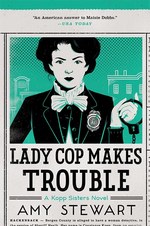
Pub Day Repost: Lady Cop Makes Trouble by Amy Stewart

Lady Cop Makes TroubleLady Cop Makes Trouble

by Amy Stewart
Series: The Kopp Sisters, #2
eARC, 320 pg.
Houghton Mifflin Harcourt, 2016
Read: August 6 – 8, 2016

Miss Constance Kopp, who once hid behind a tree near her home in Wyckoff, N.J., for five hours waiting to get a shot at a gang of Black Handers who had annoyed her, is now a Deputy Sheriff of Bergen County, N.J., and a terror to evildoers. — New York Press, December 20, 1915

The novel’s epigraph tells you pretty much everything you need to know. In the previous book, Girl Waits with Gun, Constance goes to extremes to protect her family from criminals, now she’s moved on to being an official “terror to evildoers.”

Constance begins the novel as a Deputy Sheriff, but political pressure removes her (temporarily she’s assured) and she’s demoted to matron of the women’s jail. She’d been serving in that capacity anyway, but now that’s all she does. She notes, and is probably on to something, that the police are far more willing to arrest women knowing there;s a matron at the jail to watch over them than they were when it was just men. That’s probably not the kind of women’s equality that people hoped for, but I guess you take what you can get. During this time, Constance makes a horrible blunder — one that jeopardizes her career as well as that of Sheriff Heath.

Bound and determined to keep her job (and for her friend and boss to keep his), as well as to see justice done, Constance ignores orders, protocol and (what some would consider) good sense and sets off to correct her error. Doing so will take her out of her comfort zone and into a long investigation that will remind her just what kind of evil lurks in the hearts of men.

Reading about Constance — and some of the professional women she meets in NYC — reminds me of the book I recently read about Nelly Bly and the efforts of female journalists to be taken seriously, and given the opportunities to do more than society page work. Another female law enforcement officer that Constance meets in the opening pages isn’t allowed to do much at all in her role — far less than Constance can (and does). Now this other woman seems content in that, even scandalized at Constance manhandling a suspect, but that doesn’t change the fact that times are changing, and it’s determined women like Constance and Nelly Bly that are going to make them change.

The friendship — and mutual respect — between Constance and Sheriff Heath continues to bloom, and be misunderstood by everyone (with the possible exception of Norma) from Mrs. Heath to juvenile delinquents. But really, there are no romantic sparks (and I expect Stewart will keep things that way — as did history, it seems). I do wish that more people in Bergen County — particularly some of her coworkers (even just one) — most people outside of her home (see especially almost everyone in New York) seem to be encouraging/accepting of a female Deputy.

Norma and Fleurette aren’t as important to the progress of the plot in the sequel — Norma’s stubborn, no-nonsense streak keeps Constance moving when she needs it. Fleurette’s naïveté and desire for a different life fuel Constance’s desire to make the world a better place — at least their corner of it — and to keep the money rolling in. Watching the Sheriff Heath interact with these ladies is a hoot.

I’m not sure it stacks up to its predecessor as a novel — it’s not as deep, the story’s really straightforward, and you might argue the ending is a bit rushed. But, it’s a whole lot more fun to read. Having established the world so effectively in the first book, Stewart can just let her characters live in it. This is a solid crime novel, elevated by the historical circumstances and actual history that undergirds it. Stewart really won me over with this one, I hope we have many more installments to come.

Disclaimer: I received this eARC from Houghton Mifflin Harcourt via NetGalley in exchange for this post — thanks to both for this.
N.B.: As this was an ARC, any quotations above may be changed in the published work — I will endeavor to verify them as soon as possible.

—–

4 Stars

The Essential Trinity by Brandon D. Crowe and Carl R. Trueman, eds.

The Essential Trinity The Essential Trinity: New Testament Foundations and Practical Relevance

by Brandon D. Crowe and Carl R. Trueman, eds.

Paperback, 273 pg.
Inter-Varsity Press, 2016

Read: July 31 – August 14, 2016

As far as consistency of quality amongst edited volumes goes, Crowe and Trueman have assembled one of the stronger line-ups I’ve read in a while — men from a spectrum of persuasions of Evangelical-ish thought have given the Church fourteen articles (approximately 20 pages each) to deepen our thinking about the Trinity. The aim was for a volume that “eschews overly technical discussion and focuses attention on the importance of the doctrine for every Christian.”

In Part 1, the articles look at the “trinitarian contours of every corpus of the New Testament, along with a chapter reflecting on the Old Testament roots of trinitarian doctrine.” If there are weak chapters in the volume, they’re in this part — but they aren’t that weak, either. Crowe’s chapter on Matthew is excellent, but the chapters on the Mark, Luke-Acts and John aren’t far off that Mark. Brian S. Rosner’s chapter on “Paul and the Trinity” is worth the price of the book. The chapters on the rest of the epistles are very helpful (particularity Hebrews). Mark S. Gignilliat’s article, “The Trinity and the Old Testament: real presence or imposition?” is very helpful and insightful — and as an added bonus, it’s the most stylistically entertaining and engaging piece in the book.

Benjamin Gladd’s chapter exploring Daniel’s influence on Revelation’s view of the Trinity is the biggest mental workout you’ll get in the book. I appreciated the material covered and the argument Gladd makes, but I’m going to have to read it a few more times before I think I have a good handle on it.

Part 2 addresses the importance of the Trinity for everyday living — many would say the doctrine is impractical and only belongs in Statements of Faith and academia. The authors here show the fallacy of that. It begins with a brief, but excellent, description of the doctrine by Scott R. Swain. Carl Trueman has the next chapter, “The Trinity and prayer,” which is probably as valuable as Rosner’s — it’s actually about more than prayer, but the material specifically on prayer is great — hugely indebted to John Owen (but not uncritically so). Robert Letham’s chapter on “The Trinity and worship” also draws deeply from Owen; if he doesn’t move you to worship as you understand the work of the Trinity in it, you aren’t paying attention (I probably have more problems with some of what he says than anything else in the book). Michael Reeves, typically, made me chuckle in his chapter on preaching — but he did more than that, too.

Timely, convicting, thoughtful and inspiring, this examination of the Trinity in Scripture and Life should be a great benefit to any believer ho reads it. It may not be the easiest thing read all year (but really, it’s not that difficult), but it’ll be one of the most rewarding.

—–

4 Stars

Mechanical Failure by Joe Zieja is Not [EXPLETIVE] Reviewed Here Today

Mechanical FailureMechanical Failure

by Joe Zieja
Series: Epic Failure, #1

Hardcover, 343 pg.
Saga Press, 2016

Read: August 17 – 18, 2016

I tried, I really, really tried to get this up today, but I didn’t. So I’ll just say: read it. Probably best if you buy it so 1. the publisher/Zieja get money and want to do more and 2. you’ll have it to loan to people when you’re done. It’s good, it’s funny, you’ll enjoy it.

If you want more details, come back in a day (I hope) or seven (ugh, I hope not) and they’ll be here.

Update: Yeah, come back next week — I’m out of town, and want my copy at hand while I write it up. Rats.

The Twelve Dogs of Christmas by David Rosenfelt

The Twelve Dogs of ChristmasThe Twelve Dogs of Christmas

by David Rosenfelt
Series: Andy Carpenter, #15

eARC, 336 pg.
Minotaur Books, 2016

Read: August 27, 2016


I’m not a big fan of holiday-themed installments of long-running series (see the Holiday Plum novels or the Silent Night Spenser novel as glaring examples of how bad these can be). But you know I’m a completist — and if I could make it through the aforementioned books, I could handle this. Thankfully, this was pretty light on the Christmas theme (sure, there are trees and gifts and whatnot, but it’s not really that different from your standard Andy Carpenter novel. So, if you think like I do — don’t worry. If you don’t mind/like a little holiday cheer — don’t worry, you’ll find it.

A friend of the Tara Foundation, “Pups” (so-called because she takes care of stray puppies until they’re old enough to adopt out, and might be pickier than Willie when it comes to worthy humans). Is facing eviction because of the large number of puppies she has in her home, and a new neighbor is complaining. Pups isn’t really what you call “friendly,” “polite” or someone who “should be allowed to interact with people.” She’s crabby, opinionated, blunt and has no patience for fools — particularly fools that seem intent on messing with her and her puppies. So Pups has said a few things that make it sound like she’d be happy if the neighbor stopped breathing.

Which, naturally, means that he ends up killed and that someone did a really sloppy frame job on ol’ Pups. The frame job is actually bigger than just this one killing, but you can read that for yourself.

Why prosecutors continue to play hardball with Carpenter clients, I just don’t get. I never understood why Hamilton Burger insisted on taking Perry Mason’s clients to trial, and I can’t understand why New Jersey’s prosecutors don’t just dismiss charges the instant that Carpenter and Hike show up on the other side of a courtroom. But they don’t, which means we get to watch Andy do his thing, fret about his jury deliberation superstitions, and annoy a judge. Who could ask for more?

I really think the mystery, the culprit and the way things unfold in Twelve Dogs is better than the last few books in this series. Everything’s clicking just like it should in these pages. This may be some of the best Marcus material in quite a while — the way that the gang leader acts around and talks about “Mr. Marcus” tells you more about Marcus than anything that Andy could possible tell us. The book would be worth reading just for that.

Minor spoiler: and hopefully once the book is published, this’ll be taken care of. It was a shame to see Andy betting since he and Ricky and just made a promise to stop doing that about a third way through the last book (I’m too lazy to look up page number, an approach Andy would probably endorse) — and Laurie made it clear that he was expected to keep that promise. It’s a minor note that I probably only caught because I read the two passages in the same 24-hour period.

It’d be really hard to rank Carpenter books in terms of happy and/or sweet endings. But if you were bored/ambitious enough to take on that task, I’m pretty sure that this would find itself close to the top. A great addition to one of the more entertaining mystery series around.

Disclaimer: I received this eARC from Minotaur Books via NetGalley in exchange for this post — thanks to both for this.

—–

4 Stars

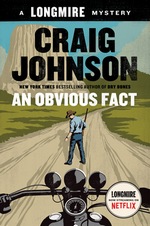
An Obvious Fact by Craig Johnson

An Obvious FactAn Obvious Fact

by Craig Johnson
Series: Walt Longmire, #12

eARC, 320 pg.
Viking, 2016

Read: July 29 – 30, 2016

4 Stars

Craig Johnson is so consistent with these books that he makes it really hard to write about them. I’ve struggled with this one for weeks — how can I say something I haven’t before? I’m not sure I can, but I guess I can start with what makes this one different from the rest.

For starters, Henry’s borrowed Walt’s set of Sherlock Holmes (without his knowledge or consent, but who cares) and spends the novel quoting Holmes at inopportune times to his buddy. I laughed every time. Walt didn’t find it that amusing — and paid him back by talking about what a silly and reckless endeavor riding motorcycles is — much less racing/jumping/etc. He had plenty of opportunity to make these kind of remarks as the two of them were in Hulett, WY for the world’s largest motorcycle rally, where Henry is attempting to recapture a victory of his younger days.

Walt’s been brought in to help with the investigation of a motorcycle crash, the small local police force is stretched beyond itself due to the rally and really can’t take it on. It seems pretty cut and dry on the surface — just a bad break and a bit of careless driving. But every time Walt looks at another piece of evidence, he finds more reasons to doubt the obvious facts.

We learn a lot about Henry in this book — but he’s not really in it all that much (at least less than he’s been in others, lately). And while he’s not really at odds with Walt, you really can’t say that he’s on his old friend’s side throughout (nor is he really acting all that rationally).

Vic comes back to Wyoming, and injects her flair into the investigation and Walt’s life. She also continues to be the embodiment of many men’s dreams between her looks, brains, language, driving and shooting. I’m not going to say if she’s my Platonic ideal, I will say that for a totally unrealistic character, she’s a whole lotta fun.

The Whodunit was pretty easy, the Whydunit was trickier (and the Accessories to the Who were more difficult, but not hard). But, hey, we don’t read these books for the puzzle — we do it to watch Walt figure things out and to spend time with our friends from the Equality State (and the nations within it). In the end, this is just what you expect out of a Walt Longmire novel — some laughs, a nice little puzzle, a little fisticuffs, maybe a little gunplay (not necessarily a shoot-out). Well-paced, well-told, all in a day’s work for Johnson.

Disclaimer: I received this eARC from Viking via First to Read in exchange for this post — thanks to both for this.

—–

4 Stars

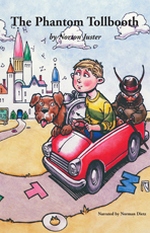
The Phantom Tollbooth (Audiobook) by Norton Juster, Norman Dietz

The Phantom Tollbooth The Phantom Tollbooth

by Norton Juster, Norman Dietz (Narrator)

Unabridged Audiobook, 5 hrs, 20 min.
Recorded Books, LLC., 1993

Read: August 1, 2016

4 Stars

I needed something to listen to at work a couple of weeks back, and the only thing I could find from the library’s collection was the audio version of the children’s classic, The Phantom Tollbooth. It’s been a few years since I read this with my kids, so I figured it was worth a shot. The story of bored (and boring) Milo receiving a magic Tollbooth that transports him to a magic kingdom where he goes on an adventure to restore Rhyme and Reason to their rightful places has long been a favorite of mine.

It wasn’t a bad use of time, but was a little disappointing. A lot of the word play needs to be read, not heard — having to over-pronounce the “h” in “whether man” to make it the joke land just doesn’t work. I could list other examples, but that’ll do.

Still, most of the magic is there, you still get the overall feel of the book, the strange adventure that Milo, Tock and the Humbug have is intact, it’s just missing some of the details.

Really, any version of The Phantom Tollbooth that doesn’t feature the art of Jules Feiffer is missing something — even the cover of this one was done by someone else! Thankfully, I remembered what most of the pictures looked like and could supply them in the right spot. But it’s just not the same.

Basically, I guess I’m saying any audio-only production of this novel is hobbled out of the gate. Which is nothing against Norman Dietz’s work — he did fine, nothing spectacular, but nothing detrimental, either. Good, capable, entertaining narration — but it’s just a bad book to try to do this with, I think. (that said, apparently David Hyde Pierce did an audiobook recording of it, too — and I will grab that if I can).

If you’ve read it before — this will scratch the re-read itch if you have it. It might be a good way to entertain the kids on a road trip. But this shouldn’t be anyone’s initial exposure to the story — get the book. Really. I’m giving it 4 Stars for sentiment’s sake — and Juster’s words/story.

—–

4 Stars

Chasing Freedom by Marina Fontaine

Chasing FreedomChasing Freedom

by Marina Fontaine

Kindle Edition, 222 pg.
Createspace Independent Publishing Platform, 2016

Read: July 27 – 28, 2016


A few decades from now, the government of the United States (although I don’t think it’s directly called that, but it’s clear that’s what it is) has become the totalitarian regime so many fear, imposing a type of public “civility” on the citizenry. Public protests are closed down by the authorities, but keep springing up (and seem to be coordinated in a way that the authorities can’t pin down) — and then they evolve into organized resistance groups and information dissemination efforts (counter-propaganda efforts).

On the whole, the book focuses on the resistance groups, their allies and those they aid — with the occasional look at those in power and their operatives. The resistance groups are full of people who are looking for different things — some out of ideology, some out of concern for the safety and health of their loved ones, there are even criminals who help just to get under the heavy thumb of the government, some just want a way to express themselves and make art rather than be “contributing members of society.”

In different ways, these people (and many others) work together (and apart) to force the government to get back to its own foundational principles. There are glimpses of violence here, but mostly this takes place between the battles — in the ramping up to them, or in the aftermath. It’s violent enough to satisfy those who want that and to seem grounded in the subject, but that’s not the focus. The focus is on what the struggle means to people and what it does to them — some characters are scarred, some characters are driven to find hidden strength(s), a few characters are both.

I noted while reading this that the type of government/society depicted in a dystopian novel tells you a lot about the politics of the author — as does what the characters of behind the resistance/opposition want to replace it. Fontaine grew up in the U.S.S.R., and knows a little about real dystopia, that’s reflected in these pages, too. Her vision of the future isn’t one you typically see in fiction — and agree with her or not — it’s a breath of fresh air.

I’ve read works that were better written, more convincing — but this one hit me right. I love the vision of this book, the way that Fontaine gets her characters to work together — even when there’s little reason to. Their hopes of the good life — or at least a better one — really resonated with me. There wasn’t (much) drive for vengeance, it wasn’t one or two people against the system — it was a variety of people, doing various things that drove the action of this novel. A solid effort, an entertaining and borderline inspirational read. I hope to see more from Fontaine in the future.

Disclaimer: I received a copy of this book from the author in exchange for my honest opinion.

—–

4 Stars

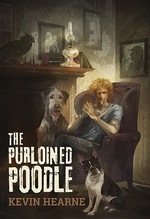
The Purloined Poodle by Kevin Hearne

The Purloined PoodleThe Purloined Poodle

by Kevin Hearne
Series: Iron Druid Chronicles, #8.5/Oberon’s Meaty Mysteries, #1

eARC, 112 pg.
Subterranean Press, 2016

Read: August 8, 2016


The best and most consistent part of The Iron Druid Chronicles has been Atticus’ Irish Wolfhound, Oberon. Now Kevin Hearne has given us a novella narrated by and starring him, with Atticus in the supporting role. It’s good that he kept the Druid around, because he has the whole opposable thumb thing going for him and can do things like communicate with other people

While playing in a dog park, Oberon stumbles upon a rash of dognappings — the victims are all Grand Champions. Oberon is appalled that such a thing can happen and vows to find the dogs and return them home. He enlists Atticus to assist him (and well, to do most of the work). They spend the next couple of days moving around the country visiting various dog trainers/owners and skirting trouble with the law. While Atticus does the heavy lifting of investigating, Oberon has a lot of fun meeting various Champion dogs — in particular, a Boston terrier named Starbuck.

The interplay between Atticus and Oberon is a lot of fun, but his narration is even better — between the repeated mentions of trying to pull off “the Full Jules” (reciting Ezekiel 25:17 at just the right moment); his summary/slash review of The Great Gatsby (which will forever alter the way I look at the book); Oberon as food critic (his takes on coffee and mustard are highlights); and a repeated tribute to Denis Leary’s best movie, this book was flat-out entertaining. Because it’s by Hearne and featuring Oberon, I assumed I’d enjoy it — I didn’t plan on (but should’ve) cackling by the 7% mark.

I thoroughly enjoyed this — the story was good enough to justify the time reading, but Oberon’s voice elevates this to something really special. It is now one of my major Life Goals to hear Luke Daniels do the audiobook of this. If you’ve read an Iron Druid Chronicle or two, you’ll know how good Oberon can be. Read this, you won’t be disappointed.

Disclaimer: I received this eARC from Subterranean Press via NetGalley in exchange for this post — thanks to both for this.

—–

4 Stars

Lady Cop Makes Trouble by Amy Stewart

(slightly modified to address something I forgot earlier)

Lady Cop Makes TroubleLady Cop Makes Trouble

by Amy Stewart
Series: The Kopp Sisters, #2

eARC, 320 pg.
Houghton Mifflin Harcourt, 2016

Read: August 6 – 8, 2016

Miss Constance Kopp, who once hid behind a tree near her home in Wyckoff, N.J., for five hours waiting to get a shot at a gang of Black Handers who had annoyed her, is now a Deputy Sheriff of Bergen County, N.J., and a terror to evildoers. — New York Press, December 20, 1915

The novel’s epigraph tells you pretty much everything you need to know. In the previous book, Girl Waits with Gun, Constance goes to extremes to protect her family from criminals, now she’s moved on to being an official “terror to evildoers.”

Constance begins the novel as a Deputy Sheriff, but political pressure removes her (temporarily she’s assured) and she’s demoted to matron of the women’s jail. She’d been serving in that capacity anyway, but now that’s all she does. She notes, and is probably on to something, that the police are far more willing to arrest women knowing there;s a matron at the jail to watch over them than they were when it was just men. That’s probably not the kind of women’s equality that people hoped for, but I guess you take what you can get. During this time, Constance makes a horrible blunder — one that jeopardizes her career as well as that of Sheriff Heath.

Bound and determined to keep her job (and for her friend and boss to keep his), as well as to see justice done, Constance ignores orders, protocol and (what some would consider) good sense and sets off to correct her error. Doing so will take her out of her comfort zone and into a long investigation that will remind her just what kind of evil lurks in the hearts of men.

Reading about Constance — and some of the professional women she meets in NYC — reminds me of the book I recently read about Nelly Bly and the efforts of female journalists to be taken seriously, and given the opportunities to do more than society page work. Another female law enforcement officer that Constance meets in the opening pages isn’t allowed to do much at all in her role — far less than Constance can (and does). Now this other woman seems content in that, even scandalized at Constance manhandling a suspect, but that doesn’t change the fact that times are changing, and it’s determined women like Constance and Nelly Bly that are going to make them change.

The friendship — and mutual respect — between Constance and Sheriff Heath continues to bloom, and be misunderstood by everyone (with the possible exception of Norma) from Mrs. Heath to juvenile delinquents. But really, there are no romantic sparks (and I expect Stewart will keep things that way — as did history, it seems). I do wish that more people in Bergen County — particularly some of her coworkers (even just one) — most people outside of her home (see especially almost everyone in New York) seem to be encouraging/accepting of a female Deputy.

Norma and Fleurette aren’t as important to the progress of the plot in the sequel — Norma’s stubborn, no-nonsense streak keeps Constance moving when she needs it. Fleurette’s naïveté and desire for a different life fuel Constance’s desire to make the world a better place — at least their corner of it — and to keep the money rolling in. Watching the Sheriff Heath interact with these ladies is a hoot.

I’m not sure it stacks up to its predecessor as a novel — it’s not as deep, the story’s really straightforward, and you might argue the ending is a bit rushed. But, it’s a whole lot more fun to read. Having established the world so effectively in the first book, Stewart can just let her characters live in it. This is a solid crime novel, elevated by the historical circumstances and actual history that undergirds it. Stewart really won me over with this one, I hope we have many more installments to come.

Disclaimer: I received this eARC from Houghton Mifflin Harcourt via NetGalley in exchange for this post — thanks to both for this.
N.B.: As this was an ARC, any quotations above may be changed in the published work — I will endeavor to verify them as soon as possible.

—–

4 Stars

Deep Down (Audiobook) by Lee Child, Dick Hill

Deep Down Deep Down

by Lee Child, Dick Hill (Narrator)
Series: Jack Reacher, #16.5

Unabridged Audiobook, 1 hr, 43 min.
Random House Audio, 2013

Read: August 4, 2016


Ahh, this is more like it — I was afraid that I was going to have to give up on these shorts to preserve my appreciation for the novels. But Lee Child and Dick Hill pulled it off.

Its the mid-80s, Reacher’s a Captain in the Army and is called to Washington to go undercover as an Army sniper. Someone is leaking information from a Congressional investigation into whether the Army and Marines need a new, super-cutting-edge sniper rifle. The Army’s got it narrowed down to 4 suspects, they want him to narrow it down. Reacher is repeatedly assured that this will just be talking and that there is “no danger.” So, yeah, things are going to get dicey.

The suspects are four women on the fast track to the top of the Army — if not Commander-in-Chief (Child apparently likes the idea of women on the Fast-Track in the Army) — we get to spend a little time getting to know them with Reacher. His handler wants Reacher to try to use his masculine wiles with one or all of them. Reacher has a pretty good idea who is target is, and then plunges in, pretty sure he’ll have to come up with something better than attempting to seduce superior officers.

Interspersed with the early portions of this story are snippets of two different individuals heading toward the center of D.C. — it’s not immediately clear what’s going on with either of them, but you get plenty of opportunities to guess. They do a decent job of increasing the tension, though.

Reacher does get enough clues (naturally) to identify the leak — not only that, he’s able to uncover a whole lot more. Best yet, the book includes a fantastic Reacher fight scene (don’t get me wrong, I love it when he uses his brain, but the last two short stories I listened to didn’t have a lot of action.).

Some of Hill’s female voices leave a little to be desired. But I have no other complaints — good stuff (he has sort of a Stan Lee quality to his voice from time to time — if Child ever made him say “true believers,” I’d flip).

Good, strong story. Capable narration — a great way to spend 100 minutes.

—–

4 Stars

Page 64 of 88

Powered by WordPress & Theme by Anders Norén