Tag: 4 Stars Page 63 of 88

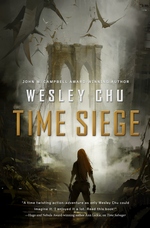
Time Siege by Wesley Chu

Time SiegeTime Siege

by Wesley Chu
Series: Time Salvager, #2

Hardcover, 341 pg.
Tor Books, 2016

Read: August 15 – 16, 2016


This is, in a sense, one of the most pointless posts I’ve done. If you’ve read Time Salvager, then I can’t imagine you needing to be convinced to read Time Siege, maybe you need convincing to move it up on your TBR, or just a reminder that this is out there. If you haven’t read Time Salvager, you shouldn’t read Time Siege yet because it won’t make all that much sense. But I’ll try to say a little about the book.

This book really could just be the next chapters of Salvager. It’s just taking the story to the next step — yes, there are distinct plot and character arcs, but on the whole, it’s just what should come next. Making it hard for me to know what to say. Some things that I thought were pretty well resolved in Siege are dealt with again, and hopefully resolved (or closer to it) now. Some characters come back in ways that I couldn’t have expected, some in ways that were exactly what I expected.

One thing that’s crystal clear now — and has been evident all along, really — is that Wesley Chu can write a fight scene. Whether it’s single combat or larger forces, he delivers. The scenes are suspenseful, intense, and believable. He captures what I imagine both the chaos and order of a battle would be like for those involved and those behind the lines.

Somewhere along the line, I got the impression that this was a duology, not a trilogy. So I spent most of the book thinking that this could be a dark, yet satisfying ending. Definitely not an “Everybody Lives happily every after” ending, but one that wraps things up well. Then the satisfying part became untenable (possible, but not likely) . . . and thankfully, it quickly became clear that it was going to be a trilogy. That said, everything is hanging in the balance here at the end of Time Siege, and it’s going to take a lot of heroics for there to be even a chance for an ending that doesn’t involve the doom of humanity. Even with a lot of heroics, that’s a distinct possibility — part of me wants that to happen, just to see how Chu pulls it off.

I remember liking Salvager more than I did, but whatever — the sequel did everything it needed to do to push the story forward into the third book, with heightened action, more investment in the characters and what happens to them. Chu accomplished everything he needed to here and more. I could really use a time machine now to get my hands on the concluding volume.

—–

4 Stars

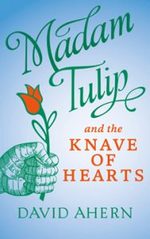
Madam Tulip and the Knave of Hearts by David Ahern

Madam Tulip and the Knave of HeartsMadam Tulip and the Knave of Hearts

by David Ahern
Series: Madam Tulip, #2

Kindle Edition, 355 pg.
Malin Press, 2016

Read: September 29 – October 1, 2016


After the dramatic events at the end of her first experiment as Madam Tulip, Derry puts away her costume and fortune-telling apparatus, focusing on something safer — like theater. Which works up until the roof caves in after her big opening night. So now she (and her friends) are without jobs, the theater’s existence is in danger, and Derry’s mother is just waiting for a chance to pounce and force her into a “real” job.

Derry and her pals organize a charity auction (with some help from her mother) to help the theater — Derry also ends up working for her mother in a temporary capacity (only one of them actually believes that part) — we see a different side of her, on e that makes you believe she has options outside of acting if she wants them. I like seeing her character rounded out — I also liked the little flash we had of her acting ability outside of Madam Tulip.

Marlene comes to the rescue as well — she has a friend from a titled family, who is throwing an extravagant engagement party and wants Madam Tulip to be part of it. This will give Derry a needed infusion of cash and the family will make a contribution to the theater’s fund as well (there’s a family connection). Bruce also picks up some work, which is convenient for Derry — and for Ahern — always handy to have your ex-SEAL buddy character nearby if things go bad. And they do, naturally — Derry has visions of an unhappy bride, body parts start showing up in the mail (don’t worry — this doesn’t get gruesome), and rumors of other family problems surround Derry. It’s up to her, her clients (featuring a spunky dowager), and Bruce to save the day.

It might just be me, but there’s a larger supernatural feel to this one. Last time, you could almost get away thinking that Derry was just good at reading people and doing the card thing as a lark. But in this volume, there’s no denying that she has some sort of “sight.” While the supernatural is more evident here, it’s not like Charlaine Harris took over, it’s still pretty much the same feel. Also, I should add that Derry putting the pieces together at the end isn’t all due to her gift — the practical side, her mother’s influence, that has as much to do with her success as anything else.

There’s a bit of a romantic storyline here, I liked this one better than the previous book’s foray into that part of Derry’s life. It was less complicated and more believable. Sure, I liked the guy from the last book more than this one — but the story worked better with this interest.

The whole gang is back for this go ’round. We didn’t get a lot of Bella, less of Marlene than I expected, and less of Bruce than I wanted (but he’s there when he needed to be) — but the just the right amount of Jacko (who was a lot of fun) and her mom. The new characters were okay, I didn’t get the sense of connection to them that I did with everyone last time — they were clearly invented just for this adventure, ready to be replaced by another group in need of her talents.

This is a fun, light mystery — great for readers of David Rosenfeldt or Janet Evanovich, who don’t mind a touch of something beyond this world. I really liked the first book in this series — I’ve even put my money where my mouth is and given it as gifts. I liked this one almost as much, but in many ways it reminded me about what I’ve heard many TV writers talk about — writing the pilot is hard, but the 2nd episode is worse — it’s basically retelling the pilot in a slightly different way. On many fronts, that’s what this felt like: a slightly tweaked version of the first book (and as soon as I wrote that, I thought of at least a half-dozen ways I was wrong to say it). I hope book 3 (assuming we get one) is a little less like these two. But I’m still going to be there, because these characters and Ahern’s voice are right up my alley and I want to spend more time with both.

—–

4 Stars

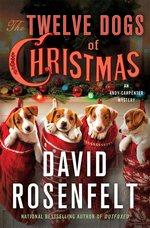
Pub Day Repost: The Twelve Dogs of Christmas by David Rosenfelt

The Twelve Dogs of ChristmasThe Twelve Dogs of Christmas

by David Rosenfelt
Series: Andy Carpenter, #15eARC, 336 pg.
Minotaur Books, 2016
Read: August 27, 2016

I’m not a big fan of holiday-themed installments of long-running series (see the Holiday Plum novels or the Silent Night Spenser novel as glaring examples of how bad these can be). But you know I’m a completist — and if I could make it through the aforementioned books, I could handle this. Thankfully, this was pretty light on the Christmas theme (sure, there are trees and gifts and whatnot, but it’s not really that different from your standard Andy Carpenter novel. So, if you think like I do — don’t worry. If you don’t mind/like a little holiday cheer — don’t worry, you’ll find it.

A friend of the Tara Foundation, “Pups” (so-called because she takes care of stray puppies until they’re old enough to adopt out, and might be pickier than Willie when it comes to worthy humans). Is facing eviction because of the large number of puppies she has in her home, and a new neighbor is complaining. Pups isn’t really what you call “friendly,” “polite” or someone who “should be allowed to interact with people.” She’s crabby, opinionated, blunt and has no patience for fools — particularly fools that seem intent on messing with her and her puppies. So Pups has said a few things that make it sound like she’d be happy if the neighbor stopped breathing.

Which, naturally, means that he ends up killed and that someone did a really sloppy frame job on ol’ Pups. The frame job is actually bigger than just this one killing, but you can read that for yourself.

Why prosecutors continue to play hardball with Carpenter clients, I just don’t get. I never understood why Hamilton Burger insisted on taking Perry Mason’s clients to trial, and I can’t understand why New Jersey’s prosecutors don’t just dismiss charges the instant that Carpenter and Hike show up on the other side of a courtroom. But they don’t, which means we get to watch Andy do his thing, fret about his jury deliberation superstitions, and annoy a judge. Who could ask for more?

I really think the mystery, the culprit and the way things unfold in Twelve Dogs is better than the last few books in this series. Everything’s clicking just like it should in these pages. This may be some of the best Marcus material in quite a while — the way that the gang leader acts around and talks about “Mr. Marcus” tells you more about Marcus than anything that Andy could possible tell us. The book would be worth reading just for that.

Minor spoiler: and hopefully once the book is published, this’ll be taken care of. It was a shame to see Andy betting since he and Ricky and just made a promise to stop doing that about a third way through the last book (I’m too lazy to look up page number, an approach Andy would probably endorse) — and Laurie made it clear that he was expected to keep that promise. It’s a minor note that I probably only caught because I read the two passages in the same 24-hour period.

It’d be really hard to rank Carpenter books in terms of happy and/or sweet endings. But if you were bored/ambitious enough to take on that task, I’m pretty sure that this would find itself close to the top. A great addition to one of the more entertaining mystery series around.

Disclaimer: I received this eARC from Minotaur Books via NetGalley in exchange for this post — thanks to both for this.

—–

4 Stars

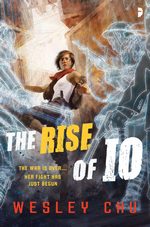
The Rise of Io by Wesley Chu

The Rise of IoThe Rise of Io

by Wesley ChuA
Series: Io, #1

eARC, 352 pg.
Angry Robot, 2016

Read: September 27 – 29, 2016

“Stick with me, kid ,” he said. “We’ll introduce you to a bigger world with all sorts of new people who will want to kill you.”

Let me start by saying that while this is a sequel to the Tao Trilogy (taking place a couple of decades after The Rebirths), you don’t have to have read them to enjoy this. You’ll miss some nuances, not understand some references and will spoil events in books that you’ll end up wanting to have read. But, it’s not essential — and this would be a great jumping-on point. If you’ve read the Tao Trilogy, let me assure you that this is a worthy successor, just as fun — a part of the same series, but it feels fresh enough that you don’t feel like you’ve read this book before.

Ella Patel lives in an Indian slum — in part of the world hardest hit by the war between the Quasing factions and their human allies (while I feel bad for these fictional Indians, I’m so glad to see alien combat not centered in the U.S.). She lives on her own, orphaned by circumstance and a Gengix attack — between her small size, quick wit and almost all-consuming greed she lives life on her own terms, two steps ahead of the law and one step ahead of criminals she’s wronged. I could’ve read at least 100 pages more of her antics before we introduced a single Quasing from either side and been entirely content (not a complaint about when we got Quasings, however), Ella’s just instantly likeable in a way that no one in these series has been (with the possible exception of Cameron).

Io’s host is in India doing some off-the-books investigating into one of the Gengix’s most ambitious projects yet. That investigation doesn’t go so well and suddenly Io needs a new host — there’s the impetuous woman who tried to help her host nearby (and a much better option than anyone else), so Io makes a choice and the Queen of the streets becomes so much more. Their relationship defines rocky initially (see Tao and Roen, but worse).

It should be obvious (but isn’t) that not every Quasing will have had as illustrious existence as Tao — Io’s haven’t developed a martial art, conquered legendary kingdoms, etc. Which isn’t to say that Io didn’t leave her mark on history — for example, I trust the name “The Maginot Line” rings a bell.

As the minutes ticked by, Io clarified some of the dreams of her glorious career inhabiting humans. If anything, it comforted Ella that the Quasing weren’t all-knowing and powerful, that they were just as culpable and mistake-prone as any human.

Nevertheless, just by having existed for a few millennia on earth, Io’s got a lot of wisdom and experience to pass on to her new host. Slowly — and with several appeals to her mercenary streak — Io convinces Ella to begin training to become a Prophus agent. Eventually, Ella begins to make a sort of peace with her new life partner and something approaching friendship begins to develop.

Incidentally, Ella’s not the only one comforted by a not-all-that-perfect Quasing.

Meanwhile, a couple of Gengix Adonis agents are vying for control over India — with the citizenry of the slum (and the nation, really) acting as pawns. Shula is one of the more lethal women you’ll come across — both politically and physically. She’s not one you want to cross in almost any situation — but that doesn’t stop many.

At some point, Prophus agents come to town and everything gets turned upside down — Ella finds a desire to help the Prophus, Shula seized the opportunity for personal power, and Io has her chance at doing something that’ll leave her mark on history.

The fight scenes (training and otherwise) are up to Chu’s pretty high standards, the humor is crisp, the characters (including a couple of old friends) are just right, and the plots are among his best — I just don’t know how else to put this. The book was a solid winner and had me eager for the next installment, and then Chu hits us with one of the best Epilogues that I can remember, making me more than eager for whatever’s next (not really sure what the word for “more than eager” is, eager squared?).

Great characters, twists, suspense and grins — I dug this one so much. He keeps the magic of the Tao books, reinvigorates it and expands it. I expected Chu to deliver just what fans wanted without it being a case of “second verse, same as the first,” I just didn’t expect it’d be this good. Get on this one, folks.

Disclaimer: I received this eARC from Angry Robot via NetGalley in exchange for this post — thanks to both for this.
N.B.: As this was an ARC, any quotations above may be changed in the published work — I will endeavor to verify them as soon as possible.

—–

4 Stars

The Purloined Poodle (Audiobook) by Kevin Hearne, Luke Daniels

The Purloined Poodle (Audiobook) The Purloined Poodle (Audiobook)

by Kevin Hearne, Luke Daniels (Narrator)
Series: Iron Druid Chronicles, #8.5/Oberon’s Meaty Mysteries, #1

Unabridged Audiobook, 2 hrs, 57 min.
Kevin Hearne, 2016
Read: October 3, 2016


The best and most consistent part of The Iron Druid Chronicles has been Atticus’ Irish Wolfhound, Oberon. Now Kevin Hearne has given us a novella narrated by and starring him, with Atticus in the supporting role. It’s good that he kept the Druid around, because he has the whole opposable thumb thing going for him and can do things like communicate with other people

While playing in a dog park, Oberon stumbles upon a rash of dognappings — the victims are all Grand Champions. Oberon is appalled that such a thing can happen and vows to find the dogs and return them home. He enlists Atticus to assist him (and well, to do most of the work). They spend the next couple of days moving around the country visiting various dog trainers/owners and skirting trouble with the law. While Atticus does the heavy lifting of investigating, Oberon has a lot of fun meeting various Champion dogs — in particular, a Boston terrier named Starbuck.

The interplay between Atticus and Oberon is a lot of fun, but his narration is even better — between the repeated mentions of trying to pull off “the Full Jules” (reciting Ezekiel 25:17 at just the right moment); his summary/slash review of The Great Gatsby (which will forever alter the way I look at the book); Oberon as food critic (his takes on coffee and mustard are highlights); and a repeated tribute to Denis Leary’s best movie, this book was flat-out entertaining. Because it’s by Hearne and featuring Oberon, I assumed I’d enjoy it — I didn’t plan on (but should’ve) cackling by the 7% mark.

I thoroughly enjoyed this as a novella — the story was good enough to justify the time reading, but Daniels doing Oberon’s voice elevates the audio version to something great. Daniel’s Oberon doing a Pickup Truck commercial-voice over killed me — how Luke Daniels could read this whole book in that voice, I’ll never know. It must’ve required a lot of takes and more recovery time than you’d want to think about.

If you’ve read an Iron Druid Chronicle or two, you’ll know how good Oberon can be. Get this — you’ll squee.

—–

4 Stars

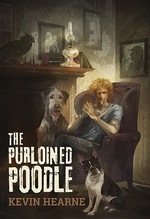
Pub Day Repost: The Purloined Poodle by Kevin Hearne

The Purloined PoodleThe Purloined Poodle

by Kevin Hearne
Series: Iron Druid Chronicles, #8.5/Oberon’s Meaty Mysteries, #1

eARC, 112 pg.
Subterranean Press, 2016

Read: August 8, 2016


The best and most consistent part of The Iron Druid Chronicles has been Atticus’ Irish Wolfhound, Oberon. Now Kevin Hearne has given us a novella narrated by and starring him, with Atticus in the supporting role. It’s good that he kept the Druid around, because he has the whole opposable thumb thing going for him and can do things like communicate with other people

While playing in a dog park, Oberon stumbles upon a rash of dognappings — the victims are all Grand Champions. Oberon is appalled that such a thing can happen and vows to find the dogs and return them home. He enlists Atticus to assist him (and well, to do most of the work). They spend the next couple of days moving around the country visiting various dog trainers/owners and skirting trouble with the law. While Atticus does the heavy lifting of investigating, Oberon has a lot of fun meeting various Champion dogs — in particular, a Boston terrier named Starbuck.

The interplay between Atticus and Oberon is a lot of fun, but his narration is even better — between the repeated mentions of trying to pull off “the Full Jules” (reciting Ezekiel 25:17 at just the right moment); his summary/slash review of The Great Gatsby (which will forever alter the way I look at the book); Oberon as food critic (his takes on coffee and mustard are highlights); and a repeated tribute to Denis Leary’s best movie, this book was flat-out entertaining. Because it’s by Hearne and featuring Oberon, I assumed I’d enjoy it — I didn’t plan on (but should’ve) cackling by the 7% mark.

I thoroughly enjoyed this — the story was good enough to justify the time reading, but Oberon’s voice elevates this to something really special. It is now one of my major Life Goals to hear Luke Daniels do the audiobook of this. If you’ve read an Iron Druid Chronicle or two, you’ll know how good Oberon can be. Read this, you won’t be disappointed.

Disclaimer: I received this eARC from Subterranean Press via NetGalley in exchange for this post — thanks to both for this.
N.B.: As this was an ARC, any quotations above may be changed in the published work — I will endeavor to verify them as soon as possible.

—–

4 Stars

Biblical Authority after Babel by Kevin J. Vanhoozer

Biblical Authority after BabelBiblical Authority after Babel: Retrieving the Solas in the Spirit of Mere Protestant Christianity

by Kevin J. Vanhoozer

eARC, 288 pg.
Brazos Press, 2016

Read: August 21 – September 4, 2016


With the 500th Anniversary of the Protestant Reformation’s accidental start coming up next year, we’ll be seeing a lot of books celebrating and/or critiquing the movement (more than usual, that is). This is one of the former, but done mostly in the way of a defense against some of the most common critiques. There’s a very real sense in which I’m not qualified to discuss this book — and I’m really looking forward to reading reviews from those who are. But, there’s another sense in which I am — I’m a Christian, I like to read and think about these issues, and VanHoozer wrote a book about them, so, you know — I might as well blather on about it some.

In the Introduction, Vanhoozer rehearses some of the more common critiques of Protestantism, mostly relying on those talking about the lack of organizational unity and those that relate that level of disunity to the doctrine of Sola Scriptura:

One adjective seems custom-made to describe the unintended consequence of the Reformation. It is a word that I never come across except in the descriptions or criticisms of Protestantism: “fissiparous”—“inclined to cause or undergo division into separate parts of groups,” from the Latin fissus, past participle of findere (to split; cf . “fissure” ).

In much of the introduction, he seems to buy into the conventional wisdom/stereotypes of Protestantism/what Protestantism teaches — including a weird reading of the Ann Hutchison case — using too many scattered quotations out of context from various authorities to build the case.

To respond to the fissiparousness of Protestantism (which he does lament), Vanhoozer uses the “Solas” of the Reformation to show why the problem isn’t inherent in Protestantism’s principles — the examination of the Solas (rooted in Sola Gratia) provides the framework for the rest of the book and his apologetic. I really appreciated this way of framing his argument, and think I need to work on doing that myself.

Throughout this work, Vanhoozer

will be arguing not for the superiority of [his] own Reformed tribe but for “mere Protestant Christianity.” This refers neither to a lost “golden age” nor to a particular cultural instantiation of Protestantism, but rather to a set of seminal insights —- encapsulated by the five solas — that represent a standing challenge, and encouragement, to the church.

While I have some concerns of the “Mere Christianity” and “Mere Orthodoxy” approaches that are gaining popularity in some circles, I can’t fault this. Sure, he’d be able to make a stronger case if he did argue for the superiority of Reformed thinking (if you ask me), but given the arguments he’s responding to it makes sense to adopt this approach.

As he looks at each Sola, he begins by examining what the Reformers meant by the phrase (too frequently different from what their heirs mean by the phrase). He then looks at competing views (historical and contemporary — with an emphasis on the contemporary), focusing each discussion on the doctrine’s relationship to Bible, Church and Authority. He starts with Grace Alone, moves on to Faith Alone, Scripture Alone, then In Christ Alone and finishing with For the Glory of God Alone. The latter part begins with a look at “The Lord’s Supper as a Test of Christian Unity.” Even the most ardent Protestant would have to admit that this is where the Reformers stumbled most — when Luther and the Reformed couldn’t come to an acceptable consensus on the meaning and nature of this Sacrament, our fissiparousness became most evident and quite possibly firmly established as a mark of Protestantism. For my money, everything else comes as a result of this failure — so for VanHoozer to focus on it at this point, really resonated with the reading/studies I’ve been doing lately. Sure, it’s not that novel an approach, but as a reader, when an author seems to be on the same page, it draws you in.

I do think some of the more technical arguments he makes get a little too creative, maybe too focused on innovation and novelty — but I’m pretty cautious when it comes to this stuff. So again, I’m looking forward to seeing what others make of this.

This isn’t an academic work, but it’ll appeal most to the academically-inclined (whether by occupation or temperament/interest). Lay people shouldn’t be put off by it, but it will be a challenge at times. Frequently, he’s deceptively easy to read — you’ll be chuckling at some remark, smiling at a bit of whimsy, and miss the fact that he’s left the shallow end of the pool for something deep and thoughtful. Re-reading paragraphs and sections is highly recommended.

Vanhoozer writes with a very engaging style, some great metaphors and imagery. One paragraph I picked while reading to try to explain this to my wife went like this: It began with some historical notes; then made references to Philip Schaff, John Nevins, and John Calvin; moved on to a quote by Augustine; and ended with a line from a line from Lewis’ The Last Battle (one that elicited a grin in addition to sealing his point). Yes, sometimes he lets that creativity run away from him — okay, he does that often (my notes are filled with that observation). I found myself frequently giving mental fist pumps to something he said and then almost immediately holding up a palm to say, “slow down!” On more than one occasion, I wondered if I was being charmed by his writing more than being convinced by it. I don’t think so, ultimately, but it’s something to be aware of.

One last note that I won’t develop because it was a slight digression for him at one point, but I really appreciated his discussion of Biblical vs. Systematic theology. It was a creative way to frame the discussion, and a helpful one at that.

On the whole, I might have cringed at or questioned his thinking, some of the details of his arguments, but typically I thought his conclusions were spot on. Which probably says more about me than him. There’s a few area to be cautious of here, but largely this is an encouraging, well-constructed, challenging and encouraging read. For those ready to gird up their minds, I’d strongly encourage picking this up. This was my first encounter with Vanhoozer outside the occasional footnote in someone else’s work — I don’t think it’ll be my last.

Disclaimer: I received this eARC from Brazos Press via NetGalley in exchange for this post — thanks to both for this.
N.B.: As this was an ARC, any quotations above may be changed in the published work — I will endeavor to verify them as soon as possible.

—–

4 Stars

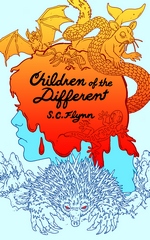
Children of the Different by S.C. Flynn

I wanted to nail this one, and I don’t think I did — just so I’m clear — you want to read this. Any of your kids over 13 (and maybe some under) will likely enjoy this. Don’t be put off by the labels attached: “Post-apocalyptic,” “YA,” or whatever — this is a good story about kids in the nearish future.

Children of the Different Children of the Different

by S.C. Flynn
Kindle Edition, 316 pg.
The Hive, 2016

Read: September 12 – 13, 2016

I’m going to get this quotation wrong, so remember it’s just a paraphrase: William Gibson’s early works were said to be set “Fifteen minutes into our future” — they’re futuristic SF, but only barely. Using that as a basis, I think you’d be safe saying that this book is set 20 minutes into our future — when Gibson’s cyberpunk present falls apart. Yes, it’s technically post-apocalyptic, but so is The Sword of Shannara, but that doesn’t mean you can walk in with any idea of what its’ going to be like. Think of this as a fantasy world very much like our own (but with cooler accents) — but where almost nothing works and teenagers are threats to their own health and safety, but also to pretty much the entire world’s health and safety.

We meet the twins Arika and Narrah just as Arika is beginning her time in the Changeland. Which is a stressful time for everyone in her life — but her brother Narrah does something quite out of the ordinary, he takes advantage of their inherent psychic link and enters the Changeland with her. By doing so, they set down on a path that could change the world forever. Not that they knew this. These aren’t a couple of Promised Children, Children of Destiny or whatever — they’re just a couple of kids in the right place and the right time to become the Children of Destiny. Arika’s the strongest character, the best fleshed out and it’s her reactions to everything that inform the readers’. Not to discount anyone else, but it’s her fears, her hopes, her determination that set things in motion (even Narrah will defer to her). Before I leave Arika — her friend, who I see as a combination of Luna Lovegood and Sybill Trelawney, but far less chatty — is such a great character. She’d have been easy to use wrongly, but Flynn gets is just right. She’s very likely my favorite part of the whole book.

While in her Changeland, Arika finds an enemy and Narrah finds a potential ally. Both show up later when Arika returns the favor and comes to Narrah’s rescue in his Changeland. It’s really kind of hard to describe, read it yourself. His is radically different and more hazardous — as are the conditions he finds himself in. I don’t want to get into the story beyond that, but let me just say that nothing in the story worked out the way I expected, and I’m so glad for it. The novel ended in such a way as to be initially dissatisfying, but with just a little thought, it was perfect — you don’t want more than you’re given, really — it seems like you do, but after a little time and thought, you get why he doesn’t the way he ended it the way he does, and actually end up pretty satisfied with the whole novel.

Oh yeah, there’s this great part that turns out to be a description of Echolocation. That was cool — I know I was wearing a big grin for a few paragraphs once I figured out that’s what was going on. That’s just an aside and your results my vary, but I really dug that scene. Almost as nifty are Narrah’s new abilities, and I’ll just leave it at that.

Flynn gives us clear, well-defined, and distinct characters here. I can’t say that I got too emotionally attached to any of them — but I was very curious about all of them. I imagined more of what life was like for the twins and their friends growing up in their circumstances, what made the various people who left their settlement do so, and just what might happen after the book ends. At the end of the day, these are people you want to see succeed, even if you don’t have that big emotional bond with them.

Once you get your bearings (which took a little longer for me than it should’ve, I think I had an off day), you can really get into this world and get an idea how things function (or don’t) on the Australian continent — and you can guess what’s going on in the rest of the world, too. Between the powers, the hard life and the machinations of the leaders — there’s plenty going on to keep you turning the pages — some is exciting, some is rich in imagery, some is tense and all is entertaining.

A heckuva debut novel — I can’t look forward to more enough.

Disclaimer: I received a copy of this novel from the author in exchange for my participation in the Book Tour and my honest post.

—–

4 Stars

Pub Day Repost: An Obvious Fact by Craig Johnson

An Obvious FactAn Obvious Fact

by Craig Johnson
Series: Walt Longmire, #12

eARC, 320 pg.
Viking, 2016

Read: July 29 – 30, 2016

4 Stars

Craig Johnson is so consistent with these books that he makes it really hard to write about them. I’ve struggled with this one for weeks — how can I say something I haven’t before? I’m not sure I can, but I guess I can start with what makes this one different from the rest.

For starters, Henry’s borrowed Walt’s set of Sherlock Holmes (without his knowledge or consent, but who cares) and spends the novel quoting Holmes at inopportune times to his buddy. I laughed every time. Walt didn’t find it that amusing — and paid him back by talking about what a silly and reckless endeavor riding motorcycles is — much less racing/jumping/etc. He had plenty of opportunity to make these kind of remarks as the two of them were in Hulett, WY for the world’s largest motorcycle rally, where Henry is attempting to recapture a victory of his younger days.

Walt’s been brought in to help with the investigation of a motorcycle crash, the small local police force is stretched beyond itself due to the rally and really can’t take it on. It seems pretty cut and dry on the surface — just a bad break and a bit of careless driving. But every time Walt looks at another piece of evidence, he finds more reasons to doubt the obvious facts.

We learn a lot about Henry in this book — but he’s not really in it all that much (at least less than he’s been in others, lately). And while he’s not really at odds with Walt, you really can’t say that he’s on his old friend’s side throughout (nor is he really acting all that rationally).

Vic comes back to Wyoming, and injects her flair into the investigation and Walt’s life. She also continues to be the embodiment of many men’s dreams between her looks, brains, language, driving and shooting. I’m not going to say if she’s my Platonic ideal, I will say that for a totally unrealistic character, she’s a whole lotta fun.

The Whodunit was pretty easy, the Whydunit was trickier (and the Accessories to the Who were more difficult, but not hard). But, hey, we don’t read these books for the puzzle — we do it to watch Walt figure things out and to spend time with our friends from the Equality State (and the nations within it). In the end, this is just what you expect out of a Walt Longmire novel — some laughs, a nice little puzzle, a little fisticuffs, maybe a little gunplay (not necessarily a shoot-out). Well-paced, well-told, all in a day’s work for Johnson.

Disclaimer: I received this eARC from Viking via First to Read in exchange for this post — thanks to both for this.

—–

4 Stars

Mechanical Failure by Joe Zieja

Mechanical FailureMechanical Failure

by Joe Zieja
Series: Epic Failure, #1

Hardcover, 343 pg.
Saga Press, 2016

Read: August 17 – 18, 2016

No duty was too great that R. Wilson Rogers couldn’t find a way to shirk it.

This is the essence of R. Wilson Rogers (don’t ask what the R. stands for) compressed into one sentence — an engineer for the Galactic Navy during the longest peacetime in Galactic Memory. As a result of all the peace, there’s not a whole lot for a Naval ship to do — nor for the men assigned to it. So, Rogers and his fellow crew members got up to a lot of nonsense — drinking, gambling and worse. Eventually, Rogers finds himself leaving under less than auspicious circumstances. Not long after that, under even less auspicious circumstances (which I’ll leave for you to read about and chuckle over) he finds himself back on the appropriately named Flagship which has transformed in his brief absence in to a serious-minded place, full of random inspections, wartime preparations (despite centuries of peace), and odd assignments.

Before long, Rogers finds himself getting promotions, leading a group of battle droids, and seriously considering suicide and desertion (favoring the latter, I assure you) — and that’s when things really start to get interesting.

This is pretty decent Military SF with a twist of humor, a dollop of irony, a pinch of satire, and so on — I don’t want to compare it to Adams. But I’ll compare it to a mix of Scalzi, Harry Harrison, Jack Campbell, Grant Naylor and Peter David. There’s a sense of play, even when he’s not going for the comedy, which makes the whole thing fun to read.

Best ‘droid since Marvin, best malfunctioning human personality software since Marvin (or Lore — but not as creepy or murderous), funniest ‘droids since Kryten. I could keep those comparisons going — essentially, I really liked all of the Droids on Flagship (especially Deet). The CO reminded me of some sort of hybrid between the pointy-haired boss and Douglas Reynholm is great comic relief, but there’s more to him than that.

Honestly, I could go on and on, Zieja assembled a great cast of characters — real enough that you can like them, outlandish enough that you don’t take them terribly seriously. Not just the obviously comedic characters either, there are a few “straight (wo)men” characters scattered throughout, keeping the rest grounded. Rogers is the best of the bunch – there’s a little personal growth to him (no one’s more surprised and dismayed by that than him), I enjoyed seeing that come out. I liked how despite himself he learns to set aside prejudices, take things seriously, and even act a little heroically. I as amused by (and occasionally disturbed by) his attraction to/fascination with the Amazonian Marine Captain. Rogers’ way of looking at the world is pretty relatable (I’m not saying that he’s the kind of guy you spend time with, he’s the guy you want to spend time with), and he’ll win you to his side pretty quickly.

One thing that I really appreciated was the respect that Zieja showed to the military personnel throughout this — too often everyone (with a maximum of a couple of exceptions) in a book like this is depicted as a moron — think of Richard Hooker’s classic for a moment. It’s just one example, but it’s a good one. You’ve got Jones, the Painless Pole, Hawkeye, Trapper, Duke, and a couple of nurses here and there who are competent, if not great, doctors. Who else? Everyone else is a “regular Army” schmuck ho shouldn’t be allowed in an operating theater or near anything where life and death decisions come into play.

Zieja doesn’t play it this way — these Navy and Marine men and women (with one or two exceptions, because there are always exceptions) are treated as competent, equipped and dedicated people whose greatest problem is that they have nothing to do, so things get a little loopy from time to time. But you give then an enemy, you give them a goal, you give them some way to target their talents and energy — good things happen. Even the really incompetent turn out to be quite competent when put in the right spot, doing what they’re good at (even if that’s not what they want to be good at). Problems are solved, crises averted, and enemies thwarted. That’s just not seen often enough, and I appreciate Zieja doing that.

That doesn’t mean he can’t find ways to make fun of the dedicated, the competent, and equipped — but he doesn’t make them into buffoons to do so (mostly).

I knew that I was going to like this book by page 3, I was audibly chuckling by page 4. The rest was just gravy. I laughed, chortled, and grinned my way through this — practically from beginning to end. The story as pretty good, the story plus the comedy made this gold. If I could think of stronger words to use to endorse this, I’d probably slap them here. But I can’t — just get your hands on this one. Meanwhile, I’m already looking forward to the sequel.

Disclaimer: I received a copy of this from the Publisher in exchange for my honest comments on it — sorry for the delay, I greatly appreciate the book.

—–

4 Stars

Page 63 of 88

Powered by WordPress & Theme by Anders Norén