Tag: 4 Stars Page 66 of 88

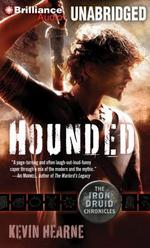
Hounded (Audiobook) by Kevin Hearne, Luke Daniels

Hounded AudiobookHounded (Audiobook)

by Kevin Hearne, Luke Daniels (Narrator)
Series: The Iron Druid Chronicles, #1

Unabridged Audiobook, 8 hours and 11 minutes
Brilliance Audio, 2011

Read: April 26, 2016


Keeping this brief so I can catch up on other things, I posted a few quick thoughts about the book previously — and that still covers most of my thoughts:

It took no time at all for this book to grab me, and another 15 pages for me to fall in love with this. Right off the bat we get a solid action sequence, get the basics of our hero’s magic system, and meet a goddess. Not a bad start–it helps a lot that Atticus’ personality and charm comes through right away and draws you in.

Then we get a talking dog. Technically a dog (Oberon the Irish Wolfhound) that can communicate telepathically with Atticus, but why get picky? Oberon’s snarky, smart and pop culturally savvy–he runs a close second behind Harry Dresden’s Mouse for coolest pooch in Urban Fantasy. I’d be willing to read a book that’s nothing but Atticus and Oberon hanging out.

Throw in a helpful werewolf pack, a friendly vampire, a troublesome local coven, and a fight with an ancient Celtic deity and you get yourself a dynamic intro to what seems to be one of the best Urban Fantasy series around.

From the point of view of someone who’s read book 8, going back to the beginning like this was a lot of fun. I could see the development in Atticus, Laksha and others (even Oberon — who is now cooler than Mouse), got to see dearly departed friends (like spoiler and other spoiler), and could see a lot of seeds being planted that are still bearing fruit. It was also nice to be reminded why I used to like Granuaile.

So, I guess I should focus on Luke Daniels’ narration. It was great — I’m not crazy about his interpretation of Oberon, but it has an undeniable charm (that goes beyond the incredible amount of charm that Hearne gave him). His characterizations of each everyone are strong — even the accents. In particular, his Widow MacDonagh made me laugh, even after repeated exposure to her (read the book at least two times, and now listened to the audiobook twice).

It’s a fun listen with some great characters — and the beginning of one of my favorite ongoing series. If you’ve still happened to miss The Iron Druid Chronicles, this is a great way to dive in.

—–

4 Stars

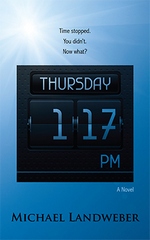
Thursday, 1:17 PM by Michael Landweber

Thursday, 1:17 PMThursday, 1:17 PM

by Michael Landweber

Kindle Edition, 208 pg.
Coffeetown Press, 2016

Read: May 18 – 19, 2016

Towel Day is tomorrow, so it seems apropos to start with a couple of Douglas Adams lines that I’d imagine Duck quoted to himself, assuming he read the book: “This must be Thursday . . .I never could get the hang of Thursdays.” and “Time is an illusion. Lunchtime doubly so.” Now, if anyone could empathize with Arthur and Ford, it’s Duck.

(like I need an excuse to quote Adams, really, but I’ll take one)

And you never know, maybe he had read Adams, after all:

We’d read Fight Club in Mr. Lorenzo’s Anarchy in Modern American Fiction class . . . And Lord of the Rings in Ms. Tutwell’s Geography of Fictional Lands seminar, which somehow got me Social Studies credit. Damn, I went to a really questionable high school.

So, earlier today, I posted something from the publisher with the idea behind this one. Basically, Duck’s head is nowhere near where it should be as he walks the busy streets of D. C. and he steps out in front of a car that doesn’t hit him. Not because of lightning-fast reflexes of the driver, nor because of fantastic brakes, or because some hero pulled/pushed/tackled him out of the way. Nope, none of those — but because faster than you can say “Rod Serling,” time stopped.

Now our 17-year-old protagonist has to figure out: what happened (if he can); how to survive in this Frozen World (if he can); and most importantly — how can he get things moving again (if he can).

Simple enough premise, right? Yup. One that seems like you’ve probably read/seen it a few times (seems that way, but I can’t remember once) — but Landweber executes it like he’s the first. It feels fresh, new and innovative — while being an old stand-by, figure out how he pulled that off and I’ll probably end up talking about your book, too.

As we talked about a little while ago, there are very strict rules governing this reality and Duck figures them out pretty fast (at least fast enough to survive awhile).

Now seems like a good place to explain what people feel like in the frozen world. Skin feels like skin, hair like hair, lips like lips. It’s one of those things that is almost normal. When no one moves, you expect them to feel like molded plastic, like mannequins, limbs swiveling on set pivots without much range. A secondary possibility was that everyone would feel rubbery, like the well-preserved fetal pig [Duck’s friend] Grace dissected for me. Wrong on both counts.

The inert water hung down from the showerhead like strands of silk caressing his body. I touched one and it came away from its cohorts, wet and liquid on my fingertips.

And, yes, that sounds kind of creepy going around touching skin, hair, lips, some dude’s shower water — but don’t worry, that’s only because it is creepy. And Duck would be the first to admit that (probably while blushing). One reason I liked the paragraphs I quoted was because, yeah, molded plastic is exactly how I’d have figured it to feel.

Duck composing a “Guidebook” to how to live in this kind of reality ticks off a few boxes: lets us see his personality, lets him talk about his experimentation to discover the rules in a slightly more objective way than the rest of his narration, and lets him give the readers an info dump — several, actually — without it feeling like one. A very nice move there.

Landweber gives us a few details a little at a time about this reality, what Duck’s been going through in the days/weeks/months leading up to stepping in front of the car (like where that nickname comes from — a tale that’s both tragic and funny). As little as he’s been paying attention to the outside world, it might as well have stopped. So one of the things he does during this time is figure out what’s been going on with his friends — between family crisis and adolescent male hormones, he’s missed a lot. He just hopes that he can make up for this time.

For the most part, this book comes across as light entertainment — but there are (at least) two big dramatic stories at play here in addition to the fun and games. There’s death, the nature of love (and reality of lust, teenage style), growing up, friendship, hurting others . . . and Duck coming to grips with all of these, and coping with them isn’t done in a heavy-handed, or overly serious manner. On the whole, while you’re chuckling about something he’ll slide right into a consideration of one of the heavier themes. Over and over again, Landweber does this seamlessly so you barely notice it. No mean trick to pull off.

In addition to that, Duck deals with some pretty deep ethical questions (and doesn’t always come up with the right answer). His father, a philosopher, had posited that:

there is no good or evil without time. Empirically, he argued, man’s actions in themselves are not right or wrong. It is only the interaction of those deeds with the passage of time and the judgments of others that leads to morality. If you were to freeze time at the instant of the act, and never allow for there to be recriminations or regret or accusations or revenge, then the act itself becomes a meaningless one. No matter what that act is. Merely a moment detached from all other moments. A moment without consequence.

Duck’s got more than enough of these detached moments, moments without consequences, to deal with. And watching him deal with these ideas and try to be moral (frequently) is a really nice touch that I don’t think I expected from the premise.

It’s told in a light tone — and never gets spooky or too tense, but that doesn’t stop what Duck is dealing with from being serious — and dealt with seriously (much of the time). Landweber balances that pretty well most of the time — while keeping Duck as believable as possible in this situation. It is a compelling read, a fun read, and a moving read. Breezy enough to keep the YA crowd engaged, and thoughtful enough to make it worthwhile.

You really want to go get your hands on this one, readers, you’ll enjoy it.

Disclaimer: I received a copy of this book from the author in exchange for an honest review.

—–

4 Stars

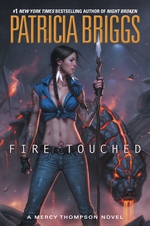
Fire Touched by Patricia Briggs

Fire Touched Fire Touched

by Patricia Briggs
Series: Mercy Thompson, #9

Hardcover, 342 pg.
Ace, 2016

Read: March 23 – 24, 2016

How is this only the 2nd Mercy Thompson book to appear on the blog?!?! Seriously, what is my problem? (other than reading all but the last two before I started this thing, I guess)

If Chapter 1 doesn’t include the funniest scene that Briggs has ever written, I’ll eat my hat. Naturally, after cracking me up, I figured she’d be taking us to a pretty dark place. And while there was a good deal of darkness — and potential for big, dark happenings down the road (but I’ve thought that before, like with Fair Game) — it didn’t get as bad as I feared.

There’s a scene fairly early on here that reminded me of the big ” …it is defended!” speech from Doctor Who‘s “The Christmas Invasion” — the moment that the new Doctor defined himself. Mercy does something a lot like that not realizing just how far her message will go (thanks to the Internet, smartphones, and 25-hour news cycles), and just how much trouble she’s created for Adam and the rest of their pack — as well as Bran and pretty much every werewolf in the U.S.

Part of the immediate fallout of this moment is that a human child who has been abducted by the Fae at some point that no one (including him) remembers comes to Mercy for help. He doesn’t quite fit in to this world any more, but he doesn’t want to be with the Fae, either. With a big emphasis on the latter. So, with she gives him sanctuary of a sort — at least temporarily. This brings attacks, threats, and destruction — with more to come if she doesn’t hand the boy over.

You can imagine how that goes over with everyone’s favorite shape-shifting mechanic.

There’s a lot more going on, but the fate of the boy is the centerpiece.

There’s a major loss in this novel that moved me more than I could’ve expected. On the one hand, I think it’ll be good for the long-term health of the series. But man, it’s going to be strange opening the next Mercy book without seeing ____.

I’ve seen some people disappointed with this book, but I’m not sure why. There was plenty of action — but it wasn’t as epic (for lack of a better word) as Night Broken or River Marked, maybe that’s it. You’ve got some really solid scenes — in the comedic and the action veins, Mercy makes a strange new friend, plenty of Fae politics, internal pack politics and Mercy as David Tennant. Not the best in the series (but they can’t all be), but a very satisfying installment in a really good series. That’s more than I can ask for.

Again, Mercy as David Tennant. Need I say more?

—–

4 Stars

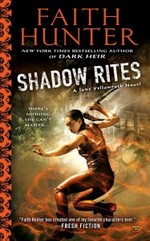
Shadow Rites by Faith Hunter

Shadow RitesShadow Rites

by Faith Hunter
Series: Jane Yellowrock, #10

Mass Market Paperback, 348 pg.
Roc, 2016

Read: May 6 – 11, 2016

Here in the tenth Jane Yellowrock novel, Hunter ties the story in to events of the first (and a few others) in a way that makes you wonder just how long she’s been planning it. But you’ll have to dig into that part yourself.

The novel begins in the last days before a large Witch Conclave, at the end of which, they may sign a peace treaty (of sorts) with Leo Pellisier and the vampires he leads. Naturally, things aren’t going to go well — and this starts with a magical attack on Jane’s house. Things get really bad, really quickly after this, and they don’t get better for almost 350 pages.

We didn’t get nearly enough Alex in this book. But we got plenty of Angie Baby, Evan, Molly, Eli and Bruiser. There’s a few changes to Jane’s house that will take some getting used to — for her, as well as her readers. More importantly, things with Bruiser are progressing in a way that things with LeFleur didn’t. So basically, personally, things are going as well for Jane as her professional life is in trouble.

But really, when hasn’t her professional life been trouble?

She spends a lot of the novel focusing on the wrong things — or at least the things that aren’t as important — which comes back to bite her in the end. It’s pretty frustrating, too. Thankfully, Eli has her back. I’m really liking him more and more all the time. There’s something going on with Angie as well that will be most interesting.

I’d be game for a Eli/Angie novella, now that I think of it.

I really enjoyed Jane transforming into a bloodhound (and Beast’s opinion of the move) and her observations about smells, they really made me chuckle. There’s a danger that Jane faces with this transformation, which adds a nice touch to things — unless I’m mistaken, there’s not been an inherent hazard to her taking on a form that’s not the Puma concolor.

I hope that as the series focuses on the European Vamps’ visit/invasion that we can move away from witches. Something about the way that Hunter describes magic just doesn’t click with me — I can’t put my finger on it, and I admit it’s probably my problem (but I’m going to blame her, because it’s my blog) — Hunter’s were-whatevers, vampires, vampire attendants, skinwalkers, private security guys — all those work just fine, but magic? Something just doesn’t translate beyond whatever Molly and Angie Baby do (except in combat, then they’re just as bad as the other witches). Which is a problem in books like this.

That aside, this is one of the more complex novels in the series — probably the most emotionally fulfilling, while occasionally frustrating. More than usual, I’m eager to see what Hunter’s got in store for this group.

—–

4 Stars

The Old World by Roy M. Griffis

The Old World The Old World

by Roy M. Griffis
Series: By the Hands of Men, Book One

Kindle Edition, 262 pg.
CreateSpace Independent Publishing Platform, 2013

Read: April 29 – 30, 2016


I was blindsided by this one — I knew what to expect plot-wise, don’t get me wrong — what I didn’t know what how little time it’d take for me to care. I got invested in this story and the characters far faster than I normally would.

Charlotte Braninov was sent to a boarding school in England to keep her safe during the tumult leading up to the October Revolution, not one to hide away, she volunteered to become a nurse tending to the English wounded in France during the Great War. Her American friend (who we could’ve spent a little more time with), Kathleen, is in a similar position. Toiling away at a hospital near the front lines — there’s a great focus on the nurses here, not just the doctors and surgeons (as one usually gets), those who tend to the wounded and dying all the time. I really appreciated that.

Charlotte has a brief encounter with a charming and wounded British officer that leaves a mark on her psyche. Not surprisingly (because this is a novel, and people like that don’t just vanish), Lt. Robert Fitzgerald is stationed at the hospital Charlotte serves. Events conspire to get them to spend time together, a friendship blooms — and maybe something else will as well.

Through Robert, we get a glimpse or two of life in the trenches while Charlotte is our entry to medical care. Between the two, you get a decent idea what things were like in France (or at least Griffis lets you think you do). The research is there, but you get the idea Griffis wouldn’t let historical data get in the way of his story (which is the way it ought to be in historical fiction). He also doesn’t overwhelm you with details the way so many slip up and do in early works — just enough to provide atmosphere and add an air of authenticity.

Tragedy, hardship, horrors of war intrude and complicate life. Honestly, peacetime isn’t a picnic for anyone, either — especially for someone from Russia. The plot takes a couple of twists and turns, setting things up nicely for a sequel that you really need after the last couple of paragraphs.

This isn’t just a love story, nor is it really that much of a war story — it’s both and a lot more. You’ll chuckle, you’ll “awww,” you’ll get ticked off, you’ll be moved. Pretty much, if you name it, Griffis characters will make you feel it.

I’m not going to tell you that Griffis is a master of style, a wizard with subtle characterization, or a weaver of intricate plots, or anything like that. What he is, however, is a compelling story-teller. You like Charlotte, Kathleen, Orlando, Robert, Matron, and the rest almost effortlessly and want to see them happy, healthy, etc. You care about the events surrounding them and the outcomes for the characters. I really liked this one and am trying to find a hole in my schedule to throw the sequel into, you should do the same.

Disclaimer: I received a copy of this from the author — sorry for imposing on your patience, Roy — in exchange for an honest review.

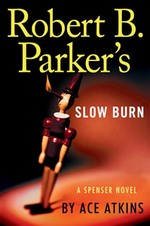
Slow Burn by Ace Atkins

Slow BurnRobert B. Parker’s Slow Burn

by Ace Atkins
Series: Spenser, #44

Hardcover, 304 pg.
G.P. Putnam’s Sons, 2016

Read: May 5, 2016

On the Greenway, a carousel turned to calliope music. The two men approached me. They tried to act like they were shopping, but they were as unobtrusive as a couple of linebackers at a Céline Dion concert.

Say what you will about the relative merits of Atkins’ two current series, but you won’t get lines like that from Quinn Colson (maybe from Lille Virgil). (That’s not really the best line of the book — it’s just the one that requires the least setup)

We’re introduced to a new world here — the Boston Fire Department, and the Arson investigators in particular (but not exclusively). It’s a little harder for Spenser to work his magic here, at least at first, being very much a duck out of water. But, he keeps at it, and eventually things start falling into place — even if he makes one serious (and perhaps life-threatening) mistake early on. There’s a series of suspected arsons, but the proof is minimal, and it doesn’t push the investigators in the right direction — or any direction, really. The usual motives (fascination with fire, insurance money) don’t seem to be involved here.

I should add that the motive for the crimes is interesting, if misguided. I’d almost like to see a bit more of it explored by the good guys, but that’s not what this book is about.

Spenser and his allies do their thing, the way they always do (but fueled by a different donut source). The same ol’ charm, wise cracks, and fists eventually do their job. I think this one is a notch above Atkins’ last — a couple of notches below Atkins or Parker at their best, but better than Parker’s average. The fact that I have to work this hard to decide where exactly in the 40+ this one lies says something — it’s on the good end, I should stress — but it’s hard to distinguish this from the master himself, Robert B. Parker.

There’s some good fodder for long-time fans here — Marty Quirk has a new job, Frank Belson has a new boss (one not particularly taken with Spenser). Not only do we get a callback to Mattie Sullivan, but we get a couple from the more distant parts of Spenser’s past — A Catskill Eagle and Promised Land, one of my least favorites and one of Parker’s best. Atkins’ ability to use for the current narrative, comment on, and tap into fanboy nostalgia all at the same time is really something to watch.

Atkins is again feeling confident enough in his role here to make significant moves in Spenser’s life — not to mention Pearl’s and Sixkill’s. I’m not sure I’m crazy about the latter two, but I’m trusting Atkins. I’m pretty sure he has a plan regarding our favorite disgraced athlete that’ll pay off. Can’t help but wonder what Parker had in store for him, though.

Speaking of plans and things in store — it’s pretty clear that Atkins has a plan for Jackie DeMarco, too. I hope it takes a few books to pull it off, but I fear it won’t.

I’m very glad to hear that we’ve got at least two more of these coming, Atkins is really helping me stay in touch with an old, old friend. I smiled, I chuckled, I even laughed a couple of times, and I reminisced a little, while wondering just how Spenser was going to save the day. All in all, a good way to spend a couple of hours. Now I’ve just got to count down the months until #45.

—–

4 Stars

Dead is Best by Jo Perry

Dead is BestDead is Best

by Jo Perry
Series: Charlie & Rose Investigate, #2

Kindle Edition, 296 pg.
Fahrenheit Press, 2016

Read: May 2, 2016

You’d think that having given up the ghost I’d be beyond the grasp of my ex-stepdaughter, the parasite.

Sure, Charlie’s less-than-charitable assessment, doesn’t make it sound like death has mellowed him at all — or that we really want to spend a novel looking into the trials and tribulations of his ex-stepdaughter, Cali. (a quick aside: I loved Charlie’s rant about the pretentious names given to Cali and her peers, “Truth, Canyon, Druid, Turquoise, Vanilla and Road. Don’t tell me those are names–– they’re brands. “) But last time we learned that 1. Charlie has actually mellowed a bit, we just need more time to see it; 2. He’s generally right about his family; and it won’t take long before the reader will actually care about Cali. As difficult as she’ll make it.

Textbooks will tell you that Cali is a “troubled teen.” Which is a pretty vague, and a likely outdated, term. She’s a drinker, a drug user, defiant daughter (although once you meet her mother and current stepfather, you kind of get that) in trouble with the law. But it doesn’t take long once Charlie and Rose start to follow her for her to end up in more trouble than she — or anyone — deserves.

Once again, there’s very little that Charlie and Rose can do other than watch what’s happening and put two and two together in the almost vain hope that Charlie can do something about it. Rest assured, they do, and it doesn’t involve another near death experience (I was a little afraid they’d just be hanging around Surgical Centers waiting for the next opportunity to talk to another ghost). It’s hard to believe that a mystery series where no one knows that the main characters did anything works. But this does.

What can I say about Rose? She’s at once one of the most realistic dog characters I can remember reading lately (she doesn’t talk, narrate, have a point of view chapter, or communicate telepathically), and yet, as a ghost, is the hardest to believe. She’s such a good influence on Charlie, I’m glad whatever or Whoever brought them together after their deaths.

Charlie said something in the last book about death not being about learning anything or insight or growth, that he stays the same. I don’t believe it, he’s not the same guy. But it’s probably a good sign that he doesn’t realize it.

Something I should’ve mentioned when I talked about the previous novel, these chapter epigraphs are great. They represent a truly impressive collection of quotations about death, some funny, some thoughtful, just about all of them keepers. The book is worth the effort just to read these (but you should really focus on the rest of the book).

Perry’s freakishly short chapters make you think Robert Parker was prone to be long-winded and rambling, but they work. You could probably make the case that they’re a commentary on the transient nature of human life or something (if you wanted to, and I don’t). They keep things moving, really keep anything from dragging, and help you get how Charlie and Rose can jump from place to place with ease.

Funny, poignant, all-around good story-telling. Plus there’s a dog. You really can’t ask for more than that. It’s easy to see why people as diverse as Cat Warren and Eric Idle commend these books. I strongly recommend this one (and the predecessor).

—–

4 Stars

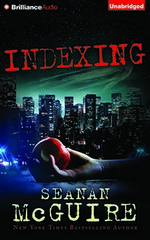
Indexing (Audiobook) by Seanan McGuire, Mary Robinette Kowal

Indexing AudiobookIndexing

by Seanan McGuire, Mary Robinette Kowal
(Narrator)
Series: Indexing, #1

Unabridged Audiobook, 13 hours
BrillianceAudio, 2015
It could easily be argued that I’ve said enough (if not too much) about Indexing. So I’m not going to talk about the story, the writing, and so on, beyond this: not listening to this episodically like I read it, highlights strengths and weaknesses. For example, it’s minor, but the way she has to re-introduce the cast in every episode gets pretty tiring when you hear them all minutes apart — but you don’t really notice at all when you read them every 2 weeks.

The book as a whole is developed better and more fully than I realized initially — the whole thing is a lot more connected than I realized. I’d been intending to kick back and read the whole thing sometime to see how it held together, and I’m glad I got the chance to with the audiobook. It’s really a much stronger whole than I realized.

The main thing I want to talk about is Mary Robinette Kowal (that’s three audiobooks in a row from her, I have to take a break before I just assume that every audiobook is by her). She was fantastic. Her Sloane wasn’t anything like the Sloane in my head, but far superior. The rest of the team was spot on — but the best was Henry. The little inflections of her voice when Henry was closest to her Story, when she was at her most Snow White-ness, added so much to McGuire’s words. I really couldn’t believe how much more I got out of it through her interpretation of the character. Just outstanding.

If you haven’t read the stories or book yet, I do recommend them — but if you get the chance, go with the audio instead. A recommendation I never thought I’d say about any book and audiobook.

—–

4 Stars

Madam Tulip by David Ahern

While in the shower this morning, it hit me that I left out something like a paragraph and a half of this — and I had to make the choice: fix this before it posted, or get to work and fix it later. Because my wife tends to appreciate things like paychecks, a roof over our heads and food for the kids, I chose the latter. If you read this already, try it again.

This one just launched this past weekend — get it while it’s hot and fresh so he can do more!

Madam TulipMadam Tulip

by David Ahern
Series: Madam Tulip, #1

Kindle Edition, 309 pg.
Malin Press, 2016

Read: April 27 – 28, 2016

‘Hi,’ said Marlene, pausing for the briefest moment before striding up the steps and through the entrance, trailing the rest behind. Derry might have been justifiably offended at the offhand greeting but recognised the signs of a woman bursting for a pee. That a supermodel needed to pee was a gratifying thought, even endearing, though Derry recognised it was odd to like somebody just because they had a bladder. . .

Derry sighed. Her father was about to lose two hundred euro on a race, and although he wouldn’t dream of blaming her, she felt responsible. And now she was condemned to spend the afternoon in the company of a supermodel. Next to Marlene, Derry felt like a hobbit—a hobbit overweight and round even by the famously relaxed standards of hobbits. She looked down at her shoes (charity shop) then at Marlene’s (Jimmy Choos) and her soul shrank a little inside her.

Derry’s an out-of-work actor — “fully qualified for unemployment in three different dialects” — trying to make a go of it in her father’s hometown of Dublin, and is on her last legs. Her mother is on the verge forcing her to return to the States and get a real job. And by “force,” I mean, “stop paying her bills so she has no choice.” But Derry’s got a little something extra working for her, she’s the only daughter of a seventh son of a seventh son — and therefore, has a bit of a gift. She uses it to read Tarot and other cards for her friends as a laugh, and that’s really about it. But suddenly, she really needs money, and the mother of invention just had another kid.

With the help of her friend, Bella, and a couple of costume and makeup artists at a local theater, they create an alter ego for Derry, Madam Tulip — celebrity fortune-teller. Her first gig is at a charity event that Marlene sets her up with — Marlene is blown away by Derry’s gift, and desperately needs a friend. The event is the perfecting launching pad for her new role, it’s attended by actors, musicians, models, has-beens, wanna-bes, people with too much money, etc. For example, there’s Mojo.

Mojo was an outlandishly gorgeous rapper from London, winner of numerous industry awards. He was also the star of TV ads for masculine cosmetics and a revolutionary vacuum cleaner also created especially for men, so presumably designed to withstand long periods of storage under the stairs.

(yeah, it was an awkward transition, but I got to use that quotation)

Not to get into details, but the event goes well — Tulip sees many people, some of whom take her card; Derry and Marlene get closer; money is raised for . . . something, I don’t know. Well, sure, nothing’s perfect — Derry runs into an old flame, Bella runs into trouble and someone died. If Derry’s sight is right, that’s just the beginning of the trouble. Before long, Derry and at least two of her friends are in danger on several fronts. Oh, yeah, and her mother is coming to town.

Ahren’s put a lot of thought into these characters, it’s clear — they’re well-drawn, well-utilized, and prime for return in a sequel. Beyond Derry and Marlene, we have the aforementioned Bella — an outspoken fellow struggling-actress, the ex-boyfriend (will let you learn about him on your own) and Bruce. Bruce is an actor, and so much more — starting with ex-SEAL, which means he can be used for the dangerous stuff. Thankfully, he’s more human than most characters in this position, he’s not a gay version of Joe Pike or Ranger from the Stephanie Plum novels (nor is he Spike from the Sunny Randall series). He’s a guy who’s done some things, seen some things, and is working to move on into his new life. We also have Derry’s folks — her mother (just as charming as you’d expect from the ultimatum) and her artist father. Derry’s father, Jacko, is the stand-out character for me — he reminded me of Moxie Mooney’s father from Fletch’s Moxie (been years since I’ve read that, so maybe he shouldn’t have). Jacko’s full of life, an inveterate gambler, a painter with an ego to match his talent, womanizer, not-as-devoted-as-he-thinks father — and, of course, the seventh son of a seventh son. I can easily see him becoming a drag on the series (see Grandma Mazur in the Plum novels), but as long as Ahren uses him right, he’s probably going to be my favorite.

Here’s the best part of the book for me, it’s also the part that keeps this in the “Mystery” category and not “Urban Fantasy,” Derry’s gift really has very little to do with the outcome of things. She knows there’s trouble afoot (murder tends to indicate that), she has friends in peril, and she does something about it (calling the police is out, for pretty good reasons). It’s Derry’s wits and some help from her friends that allows her to help bring justice to the situation. Naturally, most of the help on the friend side comes from the ex-SEAL, because when you’re in danger, and you have an ex-SEAL friend, that’s who you look to. Derry risks life and limb to help out her friends without any supernatural, extrasensory, etc. assistance.

This isn’t a comedy, but it’s comedic. Ahern writes with a light, but confident, touch. It’s well-paced, and it kept me very engaged. The mystery is fairly simple, but this doesn’t set out to to be a head-scratcher. It’s a silly adventure — and a well-executed one at that. Think Psych where Shawn actually has abilities, and doesn’t need James Roday’s affable charm to keep him from being the most annoying character in television history. Ahern’s clearly and carefully set the stage for several more books with these characters, and I’m eager to see what he does next.

Disclaimer: I received this book from the author in exchange for an honest review, and I thank him for bringing it to my attention.

—–

4 Stars

There Will Always Be a Max by Michael R. Underwood

There Will Always Be a MaxThere Will Always Be a Max

by Michael R. Underwood
Series: Genrenauts, Episode 2.1

Kindle Edition, 26 pg.
Tor.com, 2016

Read: April 23, 2016


It’s not often that I do prep work before reading something — especially a 26 page story. But I wanted to fully appreciate this, so in the weeks leading up to the release (and one week after — hence the late review), I watched the Mad Max films — I’m not sure why, but they never appealed to me back in the 80s, and while I was curious about Fury Road, I hadn’t gotten around to it yet. While I’m very underwhelmed by the first two, the third was okay, and I really liked the latest. So finally, I felt ready to read this story.

So, so glad that I watched the movies first — I’d have been okay without it, but there were nuances, etc. that you pick up with the right background.

So we’re in a post-apocalyptic area, very much out of the Mad Max movies. Angstrom King is the only Genrenaut involved here — for reasons well explained — but Roman overshadows everything. I really appreciated this approach. I’ve been curious about the hints that Underwood dropped in The Absconded Ambassador about Roman and am glad we got more here — tho’ I’m still looking forward to getting the whole story eventually. It was good to see King doing more than commanding a mission, it was good for the character to get in the thick of things.

Underwood’s treatment of “The Max” idea/character is well done. The story, while brief, is full and exciting. Not much more to ask from 26 pages, really.

—–

4 Stars

Page 66 of 88

Powered by WordPress & Theme by Anders Norén