Tag: 4 Stars Page 67 of 88

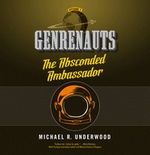
The Absconded Ambassador (Audiobook) by Michael R. Underwood, Mary Robinette Kowal

The Absconded AmbassadorThe Absconded Ambassador

by Michael R. Underwood, Mary Robinette Kowal
(Narrator)
Series: Genrenauts, Episode 2

Unabridged Audiobook, 3 hours and 25 minutes
Macmillan Audio, 2016
Read: April 8, 2016
I really don’t have much more to say about the audiobook that I didn’t say about the original, but I wanted to get something up — so if this seems largely familiar, it is. But not entirely …

Working as a Genrenaut was like being a member of a theater troupe run by a burnt-out hippie who melded Devising with MBA management: the ideas were outlandish and random, but the execution was 100% corporate.

The second episode in Michael R. Underwood’s Genrenauts delivers on the promise of Episode 1, and demonstrates that his special alchemy of Leverage + The Librarians + Quantum Leap + Thursday Next (just my current guess at his secret recipe) has legs — and will hopefully go a long time.

Leah has had about a week to get used to this new reality since her adventure in Western World — a week filled with meetings, reading assignments and trying to wrap her head around things. In the meanwhile, everyone at Genrenauts HQ is trying to prepare for the next breach (in the midst of a spike of 15% over the norm, for your corporate types), probably in Romance World. Which obviously means it’ll be pretty much anywhere else, like say Science Fiction World.

The station of Ahura-3, in the space opera region, to be specific. I’m sure the similarity between the name of the station and a certain Communications Officer is a huge coincidence. Ahura-3 is everything you want in a space station — it’s a melting pot of very-alien-looking/acting aliens, it’s a culture to itself, with strategic location, and very delicate intergalactic politics.

Leah’s excitement about being in “honest-to-goodness, Sally Ride is my homegirl zero-g” space was infectious (especially in this format). But even more fun was the amount of SF references Underwood fit into half of chapter 1 — truly astounding, and didn’t feel forced or overcrowded. He deserves a tip of the cap right there. But the fun’s not limited to the references and allusions — it’s in the alien cultural practices (and appearances), the various factions (human and otherwise), businesses, and just watching the whole Science Fiction World thing at work.

Mary Robinette Kowal did another bang-up job. I’m still not crazy about her voice for King, but I listened to this one using my earbuds instead of my car speakers and she’s much easier to hear with that voice that way, so it doesn’t bother me as much. I liked her alien characters a lot. Shirin and Leah are great (I think I like the audiobook take on Shirin better than the one in my head when reading, actually)

Good way to spend a little time — very entertaining all around.

—–

4 Stars

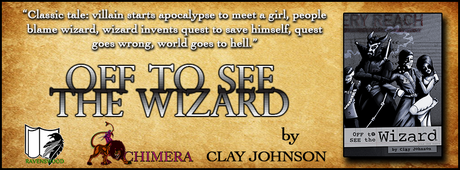
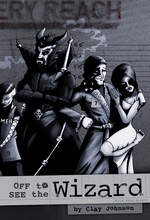
Off to See the Wizard by Clay Johnson


Here we are at the end of our day-long Book Tour stop for Off to See the Wizard (see Parts One, Two, and Three). Hope you enjoyed it.

Off to See the WizardOff to See the Wizard

by Clay Johnson

Kindle Edition, 373 pg.

Ravenswood Publishing, 2016
Read: April 18 – 22, 2016

From the beginning? Are you certain? The beginning is pretty dull, you know. All of the violence comes later. The beginning is just sex and blood and guts, and— yes, right, I see it now; fair point.

Let’s see… it began with that dwarf. At least, I think he was a dwarf. He may have been a child. I don’t honestly pay much attention to the jesters they hire. Mostly, they are little more than jingling bells in the background. I know he was very short. Wait! He had a beard. One of those awful, disgusting sort that grow scraggly and in patches. Looked like he’d glued stringy chunks of carpet to his cheeks; do you know the sort?

Yes, had to have been a dwarf.

A tale of an attempted apocalypse, a quest to thwart it, love (or something like it) in bloom, love (or something like it) in trouble, and the aftermath of it all. It may not sound like fodder for comedy, but in Clay Johnson’s hands, it is.

A royal feast ends abruptly, and in a disturbing way (although the way it’s narrated, its pretty humorous). And then soon, horrible things (mostly involving blood in places and amounts no one wants) start happening all over. Naturally, citizens, royalty and everyone in between demands answers — so they turn to a wizard to tell them what’s going on and how to stop it. The wizard has no clue (this will be a recurring theme), but sets off on a quest to find out. He takes his girlfriend, a swordsman, and a redshirt (the wizard has a strong sense of self-preservation). He soon regrets all of these choices — his girlfriend spends most of the time upset with him, the redshirt is a mopey kid who writes horrible poems (and is never used as cannon fodder), the swordsman deserts them. Thankfully, a better swordsman, and a drunken elf queen in training join up after that. Really, very little goes well on the quest.

Meanwhile, the Demon Lord who started the whole thing, really didn’t mean to — he was actually trying to do something else, and it went horribly wrong (I’ll leave it to you to learn what) — and he spends most of the book trying to ameliorate the situation and get his original purpose back on track. Very little goes well for him, either.

In the end, things are a giant mess, so a Royal Inquisitor is sent out to investigate it afterwards, and the book is a edited together compilation of transcripts of his interviews with witnesses, the quest party, the villains of the piece, and others. The mutually contradictory takes on the events given by the various interviewees are hilarious — each person has a strong voice, you pretty much get to the point where you skip the text identifying who’s speaking, you can tell who it is just from their language. It doesn’t take long for the reader to suss out how to take the competing versions and get to a pretty good idea of what really happened.

I don’t remember the details, and am short on time, so I can’t look for them. But somewhere, C. S. Lewis talks about why it’s appropriate (well, at least not totally inappropriate) to laugh at bawdy jokes if they’re cleverly told, involve some creative word play, and so on — not at the vulgarity of them. Given that cover by the noted apologist, I can freely admit that I laughed plenty at this. Johnson’s characters, their dialogue, and his creative use of words and imagery are wielded so well, that you just could help but laugh (even a few times when I knew Lewis wouldn’t approve of it). This is what Franco, McBride and the rest were going for in the movie Your Highness a couple of years ago — a funny fantasy. The Princess Bride for those who appreciate rated-R comedies.

For example, there’s a moment that got me laughing out loud — a lot — where someone inadvertently invents/coins one of the seven words you can’t couldn’t say on TV. The effect that word has on the most hardened criminals in the kingdoms was fantastic — it’s a moment that’ll stick with me for awhile.

From time to time the narrative started to drag a little bit, and I’d start to wonder if anything was actually going to happen. But within a page, I’d chuckle at something again and forget about the slow plot.

In the end, it was a little too off-color for me, but Johnson pulled it off in such a way that I was able to put that aside and enjoy his story and his story-telling. Really, Off to See the Wizard is the funniest thing I’ve read this year — and I can’t imagine much topping it.

Disclaimer: I received this book from the nice folks at Ravenswood Publishing in exchange for an honest review.

—–

4 Stars

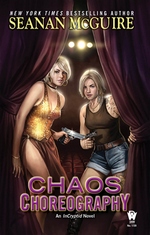
Chaos Choreography by Seanan McGuire

Chaos ChoreographyChaos Choreography

by Seanan McGuire
Series: InCryptid, #5

Mass Market Paperback, 345 pg.
DAW, 2016

Read: March 24 – 25, 2016

Hey, wow, who’d have thunk it — a positive review of a Seanan McGuire novel from The Irresponsible Reader?!? Next thing, I’ll be telling you that the sky is blue, water is wet and J. J. Abrams likes lens flares. But what do you want from me? Seanan McGuire is a great author who consistently puts out fun reads. The only reason that she hasn’t taken over the world yet is that she doesn’t want to.

Oh, spoiler alert: I’m probably going to be giving very positive reviews to two other McGuire works in the next week or two.

So what can I say about this one? It’s probably the most enjoyable, most entertaining, most emotionally resonant, best all-around entry in the InCryptid series to date.

Verity and Dominic are living with her parents, which is going about as well as you could expect, and trying to get used to life outside of NYC when Verity gets a call from the reality show she came thiiiiiis close to winning before we met her in Discount Armageddon (well, her cover identity got a call, technically). They’re doing a best-of season, and need her to round out the cast.

Next thing they know, they’re working up a new cover for Dominic and heading for L. A. Where we meet Verity’s long-lost besties, a would-be frenemy (if anyone took her seriously), and a few cryptids.

We get the return of the lady Dragons — both the group we met in Discount as well as L.A.’s very own, plus a few others. The cryptid cultures of L. A. (and the West in general) developed in very interesting ways. Sadly, one of the things that seems to be pretty popular are snake cults — there’s one that seems to be pretty serious about things and are using human sacrifices to power a spell.

Which means that Verity has to do a little more than just dance, she has to find the cultists before it’s too late. She calls upon friends new and old, Dominic, even the Aeslin mice and a Price that we’ve heard of, just never met. Leading to a final confrontation that’s one for the ages — and nothing will be the same again for the Prices family. I’m not so sure that it’ll be the same again for anyone.

I’d happily read about any and all of the new cryptids we meed here again, and most of the humans, too (not the evil ones, just for the record). McGuire’s assembled a great bunch of characters for this one.

I love the fact that not only do we get to see the Aeslin mice developing new religious celebrations, but we see them in action — putting their tiny little lives on the line to save the day. I also like to see Verity coming to grips with the choices she’s been making the last few years, what that means for her, and what place dancing and the rest have in her life.

Major kudos to McGuire for getting me to give a rip — not much of one, but still — about dance competitions. I don’t get dance — I mean dancing, I get. I’m no good at it, but I get. But watching dance — any form – I just don’t see the appeal. But for a few pages here and there I was almost interested in Verity’s other career. That’s a pretty major accomplishment.

Now I’ve just got to settle in and wait a year for lil’ sister Antimony’s first novel. Is it 2017 yet?

—–

4 Stars

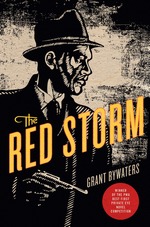
The Red Storm by Grant Bywaters

The Red StormThe Red Storm

by Grant Bywaters

Hardcover, 277 pg.
Minotaur Books, 2015

Read: March 24, 2016


So you’ve got a barely scraping by, more literate than he appears, PI in the 1930’s. He’s good with a gun, better with his fists, his mouth gets him into trouble. He has a friend with the police, and many more on the streets (well, at least people who owe him favors and vice versa). It’s not NY or LA, but so far, this is pretty straight-forward — even having his office in New Orleans doesn’t make him stand out too much. Doesn’t mean it’s bad — just that this is a variation on a theme.

What if I told you that he’s black?

Well, now here we have something new. This is a pretty big variation. Thankfully, this isn’t just a gimmick, either.

Once an up and coming boxer in NYC, William Fletcher realized that the color of his skin was going to keep him out of Title contention and falls into a life of crime, acting as the muscle for a minor-league gangster, Storm. He’s not all that crazy about the life, but he goes along for a while. Storm gets desperate, does some really stupid things and has to get out of town. Sometime in the next decade, Fletcher moves down to New Orleans, gets himself a PI license and sets up shop.

Storm comes to town, looking up his old “friend” and asks him to look for his long-lost daughter, Zelda. Without taking money from a fugitive, or even agreeing to work for him, Fletcher tracks down the girl (now a lounge singer), but will only tell Storm where if she agrees. While she’s thinking about it, things get interesting.

People start trying to kill her, for starters, and she hires Fletcher to be a body-guard. While the city begins to erupt in a gang war, somehow Zelda and Fletcher are in the middle of it — neither understands why, but Fletcher is going to find out.

The characters are so rich, so flawed, so human. Fletcher’s having to be creative to get access to people and places while being black in Louisiana in the 30’s is compelling to watch. He’s a realist about the disadvantages his color imposes on him. He’s not happy about them, but he’s not off to change hearts and minds, he just deals with the reality he finds himself in. Zelda’s deeply flawed, but trying to overcome her flaws (mostly). The criminals are great characters, too — classic mobsters in the ’30’s mold.

This is at once a historical mystery and a hard-boiled P.I. novel, a combination I hadn’t realized I wanted. But man, I had a blast with this. Along those lines, I there were a couple of vocabulary choices that seemed anachronistic, but they weren’t so obnoxious that they took me out of the moment or made me want to go look up to see if they were fitting for the time.

I feel like I should have more to say, but I really don’t. At this point, it’s just gushing — Red Storm is taut and well-paced, with a good mystery at the core and a P. I. as knight errant — protecting the damsel and righting wrongs. Fletcher is the real deal, so is Bywaters. I hope to see a lot more of both of them, soon.

Disclaimer: I was provided a copy of this by the author in exchange for my review, which didn’t influence my take. The fact that he seemed willing to banter with me and caught a reference I made in an early email didn’t either — probably.

—–

4 Stars

The Shootout Solution (Audiobook) by Michael R. Underwood, Mary Robinette Kowal

The Shootout SolutionThe Shootout Solution

by Michael R. Underwood, Mary Robinette Kowal
(Narrator)
Series: Genrenauts, Episode 1

Unabridged Audiobook, 3 hours and 25 minutes
Macmillan Audio, 2015
Read: March 23, 2016


I thoroughly enjoyed the story about Leah Tang’s introduction to the wonderful and crazy world of the Genrenauts — and it’s sequel — when I read it last November. When heading out for a road trip, I figured it’d be a good distraction from the road for my wife, son and I. It’s a fun story, filled with characters you want to root for on an adventure that we all would like to take. I mean seriously, a rocketship ride to the Old West? Sign me up.

For me, this time it was a little easier to grasp the explanations given for what the team is up to — the new reality (better, realities) that Leah finds herself in this time out. Partially because I already knew it, partially because I find that kind of thing easier to digest when I hear it (so why don’t I listen to more audiobooks?)

On the whole, I was really impressed with Kowal’s narration. My wife and I weren’t crazy about her characterization of King — the voice was hard to understand, I really didn’t think it matched the description Underwood gave. I had virtually no other complaints — and in fact, really enjoyed her work. It was a little hard for me to deal with the fact that it took nearly three-and-a-half hours to get through, I’m used to spending a lot less time with Underwood’s works (most of them, anyway). But I did appreciate being forced to soak in the world, think about things a bit more than I would have on my own.

I was hoping we’d get through the second installment as well, but we weren’t able to squeeze that in. I’m curious what Kowall did with some of the characters we meet there, and hope I can figure out a time to get to it soon.

If you liked the novella — or if you think you’d like the book, but haven’t gotten around to grabbing it, the audiobook is well worth the small investment of time and money.

—–

4 Stars

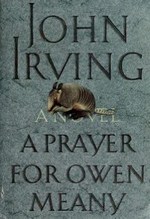
United States of Books – A Prayer for Owen Meany by John Irving

A Prayer for Owen MeanyA Prayer for Owen Meany

by John Irving

Hardcover, 543 pg.
William Morrow & Co., 1989
Read: March 4 – 10, 2016

[Marilyn Monroe] was just like our whole country — not quite young anymore, but not old either; a little breathless, very beautiful, maybe a little stupid, maybe a lot smarter than she seemed, and she was looking for something . . . She was never quite happy, she was always a little overweight. She was just like our whole country.

I’m not sure why I picked that quotation from this book, but there’s something that appealed to me about it (even if I don’t necessarily agree). You’ll note that there are both upper and lower case letters there — Owen Meany’s dialogue is always given to us in all caps. Which is annoying (it’s supposed to be), and difficult to read in extended speeches (Owen’s voice is hard to listen to), and makes you wish he’d shut up (duplicating the experience of most people who heard him).

A medical explanation for this is given, eventually. But the only explanation that Owen needs is that God gave him his voice. The same for his diminutive stature (about 5′ 0″ as an adult) — God made him that way, for His own reason.

But I’m getting ahead of myself — John Irving’s probably best known for The World According to Garp, which was one of the bigger disappointments of my college reading, so I wasn’t really looking forward to spending more time with him. You add in the fact that this is a 500+ page book with only nine chapters, and it’s downright intimidating. I’m not going to say that you shouldn’t be intimidated and that it’s a pretty easy read — it’s a challenge, it’s frequently a slog — but in the end, it’s rewarding.

When the book starts, Johnny Wheelwright (the narrator) doesn’t seem particularly fond of Owen Meany — in fact, you get the impression that he’s just one of those kids he happens to know, and he’s not that happy about it. But before long, it’s clear that he and Owen are really close — even though (because?) Owen’s responsible for the greatest tragedy of Johnny’s childhood.

John finds himself as an observer to Owen’s life, as his defender, his advocate, his way to the greater world. While Owen is constantly trying to help his friend — help him to achieve, help him to think, help him to believe. It’s a great friendship — and without the other, each was diminished. Owen less so, but in important ways.

The narrative is rambling — John starts to tell us about something, the plot moves forward a bit, but then he goes back in history to give context. Sometimes weeks, sometimes years and far more detail than you think is necessary. Eventually, you see that this is sort of the approach that the overall narrative is taking — John has something he needs to tell the reader, but he doesn’t want to. So he tells you many other things, anecdotes, vignettes, details you don’t need — anything to delay what he wants to say. He does get to it. And by that time, you’re not sure you want him to.

The story is told from the perspective of forty-something John, now a teacher at a Private School in Toronto — he spends his days reading the news about the United States, and ranting (or trying not to) to anyone near him about what President Reagan is doing. I’m not sure why we spend so much time dwelling on him in the present, we don’t need it — it adds almost nothing to the narrative. If anything, I think it might lessen the impact of the rest. The adult John telling the story about his childhood, about Owen, about their growing up together, and so on is essential — we need his perspective, his distance. What we don’t need is to hear John’s rants about Reagan, the poor reading/study habits of teenage girls.

I’m not sure that I get a whole lot of understanding of New Hampshire from this book — Owen’s family working in the granite industry doesn’t tell us much, New Hampshire is The Granite State — everyone who survived 4th grade knows that. If anything, Irving was wanting to talk about America — as an ideal, and as something that falls short of that ideal. Monroe was one example, John Kennedy’s moral failings another, Vietnam a recurring theme, and, of course, the Iran-Contra Scandal. Each of these, as either a representative individual, or representative act, demonstrates how far (in John’s/Owen’s view, at least) the United States has fallen short of the ideals it should strive for — if not achieve.

Ultimately, when I enjoyed this book, it felt like it was in spite of what I was reading. But I laughed, I cared, I kept reading — and then when I was finished, I appreciated the work as a whole, and felt a lot more affection for it than I expected. It’s hard to explain, but I liked this one and heartily recommend it.

—–

4 Stars

Dead is Better by Jo Perry

Dead is BetterDead is Better

by Jo Perry
Series: Charlie & Rose Investigate, #1

Kindle, 282 pg.
Fahrenheit Press, 2016

Read: March 12 – 14, 2016

In its young life, Fahrenheit Press has put out some great looking titles, not your typical mystery fare. I’ve only read 2 (bought 1 other), so far — but they’ve shared the off-kilter flavor that the Press’ twitter feed/publicity displays (and descriptions for the other books indicate). I don’t typically talk about publishers when I’m talking about books, but there’s something about Fahrenheit’s project — and the books they put out — that draws your attention. Dead is Better is typical of FP — a mix of darkness and light, unlikely protagonists, unlikely crime-solvers, and atypical crimes (at least as far as crime fiction goes).

Charles Stone is our protagonist, but he’s not really the character that will grab your imagination. That’d be Rose — but we’ll get to her in a moment. Charles is dead — very dead, shot several times. His ghost carries the wounds, as well as the clothing, even the hospital ID bracelet, from the time he died. He can’t remember the shooting however, and can’t think of a reason why he’d be shot. He’s (to his reckoning) no one important, and it doesn’t seem anyone around him even cares enough to kill him/arrange for his killing. After a little bit, he starts to come up with a possible motive or two. But his murder doesn’t seem to be the thing he’s most curious about. What he’d really like to know is, why does he have a constant companion?

Rose is a dog. Well, technically, she was a dog, now she’s the ghost of one. We don’t know why she’s alongside Charles, but she’s been with him the entire time he’s been a ghost. It seems that she had a really unpleasant life; and at last, in Charles, has someone caring for her. Rose is not going to challenge Crais’ Maggie, Quinn’s Chet, or Hearne’s Oberon anytime soon as the greatest dog in fiction — which is not a dig. Rose is great, she’s just not legendary. Rose does have one thing going for her that the other’s don’t — she’s pretty realistic (not that the others don’t have their moments — but even Maggie gets Point-of-View chapters), she can only communicate through suggestion — and even then, the people around her have to guess. Sometimes, they guess wrong.

The two begin investigating Charles’ murder — with the occasional glance at his family and former life. But before long, Charles becomes convinced he’s not around to look into his death, but something else. Rose, somehow, seems to know more about what’s going on than Charles, but he’s the one who needs to do the work. The pair do uncover some answers — and others uncover some others (I’m not convinced that all the answers the readers/Charles are given about anything beyond the main crime are correct, but . . . ).

More importantly, Charles finds a measure of redemption — sure, it might be too late, but nevertheless, there is some. You get the idea that if he maybe had a dog while living, he might’ve turned out to be a better person. Sure, that describes most of humanity to me, so I responded to that, but I think Perry sells it well enough that just about anyone would.

I’ve often thought of trying to do an Urban Fantasy for NaNoWriMo featuring a ghost, but I’ve never figured how to bridge the communication gap between the living and the dead without it feeling like a cheat. I liked Perry’s solution to this (I worry about the sequel repeating it — but that’s not my problem, is it?). I’m not convinced that the police could’ve/would’ve used the information that Charles got to them, but in the moment — you don’t care, you’re just glad that someone did something.

This is a fast and lean read — Perry doesn’t waste a word (actually leaves a couple of them out, but nothing too distracting). You’ll grow to like Charles, you’ll want to adopt Rose, and you’ll want to finds out what happens to them next. Thankfully, their story will continue in Dead is Best.

—–

4 Stars

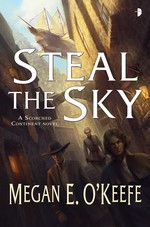
Steal the Sky by Megan E. O’Keefe

Steal the SkySteal the Sky

by Megan E. O’Keefe
Series: The Scorched Continent, #1

Mass Market Paperback, 439 pg.
Angry Robot, 2016

Read: February 20 – 23, 2016
It’s both overly-simplistic and inaccurate to describe Steal the Sky as The Gentlemen Bastards in the Firefly ‘Verse. But it’s not completely wrong.

I’m not sure I can defend that, but I tell you this: read the book and you’ll probably agree. I’m going to try to reference those other works as little as I can, because the book is more than just a combination of their DNA, but I’m going to have to a couple of times. There’s also a smattering of Steampunk-ish elements, some Epic Fantasy-like things, and a dash of The Stainless Steel Rat. You know how Data downplayed his violin playing as a combination of all those various artists, and Picard and Crusher (I think it was her, anyway) telling him that he’s the one who took all those various characteristics and made it his own? That’s what O’Keefe did here, and I hate to minimize what she did by just referencing these other works — but in the interest of brevity, you pretty much have to. I, frankly can’t wait to see in future books what other ingredients she puts in her secret sauce.

But before then, we have to step onto the Scorch, an unforgiving continent, to be sure.

What is it with SF novels and mining? Everywhere I turn lately, there are people slaving away (literally) in mines — Pierce Brown’s Darrow (and the rest of the Reds); almost everyone on Josi Russel’s Minea; and countless people in Aransa and the rest of the Scorched Continent. Really, it wouldn’t surprise me to see Raylan Givens and Boyd Crowder’s descendants digging for spaceship fuel next year on FX. One reason that you see them everywhere is that it’s really effective — you read “miner” and you see poor workers, toiling in unsafe conditions, who are very likely being taken advantage of. If that’s not grounds for compelling drama, well — did you not get where Katniss Everdeen was from?

Like on Minea, there’s a special kind of person who can find the precious resource, called Sel. Sel-sensitives — no matter what their social class, family, or other abilities — go work in the mines (well, a very few become pilots). They can find Sel, they can manipulate Sel, they are the key to getting it out of the planet and into their ships (as an aside, Sel seems to be somewhat renewable, which is nice). The last things the government wants is turmoil — and the thing they want most are Sel-sensitives who can do more than get Sel out of the ground.

The Scorched Continent looks and acts like something from the Old West (at least as we know it from movies, TV, etc.) small communities, mostly poor, with some nobility with a lot of on the “have” side of the equation. Which is where Detan Honding comes in — he’s the black sheep of the oldest of the noble houses, a small-time con man staying one step above starvation and another step ahead of the law (I’m about to break into “Street Rat” from Aladdin, so I’m going to stop). Along for the ride is his long-suffering ship’s pilot, friend, and resident voice of reason (probably the only one who keeps him from getting carried away), Tibs.

The two find themselves in Aransa, a larger city with a big mine. Detan and Tibs are known in some quarters of the city, most notably by the Captain of the Watch, Ripke Leshe, who wants them out of town. But has a unique business proposal first . . .

This is getting too long — let’s leave things there, with some people left for you to meet. And you want to, trust me. Including the villains — both petty and Big Bads (especially the Bigger Bads that you don’t think of that way at first).

O’Keefe has created a great world, with a robust culture, a specialized vocabulary, its own technology, politics and whatnot. There’s a whole invaders taking exploiting indigenous/traditional cultures thing that’s also going on — but O’Keefe doesn’t spend too much time on it, just gives us a quick glance of that — but it looks like future books will explore this more. So I’ll just leave it there, but I’m pretty curious about the whole thing. Speaking of local customs — anytime people talk about Walking the Black — put aside anything you may be snacking on.

Now, since I (and many others) have invoked The Gentlemen Bastards and Firefly, I should say that both of those have a sense of fun — a sense of play — that’s really not that present in Steal the Sky. You get the impression that maybe (probably) whatever happened before this did, though. This book is mostly like the part of Lynch’s work where play time is over and Locke is going for vengeance, not just a payday. Which is not to say that isn’t fun — there are plenty of laughs, jokes, witty rejoinders and whatnot — I’d love to quote some, but the amount of context it’d take for the you to get the joke would kill this. This novel doesn’t have the joie de vivre that the other works do, but it could.

One more Firefly reference and I’m done — towards the end, when things look pretty dire for some of our characters — you get the impression that O’Keefe spent a lot of time wondering just what happened to River while at The Academy, and a few people here would probably find themselves capable of swapping notes with Ms. Tam.

There’s excitement, piracy, politics, thievery, general mischief, subterfuge, revenge, friendship, loyalty in this story — told in a great world, with hints of more worlds to come (as well as more to learn about this one). People are going to be talking about this one for a while, I think. I am, at least.

—–

4 Stars

Reposting: The Absconded Ambassador by Michael R. Underwood

It’s Publication Day for The Absconded Ambassador, so I thought I’d better throw this up again. Go get your hands on it.

The Absconded AmbassadorThe Absconded Ambassador

by Michael R. Underwood
Series: Genrenauts, Episode 2ARC, 159 pg.
Tor.com, 2016
Read: December 31, 2015

Working as a Genrenaut was like being a member of a theater troupe run by a burnt-out hippie who melded Devising with MBA management: the ideas were outlandish and random, but the execution was 100% corporate.

Now this was a way to close out 2015 — the second episode in Michael R. Underwood’s Genrenauts delivers on the promise of Episode 1, and demonstrates that his special alchemy of Leverage + The Librarians + Quantum Leap + Thursday Next (just my current guess at his secret recipe) has legs — and will hopefully go a long time.

Leah has had about a week to get used to this new reality since her adventure in Western World — a week filled with meetings, reading assignments and trying to wrap her head around things. In the meanwhile, everyone at Genrenauts HQ is trying to prepare for the next breach (in the midst of a spike of 15% over the norm, for your corporate types), probably in Romance World. Which obviously means it’ll be pretty much anywhere else, like say Science Fiction World.

The station of Ahura-3, in the space opera region, to be specific. I’m sure the similarity between the name of the station and a certain Communications Officer is a huge coincidence. Ahura-3 is everything you want in a space station — it’s a melting pot of very-alien-looking/acting aliens, it’s a culture to itself, with strategic location, and very delicate intergalactic politics.

Leah’s excitement about being in “honest-to-goodness, Sally Ride is my homegirl zero-g” space was infectious. But even more fun was the amount of SF references Underwood fit into half of chapter 1 — truly astounding, and didn’t feel forced or overcrowded. He deserves a tip of the cap right there. I made it all the way to page 42 without having to Google one of them (I think there was only one other time I had to grab my smart phone). But the fun’s not limited to the references and allusions — it’s in the alien cultural practices (and appearances), the various factions (human and otherwise), businesses, and just watching the whole Science Fiction World thing at work.

One thing that’s been niggling at the back of my mind with these Episodes is what’s to keep Leah from being Ree Reyes 2.0? Underwood seems to be going with keeping Leah from the more Parker/Eliot Spencer-type roles and moving her into the Sophie Devereau/Alec Hardison-type roles. She and Shirin scramble all over the station trying to keep treaty negotiations moving forward. They’re thinking on their feet, using their wits, charm and SF knowledge to keep things under control — Leah’s on-the-job training under Shirin helps the readers acclimate to this world, too. The action-hero needs are served by the rest of the team, Roman and King — whose banter while throwing punches, engaging in dogfights, and so on, kept the fun going (honestly, maybe was a little more fun than the rest).

In Episode 1, I wondered if the pilot nature of the novella kept it from being everything I wanted it to be. The Absconded Ambassador built on that ground work and gave us a solid, fully-formed adventure — everything I hoped it would be. And that’s just in the main story, there’s all this other stuff going on: not only do we have a sense of impending doom — or at least very big crisis — coming to the Multi-Genre-Verse. But now we’ve got some sort of secret within the team (not one that’s going to cause much trouble, I don’t think — but you never know), and (according to the preview for Episode 3) maybe some intra-team conflict. Underwood just nailed here, and Genrenauts is about half-a-novella away from being his most consistently entertaining work.

I won a copy of this in a drawing on the author’s website — which means I got to read it two months early — and I got a very nice autograph on the title page. The downside is, I have to wait longer than I’d have had to wait otherwise between Episodes 2 and 3. I still came out ahead, but not by much.

—–

4 Stars

Thing Explainer by Randall Munroe

Thing ExplainerThing Explainer: Complicated Stuff in Simple Words

by Randall Munroe

Hardcover, 64 pg.

Houghton Mifflin Harcourt, 2015


I’m not sure what to say about this beyond just regurgitating the Publisher’s Description. If that’s not enough to make you want to pick this up for at least a glance, I don’t think I could say anything that will.

But, quickly, the idea behind the book is that using drawings/diagrams and the 1,000 most commonly used words to explain how various and sundry things work — from ball-point pens to the Large Hadron Collider, and many points in between and beyond.

The artwork is like what you see on xkcd, the humor is similar — more broadly appealing (I think), however. The material is educational. That’s about it in a nutshell. I guess I should state that the artwork isn’t like the stick figure comics, it’s the incredibly detailed diagrams that show up at other times.

To give you a taste, some of the entries I found most educational/interesting/amusing were: Shape Checker (padlock); Bags of Stuff Inside You (internal organs); Hand Computer (smart phone); Stuff You Touch to Fly a Sky Boat (airplane cockpit). From Cover to Cover (literally) Munroe’s drawings will be teaching you a little more about how things work.

This is not a sit down and read cover-to-cover kind of book, period. It’s a grab it every now and then, flip through until you get to a page or two (or six) that you haven’t read, or one you have and want to re-read. I’m just leaving this around for my kids (and myself) to pick up from time to time. I wish I could’ve got a picture of the expression on my youngest’s face just now as he was reading through the book, I could’ve not said a word and simply posted it — I’m not sure how much he understood, but he was fascinated. I’d gladly buy a sequel — actually, I could probably use one.

—–

4 Stars

Page 67 of 88

Powered by WordPress & Theme by Anders Norén