Tag: 4 Stars Page 74 of 88

Hounded by David Rosenfelt

HoundedHounded

by David Rosenfelt
Series: Andy Carpenter, #12

Hardcover, 320 pages
Published July 22nd 2014 by Minotaur Books
Read: August 22 – 23, 2014

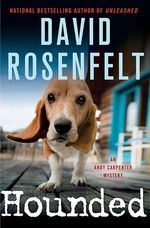
First things first: is this not the cutest cover image ever?

Secondly, I’m not a Today watcher, but my wife is when she’s home sick from work. This mini-rant from Andy was exactly what I’ve been thinking.

I am a creature of habit, and by this time I am always in the den, watching the CBS Morning News. I used to watch the Today Show, until they came up with something called “The Orange Room.” Basically, they go there to tell us what people are tweeting to the Today Show Orange Room. People who would take the time to tweet to the Today Show Orange Room are among the people in the world whose opinions interest me least, so I stopped watching it.*

On to the book itself, which is what I’m supposed to be talking about —

By this time it’s pretty much assumed that Andy will be taking in a dog for the duration of whatever case he takes up (after being forced/tricked into it by this point), and he does so this time — a six year-old Basset Hound named Sebastian. However, this one comes with an accessory Andy’s not used to — an eight year old boy named Ricky.

You see, Andy’s friend Pete Collins was pretty good friends with Ricky’s dad, Danny Diza, and an Uncle-figure to Ricky. And Ricky’s was just murdered, so until the system is able to place Ricky in a permanent home, Pete asks Laurie and Andy to take him in. Why doesn’t Pete do that? Well, he’s going to be arrested for Danny’s murder. Never mind that Pete Collins is about the best that the local Police Department has. Thankfully, he does have super-defense attorney as his best friend.

The number of people in Andy’s social circle who haven’t charged with murder is getting pretty slim at this point. He’s either going to have to make other friends, or do some marketing. Hate to have to see Andy defend Marcus.

Ricky’s presence brings out a side in Laurie we had heretofore not seen, but should’ve known were there. Similar sides in Edna (of all people) and Marcus (!) are brought out as well. Very fun to see the latter two, and heartwarming to see the former. The Ricky-factor alone elevates this particular Carpenter novel.

This case involves a conspiracy, as is almost always the case lately. But this time, it’s on a smaller scale — no worldwide terrorist networks or anything. Just one murder leading to a few others that are trying to be kept quiet by some mysterious and nefarious people. It’s definitely in Andy Carpenter’s wheelhouse, and just the thing his readers are looking for.

Here’s the thing that bugs me, and is a minor spoiler — very minor since I’m describing something that didn’t happen: At no point in time did Andy or Laurie — or some psychologist/counselor they hire — talk to Ricky about the events of the night his father was killed. He was upstairs when it happened. I’m not saying it wouldn’t have been tough, it likely wouldn’t have given Andy much to work with in the defense (I know that because I read Rosenfelt’s narration, Andy didn’t), but still, you’ve got to do it to save Pete’s neck, right?

Other than that, the only beef I have is that I talked myself out of the solution at one point. I was pretty annoyed with myself when Andy figured it out.

Despite the ongoing drought of song-talking between Andy and Sam, this is one of the better entries in the series, and was a lot of fun to read. It featured the typical courtroom antics, banter between Andy and the gang, adoration of Tara, and so on. Not to mention the laugh-out-loudest Marcus joke ever, some welcome character arcs developments, and the most “awww”-inducing closing paragraph that I’ve read in ages.

—–

* To be fair, my wife thinks about as much of The Orange Room as Andy and I do, she just likes the rest of the show’s format.

—–

4 Stars

Dusted Off: Mad Mouse by Chris Grabenstein

Mad Mouse (John Ceepak Mystery, #2)Mad Mouse

by Chris Grabenstein

Hardcover, 320 pg.
Carroll & Graf, 2006
Read: November 27 – 28, 2012

Man, this is just such a fun series. Ceepak’s a great superhero cop (though I hope he becomes a bit more rounded in the books to come), and Danny’s one of the best sidekicks around. Watching him grow up is a blast.

I thought it was great that this book didn’t focus on a murder (my wife took a different stance), a serious crime, yes, but not a murder. The sense of urgency was still real, it was a serious crime, but a crime more likely that a small town would face–rather than a Jessica Fletcher-like situation where 3 centuries worth of murders happen to a tiny city in a matter of months.

—–

4 Stars

Reread Project: Stalking the Angel by Robert Crais

Stalking The Angel (Elvis Cole, #2)Stalking The Angel by Robert Crais
Series: Elvis Cole, #2

Mass Market Paperback, 260 pg.
Crimeline, 1992
Read: August 13 – 14, 2014


Okay, here we go with the second Elvis Cole adventure — I hesitate to call this a mystery, the amount of investigating that Elvis performs before finding what he’s been hired to is pretty minimal. What can I say, the guy’s got himself some great instincts.

The book opens with a great visual — Elvis is doing a headstand in the middle of his office when in walks the man who will go on to hire him, and his lawyer — “the best looking woman [Elvis has] seen in three weeks.”

I said, “You should try this. Invigorates the scalp. Retards the aging process. Makes for embarrassing moments when prospective clients walk in.”

Bradley Warren is not amused, but is in a hurry and needs an investigator so he sticks around to hire Elvis.

Crais packs a lot into the description of Warren’s lawyer — giving us his initial impressions of her, as well as revealing a little about himself to (re-)familiarize readers to his character, in addition to the obvious physical description:

Jullian Becker was in her early thirties, slender in gray pants and a white ruffled shirt with a fluffy bow at the neck and a gray jacket. She held a cordovan Gucci briefcase that complemented the gray nicely, and had very blond hair and eyes that I would call amber but she would call green. Good eyes. There was an intelligent humor in them that the Serious Businesswoman look didn’t diminish.

They explain, Warren does a lot of business (he’s a very influential and wealthy man, they make sure Elvis realizes) with Japanese investors — and in a promotional stunt, he’d arranged a loan of one of the few original copies of The Hagakure from the thirteenth-century, and it was stolen from his home safe. He needs it back in a couple of days, and as distasteful as he fins Elvis, he needs his help. He and Elvis spend a little time annoying each other, before Elvis relents — for Jullian’s sake — and agrees to help find the manuscript. While Warren and Becker jet off to Japan, he starts investigating at the scene of the crime, where he runs into Warren’s very drunk wife who makes several passes at Elvis. Tiny spoiler: Elvis keeps it in his pants for the whole book. Maybe having established his noir cred in Monkey, Crais didn’t have to keep that going (not that Elvis doesn’t notice attractive women, flirt, etc).

Elvis taps a source for someone who dabbles in stolen art and leans on him to get an idea who’d have motive and means to steal The Hagakure, he gets a name. Elvis pushes the dabbler to the edge of despair — he know that his world could come crashing down around him and ruin the lives of his family. Elvis is disturbed by that, musing to his cat later,

“You ever notice . . . that sometimes the bad guys are better people than the good guys?”

It’s a small moment, but reveals a lot about Elvis that the reader needs to know without just telling us the information. The bad guy as a better person (and vice versa) is something we’ll see again in this book — and frequently from here out.

Elvis takes that lead he bullied out of that man and finds someone with ties to the yakuza — and the LAPD task force watching him. Things don’t go well with either group and he has to bring Joe into the picture. Oddly, things escalate with Warren and he starts receiving threats. But he goes ahead with business as usual. After failing to convince him to cancel a public event despite these threats against him and his family, Elvis and Joe help out with security in a location almost impossible to secure.

Pike drifted up to me. “This sucks.”
That Joe.
“I could off anybody in this place five times over.”
“Could you off someone and get away with you here?”
Head shake. “I’m too good even for me.”

Technically, Joe didn’t joke there — but he came close.

Things get worse from there, spiraling out of control and pushing Elvis to the brink. Which allows Crais to explore the friendship between the two — Pike spends a lot of time reassuring Elvis, trying to keep him from going over the edge. With more sensitivity than he showed Ellen Lang in Monkey, Pike’s there, keeping Elvis on track.

“You were doing your best for her, something that no one in her life has ever done.”
“Sure.” Mr. Convinced.
“Ever since the Nam, you’ve worked to hang on to the childhood part of yourself. Only here’s a kid who never had a childhood and you wanted to get some for her before it was too late.”

I know I noticed that theme of protecting childhood — Elvis’ own, and others’ — as I read the series before, but I don’t think I saw how prominent it is, this will be interesting to track.

Speaking of Joe, we get more of the Pike myth — at some point the FBI gets involved in the case. The agent talking to Elvis knows Pike’s name, and understands something of his reputation. He doesn’t want to meet Joe, but he does want to take a look at him. The Agent’s attitude is different than the LAPD’s, Pike’s not despised by him, it’s more like an urban legend that he gets to verify exists. Later, Elvis and Joe have to do a little skulking around a home that the police have staked out, and Pike stays back in case he’s recognized by them. By this point, Crais is making sure you’re wondering what’s going on here.

Elvis — both in dialogue and in narration — is still funny, but I think there are fewer jokes per inch in this book, but I think they’re funnier. Elvis cracks me up, and I appreciate that. He also drops the jokes toward the conclusion, when things get violent and deadly. I noticed that some readers were critical of Elvis’ joking at the similar point in the last book, and Crais must’ve seen something similar twenty years ago — or it’s just him being more disciplined as an author. Hopefully the latter, but I’d assume the former is possible.

Crais seems more confident, more sure of his characters and story this time out — as he should be, this is a stronger book. In addition to a strong hard-boiled detective story, we see themes of friendship, honor; the protection of childhood; criminals acting nobly, “good guys” who need someone like Elvis to threaten to kill them.

A very successful sequel to The Monkey’s Raincoat, Stalking the Angel secures Crais’ place at the top of the field. That’s about all I have to say about it, so I’ll see you next week for one of my favorites, Lullaby Town.

—–

4 Stars

—–

Drawing by Kirsty Stewart, chameleonkirsty on deviantART, used with permission.

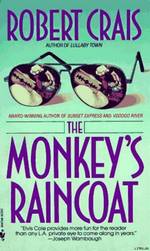
Reread Project: The Monkey’s Raincoat by Robert Crais

The Monkey's Raincoat (Elvis Cole, #1)The Monkey’s Raincoat

by Robert Crais
Series: Elvis Cole, #1

Mass Market Paperback, 201 pg.
Crimeline, 1992 (originally 1987)
Read: August 6, 2014


We start the Reread Project with The Monkey’s Raincoat, which should be read as the pilot for the Elvis Cole series. It establishes the characters, the world, the tone — the story is secondary to that. It’s also the foundation — everything after this will be building on this, and will be an improvement (if for no other reason than Crais gets better). It does all the establishment work pretty well — and some points of the non-establishment work is standard, some of it is quite well done. In the end, its a successful pilot, showing the promise to be delivered in ensuing novels.

“Peter Pan. You told Ellen you wanted to be Peter Pan.”
“Unh-hunh.”
“That’s crap. Stay a little boy forever.”
“It’s not age. Childhood, maybe. All the good things are in childhood. Innocence. Loyalty. Truth. You’re eighteen years old. You’re sitting in a rice paddy. Most guys give it up. I decided eighteen was too young to be old. I work at maintaining my self.”
“So at thirty-five, you’re still eighteen.”
“Fourteen. Fourteen’s my ideal age.”
The left corner of her mouth ticked.

Now, I contend that something happens in a few books to get Elvis to decide to grow up (I’m not convinced he realizes it though) — but for at least a handful/handful-and-a-half novels, this is a great summary of Elvis’ core.

A lot of people will compare Elvis Cole to Spenser and while it’s frequently over-stated, it is a legitimate comparison. And Raincoat Elvis compares pretty strongly with The Godwulf Manuscript Spenser, but Elvis is a lot closer to the character he’ll be from now on, than Godwulf Spenser is to the character he will be following it. Which says something about the thought that Crais put into Elvis before writing, and his experience working with character — Parker really ever had this until he had a few novels under his belt.

Before we get to the Peter Pan self-disclosure, we see that in action — in the decorations of his office, his dress style, the way he talks to prospective clients — all in the first few paragraphs. Which also contain a nice info dump disguised as dialogue, as way to introduce himself to the reader as well as the client who asked him about his qualifications. It gets the job done and it doesn’t feel all clunky and Dan Brown-like. Crais doesn’t do anything ground-breaking here, but so often (especially in first books of a series) this is done in a clumsy way, so it’s nice to see it done smoothly.

There’s a lot to Elvis Cole here that seems straight from the hard-boiled detective starter-kit: he’s got the relationship with a police detective that’s based on mutual respect, but the police detective can’t color outside the lines like Elvis can. He’s got the friend who’s a newspaper reporter — far too busy to have a real conversation with him, but will give him just the right quick answers (while being a real smart aleck) to move the investigation along (in return for tickets to a sporting event). He’s got quite the way with the ladies. He’s a lone wolf type, will drink a lot, he’ll constantly have a wise-crack at the ready, he had a few odd jobs related to law enforcement prior to this, but he can’t work within the system — and so on. It’s what Crais does with these elements — and the rest of Elvis’ characteristics that elevate the character.

So much of the what will separate Elvis from Spenser/Patrick Kenzie/Lincoln Perry/Cormoran Strike/etc. are the quirks and the little details: The nameless, beer drinking cat; the morning yoga; his Elmore Leonard fixation; his Hawaiian shirts and Disney stuff. I liked the fact that Elvis keeps a roll of nickels in his car to use in case of a fist fight. Even more, I like that he had to dig around under the seat to find the roll (and if the interior matches the exterior, it’s not easy to find anything under the seat).

Now, you can’t talk about Elvis Cole without talking about Joe Pike — his business partner with the empty office. Yes, in many ways Joe’s the Hawk to Elvis’ Spenser. But he’s more. By the time we meet him, Elvis has had a couple of very brief phone chats with him, but even the terseness of those won’t prepare us for actually meeting him. Our first introduction to Pike is striking:

The next morning I woke with brilliant white sunlight in my face, smelling coffee. The sliding glass doors were open and Joe Pike was out on the deck. He was wearing faded jeans and a great sweat shirt with the sleeves cut off and blue Nikes and government issue pilot’s sunglasses. He rare takes the glasses off. He never smiles. He never laughs. I’d known Joe Pike since 1973 and he has never violated those statements. He’s six feet one with short brown hair and muscled the way a fast cornerback is muscled, weighing in somewhere between one eighty-five and one-ninety. He had a red arrow tattooed on the outside of each shoulder when he was in The Nam. They pointed forward.

The description today would be a little different. A little. But on the whole, Joe’s consistent, he’s grown a little bit as a character (because of Elvis, he’d assure us), but even with growth, the Joe you get in Monkey’s is the Joe you get in Taken.

Every time Joe’s name is mentioned around someone from LAPD, it’s answered with scorn (at best). Elvis will shed a little light on this eventually when Ellen asks (again, info dump — however small — and dialogue that doesn’t feel forced). But on the whole, all Crais is doing is a bunch of seeds that he’ll harvest later in a way that probably no one reading this can guess. Since this is Elvis’ narration, and Elvis is his friend, we trust that the LAPD is out to lunch on this, and this is reinforced by the clueless way they handle the disappearance of Perry Lang. Time will tell if our trust in Elvis is well-placed.

There’s a clear affection between Elvis and Joe. They trust each other, they tease each other — they depend on each other (without ever coming out and saying it). They’ve known each other more than 15 years at this point, as partners for most of that, and a lot doesn’t need to be communicated anymore

The thing that truly separates Pike from your typical mercenary/bonebreaker-as-sidekick is the way he deals with Ellen Lang. He tells her things about his past, he helps her learn to shoot, he goes out of his way to empower her — and through that, comfort her. Elvis will give her pep talks, he’ll encourage her — even force her to see reality. But Joe (unintentionally) inspires her, and then will (intentionally) show her the inner strength, the character she has and needs to meet the future. Hawk would never do that.

I’m sure I should say something about the story, too. So, Ellen Lang comes (with a lot of prompting from her friend Janet Simon) to Elvis needing help finding her estranged husband, who seems to have taken off with their son (but not their daughters). Elvis isn’t crazy about the idea, but he has rent to pay — so he takes the case and starts poking around looking for the missing talent agent. He finds Mort’s girlfriend, but that doesn’t help but it sheds some interesting light on Mort’s lifestyle. Before long, there’s a body, a couple of kidnappings, a lot of missing cocaine, and a crime boss’ Eskimo enforcer roughly the size of a small bull.

As Elvis goes through the investigation, it’s good, solid stuff carried along by his narration. But there’s nothing other than his narration and the character work he’s started to make it distinctive over any other of a dozen PI’s. But then you get to the conclusion — a big, guns-blazing, bullets-flying, implausible-but-not-really, story climax — and you really start to see the potential for this Crais guy and his pair of Vietnam Vets.

I’m not sure I’d give this 4-stars if I this was my first read of the series, or even of this book (rather than the 6th or 7th). But it’s not, I know what seeds Crais planted (whether he intended to or not), I know where’s he’s going with this and how well this sets up the books to follow. As such, it deserves no less than 4-stars.

—–

4 Stars

—–

Drawing by Kirsty Stewart, chameleonkirsty on deviantART, used with permission.

Half-Off Ragnarok by Seanan McGuire

Half-Off Ragnarok (InCryptid, #3)Half-Off Ragnarok

by Seanan McGuire
Series: InCryptid, #3


Mass-Market Paperback, 356 pg.
DAW, 2014
Read: March 21 – 22, 2014

I — like a number of people, I expect — approached this one with a sense of trepidation and a laundry list of questions: No Verity? We’ve got to start over with some other guy? Why? What did we do wrong? Why is Seanan punishing us like this? How are we supposed to get along without the Aeslin mice? (good news and minor spoiler: Alex has his own colony of them — Seanan doesn’t hate us). After about 50-60 pages, I’d admitted that McGuire knew what she was doing (how could I doubt that?) and that Half-Off Ragnarok served as a good jumping-on point for the series, or good next entry for those who’d been following it already. Alex has a similar voice to Verity, but it is different — close enough that they could be siblings, though.

The story, particularly its central mystery, was just okay. But the setting and the characters elevated the whole thing. They sold me on what was going on, and once the narrative got flowing, I didn’t notice how not-stellar the story was (I’m not saying it was bad, it just didn’t knock me out). Having a cryptozoologist working in a zoo — and doing field research nearby, gave this a different feel from Verity’s nightclubs and sewers — like maybe there was something less haphazard about it this endeavor.

But more than anything else, the characters are what sell this story. There’s Alex’s Gorgon assistant, Dee; a little girl I won’t describe for your sakes here (you want to discover her eccentricity on your own); there’s Alex’s grandparents; his pet griffin, Crow; the aforementioned Aeslin mice; and the knock-out blonde Australian who works at the same zoo that he does. Best of all, his and Verity’s cousin, Sarah. She’s staying at their grandparent’s home for awhile to recover from what happened to her at the end of Midnight Blue-Light Special — well, hopefully recover, anyway. Sarah’s presence helps link the installments of the series together, helps us trust Alex more right away for the way her treats her.

A couple of notes about this world McGuire’s building here. Without getting into details, it was very nice to see that there are options other than the Prices and the Covenant for humans who are aware of the cryptozoological populations, it makes it all a little less David and Goliath. The other thing that’s highlighted here is just how different groups/species view the Prices. Which isn’t exactly all positive — there’s suspicion, distrust, antagonism, begrudging respect — along with more positive views. I got that impression during the Verity books, but it’s underlined here. This is a fun world, and it’s nice to see it fleshed out.

I like Alex, and would gladly read more of his adventures–at home or abroad. I would also like to check in on Verity again — and soon — as she was our entry point into this world, but it’s possible I like Alex more at the end of the day. Unlike Verity, he’s all in when it comes to this work, and doesn’t spend so much time wanting to do something else. Although, Verity’s conflict between her duty/interest in cryptozoology and love for dance is one of the things that makes her interesting. Never mind, my guess is that my favorite Price sibling is whichever one I’m reading/just finished reading. Just give me more of both of them.

—–

4 Stars

He Drank, and Saw the Spider by Alex Bledsoe

He Drank, and Saw the Spider (Eddie LaCrosse, #5)He Drank, and Saw the Spider

by Alex Bledsoe

Hardcover, 320 pg.
Tor Books, 2014
Read: August 6, 2014

After a couple of adventures which aren’t quite typical in their nature, Eddie La Crosse gets back to basics with a fairly straightforward case. Well, that’s not exactly true — it ‘s just that the last two were more outlandish, more grand-adventure-y, less LaCrosse-as-sword-jokey. This is Eddie doing what he does best. Yes, there’s magic, and monsters, and all the other trappings that keep this from being something that Sue Grafton or Dennis Lehane would’ve written.

Sixteen years ago, Eddie promised a dying man on the run that he’d take care of the baby that the other man was running to protect. He found a seemingly-trustworthy family willing to take the infant in, and went on his merry way, and actually forgot all about the incidents surrounding that. Until years later, when Eddie and his girlfriend, Liz, are on vacation in that area, when suddenly it all comes back to him and he decides to try and track down the (now) young woman and see how she’s doing.

Naturally, things start to go poorly about there. He does find her — pretty easily, too — it is a small community, with an economy largely-based on sheep-herding and farming, so it’s not really a bustling metropolis where no one knows anyone else. But there’s a whole lot of interesting things happening around the young woman — royalty in disguise, a meddling sorceress, an untrustworthy mercenary-type, an over-protective mother, a dose of sibling rivalry, and some sort of articulate and super-strong inhuman creature with a healthy interest in the girl.

Even though he was just supposed to check on her and not interfere with her life — he had no intention of even introducing himself to her. Eddie can’t help himself, and before you know it, he’s neck-deep in intrigue, and danger.

On the whole, this is a fun, brisk novel — a lot of humor, some good action, nice banter and interaction between the characters (especially Eddie and Liz). A good change of pace over Dark Jenny and Wake of the Bloody Angel, which tended to be more on the serious, emotionally-charged side. Yet, even as the answers to the questions surrounding the girl’s mysterious origins become obvious, and some of the characters get to the point where they seemed a irredeemable, Bledsoe (as he can every so well) keeps you completely drawn in and even tugs the heart strings a bit as the truth is revealed to the characters. Just really, really well done.

There’s a lot of nice little touches along the way. For example, towards the end of the book, Eddie and those he’s traveling with encounter a preteen who joins their little band for a while. She’s pretty new to swearing and tries to get in as much practice as she can while with them. At first, I thought she was an odd (but entertaining) and pointless distraction. It didn’t take too long to see she was a perfect tension-breaker, just what that part of the novel needed to keep from being too tense and so much more serious than what had come before.

Eddie’s narration has never been better — humor-tinged and hard-boiled, a medieval Philip Marlowe or Elvis Cole. I liked all of these characters, and really wanted to spend more time with each of them — I don’t know how Bledsoe could’ve pulled that off without getting the whole thing to slow and ponderous (which would’ve sucked the fun out of 60-70% of these characters). This is really such a well-done and fully realized series. I can’t wait to see what happens next.

—–

4 Stars

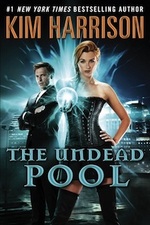
The Undead Pool by Kim Harrison

The Undead Pool (The Hollows #12)The Undead Pool

by Kim Harrison

Series: The Hollows, #12
Mass Market Paperback, 480 pg.
Harper Voyager, 2014
Read: July 30 – 31, 2014

Whaddyaknow? I can like a Hollows book unreservedly and without a list of complaints. I’d forgotten what that felt like.

If you’d told me that Rachel Morgan’s penultimate adventure would kick off on a golf course, I’d have told you that you were nuts. But if anyone can start trouble on a golf course, it’d be Rachel. In an interesting change of pace, the trouble that ensues really has almost nothing to do with her — sure, an exploding golf ball that practically creates a sand hazard on the course sounds like something she’s responsible — but not this time. Spells and charms are going wrong (mostly in a super-sized fashion) throughout Cincinnati and the Hollows — causing injuries, inconveniences and deaths.

But wait, there’s more — something’s going on in town that’s keeping the Master Vampires asleep, and they’re not waking to feed and exert influence over their clans. Which is great if that’s something you were working towards, and were prepared — like Ivy was awhile back. But these vampires aren’t ready for that level of freedom and self-determination yet. Which means that you’ve got unstable vampires roaming the streets. Which can’t be good for anyone.

This would be enough to keep any Urban Fantasy hero busy — but females in this genre have to have something going on in their personal/romantic life, too (male UF heroes frequently have that it, too — but it doesn’t see as de reguerre). So looking to that front, Ellasbeth, Trent’s fiancé returns; so naturally, Trent and Rachel go on a date the night before she arrives (their first and last). Everyone’s favorite demons, Al and Newt, are not at all happy about how close Rachel is getting to the elf. A couple of elven religious leaders come to town to help with the malfunctioning magic — and they like Trent hanging out with the day-walking demon even less than Al and Newt do. And there’s this really familiar-looking blond vampire that Rachel keeps seeing — but that can’t be right, can it?.

Yeah, that’s enough to keep Rachel, Ivy and Jenks busy.

Here’s the best part: It’s like Harrison asked herself, “How do I make ol’ H. C. happy?” and then things actually happen in the book. Resolution is reached on a lot of these plots that have been ongoing for several novels (even all, or almost all, of the series). Even things I’d forgotten about get tied up. I’m not saying I’m happy because I like all the choices that the characters/Harrison made, because I’m not. But instead of another 400+ pages of Rachel (or Trent or Ivy or . . .) hemming and hawing and then not really reaching a decision on anything, these characters think about their problems, discuss solutions in a constructive manner with each other, and then act on it. They don’t all lead to a happily ever after — but they lead to something. Finally.

Harrison’s clearly setting the table for the last book in the series and tying up what she can — as well as delivering a pretty cool story. Don’t get me wrong, I don’t want to just focus on the soap-y ongoing story arcs. The stuff with the vampires and the out of control magic was great, and would’ve been enough to make this a compelling read. But the ongoing arcs have been such a drag on this series for so long, the fact that they weren’t at all this time is leading me to focus on them.

I really don’t know how to comment on the master vampire problem or the magic problem without getting into story details — but the implications of both were fascinating, and are the kind of thing that separates the Hollows from most Urban Fantasy. I’m so glad we got these situations.

For the first time in a long time, I can say I’m looking forward to seeing what Harrison does next. I have a lot more hope for her sticking the landing than I’ve had (even as I dread the fates of a couple of characters).

—–

4 Stars

The Competition by Marcia Clark

The Competition (Rachel Knight, #4)The Competition

by Marcia Clark

Hardcover, 416 pg.
Mulholland Books, 2014
Read: July 28, 2014

So, Rachel Knight and her pal Det. Bailey Keller are called to the scene of a deadly shooting at a high school. Very deadly — it soon becomes clear that there will be a higher death count here than any other school shooting, which is exactly what the gunmen were going for. Students of mass shootings throughout our nation’s recent past, these criminals have set out to out-perform those they see as their inferiors.

The Rachel Knight novels are typically legal tension, wrangling, and some suspense — but mostly it’s about how do we catch this guy up in a lie?, how do we prove what we know?, and so on. But from page 8 when the bullets start flying, The Competition is pure, old-fashioned thriller-style tension. How long will it take to find the guys?, what will happen before they do? Riots, panic, more shooting? Yes, there’s also plenty of twists and turns, and the requisite Rachel Knight et al. cuteness. But mostly, this one’s a race against time and danger.

Marcia Clark steps out into some risky territory here — one only has to look back to the season premier of Sons of Anarchy last year to see the very divided critical and fan reaction to the school shooting. She manages it very well, not pushing any of the several political or social debates that she could here. The focus is kept on the criminals, trying to figure out why they did what they did, how to stop their evil. I can’t help but think of the old Nero Wolfe line, “Nothing corrupts a man so deeply as writing a book; the myriad temptations are overwhelming.” It’d have been so easy for Clark to succumb to temptation and pontificate here, to push her particular viewpoint on gun-issues, but she doesn’t. Well done.

I did guess almost every plot twist she used (and one I was convinced she was going to pull, but didn’t — even after the moment passed, I was looking for it). But it didn’t matter, she played every note just the way she should’ve, and even if I saw a trick coming, it worked. Was an edge-of-your-seat page-turner through and through. Hope to see a little more of Rachel the lawyer rather than Rachel the investigator next time, but chalk this up as another win for Knight and Clark.

—–

4 Stars

The Sound and the Furry by Spencer Quinn

The Sound and the Furry (A Chet and Bernie Mystery #6)The Sound and the Furry

by Spencer Quinn
Series: Chet and Bernie, #6

Hardcover, 320 pg.
Atria Books, 2013
Read: July 23, 2014

I cannot think of another narrator in contemporary fiction as charming, as relateable, as endearing Chet — unreliable as all get out, but utterly trustworthy. I’m sure there are readers out there who are not susceptible to Chet’s canine charms, but I’m not one of them. I chuckle, I laugh, I am drawn in instantly — and as long as the stories are passable, that combination is a winner.

Thankfully, usually the stories are more than passable, which is just frosting on the cake. This time out, the Little Detective Agency finds itself on the road to New Orleans, of all places — a far cry from their normal stomping grounds. It’s good to see Quinn shake things up a little, he can’t be as dependent on things like Bernie chasing down a former C.I. or a familiar source of information. They also don’t know the lay of the land at all, and Bernie has to acclimate himself quickly.

Sure, some of Quinn’s tropes are here — Bernie not making sound financial choices, Chet causing a little trouble (tho mostly charming people), Chet getting separated for a time from Bernie (although this time it felt more organic than in any other of these books — I was a little bit into the separation before it dawned on me that, “yup, it’s about time for this”). But that doesn’t detract from the change in setting — or make it seem like less of a change. Instead, the presence of Quinn’s usual moves just underlines their universality.

It’s not uncommon for the sidekick of a detective to notice something missed by their associate — and it’s not uncommon for the sidekick to be unable to get the detective to see what they want them to/understand what they’re excited about, etc. And in almost any other detective novel where the detective is so clueless about so much of what the sidekick notices would be full of griping and complaining from the sidekick (justified griping, but griping, nonetheless). Not these books , however – except for his questionable financial decisions, Chet can’t even think of Bernie negatively, and he forgets anything that approaches negative almost instantly. This leaves the reader to chew on all the clues that Bernie’s missing while Chet’s focused on other things. I Love that. Typically, it’s the detective that has access to clues before the reader/independent of the reader (and that’s true here to an extent) but these books turn the tables on that, giving us readers the advantage.

Don’t know of its because Chet’s a dog, or if Quinn’s just that good at what he does (or some other thing), but when Chet’s in danger I get tenser than I do reading just about anything else — even if the danger’s not that great ultimately. But when Chet tussles with a certain critter in this book, I know my adrenaline levels jumped up and I read a lot faster just so I could get to the resolution of the fight.

My main (only?) problem with the book is its treatment of Suzie Sanchez. She seemed more like a refugee from Three’s Company than the reporter we’ve come to know and like. Quinn’s bounced between from treating her as a strong, capable character and this disappointment — she deserves better (as do Bernie & Chet, and the readers). If I’m drawing the right inferences from the cover image on the seventh Chet & Bernie book, it looks like he’ll give it a shot. If I’m wrong, Quinn should just write the character out of the series and start over with a new love interest.

We’ll never see it — I don’t imagine — but Chet kept hinting at this deeper, darker story, this side of Bernie we haven’t really seen (I think we’ve gotten glimpses before, but nothing like in this book). The kind of thing that belongs in a far more hard-boiled novel than this one. And unless we get someone else’s point of view, we’ll never see this side of Bernie in full because Chet can’t really admit it to be true. But we got a few hints this time — I sure wouldn’t want to be on the wrong side of Bernie.

Until then, we get these light, joy-filled mysteries equal parts puzzle and entertainment. Who’d ask for more?

—–

4 Stars

Dad is Fat by Jim Gaffigan

Dad Is Fat

by Jim Gaffigan

Published May 7th 2013 by Crown Archetype
Read: July 19 – 22, 2014

It’s been years — almost decades since I last read a book by a stand-up comedian. I used to love them — you get their act, usually expanded — if not, at least more of it then you got to see on TV in Idaho. If you were familiar enough with the comedian, it was almost automatic to hear their voice in your head as you read. Always liked them, just ran out of time/money.

But I’ve been feeling the pull towards Jim Gaffigan’s Dad is Fat for awhile now, so when Blogging for Books offered me a copy, I jumped on it. Which was a good move on my part — this is a funny book.

Not a a surprise, I realize. Still, it is good to see that he can transfer his humor to the page (you can never be sure). A good deal of the material — but not all — is adapted from his stand-up, and that’s funny enough. But the rest is just as good — if not better, because it’s fresher and in a different medium, so he can do other kinds of humor. I laughed out loud more than a few times, and had to resist reading the entire thing to whoever happened to be near-by.

But frequently, Gaffigan sets the jokes aside to talk about being a parent, the choices that women and men make to do that — how so many don’t understand why people do that. He defends the choices his family made to have kids, to have as many as they have, and to have home births. He doesn’t stop joking as he does this, but they do take a back seat to what he’s talking about though (while serving as the proverbial spoonful of sugar to help). These points are where the book is the strongest, he doesn’t attack those who disagree, rather he says this is what they’ve decided to do, let them follow their own convictions and stay out of their way. Which doesn’t seem so much to ask, but we all know better. He takes a simple, commonsense approach to this stuff — he doesn’t get too esoteric or philosophical, just a simple, pragmatic “this is what we did, and it works for us.” My esteem for he and his wife/writing partner increased after reading this book.

They’re short essays, and I wouldn’t recommended reading too many of them in one sitting — just a few at a time to keep it fresh and funny.

If anyone in the world actually remembered the book, I’d compare this to Paul Reiser’s Babyhood but from a different angle. It has a similar mix of humor and sentiment on the same topic. Dad is Fat has a lot of laughs, some warming of the heart, and so many lines that I want to quote, I’d cross into copyright infringement if I tried. Give it a whirl, even if you don’t have kids, you’ll probably enjoy this.


Note:I received this book for free from Blogging for Books for this review. Which was generous and cool of them, but didn’t impact what I said about the book.

—–

4 Stars

Page 74 of 88

Powered by WordPress & Theme by Anders Norén