Tag: Cory Doctorow

The Reverse Centaur’s Guide to Life After AI by Cory Doctorow: Prudent, Thoughtful, and Entertaining (naturally)

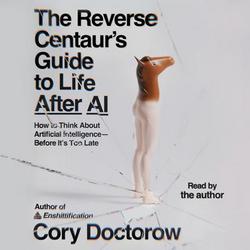
Cover of The Reverse Centaur's Guide to Life After AI by Cory DoctorowThe Reverse Centaur’s Guide to Life After AI: How to Think About Artificial Intelligence—Before It’s Too Late

by Cory Doctorow

DETAILS:
Publisher: Macmillan Audio
Publication Date: June 23, 2026
Format: Unabridged Audiobook
Length: 5 hrs, 28 min.
Read Date: June 25, 2026

Buy from Bookshop.org Support Indie Bookstores

A reverse centaur is a human who is conscripted into acting as an assistant to a machine. There’s a classic I Love Lucy episode where Lucy and Ethel are working on an assembly line at a chocolate factory, taking bonbons off the belt and wrapping them in paper. As the belt goes faster and faster, Lucy and Ethel have to work at superhuman speed. They’re reverse centaurs: the machine can move the chocolates from one place to another, but it needs a human to pack them into the box, and the humans who act as its assistant are made to work at a pace that exceeds all human capacity until calamity ensues.

What’s The Reverse Centaur’s Guide to Life After AI About?

If I try to summarize this, we’re going to be here for a while (or I’ll pitch it in a tweet-length paragraph that won’t do the job), so let me quote from the official blurb:

The Reverse Centaur’s Guide to Life After AI is not another anti-AI screed. Cory Doctorow uses AI in his work every day. As a creative person, he has no moral or dogmatic issue with AI—he thinks the technology is useful, even exciting, and full of potential. And yet.

AI has arrived surrounded by unprecedented hype driven by a tech industry desperate to maintain its unprecedented valuation based on its own promises of endless financial growth. Despite the fact that almost all of AI’s real-world implementations have proved underwhelming, AI is projected to be worth more than $16 trillion—a number that only makes sense if AI replaces vast swathes of the wage-earning human workforce. To justify that level of “value,” every story about AI must be presented as inevitable, world-changing disruption. Even the tales of the robot apocalypse are a calculated attempt to bolster the fearsome power of AI.

For Doctorow, it is imperative to see through that hype to the real story, to understand the technology not just for what it does, but for who it does it to and who it does it for. From that point of view, the story of AI is indeed dramatic and unprecedented, having generated an investment bubble so big that it endangers the entire world economy. In The Reverse Centaur’s Guide to Life After AI—as he so successfully did in Enshittification—Doctorow recounts both how we found ourselves in this dire situation and how we can get through it, to a life “after” AI in which the tools work for us, not the other way around.

There are three main themes to the book the philosophy of inevitablism that drives so much of the conversation around AI (particularly on the pro-AI side); the inevitable crash of the AI-bubble and what that will do to workers, industries, and the environment; and how to go on after the bubble pops—how we can use AI in a useful, constructive way to actually help people.

So, what did I think about The Reverse Centaur’s Guide to Life After AI?

…the future is up for grabs. It is not inevitable. Al isn’t a genie that can’t be put back into a bottle. How we use AI is up to us. Whether we use Al is up to us. The future can be ours, if we never stop remembering that the most important fact about a technology isn’t what it does, it’s who it does it for, and who it does it to.

I was much more anti-AI when I opened this book than I was at the end. I actually figured that Doctorow would give a pretty well-thought-out “another anti-AI screed” (I clearly didn’t read the description of the book). But Doctorow has made me reconsider some of my notions. I’m not sure he changed my mind—I’m still thinking.

I should rush to say that Doctorow doesn’t defend the notion of using so-called “generative AI” to create art, nor would I. But…transcribing audio files? Getting some facts for an article? If done in the right way, maybe.

But my post isn’t supposed to be about what I think—it’s about the reading experience. This is classic Doctorow—engaging, approachable, frequently amusing, thoughtful and thought-provoking. A good mixture of research and opinion.

The central image of the reverse centaur and the frequent call-backs to the idea that “the most important fact about a technology isn’t what it does, it’s who it does it for, and who it does it to” will stick with the reader, inform their ideas about AI, and so many other things.

The audiobook hold at my library came in a day before the hardcover—so I listened to it, and then re-read a couple of passages to make sure I heard what I thought I did to solidify my grasp on the notion. So, I think I can speak to both formats. It’s a short read (or listen), it’s an engaging read (or listen). Either way, as one would expect, with Doctorow sounding off on technology—you’re in for a treat.

This post contains an affiliate link. If you purchase from it, I will get a small commission at no additional cost to you. As always, the opinions expressed are my own.

Irresponsible Reader Pilcrow Icon

My Favorite Non-Fiction Books of 2025

Covers of Algospeak, Class Clown, Food for Thought, Enshittification, Everything Is Tuberculosis, Killer Conversations with Rex Stout and John McAleer, Pronoun Trouble, How to Stand Up to a Dictator, and Robert E. Lee and Me, next to an image of an anthropomorphized Pilcrow and the words 'My Favorites of 2025 Non-Fiction'
My 2025 Wrap-up continues and now we’re on to the Non-Fiction list. While I liked a number of works that didn’t make this list, I felt strange calling them a “favorite.” These are the ones that stuck with me through the year; the ones I cited in conversation; that I thought about when reading something else or watching something on TV. Yeah, there’s some overlap between this list and the audiobook list from yesterday—lately, most Non-Fiction books I work through are in audiobook format. So it makes sense, even if it makes this post seem like an echo.

As always, I only put books that I’ve read for the first time on this list. I don’t typically return to NF books (outside of looking up things for one or three points), but occasionally I do—for example, The Pleasures of Reading in an Age of Distraction by Alan Jacobs would get a permanent spot on this list, were it not for this rule.

(in alphabetical order by author)

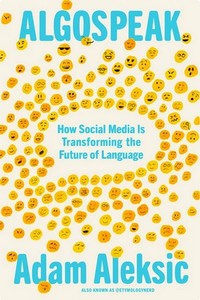
Cover of Algospeak by Adam AleksicAlgospeak:
How Social Media Is Transforming the Future of Language

by Adam Aleksic

My original post
Language in general—but English particularly—is a constantly-changing thing, and these changes are happening faster and faster all the time. Algospeak is a great look at the hows and whys of a lot of the current evolutionary processes. It is about more than language—it’s also about how the Internet changes the way we think and express ourselves in general. And therefore, how society changes (which leads to Internet changes, and other circle-of-life things).

Aleksic has obvious expertise and passion for the subject (look at just one of his videos). He’s also active in these areas. It’s a great read, informative and entertaining. Hard to ask for more.


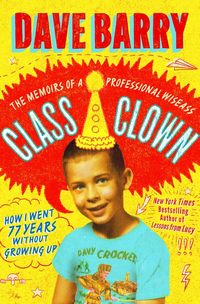
Cover of Class Clown by Dave BarryClass Clown: The Memoirs of a Professional Wiseass—How I Went 77 Years Without Growing Up

by Dave Barry

My original post
It comes as no surprise to any that I loved a Dave Barry book. It takes something pretty lackluster by him to get that reaction (and he doesn’t do that often–but I can prove it if you want). But this is something else–it’s insightful, it’s touching, it’s (seemingly) honest, and human. It’s a look at his childhood, his professional humorist origin story, and then scattered accounts of some of the very strange things that his profession has let him do.

I don’t say this about many authors–but I really don’t know that I’ve wondered anything about Barry’s personal life. But now that I know? I am more than happy to get some understanding about it. Does it necessarily help me understand his work better? No (but we’ll see the next time I take up his work, I guess). But it makes me like Barry the person a bit more.


Cover of Food for Thought by Alton BrownFood for Thought: Essays and Ruminations

by Alton Brown

Like any good fan of a TV show/personality, I like to know how they got started, how the show was developed, etc. Brown talks about how he got into food education media–and it’s not really how you’d expect. How he moved on from Good Eats to other things. There’s some great stuff about his education. But perhaps the most rewarding portion of the book is his musing and observations on the place of food/eating to human society (writ large or on an individual level).

Really, there’s so little to not appreciate from this book. Alton Brown has spent decades thinking and writing about food. This is the result of all that.


Cover of Enshittification by Cory DoctorowEnshittification: Why Everything Suddenly Got Worse and What to Do About It

by Cory Doctorow

I don’t know how to talk about Doctorow’s screed against Big Tech, the policies that led to these platforms that have taken over the internet and made it less-good than it used to be. Even that sentence is not a great way to talk about the book. The book wowed me. I wouldn’t say it radicalized me on some of this, but I sort of wish it did. The Ressa book below really struck me as a giant proof for Doctorow’s case (good idea to read the two of them around the same time). It’s a great–and terrifying–read.


Cover of Everything Is Tuberculosis by John GreenEverything Is Tuberculosis: The History and Persistence of Our Deadliest Infection

by John Green

I never imagined I would appreciate a book about an infectious disease. And despite all the good things I heard about this book, I didn’t rush to pick it up. But I’m so glad I did.

First of all, you could probably pick any number of things to use in place of Tuberculosis to trace human history, seemingly at major turning points and shaping societal developments. Say…bread, or writing, or…I dunno this is a sentence I regret starting. But from a certain point of view–you can buy the theory posited at the beginning of this book, that Tuberculosis shaped human history.

Green talks about the treatments that have been tried (and failed), the way it impacted population sizes, the devastation it’s left in it’s wake, and how things are going in the battle against the disease now. Interwoven with these is the story of one particular patient in Sierra Leone that Green met years ago. We follow his personal struggle–ups, downs, way downs, and more.

Green can relate these facts–even the bleak ones–in an engaging way that will stick with the reader. But then he drives it home and makes it gets you emotionally involved through the patient’s story.

You just can’t help but being taken in by the book and it’ll leave a lasting impression.


Cover of Killer Conversations with Rex Stout and John McAleerKiller Conversations with Rex Stout and John McAleer

My original post
Granted, there is a very limited audience for this kind of thing. But for that audience (and I’m part of it), this is catnip.

These snippets of conversations between Rex Stout and his biographer and friend are just wonderful. Quick back and forths on any number of topics–life, death, love, reputation, writing, Stout’s characters, his career, and more–it’s fun to read. It’s fun to think about. You’ll wish you were half as clever as Stout.


Cover of Pronoun Trouble by John McWhorterPronoun Trouble: The Story of Us in Seven Little Words

by John McWhorter

So, sure–this looks like it’s nothing but a screed on one side or the other about the problem we’re having with third-person pronouns the a socio-political front in English. And, yes, it is about that, (but only from a linguistic point of view), but there’s more to it. There’s also that pesky second-person plural.

Like in his book, Nine Nasty Words, McWhorter gives a quick look at the history of English pronouns one at a time–looking at various forms, usages, spellings, and assorted trivia. When appropriate, the then talks about some of the contemporary challenges and controversies with them.

Completely entertaining–McWhorter’s a great narrator–and very educating. I heartily commend this to you (no matter what you think of using “they” for the third-person singular).


Cover of How to Stand Up to a Dictator by Maria RessaHow to Stand Up to a Dictator: The Fight for Our Future

by Maria Ressa, read by Maria Ressa & Rebecca Mozo

Maria Ressa’s story is fascinating. It’s just that simple. I mean, you rarely find a Nobel Peace Prize recipient without an interesting backstory of some sort.

Like I said above, when you add this to Doctorow’s book and you see how everything he said is entirely possible and how it can work against someone.

There’s, of course, more than just Ressa’s story and struggles reflected here. There’s a call to action, a call to do the necessary work, and a call to hope, when it comes to oppressive governments or platforms.


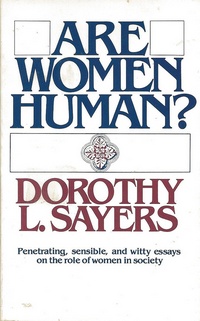
Cover of Are Women Human by Dorothy L. SayersAre Women Human?

by Dorothy L. Sayers

These are two essays by Sayers on the subject of women in society–with a particular look at academia. They are pointed, clear, and witty.

I’m not sure what else to say, really.


Cover of Robert E. Lee and Me by Ty SeiduleRobert E. Lee and Me:
A Southerner’s Reckoning with the Myth of the Lost Cause

by Ty Seidule

My original post

This is a powerful read. This very-Southern, Lost Cause adherent, West Point history professor starts looking at what he’d been raised believing, and the systemic racism of the culture he’d been raised in. The book then recounts example after example after example of the racism everywhere and the excuses made for covering up the treason of the Confederacy everywhere, including the U.S. Army–the army he left and fought against.

I thought Seifert made a compelling case in an engaging read that will stick with you for a long time.


Powered by WordPress & Theme by Anders Norén