

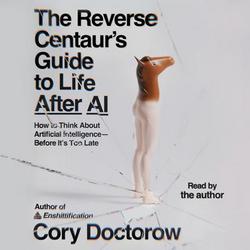
 The Reverse Centaur’s Guide to Life After AI: How to Think About Artificial Intelligence—Before It’s Too Late
DETAILS:
Publisher: Macmillan Audio
Publication Date: June 23, 2026
Format: Unabridged Audiobook
Length: 5 hrs, 28 min.
Read Date: June 25, 2026


A reverse centaur is a human who is conscripted into acting as an assistant to a machine. There’s a classic I Love Lucy episode where Lucy and Ethel are working on an assembly line at a chocolate factory, taking bonbons off the belt and wrapping them in paper. As the belt goes faster and faster, Lucy and Ethel have to work at superhuman speed. They’re reverse centaurs: the machine can move the chocolates from one place to another, but it needs a human to pack them into the box, and the humans who act as its assistant are made to work at a pace that exceeds all human capacity until calamity ensues.
What’s The Reverse Centaur’s Guide to Life After AI About?
If I try to summarize this, we’re going to be here for a while (or I’ll pitch it in a tweet-length paragraph that won’t do the job), so let me quote from the official blurb:
The Reverse Centaur’s Guide to Life After AI is not another anti-AI screed. Cory Doctorow uses AI in his work every day. As a creative person, he has no moral or dogmatic issue with AI—he thinks the technology is useful, even exciting, and full of potential. And yet.
AI has arrived surrounded by unprecedented hype driven by a tech industry desperate to maintain its unprecedented valuation based on its own promises of endless financial growth. Despite the fact that almost all of AI’s real-world implementations have proved underwhelming, AI is projected to be worth more than $16 trillion—a number that only makes sense if AI replaces vast swathes of the wage-earning human workforce. To justify that level of “value,” every story about AI must be presented as inevitable, world-changing disruption. Even the tales of the robot apocalypse are a calculated attempt to bolster the fearsome power of AI.
For Doctorow, it is imperative to see through that hype to the real story, to understand the technology not just for what it does, but for who it does it to and who it does it for. From that point of view, the story of AI is indeed dramatic and unprecedented, having generated an investment bubble so big that it endangers the entire world economy. In The Reverse Centaur’s Guide to Life After AI—as he so successfully did in Enshittification—Doctorow recounts both how we found ourselves in this dire situation and how we can get through it, to a life “after” AI in which the tools work for us, not the other way around.
There are three main themes to the book the philosophy of inevitablism that drives so much of the conversation around AI (particularly on the pro-AI side); the inevitable crash of the AI-bubble and what that will do to workers, industries, and the environment; and how to go on after the bubble pops—how we can use AI in a useful, constructive way to actually help people.
So, what did I think about The Reverse Centaur’s Guide to Life After AI?
…the future is up for grabs. It is not inevitable. Al isn’t a genie that can’t be put back into a bottle. How we use AI is up to us. Whether we use Al is up to us. The future can be ours, if we never stop remembering that the most important fact about a technology isn’t what it does, it’s who it does it for, and who it does it to.
I was much more anti-AI when I opened this book than I was at the end. I actually figured that Doctorow would give a pretty well-thought-out “another anti-AI screed” (I clearly didn’t read the description of the book). But Doctorow has made me reconsider some of my notions. I’m not sure he changed my mind—I’m still thinking.
I should rush to say that Doctorow doesn’t defend the notion of using so-called “generative AI” to create art, nor would I. But…transcribing audio files? Getting some facts for an article? If done in the right way, maybe.
But my post isn’t supposed to be about what I think—it’s about the reading experience. This is classic Doctorow—engaging, approachable, frequently amusing, thoughtful and thought-provoking. A good mixture of research and opinion.
The central image of the reverse centaur and the frequent call-backs to the idea that “the most important fact about a technology isn’t what it does, it’s who it does it for, and who it does it to” will stick with the reader, inform their ideas about AI, and so many other things.
The audiobook hold at my library came in a day before the hardcover—so I listened to it, and then re-read a couple of passages to make sure I heard what I thought I did to solidify my grasp on the notion. So, I think I can speak to both formats. It’s a short read (or listen), it’s an engaging read (or listen). Either way, as one would expect, with Doctorow sounding off on technology—you’re in for a treat.
This post contains an affiliate link. If you purchase from it, I will get a small commission at no additional cost to you. As always, the opinions expressed are my own.

Read Irresponsibly, but please Comment Responsibly