Tag: Fantasy Page 28 of 54

Reposting Just ‘Cuz: Breaking the Lore by Andy Redsmith: A Funny, Fresh Take on a Police-filled Portal Fantasy

I’d planned on reposting this today to go along with my post about the sequel, Know Your Rites—it’s been so long since I posted this, I wanted to put it back out there. But now, I’m going to just repost this today and try to find the energy to follow up tomorrow. These are good books, you should check them out.
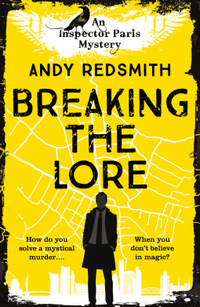

Breaking the LoreBreaking the Lore

by Andy Redsmith
Series: Inspector Paris Mystery, #1

eARC, 321 pg.
Canelo, 2019

Read: April 3 – 5, 2019

Inspector Nick Paris is your all too typical cynical, bitter, hard-drinking, chain-smoking police detective, and his world is being rocked. The latest corpse he’s been brought out to see and investigate the circumstances around the death is that of a fairy. The tiny, impossibly good looking, humanoid with wings kind of fairy. While still trying to wrap his mind around how that was possible, a crow (named Malbus) flies into his house demanding, demanding a smoke and talking to him about the murdered fairy. Not long after this, he’s visited by an elf and a rock troll (Tergil and Rocky).

And that’s just Day One of his new reality.

Essentially, there’s a connection between our world and the world of all these magical beings—a portal of sorts that those who desire to can travel between the two (or people and animals can stumble through unintentionally). For all sorts of great reasons, the magical creatures/folk kept their existence from humanity—and let what humans know fade into myth and legend. But something’s happened in their world, and those who are over here have to come seeking help (in terms of political asylum) and possibly even letting humanity in on what’s going on around them.

This is a little beyond Paris’ typical caseload, but he and his Superintendent, a no-nonsense woman named Thorpe, respond very well to these new challenges—dragging other officers and even the army along with them. They are obviously relying on the advice and guidance of the magical creatures—Tergil in particular (although Malbus makes sure his input is heard, too). They also recruit a local supernatural expert—Cassandra, a self-styled witch that no one in the police would’ve given any credence to if not for this new reality.

As fun as Paris, Tergil and Malbus are, Cassandra is a delight. She’s wise, insightful, and has a fantastic sense of humor—she might be harder for Paris to cope with than fairies, dwarves, and trolls. I shouldn’t forget Paris’ Sergeant Bonetti—he’s loyal, strong, brave, and probably not as mentally quick as he should be. He’s also the target of near-constant mockery from his superior. I’m not sure why he puts up with the abuse, but I found myself laughing at it. When the fate of multiple worlds is on the line, it’s these few who will stand strong in Manchester, England to keep everyone safe.

I can think of as many reasons that this is a lousy comparison to make as I can to make it—but throughout Breaking the Lore I kept thinking about Chrys Cymri’s Penny White books. There’ll be a big overlap in the Venn diagram of Fans of Penny White and Fans of Inspector Paris. I’m sure there are other comparisons that are as apt, or more so—but this is the one that I kept coming back to for some reason.

I had so much fun reading this book, Redsmith has a way with words that makes me think it really doesn’t matter what story he decided to tell—I’d want to read it. He was able to express the seriousness of the situation, while never stopping (either narratively or through the characters) the quips, jokes, and sense of fun. There’s an infectious charm to the prose and characters that easily overcomes whatever drawbacks the novel has. I’m not saying this is a novel filled with problems, it’s just that I wouldn’t care about most of them thanks to the voice.

Now, Redsmith’s wit does have an Achilles’ heel—puns. Redsmith is an inveterate punster, and will hit you with them when you least expect it. Now me? I love a good pun—and I hate them at the same time. Maybe you know what I mean. I cackled at pretty much all of them (frequently audibly), but I hated both myself and Redsmith for it. You know those Pearls Before Swine strips where Rat beats up Stephan Pastis because of the very carefully constructed pun? Yeah, this book is a series of those moments (but he rarely gives the setup Pastis does, usually it’s a quick sucker punch).

There are many other points I’d intended to make, but I think I’ve gone on long enough. This novel is silly, goofy, intelligent, charming—with a fresh take on a great idea. You’ll find yourself enjoying Paris, Cassandra, Malbus, Tergil, and the rest. I can see a few different ways that Redsmith takes Book Two, and I’m looking forward to seeing which one he picks (probably none of my ideas). But before that happens, I’m just going to relish the fun that Breaking the Lore was and encourage you all to go buy and read it for yourself.

Disclaimer: I received this eARC from Canelo via NetGalley in exchange for this post — thanks to both for this.

—–

4 Stars

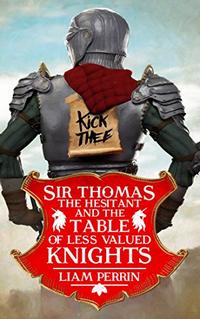
Sir Thomas the Hesitant and the Table of Less Valued Knights by Liam Perrin: Heroism Comes from the Unlikeliest Places

Sir Thomas the Hesitant and the Table of Less Valued Knights

Sir Thomas the Hesitant
and the Table of
Less Valued Knights

by Liam Perrin
Series: Less Valued Knights, #1

Kindle Edition, 272 pg.
2018

Read: July 6, 2021

…there were other tables, some almost as lofty, some not so much. Among those in the not-so-lofty category, the Table of Less Valued Knights was far and away the unloftiest. The Knights of Less Valued Table were the workhorses of the court, performing the inglorious duties that are nevertheless essential to a realm’s operation and taking care of any requests that the other orders found… uninteresting.

What’s Sir Thomas the Hesitant and the Table of Less Valued Knights About?

Thomas is the second son of a soldier turned farmer, his older brother—the favored and talented son—has recently been imprisoned for daring to ask the local Baron for aid for the struggling local populace, suffering under famine.

Thomas goes to Camelot to become a Knight—with the goal of using this position to help the people of his valley and hopefully get enough glory to impress his parents.

He is made a knight (to his surprise) and is assigned to the Table of the Less Valued Knights—those knights who keep the nation running by performing the needed, but unglamorous tasks, freeing up others to tackle the bigger, flashier tasks. It’s a noble calling, a better life than Thomas had before—now the question is, can he still use this role to help his family and their neighbors?

It’s the Characters and Relationships

The story is simple and straightforward, and charming enough. But what elevates this novel are the characters around Thomas and his relationships with them.

He meets and befriends an evil wizard who is working to put that life behind and simply be a healer. There’s a giantess with esteem issues, which lead to her changing size. Thomas’s little sister will steal your heart. And when it comes to best friends/sidekick characters, you won’t find many as fun as his fellow Less Valued Knight, Philip the Exceptionally Unlucky.

There’s a cute romance between Sir Thomas and one of Guinivere’s Ladies-in-Waiting, Marie. Marie’s an intelligent woman who’s constantly prodding Thomas to understand what’s going on around him and how he ought to respond. It’s not that Thomas isn’t that intelligent, he’s just naive and needs someone with a bit more experience to point things out and remind Thomas what he cares about.

And Thomas’ magic sword? You have to see it in action to believe it.

As far as the standard Camelot characters go, this Arthur is heroic and wise (an increasingly uncommon take on the King), Gawain might not be as heroic as you’d want, but he’s a lot of fun. Kay and Bedivere make up for Gawain on the heroism front.

So, what did I think about Sir Thomas the Hesitant and the Table of Less Valued Knights?

You want a hard slog like that to end with the bad guy losing. Through some last minute opportunity, or some deep fault of the villain, or even just sheer stubborn grit on the part of the hero, you want the good guy to stand alone in the end, battered but victorious.

[This fight] didn’t end like that.

It’s not every day I get to use words like “wholesome” around here, but it fits. Why does that strike me as a bad thing? It shouldn’t be, it just conjures up images of someone trying to be squeaky-clean enough for 1980’s Saturday Morning TV, and while this book would be, it doesn’t feel like Perrin forced anything into that mold. It just is that way. Nor does it feel like he’s constrained by this kind of writing, it just feels appropriate to the type of story he told.

The subtitle to Perrin’s website is “Agreeable Stories for Kind-Hearted People Who Take an Interest in Words.” This is a pretty good description of the book. Agreeable—full of kind-hearted people (and some who aren’t so kind-hearted, but they get theirs).

This isn’t written for an MG crowd, but it’s an increasingly rare “adult” novel that I wouldn’t blink at letting a middle-grader read. It’s the anti-grimdark.

What this is is a lighthearted, optimistic tale told with a wink and a smile. There’s peril, there’s bravery of the uncommon and very real sort, there’s hope, there’s struggle, and there are clear lines between good and evil. It’s also pretty entertaining, too. Perrin has a crisp and appealing style that ensures the reading experience will be pleasant.

I liked this, I wish I could read more things like this (aside from the sequel, which I’ll be getting soon). It’s a thoroughly pleasant way to spend a few hours. You should give it a chance.


3 Stars

20 Books of Summer '21

I Have Mostly Good Things to Say about The Mostly Invisible Boy by A.J. Vanderhorst

For the first part of this Tour Stop, we looked at the novel, The Mostly Invisible Boy from a distance, now it’s time to dive in.
The Mostly Invisible Boy Tour Banner

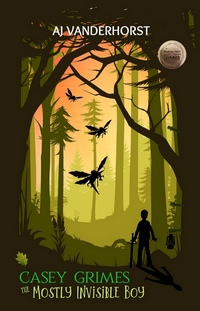
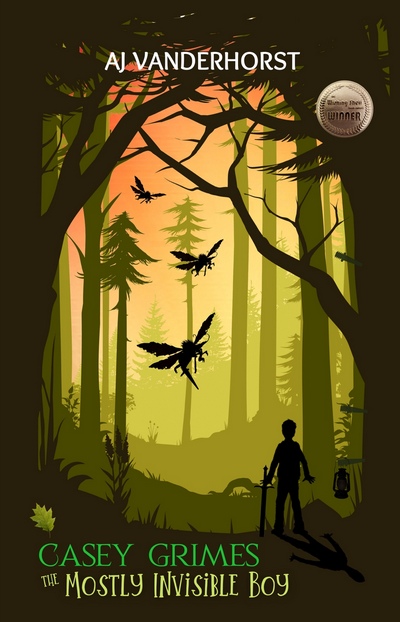
The Mostly Invisible Boy

The Mostly Invisible Boy

by A.J. Vanderhorst
Series: Casey Grimes, #1

Kindle Edition, 298 pg.
Lion & Co, 2021

Read: June 14-16, 2021
Grab a copy from your local indie bookstore!


This is one of those posts, I’m afraid, that I end up sounding less positive about than I am. So let me start off with this: I liked The Mostly Invisible Boy, I think your average Middle Grade Fantasy reader will, too. Sure, I have some issues with it, but that just means its in the same company as works by Brandon Mull, Christopher Healy, and Rick Riordan.

What’s The Mostly Invisible Boy About?

What if you find yourself in a magic kingdom only to find out that no one there believes in magic? That’s just what happens to Casey Grimes.

But I’m getting ahead of myself. Casey Grimes is an eleven-year-old who transferred into a new Middle School at the beginning of the year. As far as Casey can tell, no one at the school is aware that he exists—no one seems to see him for more than a few seconds at a time, and even people he’s spent a lot of time with don’t remember him for longer than a few seconds. To say this is getting to him would be an understatement.

When he gets home from the last day of school he learns that his parents are leaving for a surprise vacation, leaving Casey and his sister, Gloria, with a babysitter for a week. This is just not what he needs after the worst last day of school he can imagine, so he heads out to the woods behind his house to blow off some steam by climbing trees. He comes across an impossibly large oak tree he’d never noticed before.

Driven by its uniqueness, novelty, and a desire for something that he probably can’t name, Casey climbs the tree and makes several discoveries that change his life. Casey and Gloria will be brought into a new, heightened reality, a world of magic, monsters, honor, adventure, and danger. A world where he is seen, he is noticed—and he finds purpose.

Now, he just has to make sure the two of them survive it.

The Worldbuilding

The Sylvan Woods is a world hidden from regular mortals (they’re dubbed “Civilians”—not as fun to say as “Muggles,” but it gets the message across a bit more clearly). The residents of the Sylvan Woods serve as a defense against the creatures who would destroy humanity, they hold back that which overrun the world.

There’s a history of conflict, of triumphs, victories, of developing prejudices—and a loss of the sense of wonder and magic behind the duties. Many Sylvans resent Civilians, looking upon them with disdain. They’re soft and useless, taking the sacrifices of the Sylvans for granted (never realizing or even considering the possibility that we just don’t know they exist).

Worse, many of these Sylvans don’t believe in magic. Thinking it’s all stuff of fiction, legend—Dark Age belief. This is very understandable, but when the greatest defenses of the Sylvan are magical…well, that doesn’t bode well for their efforts, does it?

Some dynamite worldbuilding and it should be a great world to explore in the volumes to come.

Ms. Jones

The Grimes parents leave the children in the care of “an extremely well-qualified traveling babysitter” (her words), who are part of the vacation package the parents receive. She is the character I think we really needed more of to strengthen the book (although, more of every adult would’ve been helpful). She’s some sort of strange hybrid of the P. L. Travers version of Mary Poppins, Mrs. Piggle-Wiggle, and Professor Savant. She blithely accepts whatever weirdness that Casey and Gloria talk about, talks about even stranger things than them, has some agenda that has nothing to do with babysitting, and seems to know more about what’s going on with the Grimes family than any of the Grimes do.

And every time she’s mentioned or is in a scene, whatever she is doing, saying, or not doing or saying is more interesting than anything that Casey or Gloria is up to. Not because they’re uninteresting, it’s just she’s that interesting. A little more of her would’ve helped—too much more and she’d have overshadowed the whole thing (which wouldn’t necessarily be bad, it’d just be a different kind of book).

My Issues

My problems with the book boil down to this—too often it feels undercooked. All the flavor is there, all the ingredients are present—it just was taken out of the oven too soon.

It’s clear that Vanderhorst has a well-thought-out plan, he knows what the world is about, he has a story he’s wanting to tell—and that he thinks he told. He hits all the plot points, shows us the various monsters and geographic elements, but doesn’t give the reader everything we need to understand the importance of them.

It’s hard to explain without giving you a couple of pages and going through them line by line. But, to use an example most people reading this should get—it’s as if we see Harry and Hagrid on Diagon Alley, going into Ollivanders, Flourish and Blotts, and the Gringotts and maybe see what they get, without knowing where Diagon Alley is, how you get to it, who shops there and why. The essentials are there—we see the coins, the books, and the wand—we may even see some of the odd characters around there. But without all the context, details, and flavors that The Sorcerer’s/Philosopher’s Stone gives us, it’s not as cool (for lack of a better word to sum up the experience).

This happens several times throughout the book—including the last chapter. That felt incredibly rushed—like it was the highlight reel of a major sporting event, which might be okay for a casual viewer, but not for a fan who wants to understand what happened during the game/match.

None of this ever ruins the novel, it’s still enjoyable, you always know what happens. But…it certainly dampens my enthusiasm.

So, what did I think about The Mostly Invisible Boy?

It was…pretty okay. I liked the book and had plenty of fun watching Casey and Gloria learn about the Sylvan Woods and get into (and out of) scrapes. I thought many of the other children they encountered were interesting and can see how the relationships will develop over the coming books into the kind of thing that makes addicts of Middle Grade Fantasy readers. I also appreciated all the adult characters—not something that can be said for almost every MG Fantasy I can think of.

My issues keep me from being effusive with praise and restrain my enthusiasm about this book—but I do think it’s something you should pick up for your favorite member of the target audience. Particularly, I think, if they’re fans of Mull’s Fablehaven/Dragonwatch series.

This post contains an affiliate link. If you purchase from it, I will get a small commission at no additional cost to you. As always, opinions are my own.

My thanks to The Write Reads for the invitation to participate in this tour and the materials (including the novel) they provided.

BOOK SPOTLIGHT: The Mostly Invisible Boy by A.J. Vanderhorst

I’m very pleased and excited today to welcome The Write Reads Blog Tour for the first in a a MG Fantasy Series The Mostly Invisible Boy by A.J. Vanderhorst . This Tour Stop consists in this little spotlight post and then my take on the novel coming along a little later today. Let’s start by learning a little about this novel, okay?
The Mostly Invisible Boy Tour Banner

Book Details:

Book Title: The Mostly Invisible Boy by A.J. Vanderhorst
Publisher: ‎ Lion & Co
Release date: May 6, 2021
Format: Ebook/Paperback
Length: 298 pages

Book Blurb:

Eleven-year-old Casey is stubbornly friendly, but he’s eternally the new kid at Vintage Woods Middle School. Students look right through him—and they’re not faking. Casey doesn’t know why he’s mostly-invisible, but when he scales a colossal oak, he discovers a fortress in its branches. The forgotten sentry tree marks the border between his safe, suburban life and a fierce frontier.

Casey and his little sister Gloria infiltrate Sylvan Woods, a secret forest society devoted to ancient, wild things. Sky-high footpaths. Survival sewing. Monster control. Shockingly, people here actually see Casey—but being seen isn’t enough. He wants to belong.

Keeping his identity hidden–while struggling to prove he fits–is hard enough, but Butcher Beasts have returned to Sylvan Woods after a hundred years. Trickery is under siege. As the monsters close in, and the fearsome Sylvan Watch hunts Casey down, he and his newfound friends must unearth abandoned magic, buried at the forest’s roots…or be devoured along with everyone else, Sylvans and civilians alike.

A fast-paced middle-grade fantasy/adventure book with all the monsters kids could ever hope for.

About the Author:

AJ VanderhorstAJ Vanderhorst has had many jobs, including journalist, paramedic, escape artist, and baby whisperer. One time in fifth grade, he built a traffic-stopping fort in a huge oak tree, using only branches and imagination, and slept there for a week.

Now he and his wife live in a woodsy house with their proteges and a ridiculous number of pets, including a turtle with a taste for human toes. This makes AJ an expert on wild, dangerous things—invisibility spells, butcher beasts, hungry kids, you get the idea.

He is the only author in the world who enjoys pickup basketball and enormous bonfires, preferably not at the same time. He and his family have drawn up several blueprints for their future tree castle. Visit AJ online at ajvanderhorst.com.

My thanks to The Write Reads for the invitation to participate in this tour and the materials they provided.

Top Ten (and a bonus) Books from My Childhood

It’s been a few years since the last time I posted this, so hey, here we go, in lieu of me posting something I’m dissatisfied with (and don’t have the energy to fix), how about a re-run of something I did enjoy?


I was bemoaning how long my current read was the other day and how it was going to leave me without a post for today, and my ever-so-clever daughter suggested, “Why don’t you list the Top 10 Books from your childhood?” That sounded pretty fun, so I figured that I might as well. It turned out to have been better than I thought, so kudos to her.

Ranking them really would be impossible, but then 11 came to mind really without any effort, and I couldn’t axe one of them, so there’s a bonus entry to the list. All of these I read more than I can count — if they’re part of a series, these were the ones that I came back to most often. The links are to Goodreads pages because I can’t find good official pages for all the books/authors (a true sign of my age, I guess).

Enough of that, on with the trip down Amnesia Lane:

The Castle of LlyrThe Castle of Llyr

by Lloyd Alexander

The Chronicles of Prydain taught me most of what I needed to know about Fantasy (augmenting The Chronicles of Narnia‘s lessons). Fflewddur Fflam here is at his best, I think it’s here that I fell in love with Eilonwy, Taran’s more of a real hero than before, and you get plenty of Gurgi (who I just have to mention because thinking of him makes me smile). There’s peril, the characters grow more than they have before, a hint of romance . . . it’s not the most important book in the series, but I think it’s pivotal.

Danny Dunn and the Anti-Gravity PaintDanny Dunn and the Anti-Gravity Paint

by Raymond Abrashkin and Jay Williams

I didn’t know until today that this was the first in the series, I always figured it was mid-series. It’s the only one of the series that I owned — thankfully, the library had a few more — so it’s the one I read most. It was also my favorite — I just loved the stuff at the edge of our solar system and Prof. Bullfinch and Doctor Grimes making musical instruments from their hair — stupid as all get out, but it worked for me.

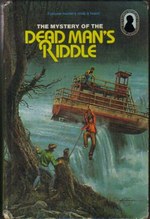
The Mystery of the Dead Man's RiddleThe Mystery of the Dead Man’s Riddle

by William Arden

While Encyclopedia Brown (see below) got me reading mysteries, it was The Three Investigators — Jupiter Jones, Bob Andrews and Pete Crenshaw (btw, the only thing there I had to look up was Pete’s last name — not bad for a series I haven’t touched since the late 80’s) got me hooked on reading detective series. The Dead Man’s Riddle was one of my favorites — and I think the first or second I read — something about the Cockney slang kept bringing me back to it. I read what I do today because of this series, really.

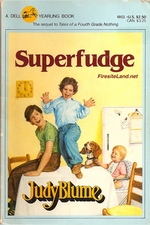
SuperfudgeSuperfudge

by Judy Blume

I remember Tales of a Fourth-Grade Nothing being funnier, but this was a better story — the Fletchers leaving NYC, Peter maturing, Fudge being a real pain, not just a cute nuisance. Blume taught me a lot about how to read non-genre stuff, probably paving the way for Hornby, Tropper, Weiner, etc.

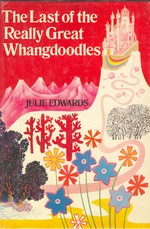
The Last of the Really Great WhangdoodlesThe Last of the Really Great Whangdoodles

by Julie Edwards

What a great world, what a great magic system . . . I’m not sure I can express what this book meant to me as a kid, and the copious warm-fuzzies the memory brings up. I remember that it was in the pages of this book about a magic kingdom that I first learned about DNA and RNA (and what those letters meant) — thanks, elementary school science classes. The creatures’ names in this are great (and, as an adult, I can “hear” Andrews saying them in my mind for an added layer of fun). There’s a great deal of whimsy here, a sense of play that permeates this — even when it gets silly. The kingdom’s motto, “peace, love and a sense of fun” really sums up the spirit of the book.

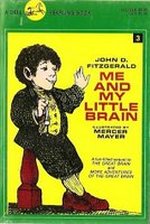
Me and My Little BrainMe and My Little Brain

by John D. Fitzgerald, Mercer Mayer (illus.)

Sure, the series was supposedly about Tom, but J. D.’s the real hero of the books. He has a conscience, a better moral compass than his brother — and is probably just as smart. This is the book that lets him shine as he ought to have all along. All the books had their strong points, and were fun, but this ruled them all.

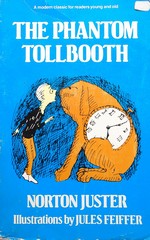
The Phantom TollboothThe Phantom Tollbooth

by Norton Juster, Jules Feiffer (illus.)

Such wordplay! What a great, twisted way to teach how important words and ideas are. Seriously, just a wonderful book. The humor is so off-kilter, any appreciation I have for puns came from this book (and it set the standard that a pun must achieve for me not to groan). If you haven’t seen the documentary about it, The Phantom Tollbooth: Beyond Expectations, get on it. (I contributed to the Kickstarter for it, I should add).

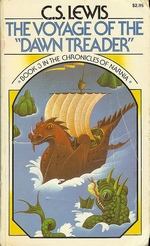
The Voyage of the Dawn TreaderThe Voyage of the Dawn Treader

by C. S. Lewis

I remember the bookstore where I bought this, the date and month that I bought it, and reading a good chunk of it before I got home. I read this one more than the rest of the series (Prince Caspian a close second). I just love this one — you get Reep at his bravest and funniest, some really odd creatures, an epic story, and Eustace’s redemption (back when I did crazy things like this, I almost got a tattoo of Eustace as Dragon). Who could ask for more?

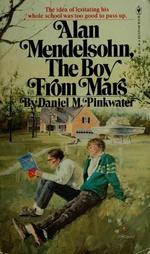
Alan Mendelsohn the Boy from MarsAlan Mendelsohn, the Boy from Mars

by Daniel M. Pinkwater

Pinkwater has funnier and stranger books (both before and after this one), but there was heart, there was depth — there was length! — to this story about a kid who didn’t really fit in until he made a friend who didn’t want to fit in. This is another one where I can peg the place and time I bought it. Science Fiction-y in a real world (didn’t know you could do that!), comic book geeks as heroes, and real non-sanitized-for-kids emotions. There’s no way this wouldn’t be a favorite. More than the rest on this list, I’m thinking of finding my old copy and taking it out for another spin (because I just read the next one a couple of years ago).

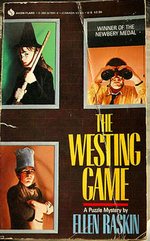
The Westing GameThe Westing Game

by Ellen Raskin

If I had to pick one off this list (and I don’t), this would probably be my favorite. I re-read it two years ago, and it was one of my favorite experiences that year with a book. The characters are great, the story was so clever, the writing so crisp. There’s nothing wrong with this book at all.

I saw a hardcover reprinting of this on Monday, and had to fight to resist buying a new copy. Kind of regretting that now. [Note: I went back a couple of days later and bought the hardcopy. It looks very nice on my shelf]

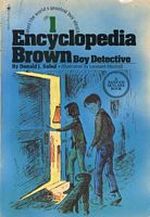
Encyclopedia Brown Boy DetectiveEncyclopedia Brown, Boy Detective

by Donald J. Sobol

Summer after second grade, we were on a forever-long road trip and I was bored, so I demanded my parents buy me something to read. I must’ve been a real snot about it, because at the next town, they did. I got two books, this one and Sugar Creek Gang Screams in the Night (not the best in the series, but it was good enough to read several times). It blew me away — I loved the puzzles, the characters, the idea. I wanted to be a P. I. This was my first mystery book, and it clearly set the stage for most of what I’ve read since (about a third of what I read).
Were you a fan of any of these as a kid? What were some of your faves? Have you read them lately?

He Drank, and Saw the Spider (Audiobook) by Alex Bledsoe, Stefan Rudnicki: LaCrosse’s Break from His Vacation Changes History

Like with the previous Eddie LaCrosse audiobook, The Wake of the Bloody Angel, I can’t think of much more to say than I did in 2014 when I read the book. But, this is the last one in the series, and I can’t just let this pass unremarked. So I shuffled it a bit, cleaned a couple of things up, and added bit here and there. That’s not cheating too much, is it?


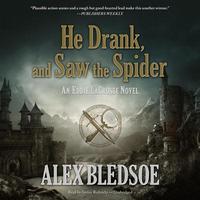
He Drank, and Saw the Spider

He Drank, and Saw the Spider

by Alex Bledsoe, Stefan Rudnicki (Narrator)
Series: Eddie LaCrosse, #5

Unabridged Audiobook, 9 hrs., 6 min.
Blackstone Audio, 2014

Read: February 16-19, 2021

Grab a copy from your local indie bookstore!

I felt that little knot in my belly that meant a mystery was taking its irrevocable hold. Usually this was a good thing, because usually I got paid for it. But here and now I was on vacation, and the last thing I wanted to do was spend it unraveling the truth of the strange prince, his rotund protector, and the girl I’d once saved from a bear. But damn it, I knew that’s exactly what I was going to do.

What’s He Drank, and Saw the Spider About?

After a couple of adventures that aren’t quite typical in their nature, Eddie La Crosse gets back to basics with a fairly straightforward case. Well, that’s not exactly true—it’s just that the last was more grand-adventure-y, less LaCrosse-as-sword-jokey, and the one before that took on this epic nature by the end. This is Eddie doing what he does best. But still, there’s magic and monsters, and all the other trappings that keep this from being something that Sue Grafton or Dennis Lehane would’ve written.

Sixteen years ago, Eddie promised a dying man on the run that he’d take care of the baby that the other man was running to protect. He found a seemingly-trustworthy family willing to take the infant in, and went on his merry way, and actually forgot all about the incidents surrounding that. Years later, Eddie and his girlfriend, Liz, are on vacation in that area and suddenly it all comes back to him and he decides to try and track down the (now) young woman and see how she’s doing.

Naturally, things start to go poorly about there. He does find her—pretty easily, too—it is a small community, with an economy largely-based on sheep-herding and farming, so it’s not really a bustling metropolis where no one knows anyone else. But there’s a whole lot of interesting things happening around the young woman—royalty in disguise, a meddling sorceress, an untrustworthy mercenary-type, an over-protective mother, a dose of sibling rivalry, and some sort of articulate and super-strong inhuman creature with a healthy interest in the girl.

Even though he was just supposed to check on her and not interfere with her life—he had no intention of even introducing himself to her. Eddie can’t help himself, and before you know it, he’s neck-deep in intrigue and danger.

Biggest Magic Yet

When you think about Fantasy novels (or maybe I should just say “I”, who knows what you think) you think about magic all over the place. But if it’s really that ubiquitous, that takes away some of the special-ness of magic. In LaCrosse’s world, almost no one believes in magic. Eddie sure wouldn’t if magic, deities, and supernatural creatures hadn’t rubbed their existence in his face on repeated occasions.

That’s certainly the case here—most of the people that Eddie is around in this novel (and by most, I mean an overwhelming majority) refuse to admit that what they are seeing—some of them on multiple occasions—has anything to do with magic. I think this is a great choice—it’s another hurdle for Eddie and Liz to get over, it adds some real tension when you’d be tempted to think we’re done with tension, and it keeps the magic mysterious.

Rudnicki’s Narration

I think this is probably Rudnicki’s best work in the series. he nails every character—particularly the character of Billy Cudgel (the aforementioned untrustworthy mercenary-type). He captures the humor, the drunkenness, the misery, the madness, and everything else. I thought the choices he makes in the narration (he and/or the director) and tone were spot-on. He’s definitely a narrator I’m going to seek out in the future.

So, what did I think about He Drank, and Saw the Spider?

On the whole, this is a fun, brisk novel—a lot of humor, some good action, nice banter, and interaction between the characters (especially Eddie and Liz). Yet, even as the answers to the questions surrounding the girl’s mysterious origins become obvious, and some of the characters get to the point where they seemed irredeemable, Bledsoe (as he can every so well) keeps you completely drawn in and even tugs the heartstrings a bit as the truth is revealed to the characters. Just really, really well done.

There’s a lot of nice little touches along the way. For example, towards the end of the book, Eddie and those he’s traveling with encounter a preteen who joins their little band for a while. She’s pretty new to swearing and tries to get in as much practice as she can while with them. At first, I thought she was an odd (but entertaining) and pointless distraction. It didn’t take too long to see she was a perfect tension-breaker, just what that part of the novel needed to keep from being too tense and so much more serious than what had come before.

Eddie’s narration has never been better—humor-tinged and hard-boiled, a medieval Philip Marlowe or Elvis Cole. I liked all of these characters, and really wanted to spend more time with each of them—I don’t know how Bledsoe could’ve pulled that off without getting the whole thing too slow and ponderous (which would’ve sucked the fun out of 60-70% of these characters). This is really such a well-done and fully realized series.

Either Bledsoe or his publishers decided that was enough, and it doesn’t look like we’re going to get any more adventures from our favorite sword-jockey, but man, I’m glad we got what we did.


4 Stars

2021 Audiobook Challenge

This post contains an affiliate link. If you purchase from it, I will get a small commission at no additional cost to you. As always, opinions are my own.

The Incredibly Dead Pets of Rex Dexter by Aaron Reynolds: A Wonderfully Ridiculous Adventure

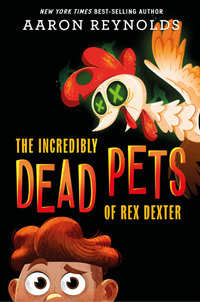
The Incredibly Dead Pets of Rex Dexter

The Incredibly Dead Pets of Rex Dexter

by Aaron Reynolds
Series: The Incredibly Dead Pets of Rex Dexter, #1

Hardcover, 213pg.
Little, Brown Books for Young Readers, 2020

Read: February 19-20, 2021
Grab a copy from your local indie bookstore!

There’s a hum from the game and it roars to life…The Grim Reaper inside starts to move. He puts his bony hand near a small chute and my quarter falls into his palm.Behind him, a little sign spins into place:

PLAY AGAINST THE GRIM REAPER
WIN AND YOUR WISH IS GRANTED
LOSE AND SUFFER THE REAPER’S CURSE!

“Whoa!” cries Darvish in realization. “This is just like that old movie from the eighties.”

“What movie?” I ask.

“You know,” he persists. “The one with Tom Hanks.”

“Never heard of him.”

“He wishes to be tall,” Darvish says. “Or grown. What was it called? Tall? Large?”

“No idea,” I tell him. “Unlike you, I do not spend my time on ancient movies from a bygone era.”

What’s The Incredibly Dead Pets of Rex Dexter About?

Rex Dexter is a sixth-grader who desperately wants a pet. Well, no. He wants a dog—and considers all other kinds of pets as beneath him. A Chocolate Lab in particular, or he’d settle for a Yellow Lab. Even a Black Lab. Or, if he must, a Golden Retriever. The kid has standards.

Due to a mishap a few years earlier with a Goldfish and, well, his entire personality, his parents have decided he’s too immature for a dog, but they do get him a rooster for his birthday to see how he handles that. Sure, this makes no sense—who gives a rooster as a pet? But don’t worry, the chicken dies in a strange mishap hours later. (That’s not a spoiler, he’s literally dead on the book’s cover).

It’s about this time that Rex plays the Reaper’s game, and loses. Soon after that a very flat chicken starts talking to him—but no one else can see or hear the chicken, but Darvish is able to see the Rooster move things, so he believes Rex. So, the Reaper’s curse has something to do with seeing dead animals. Rex and Darvish barely get the chance to start believing that when a Rhino’s ghost shows up, too. It had died in a fire at the local zoo.

The Rhino (Rex calls him Tater Tot) tells Rex she needs help finishing something on Earth before he can move on—Drumstick (the rooster) has no intention of leaving. Rex and Darvish need to figure out who killed Tater Tot to help her move on. While they’re trying, more dead zoo animals arrive—making quite the mess in Rex’s room and making it difficult for him to focus on school (never a strength in the first place).

Their age and inexperience are a couple of the biggest strikes against their success, but there are bigger obstacles. Starting with the fact that their Sixth Grade Teacher, Ms. Yardley, keeps trying to educate them, and then there’s a research project looming on the horizon, as well as the Evening of Enchantment dance. That’s just a whole lot to go up against, but these ghosts need his help.

Rex and Darvish

Rex is the kind of over-confident (arrogant-adjacent) and not all that bright hero that MG books seem to love filling themselves with lately–Greg Heffley and Timmy Failure are the two examples that jump to mind. He’s got attitude to spare, opinions on everything under the sun, and a blind spot to his own strengths and weaknesses that’s larger than himself.

Where Timmy has that Polar Bear, Rex has Drumstick. And where Greg has Rowley, Rex has Darvish. Darvish is a lot like Rowley—upbeat, considerate, and pretty clever. Also, they’re much better friends to Greg/Rex than Greg/Rex are to them. Both of them would be better off getting a new best friend, but neither do. It’s a fun dynamic to see, but man…I feel for them, you know?

So, what did I think about The Incredibly Dead Pets of Rex Dexter?

First off, thanks to The Bookwyrm’s Den for letting me know about this book and making it sound fun enough to look into.

This is a ridiculous book, a goofy premise, and an outlandish execution of that premise. And I loved it. There’s a higher joke-density to the text than The Wimpy Kid books or Timmy Failure‘s adventures. Maybe it’s too much, honestly, I had to take a couple of breaks because I just needed a break from the relentless barrage of jokes. I don’t see anyone in the target audience doing that, but it was at over-dose levels for me (like you get when you get near to the end of a package of Double-Stuff Oreos if you eat the entire thing at one sitting).*

It’s ridiculous, it’s hilarious, the story holds up, and the characters (living and dead) are just great. I think this works for all ages, there’s just enough story to keep you invested and even if all the jokes don’t land, just wait for the sentence and you’ll get another one.

It’s been a while since I just read a book for fun, with no other expectations or goals. That’s all that Reynolds offers and that’s exactly what he delivers.


3.5 Stars

2021 Library Love Challenge
This post contains an affiliate link. If you purchase from it, I will get a small commission at no additional cost to you. As always, opinions are my own.

Oh, That Shotgun Sky by Sarah Chorn: “The old way died. Now, everything’s different.”

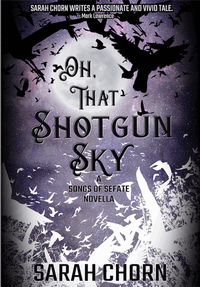
Oh, That Shotgun Sky

Oh, That Shotgun Sky

by Sarah Chorn
Series: Songs of Sefate, #1.5

Kindle Edition, 143 pg.
2021

Read: February 18, 2021

Free.

That’s such a dangerous word. Sure does look pretty sitting in the space between us like that, all glittering and gem- covered. But I can’t help but wonder how much pain is on the other side of it. After all, even diamonds cut.

What’s Oh, That Shotgun Sky About?

This novella happens in the shadow of Of Honey and Wildfires with everyone trying to come to terms with the events of the novel’s ending. The Boundary has fallen, the Shine Territory is no longer walled off from the rest of the world—access isn’t as shut off. No one knows what that means. No one is ready for this “New Normal.” All anyone is sure of is that things are different now, now’s the chance to start over.

This novella chronicles some people taking advantage of the confusion, the lack of status quo to do something else with their life. We see a grieving outlaw, a Shine Company man hunting that outlaw while he tries not to die himself, and a group of camp prostitutes (essentially prisoners) who are enjoying the freedom they now have (however temporary it may be).

Without intending to, these all come into contact with each other and offer (and receive) help in these crazy days.

Yeah, that’s vague—but it has to be. I could give all the salient plot points in one healthy paragraph if I wanted to. But you don’t read these books for the plot, or even character–you read this series for Chorn’s gorgeous prose.

Love, Grief, Fear, Confusion, and a little Hope

There’s honesty in walking through the world with open wounds. No lying about the pain that’s carving me up. No hiding the injury that’s cleaving me in two. Don’t think I’ve ever been this true.

I don’t know what to do with all I’m feeling. No one ever told me that love is an ocean. That to love, you must let yourself drown.

“There is part of me that ain’t never coming back. I gave it up willingly, you understand? I gave it all to him. That’s what love is. It ain’t all soft and pretty; it’s hard and biting, too. It’s a hungry wolf, and you just keep feeding that beast bits of yourself.” I fix her with my eyes. Feel them punch all the way through her soul. “Listen to me and listen well: Love devours.”

(yeah, I couldn’t pick one line to illustrate this point)

While there’s not a lot of plot, and we don’t get a lot about what the various characters do or think—we get a thorough understanding of what they feel—three or four of the characters in particular, with a few others to a smaller extent. They have deep feelings, deep and raw, and those feelings reveal more to the reader than anything else they might do, say or think.

You cannot read this novella and not feel what these characters are going through—the emotions are practically tangible, and Chorn puts them so beautifully

So, what did I think about Oh, That Shotgun Sky?

It’s a special kind of torture to survive after the one holding your heart has died. It twists a soul something awful. Not a person in this world deserves this.

Okay, I had to cram one more quotation in.

I’m not crazy about the characters, the plot left something to be desired for me. But I could read sentences like that all day long and not get tired of it.

Last year, when I wrote about Of Honey and Wildfires, I said: “So, yeah, I didn’t like this as much as I wanted to. Many of you will wonder what’s wrong with me after you read it (a few of you will think I’m too generous). But I am glad I read this—it’s been a long time since I’ve read a book so carefully written as Of Honey and Wildfires…It’s raw, honest, open, and beautiful. I didn’t love it, but I commend it to you.” Switch out the titles, and I can’t think of a better way to talk about this.

(and like last year, I’m going to skip the stars for this one—they’d just distract from what I had to say—if I could decide how many to give)

The Friday 56 for 2/19/21: The Incredibly Dead Pets of Rex Dexter by Aaron Reynolds

The Friday 56This is a weekly bloghop hosted by Freda’s Voice

RULES:
The Friday 56 Grab a book, any book.
The Friday 56 Turn to Page 56 or 56% on your ereader. If you have to improvise, that is okay.
The Friday 56 Find a snippet, short and sweet.
The Friday 56 Post it

from page 56 of:
The Incredibly Dead Pets of Rex Dexter

The Incredibly Dead Pets of Rex Dexter by Aaron Reynolds

…we now know I’m not imagining things.

Which means my deepest darkest fear has come true. Next to falling into a pit of snakes. And global takeover by evil robots. And paper cuts. These are the things that haunt my nightmares.

My fourth deepest darkest fear has come true.

I have been cursed by a rogue carnival game.

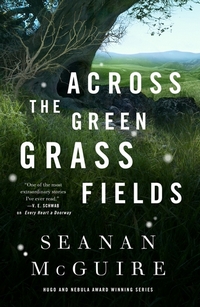
Across the Green Grass Fields by Seanan McGuire: The Sixth Wayward Children Novel is a Let-Down

Across the Green Grass Fields

Across the Green Grass Fields

by Seanan McGuire
Series: Wayward Children, #6

Hardcover, 174pg.
Tor, 2021

Read: January 25-26, 2021
Grab a copy from your local indie bookstore!

Regan slowed again, suddenly eager for her journey to take as long as possible. Maybe that was why the shape in the nearby growth caught her eye, and she stopped abruptly, sending a pebble clattering into the creek as she cocked her head and blinked at what was surely a trick of the light.

Two trees had grown around each other, branches tangling and twisting like the wicker of a basket. They looped in and out of one another’s embrace, until they formed what looked almost like a doorway. That was interesting, but not unique; branches often grew together, and the shapes they made in the process could be remarkably architectural. She’d seen castles in the trees when she was little, castles and dragons and all manner of fabulous things.

But she’d never seen a doorway before.

What’s Across the Green Grass Fields About?

Regan is ten-years-old when she finds this doorway, but we meet her when she’s a little younger. We see her making regrettable, entirely predictable (and understandable) mistakes when it comes to friendship, the kind of mistakes that shape her social future in ways she can’t imagine. We readers cringe, hope she’d make better choices, and then just wait to see how bad the damage is going to be when she realizes (probably too late) that she’s befriended and trusted the wrong sort of person. Other than that mistake, she seems like a sweet girl, she loves horses and riding, her family, and her friend.

The day after she learns something devastating from her parents, she learns that lesson about trust the hard way and runs away from school into the less-developed area between her school and home.

As children do in this series, she walks through that doorway and finds herself in a new world. The first person she meets (a centaur) tells her it’s called The Hoooflands. And she is excited to find a human. Humans arrive in The Hooflands when something is about to happen—when something that is plaguing their society will be confronted and defeated by the human (who have thumbs and can fit in places a centaur can’t, so there are two big advantages for the human).

But first, the centaur takes Regan to meet her family. And then years pass. She matures, she sees the errors she made in trusting the wrong people on Earth. She picks up skills, she learns who she is. Yes, she misses her family, but this is home to her and she’s content.

The Hooflands

…and there were people. Centaurs like the ones Regan knew. More delicate centaurs with the lower bodies of graceful deer and the spreading antlers to match. Satyrs and fauns and minotaurs and bipeds with human torsos but equine legs and haunches, like centaurs that had been clipped nearly in half. It was a wider variety of hooved humanity that Regan could have imagined.

On the one hand, I really like this world—of all the worlds on other sides of doors that we’ve visited in this series, it seems more viable than any of them (except maybe for maybe The Goblin Market), it takes a little less suspension of disbelief to see how the world works (once you accept the population, anyway).

At the same time…there’s something about this society that I don’t understand how it functions at all given the way that other species see each other. Obviously, this is a not-at-all-thinly-veiled metaphor for our society, but even metaphors should have some sort of air of believability. Maybe it’s just me, but every time that came up, it took me out of the story for a bit, because I couldn’t understand how the world functions (set aside justice and morality, I’m talking just in terms of practicality). It’d take too long to flesh this out, so I won’t. But it bugged me.

The individual people we spend time with in The Hooflands? Loved ’em.  They’re the best characters we’ve met in this series that weren’t connected to the School. I resented how much time McGuire let pass between chapters because I wanted to spend more time with them and to understand the Centaur culture a bit more.

So, what did I think about Across the Green Grass Fields?

It had been more than five years since Regan ran away from school on purpose and ran away from home by mistake.

So begins the endgame for this particular novella, Regan heads off to meet the Queen and do what she was brought to the Hooflands to do once and for all, and then (she assumes) to get her door back home. She doesn’t really want to leave the Hooflands, but circumstances are forcing her hand.

This is the crux of probably my biggest problem with the book—she’s spent five years telling anyone who’ll listen (primarily herself) that she doesn’t believe in Destiny, she won’t bend to Destiny. But in the end, that’s exactly what she does. I’m not going to get into a debate about determinism here, but Regan would be a great Exhibit A for my case if I wanted to.

This is not a subtle book, McGuire has things she wants to say about destiny, about the choices that others make on behalf of others that are just as binding as the choices they make themselves. And she goes about it in a blatant, almost ABC After School Special* manner. And this series is better than that. Or it usually is.

* Readers of a certain age might want to consult with a parent to fully understand that reference

I liked Across the Green Grass Fields, but this is not up to either McGuire’s standard or the standard of The Wayward Children series, and it was far enough short of those high marks that I’m having trouble generating much enthusiasm for it. The language, the storytelling style, the imaginative world were there. But they were overshadowed too frequently for my taste by the rest.

I was disappointed. Hopefully, you’re not, or if you were, it doesn’t put you off from trying the rest of this really wonderful series.

I fully expect (and hope) to see Regan at Eleanor West’s School for Wayward Children in the future and look forward to seeing what happens after she makes her way back home (even if I don’t think it’ll go well for her long-term). I’ll be back for the 2022 novella in this series, eager for what McGuire has in store, confident it won’t be like this.


3.5 Stars

This post contains an affiliate link. If you purchase from it, I will get a small commission at no additional cost to you. As always, opinions are my own.

Page 28 of 54

Powered by WordPress & Theme by Anders Norén