Tag: General Fiction Page 10 of 46

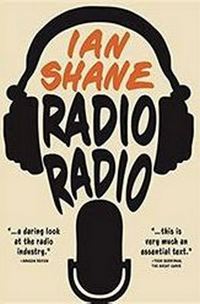
Radio Radio by Ian Shane: A Tom Petty Song in Novel Form

Radio RadioRadio Radio

by Ian Shane

DETAILS:
Publication Date: July 17, 2008
Format: eBook
Length: 253 pg.
Read Date: December 7-8, 2022

And there goes the last DJ
Who plays what he wants to play
And says what he wants to say
Hey hey hey
And there goes your freedom of choice
There goes the last human voice
And there goes the last DJ

Sure, that’s Tom Petty and not Ian Shane. But I had that song stuck in my head for almost the entire novel, they might as well be writing about the same guy.

What’s Radio Radio About?

Erik Randall is a DJ—that’s all he’s ever wanted to do. He loves being on the radio, sharing music with whatever corner of the world he can. He comes alive on the microphone, he seems to be good at the technical bits, and he loves the medium. What it has been, what it is, what it could be—but he’s very much not a fan of what it’s becoming.

He’s a True Believer, though, and is convinced that if given the opportunity, radio can still be great. He’s even formulating a plan so that one day, he can make at least one station great.

We don’t meet him on that day—in fact, shortly after we meet him, his station comes under the thumb of a corporation that makes cookie-cutter stations all over the country. In the same way you know what you’re going to be served at an Olive Garden in a different state from home, you know what you’re going to hear on the radio in your rental car once you hear a familiar station tagline. That’s what they’re going to turn his radio station into.

About the same time, he meets a local singer/songwriter, Myra. Erik’s still reeling from a semi-recent breakup and isn’t in the right frame of mind to think about romance—but she’s the kind of woman he’s dreamed about. His co-worker/friend, Shakespeare, has been pushing him for months to date again, and once Shakespeare meets Myra, he increases the pressure.

His professional life is falling apart, his personal life is looking promising for the first time in forever—can Erik handle it?

So, what did I think about Radio Radio?

I thought there was something grating—something blindly immature about Erik’s attitude and antics at work. Yes, he’s firmly in the model of the rebel DJ who cares more about the art than the business side. And as such, I can enjoy the character. Maybe it’s because I’m reading this through the eyes of someone in 2022 so I have 14 years of insight to know just how Quixotic Erik is being and how reality is going to hit him hard. Shakespeare, on the other hand, I could get behind—he’s a realist. There’s a romantic streak in him—he wants Erik and his vision to have a chance, but he knows better. I was enjoying the novel, but I really wasn’t on board with it. Which isn’t to say I didn’t find Erik amusing—I just found him a grating sort of amusing.

But then, Myra comes on the scene and two things happen. Erik starts to change, the bits of his personality that grate on me get pushed to the background.* Secondly, Ian Shane writes this stuff really well—like the way that Erik and Myra interact, the way that Erik makes an utter fool of himself because of her, the way that Myra and Shakespeare interact—this is where Shane’s later novels shine, and you can see him building that ability here. If this was the first Ian Shane book I read, shortly after Myra comes on the scene is where I’d order his next two books.

* I am fine with a protagonist grating on me—as long as there’s something about them or their story I can get behind. But I prefer the alternative.

I should also note, that some of Erik’s work attitudes and behaviors remind me of other characters in similar situations—the works of Adam Shaw, Matthew Hanover, and Andy Abramowitz jump to mind—so I’m not trying to say that Shane messed up by having Erik be this way. I just find it grating. What he does and says are, by and large, what an immature twenty-something would think and do. As he is an immature twenty-something, he’s spot-on.

Speaking of needing to grow up a little—a lot of the ways he approaches the big changes he needs to make, the conversations around them, and the way he reacts to people like Shakespeare making those changes himself, displays that immaturity. In those cases, I find it endearing and relatable.

Maybe I’m just the office crank? Out of the office issues don’t bother me as much.

One other challenge for me is that like with Postgraduate, I felt like Shane was judging me for my musical taste. And he probably should—because my musical taste not the kind of thing that Erik Randal (or anyone at Championship Vinyl) would approve of—very I’m fairly plebian, really. Frankly, I’m okay with that—and I did make a note or two to follow up on some music. I do wish I could hear Myra’s stuff, because I think I could get into it. That’s not a reflection on the novel, I just wish Shane would write a character with mainstream taste who is seen in a positive light.

This is a sweet book—there’s good character development, a strong cast of supporting characters (most of whom I didn’t mention) that I would love to see again in some form, great banter, solid comedy in a variety of forms, insight into an industry I know practically nothing about, and a sweet and well-told romantic story. It’s not as strong as his later novels, but it’s easy to see that he’ll be capable of greatness. Buy this book, it’ll make you happy.


4 Stars

The Friday 56 for 12/9/22: Radio Radio by Ian Shane

The Friday 56This is a weekly bloghop hosted by Freda’s Voice.

RULES:
The Friday 56 Grab a book, any book.
The Friday 56 Turn to Page 56 or 56% on your ereader. If you have to improvise, that is okay.
The Friday 56 Find a snippet, short and sweet.
The Friday 56 Post it.

from Page 56 of:
Radio Radio

Radio Radio by Ian Shane

He picks up the box to indicate that his ten years at this company could barely fill a cardboard box. “My last bit of advice that you’re going to ignore is to not give these bastards a reason.”

This is the best bit of advice he’s given me. It doesn’t sound so stupid when it comes from someone who’s not in an authoritative position. “Yeah,” I say softly. “Thanks.”

Tony makes his move to the door. “Hey, Tony,” I say, stopping him at the threshold.

“Yeah.”

“I’m gonna miss you, man.” Tony chuckles a bit. “No, you won’t.” He smiles at my seemingly transparent attempt at comfort. “But thanks for saying so.”

I walk to the doorframe to watch him walk away from the station for the last time. I felt a subtle sense of loss as I saw him turn the corner. It’s the sort of loss an FBI agent might feel after putting away a mob boss that was the subject of a three-year probe. He was a worthy adversary. We were like Eliot Ness and Al Capone, Dr. Richard Kimble and the one-armed man, Batman and The Joker.

The Friday 56 for 11/11/22: Less by Andrew by Sean Greer

The Friday 56This is a weekly bloghop hosted by Freda’s Voice.

RULES:
The Friday 56 Grab a book, any book.
The Friday 56 Turn to Page 56 or 56% on your ereader. If you have to improvise, that is okay.
The Friday 56 Find a snippet, short and sweet.
The Friday 56 Post it.

from Page 56 of:
Less

Less by Andrew by Sean Greer

“Do you think of yourself as a genius, Arthur?”

“What? Me?”

Apparently the Head takes that as a no. “You and me. we’ve met geniuses. And we know we’re not like them, don’t we? What is it like to go on, knowing you are not a genius, knowing you are a mediocrity? I think it’s the worst kind of hell.”

“Well,” Less said. “I think there’s something between genius and mediocrity—”

“That’s what Virgil never showed Dante. He showed him Plato and Aristotle in a pagan paradise. But what about the lesser minds? Are we consigned to the flames?”

“No, I guess,” Less offers, “just to conferences like this one.”

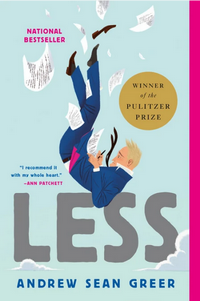
Less by Andrew by Sean Greer: Is a Thing I Read

LessLess

by Andrew Sean Greer

DETAILS:
Publisher: Back Bay Books
Publication Date: May 21, 2018
Format: Paperback
Length: 261 pg.
Read Date: November 4-7, 2022
Support Independent Bookstores - Visit IndieBound.org


I am probably going to say an awful lot of seemingly contradictory things here, so the tweet-length version of this post is: Less is full of gorgeous prose but the character and story never interested me one whit.

What’s Less About?

From the back of the book:

Who says you can’t run away from your problems?

You are a failed novelist about to turn fifty. A wedding invitation arrives in the mail: your boyfriend of the past nine years is engaged to someone else. You can’t say yes–it would be too awkward. And you can’t say no–it would look like defeat. On your desk are a series of invitations to half-baked literary events around the world.

QUESTION: How do you arrange to skip town?

ANSWER: You accept them all.

What would possibly go wrong?

Thus begins an around-the-world-in-eighty-days fantasia that will take the novelist Arthur Less to Mexico, Italy, Germany, Morocco, India, and Japan and put thousands of miles between him and the plight he refuses to face.

Why Didn’t I Just DNF This?

Three reasons, none of which hold any kind of water, but seemed to carry the day.

    1. I hate to DNF books, holding out hope that they’ll win me over eventually. Enough have that I can’t shake the habit. (as I explained here)
    2. I really hate to DNF books I spent money on. I also refuse to DNF books that I receive from an author or as an ARC. So basically, I’ve learned via this bullet point that I’ll only DNF library books (with incredibly rare exceptions)
    3. I finally took this off my TBR shelf because of a reading challenge, and it’d feel strange to cross this off my to-do list without having read the whole thing.

But I came close frequently over the first hundred pages or so, but then I figured while I wasn’t going to have a good time, there were enough gems along the way, that it was worth the bother. Also, there was one thing I was mildly curious about (although I forgot about it until the answer was revealed).

The Metanarrative at Work

This may get too close to a spoiler for the truly phobic, although I’ll be as vague as I can be, so feel free to skip to the next heading.

Throughout the book, Arthur hears some hard things about his work. Someone that he meets along his travels is very frank about the problems with his novels as a whole—although she adored one of them—and their criticisms, he hears a lot about what is wrong with the novel his publisher had just declined to buy from him.

Their words stick with him and at some point, he accepts their argument (at least about his new book) and dives in to rework it in light of those ideas. In his view, at least, saving the novel and maybe producing something his publisher would want—perhaps something that would find success both with the critics and the market.

It could be said—It shouldn’t (probably), but it could—that Greer took an early draft of Less and saw (or was shown) the same things in it that Arthur saw in his new novel, and then took the same approach that his character did, reshaping the work until it resulted in what I just read. I’m sure Greer just came up with this device for Arthur (perhaps started from it) and wrote for it.

Instead, what we really have is the Author coming alongside the reader and telling us “Here’s how to read this book. All those things along the way up to this point? This is what I’ve been doing with them.” I can appreciate why he’d do that, I think it worked pretty well for this book—and I generally like it when authors do that (although I usually think it’s unnecessary and often self-indulgent). I don’t know that the book needed that done, but I think it helped.

It didn’t change my opinion of the novel much, if at all, but it did make me a bit more certain about Greer’s intention and themes.

So, what did I think about Less?

I started with this point, and I’ll wrap up with it here at the end—the prose is gorgeous. If you can go more than three pages without admiring a sentence or paragraph (if not more), it’s because you weren’t paying attention. I can see why readers and critics who connected with the material raved about this and threw awards at it.

But I never connected to Arthur. It’s not his lifestyle, it’s not his indolence, his pretentiousness, his…cluelessness (it’s not the right word, but it’s close enough). I’ve read and enjoyed characters like that before (and will again). It’s just Arthur and his story that didn’t work for me. I found his strategy for dealing with the wedding foolish and cowardly. I didn’t find the humor in the whole less-fluent-than-he-realizes-in-German schtick.* I’m not so sure I ever bought into whatever self-discovery he made. I really think the ending—and what it suggests is about to happen—undercut whatever Less had achieved through his travels.

* On the other hand, DeLillo’s Jack Gladney being unable to read or speak German absolutely works for me. I am not anti-satire involving Teutonic languages. I just thought I should make that clear.

Because I appreciated the writing so much, I can’t bring myself to give this the 2.5/2 stars I’d have otherwise given this. Read other people raving about the book, read the book if you’re curious, but I really can’t recommend it.


3 Stars

This post contains an affiliate link. If you purchase from it, I will get a small commission at no additional cost to you. As always, the opinions expressed are my own.

I Struggle to Express my Sense of The Sense of an Ending by Julian Barnes and End Very Positively

The Sense of an EndingThe Sense of an Ending

by Julian Barnes

DETAILS:
Publisher: Alfred A. Knopf
Publication Date: October 4, 2011
Format: Hardcover
Length: 163 pg.
Read Date: October 24-25, 2022
Support Independent Bookstores - Visit IndieBound.org

What’s The Sense of an Ending About?

This is a short novel with a very simple story—well, a pair of them. The temptation at this point is to talk in detail about everything that happens—and I could still do that in fewer paragraphs than some longer novels I’ve written about.

The other option is to be very sketchy about the stories—I think that’s the way to go, it’ll be easier to cover things without tying myself in knots to avoid spoilers and it feels like it’s the spirit of the novel.

We meet Tony Webster and his friends in their teens, a new student comes to their school and they work hard to bring him into their circle of friends, and we stick with them for a few years—largely through the way the group dissolves as they disperse to various universities and make the attempts to stay in touch. Add some girls into the mix and the end is inevitable. Tony has one significant relationship that he spends some time relating with a young woman named Veronica—it’s a bad match from the outset, but both of them try to make it work. They eventually split, he travels America for a bit before coming home and getting a nice, comfortable job; getting married and divorced; and raising a daughter. (the post-America part of his life is covered in one paragraph).

All of this is told through the perspective of Tony as an older man recounting his younger days and comparing what he and his friends experienced to what “kids these days” have. This is really the introduction to the novel, the foundation—and takes roughly sixty pages to cover. He’ll breeze by a lot, and then stop and focus on a conversation or an event. Much like a conversation with my parents and grandparents about their lives (or, increasingly, how I find myself talking to my kids).

The second part builds on that foundation, Tony is now on the other side of marriage, divorce, career, “the fall of Communism, Mrs. Thatcher, 9/11, [and] global warming.” He’s contacted by a lawyer about a small item left to him in a will. Veronica’s mother, of all people, has left something for him. He has to work to find out what it is and then to actually get it from Veronica, who actually possesses the item. This leads to him having to revisit his past, re-examine friendships, their relationship, and how little he understood things then (and now).

So, what did I think about The Sense of an Ending?

While I feel an impulse to do a deep-dive on this book (like the kind of thing I’d do for a 400-level Contemporary Novel class or something, with all the journal articles, books(?), professional reviews, etc.), I’m going to resist that. I’m not even going to go as deep as I typically would because I’m not sure how I’d stop.

Bear with me, this is going somewhere positive. I think.

Tony and his friends initially struck me as the kind of protagonists you’d find in an Updike, Franzen, or Brodesser-Akner* novel, and I had to find solace in the fact that this was going to be shorter than my time with them. Well-written, crisp prose that would likely lead to something thoughtful and insightful—but I’d have to wade through some pretension, a lot of amoral callowness, and more masturbation than I really want (both literal and philosophical).

* I could’ve made the list longer, but I think I made my point. I feel bad about using the last name, but I just saw the trailer for the Hulu series, so she was on my mind—and I thought it would be nice to mention someone who wasn’t a white male author, even if they’re worst offenders.

Here’s where you expect the “But, I came around to…”, right? Well, I don’t really have one. I did grow to have some sympathy and understanding for Tony—even if I did think he’d be better off with a different hobby than obsessively trying to get his hands on the item (and trying to understand Veronica). With one exception, my opinion of everyone else in the novel went down. I probably would’ve liked a lot more time with Tony’s ex, actually. And there are some characters we spend very little time with that I might like to read about. But the named characters that we get to know are really not the kind of characters you want to get to know.

My other quibble with the book is how often Tony’s narration will say something to the effect of: “at least that’s how I remember it now.” The shifting of memory, interpretation, and perspective when it comes to relating events is clearly a theme of the book, but we don’t need to get hit over the head with it like a 2×4 in the hands of a 1980’s professional wrestler.

Once I got to Part Two, I was hooked. I was only mildly curious about the item and Veronica, and (again) thought that Tony’d be better off putting it behind him. But I couldn’t stop reading about his efforts to get to the bottom of it—it wasn’t quite the way you have to stop to look at a fender-bender on the side of the road, but it was close. His reactions, his recalculations, his reinterpretations—and the way he was forced to make them—kept me engaged and thinking. I didn’t care about the destination, I wasn’t thrilled with the journey, but I enjoyed the route and the mode of transport (to stretch the metaphor beyond use).

In a mere 163 pages (and it’s a small book in the other dimensions, as well—it could’ve been a much smaller novel had it been a more standard size), Barnes gives the reader a twisty little story with some solid character development (I refuse to commit to the word “growth” here, but it may be appropriate) and squeezes in some discussion on the nature of, and how we think about: narrative (both personal and fiction), metanarrative, history, relationships, life, death, memory, time (and its passage), aging, and other themes I didn’t pick up on during my first read or forgot to note.

Believe it or not, I do recommend this book. There was a lot I didn’t particularly enjoy (I think I made that clear), but it’s going to stick with me longer than many novels do. I think there’s a better than even chance that were I to write this post in a month that it would end up saying something different. The writing is compelling, there’s a quality to it that is clear from the opening pages, and you can see why it would be in the discussion for some prizes (many of which it apparently won). This is definitely the kind of “literary” reading I want to do—I just wish Barnes had filled it with people I wanted to read about, spend time with, and get to know.

And yes, I said first read, I think I’ll return to this in a couple of years. I’m pretty sure I’ll read more Barnes, too.

I’ve given this three different star ratings since I finished reading it, so I’m going to skip that shortcut and just let that muddle of an evaluation stand.


This post contains an affiliate link. If you purchase from it, I will get a small commission at no additional cost to you. As always, the opinions expressed are my own.

PUB DAY REPOST: The Prince of Infinite Space by Giano Cromley: Stumbling Toward Adulthood

The Prince of Infinite SpaceThe Prince of Infinite Space

by Giano Cromley

DETAILS:
Series: Kirby Russo, #2
Publisher: Propertius Press
Publication Date: August 2, 2022
Format: eARC
Length: 264 pg.
Read Date: Jane 18-19, 2022

What’s The Prince of Infinite Space About?

Kirby Russo, a “troubled youth” from Montana has been at the Haverford Military Institute in North Dakota just long enough to start to change his behavior and think about things in a different light—but not so long that he’s totally bought into the system. He’s still largely an outsider—and likes it that way.

He’s assuming that he’ll have a leadership position in the school newspaper—his one real passion—at the beginning of his Senior Year. When that doesn’t happen, he (unlike the reader, who can see it coming from the moment he starts talking about it) goes off the deep end. All the progress he’s made, all the evolution he’s been going through is out the window, and his demeanor, attitude, and focus shifts. He just doesn’t have anywhere to shift it to, so he spends the first few months of the year completely aimless.

The closest thing he has to a goal comes from a picture he saw in a Chicago newspaper. His long-lost love is shown (under an assumed name) in a homeless camp. He starts to fantasize about reuniting with her—but how can he get to Chicago?

Then his Original Biological Contributor shows up unannounced. He’s never met his father, and has heard little good about him over his life. But when his father introduces himself to Kirby and asks to take him to meet his dying grandmother outside of Chicago, Kirby seizes the opportunity.

He can escape the Institute, learn something about his father, and get close enough to Chicago that he can probably find a way to the city.

It ain’t much, but it’s a plan.

Time Period

It’s a little disconcerting reading something that’s probably considered Historical Fiction set during the protagonist’s Senior Year in high school when you share the same Senior Year. Outside the discussion of Iraq’s invasion of Kuwait and the U.S. response, there’s not a lot of references to people and events of 1990. I’m fine with that—we don’t need an Ernest Cline-level of name-dropping to establish the setting.

I’m not convinced that Cromley’s 1990 matches up with reality that well. If Kirby’s world was looking at the 2003 invasion of Iraq, I probably wouldn’t have blinked. But the attitudes that Kirby encounters—in particular on the streets of Chicago—seem to fit the early 2000s more than the early 1990s.

So, what did I think about The Prince of Infinite Space?

The writing really sang (after a heavy-handed first sentence)—I chuckled a lot, and the descriptions were fantastic and real. His depcition of Chicaco alone made this worth the read. Cromley hits all the emotions and the big moments just right. The novel moved along quickly (possibly too quickly), and you get taken along with the characters effortlessly. Kirby’s a wonderfully flawed character—he’s a self-absorbed, petulant, immature twit. But he’s at the time of life where he’s supposed to be one, so that’s a win.

But unlike many of those characters, you get drawn into his character. You like him just enough, get invested in him enough that you want to see him mature, you want to see the coming-of-age in action. You don’t just want to write him off and go read about someone else.

This feels like the bones of a good novel—there’s not enough meat on it. Or, to change the metaphor, it’s like a chili that you serve too quickly, without letting the flavors develop while simmering a decent amount of time. There’s a compliment here—I liked it, I just wanted it to be better, I wanted more of everything.

This is a sequel to The Last Good Halloween, which probably tells about the delinquency (perceived or real) that sent Kirby to the Haverford Military Institute. It’s utterly unnecessary to read before this, but I’d imagine those who had read it will be a bit more satisfied after seeing what happens to Kirby.

Disclaimer: I received this eARC from the author and Lori Hettler of The Next Best Book Club in exchange for this post—thanks to both for this.


3 Stars

Quick Take Catch-Ups: Some July 2022 Audiobooks

Some quick thoughts on some audiobooks from July—and one I forgot to write about in June. The point of these quick takes posts is to catch up on my “To Write About” stack—emphasizing pithiness, not thoroughness.


Deep HoleDeep Hole

by Don Winslow, Ed Harris (Narrator)

DETAILS:
Publisher: Audible Originals
Publication Date: May 26, 2022
Format: Audible Original
Length: 1 hr., 4 min.
Read Date: June 9, 2022

(the official blurb)
I don’t know about this. I mean, it’s a short story, so I shouldn’t expect much from this. And it’s a decent story, but…eh. It left me wanting more on just about every front.

But it wasn’t a bad story—which makes sense, Winslow can’t write a bad story—and Harris sells it.
3 Stars

Long LostLong Lost

by Linda Castillo, Kathleen McInerney (Narrator)

DETAILS:
Series: Kate Burkholder, #4.5
Publisher: Macmillan Audio
Publication Date: September 5, 2016
Format: Unabridged Audiobook
Length: 1 hr., 25 min.
Read Date: July 7, 2022
Support Independent Bookstores - Visit IndieBound.org

(the official blurb)
I wasn’t paying attention when I saw that this was the next entry for this series and checked it out of the library and was more than a little surprised when this wrapped up as quickly as it did. I was relieved, though, I didn’t think I could handle an entire novel where the setup was Kate and Tomasetti on a romantic weekend where they got distracted by a cold case.

As a short story, the concept and execution are just what you want. A nice way to tide the reader over between novels. I liked the resolution, too—sure, I saw it coming a few miles away, but Castillo ended it well.
3 Stars

My Mess Is a Bit of a LifeMy Mess Is a Bit of a Life:
Adventures in Anxiety

by Georgia Pritchett, Katherine Parkinson (Narrator)

DETAILS:
Publisher: HarperCollins Publishers
Publication Date: September 5, 2016
Format: Unabridged Audiobook
Length: 4 hrs., 15 min.
Read Date: June 28, 2021
Support Independent Bookstores - Visit IndieBound.org

(the official blurb)

This is a very amusingly told memoir, and you can see how Pritchett succeeded in comedy writing for TV. At the same time, that’s where it gets tripped up—the memories told are very brief, and almost always seem to be leading to a punchline (not necessarily a funny punchline, but a punchline). The result isn’t so much a memoir as loosely-associated scenes. There is a narrative throughout, but it’s subtle—the effect is like reading a sudden fiction collection that happens to be made up of true stories.

There are some really funny bits, some touching bits, and some good emotional moments. But…ugh. It’s like having a skeleton laid out on a table (I’m thinking of a shot from Bones or CSI: Wherever)—and I’d prefer to see some connective tissue between the bones—and maybe some organs and flesh to cover them, so that it’s an actual memoir, not the rough draft of one.
2 Stars

How the Penguins Saved VeronicaHow the Penguins Saved Veronica

by Hazel Prior, read by Helen Lloyd, Andrew Fallaize, Mandy Williams

DETAILS:
Series: Veronica McCreedy, #X
Publisher: Penguin Audio
Publication Date: June 16, 2020
Format: Unabridged Audiobook
Length: 10 hrs., 44 min.
Read Date: July 7-13, 2022
Support Independent Bookstores - Visit IndieBound.org

(the official blurb)
A sweet, almost-paint-by-numbers story of an elderly curmudgeon finding hope, kindness, and family thanks to time spent on a penguin research base in Antarctica.

There’s one scene at the end that serves to answer the reader’s questions that would be better left unanswered. We’d have been better served if we’d been left with ambiguity. Still, for a bittersweet and unnecessary scene, it was effective.

I’m not sure three narrators were necessary—I think any one of the three could’ve handled the whole thing judging by what I heard, but it wasn’t overly-distracting as multiple-narrator audiobooks can be.

I enjoyed the book, it was a perfectly charming and entertaining novel, as negative as I sound to myself—and am glad I finally indulged my curiosity about the book. But…meh. I’ve seen this story before and done better.
3 Stars

The Diary of a BooksellerThe Diary of a Bookseller

by Shaun Bythell, Robin Laing (Narrator)

DETAILS:
Series: The Diary of a Bookseller, #1
Publisher: Blackstone Audio
Publication Date: September 4, 2018
Format: Unabridged Audiobook
Length: 9 hrs., 42 min.
Read Date: July 15-19, 2022
Support Independent Bookstores - Visit IndieBound.org

(the official blurb)
I guess this would be the cure to any dreams/hopes/aspirations the reader might have to opening/buying a bookstore of their own. And the author certainly makes it clear that no one should do what he does—but it’s not like the book ends with him selling/closing down, in fact, he’s working to keep his store going.

The overall effect was like a James Herriott book—but with used books and readers in place of animals and their owners. Some pretty repetitive stories, just different enough to distinguish them—generally mildly amusing and engaging.

I had fun with it—would’ve enjoyed it a bit more if it were 20% shorter, I think. I do see that this is the beginning of a series. I’ll likely get the next installment, too. But I’m not rushing to do so.
3 Stars

This post contains affiliate links. If you purchase from any of them, I will get a small commission at no additional cost to you. As always, the opinions expressed are my own.

The Irresponsible Reader On…Self-Published “General” Fiction

(updated 7/25/22)
Self-Published Authors Appreciation Week

From the first moment that people did the strange thing of asking me to talk about their books on my blog, I’ve been impressed by the quality of a lot of what’s been published by authors going out on their own, taking all the risks, shouldering all the responsibility and doing all the work to get their words, their dreams, their blood, sweat, and tears. This should be celebrated—it’s definitely appreciated, as we’re trying to show this week.

Because I completely forgot to plan, I didn’t have a lot of new-to-me Self-Published works to talk about this week, so primarily I’m dusting off and updating these posts from last year—highlighting the self-published works that I’ve blogged about over the last few years—just a sentence or two. Hopefully, this’ll be enough to make you click on the link to the full post. Beyond that, it’d be great if I inspired you to add a few of these to your TBR. Also, be sure you check out the other posts over at the SPAAW Hub.

Today we’re going to be looking at General Fiction (for lack of a better term)—there’s some Lad Lit, a dash of historical fiction, some humor, a couple of things I don’t know how to categorize beyond “Fiction”, and a bit more. Hopefully, you can find something that tickles your fancy.

bullet Dispatches from a Tourist Trap by James Bailey—Jason (see below) and his mother move from Seattle to a small town in the middle of Washington to stay with her parents as she establishes a life away from her husband. Hilarity and conflict ensue. (my post about it)
bullet The First World Problems of Jason Van Otterloo by James Bailey—an epistolary novel (through emails) from a 13-year-old whose life is turned upside down in 2003 Seattle. A lot of heart and a few laughs. (my post about it)
bullet The Glamshack by Paul W. Cohen—A lifestyle reporter’s obsessive love for a woman and the havoc it wreaks on his life. (my post about it)
bullet The Chronicles of Iona: Exile by Paula de Fougerolles—The first novel in a series about the founding of Iona. Some historical fiction with a hint of Fantasy. (my post about it)
bullet Not Awkward by Matthew Hanover—a young man attends the funeral of his ex’s father and gets roped into staying during shiva in the days leading to his wedding. Nah, not awkward at all. (my post about it)
bullet Not Dressed by Matthew Hanover—Hanover’s (seemingly) effortless charm makes this “romantic comedy of how love goes wrong—and right—when you’re a twenty-something still figuring out how to adult” a real winner. (my post about it)
bullet Not Famous by Matthew Hanover—Hanover’s first novel is about a guy who falls for a socially awkward musician. It will steal your heart. (my post about it)
bullet The Flight of the Pickerings by John Grayson Heide—a heart-warming story about an older couple dealing with dementia and the end of their life together get their world turned upside down when their rebellious teenage grandson comes to live with them. (my post about it)
bullet Didn’t Get Frazzled by David Z. Hirsch, MD—a bildungsroman following a 20-something through his 4 years of medical school: from Gross Anatomy to the verge of residency. (my post about it)
bullet Love and Other Monsters in the Dark by K. B. Jensen—I could probably put this on most of my Self-Published Fiction lists, so I’ll limit it to this one. It’s sort of the same genre as The Twilight Zone—SF, Fantasy, Horror, Crime. Sudden Fiction and Short stories that’ll knock your socks off. (my post about it)
bullet XYZ by William Knight—A mature, old-school programmer has to start his career over at a 21st Century Startup as his family life falls apart in every way imaginable. Clearly a comedy. (my post about it)
bullet Dirt Road Home by Alexander Nader—A lot of charm fills this YA(ish) Coming of Age story about a teen forced to move from Detroit to a small town in Tennessee before graduation. (my post about it)
bullet Coffee and Condolences by Wesley Parker—A widower tries to begin recovering from the deaths of his wife and children by reconnecting with his step-sister and maybe finds love. (my post about it)
bullet Headphones and Heartaches by Wesley Parker—A teen finds home, safety, and love in a Foster Home, but is torn about leaving his mother behind. One sentence doesn’t do it justice, I simply loved this one. (my post about it)
bullet The Summer Holidays Survival Guide by Jon Rance—an out-of-shape teacher tries to prepare for a half-marathon while surviving the summer with his three kids, a marriage on the rocks, and his father (with dementia) moving in. (my post about it)
bullet The Crescent and the Cross by Kurt Scheffler— the story of The Battle of Tours (in 732) and events leading up to it, told through the lives of people close to Charles Martel and Charles on the one hand and a couple of the leaders of the Muslim forces involved in the Arab invasion of France. (my post about it)
bullet In Ten Years by Ian Shane—The reductionist description is “A 21st Century When Harry Met Sally“. We watch a couple of college friends over 18 years start to figure out that they’re in love. Hilarious and sweet. (my post about it)
bullet Postgraduate by Ian Shane—When your life falls apart, why not take your college radio show and turn it into an Internet radio show? And then, why not attend a reunion with the old college radio gang, including “The One That Got Away” (because you foolishly dumped her)? (my post about it)
bullet KA-E-RO-U Time to Go Home by B. Jeanne Shibahara—I’m so glad the blurb contains a one-sentence description because I couldn’t write one: “Desert-dweller Meryl travels to Japan, returns a WWII flag, and brings home an understanding of life that opens her heart for the unexpected.” (my post about it)
bullet Lingering by Melissa Simonson—It’s sort-of SF, sort-of a Thriller, but not really either, so I put this here. This is a novel about grief, about dealing with death—while telling the story about an effort to design an AI to mimic a dead loved one in order to help a survivor cope. (my post about it)

If you're a self-published author that I've featured on this blog and I didn't mention you in this post and should have. I'm sorry (unless you're this guy). Please drop me a line, and I'll fix this. I want to keep this regularly updated so I keep talking about Self-Published Authors.

The Prince of Infinite Space by Giano Cromley: Stumbling Toward Adulthood

The Prince of Infinite SpaceThe Prince of Infinite Space

by Giano Cromley

DETAILS:
Series: Kirby Russo, #2
Publisher: Propertius Press
Publication Date: August 2, 2022
Format: eARC
Length: 264 pg.
Read Date: Jane 18-19, 2022

What’s The Prince of Infinite Space About?

Kirby Russo, a “troubled youth” from Montana has been at the Haverford Military Institute in North Dakota just long enough to start to change his behavior and think about things in a different light—but not so long that he’s totally bought into the system. He’s still largely an outsider—and likes it that way.

He’s assuming that he’ll have a leadership position in the school newspaper—his one real passion—at the beginning of his Senior Year. When that doesn’t happen, he (unlike the reader, who can see it coming from the moment he starts talking about it) goes off the deep end. All the progress he’s made, all the evolution he’s been going through is out the window, and his demeanor, attitude, and focus shifts. He just doesn’t have anywhere to shift it to, so he spends the first few months of the year completely aimless.

The closest thing he has to a goal comes from a picture he saw in a Chicago newspaper. His long-lost love is shown (under an assumed name) in a homeless camp. He starts to fantasize about reuniting with her—but how can he get to Chicago?

Then his Original Biological Contributor shows up unannounced. He’s never met his father, and has heard little good about him over his life. But when his father introduces himself to Kirby and asks to take him to meet his dying grandmother outside of Chicago, Kirby seizes the opportunity.

He can escape the Institute, learn something about his father, and get close enough to Chicago that he can probably find a way to the city.

It ain’t much, but it’s a plan.

Time Period

It’s a little disconcerting reading something that’s probably considered Historical Fiction set during the protagonist’s Senior Year in high school when you share the same Senior Year. Outside the discussion of Iraq’s invasion of Kuwait and the U.S. response, there’s not a lot of references to people and events of 1990. I’m fine with that—we don’t need an Ernest Cline-level of name-dropping to establish the setting.

I’m not convinced that Cromley’s 1990 matches up with reality that well. If Kirby’s world was looking at the 2003 invasion of Iraq, I probably wouldn’t have blinked. But the attitudes that Kirby encounters—in particular on the streets of Chicago—seem to fit the early 2000s more than the early 1990s.

So, what did I think about The Prince of Infinite Space?

The writing really sang (after a heavy-handed first sentence)—I chuckled a lot, and the descriptions were fantastic and real. His depcition of Chicaco alone made this worth the read. Cromley hits all the emotions and the big moments just right. The novel moved along quickly (possibly too quickly), and you get taken along with the characters effortlessly. Kirby’s a wonderfully flawed character—he’s a self-absorbed, petulant, immature twit. But he’s at the time of life where he’s supposed to be one, so that’s a win.

But unlike many of those characters, you get drawn into his character. You like him just enough, get invested in him enough that you want to see him mature, you want to see the coming-of-age in action. You don’t just want to write him off and go read about someone else.

This feels like the bones of a good novel—there’s not enough meat on it. Or, to change the metaphor, it’s like a chili that you serve too quickly, without letting the flavors develop while simmering a decent amount of time. There’s a compliment here—I liked it, I just wanted it to be better, I wanted more of everything.

This is a sequel to The Last Good Halloween, which probably tells about the delinquency (perceived or real) that sent Kirby to the Haverford Military Institute. It’s utterly unnecessary to read before this, but I’d imagine those who had read it will be a bit more satisfied after seeing what happens to Kirby.

Disclaimer: I received this eARC from the author and Lori Hettler of The Next Best Book Club in exchange for this post—thanks to both for this.


3 Stars

The Border by Don Winslow: Confronting the Ghost and the Monster

The BorderThe Border

by Don Winslow

DETAILS:
Series: The Power of the Dog, #3
Publisher: William Morrow
Publication Date: February 26, 2019
Format: Paperback
Length: 716 pgs.
Read Date: June 23-29, 2022
Support Independent Bookstores - Visit IndieBound.org


I can barely scratch the surface of this book—I spent months trying to write something about the previous book in the trilogy, The Cartel, before giving up because I tried to do my typical post with it. This time, I’m going to go pretty surface-level, just to get something written.

What’s The Border About?

Adán Barrera is dead. DEA Agent Art Keller’s personal White Whale is gone, and two things are up in the air: what is Keller going to do with his life/career now? and What will happen to the Drug Trade in Mexico? Barrera may have been an evil man with a trail of bodies in his wake, corrupting government officials on every level, and is responsible for getting countless people on both sides of the border addicted to poisons. But he was a stabilizing influence on the various competing gangs, and without him, chaos ensues.

Meanwhile, a ranking Senator gets Keller appointed as the new head of the DEA. Once there, Keller attempts to change the way the War on Drugs has been fought. As one on the forefront of the “old way,” he knows how poorly it has succeeded. If he’s going to make any kind of impact, he’s going to have to change the way things are done.

But it turns out there’s something uglier and dirtier than the heinous crimes Barrera and his colleagues and rivals are steeped in—U.S. politics. Keller has to battle factions in the DEA and other law enforcement agencies to put his plans into action. He commits to a risky plan that could make a real difference in the war—if he can pull it off.

If he can’t, his career, his freedom, and maybe his life are at stake.

A Financial Education

A key part of Keller’s new strategy is to watch the money—there’s a lot going back and forth across the border, both to buy drugs and then to launder it. But then…it turns out, the cartels wanted more. They couldn’t just sit on the money, no matter how clean it was—there was just too much to leave hanging around. So they invested it, and they wanted something out of those investments.

If Keller can stop the money from going back South, that would be a significant move in the War on Drugs. They’re not going to provide the product if they’re not getting paid for it.

I didn’t go into this book expecting to get a lesson in finance or anything, but I don’t know if I’ve learned as much about that kind of thing since The Bonfire of the Vanities or Liar’s Poker. But the numbers Winslow uses make what those guys were up to seem small.

Supporting Characters that Steal the Show

One thing that Winslow does time and time again throughout this trilogy is to take a character and treat them as a case study for someone in this war on drugs. He’s used hitmen, minor drug dealers, aspiring gangsters, and others. What’s amazing is that he will consistently take someone like this and turn them into a character you really care about while using them to illustrate a reality, and at some point to advance the plot, too. The latter is probably the most impressive part—they’ll spend so much of the book seeming like a digression—a compelling, often moving digression, but a digression—and then he’ll shock you by making them integral to a plot point.

There were two that really stood out to me in this book—most prominently was a ten-year-old Guatemalan boy, forced by his mother to travel to New York (alone) to live with his Aunt and Uncle. The alternative was staying in Guatemala City and being forced to work for the gangs. His journey north is heartbreaking—and what happens to him (and how he reacts) once he crosses the border just guts me.

The other one that will stick with me for a while is a young woman addicted to heroin. Her story is tragic and frequently predictable. That predictability ends up making it even more tragic the further into her story you get.

If nothing else, characters like these two remind you that the Drug War really isn’t about the DEA, the Cartels, the gangs, or anyone else—it’s about the people who get caught up in the middle. The victims. The addicts. The people most of us never see or think about.

So, what did I think about The Border?

This is a daunting read—before you open it up, and it stays that way until the last 150 pages or so.

But it’s a powerful read. A gripping read. A haunting read.

I’ll frequently talk about how a novel feels real, like the kind of thing you’d read in the news. Usually, when I say that, it’s a compliment—like I can’t believe how well the author was at portraying something realistic. But with Winslow, I don’t know that it’s a compliment. He’s done his research—so much of this book is true. So many of these characters are amalgams of several actual people and their crimes. In many cases, I’d wager that he’s toned down the violence, the money, the debauchery, the corruption—just to make it credible. That old line from Mark Twain, “It’s no wonder that truth is stranger than fiction. Fiction has to make sense,” comes to mind.

It doesn’t bother me to think that characters like Hannibal Lecter or Ernst Blofeld are running around this world, because they’re so clearly fictional. But Keller’s targets—those south of the border, in the world of finance, and the halls of power in Washington, D.C.? Those are real. Those are frightening.

This is a disquieting book. It’s disturbing. It’s distressing. And it’s supposed to be. Winslow’s trilogy is a monumental achievement. It will entertain you as well as make you reconsider your position on the Drug War.

I can’t say enough about this accomplishment. This trilogy is one of the best things I’ve ever read.


5 Stars

20 Books of Summer

Page 10 of 46

Powered by WordPress & Theme by Anders Norén