Book Giveaway:
Prize: One winner will receive a print copy of Appointment with Yesterday and a $25 Amazon gift card (Open to USA only)
Ends Oct 28
If the handy-dandy Rafflecopter doesn’t show up below, just click this link.
a Rafflecopter giveaway
Book Giveaway:
Prize: One winner will receive a print copy of Appointment with Yesterday and a $25 Amazon gift card (Open to USA only)
Ends Oct 28
If the handy-dandy Rafflecopter doesn’t show up below, just click this link.
a Rafflecopter giveaway
Book Details:
Book Title: Appointment with Yesterday: A Novel in Four Parts with a Prologue and an Epilogue
Author: Christopher Stratakis
Category: Adult Fiction, 334 pages
Genre: coming-of-age / WWII / immigrant experience
Publisher: IndieReader
Release date: January 2017
Tour dates: Oct 2 to 20, 2017
Content Rating: PG-13 + M (There is no bad language or violence, but there are references to sex and sexual situations (including between a pre-teen and teen)
Book Description:
A poignant and compelling first novel, Appointment with Yesterday tells the story of Yanni, a cheeky and delightful Greek boy growing up in a small town on an island in the eastern Aegean.
Left in the care of his loving grandparents, Yanni endures the deprivation and terror of the German occupation during World War II and finally leaves his beloved homeland and family to rejoin the parents who had left him behind to make a better life for themselves in America.
Filled with heartbreaking and heartwarming stories of love, devotion, disenchantment, and dashed dreams, Appointment with Yesterday is, ultimately, the story of hardships overcome and a determined boy’s journey toward finding his destiny.
Christopher Stratakis was born and raised in Greece. After moving to America, he graduated from Drexel University in 1951 and New York University School of Law in 1955. Shortly after joining the law firm of Poles, Tublin & Patestides in 1960, he became a partner, specializing in admiralty and corporate law.
He has written and published several articles, lectured on professional and historical subjects, served as Legal Advisor to several non-profits (pro bono), and was an arbitrator in maritime disputes. He is the author of Mnimes “Memories” (2010), a book of essays, short stories, and poems that he wrote as a teenager. In 2015, he co-edited Chains on Parallel Roads, a book published by Panchiaki “Korais” Society of New York. In recognition of his extensive community involvement, he has been the recipient of several awards from religious, governmental, and educational institutions.
Mr. Stratakis lives with his wife in New York City. He is the proud father of three and grandfather of three. This is his first novel.
a Rafflecopter giveaway https://widget-prime.rafflecopter.com/launch.js
Two years ago, I read Robin Sloan’s Mr. Penumbra’s 24-Hour Bookstore, loved it, and spent 5 months trying to figure out how to talk about it. Last year, I listened to the audiobook, loved it, and spent 6 months trying to figure out how to write about it. I failed both times — and I’m not sure that I figured out how to talk about this book, but at least I got something posted. Short version: if you see a book by Robin Sloan somewhere, read it.
—
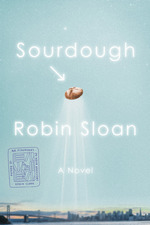
Sourdoughby Robin Sloan
Hardcover, 259 pg.
MCD Farrar, Straus and Giroux, 2017
Read: September 27 – 28, 2017

There’s a version of this where all I do is talk about how this is similar to/different from Mr. Penumbra’s 24-Hour Bookstore — but I don’t want to do that. Let me just say up front that if you liked Mr. Penumbra’s, you’ll dig this. If you didn’t like it, you will dig this — and you probably were having a bad day or weren’t paying attention when you read Mr. Penumbra’s (or you were created by the Tyrell Corporation). So let me sum up: you will dig this book.
This is the story of Lois Clary, a computer programmer working on ways to help robots redefine the concept of work for the future. It sounds like a dreadful place to work — intellectually rewarding, maybe; challenging, yes; but between the hours, the pay and the culture? No thanks. The work is demanding enough that they don’t have time to eat/prepare food, many using Slurry, “a liquid meal replacement,” for several meals each week.
Slurry was a nutritive gel manufactured by an eponymous company even newer than [the company Lois works for]. Dispensed in waxy green Tetra Packs, it had the consistency of a thick milkshake. It was nutritionally complete and rich with probiotics. It was fully dystopian.
Into her overworked and nutritive gel-sustained existence comes a menu for a small cafe that delivers. Their specialty is a spicy soup and a spicy sandwich. The sandwich is made on sourdough bread, and you get an extra slab with the spicy soup. This sourdough is a special thing (you may have guessed that based on the title). This becomes her new favorite food, and what she eats when she’s not consuming the gel.
She develops a semi-relationship with the brothers behind the soup/sandwich, and when they have to leave the country, they give her a part of their sourdoughs starter and a lesson on bread preparation (Lois doesn’t cook, and doesn’t come from a family that did). The starter has specific instructions that reminded me of what’s given when someone buys a mogwai — and just as important. Before she knows it, Lois is baking for herself, to give to others, and even to sell. She’s building a brick oven and really branching out socially (and keeping up with her work, too) — in this, Lois starts to enjoy life and work. I’m pretty sure this is the first time since school (if not ever) that this is true for her.
As she gets more involved with bread making, Lois makes friends, she travels a bit, meets new people — discovering three strange little subcultures along the. She also carries out an email correspondence with one of the brothers as he pursues his dream. That’s all I’m going to say about the plot — there is more to it than I said, but not much.
There’s something like magical realism at work throughout this, but I wouldn’t call it that. Mostly because, it’s weird science, not magic. But it’s probably not real science, just science the way we’d like it to work. Not so much so that this is Fantasy or Science Fiction, just… I don’t know what to call it. Whimsical science?
It’s the way that Sloan tells the story that makes it worth it — there’s a spark to his writing that makes you want to read it. Lois’ world is our world, only better (and maybe a little worse), filled with interesting people doing interesting things. There’s a humanity in the narration, in the action that I can’t get enough of (ditto for his other work). There’s a humor throughout, but it’s not a funny book. But man, it’ll make you happy just to read it. I loved being in this world — it almost didn’t matter what happened to Lois and her starter (not that I didn’t enjoy it), just reading Robin Sloan’s prose is good enough for me. I’ve got a list of 10 quotations I wanted to use here that I couldn’t come up with a way to force into this post, and I think I could’ve easily let the size of that list double.
A book that will make you think, that may inspire, that will make you smile — that will make you want carbs (no joke — it required Herculean effort on my part each time I read a chapter or two not to call my son to tell him to bring home a fresh loaf from the bakery he works at), Sourdough is a gem.
—–


Travels and Travails of Small Mindsby Daniel Falatko
eARC, 252 pg.
The Ardent Writer Press, 2017
Read: September 20 – 21, 2017

“I feel like I’m stuck in a mystery novel written by an unhinged individual, Amy.”
There’s a lot of truth to that lament Nathan makes to his girlfriend, Amy. In the same conversation, she had a different take on it:
“Mystery Englishmen? Ever-evolving eccentric casts of characters? Intricate layers of plot involving absolutely nothing? Two unaware and wayward employees leading the story? Nathan, you are living in a Wes Anderson film. And I’m not sure if I like it. You’re definitely more Life Aquatic than Rushmore at this point.”
There’s a lot truth to that, too. At the same time, neither of them is quite right (and please, don’t go looking for a Wes Anderson/unhinged mystery writer kind of book, you won’t get it. But you may get something that appeals to someone who’d like that kind of book). Just these commentaries on Nathan’s life during this novel shows you just how strange this is.
I don’t want to say there isn’t a plot — there is one; nor do I want to say that it’s not important, or nonsensical — there is a good amount of sense and it is a pretty good story; but compared to the experience of spending time with Nathan, his friends and colleagues, as well as those he meets over the course of the novel outweighs the story.
You’ve got Nathan; his girlfriend, Amy; his boss Dr. Behr, an elderly gentleman who just might be the living incarnation of “eccentric”; his coworker, Edward, who has spent far too many years working for Dr. Behr; and Nathan’s neighbor, who seems to do little other than use recreational pharmaceuticals. Throw in the study of a beatnik novelist of dubious quality, the attempted illegal eviction of a young woman, and some strange British citizens, and then step back and watch the lunacy begin. There’s a real estate deal at the core of this — which allows Falatko to indulge his fixation on NYC rental properties (and seals my conviction that I’ll never move there) — the sheer number of things that are wrong with the deal and that can go wrong with it. And here we are, proof that I can’t talk about this book in a way that makes a whole lot of sense.
This is a funny book, but not a comedy. It’s absurd in the best sense. It’s a wild ride, with a very human — and relatable center. Relatable might not be the best word, because I can’t imagine that any reader will have an experience like it. But even at the strangest moments, you’ll find yourself nodding with Nathan’s actions and reactions, saying to yourself, “yeah, I can see why he’d do that.” Even the conclusion that the plot careens to — for most of the book you’d say that wouldn’t work at all, but by the time it happens, it seems pretty perfect.
The illustrations are a nice touch — I don’t know that I needed them, and I don’t know that they really added all that much. At the same time, I enjoyed them. At what point was it decided that only kids could use a picture every now and then in their books?
I wasn’t a fan of Falatko’s previous novel, Condominium, but I thought it did display an element of talent. Travels and Travails put a lot more on display, and kept me entertained and engaged (and frequently smiling) throughout the novel. Although, I should note that I also spent a good deal of time wondering what I’d just read and why — but I was having such a good time that I really didn’t care about the answers to those questions. You won’t read many books like this one, but you’ll wish you could.
Disclaimer: I received a copy of this book from the author in exchange for my honest opinion and participation in this book tour. I just wish I had something more coherent to say about it.
—–


Welcome to our Book Tour stop for Travels and Travails of Small Minds. Along with this blurb about the book, my take on the book will be posted in a little bit.

Book Title: Travels and Travails of Small Minds
Author: Daniel Falatko
Details: 252 pages with 10 interior illustrations
Publisher: The Ardent Writer Press
Release date: October 1, 2017
Nathan is not ambitious, and he is perfectly happy doing nothing at the dusty and cluttered properties office of his boss, Dr. Behr, a quirky ex-literature professor pushing 80.
But things are about to get tossed in the air as Nathan uncovers a mysterious plan of Behr’s to oust one of his
renters for what appears to be a substantial but ill-gotten profit. Behr recruits his slacker employee to help in the plot, but as Nathan questions motives and discovers secrets, it is clear that Nathan might be in for surprises of his own.

Daniel Falatko is the author of a previous novel, Condominium. He is a graduate of the MFA in Writing program at Vermont College of Fine Arts. He lives in New York City.
Sometime in the reading of this novel, it occurred to me that I don’t think I’ve ever read a novel about life on the frontier (American or, now, Australian) written with a male as the central character — Laura Ingalls, Caddie Woodlawn, a few others I can’t think of the names of, all female. Clearly, that’s not that important, and even more clearly, I’ve not read deeply in this area — I just found it odd.
—
Salt Lakeby Lucy Treloar
Kindle Edition, 464 pg.
Aardvark Bureau, 2015
Read: August 29 – 31, 2017

Memories are just the survivors of complete events and are not easy to interpret; in the recalling they can be used to create a story that is only partially true or not true at all.
It’s the mid-1850’s and Hester Finch and her family are settling in the Coorong region, after her father’s finances fall apart in Adelaide (which follows them falling apart elsewhere before). This is clearly their last chance, but with some luck and determination, they should be able to survive — even if they can’t rebuild their fortunes enough to return to town. It’s too much of a step down for their mother, who seems ill-equipped for Australia at this time, much less the Coorong, and Hester has to step up and shoulder more responsibilities for the running of the household and the raising/educating of her younger siblings.
Her father sees himself as a businessman, an entrepreneur, but it doesn’t seem that his abilities match his ambitions/self-estimation. He’s a strong and pious Quaker, with some fairly (for his time) progressive ideas about the status and nature of the natives. Yes, he wants to help them via Western Civilization and Christianity (whether they want it or not), but he doesn’t see them in the same way that many others (including some of this sons) do. At least not in the beginning of the novel — things continue to not go well for him (I’m being purposefully vague here), and as that happens the broken man inside him is revealed or his ideals and hopes are shattered and something else emerges. He becomes the villain of the piece, or one of the many victims of the environment — I quite enjoy the fact that I could argue either way on that.
Space and patience (yours and mine) prevent me from talking about all of Hester’s siblings (there are several) and the others they come into contact with, so I’ll sum up by saying within and without the family display a wide swath of humanity, the good and the bad (and the worst) we have to offer. There is a native (Hester’s word), Tull, who lives around the Finch home that is befriended by the family, who comes to occasionally live with them, work alongside them, is educated with them — and becomes part of the family. Much of the plot revolves around or comes from his presence, his interactions with the Finches and others. Treloar handles the character well — Tull’s not perfect, not all-wise, or a paragon, or anything. He’s just as flawed as the rest of the people in this book (well, maybe a little less flawed than some).
This will be seen primarily as a story about love, or about the clash of native cultures and Western colonization in the harshness of pioneer life, or something along those lines. To me, the recurring theme was pride (I’m not sure the word was used all that much, but man, it was all over the place). People broken by pride, motivated by pride, people corrupted by pride, people blocked by pride — I could probably go on. I don’t think of one thing in this book that was motivated by pride that went well — it was only when pride was ignored or set aside — for love, for the sake of another — does anything actually go well (this applies to Hester post-Coorong, too). It was subtle, but it was profound.
There are enough references to Jane Eyre that the reader is forced to draw lines of comparison/contrast between Jane and Hester (and maybe some of the others, as well). This is a nervy thing for an author to do (not just to Jane Eyre, but any classic of that stature), and it rarely works out well for the newbie. I’m not saying the comparisons are invalid, I just am not sure that Treloar should’ve pushed it. One mention of the book — maybe two (her receiving a new copy and reading it in secret) would’ve been enough just to see that Hester draws some inspiration from the literature she’s exposed to.
There are passages from this book that rank right up there with some of the best I’ve read this year — one scene where Hester is overcome with grief and a sense of futility that’ll just wreck your heart. There’s another involving an injury on the farm and Hester’s tending to the wound (including some stitches), that just curled my toes — really, give me Thomas Harris describing one of Lecter’s snacks rather than make me read that again.* When it comes to pain and hardship, Treloar can write with the best of them.
But I’m not totally taken with her as an author. Early on, Treloar jumps around chronologically between the early months in The Coorang and to various periods of Hester’s time in England as an adult. I didn’t see the point to this move, unless she was going to continue that as a way to develop the story. But she stops that for several chapters, abandoning the future until the last three chapters — when it fits easily. I didn’t see the point to it, it muddied the waters a little and made it hard for me to get invested in what was happening in the 1850s.
And that ties in with my biggest problem with the book — I couldn’t get interested until slightly after the 50% mark. I really wasn’t even that curious about anyone at that point, it was just a matter of me pushing on, wondering if I’d ever get invested. Thankfully, I did. Somewhat, anyway. But that it took so long for me to care about the things that were happening — much less the people they were happening to/because of, says something about the book. There’s a lot to be said for an author taking time to establish the world she’s writing in, to develop the characters slowly, patiently — I’m all for that when it’s done well. But it’s so much easier to appreciate when I’m given a reason to keep reading beyond wanting to finish a book.
Once I did make that connection — my enjoyment of and appreciation for the book ratcheted up. I don’t think the pacing changed at this point (maybe it picked up a little bit), but everything she’d spent 52% or so of the book setting up was set up, so with all the causes in place, the effects started and that was much more engaging.
Regardless, there were some killer sentences (even in the first half) in this book, demonstrating that Treloar has the right stuff. I think she could do more with it than she has, and would like to see more from her in the future. On the whole, this is a good read — and I can easily see where some will enjoy it more than me (I can almost bet those who do are engaged more than I was during the first half), a gritty, stark examination of pioneer living in the mid-19th century with just a hint of hope. Recommended.
—
* I will always take blood and guts and gore that are clearly fantastic over those that really happened or are close enough to reality to have probably happened several times.
Disclaimer: I received a copy of this book from the publisher in exchange for this post and my honest opinion.
—–

There’s just so much I want to say about this book, I know I’m leaving stuff out even as I prepare to hit “Publish.” Also, I know that I’m not doing justice to how good this book is. Given that, here’s my best shot.
—
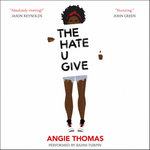
The Hate U Giveby Angie Thomas, Bahni Turpin (Narrator) Unabridged Audiobook, 11 hrs., 40 min.
HarperAudio, 2017
Read: July 27 – August 1, 2017

I’ll be honest, the hype around this one turned me off initially. It just didn’t seem like my kind of thing. But my wife bought a copy and tore through it and started telling everyone she came across that they needed to read it (especially those of us she lives with). When I saw the library had a copy of the audiobook, I snagged it, because I hadn’t got that far on my TBR. By this time, I only remembered “YA,” “something about Black Lives Matter,” and “Mrs. Irresponsible Reader said I needed to.” Which is about as tabula rasa as one could get when coming to a book.
Our central character is Starr Carter. She attends a very nice private school in the suburbs of whatever unidentified city she lives in. She plays basketball there, has friends and a boyfriend and seems to be generally well-regarded by all. Then there’s her “other life”, that has almost no relation to that one — she and her family live in a poor neighborhood where almost no one knows her by anything but “Mav’s daughter what works at the store” (or something close to that). She has a friend or two in the neighborhood, but mostly works and then goes home. On one of the rare nights she goes out to do something social, she runs into her childhood best friend, Khalil, who she hasn’t seen for a few months. Their reunion is cut short, sadly, while he drives her home and they’re pulled over by a police officer for a routine traffic stop. I’ll leave the details for you to read on your own, but essentially, her unarmed friend is shot repeatedly by the police officer in front of Starr.
In the days that follow Khalil’s death is a nationwide story, Starr’s being questioned by the police and is trying to keep her psyche intact while the wheels of justice grind slowly. There are problems at school, unforeseen challenges at home and in the neighborhood, add in the involvement with the criminal justice system and activists, and it’s clear that neither of Starr’s lives are going to be the same again.
Yes, this book is about the shooting of Khalil and the aftermath. But it’s about more than that, too. Similar to the way you could say that To Kill a Mockingbird is about the trial Tom Robinson and its aftermath. There’s a whole lot of other things going on in both books that are just as much a part of the essence as the shooting/trial. There’s family growth and change, individual characters learning more about the world and changing, there’s the evolution of localities and best of all, there are characters taking all of this in and exercising a little agency to change themselves — and impact everything in around them.
One thing I didn’t expect was how fun this book would end up being. I laughed a lot — her father’s strange theories about Harry Potter, her Fresh Prince of Bel Air obsession, the teasing between her friends, her family’s very cut-throat approach to watching the NBA finals and trying to jinx each other’s teams, are just a start. Even when it’s not being out-and-out funny, there’s a joie de vivre that characterizes the lives of these characters.
When they’re not grieving, being threatened (by criminals or those who are supposed to be protecting them from criminals), being angered at the way that the system seems to be destined to fail them, or scared about their lives, that is. Because there’s a lot of that, too. All of which is justified. The interplay between the emotional extremes speaks volumes to the authenticity of Thomas’ work, and makes it much more effective than it could’ve been in less careful hands.
There are so few YA novels with healthy — or existing families — that Thomas should probably win an award or three just for having so many in one book. None of the families are perfect (though Starr’s comes close), some push the boundaries of “dysfunctional” into something we need a new word for; but at the very least there were at least a core of people caring about each other and trying to help each other, in their own way.
Yes, there are political overtones — or at least ramifications — to this book, but this is first and foremost a human story and can be appreciated by humans from all over the political spectrum. Thomas, as far as I can tell, went out of her way to be fair and balanced. It’d have been very easy to paint some of these characters/groups as all evil, all good, all misunderstood, all [fill in the blank]. Instead, she took the more difficult, more honest, and much more interesting approach and filled the book with people all over the moral spectrum, no matter their profession, ethnicity, socio-economic background, education, etc.
A few words about Turpin’s work. I loved it. She was just fantastic, and rose to the challenge of bringing this kind of book to life. Looking at her credits just now, that doesn’t seem like much of a stretch for her — she’s clearly a talented heavy-hitter on the audiobook front.
I laughed, I cried . . . it moved me. This is the whole package, really. It’ll challenge you, it’ll entertain you, and give you a little hope for tomorrow (while helping you despair about the time until tomorrow comes).
—–

Having trouble finishing a post in time for this morning — mostly it’s that there are too many things I want to say about a few books and I’m having trouble narrowing it down. So, here’s a re-run of something I liked having written.
I was bemoaning how long my current read was the other day and how it was going to leave me without a post for today, and my ever-so-clever daughter suggested, “Why don’t you list the Top 10 Books from your childhood?” That sounded pretty fun, so I figured that I might as well. It turned out to have been better than I thought, so kudos to her.
Ranking them really would be impossible, but then 11 came to mind really without any effort, and I couldn’t axe one of them, so there’s a bonus entry to the list. All of these I read more than I can count — if they’re part of a series, these were the ones that I came back to most often. The links are to Goodreads pages because I can’t find good official pages for all the books/authors (a true sign of my age, I guess).
Enough of that, on with the trip down Amnesia Lane:
The Castle of Llyrby Lloyd Alexander
The Chronicles of Prydain taught me most of what I needed to know about Fantasy (augmenting The Chronicles of Narnia‘s lessons). Fflewddur Fflam here is at his best, I think it’s here that I fell in love with Eilonwy, Taran’s more of a real hero than before, and you get plenty of Gurgi (who I just have to mention because thinking of him makes me smile). There’s peril, the characters grow more than they have before, a hint of romance . . . it’s not the most important book in the series, but I think it’s pivotal.

Danny Dunn and the Anti-Gravity Paintby Raymond Abrashkin and Jay Williams
I didn’t know until today that this was the first in the series, I always figured it was mid-series. It’s the only one of the series that I owned — thankfully, the library had a few more — so it’s the one I read most. It was also my favorite — I just loved the stuff at the edge of our solar system and Prof. Bullfinch and Doctor Grimes making musical instruments from their hair — stupid as all get out, but it worked for me.

The Mystery of the Dead Man’s Riddleby William Arden
While Encyclopedia Brown (see below) got me reading mysteries, it was The Three Investigators — Jupiter Jones, Bob Andrews and Pete Crenshaw (btw, the only thing there I had to look up was Pete’s last name — not bad for a series I haven’t touched since the late 80’s) got me hooked on reading detective series. The Dead Man’s Riddle was one of my favorites — and I think the first or second I read — something about the Cockney slang kept bringing me back to it. I read what I do today because of this series, really.

Superfudgeby Judy Blume
I remember Tales of a Fourth-Grade Nothing being funnier, but this was a better story — the Fletchers leaving NYC, Peter maturing, Fudge being a real pain, not just a cute nuisance. Blume taught me a lot about how to read non-genre stuff, probably paving the way for Hornby, Tropper, Weiner, etc.

The Last of the Really Great Whangdoodlesby Julie Edwards
What a great world, what a great magic system . . . I’m not sure I can express what this book meant to me as a kid, and the copious warm-fuzzies the memory brings up. I remember that it was in the pages of this book about a magic kingdom that I first learned about DNA and RNA (and what those letters meant) — thanks, elementary school science classes. The creatures’ names in this are great (and, as an adult, I can “hear” Andrews saying them in my mind for an added layer of fun). There’s a great deal of whimsy here, a sense of play that permeates this — even when it gets silly. The kingdom’s motto, “peace, love and a sense of fun” really sums up the spirit of the book.

Me and My Little Brainby John D. Fitzgerald, Mercer Mayer (illus.)
Sure, the series was supposedly about Tom, but J. D.’s the real hero of the books. He has a conscience, a better moral compass than his brother — and is probably just as smart. This is the book that lets him shine as he ought to have all along. All the books had their strong points, and were fun, but this ruled them all.

The Phantom Tollboothby Norton Juster, Jules Feiffer (illus.)
Such wordplay! What a great, twisted way to teach how important words and ideas are. Seriously, just a wonderful book. The humor is so off-kilter, any appreciation I have for puns came from this book (and it set the standard that a pun must achieve for me not to groan). If you haven’t seen the documentary about it, The Phantom Tollbooth: Beyond Expectations, get on it. (I contributed to the Kickstarter for it, I should add).

The Voyage of the Dawn Treaderby C. S. Lewis
I remember the bookstore where I bought this, the date and month that I bought it, and reading a good chunk of it before I got home. I read this one more than the rest of the series (Prince Caspian a close second). I just love this one — you get Reep at his bravest and funniest, some really odd creatures, an epic story, and Eustace’s redemption (back when I did crazy things like this, I almost got a tattoo of Eustace as Dragon). Who could ask for more?

Alan Mendelsohn, the Boy from Marsby Daniel M. Pinkwater
Pinkwater has funnier and stranger books (both before and after this one), but there was heart, there was depth — there was length! — to this story about a kid who didn’t really fit in until he made a friend who didn’t want to fit in. This is another one where I can peg the place and time I bought it. Science Fiction-y in a real world (didn’t know you could do that!), comic book geeks as heroes, and real non-sanitized-for-kids emotions. There’s no way this wouldn’t be a favorite. More than the rest on this list, I’m thinking of finding my old copy and taking it out for another spin (because I just read the next one a couple of years ago).

The Westing Gameby Ellen Raskin
If I had to pick one off this list (and I don’t), this would probably be my favorite. I re-read it two years ago, and it was one of my favorite experiences that year with a book. The characters are great, the story was so clever, the writing so crisp. There’s nothing wrong with this book at all.
I saw a hardcover reprinting of this on Monday, and had to fight to resist buying a new copy. Kind of regretting that now. [Note: I went back a couple of days later and bought the hardcopy. It looks very nice on my shelf]

Encyclopedia Brown, Boy Detectiveby Donald J. Sobol
Summer after second grade, we were on a forever-long road trip and I was bored, so I demanded my parents buy me something to read. I must’ve been a real snot about it, because at the next town, they did. I got two books, this one and Sugar Creek Gang Screams in the Night (not the best in the series, but it was good enough to read several times). It blew me away — I loved the puzzles, the characters, the idea. I wanted to be a P. I. This was my first mystery book, and it clearly set the stage for most of what I’ve read since (about a third of what I read).
Were you a fan of any of these as a kid? What were some of your faves? Have you read them lately?
Oh fer cryin’ out loud, after I finished writing this, I noticed that the publisher’s description starts with the same quotation I started my post with. I swear I didn’t steal the idea.
—
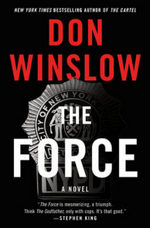
The Forceby Don Winslow
Hardcover, 479 pg.
William Morrow, 2017
Read: June 26 – 29, 2017

Our ends know our beginnings but the reverse isn’t true.
If Denny Malone’s beginning knew his ending, would it have prevented anything? Or would Malone have convinced himself he could find a work-around? Probably the latter.
Denny Malone is a one of NYPD’s Finest — a detective sergeant, and the head of a task force (known as “Da Force”) on the front line of the War on Drugs. He and his team — who’ve been together for years — rule Manhattan. Sadly — and perhaps naturally — they’re corrupt. They take (and are given) money, drugs, weapons and more from criminals (of all levels), lawyers and others. They pass on some of these to lawyers, city officials and other cops — and keep a whole lot for themselves. Through their methods, they do keep some sort of peace on their streets — sure, they pass on some of the violence and poison on to other parts of the city, but that’s not their concern.
After doing this for years, the wheels start to come off — it’s tough to say what the first domino (to mix metaphors) was to fall, but once it does, there’s nothing stopping the rest — as much as Malone may try. The result is one of the most powerful crime novels I’ve read in years.
The characters are rich, fully developed and they seem like they could step out of the book onto the streets of NYC with no trouble. You are sickened by them, want to see them stopped — yet start to understand them, like them as people, and — despite yourself — hope at least some of them get away with it all. At one point, I was laughing at their banter like we were all old friends hanging out, and it bothered me how much I enjoyed them as people (that faded somewhat in a few pages).
This book feels like the love child of Tom Wolfe’s The Bonfire of the Vanities and Nicholas Pileggi’s Wiseguy. You really feel like you understand how the city of New York is run — at least parts of it: the police, elements of the criminal world, and parts of the criminal justice system. Not how they’re supposed to run, but the way it really is. He achieves this through a series of set pieces and didactic pericopes. Three quick examples: you get Malone musing on how the way that cops have to learn how not to care about citizens and criminals, because otherwise, they’ll end up hating them. A great section showing how The Force goes out on the town to celebrate. The following quotation about the attitude of a prosecutor and Malone about his creative use/understanding of the truth while testifying:
Because the real truth that they both know is that without cops “testilying,” the DA’s office would hardly get any convictions at all.
This doesn’t bother Malone.
If the world played fair, he’d play fair. But the cards are stacked against the prosecutors and police. Miranda, Mapp, all the other Supreme Court decisions, give the advantage to the skels. It’s like the NFL these days–the league wants touchdown passes, so a defensive back can’t even touch a receiver. We’re the poor defensive backs, Malone thinks, trying to keep the bad guys from scoring.
Truth, justice and the American way.
The American way is, truth and justice maybe say hello in the hallway, send each other a Christmas card, but that’s about the extent of their relationship.
You throw that kind of stuff in with a compelling plot, believable characters, striking details and Winslow’s voice? You’ve got yourself a dynamite book.
If someone had told me this was non-fiction, I’d believe it (maybe I’d balk at some of the details of his personal life being told in a Non-fiction book, but otherwise…). It rings true — and I spent most of the book just hoping that Winslow was exaggerating and fearing that he was holding back. The whole thing feels real, it seems ripped from the headlines, and is beyond engaging — it’s engrossing, it’ll take over your mind, make you see deception and corruption everywhere.
Winslow nailed it. It’s just mindbogglingly good. I’m going to over-hype it if I keep going — so I’ll leave it at that. Get this book and then strap in for one of the best reads you’ll have this year.
—–

The Right Sideby Spencer Quinn
eARC, 336 pg.
Atria Books, 2017
Read: May 11 – 12, 2017

Okay, since I first opened the pages of Dog On It 8 years ago, I’ve been a Spencer Quinn fan — it probably took me two chapters to consider myself one. So it’s kind of a given that I’d like this book — but only “kind of.” This was so far from a Bowser & Birdie or Chet & Bernie book that they could be written by different people.
Sgt. LeAnne Hogan was an excellent athlete in her childhood and teen years, and then she joined the Army (deciding her West Point plans would take too long — an oversimplification that’ll do for now) and became an excellent soldier, serving multiple tours in combat zones. During her last sting in Afghanistan — as part of a team working to build intelligence sources among Afghan women — she is involved in an attack that leaves some dead and her injured — physically and mentally.
Her memories of that fateful day are vague and dim at best, but the scars will not leave. Not only that, she lost an eye, her confidence, her future plans, and career. She slowly befriends a woman who lost part of her leg to an IED in Iraq who shares a room with LeAnne in Walter Reed. Marci dies suddenly and unexpectedly — and that is too much for LeAnne. She leaves the hospital immediately and sets off on a drive across the country, she really doesn’t have a plan, but she needs to be somewhere else.
It’s pretty clear that LeAnne is suffering from PTSD on top of everything else — as you’d expect. She comes across as angry and rude to almost everyone she runs across and exchanges more than a few words with. She eventually finds herself in Marci’s hometown — where her daughter has gone missing. For the first time since the day everything changed, LeAnne has a purpose — bring her friend’s daughter home. Along the way, she LeAnne gets adopted by a large dog who will prove an invaluable aid in this challenge.
LeAnne is a great character — not a perfect person by any means, but you can see where a lot of writers (novelists or journalists) would try to paint her as one. She has huge flaws — some of which are easier to see after the injury (and some of them are new after it, too). There are some other good characters, too — even if you don’t necessarily like them (LeAnne’s mother would be an example of this — she’s trying to do the right thing, but the reader can sense LeAnne’s apprehensions toward her — and will likely share them). The people in Marci’s hometown (particularly those that are related to her) are the best drawn in the book — and I’d be willing to read a sequel or two just in this city to spend more time with them. Not everyone gets what LeAnne’s going through — some don’t know how to react to her — but those that come close will endear themselves to you.
The dog, Goody, isn’t Chet, he isn’t Bowser — he’s a typical dog, no more (or less) intelligent than any other. Goody won’t be serving as the narrator in a story any time — he will drink from the toilet bowl and ignore a lot of what LeAnne wants him to do.
Like I said, I’m a Quinn fan — but I didn’t think he had this in him. Funny mysteries with dogs? Sure, he’s great at those. But sensitive explorations of veterans dealing with the aftermath of life-altering injuries? I wouldn’t have guessed it. But man . . . he really got this flawed character, this incredibly human character, right. There’s a couple of moments that didn’t work as well as they should’ve — a couple of moments that were hard to believe in a book as grounded in reality as this book was. But you know what? You forgive them easily, because so much is right with this book — so much just works, that you’ll accept the things that don’t. It wasn’t all dark and moody — there’s some hope, some chuckles, a lot that is somber and sad, too. While not a “feel good” read by any means, you will feel pretty good about who things end up.
This is probably categorized as a Thriller, as that’s where Quinn’s readers are — but I can see a case for this being labeled General Fiction (or whatever synonym your local shop uses), it’s flexible that way. This is Spencer Quinn operating on a whole new level with a character we need more like — such a great read.
Disclaimer: I received this eARC from Atria Books via NetGalley in exchange for this post — thanks to both for this.
—–

Powered by WordPress & Theme by Anders Norén