Tag: Mystery/Detective Fiction/Crime Fiction/Thriller Page 28 of 61

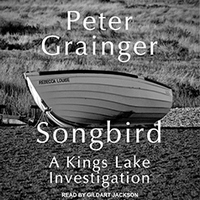
Songbird (Audiobook) by Peter Grainger, Gildart Jackson: Passing the Baton

SongbirdSongbird

by Peter Grainger, Gildart Jackson (Narrator)

DETAILS:
Series: A Kings Lake Investigation, #1
Publisher: Tantor Audio
Publication Date: September 18, 2019
Format: Unabridged Audiobook
Length: 15 hrs., 6 min.
Read Date: June 27-July 1, 2022

Support Independent Bookstores - Visit IndieBound.org

DCI Reeve was in the room now, accompanied inevitably by Detective Chief Superintended Allen. Another promotion, how was that possible—what did he actually do all day but get in the way of more junior officers trying to solve crimes and bring about convictions. Waters stopped that train of thought. Over time, we all become our fathers and mothers, that’s a sort of natural process. But surely we don’t all become our first Detective Sergeant as well.

What’s Songbird About?

It’s the first murder that’s fallen under the jurisdiction of King’s Lake since Chris Waters was promoted to Detective Sergeant, and it’s time for him to step up.

There’s been a killing at a caravan site that’s well-known to Waters, and he knows the manager. This will both work for and against him, but early on it gives him some confidence—he knows this area and doesn’t have to learn anything about his surroundings. He needs all the confidence he can get.

DI Terek and DCI Reeve take the lead on this investigation (Reeve’s much more hands-on than her predecessor, and things are better for it). Some very convincing evidence leads them to focus on a suspect early, and they go about building their case.

For reasons he can explain, and some that remain ineffable, Chris Waters doesn’t believe in their suspect’s guilt and Waters follows his mentor’s example and sniffs around a little himself. He doesn’t have the relationship with his superiors that DC Smith did, though, so he has to be careful about it. Thankfully, Serena Butler (when she’s not giving him grief over his promotion), agrees with him and the two are able to come up with some compelling reasons to look elsewhere for the guilty man.

Passing the Baton

It’s a tricky thing that Grainger tries here—the series protagonist is gone, and yet it continues. It reminded me of when Kyra Sedgwick’s Deputy Chief Brenda Leigh Johnson left The Closer and the show became Major Crimes, and the team was then led by Mary McDonnell’s Capt. Sharon Raydor. The tone shifted, the characters got to grow and develop in different ways, the team functioned differently, and the approach they took to closing cases changed, too. But the show still worked.

Grainger’s always kept a broad view of the characters while focusing on DC Smith in the past—now we spend a little more time with everyone, but the focus is on Chris. That alone will change how things go—Chris has less experience to draw upon, he’s not quite as jaded (but he’s getting there), and generally sees things differently. The introduction of Cara Freeman and her methods to the mix also changes things (sure, she’s been around for a while, but we really see her at work here).

So the series continues, it just looks and feels a little different. But the core of the storytelling seems like it’s going to persevere.

Gildart Jackson’s Narration

It’s a subtle thing, but I thought I picked up a little change in the narration—it’s got less of “DC’s voice” but it’s still distinct from other books that Jackson’s narrated. Maybe it’s all in my head, but I think I can tell the difference in his approach to the books. It doesn’t matter, Jackson’s voice and characterizations bring me to King’s Lake Central they bring the world to life. Another great job by Jackson.

So, what did I think about Songbird?

Okay, the initial suspect was clearly innocent—and it took far, far too long for someone to figure out where the evidence that implicated him came from—it was maddening yelling at my phone, waiting for them to get there. But it was satisfying very satisfying when they finally put two and two together.

And for readers of procedurals, the guilty party was pretty clear all along—but getting to the motive and then working the case so that they had evidence to arrest, that was great. Watching Waters and the rest carry on Smith’s mission was exactly what a fan wants—and the new DCI in charge of the Murder Squad, Cara Freeman has her own style and pace that makes for a pleasant new dynamic.

The plot part of this novel wasn’t Grainger at his best, but it was close enough (so close). But the heart of this book was on the transitions—the team moving on from DC, the further establishment of the Murder Squad, Waters transitioning to DS (and people getting used to that), DC transitioning to his new life—plus some personal stuff that I don’t want to spoil. And Grainger absolutely nailed it.

As this is a transition point—it’s a great time to jump in. Yeah, there’s a lot of backstory, but none of it is necessary to get 98% of this book.

This had to be a tricky needle to thread for the series (singular or plural, take your pick), and Songbird pulled it off. I’m not at all surprised to see it, but I’m very pleased.


4 Stars

This post contains an affiliate link. If you purchase from it, I will get a small commission at no additional cost to you. As always, the opinions expressed are my own.

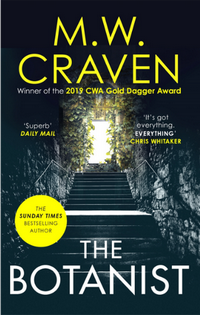
The Botanist by M. W. Craven: Nothing is Without Poison

The BotanistThe Botanist

by M.W. Craven

DETAILS:
Series: Washington Poe, #5
Publisher: Constable
Publication Date: June 2, 2022
Format: Hardcover
Length: 429
Read Date: July 5-6, 2022

Poe nodded. ‘I hate locked room mysteries,’ he said.

What’s The Botanist About?

There’s little that mystery readers/watchers enjoy more than a locked-room mystery, but you can understand why someone who actually has to solve mysteries for a living isn’t quite a fan.

And that’s not good for him because there are two cases in this book involving locked room mysteries—one Poe and Tilly are assigned to, one they take because they’re asked (and would take on even if they weren’t).

It occurs to me that I should probably define the term I keep using, just to be careful. Last year, Gigi Pandian (no slouch when it comes to locked-room mysteries) provided one on CrimeReads:

Locked-room mystery: A crime has been committed in a room or other location that’s been sealed from the inside, with no way out. An example is a dead man found inside a windowless room that’s been sealed from the inside, dead from a gunshot wound that people outside the room heard fired, yet inside the room there’s no gun and no way for the culprit to have escaped. Thus a locked room is only part of the equation; the key is that the situation appears impossible.

And Poe has two cases to work through. Should be easy, right?

Case #2 (Chronologically, Anyway)

Back in 2020, when I posted about The Curator, I said: “I know it’d be pushing things to have [Estelle Doyle] play a larger role in these books than she does, but the few scenes we have with her are just not enough to satisfy.” I’m so glad to be wrong—Doyle does play that larger role here, and it’s as good as I’d hoped it’d be.

Doyle, I should probably say, is a forensic Pathologist—one of the best around. She’s Poe’s go-to person any time he had questions about something wet and organic.” She shamelessly and aggressively flirts with him, going out of her way to make him uncomfortable—we’re told that “Poe was terrified and bewitched in equal measure.” Some things never change—in 2018’s Black Summer, Poe thinks she’s “incredibly sexy and utterly terrifying.”

And she’s been arrested for her father’s murder. Her comment to the police? “Tell Washington Poe.” That’s all she has to say to get Poe on the case, subverting the work that the DCI (and the rest of the Northumbria police) have done on the case.

There’s no evidence that anyone but Estelle or her father was in the house the day he was shot. There’s also no gun. Is it any wonder that Poe hates locked room mysteries?

Case #1

So the case that DS Washington Poe is supposed to be working on is hunting down a poisoner that the press has dubbed The Botanist.

His victims are high-profile figures, generally in the news for less than admirable activities/views (a racist political analyst, etc.). He mails them a poem and a pressed flower, and then they die a few days later. It doesn’t matter what precautions they take, how involved the police are, how secure their living space is…they die. It’s that simple.

Because these are notorious figures, The Botanist quickly develops a fan base—people are celebrating him, making him into a folk hero of sorts. There’s a lot of pressure on Poe and the other detectives working the case to put an end to his career before he inspires copycats/disciples. The dynamic of a large degree of public sympathy for the killer is a new angle for this series, and I really appreciated it.

A Quick Word About Tilly

I’ve been anticipating what Poe might need next and I have a program running. It’s called RipplePlace and I expect the results in approximately ninety seconds.’

‘And what’s that?’

‘It’s a search and merge algorithm, sorting key data into lexicographical order,’ Bradshaw explained, explaining nothing.

And with that she left the room. Doyle looked at the empty doorway in amusement. ‘I think she may be my favourite person ever,’ she said.

Poe nodded. ‘You understand any of that?’ he asked.

‘Not a word.’

Tilly Bradshaw isn’t as prominent in this novel as readers are used to—and really couldn’t be, because of all the other characters running around, and the way that the story had to be paced. But even when she wasn’t “on camera” (if you will), she was a presence—people were sharing some tidbit about her, using something she’d dug up, etc.

And when she was “on camera”? It was gold. She’d pull off some sort of wizardry with tech, get some sort of data put together in a way no one else would, or would say/do something to make you grin (at least). She really is a great character. It’s hard to disagree with Doyle, she just might be my favorite.

So, what did I think about The Botanist?

Poe had seen people die before. Too many times. Perceived wisdom was that police officers became desensitised to death, but he wasn’t sure it was true. It certainly wasn’t for him. The dead stayed with him. Haunted his dreams and occupied his waking thoughts. They were the soundtrack to his life and the day he couldn’t hear them would be the day he handed in his warrant card. Poe needed to live among the dead. It was how he protected the living.

One of my favorite days the last few summers have been the day the new Washington Poe/Tilly Bradshaw book arrives—topped only by the day I get to start it. This year has been no exception—I finished it five days ago, and am still riding the high.

Time with these characters is like walking into Cheers—you know everyone, you enjoy their company, the only thing you don’t know is what escapade they’re in the middle of. Sure, Sam and the gang were never on the hunt for a serial killer,* but you get my point. Craven takes some of the relationships in new directions here, brings in some new figures, and generally keeps them from being stale—but Poe, Tilly, Flynn, and Doyle are who we’ve come to know and love(?) over the last four novels.

* Or did they? I don’t know—they got into some strange areas there in Season 11.

The cases were just great. Estelle’s case was on the easy side for the reader to suss out (and I was close to right on the motive, as right as Poe was)—but that didn’t make it any less satisfying to read. And the reveal (and the events that led to it) were pulled off so well that I’m not going to complain a bit.

The solution to The Botanist case, on the other hand, was brilliant. I don’t want to say more than that so I don’t tip off anyone, but when the pieces started fitting together enough that you could see the solution coming? I had to stop for a minute to laugh at how perfect it was—but it’s one thing to figure out how the killer’s doing something, it’s a whole nother thing to catch him. Craven’s ending was fantastic—when I was finished, I wrote my last note: “the last 30 pages made me happier than almost anything else this year.”

For me, one of the best parts was how much of this book is dependent on characters other than our protagonists. Absolutely, the cases don’t get solved without Poe and Tilly—their investigations, research, bold moves, etc. are essential. But the secondary characters are are who provide the brilliance, the plans, and the insights that stop the Botanist and set up the dynamite conclusion. The day isn’t saved without our hero, but Poe doesn’t save the day. Fans of the series aren’t going to mind it because of the way that Craven has constructed this universe—he’s set up the other characters to be the kind of people that operate at Poe’s level (if not beyond it), so by all means, let them shine. Also, it makes the whole series more grounded, more believable if it’s not always Washington Poe who solves everything.

Clearly, I loved this. I strongly recommend it—and everything Craven’s written. Now it’s time for me to start waiting for my favorite day of the summer of 2023.


5 Stars

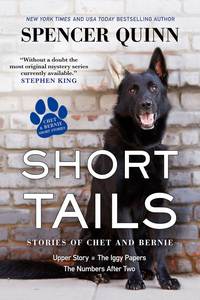
Short Tails by Spencer Quinn: Too Short, but a Lot of Fun

Short TailsShort Tails:
Chet & Bernie Short Stories

by Spencer Quinn

DETAILS:
Series: Chet and Bernie
Publisher: Forge Books
Publication Date: June 28, 2022
Format: Kindle Edition
Length: 90 pgs.
Read Date: July 7, 2022

I grabbed him by the pant leg, which was how we closed our cases, me and Bernie.

“Aieee! Aieee!”

Oh, come on, Chuckie! Suck it up. My teeth were barely engaged at all. But the funny thing is that when that Aieee sound is in the air, they—meaning my teeth—get this sort of…urge.

“AIEEE! AIEEE!”

What’s Short Tails About?

This is a collection of short stories from the Chet & Bernie series. I don’t normally do this for short story collections, but the collection is brief enough that I can get away with it, let’s take a quick look at each.

Upper Story

I want to say that this takes place during Scents and Sensibility, but I can’t swear to it (if it didn’t, I might as well have). Bernie’s in the hospital, so Chet’s staying–and working with–their friend, Rick Torres. This story is heavy on Chet’s actions and his contrasting appraisal of working with Bernie vs. Rick. As you’d expect, the comparison does not go in Rick’s favor (no matter that he’s freer with the Slim Jims).

It’s a very short story with a great emotional punch and some good chuckle-inducing lines. I’d have honestly expected this to be last in the collection because of that–but what do I know?

The Iggy Papers

This is probably the most satisfying story in the bunch. Like with The Iggy Chronicles, this focuses on something to do with Mrs. Parson’s medical care. Bernie gets to flex his investigative muscles here a bit more than in the other stories from the book, and Chet’s major contributions come from his commentary and interaction with Iggy.

This is everything that a Chet and Bernie short story should be.

The Numbers After Two

It’s been a bit since we got to see Bernie’s head for finances on display (more accurately, total lack of one), this story gives us a tale about an interrupted vacation for the detectives and a chance to see Bernie’s gullibility on display.

I know that it’s good to see Bernie’s fallibility–Chet tends toward hagiography when he describes Bernie. We need to see him stumble outside of his romantic relationships–but I have such trouble buying that he can be as gullible as he so often is when it comes to financial schemes and yet be such a good detective. Still, this is who he’s been since Day 1 of the series, so we need to see it every now and then.

The story isn’t all about watching the train wreck of Bernie making a bad investment*, but it’s the heart of it–the rest of the story makes up for that part of it, and it ends on a good note (as it started).

* That feels like a spoiler, but if you don’t know what’s going to happen the instant that Bernie gets a wad of cash, you haven’t been paying attention.

So, what did I think about Short Tails?

These were cute stories, but there were too few of them. If this collection was 2 or 3-times as long? I’d have been as happy as a dog with a new Kong. I had fun with this, but it was just enough to satisfy me. But not much more than that.

Still, I’ll take any excuse to read a Chet & Bernie story, and I figure most of Quinn’s readers will, too. So yeah, I recommend it.


3 Stars

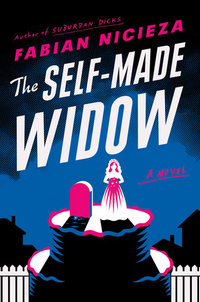
The Friday 56 for 7/8/22: The Self-Made Widow By Fabian Nicieza

The Friday 56This is a weekly bloghop hosted by Freda’s Voice.

RULES:
The Friday 56 Grab a book, any book.
The Friday 56 Turn to Page 56 or 56% on your ereader. If you have to improvise, that is okay.
The Friday 56 Find a snippet, short and sweet.
The Friday 56 Post it.

from Page 56 of:
The Self-Made Widow

The Self-Made Widow by Fabian Nicieza

At 7 in the morning on Monday, Kenny sat in a makeup chair before his segment on Fox & Friends. He had been on the network often enough that he’d lost any sense of the jitters. The segment went smoothly. The negative was that clearly none of them had read the advance galley of his book, but the positive was that they let him do the bulk of the talking during his segment.

As he left the studio on Sixth Avenue, Kenny got a text from Albert congratulating him on a job well done. He pocketed the phone and entered the subway station. He didn’t really care. Insofar as it would help the book sell, he was satisfied, but Kenny had gotten to the point where appearing on other people’s shows wasn’t enough. He wanted his own show.

Not on a stupid cable news channel talking about the hot air of the day. Something more. A Vice meets adorable but serious Jacob Soboroff meets Columbo magazine type of thing. But for a streaming platform, with episodic storytelling, blowing the lid off unsolved murders, corporate crimes, political scandal.

He didn’t want to wait any longer. He felt he had been waiting his whole life.

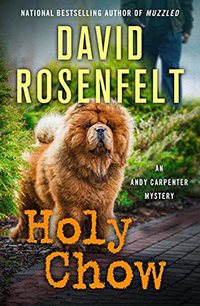
PUB DAY REPOST: Holy Chow by David Rosenfelt: Keeping the “Semi” in Andy’s Semi-Retired Status

Holy ChowHoly Chow

by David Rosenfelt

DETAILS:
Series: Andy Carpenter, #25
Publisher: Minotaur Books
Publication Date: July 5, 2022
Format: eARC
Length: 304 pg.
Read Date: June 20, 2022
Support Independent Bookstores - Visit IndieBound.org

What’s Holy Chow About?

About a year ago, Rachel—a new widow in need of a companion—came into the Tara Foundation’s dog rescue facility and fell in love with a Chow Chow named Lion (who reciprocated)—Andy remembered her fondly. Then she calls out of the blue with a favor—will Andy take the dog if she dies and her stepson, Tony, can’t/won’t take the Lion?

Andy says of course he will. Within a week, Rachel’s been murdered and Andy learns more about this woman. She was rich, in an eye-popping kind of way, and Andy is told to come to the will reading. He’s confused by this, but assumes it has to do with taking possession of Lion (just in an unusual way). The reading is interrupted by the police coming to arrest that stepson for her murder.

Andy visits Tony and decides to take his case—for solid, evidence-based reasons, and not at all because he seems like a nice guy, his Great Dane mix had recently died and he’s excited to take Lion. Okay, that’s not true—Andy smells something off about the case, but it’s (naturally) because Tony’s a nice, dog-loving guy.

The police and prosecution are presenting this as a case of an heir being angry at the size of their inheritance. But Tony doesn’t have a history of being that interested in money. Andy wonders if the murder might have something to do with the fact that Rachel had been taking an interest in her late husband’s company’s day-to-day activities lately. Or is there maybe something else afoot?

It’ll take the combined efforts of Andy’s firm, The K-9 Team, and the Bubeleh Brigade (the retirees-turned-hackers that Andy uses from time to time) to get to the bottom of this.

When Will They Ever Learn?

I’m not wondering why prosecutors don’t immediately drop the case when they hear that Andy has taken on a client. He does have a few guilty verdicts on his record. Although, you would think they’d require the police to tighten up their cases and make sure there aren’t any threads hanging once Andy requests discovery.

But what I wonder is that given his track record, why they don’t take him seriously when he calls the FBI, DEA, Homeland Security, or any other three-lettered agency. (note: I wonder similar things when Joe Pickett starts meddling in non-wildlife issues). I’m not saying they need to roll out the red carpet or anything for him—don’t let Andy Carpenter, of all people, call any shots. But he shouldn’t have to rely on favors from a friend of a friend or threats to get someone to take him seriously anymore.

How does no one have this conversation:

Agent 1: Hey remember that guy who tipped us off to that terrorist organization and saved all those lives a couple of years ago?
Agent 2: That lawyer with the hot wife and the scary bodyguard, sure. Didn’t he also tip us off to the smuggling ring last Winter?
Agent 1: Come to think of it he did.
Agent 2: Why are you bringing him up?
Agent 1: Well, he’s got this theory about _________ now.
Agent 2: Might be worth sitting down with him, looking at his theory.

Although, some of that threatening and calling in favors can make for entertaining scenes. So, y’know…

So, what did I think about Holy Chow?

Andy Carpenter #25? That’s a mind-boggling number. I know it wasn’t that long ago that I read #24, but I don’t think it registered. So, does the Andy Carpenter series have anything new up its sleeve? (I’m tempted to make an old dog/new tricks joke here) I won’t rule it out, but we don’t see much new here.

But that doesn’t make this stale, either. There’s a comfort and a reassurance in knowing Andy’s behavior while the jury deliberates, the fact that Pete and Vince are going to bust his chops and put their food on his tab, that taking a walk with his dogs will help Andy come up with an idea, and so on.

I’m not trying to take a shot at anyone here, but where this feels comfortable and not tired and repetitive is that Andy has settled into these patterns—this is his life. He’s not, say, constantly second-guessing his choice of career (as much as he complains about it), he’s not trying to decide between a sexy Homicide Detective love interest and a lethal and hot Security Specialist love interest after 30+ books. Just to come up with some completely random example that no way could be describing any particular series.

I guess what I’m trying to say is that the twenty-fifth novel in this series might not have a lot that’s new, there’s still a lot of fun to have. And, we might get a glimpse of a different side of a long-running character (a continuation of something from Citizen K-9)

The humor is still present and sharp, the courtroom antics are fun (maybe a little subdued this time compared to others because of the case), and you can’t beat the time hanging with these characters. Both the solution to this case, the reveals involved, and the resolution are as well-delivered as always.

Readers new to the series or those who’ve been around since 2003* will find plenty to enjoy in the pages of Holy Cow. A good time should be had by all.

* Or at least since Open and Shut, no matter when they read it.

Disclaimer: I received this eARC from St. Martin’s Press via NetGalley in exchange for this post—thanks to both for this.


4 Stars

This post contains an affiliate link. If you purchase from it, I will get a small commission at no additional cost to you. As always, opinions are my own.

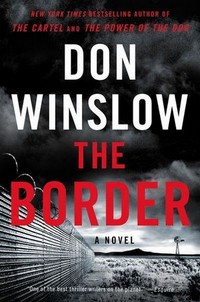
The Border by Don Winslow: Confronting the Ghost and the Monster

The BorderThe Border

by Don Winslow

DETAILS:
Series: The Power of the Dog, #3
Publisher: William Morrow
Publication Date: February 26, 2019
Format: Paperback
Length: 716 pgs.
Read Date: June 23-29, 2022
Support Independent Bookstores - Visit IndieBound.org


I can barely scratch the surface of this book—I spent months trying to write something about the previous book in the trilogy, The Cartel, before giving up because I tried to do my typical post with it. This time, I’m going to go pretty surface-level, just to get something written.

What’s The Border About?

Adán Barrera is dead. DEA Agent Art Keller’s personal White Whale is gone, and two things are up in the air: what is Keller going to do with his life/career now? and What will happen to the Drug Trade in Mexico? Barrera may have been an evil man with a trail of bodies in his wake, corrupting government officials on every level, and is responsible for getting countless people on both sides of the border addicted to poisons. But he was a stabilizing influence on the various competing gangs, and without him, chaos ensues.

Meanwhile, a ranking Senator gets Keller appointed as the new head of the DEA. Once there, Keller attempts to change the way the War on Drugs has been fought. As one on the forefront of the “old way,” he knows how poorly it has succeeded. If he’s going to make any kind of impact, he’s going to have to change the way things are done.

But it turns out there’s something uglier and dirtier than the heinous crimes Barrera and his colleagues and rivals are steeped in—U.S. politics. Keller has to battle factions in the DEA and other law enforcement agencies to put his plans into action. He commits to a risky plan that could make a real difference in the war—if he can pull it off.

If he can’t, his career, his freedom, and maybe his life are at stake.

A Financial Education

A key part of Keller’s new strategy is to watch the money—there’s a lot going back and forth across the border, both to buy drugs and then to launder it. But then…it turns out, the cartels wanted more. They couldn’t just sit on the money, no matter how clean it was—there was just too much to leave hanging around. So they invested it, and they wanted something out of those investments.

If Keller can stop the money from going back South, that would be a significant move in the War on Drugs. They’re not going to provide the product if they’re not getting paid for it.

I didn’t go into this book expecting to get a lesson in finance or anything, but I don’t know if I’ve learned as much about that kind of thing since The Bonfire of the Vanities or Liar’s Poker. But the numbers Winslow uses make what those guys were up to seem small.

Supporting Characters that Steal the Show

One thing that Winslow does time and time again throughout this trilogy is to take a character and treat them as a case study for someone in this war on drugs. He’s used hitmen, minor drug dealers, aspiring gangsters, and others. What’s amazing is that he will consistently take someone like this and turn them into a character you really care about while using them to illustrate a reality, and at some point to advance the plot, too. The latter is probably the most impressive part—they’ll spend so much of the book seeming like a digression—a compelling, often moving digression, but a digression—and then he’ll shock you by making them integral to a plot point.

There were two that really stood out to me in this book—most prominently was a ten-year-old Guatemalan boy, forced by his mother to travel to New York (alone) to live with his Aunt and Uncle. The alternative was staying in Guatemala City and being forced to work for the gangs. His journey north is heartbreaking—and what happens to him (and how he reacts) once he crosses the border just guts me.

The other one that will stick with me for a while is a young woman addicted to heroin. Her story is tragic and frequently predictable. That predictability ends up making it even more tragic the further into her story you get.

If nothing else, characters like these two remind you that the Drug War really isn’t about the DEA, the Cartels, the gangs, or anyone else—it’s about the people who get caught up in the middle. The victims. The addicts. The people most of us never see or think about.

So, what did I think about The Border?

This is a daunting read—before you open it up, and it stays that way until the last 150 pages or so.

But it’s a powerful read. A gripping read. A haunting read.

I’ll frequently talk about how a novel feels real, like the kind of thing you’d read in the news. Usually, when I say that, it’s a compliment—like I can’t believe how well the author was at portraying something realistic. But with Winslow, I don’t know that it’s a compliment. He’s done his research—so much of this book is true. So many of these characters are amalgams of several actual people and their crimes. In many cases, I’d wager that he’s toned down the violence, the money, the debauchery, the corruption—just to make it credible. That old line from Mark Twain, “It’s no wonder that truth is stranger than fiction. Fiction has to make sense,” comes to mind.

It doesn’t bother me to think that characters like Hannibal Lecter or Ernst Blofeld are running around this world, because they’re so clearly fictional. But Keller’s targets—those south of the border, in the world of finance, and the halls of power in Washington, D.C.? Those are real. Those are frightening.

This is a disquieting book. It’s disturbing. It’s distressing. And it’s supposed to be. Winslow’s trilogy is a monumental achievement. It will entertain you as well as make you reconsider your position on the Drug War.

I can’t say enough about this accomplishment. This trilogy is one of the best things I’ve ever read.


5 Stars

20 Books of Summer

Catch-Up Quick Takes: A Few May/June Books

The point of these quick takes posts is to catch up on my “To Write About” stack—emphasizing pithiness, not thoroughness. This time, I’m covering a few books from the end of May and June that I just don’t have that much to say about.


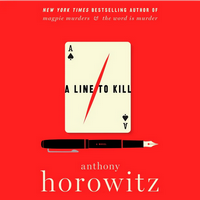
A Line to KillA Line to Kill

by Anthony Horowitz, Rory Kinnear (Narrator)

DETAILS:
Series: A Hawthorne and Horowitz Mystery, #3
Publisher: HarperAudio
Publication Date: October 18, 2021
Format: Unabridged Audiobook
Length: 8 hr., 50 min.
Read Date: May 26-31, 2022
Support Independent Bookstores - Visit IndieBound.org

(the official blurb)
If you were to ask me: “HC, what do you think of the Hawthorne and Horowitz series?” I’d tell you that I love the concept, I think Hawthorne is an intriguing character and that I really enjoy Horowitz’s fictionalized version of himself. And that’s true in theory.

I’m just not so sure about the practice. I had a hard time finishing this, and more than once thought about quitting. I’m glad I didn’t–the solution was pretty clever and the resolution was satisfying.

Hawthorne regularly annoyed me–and I found his antics held no charm for me. It’s a good read, but I can see my time with this series coming to an end soon (I can also see being won over soon, too).

(none of this is a reflection on Rory Kinnear, who did his typically good reading).
3 Stars

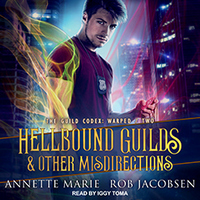
Hellbound Guilds & Other MisdirectionsHellbound Guilds & Other Misdirections

by Annette Marie, Rob Jacobson, Iggy Toma (Narrator)

DETAILS:
Series: Guild Codex: Warped, #2
Publisher: Tantor Audio
Publication Date: September 13, 2021
Format: Unabridged Audiobook
Length: 8 hr., 12 min.
Read Date: June 6-7, 2022
Support Independent Bookstores - Visit IndieBound.org

(the official blurb)
This does a great job of interweaving the events (and characters) of Demon Magic and a Martini and Taming Demons for Beginners into the events of this adventure–I love seeing the way Marie is creating a multi-faceted world here.

This time out, our petty criminal turned aspiring MagiPol Agent tries to help out his friend, Agent Shen, who had got him out of that life of crime. She needs a big win to stay in her current assignment and not be transferred to the last office on Earth she wants. Their snooping gets them on the trail of some of the shady demon contracts the aforementioned books were about and then we’re off to the races.

There’s some really good character development for Kit Morris here–especially when it comes to learning how to use his magic. This is a common tie between these series–all three protagonists are on a similar path. Given the varied amount of knowledge they all had going into it (totally unaware; not-that-experienced-but-fairly-aware; or a lot of academic knowledge, but little practical) keeps the series distinct, yet similar–which I really appreciate.

I do prefer the other magical threats these series covered before they all focused on demons. But I’m still enjoying the ride (rides?), so I’ll stick with these a little longer.
3 Stars

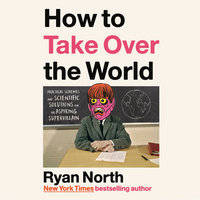
How to Take Over the WorldHow to Take Over the World:
Practical Schemes and Scientific
Solutions for the Aspiring Supervillain

by Ryan North

DETAILS:
Publisher: Penguin Audio
Publication Date: March 14, 2022
Format: Unabridged Audiobook
Length: 10 hr., 3 min.
Read Date: June 7-9, 2022
Support Independent Bookstores - Visit IndieBound.org

(the official blurb)
I’m clearly a sucker for popular-level science books with a humorous presentation (which means I really need to give Mary Roach another try, I know). In this one, North focuses on the kinds of cutting-edge science that a comic book/James Bond supervillain would use to take over the world, destroy large parts of it, accumulate power to themselves, etc.

He covers such things as cloning a dinosaur (sorry, Jurassic Park, it’s just not possible…), creating a new island to use as a secret base, becoming immortal, pulling off the perfect heist, and more. The punchline to the book is essentially that a supervillain is going to have to work hard to out-do what humans are doing already when it comes to destroying the planet.

Depressing conclusion aside–this was a fun book, and exposed me to a lot of things I never would have considered before. I’m not sure I retained as much as I would have liked to–but that’s on me, not North (who, by the way, was a perfect narrator for the material). It also means that I’ve got a good reason to listen to it again or to pick up the hard copy to refer back to. Recommended.
3 Stars

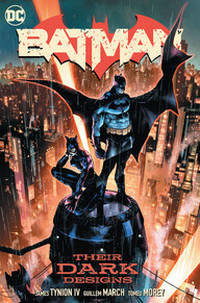
Their Dark DesignsBatman: Their Dark Designs

by James Tynion IV with too many artists to list for this kind of post

DETAILS:
Publisher: DC Comics
Publication Date: November 8, 2021
Format: Trade Paperback
Length: 264 pgs.
Read Date: June 18-25, 2022
Support Independent Bookstores - Visit IndieBound.org

(the official blurb)
I don’t read a lot of graphic novels/collections of individual comics lately, and don’t know what might appeal to me. I basically read whatever Lashaan Balasingam mentions that seems interesting. He recently posted about the last volume in this series and it got me curious.

This was a lot of fun–check out the blurb for details. I really enjoyed Tynion’s take on these characters (including the new ones)–if this is how he always writes the Dark Knight, I could be satisfied reading him for years. Most of the art was dynamite (a couple of the pencilers left a little to be desired). Simply put, this is exactly what I want in a comic series.

My major mistake is that I didn’t see that my library doesn’t have the 4 volumes that tell the rest of this story. I don’t want to spend the money on these, but not knowing how the story is going to resolve is a little maddening.
3 Stars

This post contains affiliate links. If you purchase from any of them, I will get a small commission at no additional cost to you. As always, the opinions expressed are my own.



			

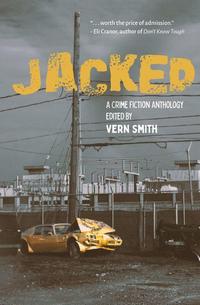
PUB DAY REPOST: Jacked edited by Vern Smith: A Dynamite Collection of Short Crime Fiction

JackedJacked

edited by Vern Smith

DETAILS:
Publisher: Runamok Books
Publication Date: July 1, 2022
Format: eARC
Length: 258 pg.
Read Date: May 23-26, 2022
Support Independent Bookstores - Visit IndieBound.org

What is Jacked?

Run Amok Books is a indie press from New Jersey, and they’ve recently launched a crime imprint. Jacked is their “inaugural anthology,” with 20 stories of all sorts of Crime/Thriller Fiction on display.

There’s some gritty realism, there’s some noir, there’s a police procedural/samurai mash-up set in the 80s, and there’s even a “cozy espionage” (a subgenre I learned was a thing in this book). You’ve got stories featuring cops, bikers, hipsters, thrill-seeking teens, kids just trying to survive, a mechanic, addicts, rookie publicists, and rookie criminals.

Some were harrowing. some were bleak, some made me grin, several shocked me, some depressed me, some made me recoil, and I didn’t really know how to react to a couple of them.

Basically, no matter how particular your Crime Fiction Taste is, you’re going to find at least one story in here that’s going to appeal to you.

Stories that I Have to Talk About

I thought about writing a sentence or two about each story but decided that never works out well for anyone—the post becomes too long to read and to write. Also, there are a handful that I’d end up ruining by saying something (a shocking twist in a 6-page story doesn’t carry an impact when you know it’s coming).

Looking over my notes, I found myself singing “One of these things is not like the others,” when I came to “Nick Flaherty and the Body in the Lab” by Anne Louise Bannon. While you get all sorts of things in an anthology, this seemed more unlike the rest than any other story. So it stands out just for that—but I think this would’ve stood out to me regardless. I like the protagonist’s style, the narrative voice, and the world that Bannon created here. This is a spin-off of her Operation Quickline series, and I’ve added the first one to my “Buy This” list.

I really should pay more attention to titles, I know (I really only think of them in retrospect). But sometimes it pays off—there’s a better than even chance that I’d have rolled my eyes at Matt Witten’s “The TikTok Murder” if I had. I’m an old crank, I can’t take TikTok seriously—and the murder of an up-and-coming TikTok star isn’t going to get me excited. But the single note I wrote about this when I was finished was “this is exactly what I wanted to read today.”

“Samurai ’81” by Andrew Miller is one of the best concepts I’ve run across this year—you’ve got a young LAPD detective being mentored by an older, but not that-jaded detective. Not just in how to be a better homicide detective, but in being a Japanese-American detective in the early 80s. Then you throw in modern-day samurai—with the swords and everything. Who puts these things together? And how isn’t this a series already? (seriously, I have money ready to spend)

I had to limit myself to these—there are another half-dozen I could go on about.

So, what did I think about Jacked?

As with just about every anthology, in this Whitman’s Sampler of Crime, there are going to be a couple of stories that you’re going to want to spit out after taking a bite. I won’t name those for me—because I know there are those people in the world who like those orange creams or cherry cordials, even if I don’t understand them. Percentage-wise, they were smaller than I’m used to in a collection as eclectic as this one.

But even the worst story was so well-written, so well-executed that I can’t write it off as bad, just…very not-for-me. But the rest were absolutely worth my time—every single one was a well-written short story and I could see where it would rise to the top of a submissions pile. Jacked is one of those collections that I’m going to remember for a while.

If this anthology is any indication, Run Amok Crime is one to keep an eye on as are every one of the contributors.

This post contains an affiliate link. If you purchase from it, I will get a small commission at no additional cost to you. As always, opinions expressed are my own.

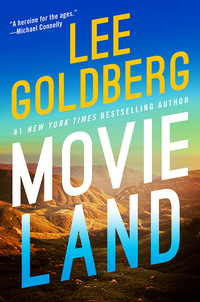
Movieland by Lee Goldberg: It’s No Walk in the Park for Eve Ronin

MovielandMovieland

by Lee Goldberg

DETAILS:
Series: Eve Ronin, #4
Publisher: Thomas & Mercer
Publication Date: June 20, 2022
Format: Kindle Edition
Length: 329 pgs. 
Read Date: June 21-22, 2022
Support Independent Bookstores - Visit IndieBound.org

“It’s hard enough solving a case without the victim working against you.”

“Now you know how I feel.”

Eve walked alongside her sister across the parking lot. “What do you mean?”

“Patients almost never do what we tell them is best for their health and then complain when they just get sicker or their injuries don’t heal. It’s incredibly frustrating.”

“So you’re saying what we do is futile.”

“All it takes is one win, one life saved, and all the other bullshit doesn’t matter.”

What’s Movieland About?

The way that Lee Goldberg describes Malibu Creek State Park in this book makes ti seem like something he created just to have a setting for this book. Exhaustive research (Duck Duck Go +45 seconds) shows me that he didn’t make it up and that he barely scratched the surface of what a great place that must be. Sadly, if Goldberg has Eve Ronin and her partner, Duncan Pavone, at the Park, it can only mean one thing: someone’s been murdered there.

Before Eve got promoted and assigned to Lost Hills station, causing upheaval in Duncan’s life, he’d been trying to tie together a series of cases of shootings (at buildings, cars, that kind of thing) around the Park. He was convinced it they were related, but once he started mentoring Eve through high-profile murder cases, that got put on the back burner. But now, his gut tells him that those shootings and this shooting are related.

The LASD brass doesn’t want to hear it–they want the two focused on the murder and preventing the media storm that’s brewing around it–also, they want this all to come to a quick resolution so the Park can be reopened and people will be willing to use it again.

This is, of course, when things get complicated.

The Victim as a Hurdle

The victim’s girlfriend is an activist blogger well-known in the area for taking on developers, local politicians, celebrities–and the LASD. She was also injured in the attack. She might be the only person who is more skeptical of the Department than Eve. Zena’s convinced that her girlfriend either was killed to silence her or that Zena herself was the intended target and the wrong person was killed.

Zena doesn’t trust the Sherriff’s Department to find the murderer, she assumes they’re not that interested, either. She has her own list of suspects and lashes out at them on the blog she works for, muddying the waters and serving as a distraction to the avenues of investigation that Eve and Duncan want to pursue.

This is a great dynamic to see play out in the book–I don’t remember seeing this a lot in fiction, but seeing the way media attention (however well-intended) makes it hard for the police to do their job properly is a great way to ratchet up the tension.

Is Eve Learning?

“When I start investigating a homicide, I go all-in.”

“You become obsessed.”

“I become focused,” she said.

He shook his head. “You can’t sustain that, physically or emotionally. I keep telling you that. The way you’re going, I’ll outlive you.”

I’ve talked before about Eve’s reckless, pursue-the-case-at-all-costs mentality, and how that’s not sustainable–Duncan’s been on her for quite a while, too. From the way she reacts after this conversation, he might be getting through to her. Then again, action is her default position, so who knows how well it’ll stick.

She also might be paying attention to what he (and others) have been saying about the way she interacts with people, how she plays politics–and tries to apply it.

Basically, Eve’s learning. Goldberg said from the beginning that this was about a rookie detective learning, making mistakes (and we see the blowback from past mistakes here–as well as new ones), and growing into a seasoned detective. Bosch was fully formed when we met him. Ditto for John Rebus, Renee Ballard, Walt Longmire, Jesse Stone, and so on. We really don’t see that many detectives learning their trade. I love this aspect of it.

Frank Belson Redux?

“Is there a way to broach it that won’t offend all of them?”

“Nope, so I’ll handle it,” he said.

“Why you?”

Duncan got out of the car with a groan, clutching his right knee. “Because I’m lovable and retiring and you’re abrasive and sticking around.

I finally put my finger on it while reading this book–Duncan Pavone is Goldberg’s version of Sgt. Frank Belson, from Parker’s Spenser series without the cigar. He’s closer to Ron McLarty’s portrayal in Spenser: For Hire, actually. He’s a slob, getting food on every item of clothing, he doesn’t seem to be incredibly interested in the job, etc. But he doesn’t miss a thing, he’s doggedly stubborn, and will do what it takes to close a case. (he’s also quick to make a caustic and/or cynical comment, and will dole out unsolicited advice like it’s his life purpose).

Knowing that when this book opens that he was 2 weeks away from retirement (which makes him impervious to political pressures, incidentally) cast a shadow over everything in the novel. Eve’s a great character, but I’m really starting to think that Duncan’s the guy to watch in this series.

So, what did I think about Movieland?

“How old so I to be before people stop offering me life lessons?”

“It’s not age, it’s experience.”

“There’s another one,” Eve said, but with a smile, to show there was no bitterness or anger behind the remark.

“It won’t be long, Eve. You’ve crammed more experience into the last few months than most detectives I know have in decades.”

It shouldn’t be this way, but I always end up liking an Eve Ronin book more than I expect to going in–and I’m always champing at the bit for the next one. This is no exception. The Eve Ronin books are one of my favorites in the last couple of years. Movieland is the twistiest, most complex case she’s dealt with, there’s a harder edge to this novel, and fewer reasons to grin or chuckle.

That is not a complaint, it’s a description. Nor does it mean that this is harder to read–Goldberg doesn’t do that–the action moves quickly, his style is deceptively breezy, and the characters pop off the page.

At this point, I’m really invested in these characters and can’t wait to see what’s next for them.

The book also features someone who might be Michael Connelly’s most misguided fan. That was a nice little treat.

Readers of this series probably don’t need the encouragement to read this, but here it is. People who are looking for solid police procedurals with engaging characters and great plots would do well to hop on the Eve Ronin train now (or jump back to book one, Lost Hills).


4 1/2 Stars

This post contains an affiliate link. If you purchase from it, I will get a small commission at no additional cost to you. As always, opinions are my own.

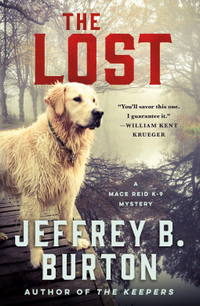
PUB DAY REPOST: The Lost by Jeffrey B. Burton: Mace and Vira Race the Clock to Find a Kidnapped Girl

I was interrupted more than usual while writing this post by one of my dogs seeking attention. “Could I give you scritches later, girl? I’m trying to talk about fictional dogs,” is a strange mind space to be in.


The LostThe Lost

by Jeffrey B. Burton

DETAILS:
Series: Mace Reid K-9 Mystery, Volume 3
Publisher: Minotaur Books
Publication Date: June 27, 2022
Format: eARC
Length: 288 pg.
Read Date: June 16-17, 2022
Support Independent Bookstores - Visit IndieBound.org

What’s The Lost About?

Mace and his dogs are moving in different circles after the events of The Keepers, and get called to help the FBI look for a missing mother and daughter—they were kidnapped after a home invasion went wrong. Their husband/father, financier Kenneth J. Druckman, was beaten and left behind. It’s up to Mace and Vira to give them a lead.

Sadly, it doesn’t take long for Vira to find the mother’s body on Druckman’s land, or for her to act like Druckman did the killing. It’s not like Mace can just point at the billionaire and shout, “J’accuse!” He’s going to need to find more than the word of his young dog—he also needs to help the FBI (if he can) to find the five-year-old girl before it’s too late.

Kippy Gimm (now a detective) and the rest of Mace’s dogs are, of course, in on this, too.

Non-Mace Perspectives

Typically, I’m not a fan of a first-person narrated book frequently switching to the third person—usually the killer. It doesn’t turn me off of a book, but I really don’t enjoy it. Burton, however, has done a better job of it in this series than most authors. I don’t know that I can say that I’ve enjoyed every instance of it—but, unlike most, in the previous two books in this series, those sections have added to the novel.

That really doesn’t sound like a compliment, but it was one.

In The Lost, most of those scenes/chapters are essential. The way this novel is set up—and the crimes perpetrated by the various criminals involved (and there are a handful)—necessitates that we see things from several perspectives that aren’t Mace’s. There’s just no way that he can find this information (he doesn’t require it, but the reader is going to demand to know what’s going on)—and it’d take months of investigation after these events for the FBI to figure some of this out (assuming they’d try).

The later in the book we get, the better these non-Mace portions get. Particularly those from the daughter’s point of view, they brought a lot to the table and got me really invested in these characters.

I still think I’d prefer more Mace and less of everyone else in future books in the series—but The Lost really shows that this approach can work. It also underlines how good at it Burton is.

So, what did I think about The Lost?

I’m not sure how the space is given to the non-Mace perspectives in this book compares to the previous novels, but it’s significantly more—that alone makes this novel feel different. The fact that many/most of those sections of the book take place prior to Mace’s involvement with the Druckman family also contributes to that feeling. I appreciate the fact that Burton’s doing things in Book 3 to make sure the series doesn’t get in a rut.

Sure, it’d be a fine rut to get stuck in and I’d have gladly read more books that were structurally similar to The Finders and The Keepers.* But I’m glad Burton made the step now and didn’t wait until he needed to shake things up.

* I read The Keepers a year ago and didn’t get the title until right this moment. I’m not too proud to admit that.

I’m not sure that we needed to learn about Kippy’s job woes at this point—it didn’t have an impact on this book, as FBI-centric as it was. It might have been better to talk about her difficulties with her new assignment when it’d have a bearing on the plot, and wouldn’t risk feeling like a repeat when it does come up. It’s not a good position for her to be in—I don’t want to minimize that—I’m just not sure the reader needed to get that information now, I don’t know what we’re supposed to do with it. As complaints go (and I think it’s the only one I had with this book), that’s a pretty minor one.

The pacing on this is strong—we hit the ground running with Mace and Vira at the beginning and we really don’t stop. There isn’t a lot of time here for contemplation and rumination—it’s not a breakneck speed, but it’s a steady jog. Again, it shows that Burton’s doing something different in this book.

I feel like I’m spending too much time talking about how different The Lost is from the other books—and I don’t mean to harp on it, I’m just commenting on the various ways it is. I don’t know that readers who aren’t writing about the book are going to spend that much time thinking about it—I think they’ll note the freshness of it, they’ll feel the overall effect, though. I’m not saying it’s better or worse than the other two, just appreciatively different. And that’s a nice thing.

As always, any time spent with Sue, Maggie May, Delta Dawn, Vira, and Billie Joe is a boon. They’re a fun pack of animals to read about—and I’m already looking forward to their next adventure. Mace and Kippy are good, too—but we all know who the stars are here.

This would be an okay jumping-on point to the series, I’m not sure you’d get the full idea of Vira’s special talents—but that’s okay, it’s not required to appreciate the books. The important thing is that mystery readers—particularly the dog-loving kind—jump on to the series at some point.

Disclaimer: I received this eARC from St. Martin’s Press via NetGalley in exchange for this post—thanks to both for this.


4 Stars

This post contains an affiliate link. If you purchase from it, I will get a small commission at no additional cost to you. As always, opinions expressed are my own.

Page 28 of 61

Powered by WordPress & Theme by Anders Norén