Tag: Mystery/Detective Fiction/Crime Fiction/Thriller Page 54 of 62

The Man in Milan by Vito Racanelli: A Hunt for the Truth on the Streets of New York and Milan

The Man in Milan

The Man in Milan

by Vito Racanelli

eARC, 336pg.
Polis Books, 2020

Read: November 9-14, 2020
Grab a copy from your local indie bookstore!

What’s The Man in Milan About?

NYPD detective Rossi is called to the scene of a homicide. It looks like a mugging gone bad, but there’s something wrong with the scene that Rossi can’t accept the first impression. Soon, he and his partner discover that this man is attached to the Italian embassy (although it’s initially denied). The deeper they get into the investigation, the murkier things get and the deadlier things get, too.

While they try to deny it, try to avoid the conclusion, the detectives have to admit that the evidence is pointing to a solution in Italy. They’re able to follow the evidence to the victim’s homeland, leading to an explosive conclusion.

The Police

Probably the strongest part of this book—and it’s key to the success of a police procedural are the characters—particularly the police characters*. From practically the instant we meet Detectives Paul Rossi and Hamilton P. Turner, I felt I knew them. Racanelli nailed these characters. They’re at once characters we’ve seen before, and know well—but made them feel fresh.

* There are a few other strong characters that I don’t have the space to talk about, for example: a newspaper journalist who’s almost as strong and developed as Rossi and Turner, that we don’t get quite enough of; and Rossi’s ex-wife and daughter, who I’d like to see again, too.

Rossi is divorced, in AA, more than a little jaded, but driven by the work that’s the only thing he has left in the world aside from the daughter he doesn’t get to see as often as he wants. He has strong ties to his Italian heritage—can speak and read it fluently (which comes in handy)—without being a stereotype. He has a medical condition that crops up to make life inconvenient, if there’s a sequel or two in the future, I’d like to learn more about this.

Turner is a solid cop, but he has ambitions beyond the NYPD, he wants to get into city politics—ultimately that mayor-ship. And he’s open about it. But more, he’s a poet, who regularly presents at events throughout the city, he can’t seem to go anywhere without finding a woman to seduce, dresses better than most detectives (shades of Connelly’s Jerry Edgar?), and has been described as a “black beatnik.” Some authors would take these traits and give us a character that’s just a collection of quirks, but Racanelli uses them to turn Turner into a well-rounded character.

The deceased’s sister, Tenente Laura Muro, is a policewoman from Italy. She arrives to claim the body and return it to be buried. But she’s also interested in helping the investigation and brings a knowledge of both Muro as a person, his past and his home that prove invaluable to Rossi and Turner. That she’s attractive and intelligent just makes her presence all the more welcome to the partners.

Rossi and Turner have a Lieutenant who has no interest in the case until it becomes something the mayor is taking an interest in, and actually wants them to drop it almost immediately. He’s the kind of petty bureaucrat that you hope doesn’t exist outside fictional police departments (but sure seem to show up in all sorts of police procedurals). He’s a solid character, but not one you’ll enjoy (and aren’t supposed to).

What Really Worked

The initial chapters following Rossi and Turner as they look into Muro’s death, talking to the Italian ambassador, Muro’s estranged wife and so on. Once others associated with Muro are killed, there’s a lot of political pressure put on them to make an arrest. Once it becomes clear that someone wants to add their deaths to the list, the external pressures to make an arrest outweigh all the politics.

When the evidence begins to point to an Italian group that seems more Urban Legend than reality, things take off plot-wise and the stakes get higher. Racanelli handles this skillfully, both the reticence of the detectives to follow the evidence and the way they come around when they have to.

What Wasn’t as Strong

Once it became clear to me that the case was going to take the detectives to Italy*, I worried a little about things. And sadly, those worries were valid. But maybe it’s just me.

* It’d been a few weeks since I read the pitch for the book, so I’d forgotten all of it.

Whether it’s Michael Connelly (Nine Dragons) or Neil Lancaster (Tom Novak series)—and probably other examples I can’t think of at the moment, anytime when you take police detectives and put them into a foreign context (especially when it becomes less police procedural and more international thriller), I think the book loses something. This one didn’t lose a lot, but I think it stumbled a little bit—Racanelli handled the switch in flavors as well as anyone, though, I want to stress that this is a me-thing, not a Racanelli-thing.

The Setting

There are plenty of reasons for this to be set in 2002 for the plot to work—beyond that, it’s a great setting for this kind of book. The characters can use cell phones and the internet, but smart phones aren’t ubiquitous and what characters can do with phones/internet is still limited enough that the detectives have to work for their information, not everything is captured on phones, and so on. It may have been a practical choice to set the book when he did, but the benefits make it a great choice.

So, what did I think about The Man in Milan?

From the voice, the style, the characters and the nature of the story—this is a solid, entertaining story. The persons responsible for the murder are dark and mysterious, but it’s not overplayed. The motive behind the (initial) killing, and its method make sense and are just chilling. The escalation in terms of violence and scale feels natural, it felt like this could be based on real events.

Racanelli’s take on Italian culture isn’t one that I think I’ve seen before and it’s one I’d like to learn more about, too.

The more action-thriller parts of the novel are as tense and compelling as you’d want, the procedural material is as good as you’ll find anywhere. The Man in Milan is a great way for Vito Racanelli to introduce himself to Crime Fiction readers, and I look forward to seeing what he produces next.

Disclaimer: I received this book from the author via Saichek Publicity in exchange for this post and my honest opinion—thanks to both for this.


4 Stars

This post contains an affiliate link. If you purchase from it, I will get a small commission at no additional cost to you. As always, opinions are my own.

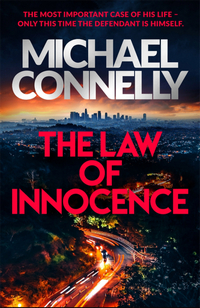
PUB DAY REPOST: The Law of Innocence by Michael Connelly: To Prove He Didn’t Do It, Haller has to Prove Who Did

The Law of Innocence

The Law of Innocence

by Michael Connelly
Series: Mickey Haller, #7

eARC, 416 pg.
Orion, 2020

Read: September 26-27, 2020
Grab a copy from your local indie bookstore!

What’s The Law of Innocence About?

On his way home from celebrating a win in court—a precious finding of “NG” (Not Guilty), Mickey Haller is pulled over in a traffic stop that quickly goes south and Haller finds himself in the back of the patrol car while the officer opens his trunk to discover a dead body—it turns out to be a former client of Haller’s who happens to owe his former defense lawyer a hefty amount of money.

It’s clearly a frame-up. There’s no reader who will buy Haller committing the crime in this way—sure, it’s possible that Haller would be driven to murder by something (for the sake of argument), but he wouldn’t do it this way. He’s too slick, too clever for that. Thinking like that is well and good for readers of Crime Fiction, it’s not how the police think. If you get all the evidence pointing at someone, they’re likely to be guilty, especially if there’s no evidence pointing in another direction.
Which is what happens here. So from his cell in the Twin Towers Correctional Facility, Haller has to plan his own defense. Sure, he knows all the conventional wisdom and jokes about defending yourself, but defending people in court is what has defined Mickey Haller for his adult life and there’s no way he can let someone else take the lead on this. It’s the fight of his life—literally a fight for his life—and Haller has to be the one doing the fighting.

Haller can’t count on a “reasonable doubt” defense. It won’t be enough to get a “Not Guilty” verdict, not if he wants to be a defense lawyer ever again, he can’t go into court with the world thinking he got off on a technicality. Haller has to prove he’s innocent, and the only way he can do that is by finding out who’s guilty, and proving that in court.

The prosecuting attorney is no slouch—frequently in legal fiction, you get someone who’s clearly there to play Washington Generals to the series protagonist’s Harlem Globetrotters, putting up a token case for the defense attorney to use as a way to show off all his tricks. But Dana Berg, star prosecutor for the Major Crimes Unit is hard, smart, and utterly convinced that Haller is guilty. So convinced that she’s not above using as many tricks and sneaky moves as Haller. She’s a worthy opponent which makes it all the better.

Hail, Hail, the Gang’s All Here

Mickey’s friends and family won’t believe this accusation—he’s not a killer. They know this and show up to help—many of them probably would if they had some doubt about his guilt, but we all know that Haller’s half-brother. Harry Bosch, wouldn’t have anything to do with him if Bosch thought there was a chance he was a killer. But Bosch is as involved as Cisco, Haller’s own investigator is. Lorna’s there, as well as Jennifer Aronson. I wasn’t terribly impressed with Aronson the last time we saw her in The Gods of Guilt, but she’s come a long way since then and is key to Haller’s defense.

It keeps going, Maggie “McFirece” McPherson, his ex-wife, and his daughter, Haley, are stalwart supporters, too—and Maddie Bosch even pops in. I’ve always liked Haley and enjoyed her a lot here. You’ll never see me say anything against Maggie’s character, either. Connelly created a great family for Haller back in The Lincoln Lawyer and they continue to pay off here.

While it’s great to see everyone show up to support and help—and Haller needs all that he can get—it’s his novel, it’s his fight, it’s his life in the balance and the novel’s focus is solely on him. With a character like Bosch, he’s a constant threat to steal the reader’s (and likely the writer’s) attention—but he doesn’t even come close. It’s all about Mickey Haller.

Isn’t this just like Fair Warning?

I was slightly afraid of that when I read the blurb for this—do we really need two books from Connelly in 2020 where the protagonist is suspected of a murder that there’s no chance at all that he committed? I figured Connelly would pull it off, but, yeah, there was a degree of trepidation on my part going into it.

Here’s where they were different—in Fair Warning, McEvoy being suspected is just his way into the mystery, and the shadow of suspicion may linger over him, but it’s never really much more than that. But here, Haller being the suspect is the whole novel—he’s only the suspect for a couple of days (which we don’t even see), he’s the accused for all but the first chapter. That makes all the difference, there’s no way to compare the experiences of McEvoy and Haller.
Current Events

This book takes place at the close of 2019 and over the first few months of 2020, and through news reports in the background and some conversations between characters we get glimpses of what’s going on in American culture at the time—specifically, the impeachment and reelection bid of Donald Trump and the early days of the spread of COVID-19. Neither makes a significant impact on the plot, but they act as part of the background, nailing the events of the novel to a specific moment.

I wondered for a while if this would make the novel dated in years to come, making it too “of the moment” to last. But the more I think about it, the more I think adds some flavor, some perspective to the novel, and the way that Connelly uses the current events to ground the novel. I ended up really liking the way he did it. Sure, Haller’s very few and quick comments about the President may put off some readers, if they couldn’t have guessed Haller’s political leanings, they haven’t been paying attention.

So, what did I think about The Law of Innocence?

If I hadn’t been approached to be on this tour, what would’ve likely happened is this: I’d buy The Law of Innocence on release day and had been really excited about it, but would’ve set it aside so I could catch up on some backlog—and it would’ve ended up languishing away on my shelf unnoticed. I’d have probably have made it my last book of 2020 or first of 2021 as a little treat to myself. And I would’ve been mad at myself for that once I got to about the 20% mark (if not earlier). For this to be available and unread would be just wrong.

There’s a one page (or so) introduction/foreward that’s just dynamite, followed by a really strong first chapter, and then starting in chapter 2, we’re off to the races. It’s just unrelentingly good, gripping, fast-paced, smart, and tension-filled from that point through to the jaw-dropping end. Sure, you may be confident that Haller would prevail, but you can never be sure for a moment how that might come to pass—and any time you start to think you know? You quickly discover that was hubris.

Connelly is one of the best in the business, but he’s not satisfied with coasting on his reputation or his laurels, he’s constantly striving to prove that he’s one of the best around—and usually succeeds at it. The Law of Innocence has him doing just that. The prose is lean and tight, the characterizations are spot on, the pacing is perfect and you just can’t put this down. I had a lot going on last week when I read this and several things I needed to accomplish—and I ignored almost every single one of them just so I could finish this. I gave myself five days to read this and finished it in two. Between the story, the characters, and the way Connelly put this together, I had no choice.

A lot of the legal thrillers I’ve read over the last couple of years save some of their best moments for things the lawyers get into outside of the courtroom, The Law of Innocence doesn’t do that. Yes, there are some good moments with Haller and the team investigating things, or while Haller is incarcerated. But the best moments of the novel take place in the arena that Haller comes most to life—in the courtroom, facing off against a good prosecutor, in front of a smart judge and a jury that he can only hope to persuade. Haller’s good at putting the pieces of a puzzle together (especially when Bosch and Cisco give him the right pieces), he can get a witness to give up just the right information, but he shines when he’s using the rules of the court, rules of evidence and the laws of California to further his own ends.
If you’ve been through the wringer with Haller before, you have an idea of what to expect—and you won’t be disappointed. If you’ve never spent time with the Lincoln Lawyer before this, you’re in for a treat. Either way—The Law of Innocence is one of the best thrillers of 2020 and you need to get your hands on it.

4 1/2 Stars

Disclaimer: I received this eARC from Orion via NetGalley and Compulsive Readers in exchange for this post—thanks to all for this, but the opinions offered above are solely mine.

This post contains an affiliate link. If you purchase from it, I will get a small commission at no additional cost to you.


My thanks to Tracy Fenton and Compulsive Readers for the invitation to participate in this tour and the materials (including a copy of the novel) provided.

The City That Barks and Roars by J. T. Bird: It Takes Four Legs to Walk These Mean Streets

The City That Barks and Roars

The City That Barks and Roars

by J. T. Bird

Kindle Edition, 200 pg.
2020

Read: October 30-November 6, 2020

What’s The City That Barks and Roars About?

The book opens with an injured police detective hiding from those who injured him, focused on trying to survive long enough to be rescued while replaying the moments that put him in this situation. This is followed by some of his colleagues beginning the search for the detective, finding only plenty of reasons to assume the worst has happened.

Next, we see a young detective freshly transferred from a small, quiet town to the city to be partnered with the missing detective’s old, jaded partner. The newly matched pair lead the investigation into the missing detective. an apparent kidnapping of some local criminal figures, and the tie between the crimes. Along the way, while some camaraderie builds between the partners, the young detective gets exposed to the worst of the city, underground figures on both extremes of the social ladder, true depravity, and maybe (just maybe) a few upstanding citizens.

What makes this variation on the familiar-feeling story is this: all the characters are anthropomorphic animals who’ve evolved to a 1950’s America-like civilization. The missing detective is a Panda Bear, the kidnapped criminals are beavers, the primary detectives on the hunt are a king penguin and a red howler monkey—other characters are a polar bear, vulture, panther, leopard, lioness, and more.

Is this the Correct Medium for the Story?

I couldn’t stop thinking the entire time that a novel might not be the best way to tell this story, time after time, the visual jokes just didn’t seem to land the way they ought because Bird has to spend so much time describing them.

That’s the major problem of the whole novel—the descriptions chew up too much space, slowing down the movement of the story—and taking away from the impact of the jokes, images, or other moments.

You take this story, these characters, and put them in a graphic novel in a Spiegelman-Maus kind of style? It’d be dynamite.

The jokes are still there, the images are still strong and amusing—I just think this medium dilutes things, makes it less effective. With such a well and richly developed world, I’d just like that to come across better.

So, what did I think about The City That Barks and Roars?

The animal nature of the characters is secondary (or at least seems like it ought to be) to the story and who the characters are aside from that. As such, the book could use a little more depth. Enough space is devoted to the animal setting and characteristics that Bird really can’t give the depth of characterization or subtlety of plot that I’d like to see.

That said, this is some of the best worldbuilding I’ve seen—ever—in a police novel. Bird went well above and beyond on that front, to deliver a unique and entertaining novel. From the original premise to the jaw-dropping final reveals, you won’t find Crime Fiction like this anywhere.

This would serve well as the beginning of a series, and if that’s the case, I’m in for a few more. If it’s strictly a stand-alone? Readers are in for a treat.


3 Stars

My thanks to damppebbles blog tours for the invitation to participate in this tour and the materials (including a copy of the novel) they provided.

The Law of Innocence by Michael Connelly: To Prove He Didn’t Do It, Haller has to Prove Who Did

The Law of Innocence

The Law of Innocence

by Michael Connelly
Series: Mickey Haller, #7

eARC, 416 pg.
Orion, 2020

Read: September 26-27, 2020
Grab a copy from your local indie bookstore!

What’s The Law of Innocence About?

On his way home from celebrating a win in court—a precious finding of “NG” (Not Guilty), Mickey Haller is pulled over in a traffic stop that quickly goes south and Haller finds himself in the back of the patrol car while the officer opens his trunk to discover a dead body—it turns out to be a former client of Haller’s who happens to owe his former defense lawyer a hefty amount of money.

It’s clearly a frame-up. There’s no reader who will buy Haller committing the crime in this way—sure, it’s possible that Haller would be driven to murder by something (for the sake of argument), but he wouldn’t do it this way. He’s too slick, too clever for that. Thinking like that is well and good for readers of Crime Fiction, it’s not how the police think. If you get all the evidence pointing at someone, they’re likely to be guilty, especially if there’s no evidence pointing in another direction.

Which is what happens here. So from his cell in the Twin Towers Correctional Facility, Haller has to plan his own defense. Sure, he knows all the conventional wisdom and jokes about defending yourself, but defending people in court is what has defined Mickey Haller for his adult life and there’s no way he can let someone else take the lead on this. It’s the fight of his life—literally a fight for his life—and Haller has to be the one doing the fighting.

Haller can’t count on a “reasonable doubt” defense. It won’t be enough to get a “Not Guilty” verdict, not if he wants to be a defense lawyer ever again, he can’t go into court with the world thinking he got off on a technicality. Haller has to prove he’s innocent, and the only way he can do that is by finding out who’s guilty, and proving that in court.

The prosecuting attorney is no slouch—frequently in legal fiction, you get someone who’s clearly there to play Washington Generals to the series protagonist’s Harlem Globetrotters, putting up a token case for the defense attorney to use as a way to show off all his tricks. But Dana Berg, star prosecutor for the Major Crimes Unit is hard, smart, and utterly convinced that Haller is guilty. So convinced that she’s not above using as many tricks and sneaky moves as Haller. She’s a worthy opponent which makes it all the better.

Hail, Hail, the Gang’s All Here

Mickey’s friends and family won’t believe this accusation—he’s not a killer. They know this and show up to help—many of them probably would if they had some doubt about his guilt, but we all know that Haller’s half-brother. Harry Bosch, wouldn’t have anything to do with him if Bosch thought there was a chance he was a killer. But Bosch is as involved as Cisco, Haller’s own investigator is. Lorna’s there, as well as Jennifer Aronson. I wasn’t terribly impressed with Aronson the last time we saw her in The Gods of Guilt, but she’s come a long way since then and is key to Haller’s defense.

It keeps going, Maggie “McFirece” McPherson, his ex-wife, and his daughter, Haley, are stalwart supporters, too—and Maddie Bosch even pops in. I’ve always liked Haley and enjoyed her a lot here. You’ll never see me say anything against Maggie’s character, either. Connelly created a great family for Haller back in The Lincoln Lawyer and they continue to pay off here.

While it’s great to see everyone show up to support and help—and Haller needs all that he can get—it’s his novel, it’s his fight, it’s his life in the balance and the novel’s focus is solely on him. With a character like Bosch, he’s a constant threat to steal the reader’s (and likely the writer’s) attention—but he doesn’t even come close. It’s all about Mickey Haller.

Isn’t this just like Fair Warning?

I was slightly afraid of that when I read the blurb for this—do we really need two books from Connelly in 2020 where the protagonist is suspected of a murder that there’s no chance at all that he committed? I figured Connelly would pull it off, but, yeah, there was a degree of trepidation on my part going into it.

Here’s where they were different—in Fair Warning, McEvoy being suspected is just his way into the mystery, and the shadow of suspicion may linger over him, but it’s never really much more than that. But here, Haller being the suspect is the whole novel—he’s only the suspect for a couple of days (which we don’t even see), he’s the accused for all but the first chapter. That makes all the difference, there’s no way to compare the experiences of McEvoy and Haller.

Current Events

This book takes place at the close of 2019 and over the first few months of 2020, and through news reports in the background and some conversations between characters we get glimpses of what’s going on in American culture at the time—specifically, the impeachment and reelection bid of Donald Trump and the early days of the spread of COVID-19. Neither makes a significant impact on the plot, but they act as part of the background, nailing the events of the novel to a specific moment.

I wondered for a while if this would make the novel dated in years to come, making it too “of the moment” to last. But the more I think about it, the more I think adds some flavor, some perspective to the novel, and the way that Connelly uses the current events to ground the novel. I ended up really liking the way he did it. Sure, Haller’s very few and quick comments about the President may put off some readers, if they couldn’t have guessed Haller’s political leanings, they haven’t been paying attention.

So, what did I think about The Law of Innocence?

If I hadn’t been approached to be on this tour, what would’ve likely happened is this: I’d buy The Law of Innocence on release day and had been really excited about it, but would’ve set it aside so I could catch up on some backlog—and it would’ve ended up languishing away on my shelf unnoticed. I’d have probably have made it my last book of 2020 or first of 2021 as a little treat to myself. And I would’ve been mad at myself for that once I got to about the 20% mark (if not earlier). For this to be available and unread would be just wrong.

There’s a one page (or so) introduction/foreward that’s just dynamite, followed by a really strong first chapter, and then starting in chapter 2, we’re off to the races. It’s just unrelentingly good, gripping, fast-paced, smart, and tension-filled from that point through to the jaw-dropping end. Sure, you may be confident that Haller would prevail, but you can never be sure for a moment how that might come to pass—and any time you start to think you know? You quickly discover that was hubris.

Connelly is one of the best in the business, but he’s not satisfied with coasting on his reputation or his laurels, he’s constantly striving to prove that he’s one of the best around—and usually succeeds at it. The Law of Innocence has him doing just that. The prose is lean and tight, the characterizations are spot on, the pacing is perfect and you just can’t put this down. I had a lot going on last week when I read this and several things I needed to accomplish—and I ignored almost every single one of them just so I could finish this. I gave myself five days to read this and finished it in two. Between the story, the characters, and the way Connelly put this together, I had no choice.

A lot of the legal thrillers I’ve read over the last couple of years save some of their best moments for things the lawyers get into outside of the courtroom, The Law of Innocence doesn’t do that. Yes, there are some good moments with Haller and the team investigating things, or while Haller is incarcerated. But the best moments of the novel take place in the arena that Haller comes most to life—in the courtroom, facing off against a good prosecutor, in front of a smart judge and a jury that he can only hope to persuade. Haller’s good at putting the pieces of a puzzle together (especially when Bosch and Cisco give him the right pieces), he can get a witness to give up just the right information, but he shines when he’s using the rules of the court, rules of evidence and the laws of California to further his own ends.

If you’ve been through the wringer with Haller before, you have an idea of what to expect—and you won’t be disappointed. If you’ve never spent time with the Lincoln Lawyer before this, you’re in for a treat. Either way—The Law of Innocence is one of the best thrillers of 2020 and you need to get your hands on it.


4 1/2 Stars

Disclaimer: I received this eARC from Orion via NetGalley and Compulsive Readers in exchange for this post—thanks to all for this, but the opinions offered above are solely mine.

This post contains an affiliate link. If you purchase from it, I will get a small commission at no additional cost to you.


My thanks to Tracy Fenton and Compulsive Readers for the invitation to participate in this tour and the materials (including a copy of the novel) provided.

BOOK SPOTLIGHT: The Law of Innocence by Michael Connelly

I’m excited to welcome the Book Tour for new Lincoln Lawyer thriller, The Law of Innocence by Michael Connelly this morning—proof that even publishing behemoths need help getting the word out. I’ve got this little spotlight post and my take on the novel coming along in a bit. But let’s start by learning a little about this book, okay?

Book Details:

Book Title: The Law of Innocence by Michael Connelly
Publisher: Orion (UK)/Little, Brown and Company (US)
Release date: November 10, 2020
Format: Hardcover/Ebook/Audiobook
Length: 416 pages
The Law of Innocence

Book Blurb:

The brand-new blockbuster crime thriller from Michael Connelly – the #1 Sunday Times, New York Times and international bestseller.


Heading home after winning his latest case, defense attorney Mickey Haller – The Lincoln Lawyer – is pulled over by the police. They open the trunk of his car to find the body of a former client.

Haller knows the law inside out. He will be charged with murder. He will have to build his case from behind bars. And the trial will be the trial of his life. Because Mickey Haller will defend himself in court.

With watertight evidence stacked against him, Haller will need every trick in the book to prove he was framed.

But a not-guilty verdict isn’t enough. In order to truly walk free, Haller knows he must find the real killer – that is the law of innocence…

About Michael Connelly:

Michael Connelly

A master of the genre’ – Stephen King

No one writes a better modern thriller than Connelly’ – Evening Standard

America’s greatest living crime writer’ – Express

‘A superb natural storyteller’ – Lee Child


Michael Connelly, the bestselling author of thirty-five novels with over seventy-four million copies sold worldwide, is also the executive producer of Bosch, an Amazon Studios original based on his bestselling character Harry Bosch. In January 2019, Connelly launched the true-crime podcast The Murder Book which takes listeners inside a real-life Hollywood Homicide cold case with unprecedented access to the detectives themselves.


My thanks to Tracy Fenton and Compulsive Readers for the invitation to participate in this tour and the materials (including a copy of the novel) provided.

BOOK BLITZ: The Path of Good Response by Steve Frogley

Today I’m pleased to welcome the Book Blitz for the dystopian thriller The Path of Good Response by Steve Frogley.


Book Details:

Book Title: The Path of Good Response by Steve Frogley
Release date: August 27, 2020
Length: 272 pages
Publisher: Vanguard Press
Format: Ebook/Paperback

Book Blurb:

Do you value your mother’s health above peace in the Middle East? How about your career over global warming?

If a company runs the best graduate scheme in the world, then it can afford to be probing with its interview questions.

When Joe Massey is offered a role aboard Schelldhardt’s luxurious headquarters at sea, he discovers that the company mission is beyond anything he had ever imagined.

Strange dreams disturb his sleep, and it soon becomes clear that nothing is quite as it seems.

Is he really the right man for the job? And if not, then why is he there at all?

Purchase Links

Pegasus Publishing ~ Barnes & Noble ~ Waterstones ~ Foyles ~ Book Depository ~ Amazon (UK) ~ Amazon (US)

About the Author:

Steve FrogleySteve is a writer of contemporary fiction, who enjoys reading books of many different genres.

Originally from Southend in Essex, Steve now lives on the South Coast of England with his family, after a few happy years spent in New Zealand. The Path of Good Response is his first novel. He has spent most of his working life in the IT industry, but writing is his real passion.

The workplace has changed a great deal during Steve’s career. He started writing The Path of Good Response back in 2016, and the fictional company in the novel, Schelldhardt, seems less of an exaggeration by the year. It appears that reality is fast catching up with dystopian writing, and in many ways overtaking it.

He hopes that you enjoy reading his book, and welcomes any feedback.

My thanks to Love Books Group for the invitation to participate in this tour and the materials they provided.

Love Books Group

Pub Day Repost: Rattlesnake Rodeo by Nick Kolakowski: Out of the Frying Pan, Into the Fire

Rattlesnake Rodeo

Rattlesnake Rodeo

by Nick Kolakowski
Series: A Boise Longpig Hunting Club Noir, #2

eARC, 162 pg.
Down & Out Books, 2020

Read: September 8, 2020


In 2018, I read my first book by Nick Kolokowski, Boise Longpig Hunting Club, which is pretty much everything you think it is from the title. In the two years and change since then, I’ve read five other books by Kolokowski—well, six now. That alone should be an indication of what I think about his stuff.

What’s Rattlesnake Rodeo About?

This is the sequel to Boise Longpig Hunting Club, taking up minutes after it. Spoilerly talk about BLHC—bounty hunter, Jake; his sister, Frankie (a gun smuggler); and ex-wife/fiancé, Janine (who has nothing to do with criminals); are kidnapped by a group of super-wealthy people, and set loose in an Idaho forest while they’re being hunted. Jake and Frankie are a lot more resourceful than anyone expected—and Janine has depth that no one expected—and they end up killing all the hunters.

We rejoin them in this book headed back to Boise. They have a number of emotions and thoughts running through their minds at this time—as they should—the most prominent of them is: how are we going to get away with this? There’s no way that they didn’t leave all sorts of DNA, fingerprints and other sorts of evidence behind that’ll make forensic techs happy. And there will be scores of techs, investigators, agents and what have you at the crime scene—very rich, very important people died up there and someone is going to have to pay for that. Oh, and Frankie wants fries. You work up an appetite fighting for your life.

Karen

They quickly learn about one person who not only has links to the Longpig Hunters, evidence about Jake and Frankie’s involvement, and a reputation to make people quake in their boots. Like Prince, Madonna, or Hawk (to bring it back to crime fiction), she’s known by one name: Karen.

Quick aside: I wonder if in early drafts, she was called something like Margo or Helen, but given, well, all of 2020, Kolakowski decided to go back and change it. Or did he have enough foresight months ago to go with that?

Back to the book: Karen offers them a deal, they do one incredibly horrible task for her, or she ruins the lives and reputations of Jake, Frankie, and Janine. They have no choice…they have to find an Option C.

Gunfights, treachery, and (obviously) rattlesnakes ensue.

Frankie and Her Troops

In almost every novel I’d normally read, Frankie and her employees would be the targets of the protagonist, not their ally. But I’ve gotta say, for a bunch of gun-running criminals, benefiting from the miseries of others (and being a means to innocents being killed at the hands of their customers), they’re a lot of fun. There’s a fun sense of camaraderie and some good banter among them. They’re a pretty effective squad, too. Kolakowski could write a pretty entertaining series featuring these guys. And not just because they’re led by a man who always wears a rubber gorilla mask.

Which is fitting, considering how cool their boss is. Spenser has Hawk, Kenzie and Gennaro have Bubba, Elvis Cole has Joe Pike, Walt Longmire has Henry Standing Bear, Joe Pickett has Nate Romanowski, Sunny Randall has Spike, and Jake has Frankie. The “not-bound by the same laws and ethics that the series protagonist is” so that the protagonist can keep his/her nose clean and still get the job done. They’ll cut the corners, they’ll take and make the shots that no one else will, they’ll be the ones to use lethal force when their friend just can’t bring themselves to do it—and they won’t feel guilt (at least not enough to interfere with their ability to get things done).

Frankie is, as far as I know, the only female lethal sidekick, in crime fiction. Through grit, determination, skill, and panache—Frankie is what ultimately keeps her brother and sister-in-law breathing. It’s just fun to see a female in this role, particularly one that fits. I could never see Sunny Randall go toe-to-toe with some of the dudes she needs to without Spike (or Jesse, or Richie, or Richie’s family)—but I can see Frankie (like Lori Anderson or Charlie Fox) do it without blinking.

The Setting

I’ve talked a little about this in the other book, but it’s fun for me to see the region I’ve lived my whole life in depicted so well in these pages. I enjoy anyone finding a way to bring a crime novel to life outside of Boston, NYC, New Jersey, Chicago, Miami or LA—Elmore Leonard, Jason Miller, Craig Johnson, C. J. Box, Darynda Jones, and G. M. Ford have/continue to do a good job of that, but there needs to be more*. Kolakowski brings my corner of the world into that fold (Jayne Faith did it in Urban Fantasy, and Wesley Chu set a Tao book near where the climax of this novel took place). It’s nice not having to use my imagination much when picturing a scene, at the same time—if I’d never been anywhere near this place, Kolakowski depicts it well enough that someone from Michigan, Mississippi, or New Mexico would have no problem seeing what he’s going for.

* I don’t pretend that’s an exhaustive list, still feel free to add others I should get to know.

So, what did I think about Rattlesnake Rodeo?

You could feel the dread coming off of Jake and Frankie as they thought about the police and (probably) feds coming for them after surviving the last novel, you could feel their hatred (for Karen) and revulsion for their task for her, and you could sense the chaos, smell the smoke, and taste the air from the big scenes at the end of the novel. There are significant portions of this novel you experience as much as you read. You’ve gotta love that.

There was one death that totally caught me unprepared and left me stunned. The violence felt a little more grounded than the genre demands, but Kolakowski knows when to loosen the reins and let things go a little over the top. Which is just fun.

At the same time, there’s a great sense of enjoyment to this novel—to the characters, what they do, and how they go about it. It’s the kind of action novel that gets your fists pumping as much as anything else.

Just the fact that the novel starts with the trio worried about all the evidence they left behind made this a winner—how many characters in novels worry about that sort of thing? Add in the characters—from the oddity of Monkey Man, to the implausibly competent Frankie, to the quiet strength of Janine, to the terror that is Karen—and the great balance of tones, and you’ll see why Kolakowski is my favorite US indie Crime Novelist.

I strongly recommend Rattlesnake Rodeo, whether or not you read BLHC first, it’s a fun ride.

Disclaimer: I received this eARC from the author in exchange for this post and my honest opinion, I appreciate the opportunity.


4 Stars

Happy Birthday, Archie!

My annual tribute to one of my favorite fictional characters (if not my all-time favorite). I’ve got to do an overhaul to this soon, but it is slightly updated and tweaked from last year.

On Oct. 23* in Chillicothe, Ohio, Archie Goodwin entered this world—no doubt with a smile for the pretty nurses—and American detective literature was never the same. He’s the narrator (and, I’d argue protagonist) of the questionably named Nero Wolfe mysteries. While the eccentric and overweight genius might be what brings people to the series, it’s Archie’s wit, attitude, and snappy narrative voice that brings people’s back.

* About 34 years ago, no matter what year it is that you read this.

Since I was in Middle School, if I was suffering a slump of any kind (reading, emotional, physical), time with Archie Goodwin could get me out of it. There were a few years that when I got sick, I’d grab a Nero Wolfe novel to help me get through it (along with the Vitamin C and Chicken Noodle soup), and you can’t tell me it didn’t work. Noted critic Jacques Barzun says it well:

If he had done nothing more than to create Archie Goodwin, Rex Stout would deserve the gratitude of whatever assessors watch over the prosperity of American literature. For surely Archie is one of the folk heroes in which the modern American temper can see itself transfigured. Archie is the lineal descendant of Huck Finn.

While Archie’s about as far from a teetotaler as you can get, to commemorate his birthday, I’m toasting him in one of the ways I think he’d appreciate most—by raising a glass of milk in his honor.

Who was Archie? Archie summed up his life like this:

Born in Ohio. Public high school, pretty good at geometry and football, graduated with honor but no honors. Went to college two weeks, decided it was childish, came to New York and got a job guarding a pier, shot and killed two men and was fired, was recommended to Nero Wolfe for a chore he wanted done, did it, was offered a full-time job by Mr. Wolfe, took it, still have it.” (Fourth of July Picnic)

Long may he keep it. Just what was he employed by Wolfe to do? In The Black Mountain he answers the statement, “I thought you was a private eye” with:

I don’t like the way you say it, but I am. Also, I am an accountant, an amanuensis, and a cocklebur. Eight to five you never heard the word amanuensis and you never saw a cocklebur.

In The Red Box, he says

I know pretty well what my field is. Aside from my primary function as the thorn in the seat of Wolfe’s chair to keep him from going to sleep and waking up only for meals, I’m chiefly cut out for two things: to jump and grab something before the other guy can get his paws on it, and to collect pieces of the puzzle for Wolfe to work on.

In Too Many Women, he’s a bit more concise and describes himself as the:

heart, liver, lungs and gizzard of the private detective business of Nero Wolfe, Wolfe being merely the brains

In Black Orchids, he reacts to an insult:

…her cheap crack about me being a ten-cent Clark Gable, which was ridiculous. He simpers, to begin with, and to end with no one can say I resemble a movie actor, and if they did it would be more apt to be Gary Cooper than Clark Gable.

Over at The Thrilling Detective, he’s described this way:

If Goodwin hadn’t gone to work for Wolfe, he’d certainly have his own agency by now (and temporarily does, in one novel). Far more of the traditional eye, Goodwin is a tough, handsome guy with a photographic memory, a .32 under his well-tailored suit (and sometimes an extra .38 in his overcoat pocket), and a well-developed appreciation for the ladies. And, in the opinion of more than a few cops, officials and stuffed-shirt executives, a mouth that ought to be nailed shut permanently. (Wolfe isn’t immune either – part of Goodwin’s job, as he sees it, is needling the fat man into taking cases, if only to make sure the bills get covered.) He’s not the deductive genius that Wolfe is, but a smart and tenacious op with a good right hook, and a decent and personable man. Most of all, in his narration of the books, he’s a helluva storyteller; it’s his view of the world, and his interaction with Wolfe, that keeps us coming back for each new mystery.

The Archie Goodwin FAQ is less succicnt but does a good job of laying out the facts.

I’m not the only Archie fan out there:

  • Someone pointed me at this post, The Wit and Wisdom of Archie Goodwin. There’s some really good stuff here that I was tempted to steal, instead, I’ll just point you at it.
  • Robert Crais himself when writing an introduction to a Before Midnight reprint, devoted it to paying tribute to Archie—one of the few pieces of anything written that I can say I agree with jot and tittle.

In case you’re wondering if this post was simply an excuse to go through some collections of Archie Goodwin quotations, you wouldn’t be totally wrong…he’s one of the fictional characters I like spending time with most in this world—he’s the literary equivalent of comfort food. So just a couple more great lines I’ve quoted here before:

I would appreciate it if they would call a halt on all their devoted efforts to find a way to abolish war or eliminate disease or run trains with atoms or extend the span of human life to a couple of centuries, and everybody concentrate for a while on how to wake me up in the morning without my resenting it. It may be that a bevy of beautiful maidens in pure silk yellow very sheer gowns, barefooted, singing “Oh, What a Beautiful Morning” and scattering rose petals over me would do the trick, but I’d have to try it.

I looked at the wall clock. It said two minutes to four. I looked at my wrist watch. It said one minute to four. In spite of the discrepancy, it seemed safe to conclude that it would soon be four o’clock.

Description:I shook my head. “You’re flattering me, Inspector. I don’t arouse passions like that. It’s my intellect women like. I inspire them to read good books, but I doubt if I could inspire even Lizzie Borden to murder.”

She turned back to me, graceful as a big cat, and stood there straight and proud, not quite smiling, her warm dark eyes as curious as if she had never seen a man before. I knew damn well I ought to say something, but what? The only thing to say was ‘Will you marry me?’ but that wouldn’t do because the idea of her washing dishes or darning socks was preposterous.

“Indeed,” I said. That was Nero Wolfe’s word, and I never used it except in moments of stress, and it severely annoyed me when I caught myself using it, because when I look in a mirror I prefer to see me as is, with no skin grafted from anybody else’s hide, even Nero Wolfe’s.

If you like Anglo-Saxon, I belched. If you fancy Latin, I eructed. No matter which, I had known that Wolfe and Inspector Cramer would have to put up with it that evening, because that is always a part of my reaction to sauerkraut. I don’t glory in it or go for a record, but neither do I fight it back. I want to be liked just for myself.

When a hippopotamus is peevish it’s a lot of peeve.

It was nothing new for Wolfe to take steps, either on his own, or with one or more of the operatives we used, without burdening my mind with it. His stated reason was that I worked better if I thought it all depended on me. His actual reason was that he loved to have a curtain go up revealing him balancing a live seal on his nose.

It helps a lot, with two people as much together as he and I were, if they understand each other. He understood that I was too strong-minded to add another word unless he told me to, and I understood that he was too pigheaded to tell me to.

I always belong wherever I am.

Pub Day Repost: Silent Bite by David Rosenfelt: Andy Carpenter Does a Favor for a Friend and Ends Up Regretting It

Silent Bite

Silent Bite

by David Rosenfelt
Series: Andy Carpenter, #22

eARC, 304 pg.
Minotaur Books, 2020

Read: September 16-18, 2020
Grab a copy from your local indie bookstore!


Wow. Andy Carpenter #22. That’s hard to believe. It doesn’t seem that long ago that I started reading these (I think back in the single digits). But all-in-all, it’s been a fun ride. How’s this one stack up?

What’s Silent Bite About?

When Andy and his family return from a holiday cruise (a novella describing that in more detail than we got here would quickly become a fan favorite, no doubt), he’s got a bunch of messages from Willie Miller. A friend, and former cellmate, of Willie’s has been arrested for murder. Both Willie and his friend, Tony Birch, want Andy to take the case and clear him. Andy wants nothing to do with a problematic looking case*, but Willie’s a friend—and Andy’s son, Ricky, has pointed out that Willie does stuff for Andy all the time. Also, Tony has a dog that’s miserable without him around.

* or any case, really.

The murder victim is one of the witnesses against Birch for the manslaughter charge that put him in prison with Willie years ago. At the trial, Tony threatened to kill him (and a few others) for turning on him, after years in a gang together. But upon his release from prison, years before this new murder, Tony had turned his life around—he owned and operated a fairly successful auto repair garage, and had no interest in criminal activity again. So why seek vengeance now?

And why be as utterly stupid with the murder weapon as the prosecution wants people to believe?

But then another witness against Tony in the original case turns up dead, and things start looking really bad for him. So it’s up to Andy and his team to save the day.

Zoey, the Nova Scotia Duck Tolling Retriever

I really don’t have much to say about Zoey, Tony’s dog, but I’ve never heard of her breed before—and I don’t feel too bad about that Andy hadn’t seen one before. If your day could use a little lift, take a minute or two to scroll through some pictures online. Cute dogs.*

* That’s a tautology, I realize.

The New Associate

In most of his cases, Andy Carpenter utilizes an associate to do the ugly detailed work, filing motions, looking up pertinent case law, and so on, while Andy goes around visiting people, investigating, getting saved from certain peril by Marcus Clerk, and being snarky and clever in court. He started with Kevin Randall, who owned a laundromat and gave legal advice to those who couldn’t afford it. He eventually moved on and Hike Lynch moved in—largely, I think because Hike is a more entertaining character than Kevin. Well, Hike isn’t around for this one and he suggests Eddie Dowd step in.

Eddie used to play for the Giants, but a knee injury ended that career, so he went to law school. He speaks almost entirely in sports phrases (spike the ball, put me in, pitch in, and so on). It’s fairly ridiculous, but when done right, it’s pretty funny. He’s a nice change from the Eeyore-like character that Hike had been. I’m not sure if he’ll be back, or if Hike will return—I’ll be glad to see him if he is, even if it seems like the joke about his figures of speech will get old. I have faith in Rosenfelt. I’d have thought that Hike’s extreme pessimism or Kevin’s hypochondria would.

So, what did I think about Silent Bite?

I thought the identity of the killer was pretty obvious, but Rosenfelt’s execution of the reveal and of keeping Andy from seeing the solution all along sold me. I can’t be more descriptive of that because I don’t want to tip anything. It was a great conclusion to a really solid legal thriller, that comes with all the canine affection, snappy dialogue, some clever courtroom action, and a solid plot. Pretty much what the doctor ordered.

Once we got The K Team this year, with Muzzled as well, I didn’t figure we’d have a Holiday Andy Carpenter book. Then when I saw this was coming, I worried it wouldn’t live up to the other Holiday books in this series. I kept being wrong about this book—we got it and it wasn’t a let-down. Rosenfelt managed to give us three strong novels in 2020 (hey, look, 2020 didn’t wind up in a disaster on one front!)—that right there, folks, is a sign of a professional.

Whether you’re new to the world of this would-be retired criminal defense lawyer and are in the mood for a witty and sharp legal thriller, or if you’re familiar with Andy and his associates—this will entertain you. You’d do well to give this a shot.

Disclaimer: I received this eARC from St. Martin’s Press via NetGalley in exchange for this post—thanks to both for this.


4 Stars

This post contains an affiliate link. If you purchase from it, I will get a small commission at no additional cost to you. As always, opinions are my own.

Even More Quick Questions With…Nick Kolakowski

Wow, Nick Kolakowski is back for a fourth go ’round with my questions. I’m a major fan, and really enjoy these. I hope you do, too. Be sure to check out my take on his upcoming novel, Rattlesnake Rodeo earlier today.

<

table>

How has 2020 treated Nick Kolakowski the writer—have you been able to work? Are you finding writing time vanishing into doom-scrolling or binging something? Is there a pandemic novel in your near future?
When New York City went into lockdown, I threw myself into writing and editing. It became my coping mechanism, to such a degree that I had to step away a bit a few months later. First I poured my energy into “Lockdown,” a charity anthology of horror and crime stories that I co-edited for Polis Books; proceeds went to support BINC, which is helping booksellers through this weird time. With that completed, I finished work on “Absolute Unit,” a horror novella coming out next year from Crystal Lake Publishing; I’d started writing it last year, well before the pandemic, but it has some uncomfortable echoes with what’s happening now—mass infection is a big theme. By that point, I was pretty fritzed out, so I started trying to balance out the schedule; less writing, more actually getting outside.
How was it coming back from the dystopian-SF/Crime of Maxine Unleashes Doomsday to something very contemporary, very non-SF?
It felt good! With contemporary crime fiction, you don’t have quite the same pressure of world-building as you do with sci-fi and dystopian fiction. That being said, I did struggle with the plot of “Rattlesnake” a bit—for the longest time, I had the first two-thirds written, but couldn’t figure out a way to end it that really came together.
As much as I enjoy Frankie, Jake, and Janine—the character that keeps hanging out in the back of my mind is The Monkey Man. (Shockingly, a criminal always wearing a rubber gorilla mask is memorable!) Where did he come from? Too much time spent listening to The Traveling Wilburys? I’d imagine there’d be a big temptation to go wild with the character, but you kept him fairly low-key and reserved over these two books. How’d you resist?
The Wilburys were the inspiration for the name. And there was a lot of temptation to unleash him in a particularly messy/funny/creative way. What held me back was, of all things, Hannibal Lecter.

Specifically, when I was writing “Rattlesnake,” I was also watching both Hannibal Lector movies, and what I noticed was that Hannibal was a more effective character the less he was shown doing. He’s an incredibly powerful character in “Silence of the Lambs,” but aside from talking, he doesn’t do terribly much beyond his brief escape at the end; his power comes from his reputation. In the sequel, by contrast, he’s doing lots of things, and that drains the mystique from the character; he becomes something of a hammy joke. So that curbed my impulses to do something grand with Monkey Man.

Sometimes I think I resisted that impulse a little too much, though. Someone who dresses like that is no doubt capable of some freaky shit.

Jake’s wife, Janine, is never the focus of these books, but I think she has the most interesting arc over the course of these two novels. Somehow, she and Jake have managed for years to keep her pretty isolated from his world. But in the few days these two books cover, all that’s gone away, and she reacts better than Jake (and probably Janine herself) expects. Why tell that story in the midst of all the action and chaos? Was there a version where she gets overwhelmed by everything and can’t adapt to the circumstances?
Nope! In so many thrillers, there’s this cliché of a civilian character (whether the wife, daughter, husband, etc.) who falls apart completely under stress, and I wanted to steer away from that as hard as I could. Janine’s ability to deal with the situation, I felt, also gave some additional nuance to Jake and Frankie—they’re so tough that they can’t grasp that someone like Janine, who doesn’t have any criminal or combat experience, might be totally adaptable to a hard situation; it’s a huge blind spot that reveals something about their egos.
It’s one thing for authors to make specific geographic references in New York City—most non-New Yorkers have enough of a grasp of that area to mostly understand them. To a lesser extent that’s true of LA, Chicago, Boston, etc. But in Rattlesnake Rodeo, you throw around references to the Boise-area like a native, 97% of which are going to mean nothing to anyone not from around here. Is there a risk in that? Yeah, it’s a very authentic feel, but does the authenticity outweigh the potential alienation of someone from another part of the country/world? Or in the age of a search engine, does that not matter?
I’m not sure there’s a risk in it. This summer, I read S.A. Cosby’s “Blacktop Wasteland” and David Heska Wanbli Weiden’s “Winter Counts,” both excellent thrillers/mysteries that take place in areas not well-trod by most crime fiction (rural Virginia and a Native American reservation, respectively). Both of those books have tons of esoteric detail about those locations, and it adds a lot of nice texture to the narrative. I look at “Rattlesnake” (and “Boise Longpig Hunting Club”) the same way—a substantial portion of the audience is never going to go to Nyssa or any of those towns along the Snake River; they’re never going to swing by Fanci Freez, which has some of the nation’s finest milkshakes; but hopefully all the detail gives them a sense of place.
As usual, I’ve got to ask, what’s coming down the pike? Are you far enough into your next book to talk about it?
“Absolute Unit,” a horror novella told from the perspective of a sentient parasite living inside the body of a corrupt health inspector, is the next one (mid-2021)! Then after that, there’s another novella, “Payback is Forever,” that should come out from Shotgun Honey in late 2021. The latter is my attempt at a classic Chandler-style thriller, although there’s a contemporary twist to it that the audience will hopefully never see coming.
Thanks for your time—and thanks for another great ride with Jake and Frankie!

Page 54 of 62

Powered by WordPress & Theme by Anders Norén