Tag: Mystery/Detective Fiction/Crime Fiction/Thriller Page 57 of 61

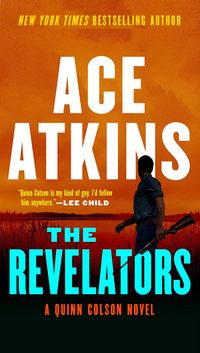
The Revelators by Ace Atkins: It’s All Been Leading to This

The Revelators

The Revelators

by Ace Atkins
Series: Quinn Colson, #10

Hardcover, 386 pg.
G.P. Putnam’s Sons, 2020

Read: August 4-10, 2020
Grab a copy from your local indie bookstore!

“Place kinda looks like when you came home ten years back?”

“Nope,” Quinn said, placing the small bottle back in the glove box. “It’s a lot worse.”

What’s The Revelators About?

How is it already book ten?

The Revelators starts with Boom Kimbrough trying to keep his friend alive. Quinn Colson has been responding to a call about a domestic dispute and had been ambushed by The Watchmen—the far-right vigilante militia beating him and then someone shooting him. When a book starts off with your series’ protagonist clinging to life, you know it’s going to be a grim time and it is.

A year passes and Quinn’s rehab has gone pretty well. The governor has appointed someone to fill in as Sherriff, and that man is everything that Quinn isn’t, he make’s Quinn’s crooked uncle look like a fine lawman. He’s not entirely physically ready, but he can’t wait anymore—Quinn’s got to step up and do his job before it’s too late and criminal elements have completely taken over. Quinn, Boom, Lillie Virgil, and the Jon Holliday (plus who knows how many undercover agents he has—he won’t tell anyone) prepare for a significant move that’ll put most, if not all, of the major elements in prison.

Meanwhile, the new Sherriff and ICE raid a local chicken processing plant (to the surprise of almost everyone in the county), arresting everyone, not allowing anyone to provide their immigration papers (of those who have them), merely sending them off somewhere to await deportation. Lillie and her church have their hands full with the children left behind by this move. If anything, this action galvanizes Quinn to step up his work.

Fannie Hathcock is making moves of her own, securing her position not only in Tibbehah County but the entire state (and beyond). And…well, I don’t have the space to keep going. There are so many moving pieces in this book I’m not even going to attempt to summarize.

There’s at least an allusion to the previous books, and many characters/crimes/events from them directly impact what happens here. The Revelators is the culmination of ten novels’ worth of events and nothing’s going to be the same after it. It’s clear from the get-go that Atkins has something major in mind and the atmosphere of the whole book reflects that. At various points in the novel, I have notes like “please don’t do anything to X and Y.” And at times it feels like this could be the series finale, and I spent a little time wondering how there’ll be any way for it to continue.*

* I’ve heard/read enough interviews of Atkins at this point to know he’s not keeping the next novel a secret, so I don’t feel bad about saying that.

Is this Fiction?

From the ICE raid on a chicken processing plant—and the way that parents are kept from their children afterward, to the police corruption and abuse of power, to the militant (and well-armed) right-wing group pushing their way around, and a few other spoilery actions—these “ripped from the headlines” storylines made me wonder time and time again how little fictionalization/sensationalism Atkins was pouring int this. I’m so relieved that it is fiction but at far too many points, it doesn’t feel all that fictional and you get a little sick wondering just how much of this could really be happening in Mississippi (or your own state).

Lights in the Darkness

In the middle of all this corruption, crime, inhumanity, and impending doom, there are moments of hope, joy, and family. Quinn’s nephew, Jason, falls for a girl (who falls right back). Quinn and Maggie are expecting. Maggie’s son Brandon grows closer to his new family—there’s one very sweet scene between Brandon and Quinn. Caddy seems to have found another chance at love.

And an old foe realizes how far down the wrong road they’ve gone and seeks to make it up to Quinn. I had to read a couple of scenes twice to make sure I understood what was going on.

Not only does that kind of thing keep Quinn and his allies going—it’s a reason to keep fighting, even if things are worse in the ten years since he came home. But, it also makes it easier to read. If it was all crime, corruption, racism, impending doom, and the rest, sure, it’d be worth reading, but these brief reminders that even Tibbehah County isn’t as bad as it could possibly be make it so much easier to keep reading.

So, what did I think about The Revelators?

“Johnny Stagg, J. K. Vardaman, the Watchman—all of them come from the same place,” Quinn said. “Me and you been fighting them over since we came home.”

“Been here long before me and you were born,” Boom said. “And they gonna be around long after we die.”

“That’s a hard take,” Quinn said.

“Do I lie?”

That is a hard—and honest—take. But what Quinn leaves unspoken is that it really doesn’t matter how long this kind have been around, people like he and Boom have been around resisting, fighting back the darkness, and trying to make it easier for light to shine. That’s why readers have kept coming back to this series for ten years. And they’ll keep coming back as long as that fight’s being waged.

Atkins has outdone himself this time—there are so many moving parts, so many interweaving plotlines, so much that he has to reveal slowly (or not let us see) so that he can let it all loose at the right time.

While reading it, I kept muttering about how good it all was, how fantastically Atkins was pulling off this very ambitious novel—and he made it look easy while keeping the reader white-knuckling the cover.

Book 11 in this series is going to look pretty different than the ten that came before, but it’ll be Quinn facing off with the same type of people—and as long as we get books of this caliber (or near it), that’ll be more than good enough.


5 Stars

20 Books of Summer2020 Library Love Challenge

This post contains an affiliate link. If you purchase from it, I will get a small commission at no additional cost to you. As always, opinions are my own.

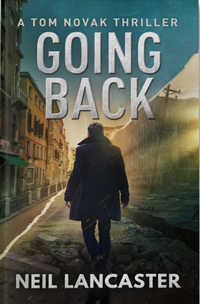
Going Back by Neil Lancaster: Improvise, Adapt, Overcome. Just another day for Novak.

Going Back

Going Back

by Neil Lancaster
Series: Tom Novak Thriller, #3

eARC, 506 pg.
Burning Chair Publishing, 2020

Read: August 11, 2020

What’s Going Back About?

Over the last couple of books, Tom Novak has received some pretty significant favors from Mike Brogan, his old friend who does some sort of work for American Intelligence (I like how vague his actual role is kept). And now he’s collecting.

There’s an ex-Serbian Special Operations officer who was freed from a prison van by a paramilitary force using some sort of device that seems like a portable EMP. Which is something that everyone (including governments around the world) wants, but no one’s been able to create. There’s a two-fold interest in this—1. can that portable device actually do what they think? and 2. There seems to be something major underway from this officer, probably using the EMP-like device. Which is not good for anyone.

Brogan’s team is pretty sure they know who’s bringing the tech-savvy to the team. Stefan Cerović left the country about the same time as Novak—but he ended up in the States. He was recently fired from a prominent tech company for failing a drug test and resurfaced in Belgrade. Cerović appeared to be relying on one particular black-market arms dealer, who’d recently been arrested. The job is for Novak to present himself as a new supplier as a way in. His ability with the language and similar background to Cerović is seen as a way for him to connect.

Mike will be around as backup, and of course, Pet will be around, too, doing all the typical technical wizardry.* Pet’s one of those characters that changes every scene she’s in—and makes Novak a more likable character when she’s around. I forget how much I like her until she shows up.

* Minor spoiler: Pet makes a costly mistake. I was so happy to see this. So often tech wizards like her are depicted as nigh infallible. But she makes a bad judgment call and she and Tom pay for it, keeping her human—a fantastically talented human, sure—but human.

As things are wont to do, after some initial success (Cerović’s a lot more interested in drugs than initially thought, which opens up so many doors for Novak), Brogan’s nifty plan goes off the rails—but not in a way you’d expect. Novak and Pet have to rely on Novak’s Marine slogan, and improvise and adapt so they have a shot at overcoming their opponents.

Serbia, huh?

I keep wondering how much mileage Lancaster’s going to be able to get out of Novak’s heritage and assume at some point we’re going to get a novel where it’s not so central. But until then, I’ll continue to be interested in seeing how Lancaster can adapt it.

This time out, putting him in his old homeland allows (forces?) him to confront and better understand his history (both recent and decades-old). Lancaster is able to get a two-for-the-price-of-one return here, not only is it the perfect setting for this kind of story, but we get a little character development.

One Gripe…

No self-respecting Texan is going to describe himself as from the “Deep South.” Sorry. Yes, it’s a minor issue, but it took me out of the moment. And for a book/series that reeks of authenticity, it’s a conspicuous blunder.

I did read an eARC which I know are still subject to change. Hopefully, that’s one of those edits that’s addressed before publication date.

So, what did I think about Going Back?

The first two books in this series had a pretty clear line of demarcation between the “undercover police officer” part and the “action hero” part of the book, and it worked pretty well. In Going Back, however, Novak slides back and forth between the two pretty easily (although the there is a clear shift in emphasis). I liked that a whole lot and hope Lancaster can do more of that in the future.

Throughout the whole book it felt to me like Lancaster had taken everything that worked best in Going Dark and Going Rogue, combining them while leaving off everything that didn’t work as well. Giving us the best in the series, a confident and well-paced thrill ride that will please fans and probably pick up a few for the series. You don’t have to have read the previous three to enjoy this one, the backstory isn’t that important to it. This is a fun way to spend a couple of hours and I recommend it to you.

Disclaimer: I received this eARC from the author in exchange for this post and my honest opinion—thanks for this.


4 Stars

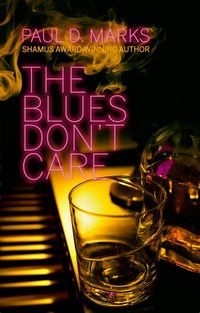
The Blues Don’t Care by Paul D. Marks: Jazz, Murder, and Rampant Phone Book Vandalism

Earlier, I posted an excerpt from this book (which you should read if you haven’t yet), now here’s what I thought about the book.


The Blues Don’t Care

The Blues Don’t Care

by Paul D. Marks
Series: Bobby Saxon, #1

Kindle Edition, 376 pg.
Down & Out Books, 2020

Read: July 30-31, 2019
Grab a copy from your local indie bookstore!

What’s The Blues Don’t Care About?

Bobby Sexton is a young Los Angeleno, of military age (who is not serving but wants to) during the height of World War II. His greatest desire in life is to be a piano player—he can’t get on with a serious band (mostly due to age, it seems—but there’s something else, too). So he starts spending time in black jazz clubs and finally works out the nerve to try to get in with the Booker ‘Boom-Boom’ Taylor Orchestra. He’s given a shot, and during his first gig, a white man is murdered. One of the other band members is arrested for the murder, but Booker (and Bobby) are sure he’s only arrested because he’s a convenient black man.

So, Booker makes Bobby a deal—use his whiteness in a way that no one else in the band can—find the killer. Or, at least, find a way to get James out of jail. Drawing on knowledge of detecting gained solely out of films, Bobby gives it a shot.

He catches a break by striking up the beginning of a friendship with a Deputy assigned to the case (who is not all that sure that James is guilty, but isn’t free to find an alternate suspect). Given the hints from that deputy, Bobby plunges in and soon finds himself lost in a maze of smuggling, big business, refugees, intelligence about the Concentration Camps, Nazis, and more. Bobby quickly learns (and relearns and relearns) that real life and real detective work isn’t like it looks in the movies, still he seems to have some talent for detecting (or is he just too stubborn to realize he doesn’t?).

A Couple of Thoughts about the Setting

It occurs to me, that every book I’ve read that takes place in World War II (and doesn’t involve the armed forces) takes place in or around New York City (or wherever the Pevensie children go). Seeing Los Angeles at this time was a nice change. I’d never really thought about what it was like during this time in L.A.—or anywhere that wasn’t where my grandparents lived or NYC.

For a book that’s largely about tolerance and acceptance of others, the era-appropriate racial and ethnic slurs fly pretty freely in this book. I can see a lot of people being made uncomfortable by it, being offended, or objecting to it. Not me, it’s how people talked—the slurs directed toward the African Americans Bobby plays with or spends time around did feel ugly, and those who used them weren’t depicted favorably. But the epithets for Axis powers (or their citizens) were casually used by just about every character. It didn’t strike me as hateful, just as slang. Maybe it says something about me (or maybe I read too many books written in the 1940s and 50s) that I didn’t care about it, it just seemed like context-appropriate dialogue. But I do know that not all readers will appreciate that aspect.

A Note about the Framing Device

There’s a framing device used here to introduce us to Bobby, Booker, Bobby’s music, and to give us a glance at their future. I’m not sure it was needed, I don’t know what it added—but I didn’t mind it. But as I thought about the book, I wondered, “why?” I just didn’t see the value.

I can see where in any sequels it could come back, and maybe turn into something I don’t wonder about, but I’m not convinced we need that device.

I’m not saying it was bad…just extraneous.

Has Bobby Never Heard of a Notepad?

Sure, I get it. There were shortages of everything, rations were the name of the game, but Bobby couldn’t have used a notepad, scratch paper, the back of sheet music, anything? Every time he looks something up, like an address in a phone book*, he rips out the page that has the information to take it with him.

* Kids and younger adults should ask your parents.

I remember reading other, older, PI novels where this happens some—and even some TV shows/movies. But Bobby’s a serial vandal—I lost count of who many phone books he ruined. Please, please, Mr. Marks, get the guy a pencil and a notepad for the sequel.

So, what did I think about The Blues Don’t Care?

First of all, I would’ve liked more about the jazz/band. Bobby playing, thinking about, or listening to music was the best part of the book. Yeah, I know, it’s a murder mystery, not a band novel, so the focus needs to be on the murder and hunt for the murderer. But, I tell you what, we could’ve used a lot more of the music scene for flavor, for grounding the story—and just for fun.

There are aspects of the novel, particularly about Bobby, that I don’t feel comfortable talking about at this point—I can’t do it without ruining some reveals. But I do appreciate the way that Marks deals with the characters and their circumstances. That’s really all I can say.

I see that this is listed as the first of a series, and I’m not sure how long you can use the “fish out of water” musician-turned-detective idea before it stops working, but I’m interested in seeing how Marks tries to do it. I’ll be back for at least the first sequel.

On the whole, though, I enjoyed this book. I enjoyed the amateur (very) detective stumbling his way through the L.A. underworld, through the racial divide, and through his first case—and through a degree of maturation and self-acceptance. It’s got the heart of a hard-boiled mystery, but isn’t as grim or violent as you’d expect (not that it’s a cozy by any means). Marks hits the right notes* with his prose and characters, creating a mystery that appeals on many levels. I recommend this for mystery readers looking for the kind of thing they haven’t read before.

* You know I had to.

Disclaimer: I received this book from the author via Saichek Publicity in exchange for this post and my honest opinion—thanks to both for this.


3.5 Stars

This post contains an affiliate link. If you purchase from it, I will get a small commission at no additional cost to you. As always, opinions are my own.

EXCERPT from The Blues Don’t Care by Paul D. Marks

I was pretty excited when I got the email for this excerpt, it was precisely what I’d hoped Marks would give me (and a little more, but that’s just frosting on the cake). This is a great sample of the book.


From author Paul D. Marks: Bobby Saxon’s on a mission. He wants to play piano for the Booker ‘Boom-Boom’ Taylor Orchestra (big band), the house band at the famous Club Alabam on Central Avenue in the heart of Los Angeles during World War II. But there’s a problem: he’s young and he’s white. So if he gets the gig he’d be the only white player in the otherwise all-black band. That’s not the only thing standing in his way. In order to get the gig he must first solve a murder that one of the band members has been accused of. And if that’s still not enough there’s another big thing standing in his way…

This excerpt begins the morning after the murder of Hans Dietrich aboard the gambling ship Apollo offshore from Los Angeles. Bobby had just played his first gig with the Booker ‘Boom Boom’ Taylor Orchestra on the ship and the band’s sax player James Christmas has been arrested for Dietrich’s murder. Booker shows up at Bobby’s apartment and asks Bobby to try to clear James of the murder. He figures since Bobby is white he can go places and ask questions that Booker can’t. And he makes Bobby an offer he can’t refuse…a permanent place in the band if he agrees to help.

from Chapter Four of The Blues Don’t Care by Paul D. Marks (available from Down & Out Books)

Bobby’s head swirled with thoughts of James and the dead guy, Dietrich. Had James done it? Bobby didn’t know him very well but James seemed like a hot head. The way he overreacted to everything and seemed angry all the time, Bobby wouldn’t put it past him, especially since the dead German had made comments about colored people.

His wristwatch read five to twelve, almost the witching hour, but not very late by musicians’ standards, when he pulled up in front of his apartment in his 1935 Oldsmobile Six convertible. Several years old, it had been in an accident, so Bobby got it cheap. It was still one snazzy car and he loved the running boards, rag top, rumble seat, and magenta color. Not the original color, but a hot jazz color if ever there was.

Bobby grabbed his stuff, didn’t bother locking the car, headed up the walk. His building was like a thousand others in Hollywood, a million in L.A. White stucco and Spanish style, but it had seen better days. He opened the wood-and-glass-paneled front door, walked down the carpeted but threadbare hall to his tiny apartment in the back. He’d thought about going to a Gene Autry Western at the all-night theater to unwind, decided against it. A smoke and his couch would help him unwind just fine.

He threw off his hat and coat, yanked off his tie and shoes, and flopped on the sofa. It was too much trouble pulling down the Murphy bed. He pulled out the ever-present pack of Viceroys, lit up, drew hard, turned on the radio—war news, what else? It was as good as anything to drift off to sleep to.

Intense morning sun streamed through the venetian blinds, casting long shadows, while dust mites jitterbugged on the light. Bobby, asleep in his clothes on the couch, turned. A loud knock on the front door seeped into his semi-consciousness. Who the hell was it, the cops?

He got up, adjusted his shirt carefully, making sure everything was in place. He ran his hand over his chin and cheek, then headed to the door, saw Booker through the peephole. Booker was in the same suit he’d worn last night; looked like he’d slept in it.

“Booker,” he said, opening the door.

Booker stumbled in. “You got any coffee?”

“Sure.” Bobby walked to the kitchen on the far side of the room, followed by Booker. He started the percolator while Booker made himself comfortable at the banquette. “How ’bout some breakfast?”

“I didn’t sleep at all, Bobby. You?”

“Nothing keeps me from sleeping.”

“You’re lucky.”

“In some ways.” Bobby thought this was a slip, but Booker didn’t pick up on it. Bobby started frying up some eggs and bacon. Making toast. They would use up most of his rations for the week, but Booker was a guest.

“I got a funny look from one-a your neighbors coming here.”

“Probably Mrs. Hazelton, the landlady.”

“I don’t think she likes colored folk in her neighborhood.”

“She looks at everyone like that. I’ve been living here a year and she still looks at me funny.”

“I don’t know if you’re telling me the truth or not, but it makes me feel better anyways. Bobby, this is a nice place.”

“This dump? It’s all right, but I’m aiming to move to better digs.”

“You ain’t no rich white boy just slumming, playin’ on Central Avenue with the darkies to stick it to your folks?”

“Nope.”

“You go to school?”

“I graduated high school. I like to read. But I’ve never been to college.”

“That’s good. I don’t want no eggheads in my band. They tend to intellectualize everything.” Booker sipped the coffee Bobby gave him. He looked the room over. “So, where’s your piano?”

“If there was a piano in here there’d be no room for me. I go to my old piano teacher’s house in Edendale to practice.”

“Edendale? The land of kooks and crazies.”

“Maybe that’s why I fit in.” Booker laughed. “So who do you like? Musically.”

“Benny Goodman. Dorsey. Ellington. Armstrong.” “All the usual suspects.” Booker threw a hard glance at Bobby. “So whatd’d ya think about them hauling James off?”

Booker’s abrupt change of subject threw Bobby for a moment as he put out the plates of food and topped off Booker’s coffee. He set a bottle of ketchup on the table. Both of them dug in. Anyone looking at this scene from outside would have seen two pals chowing down.

“Do you think he did it?”

“I don’t know, man,” Booker said. “What I do know is that the cops don’t care. They got a suspect. A colored suspect. They’re happy. I know you and James aren’t exactly tight, but maybe you can do some checking around.”

“What do you mean?”

“You know, ask some questions. See what you can find out.”

“Criminy, Booker, I’m no detective.”

“I know that. But you got something I don’t, something no one else in the band has.”

“What’s that?”

“A passport.”

“Passport?” Booker pinched Bobby’s pink cheek. “White skin. You can go places we can’t. Ask questions we can’t and get away with it. Maybe even get some answers.”

“You want me to play Sam Spade? Like in that movie The Maltese Falcon?”

“Sure, why not? But you ain’t no ‘spade’ far as I can see.” Booker looked Bobby up and down, grinned.

“I’m no Humphrey Bogart either.”

“Hell no, you’re ten times better looking.”

“I’m not sure how much that says about me,” Bobby said. “But I do have a fedora. What else is there?”

“A gun.”

“Well, that I don’t have.”

“And hopefully you won’t need one.”

Bobby hoped not. He had never fired a gun, though he’d seen Gene Autry and Roy Rogers and Bogart all do it in the movies a million times. What was he getting himself into?

“What about the gig, I’ll have to be there every night to play.”

“There is no gig. The Apollo’s shut down, at least temporarily. And you’re on probation with the band. You solve this, you got the gig.”

“I thought I’d get the gig ’cause I can play.”

“That too. ’Sides, what else you got to do now that we’re on hiatus since they shut the Apollo down?” Booker shrugged. “If you get James off, I’ll give you a permanent spot with the band.”

“What if he’s guilty?”

“If he is, if you prove him innocent or guilty without a doubt either way, you got the gig.”

“So where do I start?”

“You seemed to be talking to that plainclothes deputy a long time. Maybe start with him. See what they have on James. I’m gonna try and get him a lawyer. White lawyer. Jewish lawyer.” Booker took a drag on his cig.

“I want a spot, but I want it ’cause I’m a good musician.” “You are a good musician. Now go and be a good detective.” Bobby had no idea where to begin, but something inside him liked the idea of playing detective, at least for a little while, even if he wouldn’t admit it to Booker. It might make him more of a man.


Bobby parked across the street from the Los Angeles County Hall of Justice, an imposing building and right now it was imposing itself on Bobby. The top five floors of the 1926 beaux arts structure housed the main jail for the county and that’s where Bobby was headed. He stood in its shadow, trying without success to light a cigarette in the wind. He stopped, looked at the columns of highly polished gray granite, tossed his match. Headed inside.

Ionic columns, marble walls, a gilded ceiling, and a vaulted foyer, looking like a Grecian palace and running the length of the building, belied the jail that lay on the top floors. All that majesty changed when Bobby got off the elevator on the fifth floor. The unwelcoming yellowed linoleum and hard-tiled walls made Bobby’s footsteps carom off the ceiling. The visitor’s area, with its filtered yellow light and stained dull green walls, didn’t improve his mood. And if this is what the county presented to the public, he couldn’t imagine what the jail’s cells were like. He longed for a drag on a cigarette.

A uniformed deputy sat him at a long wooden table. The scarred surface bore the marks of almost every prisoner who’d sat there. A large, pissed-off-looking man shuffled in, accompanied by a larger, more pissed-off deputy.

“Yer the last person I expected to see here,” James said, looking even angrier upon seeing Bobby.

“Booker asked me to come.”

“’Course you wouldn’t come on your own.”

Why the hell would I the way you went after me?  “Do you hate everyone or just whites?”

“Mostly whites. But I pretty much hate everyone equally.”

“I think you hate yourself more than anyone else.”

Instead of shutting James up, he came back with, “Don’t go being no Freud on me. Why don’t you go home to your silver spoon and perfect family?”

Bobby stifled a laugh. “Booker asked me to help you.”

“An’ what can you do for me, white boy? You who’s wet behind the ears and don’t even look like you started shaving yet.”

“I see that you don’t need my help. Enjoy the food, I hear it’s yummy in here.” Bobby got up to leave, turned his back on James.

“Bobby?” James stood. The deputy shoved him down on the chair—hard. “Wait.”


They stared at each other across the table. The deputy stood rock solid behind James. The look in his eyes said he hoped the big man would make a move. James disappointed him. In a very small voice that admitted defeat, he said, “Got a smoke?”

Was that James’ way of asking Bobby to stay, maybe even to help? Bobby shook out a Viceroy, started to pass it across the table. The deputy took it, rolled it around in his fingers, probably to make sure a Bowie knife wasn’t hidden inside, and handed what was left of the crumpled cigarette to James. He put it in his mouth and Bobby lit it for him.

“Maybe I do have a small chip on my shoulder.”

Bobby sat down again. “I’ll say. Only about as small as the Rock of Gibraltar.”

“Well, could be bigger. Could be as big as Everest.” James cracked the slightest smile, held up his arm. A long, angry slash. Fresh. He pulled up his shirt. More bruises. The deputy slapped his billy club on James’ shoulder. The shirt went down.

“What happened?”

James leaned in, talked softly, “They beat me. Of course, they kept away from my face. But they had a hell of a good time doin’ it. And my chip keeps growing. So what’d Booker send you here for? Got a hack saw up your sleeve?”

“He thought I might be able to help.”

“You got friends or maybe your daddy’s on the po-lice force?”

“No. But why don’t you tell me where you were when Dietrich was killed.”

“That his name? No one ever told me.” He sighed. “’Course no one knows exactly when he was killed. But they had to have enough time to haul the body up to the rafters. I think I was probably back in the lifeboat, smoking reefer. Wasn’t feeling too good that night. Seasick, you know. And mad as hell after my confrontation with this Dietrich.”

“Uh,” Bobby didn’t know how to proceed. He was no private eye. “Was anyone with you?”

“I know I’m just a lowly spade, but I don’t have to have someone holding my hand every minute.” “I’m trying to help. It would be good if we had someone to alibi you.” Bobby was getting into the rhythm of being a detective.

“Got no alibis. All I got is my sax and I don’t even have that here.”

“And we miss it in the band.” Bobby stared beyond James, at the grimy walls. “James, did you do it?”

“Hell no!”

Bobby figured people in jail lied. He didn’t know if James was lying or not. But for now he’d take him at his word. “I’ll do what I can.”

He pulled out his pack of Viceroys, tossed it on the table. The deputy grabbed it. Stuck his fingers inside, pulled two cigs, tossed them to James. Stuck the pack in his pocket.

Out on the street in front of the jail, Bobby sucked in a deep breath of fresh air, opened a new pack of smokes. Lit up and took one long drag. He looked across the road to the rundown Bijou Theatre, playing a re-release of The Maltese Falcon. Bobby darted across the street. Short of a correspondence course on private detecting, he figured this would be about as much of a class in the subject as he could hope for.

Bobby emerged from the theater a couple hours later to a dark Los Angeles, lit by streetlamps haloing in the low-hanging fog that had rolled in.  He got in the Olds, cut over to Beverly Boulevard, drove west. I should be playing music, not hunting for a killer. I didn’t take a correspondence course in Detecting 101. Criminy, I’m even more of a fish out of water than Booker knows. 

Where the hell do I go now? I guess it would help to know who the, uh, dead guy is, was. I have to look at this logically, Bobby thought on the drive home. The answer’s probably right in front of my face. 

He flopped on his sofa, listening to Artie Shaw’s sweet clarinet on the radio in between war news. Bobby flipped through the pages of his high school yearbook. He had tried calling Deputy Nicolai. He had gone home for the day. The desk sergeant wanted to take a message. Bobby didn’t leave one.

The Andrews Sisters’ “Boogie Woogie Bugle Boy” followed Shaw. Bobby’s eyes grew moist. All those boys overseas. The service flags in almost every window, gold star flags in too many of them. Sometimes he wished he could join the boys in Europe or the Pacific. He didn’t want to think about that now. He wanted to look at the pictures in the yearbook. Johnny Larkman, senior class president. Very handsome. Is that why he was prez? Jane Feldman, most likely to succeed. What else could she be with her glasses and librarian hair? David Chambers. Handsome, smart. The reason Bobby had pulled out the dusty old yearbook in the first place. David in drama club with Bobby. They had appeared in Cyrano de Bergerac together. In the lead roles. Georgiana Greene, voted prettiest and homecoming queen. Bobby had had a major crush on her. Who didn’t? Mary Cooper. Bobby’d sent her a love note in fifth grade and gotten in trouble for it. Mary never said another word to him. They all went through school together, elementary, junior high, high school. And now they were all out on their own, facing their demons. Facing the world. He kept turning pages and reliving memories. Band. Drama club. Lunches in the quad.

It was fun seeing David Chambers the other night, even if Bobby had been too shy to go up to him. He must be doing pretty good to have money to spend on the Apollo.


Bobby fell asleep on the sofa again.

The Malibu sheriff’s outpost, or station, wasn’t much to look at. At least parking was easy. Bobby got out of the Olds Six, inhaled fresh ocean air. Walked inside. After some palavering with the desk sergeant he was allowed back to the detective room. It looked a lot like detective rooms in the movies did. A bunch of wood desks with blotters, file cabinets, and telephones. Men in shirt sleeves and shoulder holsters, some with fedoras on their heads, some with their hats on their desks or hanging from a rack.

Bobby and Sergeant Nicolai sat at a desk in the corner, by the water cooler. Bobby explained he’d come to find out what he could about the Dietrich case.

“Why’re you so interested?”

“James is a member of the band. I’m a member of the band.”

“Doesn’t sound right. Gotta be something more.”

“We have no gig. The Apollo is shut down. We need to hold the band together,” Bobby vamped.

“With a murderer?”

“What if he isn’t?” Nicolai thought a moment. “I’d like to help you but I can’t divulge information on an ongoing investigation.”

“Is it ongoing, Sergeant? And that sounds like a very nice, very formal ‘don’t bother me, kid.’ ”

“I don’t buy your spiel. That boy a friend of yours?”

“I’d hardly say that. But he is a bandmate and we need our first sax.”

“So why doesn’t your leader, Mr. Booker Boom-Boom, come down here himself?”

Bobby’s eyes wandered the room. Nicolai followed. He knew the answer.

“All right, I know why he doesn’t come down. Still—”

“Can’t you give me something?”

“His name’s Hans. Hans Dietrich. I believe he worked in the import-export field. That’s all I know.”

Bobby looked down, then up and straight into Nicolai’s eyes. “I got that much from the papers.”

“You’re a persistent little cuss, aren’t you?” “I got Booker to give me a spot in the band.” “And now you think I’ll just give you information in an ongoing—”

“Tell me something I don’t know and I’ll get out of your hair.”

“Something tells me you’ll never be out of my hair.” Nicolai drew a deep breath. “He and his partner, Harlan Thomas, an American, worked as Dietrich Enterprises, on Third Street. Dietrich’s a German citizen, moved here a couple years ago. Forty-five. Unmarried. Blonde over blue. No arrests.”

“That should get me started. Thanks, Sergeant.” Bobby stood, tipping his hat to Nicolai.

Bobby lit up a Viceroy, stepped out into the raging sun and wind and fresh, stinging ocean scent.

“So who are you,” Bobby sucked in the cigarette, exhaled, “Mr. Hans Dietrich?”


Excerpted from THE BLUES DON’T CARE Copyright © 2020 by Paul D. Marks. Reprinted with permission. All rights reserved.


Read the rest in The Blues Don’t Care by Paul D. Marks to see what happens from here.

Thanks to Down & Out Books, Paul D. Marks and Saichek Publicity for this excerpt!

The Friday 56 for 8/7/20

The Friday 56This is a weekly bloghop hosted by Freda’s Voice

RULES:
The Friday 56 Grab a book, any book.
The Friday 56 Turn to Page 56 or 56% on your ereader. If you have to improvise, that is okay.
The Friday 56 Find a snippet, short and sweet.
The Friday 56 Post it

from page 56 of:
The Revelators

by Ace Atkins

(a rare lighter moment in this book)

“How you feeling, brother?” Donnie said.

“Might ask you the same.”

“Nobody’s been shooting at me,” Donnie said. “Not in a long while.”

“Those Cartel boys got you pretty good,” Quinn said. “You’re lucky they didn’t kill you.”

“Takes a lot more to kill ole Donnie Vamer,” he said, grinning. “You see that woman I was just talking to? That’s damn Rita Wright, Pat Wright’s little sister. She wasn’t nothing but a kid when I left. But damn, she ain’t a kid no more. That little yellow dress about busting at the seams.”

“You’re too old for Rita Wright,” Quinn said.“You forget we’re the exact same age.”

“Nope,” Donnie said. “I’m six months older. And six months smarter. I rode a bike, drove a car, and got nekkid with a woman long before you and Boom. Y’all can deny it all you want. But those are some braggin’ rights, son.”

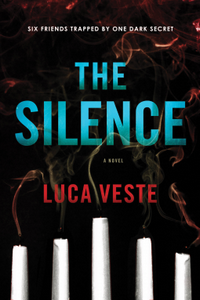
The Silence by Luca Veste: A Chilling Look at Spiraling Consequences of One Fatal Night

The Silence

The Silence

by Luca Veste

eARC, 400 pg.
Sourcebooks Landmark, 2020

Read: July 17-20, 2020
Grab a copy from your local indie bookstore!


This is one of those thrillers where it feels like if you say anything, you’ll ruin something. But, I’ve got to try (if only for the sake of my NetGally Feedback Ratio).

What’s The Silence About?

I’m going to borrow the blurb, because if that says too much, it’s on Sourcebooks, not me.

It was supposed to be our last weekend away as friends, before marriage and respectability beckoned. But what happened that Saturday changed everything.

We killed a stranger and covered it up.

In the middle of the night, someone died.

We didn’t know our victim was a serial killer.

The six of us promised each other we would not tell anyone about the body we buried.

But now the pact has been broken.

We don’t think he was working alone.

And the killing has started again …

The year following the killing of the serial killer was not easy on these six friends, the toll on them all is great. Then when the killing starts again, it’s even worse, the fragile hold that Matt (the narrator) has on his life and mental health is about to shatter. Sone of his friends are doing somewhat better, while others…well, you should read that for yourself.

While we what happens to these six around the one-year anniversary we get some quick glimpses at some of the formative experiences they shared through childhood, adolescence, and university that shaped who they are and how they reacted to the present crisis.

What can I talk about?

That borders on too much about the plot, and I really don’t think I can talk much about the characters for the same reason—almost everything we learn about them is tied to the story.

Let’s focus instead on the feel of the book, the atmosphere. Wow. The opening pages are upbeat, joyful—but you can tell that won’t last for long (and not just because you’ve read the blurb). Then it gets bad, and worse, and worse yet. And you can’t look away—like the proverbial car wreck you see coming. Not only can you not look away, you have to see more, you have to keep turning the pages to see just what kind of damage will be done. How these lives will be further shattered.

It’s horrible. It’s tragic. It’s compelling.

So, what did I think about The Silence?

I don’t know that I can honestly say that I enjoyed this book—I don’t think anyone can. It’s not that kind of book. It’s a serial killer novel like you’ve never read before. If for no other reason than the focus isn’t on the killer or the hunt for the killer. It’s about the victims, prospective victims, and those that are left behind. It’s about seeing the ripple effects of trauma.

It’s a great experience. An intense read. This will be lurking in my subconscious for a while. Veste tapped into something here, and you’ve gotta try it.

Disclaimer: I received this eARC from Sourcebooks Landmark via NetGalley in exchange for this post—thanks to both for this.


4 Stars

This post contains an affiliate link. If you purchase from it, I will get a small commission at no additional cost to you. As always, opinions are my own.

Catch-Up Quick Takes Timeless; Point Blank; Smarter Faster Better; Heartburn; In Plain Sight; Wonder Woman: Tempest Tossed; The Bitterroots

The point of these quick takes post to catch up on my “To Write About” stack—emphasizing pithiness, not thoroughness. Half of this particular group bothers me to include here, but I’m afraid I’m about to lose track of them. The other half? Well, I might have trouble coming up with enough to talk about even in this format.

Timeless

Timeless

by Gail Carriger, Emily Gray (Narrator)
Series: The Parasol Protectorate, #5
Unabridged Audiobook, 11 hrs., 25 mins.
Hachette Audio, 2012
Read: May 13-18, 2020
Grab a copy from your local indie bookstore!

(the official blurb)
I won’t deny that there were a couple of moments that had me on the edge of my seat, but overall this concluding novel felt like a letdown. There was just a lot of treading water going on, the plot just wouldn’t move for ages, it seemed.

An audiobook narrated by Emily Gray Unabridged Audiobooks a multitude of shortcomings, however. She’s just so much fun to listen to.

I’m glad I listened to this series, but I’m also glad that I’m done. It started strong, but over the course of the series, it kept getting weaker and weaker. A fun mash-up of Urban Fantasy and Victorian Steampunk, but ultimately unsatisfying.
3 Stars

Point Blank

Point Blank

by Anthony Horowitz, Simon Prebble (Narrator)
Series: Alex Rider, #2
Unabridged Audiobook, 5 hrs., 42 min.
Recorded Books, 2013
Read: May 29, 2020
Grab a copy from your local indie bookstore!

(the official blurb)
Alex Rider is back with another dose of escapist spy fiction for the MG set. It’s fun, but disposable. It’s the audiobook equivalent of NCIS, an entertaining way to spend some time, but that’s about it. I liked what Horowitz did with his character and I appreciated the growth in Alex.

This time, Alex is sent to an exclusive private school in the guise of a child of a rich and powerful man. Two similar fathers, from different parts of the world, with sons at this school, had recently been assassinated and M16 wants to get to the bottom of it.

Prebble did a fine job with the narration, I hope he continues.

This was clever and pretty exciting, I hope the series continues in this veinI can absolutely see why my son tore through them (and re-read them, probably the only things he re-read). I’ll be back for more (just wish I’d made myself do this back when he was reading them).
3 Stars

Smarter Faster Better

Smarter Faster Better: The Secrets of Being Productive in Life and Business

by Charles Duhigg, Mike Chamberlain (Narrator)
Unabridged Audiobook, 10 hrs., 23 min.
Random House Audio, 2016
Read: July 2-6, 2020
Grab a copy from your local indie bookstore!

(the official blurb)
My chief complaint about Duhigg’s book, The Power of Habit, was that I expected something the reader could use for themselves. This isn’t as easy to apply as you might want, but it’s clearly written with an eye for the reader not just to understand the principles of efficiency and productivity, but to show some ways to bring the lessons home.

That said, it’s not a how-to book, it’s not self-improvement, it’s largely about the science/study/understanding of productivity. I found it just as fascinating as the last book, and can see where it’d be a useful guidebook for people in some sort of position of authority in an organization.

Duhigg also shows us his process while illustrating his own application of the book’s lessonswhich I really enjoyed.

I’m absolutely on board for whatever book Duhigg puts out next, Chamberlain is a great narrator for his material, too.
3.5 Stars

Heartburn

Heartburn

by Nora Ephron, Meryl Streep (Narrator)
Unabridged Audiobook, 5 hrs., 30 min.
Random House Audio, 2013
Read: July 7, 2020
Grab a copy from your local indie bookstore!

(the official blurb)
A very pregnant cookbook writer/TV host/new mom’s marriage crumbles around her, as she attempts to salvage it, protect her children, and make a way for herself in the world. Really, she’s trying to do it all, and do it well. (that’s a lousy summary, just click the link above, will ya?)

The narrator? This Meryl Streep person? I tell you what, I think she’s going placesthere’s something special about her performance. Seriously, she did a great job, no surprise there.

Nor is it a surprise that Ephron can write a clever little book. I’m a long-time fan, I knew I should’ve picked this up when it was released. I don’t know that it’s necessarily deep, or that you walk away with new insight into the human condition, marriage, or love. But it was funny, it felt honest and real, and you get caught up in the life of Rachel Samstat right away. Solidly entertaining.
3.5 Stars

In Plain Sight

In Plain Sight

by C. J. Box, David Chandler (Narrator)
Series: Joe Pickett, #6
Unabridged Audiobook, 8 hrs., 23 min.
Recorded Books, 2008
Read: July 22-24, 2020
Grab a copy from your local indie bookstore!

(the official blurb)
So this is all about chickens coming home to roostalmost everything that happened in this novel ties into one or more of the previous novels. And never the fun stuff from those novels. There’s the marital issues we got a glimpse at since Day 1 (and getting worse all the timeespecially in the last book), the dead former Sheriff, the new Sheriff and his issues with Joe, Joe’s new bossand more that I will just gloss over and let you read.

There’s a truly disturbing secret unearthed that really sheds light on so much of what happened in the book, most authors would’ve spent a lot more time on it than Box did here, he just let it be something that happened on the way to the major showdown. I like that he did it, but also kind of wish he’d given us a little more about it.

I did like the new governor and hope we get to see him again. (I especially like the fact that he’s a fictional politician and governs a neighboring state, not my own, I don’t even think I could enjoy him as a fictional Idaho governor).

There’s a lot left hanging at the close of this novel, I know the series continues (for many, many books to come), but I really have no idea what it’ll look like when I come back for Free Fire. Joe will be different, too, no matter what the circumstances around him are like. I assume Box is going to address it and I’m very curious about it.
3 Stars

Wonder Woman: Tempest Tossed

Wonder Woman: Tempest Tossed

by Laurie Halse Anderson, Leila del Duca (Art)
Paperback, 208 pg.
DC Comics, 2020
Read: July 25, 2020
Grab a copy from your local indie bookstore!

(the official blurb)
I really didn’t need this book, Leigh Bardugo’s YA retelling of Wonder Woman’s origin was good enough, and superior to this one. But I’d read some largely positive reviews and decided to give it a shot.

It felt less like a Wonder Woman story, and more like Anderson wanted to find a way to talk about certain issues and shoved Diana into the necessary circumstances and then shaped the character around that, rather than making it feel organic and earned. Also, there was too much left unexplained. There was so much I didn’t understand about what was going on with Diana on the Themyscira and physically that it felt more like Anderson dropped the ball and less like she was being understated.

It wasn’t bad, but it sure wasn’t good.
2 1/2 Stars

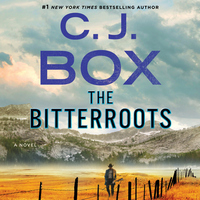
The Bitterroots

The Bitterroots

by C. J. Box, Christina Delaine (Narrator)
Series: The Highway Quartet, #5
Unabridged Audiobook, 9 hrs., 49 min.
Macmillan Audio, 2019
Read: July 30-31, 2020
Grab a copy from your local indie bookstore!

(the official blurb)
Cassie’s done with law enforcement (but like Harry Bosch, will always think like a cop), and is making a living as a PI. A blast from the past calls in a favor owed and hires her to do some work as an investigator for the defense in a criminal proceeding. Cassie hates the idea in general, and loathes it in particularthe client is clearly guilty. Clearly guilty of raping his teenage niece, no less. He’s also a highly unpleasant personshe wouldn’t want to work for him even before the rape charge. But a debt’s a debt, and she figures she’ll find enough evidence to get him to switch his plea to guilty and work out a deal.

Readers/Listeners know all too well that the clearly guilty part guarantees that Cassie will eat some crow on this point, but that’s for later.

So Cassie travels to the very small town in northern Montana where the crime took place and the client’s estranged family runs everything from their ranch to the school board and all things in betweenincluding the Sheriff’s Office and Courts. Things do not go well for her and her investigationwhich just makes her think there’s something for her to find to help the client after all.

I definitely listened to this too soon after In Plain Sight, one of the themes of it is repeated herenot something I’d have noticed (at least not as much) if a few more weeks had passed.

Box ultimately won me over, but I came close to DNFing this a time or two, and I really didn’t enjoy most of the book. It was just a little heavy-handed, and the tie-in to a prior nemesis really didn’t work for me at all (and I’m not sure the introduction of the tie-in works now that I’ve seen where Box was taking itit’s too complicated to explain, especially for this post, let’s just say I didn’t like it). But by the end, I liked what Cassie got up to and how she handled herselfand I like the way that Box dealt with the climax and denouementboth were really strong (and semi-unexpected).
3 Stars

2020 Library Love Challenge
This post contains affiliate links. If you purchase from any of them, I will get a small commission at no additional cost to you. As always, opinions are my own.

Classic Spenser: Looking for Rachel Wallace by Robert B. Parker

Classic Spenser

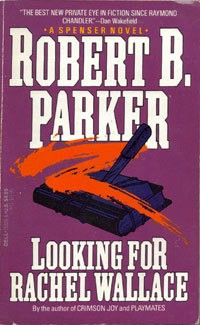
Looking for Rachel Wallace

Looking for Rachel Wallace

by Robert B. Parker
Series: Spenser, #6

Mass Market Paperback, 217 pg.
Dell, 1980

Read: June 26, 2020
Grab a copy from your local indie bookstore!

“What is it you want to know?”

“Why you engage in things that are violent and dangerous.”

I sipped half a glass of beer. I took another bite of veal. “Well,” I said, “the violence is a kind of side-eiffect, I think. I have always wanted to live life on my own terms. And I have always tried to do what I can do. I am good at certain kinds of things; I have tried to go in that direction.”

“The answer doesn’t satisfy me,” Rachel said.

“It doesn’t have to. It satisfies me.”

“What he won’t say,” Susan said, “and what he may not even admit to himself is that he’d like to be Sir Gawain. He was born five hundred years too late. If you understand that, you understand most of what you are asking.”

“Six hundred years,” I said.

What’s Looking for Rachel Wallace About?

Spenser is hired to act as a bodyguard for Rachel Wallace. Wallace is a no-nonsense feminist activist and lesbian author. There have been threats made against her if her book exposing the discriminatory practices of several New England companies is published. The threats make little sense since the galleys have already been released (and therefore the material is out there), but they’re still there.

Despite clashing in their first meeting, Wallace agrees to her publisher’s choice in Spenser and he agrees to try not to annoy her. The two continue to squabble for the first eighty or so pages. Wallace keeps trying to provoke Spenser, questioning his professionalism, wanting to debate her brand of feminism with him. Spenser really doesn’t care about all that—and as much as he’s willing to discuss and think about those issues at other times (he’d read Wallace’s previous work before going to work for her)t—this is about work for him. He doesn’t care who she sleeps with, what she thinks, he’s about keeping her as safe as he can.

There is a moment where Wallace knows she’s going into somewhat hostile territory and tells Spenser to stand down beforehand. When security guards arrive to drag her off, and she goes limp to make it hard for them, Spenser intervenes. Which robs Wallace of the opportunity to make her statement, get the attention she wants, and hopefully a hearing with her target-audience. Wallace takes this as an insult, thinking Spenser’s machismo forced him to protect a (seemingly) helpless woman. And, yes, that’s true. But it’s also true, that if Wallace had been a male academic attracting this kind of response, he’d have done the same thing.

It was the wrong thing for Spenser to do regardless, which he admits later. Wallace fires him—and apparently doesn’t replace him. A couple of months later, she’s kidnapped. Belson* brings Spenser in for his perspective—and of course, that just spurs Spenser into his own investigation. He blames himself for not being a better employee, so he wasn’t around to protect her.

* It’s never explained why a homicide detective is brought in to discuss an abduction, but let that pass.

Spenser has very little to go off of here. He has one name, from a minor incident on his first day with Wallace to look into, and he essentially spends a lot of time trying to find evidence to tie this guy to the kidnapping. There’s also a KKK leader that Spenser arrested back when he was a law enforcement officer and hasn’t lost track of. Working off the assumption that a racist is going to operate in the same circles as a militant misogynist, Spenser harasses him for information. It works out (to a degree), but watching Spenser bully this guy on less than a hunch really bothered me.

Almost randomly, the one piece of evidence that Spenser (and Belson, to be fair) needs to tie everything together is essentially dropped into their lap. As a record blizzard descends on Boston, Spenser decides to walk (almost all roads are closed) fifteen miles to make the best of that piece of information. And well, you can guess the rest.

I Feel Compelled to Share this Quotation that has Nothing to do with the Plot

The Main Entrance to the Boston Public Library used to face Copley Square across Dartmouth Street. There was a broad exterior stairway and inside there was a beautiful marble staircase leading up to the main reading room with carved lions and high-domed ceilings. It was always a pleasure to go there. It felt like a library and looked like a library, and even when I was going in there to look up Duke Snider’s lifetime batting average, I used to feel like a scholar.

Then they grafted an addition on and shifted the main entrance to Boylston Street. Faithful to the spirit, the architect had probably said. But making a contemporary statement, I bet he said. The addition went with the original like Tab goes with pheasant. Now, even if I went into study the literary influence of Eleanor of Aquitaine, I felt like I’d come out with a pound of hamburger and a loaf of Wonder bread.

So, what did I think about Looking for Rachel Wallace?

I guess I’ve made it clear that this isn’t my favorite Spenser. But it’s not that I dislike it. I enjoy spending time with Spenser and Susan. I liked when Wallace and Spenser engaged with each other—seeing Spenser in these settings tells a lot about him, as does the way he reacts to Wallace. At the same time, it’s interesting seeing Spenser through her eyes (as mistaken as I think her estimation of him is, it’s not merit-less). The dialogue is great, Spenser verbally sparring with Wallace’s publisher and a prosecutor looking into her disappearance is just fun to read. I can’t forget there are some pretty good action scenes (even if Spenser does bring a handgun to a pie fight).

It’s just that this is the first one since The Godwulf Manuscript that I have to add provisos to my enjoyment. I have had the impression on many re-reads (including this time), that Parker was more interested in bringing up some of Wallace’s ideas, positions, and practices than he was in telling a good story. At the very least, he was frequently distracted during the telling.

Do I recommend it? Yeah, it’s a good read. It’s a great way to understand the character, and the story is okay. Am I in the same kind of fan-boy mode for it as I was for Mortal Stakes, The Judas Goat or Promised Land? Nope. Still, I’ll take this over almost Spenser novel from the 2000’s.

This post contains an affiliate link. If you purchase from it, I will get a small commission at no additional cost to you. As always, opinions are my own.

The Silence by Luca Veste: A Chilling Look at Spiraling Consequences of One Fatal Night

The Silence

The Silence

by Luca Veste

eARC, 400 pg.
Sourcebooks Landmark, 2020

Read: July 17-20, 2020
Grab a copy from your local indie bookstore!


This is one of those thrillers where it feels like if you say anything, you’ll ruin something. But, I’ve got to try (if only for the sake of my NetGally Feedback Ratio).

What’s The Silence About?

I’m going to borrow the blurb, because if that says too much, it’s on Sourcebooks, not me.

It was supposed to be our last weekend away as friends, before marriage and respectability beckoned. But what happened that Saturday changed everything.

We killed a stranger and covered it up.

In the middle of the night, someone died.

We didn’t know our victim was a serial killer.

The six of us promised each other we would not tell anyone about the body we buried.

But now the pact has been broken.

We don’t think he was working alone.

And the killing has started again …

The year following the killing of the serial killer was not easy on these six friends, the toll on them all is great. Then when the killing starts again, it’s even worse, the fragile hold that Matt (the narrator) has on his life and mental health is about to shatter. Sone of his friends are doing somewhat better, while others…well, you should read that for yourself.

While we what happens to these six around the one-year anniversary we get some quick glimpses at some of the formative experiences they shared through childhood, adolescence, and university that shaped who they are and how they reacted to the present crisis.

What can I talk about?

That borders on too much about the plot, and I really don’t think I can talk much about the characters for the same reason—almost everything we learn about them is tied to the story.

Let’s focus instead on the feel of the book, the atmosphere. Wow. The opening pages are upbeat, joyful—but you can tell that won’t last for long (and not just because you’ve read the blurb). Then it gets bad, and worse, and worse yet. And you can’t look away—like the proverbial car wreck you see coming. Not only can you not look away, you have to see more, you have to keep turning the pages to see just what kind of damage will be done. How these lives will be further shattered.

It’s horrible. It’s tragic. It’s compelling.

So, what did I think about The Silence?

I don’t know that I can honestly say that I enjoyed this book—I don’t think anyone can. It’s not that kind of book. It’s a serial killer novel like you’ve never read before. If for no other reason than the focus isn’t on the killer or the hunt for the killer. It’s about the victims, prospective victims, and those that are left behind. It’s about seeing the ripple effects of trauma.

It’s a great experience. An intense read. This will be lurking in my subconscious for a while. Veste tapped into something here, and you’ve gotta try it.

Disclaimer: I received this eARC from Sourcebooks Landmark via NetGalley in exchange for this post—thanks to both for this.


4 Stars

This post contains an affiliate link. If you purchase from it, I will get a small commission at no additional cost to you. As always, opinions are my own.

Pub Day Post: Of Mutts and Men by Spencer Quinn: Water, Water Everywhere and a Murder, too

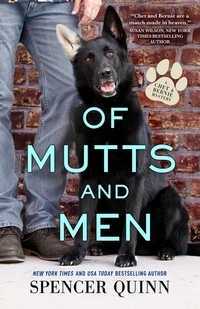
Of Mutts and Men

Of Mutts and Men

by Spencer Quinn
Series: Chet and Bernie, #10

eARC, 304 pg.
Forge, 2020

Read: June 27-29, 2020
Grab a copy from your local indie bookstore!


Bernie meets the man destined to his new best friend—a hydrologist who seems to share many of the same opinions as Bernie when it comes to water usage in Phoenix. I don’t think we’ve managed to get a novel where Bernie hasn’t complained about the waste of water in the area (except maybe those two when they were back East), “we only have one aquifer.” It appears that Wendell has need of a P.I., too—the two make arrangements to meet the next day to discuss it.

But when our dynamic duo shows up at Wendell’s worksite office, they find him murdered. Which puts the kibosh on the bromance. Bernie naturally begins investigating—spurred to action after meeting the Sheriff’s Deputy in charge of this case, if nothing else—who is one of the sorriest excuses for a law enforcement officer that I’ve read this year. Some quick detective work leads Bernie to a suspect—not one that he believes really did it, but he still feels compelled to hand him over to Deputy Beasley.

This was a mistake as Beasley locks in on the suspect and ignores any other possibilities. But the more that Bernie looks into things—if only to find out why Wendell wanted to hire him—the more he’s convinced the suspect is innocent. Only no one—including the deputy, and the suspect’s own defense attorney—will listen to him.

We Need to Talk About Chet

What is there to say about Chet the Jet? He’s the same loveable, heroic champ we’ve come to know and love. For those who don’t know—Chet’s our narrator, Bernie’s partner, and a 100+ pound dog. Other than a couple of sentences showing a more libidinous side to Chet than we’re used to seeing, he’s exactly what we’ve come to expect. Don’t read anything into me not having a lot to say about him—he’s the best dog in fiction (for my money), but there are only so many ways you can say that.

But We Can’t Forget Bernie (or Anyone Else)

On the other hand, I think I’ve given Bernie short shrift over the years—it’s easy to focus on Chet. But Bernie’s more than just the guy who complains about wasting water while making horrible investment choices. He’s a top-notch P.I., but like most fictional P.I.’s, his principles, independence, and lousy business sense keep him from being much of a success. His residence and devotion to Chet are most of what separates him from Elvis Cole, for example (sure, Elvis has his cat, but he doesn’t take the cat with him on cases).

I felt more connected to Bernie in this novel than usual—I’m not sure if that’s a reflection on me or Quinn’s writing. Bernie’s outrage at the treatment of the suspect (some directed at himself for getting the Deputy looking at him) drives him more than any desire for a fee or to discover what Wendell wanted.

In addition to the case and the machinations of the principles involved, there’s a lot going on in Bernie’s private life. He doesn’t deal well with most of it, which isn’t a surprise, dealing well with personal relationships isn’t his trademark. It seems to affect him more in this novel than I’m used to seeing him—both positively and negatively (although, there’s a lot of negative in this novel—all around).

In case you can’t tell, I can’t put my finger on what’s different this time—but Bernie seems more human, more real, less “merely the guy who Chet is devoted to” (although he absolutely is that). Quinn puts him through the wringer in many ways here, and the novel is better for it.

It’s not just with Bernie, I think that this novel has some of the most subtle and rich character work in the series (last year’s Heart of Barkness) headed in this direction (growth prompted by The Right Side?). The villain of this novel is the most complex and compelling foe for these two. Beyond that, there were so many characters that showed up for a scene or two—five or six pages total—that were just dynamic. Even Malcolm, the husband of Bernie’s ex-wife, Leda makes a couple of positive contributions! He’s rarely been much beyond an antagonist for Bernie, a competitor for the paternal role for Bernie’s son—and here he’s in such a better way, I almost liked him.

Don’t Forget the Kleenex.

There are three—maybe four—scenes in this book that “hit you in the feels.” One only took two or three sentences to deliver the punch, and could easily be missed. But the emotional core of this novel is shown in a couple of others (some readers will be torn up by them, others will be satisfied—either reaction is warranted).

But there’s one scene—it has only the most tangential tie to the plot—that will (or ought to) devastate you. I’m honestly not sure why Quinn included it, but I am so glad he did. You’ll know it when you read it, I’m not going to say anything else about it. Chet was still his goofy self, but even he came across differently in it. The book is worth the purchase price for it alone.

So what did I think about Of Mutts and Men?

I’ve said it before, I’ll say it again, I’ve been a fan of this series since maybe the third chapter of the first book eleven years ago. And I’ll be a fan until Quinn moves on. But there’s something different about this book. Still, I’m going to try to thread the needle here—this is not my favorite book in the series. However, I think it’s unquestionably the best book so far. I’m not crazy about some of the longer-term arc events here—hey’re the smart move by Quinn, I’ll defend them, but I didn’t like them.

Still, there’s a good mystery, you get the wonderful partnership of Chet and Bernie, probably the best use of Bernie yet, and a new depth to Quinn’s writing—it’s precisely what the doctor ordered. New readers will have no problem jumping in at this point, returning fans have to be pulling on their leashes to get to this. Highly recommended.

Disclaimer: I received this eARC from Macmillan-Tor/Forge via NetGalley in exchange for this post—thanks to both for this. Also, sorry that I didn’t get this posted sooner, I really did try.
4 1/2 Stars

20 Books of Summer

This post contains an affiliate link. If you purchase from it, I will get a small commission at no additional cost to you. As always, opinions are my own.

Page 57 of 61

Powered by WordPress & Theme by Anders Norén