Tag: Mystery/Detective Fiction/Crime Fiction/Thriller Page 63 of 64

Open and Shut (Audiobook) by David Rosenfelt, Grover Gardner

Open and ShutOpen and Shut

by David Rosenfelt, Grover Gardner (Narrator)
Series: Andy Carpenter, #1
Unabridged Audiobook, 6 hrs, 50 min.
Listen & Live Audio, Inc., 2008

Read: August 21 – 22, 2017


I honestly can’t believe I’ve talked to little about Andy Carpenter and David Rosenfelt here — it works out, when you look at timelines and whatnot, I’ve been reading him a long time before I started blogging. Still, it’s hard to believe since it’s one of my favorite series, and has been going for so long. Yeah, maybe the series is getting too long in the tooth, but for something to get to book 16+, it’s got to have a pretty solid foundation, right? That foundation is Open and Shut, where Rosenfelt introduces the world to Andy Carpenter, dog lover extraordinaire and pretty decent defense attorney.

Carpenter is a hard-working lawyer, taking on many cases that don’t pay much, but do some good. He’s obsessed with New York sports and his golden retriever. He’s going through a divorce — and has started dating his investigator. He’s got a great sense of humor, is known for a hijink or two in court, and seems like the kind of guy you want in your corner. His father is a big-time D. A., the kind of Prosecutor that people hope/assume theirs is — honest, hard-working, tough on crime. So it shocks Andy when his dad asks him to take on a client for a retrial on a murder case — a murderer his dad put away and his currently on Death Row.

Andy goes ahead with the case, not sure that he should. But it doesn’t take long before he starts to believe in his client’s innocence. About that time, things get interesting and maybe even a little dangerous.

Almost all the elements that go into a typical Andy Carpenter novel are here — even if they’re just being introduced at this point. The jokes are fresh, the clichés have yet to be developed. It’s a good mystery with some good non-mystery story elements. And, best of all, some really fun courtroom moments — not just antics on Andy’s part, but some good depictions of legal/trial strategy and the like. I’ve been thinking lately that the latter Carpenter books have been giving the courtroom short shrift, and seeing what Rosenfelt does here just solidifies that thinking.

Gardner’s narration didn’t blow me away or anything, but it was good work. I can easily believe him as Andy’s voice and can see him really growing on me (not unlike George Guidall and Walt Longmire). He’ll keep you engaged in the story, and deliver a line or two in a way that will bring a smile to your face.

Give this one a whirl, folks — text or audio — you’ll enjoy yourself.

—–

3.5 Stars

IQ by Joe Ide

IQIQ

by Joe Ide
Series: IQ, #1

Hardcover, 321 pg.
Mulholland Books, 2016

Read: September 18 – 19, 2017


The book opens with a criminal in the making, and a very slapstick-y incident. But even while grinning about that, you get the sense that this character isn’t going to be good for more laughs. He’s not — but thankfully, we don’t have to spend a lot of time on him, because Isaiah Quintabe (a.k.a. IQ) finishes his blossoming criminal career. Which is very effective way to introduce Isaiah, the unlicensed investigator, and his world to readers.

After this, we spend some more time with our modern-day Sherlock of South Central LA. He needs money, not another case that he takes on in return for some homemade cookies or something, he’s got a couple of big bills heading his way and requires cash to take care of things. His need for an infusion of cash forces him to align himself with a former friend (there’s a very good reason for that “former”) with a tie to a well-paying client. The client is a famous rapper who is convinced that someone is trying to kill him — he happens to be right, I should add, which makes the book a lot more interesting. (obviously, an investigator looking into a paranoid delusion isn’t going to be as action-packed as one looking into a person actually trying to kill someone). This investigation will bring Isaiah and Dodson into the not-as-lucrative-as-it-used-to-be music industry, into marital problems, petty jealousies, and a whole lot closer to pit bulls than at least one of them wants to be. The case is at once a showcase for Isaiah’s talents and something almost too complex for him.

We also get a series of flashbacks to the events that set Isaiah on this path, how he honed his natural abilities and inclinations to become the man he his — an unlicensed PI that helps out people in his neighborhood, many of whom wouldn’t turn to the authorities. So often with a Sherlock-type character, we just get the finished product — the Great Detective at the height of his powers, knowing all sorts of arcane information. But Ide shows us how Isaiah gets this information, how he earned it, improved his reasoning and observation skills. Also the why behind it all — why didn’t Isaiah take his genius into something that would make him more money? Why does he stay where he is? The flashbacks also show us Dodson and Isaiah meeting and falling out.

The two stories intertwine and are pretty equally intriguing, which is a real bonus.

There’s what seems to be an authenticity to the world Ide portrays — honestly, what do I know about the realities of LA? But it sure feels real, so either way, I guess Ide did his job. The characters — all of them, the good, the bad, the creepy, the slimy and everyone else are wonderfully conceived and executed. The crimes depicted are varied sophisticated (making them worth Isaiah’s time) — and at least one method of assassination is something I’ve never seen before. Ide does a great job of balancing the moods at work, the grim, the hopeful, the silly and all points in between.

There’s a passage in this book that is one of the best brief pieces of writing I’ve read this year, period. As I reread it (at least 5 times), I kept thinking of the Fiction Writing professors I had in college that would’ve made us study it for at least one class session. It’s during the “origin” portion, where Isaiah’s Geometry teacher is explaining inductive reasoning — these four paragraphs give you a strong character, setting, tone, a minor character (and even a brief storyline), a good idea what she looks like, her past, her relationship with her husband — and you get a good working definition of inductive reasoning, too! It’s really great.

This year (most recently, last week), I’ve also talked about another modern Sherlock — Victor Locke. How would I compare the two of these? There’s some similarities, and more than a few differences. At the end of the day, Victor Locke is a lot more amusing and entertaining. Isaiah, on the other hand, I could believe was real (I know he’s not, don’t worry). Isaiah is driven, he’s brilliant, he’s proud, he’s haunted, he has no obvious addictions (phew! wonderful change), he’s a bit more grounded than your typical Holmes-type. Dodson is the least John Watson-y Watson-figure you’ve ever seen, more of a hindrance than an assistant. Thankfully, also he’s not a narrator, and I’m not sure I could’ve handled a book from his point-of-view. It’s hard to summarize, but he works really well in this role.

I thoroughly enjoyed this book from beginning to end, with not a dull moment in between. Isaiah Quintabe is a keeper, and I’m already counting the days until his next book.

—–

4 Stars
2017 Library Love Challenge

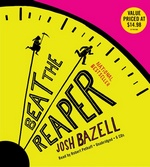
Beat the Reaper (Audiobook) by Josh Bazell, Robert Petkoff

Beat the ReaperBeat the Reaper

by Josh Bazell, Robert Petkoff (Narrator)
Series: Dr. Peter Brown, #1

Unabridged Audiobook, 6 hrs and 48 mins
Hachette Audio, 2009

Read: April 19 – 21, 2017


Dr. Peter Brown is having a rough day — he’s fighting to keep a patient alive long enough for someone competent to diagnose him properly — he’s also fighting to get someone to diagnose him properly. And he’s a got a new patient that recognizes him from his past life, who makes a threat — keep him alive, or someone will divulge that Brown’s got a new name and can be found at this hospital.

Peter Brown is the new name for someone in the Witness Protection Program — he was a contract killer who flipped on his employers and got sent to medical school. He’d been doing a pretty good job of moving on, but . . .

The novel tells Brown’s story in flashbacks through his childhood, becoming a criminal and what forced the break from that, um, atypical career path. Then we get to see him scrambling to stay alive in the present, and maybe keep some of his patients in the same state.

A first-person narrator describing how he’s killing someone with medical precision, and a touch of humor is just so much fun. This is a very visceral book — whether describing what a patient is suffering, what Peter is inflicting on someone, what someone’s inflicting on Peter, or even the drugs he takes to maintain alertness — he describes in the kind of detail you just don’t see anywhere else. You can feel it.

Peter’s got a great sense of humor — dark, sure, but what else can he have in is position? But if you don’t find yourself at least grinning a a few times, there’s something wrong with you.

Robert Petkoff narrates this in a hyper-masculine tone of voice, which fits perfectly. He embodies Peter in a way that you hope an audiobook narrator can. I liked the audiobook by him I heard last year, but this one seems like he got into the story more, like he was having fun (of course, this is a much more “fun” book than Before the Fall wants to be). Basically, he does a great job.

Part of me wants to go into more detail — but I find myself being restrained. Beat the Reaper is visceral, witty, intelligent and violent — this has all the elements of a thriller that’ll appeal to me. The plot and characters are pretty decent, too — that’s more than you can ask, really.

—–

4 Stars

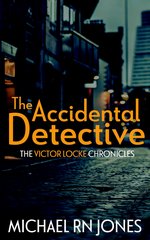
The Accidental Detective by Michael RN Jones

The Accidental DetectiveThe Accidental Detective

by Michael RN Jones
Series: The Victor Locke Chronicles, #1

Kindle Edition, 252 pg.
Fahrenheit Press, 2017

Read: March 23 – 30, 2017


I have this section of my Kindle, a corner area, where I put Fahrenheit Press titles to gather dust after I buy them (I imagine the drive like a big patch of land — I know that’s not how things work, but I like it). Only Jo Perry and Charles Kriel have managed to avoid that area (Duncan MacMaster’s Hack never ended up there, because FP gave it to me to read — his other book, however . . . ). There are a handful of books there, and on adjacent plots, that I was going to actually read in January of this year, but well, that didn’t work. Maybe by July? (feel free to pause for laughter here).

I bring this up because The Accidental Detective was purchased on release and placed their next to the other titles and was only FP’s releasing of HER: The 1st Victor Locke Story back in March that got me to read this one so quickly. I didn’t realize at the time that HER was the first story in this collection, I thought it was more of a prequel to this novel. Whoops. Still, HER was a fun story and I had to find out more about Victor Locke and his buddy, Dr. Doyle quickly, so I was able to rescue this from FP corner.

Essentially, this is a short story collection — or a very episodic novel, depending how you want to look at it — about a convicted hacker and his formerly court-mandated psychologist solving mysteries. The stories are very much in the updating-Sherlock Holmes vein. Basically, the stories are a Sherlock-like update featuring a Holmes (Locke) with a demeanor more akin to Elementary‘s Holmes while living a Mr. Robot lifestyle (at least early Season One Mr. Robot — look, don’t go examining these comparisons too far, all right?). Some of the ways that the Locke stories are updates of/tributes to/etc. the Holmes canon are obvious, some are subtle, and some are blatant — and all work wonderfully. I’ve read most of the Holmes stories and all the novels at least once, but I’m not an expert by any means; still, I’m familiar enough to catch most of them without work. I laughed hard at this version of Mycroft in his first appearance.

All that’s background — now to the book itself, HER kicks off the collection with Locke (and his not-sidekick Doyle) being drafted into working for the FBI. The story doesn’t end the way the FBI agents would like, but it seems to give Locke the idea that he could do more of this detecting thing. Unofficially, of course. So he goes looking for further opportunities like this. Most of his work is for friends and acquaintances from his neighborhood, but he does get pulled into doing some work for the police.

Locke’s personality pretty much demands that he will have conflict with whatever authority/official-types he encounters, but, like every good Sherlock, most will recognize his talents and let him get away with it. Doyle is more than a sidekick and chronicler of his adventures, but he’s no Joan Watson. Yet. I don’t think Brown will leave him in his current role. Doyle is brilliant, he’s a great observer of people and things, he thinks and talks fast and doesn’t suffer fools gladly (unless he likes them). This doesn’t mean that he won’t have a blind spot or two, that he can’t use some help from others occasionally, either. He usually knows when he needs the help, too.

Few of the stories result in any public success — Locke gets the solution, but sometimes he can’t do anything with it, or has to keep it under wraps. I love this — it’s be so easy to make him some publicity-seeking type. Or someone who doesn’t seek it, but gets it nonetheless. But Jones lets his hero have public failures pretty regularly, keeping him as a struggling detective, not a superstar of deduction.

Fast-paced, clever, charming, funny, clever, and I should repeat clever. I thoroughly enjoyed these stories and gobbled them up pretty quickly. I know Volume 2 is on the way, and it won’t end up in the dusty and ignored FP corner. You should go grab this one if you’re a fan of Holmes or any of his modern incarnations. Even if you’re not a fan of Holmes, you might find yourself changing your mind after reading Jones’ take on the character.

—–

3.5 Stars

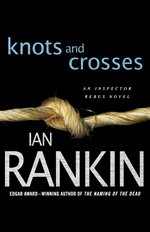
Knots & Crosses by Ian Rankin

Knots & CrossesKnots & Crosses

by Ian Rankin
Series: John Rebus, #1

Hardcover, 256 pg.
Minotaur Books, 1987

Read: February 1 – 4, 2016

Yet there had to be clues. There had to be. Rebus drank his coffee and felt his head spin. He was feeling like a detective in a cheap thriller, and wished that he could turn to the last page and stop all his confusion, all the death and the madness and the spinning in his ears.

After 21 novels and 30 years of being in print, I finally decided to give DS John Rebus and his author Ian Rankin a shot, it looks like they might stick around for a bit. Seriously, I’ve seen the names a lot over the last few years, and despite being unimpressed with his appearance in the Face/Off collection a couple of years ago (I’m sure I’ll change my opinion once I get to know Rebus a bit), when I needed a new mystery series to sink my teeth into, this looked like a good candidate.

In Knots & Crosses we meet DS John Rebus, a former SAS officer, now a Detective Sergeant in Edinburgh. He’s scraping by, he has an ex-wife and daughter; a small, dusty apartment; stacks of books; a pretty successful brother that he really has no relationship with; a large capacity for drinking; a surly attitude; and a not-that-successful program to limit his smoking. On the whole, that sounds a lot like many other fictional detectives (police and otherwise) — but there’s something about him that doesn’t seem that cookie-cutter when you read him. Maybe it’s just Rankin’s writing, maybe there’s something else — I’m not sure yet, I’ll have a better idea in a book or two (which will also give Rankin the time to distinguish Rebus). There is one other thing that separates him, but that’s the crux of this book, so I won’t get into it.

There’s a serial killer at loose in Edinburgh, killing girls and sending little notes to Rebus, taunting him about it. Sadly, Rebus doesn’t realize that for quite some time. Whoops. Not that there’s any reason for him to have seen the link, really — the killer was really more clever than he needed to be on that front. Rebus is part of the army of police working on his case, while dealing with some personal demons of his own — hopefully, the latter doesn’t prevent him from doing his part to help with the former.

The best part of the book for me was Rankin’s writing — the book is full of great sentences. Not so much that it distracts from the characters or story, but enough that you can admire his prose while enjoying the rest. This book wasn’t intended to be the beginning of a series, and doesn’t really feel like one — it’s a character study (probably a couple of characters, really), but one that’s rich enough that Rankin could come back to Rebus and build. There’s no way that future cases will be solved the way that this one was, this isn’t a prototype for Rebus’ methods, but an introduction to the detective and his world.

I liked Rebus — well, not “liked,” really. But as a character, he’s someone I want to spend more time with. Like Harry Bosch, he doesn’t seem to be a likable person, but frequently, those are the kind of guys you like reading about. I also liked that he wasn’t some sort of super cop. At one point, he’s described as not “a very good” cop, merely “a good one” (or something quite like that, I don’t have the book on me to get the exact wording). I imagine that over another 20 novels, he’ll get better — and I look forward to seeing that growth.

I really wish I’d known what “Noughts and Crosses” was before the killer mentioned it late in the book, sending me to google. I’m not sure it would’ve improved the book much for me, but I’d have appreciated aspects more and when I should’ve. Stupid “two countries separated by the same language”-thing….

Anyway, a solid beginning to the series, and more importantly, a good read for those who like police procedurals. I’ve already got the sequel on my shelf and will be getting to it in a week or so.

—–

3 Stars

2017 Library Love Challenge

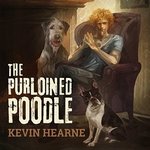
The Purloined Poodle (Audiobook) by Kevin Hearne, Luke Daniels

The Purloined Poodle (Audiobook) The Purloined Poodle (Audiobook)

by Kevin Hearne, Luke Daniels (Narrator)
Series: Iron Druid Chronicles, #8.5/Oberon’s Meaty Mysteries, #1

Unabridged Audiobook, 2 hrs, 57 min.
Kevin Hearne, 2016
Read: October 3, 2016


The best and most consistent part of The Iron Druid Chronicles has been Atticus’ Irish Wolfhound, Oberon. Now Kevin Hearne has given us a novella narrated by and starring him, with Atticus in the supporting role. It’s good that he kept the Druid around, because he has the whole opposable thumb thing going for him and can do things like communicate with other people

While playing in a dog park, Oberon stumbles upon a rash of dognappings — the victims are all Grand Champions. Oberon is appalled that such a thing can happen and vows to find the dogs and return them home. He enlists Atticus to assist him (and well, to do most of the work). They spend the next couple of days moving around the country visiting various dog trainers/owners and skirting trouble with the law. While Atticus does the heavy lifting of investigating, Oberon has a lot of fun meeting various Champion dogs — in particular, a Boston terrier named Starbuck.

The interplay between Atticus and Oberon is a lot of fun, but his narration is even better — between the repeated mentions of trying to pull off “the Full Jules” (reciting Ezekiel 25:17 at just the right moment); his summary/slash review of The Great Gatsby (which will forever alter the way I look at the book); Oberon as food critic (his takes on coffee and mustard are highlights); and a repeated tribute to Denis Leary’s best movie, this book was flat-out entertaining. Because it’s by Hearne and featuring Oberon, I assumed I’d enjoy it — I didn’t plan on (but should’ve) cackling by the 7% mark.

I thoroughly enjoyed this as a novella — the story was good enough to justify the time reading, but Daniels doing Oberon’s voice elevates the audio version to something great. Daniel’s Oberon doing a Pickup Truck commercial-voice over killed me — how Luke Daniels could read this whole book in that voice, I’ll never know. It must’ve required a lot of takes and more recovery time than you’d want to think about.

If you’ve read an Iron Druid Chronicle or two, you’ll know how good Oberon can be. Get this — you’ll squee.

—–

4 Stars

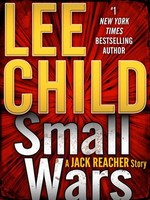
Small Wars (Audiobook) by Lee Child, Dick Hill

Small Wars Small Wars

by Lee Child, Dick Hill (Narrator)
Series: Jack Reacher, #19.5

Unabridged Audiobook, 1 hr, 30 min.
Random House Audio, 2015

Read: July 5, 2016


Reacher is still in the army for this one, and is pulled from his assignment to take over for an injured MP. Major Reacher’s first job at his new post is to investigate the murder of one of the Pentagon’s fastest rising stars.

To help him out (and to help train his underlings) Reacher gets Frances Neagly assigned to him. This story turns out to be a great spotlight for Neagly, actually. She even gets the big fight! This case hits close to home and ends up revealing a lot more about the Pentagon and the victim than anyone expected.

Dick Hill’s performance was fine — there wasn’t a lot for him to do here, but what he did worked.

This one didn’t work all that well for me — the solution was unsatisfying, and Reacher’s reaction to it might even be worse.

—–

2 Stars

Let There Be Linda Excerpt: Detective Gary Shuler

Detective Gary Shuler

Early on, when he was six, seven, and eight years old, when he was hurt and confused because he was the one and only child who was addressed by his full name plus a name that wasn’t his name, his parents had pacified him with tall cold glasses of milk and stacks of Oreo cookies. The cookies became physically, emotionally, and intellectually synonymous with safety and comfort. He ate them constantly throughout his life. He couldn’t stop eating them. At the same time that they were feeding him Oreos, his parents also recognized there was nothing they could do to stem the Gary Shuler Vista tide, so they taught their son to ride those waves with laughter, to be in on the joke instead of being the joke.

Oreos and comedy became the subconscious pillars upon which his life was built. He became the class clown in every class and carried an Oreo four-pack everywhere he went. He was popular and smart and a good athlete. But he was also a bit of offline, not your normal everyday kid. He saw the world at odd angles. He was an odd angle himself. “He’s a good guy, Gary Shuler Vista,” people would say, “but he’s a strange bird.” 

A Few Quick Questions With…David Ahern

Earlier today, I posted my take on Madam Tulip, and now here’s a quick Q & A with the author, David Ahren.

According to your author bio, Madam Tulip isn’t your first novel — but it’s the first published, though, right? What made this one different than the others?
My last novel was a dark thriller, edgy and disturbing. When I was lucky enough to get to talk to several publishers about it, I found they were only interested if I meant to follow up with a couple more in the same vein. I really didn’t want to do that. So it sits in the imaginary drawer and will probably stay there.
In the writing of Madam Tulip, what was the biggest surprise about the writing itself? Either, “I can’t believe X is so easy!” or “If I had known Y was going to be so hard, I’d have skipped this and watched more TV”.
How much sheer fun they are to write was a real surprise. I love living with these characters.
I particularly enjoyed the character Jacko. What can you tell me about him — where did he come from?
Ah! He sprang up fully formed, hair and all. I love characters who are impossible people you can’t dislike. Jacko owes a lot to one of my grandfathers who had a wonderful ability to relish life. He had extraordinary energy and always had a scheme of some sort, usually unwise.
Did you intend from the beginning on this being a series and construct things with that in mind, or was this a novel you liked enough that you wanted to continue with Derry and the rest?
Madam Tulip was a series from the start. I used to make TV documentary series in another life, so thinking that way is instinctive for me. I like the way a series forces you to be consistent with your structures. You have to set yourself strict rules. Tough, but satisfying when you succeed.
Is there a genre that you particularly enjoy reading, but could never write? Or are you primarily a mystery reader?
That question really makes me think. These days I read mostly non-fiction, because I don’t like to be influenced stylistically by other novels while I’m in the middle of writing one. Historical novels I love. In fact my all-time favourite writer of series is Patrick O’Brien who wrote the most wonderful series of sea-stories. But any time I tried to write in that genre, I got bogged down in hugely enjoyable research and forgot I was meant to be creating a story.
Thanks so much for your time, hope the launch goes well!
And thank you H.C. for your interest in Madam Tulip. She thanks you too and sees a wonderful future for your blog.

Stay by Victor Gischler

StayStay

by Victor Gischler


Hardcover, 295 pg.
Thomas Dunne Books, 2015
Read: July 4, 2015
I must say that it sort of bugs me that everything I read about this book mentions the deal with CBS for the rights — I’m happy for Gischler, but that doesn’t make me want to read it more (or less). Still, Stay can at times seem like a really thorough pitch for a movie deal.

Beyond that — I was a little disappointed. Gischler takes so many suspense novel mainstays — the special ops guy with a troubled past forced into violence to protect his family, the paranoid old service buddy who’s an expert hacker and willing to drop everything to help his pal, the foreign mobsters who will stop at nothing . . . yada yada yada. There was virtually nothing new here. Now just because you have so many genre tropes, doesn’t mean the book has to be hacky (I’m not saying this was, but you could see hacky from the front porch) — take Finder’s Nick Heller books. Almost entirely the same tropes, but Finder pulls it off. Gischler doesn’t.

The dialogue was mediocre, the characters were thin, the sex was a touch too detailed, the violence was about right (maybe a less detailed than expected a few times). One thing I don’t need is the same narrator justifying the use of a head-butt twice in the same novel — and almost in identical terms.

Ultimately, I wanted more. More surprise, more details, more originality to the characters, more depth to David and Amy (and heck, the bad guys as well). There wasn’t enough grit, enough horror, enough….anything. I guess you could say that I think this was a good start — but not a good final draft. Entertaining enough to keep me turning the page. But could’ve been so much more.

—–

2 1/2 Stars

Page 63 of 64

Powered by WordPress & Theme by Anders Norén