Tag: Non-Fiction Page 11 of 31

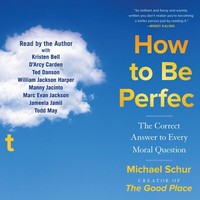
How to Be Perfect (Audiobook) by Michael Schur: Being Ethical/Virtuous and Funny at the Same Time

How to Be PerfectHow to Be Perfect:
The Correct Answer to
Every Moral Question

by Michael Schur (Writer, Narrator)
with: Michael Schur, Kristen Bell, D’Arcy Carden, Ted Danson, William Jackson Harper, Manny Jacinto, Marc Evan Jackson, Jameela Jamil, and Todd May

DETAILS:
Publisher: Simon & Schuster Audio
Publication Date: January 25, 2022
Format: Unabridged Audiobook
Length: 9 hrs., 13 min.
Read Date: April 11-13, 2022
Support Independent Bookstores - Visit IndieBound.org

What’s How to Be Perfect About?

From the Publisher’s Website:

Most people think of themselves as “good,” but it’s not always easy to determine what’s “good” or “bad”—especially in a world filled with complicated choices and pitfalls and booby traps and bad advice. Fortunately, many smart philosophers have been pondering this conundrum for millennia and they have guidance for us. With bright wit and deep insight, How to Be Perfect explains concepts like deontology, utilitarianism, existentialism, ubuntu, and more so we can sound cool at parties and become better people.

Schur starts off with easy ethical questions like “Should I punch my friend in the face for no reason?” (No.) and works his way up to the most complex moral issues we all face. Such as: Can I still enjoy great art if it was created by terrible people? How much money should I give to charity? Why bother being good at all when there are no consequences for being bad? And much more. By the time the book is done, we’ll know exactly how to act in every conceivable situation, so as to produce a verifiably maximal amount of moral good. We will be perfect, and all our friends will be jealous. OK, not quite. Instead, we’ll gain fresh, funny, inspiring wisdom on the toughest issues we face every day.

Schur did a lot of thinking, reading, and research into ethics as he was creating and writing The Good Place, this book comes out of that—it’s not quite the same as the classes that Chidi Anagonye would give, but it’s about as close are you’re going to get.

Morally Problematic Sandwiches

The most important part of becoming better people, I’ll say yet again, is that we care about whether what we do is good or bad, and therefore try to do the right thing. If we love a problematic person or thing too much to part with it altogether, I think that means we have to keep two ideas in our head at the same time: I love this thing. The person who made it is troubling.

One of the chapters I found most interesting—for a variety of reasons—is Chapter Ten, “This Sandwich Is Morally Problematic. But it’s also Delicious. Can I Still Eat It?”

For a range of issues, a lot of people struggle with things like watching Woody Allen or Kevin Spacey movies; listening to Michael Jackson; enjoying The Cosby Show; reading J. K. Rowling, Orson Scott Card, or Stacey Abrams novels; or eating Chick-fil-A or Burger King. This chapter explores how someone can enjoy these things while maintaining their ethical/political/social position.

Like almost every topic Schur addressed, I enjoyed seeing the way he approached the topic, and the kind of thinking he applied to it, more than I liked his conclusions. Although, I think I came closer to agreeing with him on this one than the rest. This is a common thread for me when it comes to non-theistic/atheistic philosophy, so I go into something like this expecting it. Interestingly, Schur’s conclusions on this idea come close to Alan Jacobs’ (Christian) conclusions in Breaking Bread with the Dead—not identical, but they strike me as pretty compatible.

The Narration

I frequently approach author-narrated works with a degree of trepidation, but I didn’t this time. Michael Schur knows what he’s doing, and I reflexively assumed that. He’s very capable of delivering this material in an interesting, almost conversational manner—as this book is a crystalization of his thoughts and the result of his research, he’s a great vehicle for this material.

And then there’s the rest of the cast…clearly, when Schur thinks “Virtue Ethics” he thinks about The Good Place and got the cast involved (along with Todd May, an actual ethicist). Would Schur on his own have been fine? Absolutely. But just having different voices helps break up what could be dry listening and add a level of variety that helps, it’s also good for distinguishing Schur’s words from a citation from any number of sources. And any time you can add Ted Danson’s voice to something, you know it’s going to improve things (I wonder if I could handle Marc Evan Jackson for an entire audiobook, or would that be too much of a good thing?).

I did have to do a mental double-take every time Manny Jacinto read, I’m not used to his normal voice.

Basically, narrator-wise, there’s nothing to complain about here.

So, what did I think about How to Be Perfect?

This is one of those books that invites you to stop and think about it. I don’t have the time or energy to do this, but what I really wanted to do when I finished this was to buy a hard copy of the book and sit down to work through it a few times to really engage with the ideas. I know myself well enough to realize I wouldn’t do it—or wouldn’t do it well enough to satisfy myself. But that was my initial reaction.

It’s a good book—it’s problematic in some of/many of its conclusions, sure, but it’s still a good book. Because of the nature of the show that this is based on, Schur produced something that assumes God does not exist. He doesn’t come out and deny or question it*, he simply writes as if that’s not something to be considered. So I’m obviously not going to be able to agree with everything he says, and will ultimately find fatal flaws to some of his conclusions—but that’s me. You’ll have your own set of issues, I’m sure. But when it comes to recent(ish) pop-philosophy books, this is better than many.

* Later in the book, there’s at least one shot at the notion of a reliable set of scriptures, or those who would pay attention to them, at any rate. But As far as attacks on religion go, it’s pretty mild.

I truly appreciated and enjoyed the way that Schur was able to explain the concepts he was wrestling with and the way he used humor throughout. Using himself as an example of ethical reasoning—especially as a negative example—made it all much more relatable, too. He never comes across as “you should live like this” but as “here’s what I’ve learned, here’s where I struggle, walk alongside me.”

Would I listen to this again? Yeah, absolutely. Would I go through the hard copy of the book? Sure (especially if I could find a way to take the time to do it right). Would I suggest you get the book in the medium of your choice? Absolutely. Entertaining, educational, funny, and thought-provoking. I’m not sure what else you could ask for.


4 Stars

This post contains an affiliate link. If you purchase from it, I will get a small commission at no additional cost to you. As always, opinions are my own.

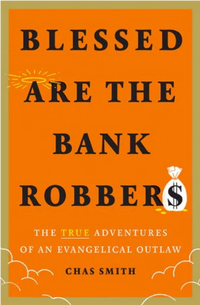
Blessed Are the Bank Robbers by Chas Smith: Not as Catchy as a Story about Billy Joe and Bobbie Sue

Blessed Are the Bank RobbersBlessed Are the Bank Robbers:
The True Adventures of an Evangelical Outlaw

by Chas Smith

DETAILS:
Publisher: Abrams Press
Publication Date: March 14, 2022
Format: Hardcover
Length: 264 pg.
Read Date: April 11-18, 2022
Support Independent Bookstores - Visit IndieBound.org

What’s Blessed Are the Bank Robbers About?

From the Publisher’s Site:

Chas Smith grew up deeply enmeshed in the evangelical Christian world that grew out of Southern California in the late 1960s. His family included famous missionaries and megachurch pastors, but his cousin Daniel Courson was Grandma’s favorite. Smith looked up to Cousin Danny. He was handsome, adventurous, and smart, earned a degree from Bible college, and settled into a family and a stable career.

Needless to say, it was a big surprise when Cousin Danny started robbing banks. Known as the “Floppy Hat Bandit,” Courson robbed 19 of them in a torrid six-week spree before being caught and sentenced to seven years. When he tried to escape, they tacked on another year. And when he finally got out, despite seeming to be back on the straight and narrow, Cousin Danny disappeared. Banks started getting robbed again. It seemed Cousin Danny might be gunning for the record.

Smith’s Blessed Are the Bank Robbers is the wild, and wildly entertaining, story of an all-American anti-hero. It’s a tale of bank robberies, art and jewel heists, high-speed chases, fake identities, encrypted Swiss email accounts, jilted lovers, and the dark side of an evangelical family (and it wasn’t just Danny; an uncle was mixed up with the mujahideen). It’s a book about what it means to live inside the church and outside the law.

Some of the material in this book comes straight from Courson himself—emails while he was a fugitive and writing he did while in prison to describe his career.

Other Bank Robbers

Scattered throughout are descriptions of other prodigious bank robbers, their streaks, and their methods. Most of these are pretty interesting and probably worth a book themselves. It’s not my typical genre, but there are a couple of these that I’d jump on.

So, what did I think about Blessed Are the Bank Robbers?

Well, it wasn’t bad. A lot of it was pretty entertaining and well-written. Significant portions of it were a blast and really sucked me in. But for every section of the book that sang, there was a section or more that fell flat. I had high hopes for this one and none of them were met.

This felt like the journalism surrounding Capone and the like during their heyday—it was a celebration of Courson’s crimes. The acknowledgment that his crimes caused actual harm came from Courson himself in a throwaway comment. Sure, it’s exciting to read about this kind of crime and Courson is clearly a charismatic figure. But celebrating him like this left a bad taste in my mouth. Then sending emails back and forth with him while he’s “on the lam”* and daydreaming about following in his footsteps? Were Smith a starry-eyed adolescent, I could accept it, but in a father? It discredited the author in my eyes (it would’ve taken a 2-sentence paragraph where he acknowledged the problem with it).

* I did appreciate getting the etymology of that phrase.

I don’t think Smith did an effective job of exploring the link between Courson’s Calvary Chapel upbringing and his turning to a life in crime—it’s there if you look for it (and make some assumptions), but if you’re going to put “Evangelical” in the subtitle, you need to expand on this.

There was a lot of promise in the premise, some entertaining/informational moments, and it was an easy read—but ultimately, it was a letdown. I fully expect that others won’t stumble over the things I did (some of which are above), and I don’t know that I would argue with them.


2 1/2 Stars

This post contains an affiliate link. If you purchase from it, I will get a small commission at no additional cost to you. As always, opinions are my own.

Catch-Up Quick Takes: Some Audiobooks from Feb. & March 2022

Here are some audiobooks that I’ve listened to in the last couple of months, and I really don’t have much to say about them—all are worth the time to listen to (or read, if you prefer), I just don’t have enough to say to make up a typical post.


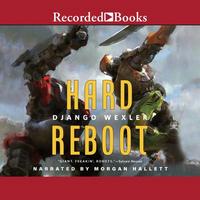
Hard RebootHard Reboot

by Django Wexler, Morgan Hallett (Narrator)

DETAILS:
Publisher: Recorded Books
Publication Date:  May 24, 2021
Format: Unabridged Audiobook
Length: 3 hrs., 57 min.
Read Date: March 14-15, 2022
Support Independent Bookstores - Visit IndieBound.org

(the official blurb)
This just seemed like a lot of fun when it was published last year, so when I saw it on the library site, I had to jump on it. And it was fun.

But it was a bit too shortI know that’s by design, but it felt too abrupt. You got fighting robots on the cover, I want more than two major fights. Sure, the fights we get are pretty cool, but I wanted more.

If this was 20 percent longer, I’d have been happy. As it was? I was satisfied.
3 Stars

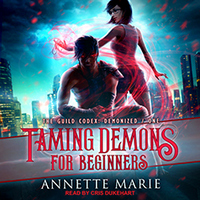
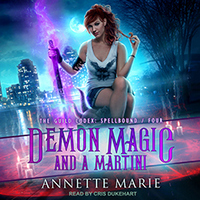
Demon Magic and a MartiniDemon Magic and a Martini

by Annette Marie, Cris Dukehart (Narrator)

DETAILS:
Series: The Guild Codex: Spellbound Series, #4
Publisher: Tantor Audio
Publication Date: April 22, 2019
Format: Unabridged Audiobook
Length: 7 hrs., 15 min.
Read Date: March 9-10, 2022
Support Independent Bookstores - Visit IndieBound.org

(the official blurb)
So, um…yeah. This was okay.

For the second book in a row, we get to peel back the mysterious backstory of one of Tori’s new best friends while they’re battling a new magical threat. This time it’s demonsand rival guilds. One of which is pretty ethically challenged.

It was a bit too similar to the previous book for me. But it delivered the same kind of quippy UF action that characterizes the series. It’s entertaining enough to keep going with the seriesand to recommend themI just want to see a little more out of them.
3 Stars

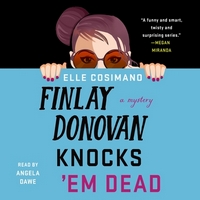
Finlay Donovan Knocks 'Em DeadFinlay Donovan Knocks ‘Em Dead

by Elle Cosimano, Angela Dawe (Narration)

DETAILS:
Series: Finlay Donovan, #2
Publisher: Macmillan Audio
Publication Date: January 31, 2022
Format: Unabridged Audiobook
Length: 9 hr., 20 min.
Read Date: February 25-28, 2022
Support Independent Bookstores - Visit IndieBound.org

(the official blurb)
I was a little worried how the premise would carry over to a sequel, and I clearly shouldn’t havelargely because Cosimano didn’t just repeat the way the first book went. It was very much an “okay, so now with that finished, what comes next?”assuming that Finlay and Vero don’t just wholly abandon their new revenue stream.

We get some important new information about Veromaking a lot of what she did in the first book make sense. Finlay makes some smart romantic movesand there’s some decent movement on the divorce front.

All in all, a solid sequel that shows that this can be a series with legs, not just a quirky one-off.
3 Stars

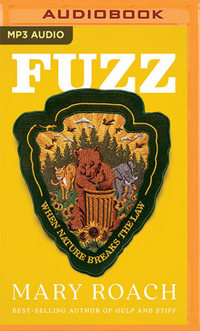
Fuzz: When Nature Breaks the LawFuzz: When Nature Breaks the Law

by Mary Roach

DETAILS:
Publisher: Brilliance Publishing
Publication Date: September 13, 2021
Format: Unabridged Audiobook
Length: 9 hrs., 17 min.
Read Date: January 31-February 1, 2022
Support Independent Bookstores - Visit IndieBound.org

(the official blurb)
So this is about what happens when animals and humans have a hard time co-existingwhich basically means when animals being animals inconvenience (or worse) humans. Was that hiker killed by an animal, or did they die of other causes and become food for an animal? What happens when we put a building where an animal expected to be able to be?

I don’t think it was as amusing as Roach tried to make it. It was interesting, but it went on too long and therefore became less-interesting the longer it went on. I don’t remember anything more specific than thatwhich says something about the book. It just didn’t hold my attention for long.

This is my first Mary Roach bookand maybe would’ve been my last if I hadn’t run into a couple of other bloggers who are Roach fans that were as tepid as I was about the book. Still, I’m going to get a bit more distance between this book and my next.
3 Stars

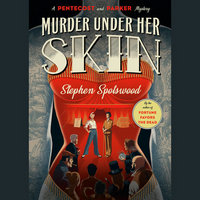
Murder Under Her SkinMurder Under Her Skin

by Stephen Spotswood, Kirsten Potter

DETAILS:
Series: A Pentecost and Parker Mystery, #2
Publisher: Random House Audio
Publication Date: December 6, 2021
Format: Unabridged Audiobook
Length: 9 hrs., 40 min. hrs and 40 mins
Read Date: March 28-29, 2022
Support Independent Bookstores - Visit IndieBound.org

(the official blurb)
The circus that Will used to be in is in troubleone of their performers has been killed and another has been arrested. Will’s mentor, to be specific. So she and Lillian Pentecost head down south to see what they can do.

It’s a culture clash (both the South and the circus) for the duoWill learns the hard way that maybe she’s been gone too longas well as a fish out of water kind of thing for Pentecost. Although not as much as Will and the reader might expect.

I enjoyed this one a lot more than the predecessorit’s still a bit too much about Will and her current love interest than it is about Pentecost and the case they’re supposed to be working on. The mystery was clever, the character arcs were solid and Will’s narrative voice is strong enough to keep the reader/listener locked in.
3 Stars

Free BillyFree Billy

by Don Winslow, Ed Harris (Narrator)

DETAILS:
Series: The Dawn Patrol 
Publisher: Audible Originals
Publication Date: 2022
Format: Audiobook
Length:1 hr., 6 min.
Read Date: March 30, 2022

(the official blurb)
This is a silly, fun, and sweet story in the world of The Dawn Patrol (one of my top 5 All-Time books), all our favorites get a quick appearance and we’re introduced to a couple of new characters.

Despite being in the same world as the crime novels that introduced Winslow to me, there’s no crime to be found here.

Which is fineit’s not needed in this short story. It’s just a fun story about one of Boone’s friends. I laughed audibly more than once, and just enjoyed the story as a wholeI just wish it was longer so I could spend more time in this world. The story didn’t require it.

Ed Harris gives exactly what you’d expect from him in an audiobook narrationnear perfection. I thought his stuff was great.
5 Stars

This post contains affiliate links. If you purchase from any of them, I will get a small commission at no additional cost to you. As always, opinions are my own.

REPOSTING JUST CUZ: Who Shall Ascend the Mountain of the Lord? by L. Michael Morales

Fatigue is winning over my will to get the post I intended for today finished. So, I’m going to repost this—I’ve been thinking a lot about this book recently, but I feel like I remember too much of it to commit, even if I want to master the arguments. I didn’t do justice to the book when I wrote the original post, but maybe it’ll nudge someone to read the book.


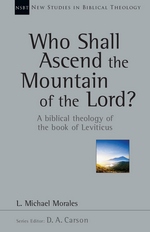
Who Shall Ascend the Mountain of the Lord Who Shall Ascend the Mountain of the Lord?: A Biblical Theology of the Book of Leviticus

by L. Michael Morales
Series: New Studies in Biblical Theology, #37Paperback, 306 pg.
IVP Academic, 2015
Read: October 16 – November 27, 2016

So this is another one of those books that I’m not really qualified to talk about, but . . . whoops, here I go.

Morales doesn’t give us what you typically find/look for in a study of Leviticus — detailed explanations — or dodges — of the various purity laws and other commands and regulations contained in it. Instead, he begins by explaining his conclusion that Leviticus is the center of the Pentateuch, and that Chapter 16 is the center of it. Beginning in Genesis, everything is leading up to the Day of Atonement, and then everything from that is to be seen as the result of, or in light of that day.

That’s a lousy summary, but that’s the best you’re going to get from me in a couple of sentences. The argument is so detailed, so complex that I can’t really do much better without spending a few pages on it — and no one wants to read that (especially since you can read Morales doing a better job). At first, I thought that it was an interesting idea, but it really didn’t matter much. But as I read on and understood what he was doing better, it started to capture my imagination and draw me in. This was well argued, well researched — and well explained for even non-technical types like me.

But when it comes to Biblical Theology, the proof in the pudding comes from tying in his theses to the unfolding story of redemption — first in Israel’s story and then showing how it leads to Christ and His work on earth, His Ascension and pouring out of His Spirit to prepare a people to meet with Him on Mount Zion. The last two chapters were fantastic — and I’m going to have to reread them a few times to really wrap my brain around it all. There were moments of beauty here — it’s hard for an academically-inclined work to inspire and touch the emotions of a reader, but Morales did it.

This volume is the first I’ve read in New Studies in Biblical Theology (I believe it’s the first I heard of it, too) — the series is edited by D. A. Carson. The series aims “to simultaneously instruct and to edify, to interact with current scholarship and to point the way ahead. . . While volume notes interact with the best of recent research, the text of each work avoids untransliterated Greek and Hebrew or too much specialist jargon. The volumes are written within the framework of confessional evangelicalism, but they also engage a variety of other relevant viewpoints and significant literature.” If this is a representative volume, it won’t be my last in the series. If I can just pick another — the list of 41 is daunting — just too many choices.

Anyway, Who Shall Ascend was a challenging, interesting, educational and inspiring work — there’s not much more that you can ask for. If you’re up for the work, I heartily recommend it.

—–

4 Stars

Just a Spoonful of Sugar—Non-Fiction to Smile With and Learn From

(Updated and Revised 3/7/22)
Just a Spoonful of Sugar—Non-Fiction to Smile With and Learn FromI stumbled onto my notes from Funny, You Don’t Look Autistic: A Comedian’s Guide to Life on the Spectrum a while back (and yeah, I forgot almost all of them in my post about the book). But it got me thinking about McCreary’s approach—taking a hard-to-talk about subject and adding a touch of humor (or at least a light-hearted voice) to it to make it palatable. It’s a great way to get someone to look at the subtleties of what the Autism Spectrum Disorder can be, how individuals can fall somewhere on that spectrum (and therefore have many things in common), and yet be very different from one another.

Now, I realize that some would point to our cultural inability to discuss difficult subjects with the sobriety and seriousness they deserve as a significant problem. And there’s something to that. More than something, probably. Still, I don’t like to think I enjoy these books and their approach because I’m shallow, but I guess I shouldn’t rule that out.

Shallowness aside, there’s something to the approach—whether it’s technical issues, trauma, socially awkward topics, disease, disorders, or other things people try to avoid discussing—doing so in a light-hearted manner or with plenty of laughs, tends to make the audience receptive. It takes a lot of skill to blend the difficult topic into an entertaining package. But it’s a great way to gain a new perspective, a deeper understanding, or learn something.

Here’s a list of the books that I’ve read/posted about in the last few years that entertain while informing/giving insight:

bullet Go Back Where You Came From: And Other Helpful Recommendations on How to Become American by Wajahat Ali—Ali’s memoir of growing up as the child of immigrants from Pakistan. While telling his own story, he shines a light on the kinds of things that people that look like him and/or come from similar backgrounds have to deal with in school and society (both within the Muslim community and without). Of special focus are the days and years post-9/11 and how that’s changed things for better or worse (mostly worse). His telling shows a good sense of humor, and sometimes will spend a good deal of time on humor, but that’s not the focus.
bullet Wishful Drinking by Carrie Fisher—Fisher addresses her addictions and mental health problems (and the extreme solutions) in this frequently laugh-out-loud memoir
bullet Everything is Normal by Sergey Grechishkin—Grechishkin’s memoir of growing up in 1980’s-era Soviet Russia brings the grins (and a chuckle or two) while not letting us forget how hard and terrifying it could be.
bullet Kasher in the Rye: The True Tale of a White Boy from Oakland Who Became a Drug Addict, Criminal, Mental Patient, and Then Turned 16 by Mose Kasher—Kasher’s account will make you smile, break your heart, and help you understand addiction
bullet We Had a Little Real Estate Problem by Kliph Nesteroff—This is the story of Native Americans/Indigenous people in Entertainment–particularly comedy, but there’s a little spill over to other areas, too. Unlike the rest of this list, the prose is straightforward and no-nonsense. But Nesteroff’s subject is comedy and he quotes frequently from those he tells the story of–and their humor shines forth while this dark, yet hopeful, story is told.
bullet Gluten Is My Bitch: Rants, Recipes, and Ridiculousness for the Gluten-Free by April Peveteaux—on the one hand, this seems the slightest of the issues addressed. Ask any person with Celiac Disease how hard it can be to find food that doesn’t make you violently ill—and just how violent that illness can be. But Peveteaux will make you laugh, while offering hope and help..
bullet Henry by Katrina Shawver—even in a Nazi work/death camp, friendship helps, people can find some release.
bullet Funny, You Don’t Look Autistic: A Comedian’s Guide to Life on the Spectrum by Michael McCreary—I realize I started this post talking about the book, but when I revised things, it felt like a bad list if it wasn’t on it. This Comedian talks about growing up with Autism Spectrum Disorder and how he became a comedian—he works to dispel some myths, and offer some real insight while entertaining.
bullet You’ll Never Believe What Happened to Lacey by Amber Ruffin, Lacey Lamar:—Amber Ruffin and her sister, Lacey, recount various racist things that people have said (or done) to Lacy on an almost daily basis in her professional and personal life. It may not sound that funny, but it frequently is.
bullet And Then You’re Dead: What Really Happens If You Get Swallowed by a Whale, Are Shot from a Cannon, or Go Barreling Over Niagara by Cody Cassidy and Paul Doherty—the publisher describes this as, a “gleefully gruesome look at the actual science behind the most outlandish, cartoonish, and impossible deaths you can imagine.”

Help me expand this list—what are some other works along these lines that I should read?

PUB DAY REPOST: Jumping Sharks and Dropping Mics by Gareth Carrol: Adding Some Flavor to Our Speech

Jumping Sharks and Dropping MicsJumping Sharks and Dropping Mics:
Modern Idioms and Where
They Come From

by Gareth Carrol

DETAILS:
Publisher: iff Books
Publication Date: February 25, 2022
Format: eARC
Length:176 pg.
Read Date: February 10-11, 2022
Support Independent Bookstores - Visit IndieBound.org

What’s Jumping Sharks and Dropping Mics About?

The subtitle pretty much tells you everything you need to know. This is a look at several idioms, expressions, and figures of speech that have entered common usage over since the latter half of the twentieth century.

The introductory chapter describes idioms and their usage, the various types of idioms, the history of a few not-modern examples, and so on. This chapter was great and I could’ve used a whole book on this topic. But that’s something for a future library trip, I guess.

Following that we get chapters devoted to: Idioms from TV (including from commercials); Movies; The Internet (memes, hashtags, and so on); Sports; Modern Literature; and then a handful that have entered common usage without a tie to any of the rest, some from the news. that sort of thing.

Carrol talks about the origin and spread of each idiom, notable uses outside the source, and clarifies the meaning—and other commentary or trivia.

Oh, It’s That Kind of English…

Early on there was something in the back of my mind, like I was missing something. Then I ran across the phrase “TV advert,” and a lightbulb went on over my head. This book comes from the other side of the Atlantic, which is going to affect a little bit what idioms are used.

I’m not complaining or anything, I just had to tweak my expectations and go in knowing that there were going to be a few things I had no previous exposure to or that I’d be going into without the necessary frame of reference.

So, what did I think about Jumping Sharks and Dropping Mics?

The Sports chapter did nothing for me—most of that is my utter disinterest in the category, but a decent chunk of that is due to the number of cricket references. They might as well have been in Greek.

On the other end of the spectrum, as one might expect, the chapter devoted to Modern Literature was my favorite. Not just because of the page or two devoted to Douglas Adams, either. The section on The Right Stuff was a lot of fun.

There weren’t a lot of idioms that were new to me, but there were a handful—I’ve tried them out a little bit in the few days since I read the book, I’m not sure they’re going to stick, but you never know. It’s fun to watch people try to suss out what I meant, at least.

The book was a lot of fun, I appreciated re-familiarizing myself with some of these phrases, and I learned a couple of things, too. It was an entertaining read and just the kind of thing that language nerds should really enjoy.

Disclaimer: I received this eARC from John Hunt Publishing Ltd, via NetGalley in exchange for this post—thanks to both for this.


3 Stars

This post contains an affiliate link. If you purchase from it, I will get a small commission at no additional cost to you. As always, opinions are my own.

Jumping Sharks and Dropping Mics by Gareth Carrol: Adding Some Flavor to Our Speech

Jumping Sharks and Dropping MicsJumping Sharks and Dropping Mics:
Modern Idioms and Where
They Come From

by Gareth Carrol

DETAILS:
Publisher: iff Books
Publication Date: February 25, 2022
Format: eARC
Length:176 pg.
Read Date: February 10-11, 2022
Support Independent Bookstores - Visit IndieBound.org

What’s Jumping Sharks and Dropping Mics About?

The subtitle pretty much tells you everything you need to know. This is a look at several idioms, expressions, and figures of speech that have entered common usage over since the latter half of the twentieth century.

The introductory chapter describes idioms and their usage, the various types of idioms, the history of a few not-modern examples, and so on. This chapter was great and I could’ve used a whole book on this topic. But that’s something for a future library trip, I guess.

Following that we get chapters devoted to: Idioms from TV (including from commercials); Movies; The Internet (memes, hashtags, and so on); Sports; Modern Literature; and then a handful that have entered common usage without a tie to any of the rest, some from the news. that sort of thing.

Carrol talks about the origin and spread of each idiom, notable uses outside the source, and clarifies the meaning—and other commentary or trivia.

Oh, It’s That Kind of English…

Early on there was something in the back of my mind, like I was missing something. Then I ran across the phrase “TV advert,” and a lightbulb went on over my head. This book comes from the other side of the Atlantic, which is going to affect a little bit what idioms are used.

I’m not complaining or anything, I just had to tweak my expectations and go in knowing that there were going to be a few things I had no previous exposure to or that I’d be going into without the necessary frame of reference.

So, what did I think about Jumping Sharks and Dropping Mics?

The Sports chapter did nothing for me—most of that is my utter disinterest in the category, but a decent chunk of that is due to the number of cricket references. They might as well have been in Greek.

On the other end of the spectrum, as one might expect, the chapter devoted to Modern Literature was my favorite. Not just because of the page or two devoted to Douglas Adams, either. The section on The Right Stuff was a lot of fun.

There weren’t a lot of idioms that were new to me, but there were a handful—I’ve tried them out a little bit in the few days since I read the book, I’m not sure they’re going to stick, but you never know. It’s fun to watch people try to suss out what I meant, at least.

The book was a lot of fun, I appreciated re-familiarizing myself with some of these phrases, and I learned a couple of things, too. It was an entertaining read and just the kind of thing that language nerds should really enjoy.

Disclaimer: I received this eARC from John Hunt Publishing Ltd, via NetGalley in exchange for this post—thanks to both for this.


3 Stars

This post contains an affiliate link. If you purchase from it, I will get a small commission at no additional cost to you. As always, opinions are my own.
Go Back to Where You Came From by Wajahat Ali: An All American Story

Go Back to Where You Came FromGo Back to Where You Came From:
And Other Helpful Recommendations
on How to Become American

by Wajahat Ali

DETAILS:
Publisher: W. W. Norton & Company
Publication Date: January 25, 2022
Format: Hardcover
Length: 231 pg.
Read Date: February 2-4, 2022
Support Independent Bookstores - Visit IndieBound.org

As the two towers fell, I was standing in my pajamas, staring at the TV, and I realized our lives had forever changed. There was a permanent fork in the road for my generation. A disruption in the timeline. A disturbance in the Force. For us, there would always be a pre—9/11 and a post—9/11 world. A few hours earlier, I had been a twenty-year-old senior still trying to figure out his major and serve as a board member of the Muslim Student Association of UC Berkeley. Instantly, I was transformed into an accidental activist, a global representative of 1.8 billion Muslims worldwide and a walking Wikipedia of 1,400 years of all things Islam.

I have to be perfect, because any flaw, mistake, errant word, or quote can and will be used against me and all my people in the court of public opinion. On the drop of a dime, I have to be an expert on the following topics: Islam, Quran, the Prophet Muhammad, Sharia, Iran, Iraq, Pakistan, India, Hamas, Hummus, Hezbollah, Arabic, Agrabah, Afghanistan, Al Qaeda, Al Aqsa, Aladdin, Salman Khan the Bollywood Actor, Salman Khan of the Khan Academy, and everything in between. I have to be able to explain them to a skeptical national audience, being sure not to say anything too radical or extreme, because that one mistake will be emblazoned on me like a scarlet letter and be used to beat up this thing called the “Muslim world.”

What’s Go Back to Where You Came From About?

From the Publisher’s Website:

“Go back to where you came from, you terrorist!”

This is just one of the many warm, lovely, and helpful tips that Wajahat Ali and other children of immigrants receive on a daily basis. Go back where, exactly? Fremont, California, where he grew up, but is now an unaffordable place to live? Or Pakistan, the country his parents left behind a half-century ago?
Growing up living the suburban American dream, young Wajahat devoured comic books (devoid of brown superheroes) and fielded well-intentioned advice from uncles and aunties. (“Become a doctor!”) He had turmeric stains under his fingernails, was accident-prone, suffered from OCD, and wore Husky pants, but he was as American as his neighbors, with roots all over the world. Then, while Ali was studying at University of California, Berkeley, 9/11 happened. Muslims replaced communists as America’s enemy #1, and he became an accidental spokesman and ambassador of all ordinary, unthreatening things Muslim-y.

Now a middle-aged dad, Ali has become one of the foremost and funniest public intellectuals in America. In Go Back to Where You Came From, he tackles the dangers of Islamophobia, white supremacy, and chocolate hummus, peppering personal stories with astute insights into national security, immigration, and pop culture. In this refreshingly bold, hopeful, and uproarious memoir, Ali offers indispensable lessons for cultivating a more compassionate, inclusive, and delicious America.

The Universality of Humor

Like with Native Americans in Nesteroff’s We Had a Little Real Estate Problem and Soviet-era Russians in Grechishkin’s Everything is Normal, one thing that Ali talks about is how often people are surprised that Muslims have senses of humor, that they enjoy laughing. A lot of that comes down to media representation—in the news, in our TV and movies, the typical depiction of Muslims is of angry, violent men—or those suffering because of them—or those in the middle of a serious religious observance. We don’t get to see a lot of people relaxing at home, enjoying a meal, or just hanging out.

I’m not sure why this is so hard for people to wrap their heads around—people of all backgrounds laugh. People find things funny. People are funny. These three books (and others, sure, but these are those I’ve talked about here) help readers remember that there’s a shared humanity in laughter (remembering that what’s funny varies a little bit from culture to culture), and I have to think that we’d all be better off to remember that and look for it as a starting point.

Cross-Cultural Hardship

Before he began to get into the details of the hardships that his cultural, ethnic, and religious background would bring on him in our culture, he talks about a challenge that crosses ethnic, religious, geographic, and political lines—he’s a southpaw.

True, there’s a particular accentuation for Muslims, but at the root is the inconvenience that all left-handed people put up with every day. I thought it was a rhetorically nice touch because it makes him universally relatable—it was also pretty funny.

So, what did I think about Go Back to Where You Came From?

Let me start by saying, I had no idea who Wajahat Ali was before this book—I may have seen him on a news show or five as a talking head—but, like most of those, he didn’t make enough of an impression for me to remember his name*. So I didn’t come into this book with any preconceived notions of what to expect, I wasn’t a fan already (or a detractor). All I knew was that Paul from Paul’s Picks had very positive things to say about the book (as he should have).

* I will absolutely take notice next time I see him in that role, however.

This was a great mix of memoir, social commentary, and satire—with a little sprinkling of a more general humor thrown in. The way he shifted between the genres was fairly seamless and quite effective—his own story (and that of his parents) were good illustrations of the societal ills he wanted to point to, and also it worked well occasionally as argumentum a minore ad maius.

I found myself reading large sections of this to whatever family member happened to be around when I read it (or I’d bookmark a section I thought someone might find almost as interesting as I did to read at them later)—there’s just so much good to be found here. The material about 9/11 and its aftermath was the most poignant—which kind of feels like a gimme sometimes, and some authors shouldn’t milk it. Given Ali’s subject matter, however, it was something he had to discuss and it was the book’s most powerful material.

Ali’s story is the kind that Americans love to tell and hear about success—even if his telling points to many of the flaws in our society. Through grit, determination, perseverance, and endurance, Ali pushes through all sorts of cultural, societal, legal, medical, and circumstantial challenges to arrive where he is. Because he believes in what we can be as a people, based on our (incredibly inconsistently applied and demonstrated) ideals and aspirations. It’s the kind of story we need to see, hear, and read more of.

Go Back to Where You Came From is a challenging read, it will make you uncomfortable, but it should also give you a little glimmer of hope. I strongly encourage you to read this.


4 Stars

This post contains an affiliate link. If you purchase from it, I will get a small commission at no additional cost to you. As always, opinions are my own.

Reposting Just Cuz: In Christ Alone: Living the Gospel Centered Life by Sinclair B. Ferguson

I’ve been thinking about this book lately, and last night, I was so knackered that I couldn’t writ anything, so, I figured that it’d be nice to revisit this. Maybe someone else might want to think about it a bit.

—–

In Christ Alone: Living the Gospel Centered Life
In Christ Alone: Living the Gospel Centered Life by Sinclair B. Ferguson

My rating: 4 of 5 stars

There’s not a lot of in-depth theology here, you won’t come away from this with a deep understanding of any one subject, or a few related ones. This is a compilation of fifty articles, grouped together by topic, which will enable you to gain a refresher on a spectrum of topics, or an introduction to ideas, concepts and texts that you want to come back to and study in the future. As such, it’s a really strong compilation and one that I’m glad I spent an afternoon with.

Don’t get me wrong — it’s not that I didn’t learn anything, or gain a deeper understanding of anything. But compared, say, to his The Holy Spirit or Pundits Folly, it’s (by design) not as in-depth. I thought his framing the book of Romans as a series of exchanges (e.g., man exchanging the truth of God for a lie; the gospel exchange of righteousness and justification instead of unrighteousness and condemnation) was very handy and something I’m trying to internalize. The chapters that followed it were a series of glimpses at the letter to the Hebrews, and now I want an entire book on that epistle by Ferguson.

In the section on “The Spirit of Christ,” he has a chapter called “When the Spirit Comes,” which is an examination of John 16:8-11.

And when he comes, he will convict the world concerning sin and righteousness and judgment: concerning sin, because they do not believe in me; concerning righteousness, because I go to the Father, and you will see me no longer; concerning judgment, because the ruler of this world is judged.

His thesis is that while, yes, there is a continuing relevance of these verses,

we miss their rich significance of we interpret them in a way that bypasses their historical context. In their original setting, these words constitute a prophecy of the Spirit’s work on the day of Pentecost (Acts 2:1 ff).
When we recognize this, we are able to fill out the content of the promise. But when we fail to recognize it, we are in danger of interpreting (and thus remolding and distorting) Scripture in the light of our own experience.

I’ve got to say, I’ve been guilty of this remolding and distorting until today, and will have to set to work on correcting my thinking.

On the whole, the book doesn’t feel too much like a collection if unrelated articles, rather than a book he set forth to write; and as such it doesn’t really suffer from being a compilation — though Part IV, “The Privileges of Grace,” is the weakest and most scattered. That said, the chapters from Part IV, “The Life of Faith” (on “Now faith is the assurance of things hoped for, the conviction of things not seen.”) and “‘The Greatest of All Protestant Heresies’?” (on the doctrine of assurance) were very helpful and thought-provoking. So even at its weakest, this book rewards the reader.

Part V, “A Life of Wisdom,” is really a section on sanctification. But instead of the approach that is usually employed here, Ferguson focuses on the more internal sanctification that needs to happen to result in the external fruit. All of which could use some extended treatment by this author. Particularly, I found the chapter on discernment rich and one that I need to return to for further meditation. His extended look at Psalm 131 to show how to cultivate contentment is, naturally, valuable — Ferguson’s always at his best when discussing the Psalter.

The final chapters center on the idea of spiritual warfare — not the flashy, type that characterize so much evangelical writing on the topic. But the quieter, more difficult, and (dare I say) more Biblical approach — focusing on our sin, our need for mortification, or own worldliness.

The closing chapter on Sabbath rest is far too brief, but excellent. He reminds us that the Sabbath in creation was a “time for Adam to listen to all the Father had to show and tell about the wonders of His creating work,” — a “Father’s Day” every week. Which, of course, was ruined by the Fall, redeemed by Christ and will be fully enjoyed every day in Glory. Practically,

this view of the Sabbath helps us regulate the whole week. Sunday is “Father’s Day,” and we have an appointment to meet Him. The child who asks, “How short can the meting be?” has a dysfunctional relationship problem — not an intellectual, theological problem. Something is amiss in his fellowship with God.

There’s a lot to be mined here for devotional use, as well as a spring-board for future study.

Dogtripping by David Rosenfelt: Moving a Very Unusual, Very Large, Very Hairy Family Across the U.S.

DogtrippingDogtripping:
25 Rescues, 11 Volunteers,
and 3 RVs on Our Canine
Cross-Country Adventure

by David Rosenfelt

DETAILS:
Publisher: St. Martin's Press
Publication Date: July 23, 2013
Format: Hardcover
Length: 278 pg.
Read Date: January 19-20, 2022
Support Independent Bookstores - Visit IndieBound.org

The overriding view of everyone was that it was going to be a great adventure, successful and a hell of a lot of fun.

Except for me.

I was expecting a disaster.

What’s Dogtripping About?

After a decade and a half or so of running their dog rescue in southern California, David Rosenfelt and his wife decide to move out of California (a very close call with a wildfire is a primary impetus for this) to Maine. But they have a bigger logistical challenge than most of us do when we make a move—either cross-town or cross-country. Sure, it can be hard to figure out the best way to move a piano or a fragile heirloom—but ultimately, that’s something that people do all the time. But how do you get twenty-five dogs cross-country?

First of all, you need help—and we’re not talking the kind of help where you get a few friends together, promise a pizza and a six-pack to split, and get them to help you move a piano or a sofa. This is a bigger project. You also have to figure out what kind of vehicle—or vehicles—will be needed, where you all will sleep, how can you deal with the bathroom breaks, and so on.

Right there, that’s an interesting story, many people—especially dog lovers would read that. When the talented and amusing author of the Andy Carpenter novels tells the story, it becomes an entertaining read.

Interspersed between chapters discussing the preparation for the trip and the trip itself are chapters describing the background for The Tara Foundation (starting with the dog it’s named after), the development and growth of their rescue efforts, and profiles of some of the dogs.

Dog Profiles

My favorite parts of the book are the 2-3 page profiles of some of the dogs that have stayed with their pack—for anywhere from a week to several years. He starts by describing how the dog came to their attention, then he talks about the specific challenges for that dog, their personality, and how they integrated into the menagerie. Then he’ll describe how they took to the move—if they were part of that 25—found a family to adopt them, or how their life came to an end.

Obviously, I preferred reading the first two endings—but they’ve been at this for a long time, and most of their rescues are senior dogs, it’s a reality they have to deal with far too often. Not always, but I generally got a little misty for those other endings. Rosenfelt has a real knack for making you grin/chuckle, telling a heartwarming story, and then hitting you with the sadness that comes from the brevity of canine life.

Still, I’d read an entry on every dog they ever had in their shelter and come back for more.

Incidentally, he includes some really sound advice on deciding when to put an ailing dog to sleep.*

* Please, no one tell my almost 16-year old Pug/Beagle mix that I read anything about that. No need to stress her out.

Too Many Italics

I am not a fan of extended sections of italics—there are better ways to set aside chunks of text (going to a sans serif typeface, for example), but I’m mostly used to them. A character’s thoughts—usually a sentence or two–I can handle. I can even put up with a few paragraphs for a dream sequence or flashback or something. But whole chapters really bug me.

And that’s what we get here—and not just a few, but several. There’s no set pattern, but typically a couple of chapters in regular type (one of them being really brief) and then one in italics. It’s very aggravating.

But here’s the worst part—it’s the chapters that are about the subject of the book that are italicized! The background chapters, the chapters that profile individual dogs, or are just full of Rosenfelt talking about some topic (for example: their efforts to keep the smell of all their dogs using the back yard as a bathroom from bothering the neighbors) are all in regular type. But the part of the book that the title and subtitle describe are italicized.

I don’t understand that choice. I certainly didn’t enjoy it.

So, what did I think about Dogtripping?

Twenty-five is pretty much the fewest dogs Debbie and I have had in the last ten years. We’ve had as many as forty-two, but we feel that more than forty is slightly eccentric.

This was a fast, fun read—with some really touching moments mixed in.

I’m going to borrow the conclusion to my post about Rosenfelt’s other book about their rescues, Lessons from Tara, because it works just as well here, and I’m tired:

Fans of the Andy Carpenter series will be happy to hear that Andy’s voice is Rosenfelt’s—the book at times feels like an Andy Carpenter book without all the muss and fuss of a plot, murder, or trial. I laughed, I chuckled, I learned a thing or two, and I even got misty more than I wanted to. All in all a really strong read. If you’re a dog lover, or just someone who likes to read good things, find some time for this one.


3.5 Stars

This post contains an affiliate link. If you purchase from it, I will get a small commission at no additional cost to you. As always, opinions are my own.

Page 11 of 31

Powered by WordPress & Theme by Anders Norén