Tag: Non-Fiction Page 22 of 31

Riding the Elephant by Craig Ferguson: Heartfelt, Amusing, Occasionally Inspirational and/or Hilarious.

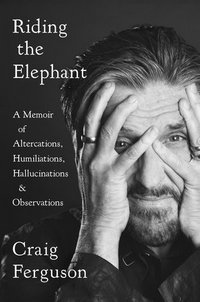
Riding the ElephantRiding the Elephant: A Memoir of Altercations, Humiliations, Hallucinations, and Observations

by Craig Ferguson
Hardcover, 266 pg.
Blue Rider Press, 2019
Read: July 1 – 18, 2019

The following year, 2009, I actually sang ”Sweet Caroline” along with Neil Diamond on stage—he put his hand on my shoulder! ”Reachin’ out. . . touchin’ me. . . touchin’ you . . .,” which means, no matter what you may achieve in your life, I’ll always be that little bit more awesome than you.

Early on, Ferguson talks about his approach to the writing of this bookafter years of writing the monologue-type things he started his talk show with (I call them type, because they’re not like your standard late night monologue), he’s continued to think in those terms, he finds it natural to write in. So, he wrote a few of those looking back on his past. Prestoa new memoir.

The timeline jumps around a lot, so there’s no real linear storyline. But there are trends, if you’re looking for them. More than that, there are themessobriety, family, and personal growth would be at the top of the list.

There are some wonderfully-written passages, not enough for my tastebut it’s not that kind of book, so those moments shine. Mostly, it’s a showcase for Ferguson as story-teller. And he’s a good one: whether it’s about a fishing trip, a vacation in Japan, performing somewhere, teenage romance (unrequited, I should add) or meeting his wife (for example) — you get caught up in the tale. Maybe the lessons he takes from the story or the point he was trying to raise, aren’t quite as good as the story itself, but frequently it is.

I could read the account of his learning to fly a couple of times a year and find it amusing and inspiring each time. I loved his discussion about his tattoos, tooit made me wish I had a session lined up.

One of the most prominent themes (maybe the most) is sobriety and his alcoholism. As you’d expect, Ferguson balances the harsh truths about both with his signature wit.

The problem with trying to hide active alcoholism from someone you live with is one of balance. You have to drink because you’re an alcoholic, but you don’t want to appear too drunk because then the poor unfortunate that is supposedly in a relationship with you might insist on you getting help. That’s the last fucking thing you want because every drinking alcoholic knows ”getting help” means stopping drinking, and that is unthinkable. Keeping your shit together is a tightrope act and is only halfway possible with luck, good timing, and cocaine. Even then it doesn’t always work.

Let’s be honest, it hardly ever works.

It never works.

I do think I would’ve enjoyed this more if I’d listened to the audiobookalas, it wasn’t available at my library. I think I’d have responded better to Ferguson’s voice telling me the stories, not reading them with frequent approximations of his voice in my head. But it was nice enougha few chuckles, some really well-written passages, some good insight into Ferguson. It wasn’t spectacular, as I’d hopedbut it was good. I’m glad I read it, and I bet if you like Ferguson to any extent, you’ll enjoy reading this, too.

—–

3 Stars

2019 Library Love ChallengeHumor Reading Challenge 2019

✔ A memoir or biography of a favorite celebrity.
✔ A book written by a comedian.

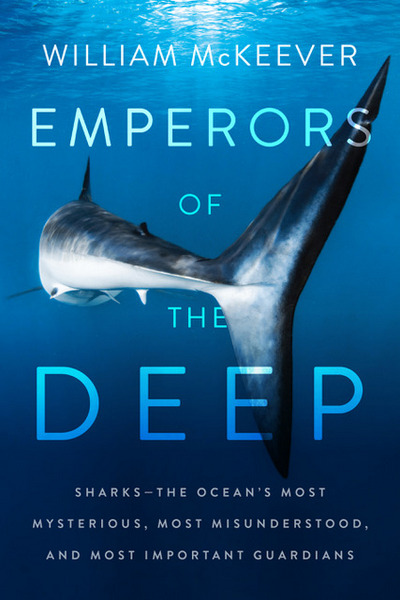
BOOK SPOTLIGHT (and Giveaway!): Emperors of the Deep by William McKeever

Today I’m pleased to welcome the Book Spotlight Tour for Emperors of the Deep by William McKeever. Who doesn’t find sharks fascinating?. Check out the information about the book or just scroll down to the end of the post and enter the givewway — or just go buy it.

Book Details:

Book Title: Emperors of the Deep by William McKeever
Publisher: Harper Collins
Category: Adult Non-Fiction
Release date: June 25, 2019
Format: Ebook/Hardcover/Audiobook
Length: 320 pages
Content Rating: PG-13 + M (Intense underwater moments and descriptions of interactions with Sharks both in diver and hunting situation)

Book Blurb:

In this remarkable groundbreaking book, a documentarian and conservationist, determined to dispel misplaced fear and correct common misconceptions, explores in-depth the secret lives of sharks—magnificent creatures who play an integral part in maintaining the health of the world’s oceans and ultimately the planet.

From the Jaws blockbusters to Shark Week, we are conditioned to see sharks as terrifying cold-blooded underwater predators. But as Safeguard the Seas founder William McKeever reveals, sharks are evolutionary marvels essential to maintaining a balanced ecosystem. We can learn much from sharks, he argues, and our knowledge about them continues to grow. The first book to reveal in full the hidden lives of sharks, Emperors of the Deep examines four species—Mako, Tiger, Hammerhead, and Great White—as never before, and includes fascinating details such as:

  • Sharks are 50-million years older than trees;
  • Sharks have survived five extinction level events, including the one that killed off the dinosaurs;
  • Sharks have electroreception, a sixth-sense that lets them pick up on electric fields generated by living things;
  • Sharks can dive 4,000 feet below the surface;
  • Sharks account for only 6 human fatalities per year, while humans kill 100 million sharks per year.

McKeever goes back through time to probe the shark’s pre-historic secrets and how it has become the world’s most feared and most misunderstood predator, and takes us on a pulse-pounding tour around the world and deep under the water’s surface, from the frigid waters of the Arctic Circle to the coral reefs of the tropical Central Pacific, to see sharks up close in their natural habitat. He also interviews ecologists, conservationists, and world-renowned shark experts, including the founders of Greenpeace’s Rainbow Warrior, the head of the Massachusetts Shark Research Program, and the self-professed “last great shark hunter.”

At once a deep-dive into the misunderstood world of sharks and an urgent call to protect them, Emperors of the Deep celebrates this wild species that hold the key to unlocking the mysteries of the ocean—if we can prevent their extinction from climate change and human hunters.

Purchase Links for Emperors of the Deep:

Amazon ~ Barnes & Noble
Add to Goodreads

Book Trailer:

MBS_TRAILER_04052019_2 Min from Wmckeever on Vimeo.

(Vimeo tells me it might not show correctly, if that’s the case, click here to watch the trailer. It’s one of the best looking book trailers you’ve ever seen — you really should watch it)

About William McKeever:

William McKeever

William McKeever is a writer and documentary Filmmaker. He is the founder of Safeguard the Seas, an NGO dedicated to ocean conservation. He is the producer and director of the forthcoming feature-length documentary Man Bites Shark.

Connect with the author: Website ~ Twitter ~ Facebook ~ Instagram

GIVEAWAY:

Win a copy of Emperors of the Deep (1 winner / open to USA only)

(ends July 20, 2019)

a Rafflecopter giveaway

https://widget-prime.rafflecopter.com/launch.js

(if the Rafflecopter script isn’t working, just click here — it’s not as pretty, but it works)

BOOK SPOTLIGHT: Play To Live: Life Skills and Joy Through the Natural Talent to Play by Brian VanDongen

Today I’m pleased to welcome the Book Spotlight Tour for Play to Liveby Brian VanDongen. I think this book good — especially for parents of kids who are about a decade younger than my youngest, but I can’t fit in to my schedule (at least not quickly enough to help out with the tour). Still, I thought it was potentially useful and wanted to help spread the word about it. So we’ve got this here spotlight and then a little later this morning a A Few Quick Questions with the author. But first, check out the information about the book and the givewway — or just go buy it. Either way…

Book Details:

Book Title: Play to Live: Life Skills and Joy Through the Natural Talent to Play by Brian VanDongen
Publisher: BVDPlays
Category: Adult Non-Fiction
Release date: April 30, 2019
Format: Ebook/Paperback
Length: 119 pages
Content Rating: G

Book Blurb:

Play To Live: Life Skills and Joy Through The Natural Talent To Play by author Brian VanDongen takes you back to your childhood to remind you about what being a child is all about. Playing! We all have those fond childhood memories of growing up playing with our friends in social settings. Developing social skills and learning how to handle friendships and relationships.

What we didn’t realize at the time was that those skills we learned for the building blocks which lay the foundation for the rest of our lives. What are our children learning right now? How are they playing now and what part are we playing in how our children interact with the world around them.

For many children, their idea of play and playing now consists of talking to friends online and playing with electronic devices, staying safe indoors, and not venturing further than their own small safe world which we have created.

Inside Play To Live you’ll discover:

  • Understanding what it means to play.
  • Where play has gone and what has changed?
  • How playing inside the box promotes the simplicity of play.
  • Why risky play is not the same as dangerous play. Are we too overprotective?
  • That climbing up the slide is just as important as sliding down.
  • Getting muddy outside and rediscovering nature is imperative.
  • That play is serious business and so much more.

Inside Play To Live: Life Skills and Joy Through The Natural Talent To Play you’ll read about case studies and reports followed by tips, tricks, and information to help you. If you would like to rediscover what it means to play, then grab a copy of Play To Live right now!

Purchase Links for Play to Live:

Amazon ~ Apple Books
Add to Goodreads

About Brian VanDongen:

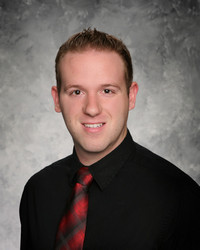
Brian VanDongen

Brian is a life-long “parks and rec kid.” Now, he is a parks and recreation professional.

Brian has created, designed, and implemented transformational recreational programming for thousands of residents. ​ Through his work as a park and recreation professional, Brian helps people play and find their natural talent to play.

He believes everyone has that talent, but it is sometimes hard to find, or even suppressed in today’s society. ​ Fortunately, play at its most basic level is easy, fun, healthy, and desirable. That playful talent just needs to be unleashed.

Brian has helped thousands of people find their natural talent to play and become happier and healthier people through the power of play.

Connect with the author: Website ~ Twitter ~ Facebook ~ Instagram

GIVEAWAY:

Win a signed copy of Play to Live: Life Skills and Joy Through the Natural Talent to Play (1 winner / open to USA only)

(ends July 13, 2019)

a Rafflecopter giveaway

https://widget-prime.rafflecopter.com/launch.js

(if the Rafflecopter script isn’t working, just click here — it’s not as pretty, but it works)

My thanks to iREAD Book Tours for the invitation to participate in this tour and the materials they provided.

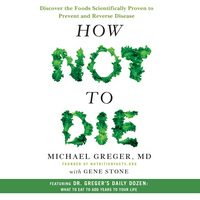
How Not to Die by Michael Greger M.D. FACLM, Gene Stone: I Didn’t Want to Enjoy This Book . . .

How Not to DieHow Not to Die: Discover the Foods Scientifically Proven to Prevent and Reverse Disease

by Michael Greger M.D. FACLM, Gene Stone


Unabridged Audiobook, 17 hrs., 9 min.
Macmillan Audio, 2015
Read: June 3 – 12, 2019

           Health nuts are going to feel stupid someday, lying in hospitals dying of nothing.
                                        — Redd Foxx
           Be careful about reading health books. You may die of a misprint.
                                        — Mark Twain

I hate, really hate — and frequently resist — talking about books like this here. But I spent so much time listening to this book, I felt I had to. I do not possess the time, knowledge, or resources to really dig into this book and its claims. I’m only commenting as someone who listened to the material once — I’m not a medical expert by any means. I’m just a guy whose doctor recommended this book and who is taking classes/guidance from a couple of dieticians who think a lot like Dr. Gregor (but have disagreed with some of his conclusions), and is trying to learn from it. At the same time, I ran into those lines I quoted above in High School and I don’t know if I’ll ever forget them — they’re good to keep in the back of your mind with ideas like this — errors are costly, and death is inevitable — you can delay it, but it’s coming.

I’ve seen this book described as veganism without the ideology. That’s not a bad way to put it. I’ve seen someone else say it’s a tool to help them do vegetarianism/veganism better and to understand it more. That’s probably not bad. Gregor and Stone describe their approach as “evidence-based nutrition” (but it’s not like there are a lot of people out there arguing against evidence, are there?). But I’m getting ahead of myself.

Following the introduction wherein Gregor gives his personal background into the idea of nutrition and medicine — initially from his family’s experience and then what he learned in med school and after. He then lays out his complaints against the US medical industry’s lack of education/emphasis on nutrition and its use in treatment/prevention of disease. I’m all in on that idea — if we are what we eat, most Americans are processed junk with only trace amounts of plant elements in our make up.

From there the book is essentially divided into two sections — the first focuses on the Top 15 Causes of Death in the U.S. The authors go through each of the 15 (Heart Disease, various Cancers, Mental Health, High Blood Pressure, Diabetes, and so on). The chapter will begin by looking at how the disease operates and how diet/exercise can play a role in worsening the condition and then how diet/exercise can aid in the treatment — or at least alleviate the symptoms — of each.

In Part 2, Gregor turns to answer the inevitable question, “Well, what do you eat?” He has developed a “Daily Dozen” approach — eating X amount of things like berries, nuts, beans, cruciferous vegetables, spices, etc. He explains the origins of this Daily Dozen (there’s a handy app version of this that I’ve been using for a couple of months to help track/guide my eating, by the way). And then looks at each — what health benefits can be gained from a whole foods, plant-based diet by category, and also specifics. For example, he’ll tell you all the ways that X amount of goji berries can help you, or the ways that Y amount of kale, quinoa, or apples will give you a boost — and so on.

It’s a lot to take in, and will certainly provoke thoughts. He’s quick to point out when researchers that disagree with his conclusions seem to cherry pick their results/findings/studies — and the biases of the researchers/funding. But they doesn’t do as thorough a job of demonstrating his counter-examples are free from that. It seems simplistic pretty often to take this approach without a large grain or two of salt (just kidding…that much sodium would incur the wrath of the authors). They do stress frequently the need to make some of these diet changes in consultation with your doctors, and not to just run off and do it — but it’d be pretty easy to disregard the warning and go off on your own guide-less.

As far as an audiobook goes . . . there are pluses and minuses. Greger himself reads the book — making it of a piece with his videos, etc. — and you can easily understand why he was in demand as a public speaker. He’s got great delivery and his personality shines through the reading. I may be the only one who hears it this way, but if you ask me — he delivers 98% of these lines (both the factual lines, and the little bit of snark or playfulness included) just as Wil Wheaton would. His voice has a Wheaton-esque quality, too. Which works for me — it wouldn’t for everyone, I know. The downside is that it’s just too much to take in via audio — there’s just so much thrown at you that you can’t get it all on a listen. The audiobook is a great way to introduce yourself to this book, but you’re going to need the hard copy for reference.

Gregor and Stone make some powerful arguments, and have convinced me of a lot — but I’m clinging to a bit of skepticism. But it’s a good starting point for re-evaluating your personal diet and priorities when it comes to food. How Not to Die is entertaining, informative and potentially life-altering. Hard to ask for more from a book.

—–

4 Stars
2019 Library Love Challenge

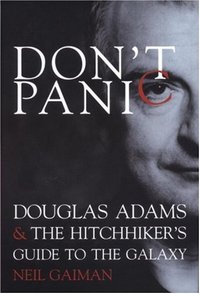
Don’t Panic by Neil Gaiman, David K. Dickson and MJ Simpson: An Indispensable Guide to Douglas Adams and his Work

I’d intended to get this up and ready for Towel Day last week — but, obviously, I failed. Schemes once again, Gang aft a-gley. It’s pretty fitting, really that this is late.

Don't PanicDon’t Panic: Douglas Adams & The Hitchhiker’s Guide to the Galaxy (Third Edition)

by Neil Gaiman; Additional Material by David K. Dickson & MJ Simpson
Series: The Hitchhiker’s Guide to the Galaxy Trilogy (related)

Hardcover, 207 pg.
Titan Books, 2003
Read: May 22 – 23, 2019

          
The idea in question bubbled into Douglas Adams’s mind quite spontaneously, in a field in Innsbruck. He later denied any personal memory of it having happened. But it’s the story he told, and, if there can be such a thing, it’s the beginning. If you have to take a flag reading THE STORY STARTS HERE and stick it into the story, then there is no other place to put it.

It was 1971, and the eighteen year-old Douglas Adams was hitch-hiking his way across Europe with a copy of The Hitchhiker’s Guide to Europethat he had stolen (he hadn’t bothered ‘borrowing’ a copy of Europe on $5 a Day, he didn’t have that kind of money).

He was drunk. He was poverty-stricken. He was too poor to afford a room at a youth hostel (the entire story is told at length in his introduction to The Hitchhiker’s Guide to the Galaxy: A Trilogy in Four Parts in England, and The Hitchhiker’s Trilogy in the US) and he wound up, at the end of a harrowing day, flat on his back in a field in Innsbruck, staring up at the stars. “Somebody,” he thought, “somebody really ought to write a Hitchhiker’s Guide to the Galaxy.”

He forgot about the idea shortly thereafter.

Five years later, while he was struggling to think of a legitimate reason for an alien to visit Earth, the phrase returned to him. The rest is history, and will be told in this book.

I distinctly remember purchasing the first edition of Don’t Panic from BookPeople of Moscow in the fall of 1991 — I remember being blown away by the idea that someone would write a book about Douglas Adams’ work. I had no idea who this Neil Gaiman fellow was, but I enjoyed his writing and loved the book he wrote — and read it several times. It was a long time (over 2 decades) before I thought of him as anything but “that guy who wrote the Hitchhiker’s book.” The Hitchhiker’s Trilogy had been a favorite of mine for years by that point, and getting to look behind the scenes of it was like catnip.

This is the third edition, and as is noted by Gaiman in the Forward, it “has been updated and expanded twice.” The completist in me would like to find a second edition to read the original 3 chapters added by David K. Dickson in 1993, but the important change was in 2002, when “MJ Simpson wrote chapters 27-30, and overhauled the entire text.” If you ask me, Gaiman’s name should be in the smaller print and Simpson’s should be the tall letters on the cover — but no publisher is that stupid, if you get the chance to claim that Neil Gaiman wrote a book, you run with it. Overhauled is a kind way of putting it — there’s little of the original book that I recognize (I’m going by memory only, not a side by side comparison). This is not a complaint, because Simpson’s version of the book is just as good as the original, it’s just not the original.

This is a little more than the story of The Hitchhiker’s Trilogy, but it’s certainly not a biography of Adams — maybe you could call it a professional biography. Or a biography of Adams the creator, which only touches upon the rest of his life as needed. Yes there are brief looks at his childhood, schooling, etc. But it primarily focuses on his writing, acting, producing and whatnot as the things that led to that revolutionary BBC Radio series and what happened afterward. Maybe you could think of it as the story of a man’s lifelong battle to meet a deadline and the lengths those around him would go to help him not miss it too much.

Once we get to the Radio series, it follows the The Hitchhiker’s Trilogy through each incarnation and expansion — talking about the problems getting it produced (in whatever medium we’re talking about — books, TV show, movie, stage show) and the content. Then the book discusses other Adams projects — Dirk Gently books, The Last Chance to See, his computer work, and other things like that.

It’s told with a lot of cheek, humor, and snark — some of the best footnotes and appendices ever. It’s not the work of a slavish fanboy (or team of them) — there are critical moments talking about problems with some of the books (some of the critiques are valid, others might be valid, but I demur). But it’s never not told with affection for the man or his work.

Don’t Panic is a must for die-hard fans — and can be read for a lot of pleasure by casual fans of the author or his work. I can almost promise that whatever your level of devotion to or appreciation of Adams/his work, it’ll increase after reading this. Any edition of this book should do — but this third edition is an achievement all to itself. Imagine someone being able to say, “I improved on Gaiman’s final draft.”

I loved it, I will return to this to read as well as to consult for future things I write about Adams, and recommend it without hesitation.

—–

5 Stars

Humor Reading Challenge 2019

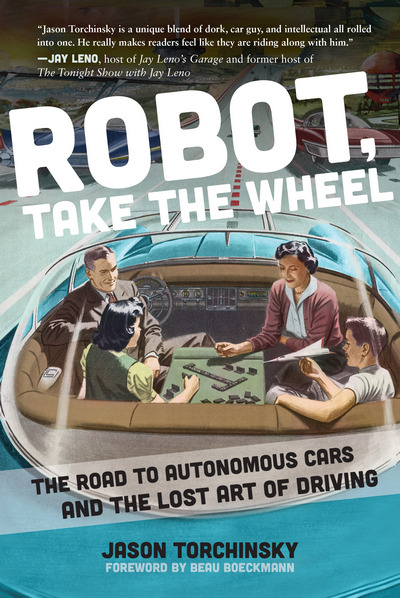
BOOK SPOTLIGHT: Robot, Take the Wheel by Jason Torchinsky

Today I’m pleased to welcome the Book Spotlight Tour for Robot, Take the Wheel by Jason Torchinsky. I jumped at the chance when asked if I’d participate in this because: 1. Content I didn’t have to work for at all; 2. It looks like a fun book that I’d like to help get eyeballs on; 3. How often to I get asked to do anything with a non-fiction book?; and 4. Check out the cover — that’s just awesome.

Read the post, enter the giveaway — or don’t wait for fortune to smile on you, go buy the thing!

Book Details:

Book Title: Robot, Take the Wheel: The Road to Autonomous Cars and the Lost Art of Driving by Jason Torchinsky
Publisher: Apollo Publishers
Category: Adult Non-Fiction
Release date: May 7, 2019
Format: Ebook/Hardcover
Length: 207 pages
Content Rating: PG (this book is accessible to everyone)

Book Blurb:

From the witty senior editor of Jalopnik, Gizmodo Media’s acclaimed website devoted to cars, technology, and more, comes a revealing, savvy, and humorous look at self-driving cars.

Self-driving cars sound fantastical and futuristic and yet they’ll soon be on every street in America. Whether it’s Tesla’s Autopilot, Google’s Waymo, Mercedes’s Distronic, or Uber’s 24,000 modified Volvos, companies across industries and throughout the world are developing autonomous cars. Even Apple, not to be outdone, is rumored to be creating its own technology too.

In Robot, Take the Wheel, Jason Torchinsky explores the state of the automotive industry. Through wit and wisdom, he explains why autonomous cars are being made and what the future of automated cars is. Torchinsky encourages us to consider autonomous cars as an entirely new machine, something beyond cars as we understand them today. He considers how we’ll get along with these robots that will take over our cars’ jobs, what they will look like, what sorts of jobs they may do, what we can expect of them, how they should act, ethically, how we can have fun with them, and how we can make sure there’s still a place for those of us who love to drive with manual or automatic transmission.

This unique and highly readable volume is brimming with industry insider information and destined to be a conversation starter. It’s a must-have for car lovers, technology geeks, and everyone who wants to know what’s on the road ahead.

Purchase Links for Robot, Take the Wheel:

Amazon ~ Barnes & Noble ~ Indiebound ~ Book Depository

About Jason Torchinsky:

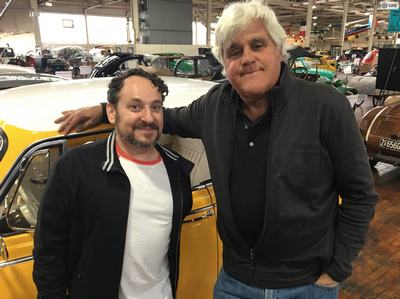
Jason TorchinskyJASON TORCHINSKY is senior editor of Jalopnik, a website devoted to news and opinions about all things automotive. As a writer and artist, he is known for his articles, artworks, talks, and videos about cars, technology, and culture. He has raced cars, wrecked cars, and driven possibly one of the most dangerous cars ever made with the King of Cars on the Emmy-winning Jay Leno’s Garage. He lives in North Carolina.

Connect with the author: Twitter

GIVEAWAY:

Win a print copy of Robot, Take the Wheel (5 winners / open to USA only)
(ends May 31, 2019)

a Rafflecopter giveaway

https://widget-prime.rafflecopter.com/launch.js

(if the Rafflecopter script isn’t working, just click here — it’s not as pretty, but it works)

And Drink I Did: One Man’s Story of Growing Through Recovery by Jay Keefe: An underdeveloped, but powerful memoir of addiction and recovery

And Drink I DidAnd Drink I Did: One Man’s Story of Growing Through Recovery

by Jay Keefe


Kindle Edition, 154 pg.
2018

Read: March 2 – 5, 2019

This is one of those books that’s pretty well summed up by the title and subtitle. There’s not a lot more to say, really. But I’ll flesh it out a little — the first two chapters are primarily focused on his pre-alcohol life to gain some insight into his alcoholism. He begins by saying that he doesn’t know why he’s an alcoholic, he doesn’t know what made him one — moreover, it doesn’t matter. What does matter is that he is an alcoholic. That doesn’t stop him from thinking and writing about his childhood — not in an effort to justify or explain away his alcoholism, but to understand it. He explains some early emotional experiences, as part of this — and even his earliest memories of OCD.

This might be the closest I’ve gotten to understanding the compulsion’s sensation:

I didn’t feel right or complete until I had done specific tasks.

Even after I did them, there was still a lingering sense that something was off. When people ask me to describe it, the best I can do is to say it’s like an itch that can’t be scratched- kind of like when the top of your mouth tickles, and you use your tongue to scratch it, but it doesn’t really help because your tongue just isn’t the right instrument to scratch an itch.

It’s like that.

Kind of.

Then he explained his initial drinking experiences and how alcohol made him feel. It reminded me of a similar passage in Mose Kasher’s memoir of addiction.

I always felt a void and had no idea how to fill it.

Alcohol filled that void perfectly.

It took me out of myself.

I could relax. . . .

Alcohol quelled the OCD too.

I didn’t clean when I was drunk.

It didn’t bother me that things weren’t in their place.

I didn’t sweat the small stuff, so to speak.

And I knew I wasn’t sweating it. That was the beauty of it.

It’s so easy for people — especially for non-addicts — to pin drugs and alcohol use and abuse to people who are partying or having a good time and can’t stop. For Kasher, it was about feeling normal; for Keefe it’s about quieting the OCD, about not having the self-doubt and insecurities that plagued him. It’s about self-medicating. Addiction’s never more understandable to me than when I hear someone talking like that — who wouldn’t want that experience? Forget about feeling good, just getting to neutral — no problems.

Anyway, from there Keefe spends a few chapters talking about his experiences drinking — at one point he says that other addicts’ war stories never impressed him, and initially you get the feeling that’s hypocritical because he talks a lot about some of the stupid or out of control things he did while drinking. But he never glorified the experience, he never celebrates what happened — it’s just a list of things he did. Like reciting the tasks (largely routine) at work you completed one week. More than once I found myself wondering how Keefe is still living — and he probably did, too, while writing it.

He then talks about his early days of recovery — his early 12-Step days and when it started to work for him, and how that changed his life. How being sober didn’t fix all of his problems, and how he still has impulse control issues and what he’s done to minimize the problems that causes him. Then he discusses his current circumstances, with a few years of sobriety behind him — how he’s doing, what he’s doing with himself, and that he’s still an alcoholic, living in fear of stumbling.

Those last couple of chapters, in particular are really powerful.

I’m a little of two minds about this book — you can see from what I’ve quoted how this book reads. Paragraphs that are 1 or 2 sentences long (there are some that are a little longer), some aren’t even complete sentences. The book largely reads like a very detailed outline — at best like a good first draft. Also, the timeline’s a little fuzzy and his knack for not using names all the time when talking about his life doesn’t help keep things clear.

None of that keeps the book from making an impact. It’s moving, it’s powerful, and you have a very real sense of what he went through. So Keefe’s not Tobias Wolff or Frank McCourt — who cares? The book accomplishes what he sets out to accomplish, is insightful, touching and inspiring. That’s good enough for me.

—–

3 Stars
Disclaimer: I received this book from the author in exchange for this post and my honest opinion, which is what I provided.
LetsReadIndie Reading Challenge

Saving the Reformation: The Pastoral Theology of the Canons of Dort by W. Robert Godfrey: A great Intro to the Canons of Dort and a valuable tool for study

Saving the Reformation: The Pastoral Theology of the Canons of DortSaving the Reformation: The Pastoral Theology of the Canons of Dort

by W. Robert Godfrey


eARC, 265 pg.
Reformation Trust Publishing, 2019

Read: February 3 – 10, 2019


I’m halfway inclined to just copy and paste the Table of Contents here and say, “If you want to know about any of this, here’s where you start.” Slap a nice little graphic with some stars on it, and we’re done. But I’m not that lazy. This is a historically-based study of the Synod of Dort’s major product — the Canons of Dort (although it does look at some other concerns), the defense of the Reformed doctrines in answer to the challenges of Jacob Arminius and the Remonstrants that took up and furthered his cause following his death. The Canons gave us the so-called “5 Points of Calvinism” and are often misunderstood because of that and as mischaracterized as those points themselves. If this book only helps people stop doing that, it’d be well worth the effort (it won’t, but it’s pretty to think so) — but it’s so much more.

There are four parts to this book — any one of which can be read independently from the others. I’m not sure why you would do that, but they’re self-contained enough that you don’t have to.

Part I focuses on the historical and theological context for the calling of the Synod, those who attended and the topics it would address. Godfrey is a Church Historian and former History professor, this is his bread and butter, and you can tell that from these chapters. You also get the impression that he could’ve written a book about the same length as this one just on the historical matters without breaking a sweat. This isn’t the best part of the book, but it gets things off to a great start.

Part II is a “Pastoral” translation of the Canons prepared by Godfrey for this book. I’m not familiar enough with other translations to really have much to say about this. I’ve read others, but I don’t have them committed to memory. Besides, I don’t know Latin well enough to evaluate the translation. But I can say that this was a clear translation, it didn’t read like something written in Latin for experts, but something written to help me and other Christians to wade through some weighty topics. As the problems caused by the Remonstrants were in the churches more than in the academy, the language matched that.

The heart of the book is in Part III, An Exposition of the Canons of Dort. Godfrey beings with some observations about the Canons as a whole — how they’re structured before he dives in to the Canons themselves. In addition to the errors of the Remonstrants, the Canons address other issues related to the doctrines involved, providing a resource for believers for generations not just an answer to their contemporary problems. The pastoral focus of the Canons — and Godfrey — is evident throughout the Exposition, he’s frequently talking about comfort, encouragement, and assurance. It’s not just an explanation and defense of the Reformation and Protestant teaching, it’s an aid and comfort to believers.

It may come as a surprise to see what Godfrey points out as a result of compromise, and the reasoning behind those things that needed no compromise. The behind-the-scenes portions of the book are as interesting as the exposition (giving an indication to those of us who didn’t sit under Godfrey’s Church History lectures that we really missed out on something). Godfrey also points out how the Canons weren’t as successful in some ways as they wanted to be — not as a failure, just that some of their goals were out of reach of the assembly.

Some of this section gets repetitive — because each Head of Doctrine is complete in itself, capable of standing alone — so similar points are covered repeatedly. Godfrey’s exposition both points that out and is written to keep the repetition from being dull, but instead an indication of the importance of the various points. This section is so helpful that I really can’t do justice — my copy is full of highlighted lines/paragraphs. I will be returning to it often, I know that. Concise, clear, insightful — everything you want in this kind of study.

The remainder of the book is Appendices. There’s an outline of the Canons, an explanation for the pattern of each head of doctrine (very similar to the same idea in the Exposition) and a handy guide to the relation of the positive articles to the rejection of errors. The last appendix is a new translation of the Synod’s provisional position on the Sabbath, giving some insight into the relation of the Synod’s stance to that of British Puritanism. The largest, and probably most helpful (and maybe controversial) is an extended look at Arminius and his overall project. Godfrey takes a position that argues against some recent scholarship (as I understand) and insists that he wasn’t a moderate Reformed churchman, but someone seeking to overturn segments of the church’s teaching and introduce serious Pelagian error.

In this anniversary year, I know this will not be the only book about the Synod released (I have another pre-ordered, and am sure I’ll pick up others) — but I can’t imagine that it won’t be one of the better. It is well-researched, careful, encouraging and pastoral — this is not dry and dusty history, nor dry and dusty doctrine. This book, like the Synod it focuses on, seeks to defend, protect and further the cause of the Protestant Reformation, the Gospel itself. As such, it succeeds and you’d do well to study it.

Disclaimer: I received this eARC from Reformation Trust Publishing via NetGalley in exchange for this post — thanks to both for this.

Baptism: Answers to Common Questions by Guy M. Richard: A Solid and Encouraging Introduction to a Complicated Topic

Baptism: Answers to Common QuestionsBaptism: Answers to Common Questions

by Guy M. Richard


eARC, 129 pg.
Reformation Trust Publishing, 2019
Read: February 3, 2019

It’s been awhile since I’ve read a book on baptism — it’s been awhile since I’ve seen a new one published, too (but maybe I stopped paying attention), so when I saw this on NetGalley, I had to take a chance. I’m very glad I did. Richard discusses in his introduction that questions about this sacrament are some of the most frequently asked to Presbyterian (and, I assume, Reformed) pastors. Sadly, they’re usually asked when pastors can’t give the kind of answers they should — at least based on his experience.

He begins looking at the meaning of Baptism — both the Greek terms translated as “baptism” and the sacrament. He does so very well, covering all the bases. Following that he moves to the method of baptism — how should the water be applied? Once he’s finished with these matters he moves into the more complicated question — who should be baptised? He begins with the “household” baptisms in the New Testament before turning to the objections and arguments of Baptist and baptistic brothers. He not only examines and explains them fairly well, he responds to them in an irenic manner, but not giving an inch to them.

The conclusion, “What Can We Take Away from All This” is just fantastic. Richard’s meditations on how our baptisms should shape our lives and our faith, to build our faith and give us assurance. It’s easily worth half of whatever you pay for the book, and maybe more.

This is probably not a book that will convince any detractors. It may not be enough to convince the earnest seeker. But it will explain the basics for each topic considered. It will demonstrate the systematic and biblical basis for Richard’s positions exists and they aren’t mere tradition. These are outlines to be filled in with further reflection, reading and research by the reader.

Along those lines, each chapter could really use a “For Further Reading” to help the reader get deeper into the topics covered — or one at the end of the book. But I do think as each chapter is so topic-focused, it’d be very helpful. As good as each chapter is, they are just an overview. Not every reader is going to want to go deeper into, say, the mode/method of baptism but they might want to spend more time on the meaning of Baptism, or his response to Baptist interpretations of Jeremiah 31. For example, I think I agree with his differing from Murray on the former — but I’d like to read more about that, if it’s possible.

Richard’s tone throughout is gracious, kind, yet unbending. It’s not easy to putt off in print, especially on a topic like Baptism. There were many times he could’ve gone for the jugular, rhetorically speaking. He never did, trusting that the arguments would carry the day. And, in my not so humble opinion, he’s right to trust that.

Gracious, encouraging, thorough and easy to read — this introduction to “the waters that divide” Christians is just what you want in a book on this topic. But more than those, it’s deeply biblical in nature. Richard’s focus in bringing the light of the canon to this topic, and he succeeds there. I strongly encourage you to read it.

Disclaimer: I received this eARC from Reformation Trust Publishing via NetGalley in exchange for this post — thanks to both for this.

—–

4 Stars

Death Valley Superstars by Duke Haney: Cautionary Tales about Hollywood

Death Valley SuperstarsDeath Valley Superstars: Occasionally Fatal Adventures in Filmland

by Duke Haney
Kindle Edition, 306 pg.
Delancey Street Press, 2018
Read: January 2 – 16, 2019

Duke Haney, actor, screenplay writer, novelist, essayist, has delivered a well-written collection of sixteen essays revolving around some of those impacted by, affected by, corrupted(?) by, shaped by Fame — that fleeting authority and celebrity bestowed by a chosen few in the Hollywood system that has captured the American imagination and attention since the 1900s.

The quality of the writing throughout was pretty consistent, as was the voice, etc., etc. But my own interest varied widely from piece to piece. I think that’s largely on me, not Haney. But then again, maybe Haney shouldn’t have picked topics that have been done to death. I’m not sure that the universe needs another essay/reflection/biography/anything about Marilyn Monroe, Lee Harvey Oswald, or Jim Morrison. It certainly doesn’t need any further effort to celebrate Hugh Hefner.

On the other hand, the pieces about Sean Flynn (son of Errol), William Desmond Taylor, Christopher Jones, and other people that I’d never heard of were fascinating. I learned something, I was introduced to people I’d missed out on. They weren’t slightly different takes on worn-out ideas about legends that have had dozens of books written about them.

Better yet were the pieces that were about his life — encountering Elizabeth Taylor as a youth, working on various films, his nude scenes, his crush on (and seen in retrospect, stalking) of a noted actress, the encounter with the lady on the bus talking about the video store they both frequented, even the part of the Jim Morrison essay about his quest to hire a psychic (it shouldn’t be that hard in L.A.) to do a séance in a hotel room Morrison lived in. He’s really his best — and most entertaining — subject (although when the subject of an essay is someone else, Haney tends to talk about himself too much). He doesn’t come across as someone trying to gloss over mistakes, missteps, or embarrassing moves — in fact, he seems to revel in them. These are honest (seeming), frequently funny and charming.

I have no doubt that there are plenty of people out there who will invert my rankings, or dispute them all together. And they’d likely be right to do so (I doubt they’d convince me, but you never know). Most collections I read are pretty uneven. This isn’t the case with Death Valley Superstars, I think the quality is consistent — it’s just my own reaction to the chapters that are varied. I’d wager the same will be true for other readers.

If nothing else, I think the above summary rundown demonstrates the variety of pieces in this collection — and I didn’t make mention of all of them. One thing that is fairly consistent is the takeaway from the collection as a whole — fame is fleeting, but its effect on the lives of the famous (and those near them) is long-lasting, and rarely pleasant or beneficial. Really, the whole book can be seen as a collection of cautionary tales with a persistent message — stay away from Hollywood.

I didn’t love this book, but I really liked parts of it, and am glad I read it. I can easily see many readers wondering what was wrong with me, however, and eating this thing up.

Disclaimer: I was provided with a copy of this book in exchange for my honest opinion, which is seen above.

—–

3 Stars

✔ An essay collection.

LetsReadIndie Reading Challenge

Page 22 of 31

Powered by WordPress & Theme by Anders Norén