Tag: Non-Fiction Page 3 of 31

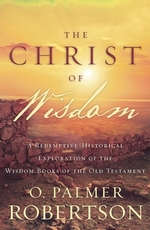
REPOST: The Christ of Wisdom by O. Palmer Robertson

The Christ of WisdomThe Christ of Wisdom: A Redemptive-Historical Exploration of the Wisdom Books of the Old Testament

by O. Palmer Robertson

eARC, 432 pg.
P&R Publishing, 2017

Read: May 7 – 21, 2017


Robertson’s preface laments the way that the Wisdom Literature of the Old Testament is usually ignored in Redemptive-Historical studies —

…how do you fit these wisdom books into the flow of redemptive history that consummates in the Christ? By letting them be what they are in their own distinctiveness. They are, it should be remembered, canonical, divinely revealed, and authoritative writings that tell the world how and what to think about the deeper mysteries of human life. Rather than submitting to the moldings and bendings of modernity, these books broaden our understanding of the nature of redemptive history. Divine progress in the complete restoration of reality does not merely move in a purely linear fashion like the flight of an arrow moving across time and space without deviation until it reaches its target. This “third dimension” of redemptive history moves in a cyclical pattern. For certain aspects of God’s salvation perform according to a pattern of regulated repetition.

To ignore this dimension of redemptive history is to exclude a major portion of the old covenant canon—and that you do not want to do.

So how do you discuss these books from a RH point of view? This is what Robertson seeks to do in this book — not as a final answer, but as the beginning of a search for wisdom along these paths.

In one sense, Robertson could’ve made this easier to talk about this book — there’s not one central argument developed throughout. There’s a general discussion (brief) of wisdom, wisdom Biblically defined, that is. And then using that discussion, Robertson looks at the Wisdom Literature of the Old Testament (and Lamentations, which is not usually considered Wisdom Literature, but can function as such), summarizing each book, looking at the various forms of wisdom described and passed on through it.

Simply,

Wisdom is the ability to understand the basic principles inherent in God’s created order, and to live by those principles. Wisdom enables a person to summarize these basic principles in a succinct and memorable fashion. Wisdom is living out the whole of life with a constant awareness of accountability before a loving, gracious, and just Creator and Redeemer.

The work he does to get to this summary is well worth the time and effort to work through. Actually, that goes for everything in the book, but I’ll hold off on saying that kind of thing for a few paragraphs.

The chapter on Proverbs is, fittingly, the longest and most developed. He discusses various approaches to the book, to understanding its construction and from there trying to understand it:

A much more accurate view of the theology of Proverbs may be gained from a covenantal perspective. The wise sayings of the book are not presented in a vacuum. They are not purely moralistic aphorisms. Instead, they are steeped in theistic assumptions. These wise observations about how the world works assume that God the Creator is none other than Yahweh, the Lord of the Covenant.

This, right here, would help so much of what I’ve read about Proverbs over the last few decades. To get into everything that Robertson says about the pursuit of Wisdom, passing it on and living by it from this book would make this post unbearably long — but it builds the foundation for everything that comes. Proverbs covers Wisdom as a whole — the rest of the book deals with it in specific areas.

While dealing with the personification of Wisdom in Proverbs 8, Robertson gives an excursus, “Athanasius as the Champion of the opponents of Arianism,” that is just gold. I’d love to see this developed into something longer.

Following Proverbs, he moves on to Job. Job doesn’t give us the answers to the puzzling circumstances of life, but for those who understand the book, they learn how to puzzle through the circumstances, how to think about them — how to ask God about them. Yes, there are answers given in the book — not easy answers, not the answers anyone necessarily wants, but answers — answers tied to the hope of the Resurrection. But wisdom knows to look for those answers in the difficulties of life, with a sure faith that is willing to look at dark circumstances and say, “I don’t know why this is happening, but I trust in Him Who does.”

Ecclesiastes, is, naturally, a tricky chapter — Robertson threw me a curveball when setting aside the usual discussion of authorship of the book to note

But a related question of some significance for understanding the book has been generally neglected. This neglected question is the identity of the “target audience”of Ecclesiastes.

Chewing on this a little helps get through some of the discussion of authorship. There are so many divergent readings of Ecclesiastes that your head can swim just trying to get a sense of them, Robertson is a pretty sure guide through them before landing on his conclusion that Ecclesiastes presents a “realistic picture of life” — one that is a precursor to Paul’s discussion in Romans 8, where creation is subjected to frustration, but that this is being renewed. I do think this chapter could’ve been organized in a more straight-forward way, but I appreciate the way that Robertson makes you work through various considerations and themes before leading to his conclusions — which are all very helpful.

His discussion of Lamentations, summed up in the subtitle “How to Weep,” was one of the best things I’ve read on the book (an admittedly too-short list). You may think that’s a pretty easy thing to learn — but there’s a wise way, a godly way to weep over the tragedies that will come into our lives. The book of Lamentations teaches us that — and, here’s the RH emphasis coming through — there’s a hope tied to the wise weeping. A hope tied to faith in God’s commitment to preserving a repentant people to Himself.

Lastly, we get to the wisdom of “How to Love” (in a marital sense) in the Song of Songs. The way he reads the book is a “Redemptive-Historical” way, in

terms of the redemptive work of God in restoring humanity to the situation prevailing at the time of creation . . . a restoration of the initial blessing of man and woman in their relation to each other, just as when they first stood in each other’s presence “both naked” but feeling “no shame” (Gen. 2:25). This Song rejoices in the fullness of God’s redemption of the marriage relationship.

He concludes this chapter uniquely, with a script for a Dramatic Reading of the Song of Songs — I think there could’ve been a bit more instruction on how to approach such a Reading — and why — than he gave. But I really appreciated that part.

He could’ve used a conclusion to wrap things up — returning to the closing admonition of the opening chapter. But that’s probably just a taste thing on my part.

There’s a focus on the literary/poetic forms in each book tying in the themes and teachings of them to the way the author presents them. This kind of discussion — no matter the type of literature (inspired or not) always stretches me. I imagine I’m not alone in that — in fact, I bet many people will skip those parts. This is to their own detriment. Robertson discusses these matters in a way that takes some effort to understand, but it’s effort that pays off.

This is a truly helpful book — not full-fledged commentaries on any of the books, but helpful summaries pointed towards seeing the wisdom passed down in each book, and tied into the Redemptive work going on in history all around us. I found it interesting that the recent A Biblical-Theological Introduction to the Old Testament doesn’t approach some of these books the same way as Robertson — in some ways flatly contradicting him. I’d hoped for more overlap between the two works approaching this material from the same framework — but none of the contradictions or differences change the overall message of the Biblical material, just shadings. Honestly, in each case, I think Robertson’s readings are easier to square with the texts in consideration (and not just because he has more pages to develop his points, either).

Robertson, as always, delivers the goods with this book. The reader has to think about what he says, has to drag out their Bible and use the two books together, but will ultimately come out the better for it. I found this book to be incredibly helpful, insightful and something that drove me back to the fullness and fulfillment of all the wisdom of God — Jesus the Messiah. Just where Robertson wants his readers to focus.

Disclaimer: I received this eARC from P&R Publishing via NetGalley in exchange for this post — thanks to both for this.
N.B.: As this was an ARC, any quotations above may be changed in the published work — I will endeavor to verify them as soon as possible.

—–

4 Stars

Killer Conversations with Rex Stout and John McAleer: Ridiculously Fun (and insightful, too, if you’re into that sort of thing)

Cover of Killer Conversations with Rex Stout and John McAleerKiller Conversations

with Rex Stout, John McAleer

DETAILS:
Publisher: Andrew McAleer
Publication Date: March 30, 2025
Format: eBook
Length: 91 pgs.
Read Date: May 21, 2025

How Does the Publisher Describe Killer Conversations?

Rex Stout: Killer Conversations (formerly Royal Decree) is a must read for aficionados of detective fiction. Here Edgar winner John McAleer shares some of his most memorable conversations with Nero Wolfe creator Rex Stout. Featuring an updated Introduction by crime fiction icon William G. Tapply and an Afterword by Grand Master Edward D. Hoch, Killer Conversations is an essential collectors’ volume. These in-person discussions with Stout were compiled to inform and gratify, in Stout’s own words, the millions of Rex Stout fans who would be putting these questions to him as if he were alive answering his mail from Wolfe’s West 35th Street Brownstone. Hailed by CBS as the “American Conan Doyle,” in Killer Conversations Stout discusses, among other things, his writingcraft, the Wolfe mysteries, plotting methods, characterization, the modern detective story, his service aboard President Teddy Roosevelt’s yacht, and offers his appraisal of crime fiction icons such as—Agatha Christie, Georges Simenon, G. K. Chesterton, and more. Killer Conversations will keep mystery fans glued to their chair till midnight chimes the hour. And why not, isn’t that what a Stout mystery does?

(the only problem with this blurb is the bit about midnight chimes the hour…the only way most people would be reading this until midnight is if they started at 11:20p.m.)

Some of My Favorite Responses

This is a great collection of pithy takes on everything outlined above—and Stout was great at them. I have to share some to give you a little taste (and because I just had to share some). I won’t cite all the best ones here—but I’m tempted to.

McAleer: When you were writing for the pulps, between nineteen twelve and nineteen seventeen, did you see yourself as a hack writer or as an aspiring young writer on his way to the top?

Stout: I have never regarded myself as this or that. I have been too busy being myself to bother about regarding myself.

McAleer: I know a writer who, before beginning a book, separates a ream of paper into unequal piles of twenty-three, thirty-seven, forty, twenty-seven, and so forth, because he knows in advance how many pages will go into each chapter. How does that strike you?

Stout: He isn’t a writer, he’s a puzzle fiend. Revolting.

McAleer: You’ve said you’d rather have written Alice in Wonderland than any other book in English written in the last century. Why?

Stout: I could write pages about it and they would have to be well written. While giving glorious entertainment in the form of playful nonsense, it does the best job in the English language of exposing our greatest fallacy, that man is a rational animal. A couple of instances out of many: The Queen’s “Off with their heads” shows that the greatest danger of unlimited power is not that it can act by malice but that it can act on whim. The shifting of places at the Mad Hatter’s tea party shows that if all of the members of a group wish to make a change it is not true that they should change in unison in the same direction. To do this right would take hours.

McAleer: Yet you hold Hammett in high regard?

Stout: Certainly. He was better than Chandler, though to read the critics you wouldn’t think so. In fact, The Glass Key is better than anything Hemingway ever wrote. . .Hemingway never grew out of adolescence. His scope and depth stayed shallow because he had no idea what women are for.

McAleer: Inspector Cramer is called “Fergus” Cramer in Where There’s a Will. Later, in The Silent Speaker, his initials are given as “L. T. C.”. How do you explain this discrepancy?

Stout: No significance. Laziness. I didn’t bother to check whether he already had a first name. Of course all discrepancies in the Nero Wolfe stories are Archie Goodwin’s fault.

So, what did I think about Killer Conversations?

Some of the answers Stout gives are deep. Several are flip. He doesn’t always use more than one word (really, would a little elaboration of killed him?) All are just fun to read.

This is a Lay’s Potato Chip kind of read—I bet you can’t read just on Question and Answer. You have to keep going—you might be able to make yourself stop because of something, but you won’t want to. It’s just too much fun to keep going.

Also? This is clearly going to be re-readable (I almost slipped into a re-read while putting this post together).

Ultimately, the question you want to ask yourself about this book is this: Do I want to learn more about Rex Stout? If the answer is yes, you’re going to have a blast with this. If you don’t—why have you read this far? You might appreciate someone talking about obscure authors and classics of the mystery genre. But you’re probably not going to be that engaged.

Me? I loved it. The two cover life, death, love, reputation, writing, Stout’s characters, his career, a little bit about people in his life, and more. If this book was three times as long—I’d say the same thing.

Irresponsible Reader Pilcrow Icon

REPOSTING: Breaking Bread with the Dead by Alan Jacobs: Interacting with the Classics from a Contemporary Perspective in Order to Learn and Critique

Earlier this year, I re-read three books by Alan Jacobs in what he styles as a trilogy of sorts (my paraphrase), with the intention of writing new, longer, posts about them all–or maybe one mega-post about all three. Neither of those happened, and I’m pretty sure it’s not going to happen this year–as much as they deserve it. But I still wanted to reflect on them a bit and call your attention to them. So, I’m just going to repost what I’ve said before–this one, in particular, deserves much more than I gave it. I maybe should try again next year.


Breaking Bread with the Dead

Breaking Bread with the Dead: A Reader’s Guide to a More Tranquil Mind

by Alan Jacobs

Hardcover, 192 pg.
Penguin Press, 2020

Read: September 26-October 15, 2020
Grab a copy from your local indie bookstore!

What’s Breaking Bread with the Dead About?

If I tried to summarize this book (unless I read it 3-4 more times), it would be out-of-control, just me blathering on for 4+ pages. So, let’s have mercy on us all and just appropriate what’s on the publisher’s site:

From the author of HOW TO THINK and THE PLEASURES OF READING IN AN AGE OF DISTRACTION, a literary guide to engaging with the voices of the past to stay sane in the present

W. H. Auden once wrote that “art is our chief means of breaking bread with the dead.” In his brilliant and compulsively readable new treatise, Breaking Bread with the Dead, Alan Jacobs shows us that engaging with the strange and wonderful writings of the past might help us live less anxiously in the present–and increase what Thomas Pynchon once called our “personal density.”

Today we are battling too much information in a society changing at lightning speed, with algorithms aimed at shaping our every thought–plus a sense that history offers no resources, only impediments to overcome or ignore. The modern solution to our problems is to surround ourselves only with what we know and what brings us instant comfort. Jacobs’s answer is the opposite: to be in conversation with, and challenged by, those from the past who can tell us what we never thought we needed to know.

What can Homer teach us about force? How does Frederick Douglass deal with the massive blind spots of America’s Founding Fathers? And what can we learn from modern authors who engage passionately and profoundly with the past? How can Ursula K. Le Guin show us truths about Virgil’s female characters that Virgil himself could never have seen? In Breaking Bread with the Dead, a gifted scholar draws us into close and sympathetic engagement with texts from across the ages, including the work of Anita Desai, Henrik Ibsen, Jean Rhys, Simone Weil, Edith Wharton, Amitav Ghosh, Claude Lévi-Strauss, Italo Calvino, and many more.

By hearing the voices of the past, we can expand our consciousness, our sympathies, and our wisdom far beyond what our present moment can offer.

So, what did I think about Breaking Bread with the Dead?

Really, what I want to do at this point is to write a series of posts about this book (probably not one per chapter, I could probably combine a couple of chapters together). But really, they’d be the equivalent of those old Chris Farley SNL interviews, “So, you remember X? Yeah…that was cool.”

I’m not saying this book is perfect, but it’s insightful, it’s thought-provoking, and it’s impossible to read without feeling a whole lot more well-read than you are* and (simultaneously) be inspired to read more and more widely. This is essentially true of everything Jacobs writes, I have to admit, so that’s not news. But it’s accurate.

* This is not necessarily true for you, just me.

At the end of the day, you may not agree with every way that Jacobs applies his principles for reading outside your time/culture/perspective, but those principles he enumerates are pretty sound—and at the very least provide a starting point. I think Jacobs is right more than he’s not, and even when I’m not convinced by him, I still find a lot to value.

Get it, chew on it, see if you can apply it yourself.


4 1/2 Stars

2020 Library Love Challenge

This post contains an affiliate link. If you purchase from it, I will get a small commission at no additional cost to you. As always, opinions are my own.

REPOSTING: How to Think by Alan Jacobs

Earlier this year, I re-read three books by Alan Jacobs in what he styles as a trilogy of sorts (my paraphrase), with the intention of writing new, longer, posts about them all–or maybe one mega-post about all three. Neither of those happened, and I’m pretty sure it’s not going to happen this year–as much as they deserve it. But I still wanted to reflect on them a bit and call your attention to them. So, I’m just going to repost what I’ve said before–oh, man…after the last few years, this book is needed more than ever.


How to Think: A Survival Guide for a World at OddsHow to Think: A Survival Guide for a World at Odds

by Alan Jacobs
Uncorrected Proof, 156 pg.
Convergent Books, 2017

Read: October 3, 2017

I haven’t read any of them, but over the last few years I’ve seen a pretty good number of books about human thinking processes — how it works, how it can/can’t be changed, and how this can/may/should change the way we approach decision-making, etc. (it’s not that I’m uninterested, there’s only so much time). Unlike me, Alan Jacobs has read many of these — and one thing he notes, that while these books are great on the science of human cognition, there’s also an art to it. Enter this book.

The sub-title is “A Survival Guide for a World at Odds.” Now, while it’s clear that our society is quite divided, I honestly don’t think that the world is really all that much more divided than we’ve been before — even in this society. However, I think it’s safe to say that we’re much more open and aggressive about the divisions that exists, and far less inclined to listen to the other side(s). Jacobs’ writing can help his readers bridge some of the divisions with those they interact with (not every one will want to, I’m sure, but they could try if they want to). I almost think that this book could be called How to Disagree instead, because so much of the book (but not all of it) is about how to disagree with others like civil, empathetic, adults, looking to change minds (or have our own be changed); not simply to attack someone or win an argument.

Jacobs begins by showing what strategies, devices, etc. we all already use in our thinking (taken largely from common sense/experience or all the science-y books mentioned above), and then as we’re aware of these, he shows how we can improve them. Building on ideas from one chapter to the next and showing how something we learned already can inform what he’s discussing now, these are not individual essays, but a cumulative case. I find it difficult to give examples for just that reason — his is a carefully laid out argument, and summarizing some of my favorite components would do little justice to those parts and not work that well out of context. So, I’ll keep it vague. He addresses how the idea of “thinking for oneself” is impossible, how it’s problematic to have an “open mind” always, the importance of waiting, of not having to address everything, and how it’s vital to keep a diverse selection of thoughtful people in your life.

Jacobs doesn’t only draw from social sciences and philosophers (but he does, and frequently — in an accessible way), he cites and draws from Robin Sloan, Walter White, C. S. Lewis, George Orwell and many others. He does so in a way that illustrates his points, strengthens and furthers his arguments. (I point this out, because I just finished a book that seemed only to do this kind of thing to lengthen chapters — no light was added, just space taken up). While readers from High School on up can feel as if the ideas are stretching their minds, the writing will not — Jacobs (as always) is good at convincing the reader they can handle bigger ideas.

Frankly, I wish this book (or one much like it) was required reading for anyone wanting a social media account — I’ve been telling all sorts of people to read it for a few days now, and I probably won’t stop anytime soon. How to Think is helpful, insightful, entertaining, wise, and — dare I say? — thought-provoking. Go get it.

Disclaimer: I received this copy from a Goodreads Giveaway.

—–

4 Stars

REPOSTING: Reread Project: The Pleasures of Reading in an Age of Distraction by Alan Jacobs: A very different model of what reading can be all about.

Earlier this year, I re-read three books by Alan Jacobs in what he styles as a trilogy of sorts (my paraphrase), with the intention of writing new, longer, posts about them all–or maybe one mega-post about all three. Neither of those happened, and I’m pretty sure it’s not going to happen this year–as much as they deserve it. But I still wanted to reflect on them a bit and call your attention to them. So, I’m just going to repost what I’ve said before–which, yes, means two posts about this book.


The Pleasures of Reading in an Age of Distraction

The Pleasures of Reading in an Age of Distraction

by Alan Jacobs

Hardcover, 150 pg.
Oxford University Press, 2011

Read: January 2-3, 2020
Grab a copy from your local indie bookstore!

Read what would give you delight—at least most of the time—and do so without shame. And even if you are that rare sort of person who is delighted chiefly by what some people call Great Books, don’t make them your study intellectual diet, any more than eat at the most elegant of restaurants every day. It would be too much. Great books are great in part because of what they ask of their readers: they are not readily encountered, easily accessed. The poet W. H. Auden once wrote, “When one thinks of the attention that a great poem demands, there’s something frivolous about the notion of spending every day with one. Masterpieces should be kept for High Holidays of the Spirit”—for our own personal Christmases and Easters, not for any old Wednesday.

I picked this up as my first book of the year as a way to refresh the mind, come into the year with a reminder of what kind of reader I want to be. As I write this, I’m deliberately not looking at what I wrote last time I read this, but you may find it interesting. Maybe not. I don’t know if I’ll end up repeating myself.

I remember this book being as close to a mission statement for my approach to reading as you could hope for—particularly because I came to it late in life. It’s not like this is a book I read in college and it shaped me/my thinking, but it’s something that I came to a couple of years ago and it was as if a more erudite and thoughtful version of myself had written it.

The beginning of the book is the heart of it, he sets forth his central theses, core argument:

one dominant, overarching, nearly definitive principle for reading: Read at Whim.

Reading shouldn’t be about self-improvement (primarily), it isn’t the mental equivalent of eating Brussels Sprouts. It should be for pleasure. And to maximize that, Jacobs will argue—read at whim.

Following that, Jacobs talks about many aspects of reading for pleasure—note-taking, thinking about what we read, focus (and how to expand it), the role of ereaders (he’s surprisingly pro-ereader), fighting distractions, evaluating what we read and more.

I was particularly struck this time through by his section on re-reading. For growing in appreciation for, or understanding of a work. Or because you enjoy escaping into a well-known and beloved world for a period.

Jacobs frequently quotes Auden, at one point he cites Auden’s five ratings for a book—I think we should maybe replace the standard 5-Star system with this:

For an adult reader, the possible verdicts are five: I can see this is good and I like it; I can see this is good but I don’t like it; I can see this is good, and, though at present I don’t like it, I believe with perseverance I should come to like it; I can see that this is trash but I like it; I can see that this is trash and I don’t like it.

Most of all, this is a celebration of/appreciation of reading. Jacobs is a kindred spirit to us readers as well as a humanities professor. Reading is both a passion and a profession—and both (particularly the former) are clearly seen in these pages.

Our goal as adults is not to love all books alike, or as few as possible, but rather to love as widely and as well as our limited selves will allow.

Hear, hear. That’s a good reminder.


5 Stars

This post contains an affiliate link. If you purchase from it, I will get a small commission at no additional cost to you. As always, opinions are my own.

REPOSTING: The Pleasures of Reading in an Age of Distraction by Alan Jacobs

Earlier this year, I re-read three books by Alan Jacobs in what he styles as a trilogy of sorts (my paraphrase), with the intention of writing new, longer, posts about them all–or maybe one mega-post about all three. Neither of those happened, and I’m pretty sure it’s not going to happen this year–as much as they deserve it. But I still wanted to reflect on them a bit and call your attention to them. So, I’m just going to repost what I’ve said before–which, yes, means two posts about this book. I like all of this, except the rating–what was I thinking?


The Pleasures of Reading in an Age of DistractionThe Pleasures of Reading in an Age of Distraction

by Alan Jacobs

Hardcover, 150 pg.
Oxford University Press, USA, 2011

Read: December 21 – 25, 2015

A while back my teenage son drifted into the room where I was reading, tilting his head to catch the title of the book in my hands. It was that venerable classic How to Read a Book, by Mortimer Adler and Charles van Doren. “Oh man, he said, “I had to read that in school last year. Maybe I learned something about how to read a book, but after that I never wanted to read a book again.”

Oh, I hear ya, brother! I endured Adler/van Doren for a graduate-level course and thought it was one of the most pointless books I’d ever read. Now, Jacobs finds more profit in the tome than I do, but he’s clearly not a fan.

The book starts with a call to read what you want, reading based on whim, rather than thinking of it as a self-improvement program (which it is, in a way, but it doesn’t have to be followed like one). In fact, Alden, Harold Bloom, etc. turn

reading into the intellectual equivalent of eating organic greens. . . That sort of thing is not reading at all, but what C. S. Lewis once called “social and ethical hygiene.”

Instead, Jacobs calls for people to:

Read what gives you delight–at least most of the time–and so without shame. And even if you are that rare sort of person who is delighted chiefly by what some people call Great Books, don’t make them your steady intellectual diet, any more than you would eat at the most elegant of restaurants every day.

Jacobs is a Professor of the Humanities at Baylor University, and author of many books and articles on books, reading, and authors. He’s one of those guys I’ve seen the name of everywhere, and associated with insight, but if push came to shove, I couldn’t tell you why. But now he’s the professor I wish I had (nothing against most of the early ’90s English department at the University of Idaho, most).

Reading on a whim doesn’t mean you can’t stretch yourself, read above your comfort level, or to better yourself — but you do it because it interests you, because you want to (and when you want to), rather than subjecting yourself to someone’s checklist.

After that, Jacobs moves into trying to understand how reading works, how it captures so many imaginations — and sure, he cites some studies that explain how we take black marks on paper and make them ideas in our head, at some point even the professionals have to stop and say, “it just works.” (but Jacob puts it better).

We also get discussion about the “iron-clad Law of Diminishing Returns” regarding rereading too soon (and yet, why we should reread). An interesting defense of/encouragement of fanfic. I was surprised, quite surprised, at his advocacy for e-Readers — I fully expected him to be solidly Dead Tree Edition Only, whoops — I don’t use my Kindle the way he does, but I can see where it’d work for him (or Nook, either). Why a lot of the doomsayers about the state of reading/publishing are wrong.

But mostly this is advice and guidance for the reader trying to recapture the same joy that he had before (or never had), encouragement for the active reader to keep at it, the person who still can’t get poetry, etc., etc.

I can’t resist another quotation. Towards the end of the book, he talks about the joy of finding a book by Serendipity:

serendipity is the near relation of Whim; each stands against the Plan.

Plan once appealed to me, but I have grown to be a natural worshiper of Serendipity and Whim; I can try to serve other gods, but my heart is never in it. I truly think I would rather read an indifferent book on a lark than a fine one according to schedule and plan.

Charmingly written, full of allusions (that most of us can get even without reading the works), witticisms and research — a book to entertain and edify. This one really speaks to me as a reader — it’s practically a mission statement for this blog. I expect I’ll come back to this one soon (maybe even annually). Still, for this time, I’m rating it 4-Stars, though I expect it’s a 5-Star book. I think it’s because I read it in 2-5 page spurts (one of those weeks, y’know?) after I got to page 70. Which doesn’t do the thing any favors. Towards the end of the book, Jacobs says:

All books want our attention, but not all of them want the same kind of attention.

I didn’t give this the right kind, and I’ll regret that for awhile.

If you like this blog, you’ll dig this book.

—–

Big Thanks to Aman Mittal for pointing me to this book — I haven’t read his take on it in a couple of months, so I don’t know how much we agree, but I know his post made me look for the book.

—–

4 Stars

Class Clown by Dave Barry: A Chuckle-Filled Peek Behind the Curtain

Cover of Class Clown by Dave BarryClass Clown:
The Memoirs of a Professional Wiseass: How I Went 77 Years Without Growing Up

by Dave Barry,

DETAILS:
Publisher: Simon & Schuster
Publication Date: May 13, 2025
Format: eARC
Length: 256 pg.
Read Date: May 4-6, 2025
Buy from Bookshop.org Support Indie Bookstores

What’s Class Clown About?

It’s really all there in the subtitle: it’s Dave Barry’s memoirs about his career as a professional wiseass—primarily through his humor column, but he’s found other outlets for it, too.

Here’s some of the jacket copy to help beef that up:

America’s most beloved wiseass finally tells his life story with all the humor you’d expect from a man who made a career out of making fun of pretty much everything.

How does the son of a Presbyterian minister wind up winning a Pulitzer Prize for writing a wildly inaccurate newspaper column read by millions of people?

In Class Clown, Dave Barry takes us on a hilarious ride, starting with a childhood largely spent throwing rocks for entertainment—there was no internet—and preparing for nuclear war by hiding under a classroom desk. After literally getting elected class clown in high school, he went to college, where, as an English major, he read snippets of great literature when he was not busy playing in a rock band (it was the sixties).

He began his journalism career at a small-town Pennsylvania newspaper where he learned the most important rule of local journalism: never confuse a goose with a duck. His journey then took a detour into the business world, where as a writing consultant he spent years trying, with limited success, to get corporate folks to, for God’s sake, get the point. Somehow from there he wound up as a humor columnist for The Miami Herald, where his boss was a wild man who encouraged him to write about anything that struck him as amusing and to never worry about alienating anyone…

Class Clown isn’t just a memoir; it’s a vibrant celebration of a life rich with humor, absurdity, joy, and sadness. Dave says the most important wisdom imparted by his Midwestern parents was never to take anything too seriously. This laughter-filled book is proof that he learned that lesson well.

His Origin Story

The first four chapters are the most autobiographical part of the book—a little less than 50% of it. Here we cover his parents, his childhood, schooling, and early career—from his first newspaper job, his detour through business education, and then finding his way back to journalism and becoming a humor columnist.

This is all the nitty-gritty stuff—what were his parents like? (nothing like you’d guess) What did his childhood entail? (bad jokes and throwing things) What did he write before making money with booger jokes? And so on.

This was the more educational—in a good way, I stress—part. He wrote about is parents, in particular, with warmth and humanity. He was open about some of their struggles, but with sensitivity. I really appreciated the way he talked about his marriages—past and present—very briefly, yet definitively. There is some humor, but it’s largely self-directed, or at the culture he and his parents were in.

This is really the kind of thing you come to a memoir for, and Barry did it well. He quotes some of his more serious (and some of his less-serious) columns here to show what he’s said about these things in the past.

Topical Memories

A little over half the book is devoted to what I’m describing as “Topical Memories”—he has a chapter on things like “My Readers,” “Politics,” and “Books, Music, and Movies.” In these, he relates a collection of stories and anecdotes from all over his career along these lines.

So we get stories about the great things his readers have sent him—and some of the less positive things they’ve said. Scandals he created—inadvertently or not. How he was involved in Obama’s first inaugural parade, or had Bruce Springsteen sing backup for him, how he accidentally offended an audience of Russians by screening one of his films. I particularly enjoyed him talking about his feud with his Neil Diamond-loving readers (I’m a pretty big Diamond fan, but thought Barry’s jokes were good and deserved, for what it’s worth)

There are several extended quotations from his columns here—and we get a lot of the stories behind the columns, too. Not the nuts-and-bolts of how he wrote them, but what led to them.

If the Origin Story chapters were educational—this was recess. Just a lot of fun and goofing off, telling wild stories and recounting past glories (and blunders). It was exactly the kind of thing that Barry readers pick up his books for.

The Appendix

I don’t frequently talk about appendices; they’re supplemental material, and I prefer to focus on the main portion of the book, but every now and then, one comes along that demands attention.

For example (as you might have guessed), this appendix. It was a hoot—its title is “A Good Name for a Rock Band.” Barry (like many of us) will frequently pick up on a phrase from something he quoted and say it would be a good name for a rock band (also known by the super-easy and memorable acronym WBAGNFARB). After discussing this practice a bit, Barry gives a non-exhaustive, but extensive list of some of those bands.

I think reading them in context is best—but you definitely can appreciate them in a different way with no context whatsoever. They are definitely more ridiculous that way.

It’s worth picking the book up from the shelf at your local bookstore/library just to read those few pages. (Of course, you’d be better served by reading the whole thing). Even people who don’t have a background with Barry will find some laughs there.

So, what did I think about Class Clown?

I’m fairly certain at this point in my life that I’m hardwired to enjoy Davy Barry’s writing, and that I don’t have the neuroplasticity to change that. No matter what apps for seniors I try. So maybe take this with a softball-sized grain of salt.

I really enjoyed this book. A lot—and on several levels.

Part of me would’ve liked a little more depth, a little more digging into details of his life, maybe his approach to writing. But it’d just feel strange knowing that much about Barry—and we all know what happens to a joke when you dissect it, knowing too much about how his sausage is made might not be that entertaining. Really, for Dave Barry—this is about as deep as we want. Every time I started to say “I wish he’d given us more about X,” I stopped myself and realized that no, this was just the right amount.

So no, it’s not as self-revealing as say, Patrick Stewart’s or Matthew Perry’s books—and that’s good.

This is a great way to get to know Barry a little better—given the nature of his work, a lot of us have had a para-social relationship with him before that was a phrase people used. It’s nice for us to deepen that relationship to a degree—before we get back to jokes about exploding cows, questionable song lyrics, or whatever.

I heartily encourage readers of Dave Barry to pick this up—even casual readers will have fun with this, you don’t have to be a die-hard like me. He’s one of a kind, and it’s great to bask in that for a little while.

Disclaimer: I received this eARC from Simon & Schuster via NetGalley in exchange for this post which contains my honest opinion—thanks to both for this.


4 1/2 Stars

This post contains an affiliate link. If you purchase from it, I will get a small commission at no additional cost to you. As always, the opinions expressed are my own.
Irresponsible Reader Pilcrow Icon

Good Trouble by Forest Issac Jones: Marching toward Victory

Good Trouble Tour Banner


Cover of Good Trouble by Forest Issac JonesGood Trouble:
The Selma, Alabama and Derry, Northern Ireland Connection 1963-1972

by Forest Issac Jones

DETAILS:
Publisher: First Hill Books
Publication Date: April 1, 2025
Format: eARC
Length: 200 pg.
Read Date: May 1-3, 2025
Buy from Bookshop.org Support Indie Bookstores

What’s Good Trouble About?

It’s really simple, based on several interviews as well as plenty of research, Jones shows the connections between the Catholic Rights movement in Northern Ireland and the Civil Rights Movement in the Southern US in the late 60s and early 70s.

Essentially, groups and individuals in Northern Ireland saw what the non-violent protests in the U.S. were able to accomplish, how they went about it—and the costs they paid. Drawing inspiration—at the least—and borrowing methodology, they sought to follow in the footsteps of their predecessors.

Selma

After a chapter or two covering Michael Collins, the Easter Rising, and the rise of the IRA to set the stage, Jones turns his focus to the Eastern US—he discusses the Student Nonviolent Coordinating Committee, the March on Washington, and the Selma to Montgomery March. It’s a real mix of hope, joy, and trauma.

The bulk of this section is on the Selma to Montgomery March—the first-person accounts from those who participated in the March adds so much to this.

Derry

Jones then shifts to his discussion of the Catholic Rights movement—the way they self-consciously (and likely) unconsciously appropriated the methodology of the Black marchers and demonstrators on the other side of the Atlantic. They used similar thinking, learned lessons from the missteps of the Civil Rights marchers, and even used the song “We Shall Overcome.”

Despite some promising moves, and rallying after devastating counter-protests and police action, things did not stay non-violent in Northern Ireland, as we all well-know. Jones doesn’t spend as much time on that (if for no other reason than it stopped drawing inspiration from the South), but he does give a solid overview of it. Again, the first-person accounts he weaves into things like the account of the Long March from Belfast to Derry in 1969 are genuinely effective.

Some Minor Issues

I’m not sure that Jones inserting himself into the narrative quite as often as he did helped things that much. His friends fit in better—largely because they were among the first-person accounts mentioned before—but I’m not sure he needed to give them the same introduction every time. His parents might have been mentioned too often—they also didn’t need the same introduction almost every time they were mentioned. Nor did we need to be told twice in the same chapter how surprised they were to see Obama elected.

The repetition there makes me think of my main gripe—too many of the sentences and structure of various sections just needed a little more work. It really felt like another draft or two would’ve helped. The prose needed a little more tightening and a little less redundancy.

I don’t know that I’d have mentioned this in other circumstances, but it feels like a book talking about topics and themes that are this important should have writing to match—and this just doesn’t. I’d like for Jones to have elevated his prose to match this.

So, what did I think about Good Trouble?

In the movie The Commitments*, the band’s manager tells them:

Do you not get it, lads? The Irish are the blacks of Europe. And Dubliners are the blacks of Ireland. And the Northside Dubliners are the blacks of Dublin. So say it once, say it loud: I’m black and I’m proud.

Despite it being the wrong part of Ireland, that kept running through my mind while reading this book—and it only got louder when protestors in Derry started calling themselves “White Negroes.” Sure, it was a lighthearted moment in the movie—it wasn’t lighthearted (at least not for long) for those in Derry. This identification with the cause in the States underlines just how similar the causes and how precarious the situations for both groups were (this is particularly helpful for U.S. readers who may not be as familiar with “the Troubles” as we might want to be). Jobs, health, housing, and access to government—it all hung on getting the people and the government to sympathize with, to make systemic changes for these minority populations.

While hopeful—at least ultimately—this was not an easy read, the reminders, refreshers, or first-looks (depending on the reader) at the struggles, the hardships, the injustices before, during, and after the marches and the movement are harrowing and hard to read. Man’s inhumanity to man because of some perceived superiority is frightening and sickening—and Jones makes sure the reader sees that. And it won’t be easy to move on from that.

Yeah, there were some flaws with the book (hopefully some of them were caught before the final printing)—but they are overshadowed by the power of the book.

More than that—there’s a playbook to be found here for those who might be looking at mass demonstrations and marches in the future. They’re paths that are well-trodden, with various levels of success. Just knowing that others have faced these challenges and stuck to their non-violent convictions as much as possible can—and hopefully will—help others to do the same.

I’m glad I read this book—and think you will be, too.

* Probably the novel, too. But, it’s dangerous for me to check that unless I’m prepared to end up re-reading the whole thing.


This post contains an affiliate link. If you purchase from it, I will get a small commission at no additional cost to you. As always, the opinions expressed are my own.


My thanks to The Write Reads for the invitation to participate in this tour and the materials they provided.

BOOK SPOTLIGHT: Good Trouble: The Selma, Alabama and Derry, Northern Ireland Connection 1963-1972 by Forest Issac Jones

I’m very pleased today to welcome The Write Reads Blog Tour for Forest Issac Jones’ provocative Good Trouble: The Selma, Alabama and Derry, Northern Ireland Connection 1963-1972 on its last day! If you take a look at the feed for https://twitter.com/WriteReadsTours from the last week, you’ll see what several other bloggers have had to say about it. My $.02 will be coming along in a little bit.

Good Trouble Tour Banner

Book Details:

Title: Good Trouble: The Selma, Alabama and Derry, Northern Ireland Connection 1963-1972 by Forest Issac Jones
Genre: Non-Fiction
Age Category: Adult
Format: Paperback/Ebook
Length: 200 pages
Publication Date: April 1, 2025
Good Trouble Cover

About the Book:

Good Trouble will show the strong connection between the Black Civil Rights Movement in the United States and the Catholic Civil Rights Movement in Northern Ireland – specifically the influence of the Montgomery to Selma march on the 1969 Belfast to Derry march through oral history, based on numerous interviews of events leading up to both marches and afterwards. This is close to the author’s heart as both of his parents marched to integrate lunch counters and movie theatres in Salisbury, North Carolina, in 1963 as college students. His mother was at the 1963 March to Washington where Martin Luther King gave his ‘I Have a Dream’ speech.

Award-winning author Julieann Campbell (On Bloody Sunday) wrote the introduction for Good Trouble, looking back at her times growing up in Derry, in the heart of the Catholic Civil Rights Movement. Jones traveled to Dublin, Belfast, and Derry to conduct interviews for the book. In all, he did fifteen interviews with people who were involved in the movement in Northern Ireland (including Billy McVeigh – featured in the BAFTA winning documentary, Once Upon A Time In Northern Ireland) and in the United States (including Richard Smiley and Dr. Sheyann Webb-Christburg – both were at Bloody Sunday in Alabama and on the Selma to Montgomery march among others). Jones was also able to talk with Eamonn McCann (he took part in the Belfast to Derry march in 1969; he was the John Lewis of Northern Ireland).

Unlike most books on Northern Ireland, this goes into detail about the connection and the influence between the two movements. Also, most focus on Bloody Sunday and not the pivotal incidents at Burntollet Bridge and the Battle of the Bogside. Building off of unprecedented access and interviews with participants in both movements, Jones crafts a gripping and moving account of these pivotal years for both countries.

Book Links:

Amazon Canada ~ Amazon US ~ Amazon UK ~ Goodreads ~ The StoryGraph

About the Author:

Forest Issac JonesForest Issac Jones is the author of the upcoming Good Trouble, a historical examination about the connection between the US Black Civil Rights movement and the Catholic Civil Rights movement in Northern Ireland. ‘An insightful and compelling examination of a terrible period in our shared histories” (Brian McGilloway), it focuses specifically on the influence of the 1965 Montgomery to Selma march on the 1969 Belfast to Derry march through oral history, based on numerous interviews from people who were there on the front lines.

He is an award-winning author of nonfiction and essays, specializing in the study of Irish history, the US Civil Rights movement, and Northern Ireland. His latest essay, ‘The Civil Rights Connection Between the USA and Northern Ireland’ was awarded honorable mention in the category of nonfiction essay by Writer’s Digest in their 93rd annual writing competition in 2024.

In addition, Forest is a member of the Historical Writers Association, Crime Writers of Color, and the James River Writers.


My thanks to The Write Reads for the invitation to participate in this tour and the materials they provided.

REPOSTING JUST CUZ: The Ten Commandments by Kevin DeYoung: A Warm, Engaging Study of God’s Revealed Will

Well, I ran out of time to finish a post about a book I read this year about the Commandments, so…let’s dust this off.


The Ten CommandmentsThe Ten Commandments: What They Mean, Why They Matter, and Why We Should Obey Them

by Kevin DeYoung

eARC, 208 pg.
Crossway, 2018
Read: September 23, 2018

My initial thought when I saw this book was: do we need another popular-level work on The Ten Commandments? We’ve got so many already, like: Ryken’s Written in Stone, Horton’s The Law of Perfect Freedom, Packer’s Growing in Christ. We’ve got Douma’s, Watson’s and Durham’s (newly republished) on the heavier end of the spectrum, too. Why bring out a new book by DeYoung? Still, I was intrigued, so I requested a copy.

Not too surprisingly, I’m glad I did. This is typical DeYoung: a strong, affectionate, orthodox take on the Law delivered in a very accessible and affable manner. He made me think, he made me reconsider a thing or two, and he reminded me of a few things I needed reminding of.

He begins this work against the framework of the secular “anything goes” point of view, where everything certainly does not go — as much as we as a culture might rail against an external source of morality — there are things that simply cannot be said or done. Giving us a choice between humanity’s unwritten, assumed code — or God’s revealed will. DeYoung then goes on to list reasons for the study as well as the following of God’s Law.

The other important groundwork comes from the midst of his very strong chapter on the First Commandment in which he describes the role of the Law for New Covenant believers. It’s still applicable, still binding — just in a different manner. I think this could’ve been developed more — maybe in its own chapter, but what we got here was good. I do particularly appreciate his metaphor of transposition. The Law in the New Covenant is the same for believers as it was in the Old, it’s just in a different key.

Following the introduction where he lays out his framework, DeYoung turns to consider the commandments individually. This is the bulk of — and the heart of — the book, with a chapter devoted to each commandment. If the book has any value, it’ll be found here, and there’s a lot of it to be found. I briefly considered summarizing each chapter, but why steal his thunder. Also, he’s not carving out anything new here, so there’s little need. What’s new is his expression of the timeless truths, his way of explaining and applying them. If you want a quick summary of what he’ll say about each commandment read The Heidelberg Catechism questions 92-115 or the Westminster Shorter Catechism questions 39-85, and you’ll get a pretty good idea.

Instead, I’ll just comment on a few highlights and a couple of problems I had (your mileage may vary). I found his comments regarding the Fourth Commandment to be helpful, but hesitant — in his effort to not be legalistic, or overly dogmatic, he comes across as wishy-washy. I appreciated most of what he had to say about the Second Commandment, but again, he’s hesitant enough in some of his application to stumble a bit. Which is not to say that the bulk of those chapters weren’t good and helpful — they were. I think he could’ve been more consistently so.

Conversely, the chapters on the Eighth and Tenth commandments were incredibly helpful. If you ask me, these two are where the American Church and American Christians stumble more often than we realize (or care about). Publicly, Protestants are expounding so much energy on certain applications of the Sixth and Seventh commandments that one would be tempted to think that 8-10 are concerns of the past. DeYoung doesn’t let the reader think that for an instant, and if you don’t come away from these chapters with a good dose of conviction of your own sin, you probably didn’t read it too closely.

The chapter on the Third Commandment was invaluable also. It’s far too easy for Western Christians to reduce this to “don’t be a potty mouth” and far too hard for us to really get what the importance of “name of the Lord” is. DeYoung does a yeoman’s job on both fronts and does a good job expounding the meaning of this commandment.

You’ll never walk away from any of these chapters thinking that DeYoung is writing a hellfire and brimstone jeremiad against the Church, you, or anyone. He’s sharply critical of a lot of general culture, and individual inclinations, but that’s to be expected. There’s conviction and inspiration both to be found in these pages — all delivered in DeYoung’s warm, almost conversational, style — a strong blend of wit and charm with the steel in his words. I won’t get into it, but his chapter on the Third Commandment contains one of the funniest anecdotes (more in the telling than the story) I’ve read from him. Ignoring his content for a moment, his writing style is what will keep me coming back to DeYoung’s books for years to come.

I think I’ve said before, I’m not a big one for study/discussion questions in books — I like to think the engaged reader doesn’t need them and someone leading a discussion/study of a book will be clever enough to come up with their own. But, I’m obviously swimming against the tide on this because publishers keep printing them. That said, on the whole, this is a pretty good set of questions and would help someone who likes those kind of questions for their own use or for those using the book in Family Worship, Sunday School, or Bible Study.

In the end, my question, do we need another popular-level book on The Ten Commandments? Is answered yes: we need frequent — constant — reminders of the revealed will we’ve been called to obey, so we never stop striving for that perfection and never cease calling on the Spirit’s assistance. We also need to remember how great our sin and misery are so that we constantly live lives of repentance. So bring on DeYoung’s good summary. And others as well — and we need to read them, as well as the older popular-level works. And then we need to push ourselves and read some of the less-popular level ones as well.

This is a good, short set of meditations and reflections on the perfect law, the law of liberty for a contemporary audience. It’s approachable, it’s warm, it’s pointed, and it’s Gospel-centered. It’s not perfect, but it’s good. It functions well as a refresher for those who need one, and a good starting point for their own study of The Ten Commandments. I’m buying a copy (at least one) for my personal library and will be encouraging my household to read it — and anyone else who asks.

Disclaimer: I received this eARC from Crossway via NetGalley in exchange for this post — thanks to both for this.

—–

4 Stars

Page 3 of 31

Powered by WordPress & Theme by Anders Norén