Tag: SF Page 21 of 30

Degrading Orbits by Bradley Horner: What comes next for the Star-Crossed Axel and Helen

Degrading OrbitsDegrading Orbits

by Bradley Horner
Series: Darkside Earther, #2

Kindle Edition, 225 pg.
2018
Read: November 12 – 13, 2018

So, in each of the three books by Horner that I’ve read, he throws his readers deep into a technologically-enhanced future that requires a very specialized vocabulary. The books are chock full of what I’ll be calling SF hooptedoodle, which is cool — it can be intimidating at times, it can be overwhelming at times, but it suits his fiction well. Now, in Darkside Earther (this book’s predecessor), Horner told a sweet teen love story surrounded by SF hooptedoodle. Degrading Orbits, on the other hand, frequently feels like a swamp of SF hooptedoodle with a little bit of a human story here and there.

This is all about the fallout from the climatic events from Darkside Earther, how Axel’s parents are trying to save him, the Ring, and their careers (not necessarily in that order). They do this by putting Axel under the care of a security team to protect, heal and train him into being what his parents need him to be.

The biggest part of this protection and training takes the form of cutting off all communication with Helen and the rest of his friends and former life. Axel obviously doesn’t want this, but is unable to do anything else.

Thankfully, Helen, his friends and the large gaming community they’re part of are busy trying to hack into his brain — among other things. We don’t get to see most of what they’re up to, but we do get to hear summaries of it in the brief moments that Axel and Helen get to spend communicating. And it sounds very promising.

My biggest problem with this book is that Helen and Axel have practically zero agency — what they do has almost no impact at all on the events of this novel. And the events of the novel aren’t affected all that much (with one exception) by anything Axel does. Now, it’s pretty clear that what they did do in this novel will have huge impact on what’s to come. But here it was less useful than using a piece of crabgrass to pick a deadbolt. I know that’s how things have to go sometimes, but it’s more than frustrating in a novel.

I liked these characters going in and was looking forward to seeing how they recovered from the previous book. So I was a little disappointed in this one, but I do have every confidence that this was necessary to set up a great finale. I’m looking forward to being proven right. In the meantime, I had enough fun watching Axel get put through his paces and Helen trying to save the day. I even enjoyed trying to suss out what was going on with the SF hooptedoodle.

In the end, while this didn’t work for me as much as I wanted it to, I still enjoyed it and am looking forward to seeing how Horner wraps up this trilogy — I’m sure that this book set up things for that conclusion in such a way that the things that I wasn’t crazy about in Degrading Orbits won’t be as prominent in it. It’s a good book, even with my quibbles — but it could’ve been a little better.

—–

3 Stars

BOOK BLITZ: Freefall by Jana Williams

About the Book:

The deep-space transport ship, the Vera Rubin, is light years from Earth when botanist Elle Silver begins to question the use of their space-travel drug, HCH.  Elle notices a growing number of her friends and  fellow colonists awaken from their 90-day sleep cycles exhibiting a variety of negative side-effects and she begins to believe the drug is the culprit.  Some of the effects are minor, dry eyes and lack of appetite. Other symptoms are a bigger concern on a tiny ship packed with colonists.  With each sleep cycle completed, more and more colonists awaken both confused and barely concealing a simmering rage – rage that could be a catastrophe on a ship as crowded as the Vera Rubin.  Elle needs proof, but she also needs a plan. If the drug that allows them to travel deep-space is at fault, what then?  Elle and her friends Ashok, Achebe and Jin-Hai are pressed to their limits to find a solution to their problem before the ship erupts into chaos… with light years left to travel.

Find FREEFALL on Amazon.Com & Amazon.In

Guest Post:

As a guest writer for a post on books – I thought that rather than talk about my novel, FREEFALL per se…. readers like yourself might be interested in how the book came to be written. I think when we discover a book that really engages us, we begin to believe that writers are some mythical beings with a special ‘secret’ ingredient that allows them to write.

This could not be further from reality in my case and in many other writers’ lives too. The only ‘secret’ ingredient I might possess is a dogged determination to get my story onto the page. I learned determination and persistence from my mother. My mother also seeded in all her daughters an absolute love of reading and storytelling. Although, I continue to be the only writer in our immediate family, my sisters actively read books and even lead book club discussion groups too.

Growing up in a household of females (my father deserted us) was pivotal to my central attitude about life. I believe that there is very little that a determined girl or woman cannot accomplish. As a child, there was no one to tell me ‘girls can’t do that’ OR if my sisters did say it – I immediately set out to prove them wrong. This attitude is woven into the story of FREEFALL throughout the book.

The other tenant of the book is the importance of curiosity. I spent a fair bit of time alone as a child, poking into things, exercising my curiosity about how things worked, why they worked and even sometimes dismantling things to find out if I could make them work again. My single mother had very little extra money to fix toys that were broken or even buy new ones. So all of us girls became adept at putting dolls back together, or gluing tea sets that got broken or putting wheels back on wagons to get them working again.

In the book Elle reminds herself that curiosity is a good thing, it can lead to new ideas and discoveries of importance that might have gone unnoticed by others who never asked the question ‘Why?’ Asking yourself why and then setting out to find the answer can lead to amazing things. As you will see, Freefall reflects core values that I hold that women are smart, capable and caring – and can do almost anything if they try.

My own sense of adventure stems from my curiosity about life here, on this planet – which led to speculation about life – out there in another corner of the universe. Another core belief of mine is that you don’t have to have a degree from a university to write and write well. What you do need is the desire to tell an engaging story. The best place to learn how to do that is from inside a book where you can read, read, and read.

Once you’ve read a fair number of books, start mentally sorting them out into the ones you liked and the ones that were just okay – but not spellbinding. And finally, what about the books you didn’t like? Stack them up, and then start thinking about the ones you liked – What did they have in common? Do the same mental exercise with the books you didn’t like – What did they have in common? You will learn as much about writing from what you didn’t like – as from what you did. Once you know what you like in a book, you’re ready to start writing your own story.

It’s important to write something you would enjoy reading yourself, because if you’re writing a novel you’ll be spending days and weeks and months in the world you’re creating. So it better be a place that you look forward to visiting – you owe it to yourself to make it so. I truly loved every minute of writing Freefall. The editing portion was a challenge for me – because it is a bit like cleaning the house; necessary and important but certainly not thrilling to do.

Freefall came into being because I love good Science Fiction and Fantasy – and I hoped to write a story worthy of some that I have read. Also Freefall came into being because I was persistent enough to sit down every morning before going to work (and sometimes after work too) to continue writing Elle’s adventures with her friends. I would spend hours thinking about what would happen next, so that I would have a focus for the next days writing. And then, when I was done with the first draft, I willingly put in more time to fix the things that needed fixing to make the story more clear and uncluttered.

And of course you must be wondering, ‘Have I started the sequel?” Of course I have! I can’t wait to see what happens next in the Amalie Noether Chronicles. I hope you will join me in reading FREEFALL. Be assured – Elle’s adventures will continue in space in the next volume of the series

About the Author:

Jana Williams is certain that fiction can change people’s lives – especially women and girls.  Her own life is testimony to that fact.  One of five daughters, she was raised by a single-mom who placed a high value on reading and storytelling.

The ability to read, coupled with a child’s innate curiosity about the world, and access to books to satisfy that curiosity can offer significant opportunity to a child. Like most writers Jana has bounced from job to job, absorbing stories, cultures and customs as she worked.  She has been a high-speed motion picture photographer, a VFX coordinator, worked in the film industry, and the publishing trade as a book seller – a publisher’s rep and now an author.

But her first love is reading…. and with each book of the Freefall trilogy sold Jana will donate funds to Literacy agencies around the world whose work is to bring the joy of reading to others.

Enjoy a good adventure story and help others learn to read at the same time !

Find/Like Jana on Facebook  
Find Jana’s Writing advice – Twitter


Zero Sum Game by S.L. Huang: A Healthy Dose of SF Peanut Butter in this Thriller’s Chocolate Results in a Very Tasty Book

Zero Sum GameZero Sum Game

by S.L. Huang
Series: Cas Russell, #1

Hardcover, 334 pg.
Tor Books, 2018
Read: October 22 – 26, 2018

           “I’m really good at math,” I said. Too good. “That’s all.”

I’m not sure how many times I stopped reading this book to ask, “What did I just read?” Not because I’m too dense to comprehend the words on the pages, but Huang’s work was so audacious, so confident, so imaginative that i couldn’t believe it.

Cas Russell retrieves things — all sorts of things. We don’t get details, but it’s safe to say that things like legalities, procedures and technicalities don’t enter into her Cas’ thinking. When this book opens, she’s retrieving a person — which is not typical for her, nor that easy. But Cas does it, but before she returns that person to her family, she goes the extra mile to keep the retrieved person safe (she doesn’t want to have to get her again).

This ends up plunging Cas into a world of deceit, conspiracies, secret organizations, and some of the most mind-bending situations I can remember reading.

Here’s what separates Cas from most of the action/suspense heroes we have today — that line above about being good at math. She’s some sort of genius — maybe beyond that — at math. She looks at a situation — say, getting punched in the face — and while the fist is coming at her, calculates things (velocity, force, angles) rapidly enough to know how to adjust herself to lessen the blow and the injury to herself minimal and how best to counter the attack in such a way to put down her opponent. The same goes for shooting someone, using a knife, jumping into a building, etc., etc. The math is everywhere — but Huang deals with it in such a way that even an English major like myself can see it, appreciate it, and not get put off by it.

I’m not sure that makes sense. Let me try this — I don’t know if you watched the recent Luc Besson movie, Lucy, where Scarlett Johansson plays some sort of hyper-intelligent woman who is a near-unstoppable one-woman army, it’s kind of like that — but more successful. Or maybe think Bradley Cooper in Limitless, but without the pills.

Throw that kind of thing into a gritty, twisty world of damaged PI’s, hackers, dubious government agencies and drug cartels — and you’ve got an idea about what this book holds. It’s a little SF, it’s a lot of Thriller — an action-packed winner. I don’t want to talk more about it — the characters other than Cas are fascinating. I’d be more than happy to spend more time with all of them — there’s a very mysterious figure named Rio that I really want to know a whole lot more about, but I think I prefer not knowing — he works so well wrapped in mystery. This would’ve been a fantastic stand-alone, but I’m excited to see that this is listed as the first in a series. Sign me up for a handful of these right now.

I thoroughly enjoyed this book — it all worked wonderfully. There was one thing I cracked up at (it was funny, character revealing and oh-so-original) and when I made a note about it, I noticed that I was on page 69. I’ve never tried the Page 69 Challenge, where you decide whether to read a new book based on reading that page first, because that just seems annoying. But if I’d tried it with Zero Sum Game, it’d have worked for me.

For a first-time novelist (especially one with a math degree), Huang delivers a fantastic, assured read that’s almost sure to please. Give it a shot and you’ll see why I struggled to explain why you want to read this, while thinking that you really should.

—–

4 Stars

2018 Library Love Challenge

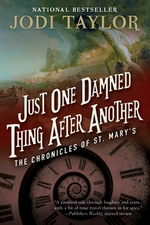
Just One Damned Thing After Another by Jodi Taylor: A Delightfully Charming and Fun Time-Travel Epic Kicks Off

 Just One Damned Thing After Another Just One Damned Thing After Another

by Jodi Taylor
Series: The Chronicles of St. Mary’s, #1

Paperback, 480 pg.
Night Shade Books, 2016
Read: July 30, 2018

Thinking carefully is something that happens to other people.

I lost my notes to this book, which is annoying me greatly. So I’m going to be a bit more vague than I want to be.

I could tell from the first couple of pages that I was going to have a great time with this book — our narrator is Dr. Madeline “Max” Maxwell, a specialist in ancient history. She is charming, engaging, brash, and funny. She’s a few more things, too, but let’s leave it there. Essentially, she’s a delight — it almost doesn’t matter what setting you put her in, what story you tell with her — I’m in.

Thankfully, Taylor puts her in a crazy novel, one perfectly suited for her. When we meet her, Max is being recruited by a former mentor to join St Mary’s Institute of Historical Research, a very strange research facility. These historians get their hands dirty in their research in the ways that no other facility on Earth can manage — they have time machines to take them to whatever point in time they’re studying so they can see ad experience history first-hand.

Sounds great, doesn’t it? But things go awry — in spectacularly bad fashion. But, for these Historians, where there’s tea, there’s hope. Using wit, sheer determination, and a little luck Max and her new colleagues will have to find a way to meet these new and dangerous challenges.

There’s a lot more action and fighting than you’d think given that the book is about Historians and the Technicians who work with them. There’s a lot of humor, some pathos, a little love — and a little more sex than I’d prefer (thankfully most of it happens “off screen,” but not all of it). The plot is impossible to summarize well — it bounces around from point to point like a ball in a pinball machine. This is not a complaint, this is a description. Months will go by in a paragraph (or less) and then things will slow down for the events of a day or two. These are Time Travelers, after all, they can squeeze a lot of activity into a short period of time.

There are some other great characters here, too. Max has wonderful, loyal and capable allies (who happen to be interesting to read about); she has fantastic antagonists — the kind of characters you can relish your annoyance/anger/moral superiority over; her friends are interesting, he love interest is about as fun as you could ask for, and is charming enough in his own right.

I wish I’d had the time to write this up when the book was fresher in my mind — or if I’d not lost my notes. This book deserved a bit more from me. Basically, this book — between characters, circumstances, plot and tone is what I’d hoped for from the Tuesday Next books. I have no idea if Taylor can keep up the freshness of the voice, the zaniness of the plot, and the engaging quality of the characters (particularly Max) — it’ll be tough to do. But I’m looking forward to finding out. I had a blast reading this one, and can’t imagine that Taylor’s charm wouldn’t win over at least 87% of those who give this a try.

—–

4 Stars

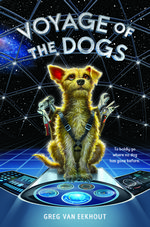
Voyage of the Dogs by Greg van Eekhout: An All-Ages SF that is a sure-fire crowd-pleaser

Voyage of the DogsVoyage of the Dogs

by Greg van Eekhout

Hardcover, 208 pg.
HarperCollins, 2018
Read: October 1, 2018

           Of course, the humans couldn’t go alone. There had to be dogs. Because wherever humans went dogs came along. Like rats, only more helpful. Dogs would herd livestock. Dogs would keep watch against the unknown. And, more importantly, dogs would keep the human crew company during the long spaceflight, and on their new home, far away from Earth.

But first they had to get there.

I guess this is technically a “Middle Grade” book — but forget about that. Call it All-Ages instead — that way, adults and YA readers and . . . everyone can enjoy this SF guilt-free. I should also include this line from The Big Idea post Van Eekhout wrote on Scalzi’s blog: “Spoiler: I don’t kill off any of the dogs in this book. Why not? Because I’m not a monster, that’s why not.” It’s important to get that out of the way.

Let’s start with this: the rationale to bring dogs along on a spaceship. It’s brilliant. It also points to one of the biggest problems with Starfleet, the Colonial Battle Fleet, the Serenity, etc. A lack of animals. Sure, NCC 1701-D had pets (not that we saw them often), but they were sealed up in cabins. And Firefly‘s episode “Safe” had cattle, but that was an oddity. The animals aboard Laika are there for purposes — like the main character, Lopside. He’s there to hunt rats — where there are humans and cargo, there are rats. Something small and fast — and with a good nose — is needed to hunt rats down.

The book will do a better job explaining the roles of the other three dogs and what advances in breeding have led to dogs being capable of being more than the dogs we have today — while still remaining dogs — to become Barkonauts.

These poor, brave dogs go into the hibernation state just before the humans do to complete the voyage to a nearby star system as part of human exploration and colonization, the first mission like this humanity has tried. But when the dogs wake up, they notice something’s wrong — part of the ship is missing, as is the crew.

They’re too far into the mission to turn around, too far away for a rescue mission to reach them. At this point, Lopside and the others have to try to salvage what they can and limp along to their final destination.

Lopside is a terrier mix, he’s brave, he has (understandably) abandonment issues — which are not helped at all by the absence of the humans. He’s a little scatter-brained (like a good terrier) and he’s incredibly loyal and has a great heart. The other barkonauts are as well-drawn and lovable.

Van Eekhout is clearly a dog-lover and it comes out in his characters. He’s also a pretty good story-teller, because even with that spoiler, I was invested in the outcome and really wasn’t sure how he was going to pull things off in a way that was satisfying and that wouldn’t reduce semi-sensitive 5th-graders across the globe to quivering balls of tears (a lesson Wilson Rawls could’ve used, I have to say — no, I’m not still torn up about Old Dan and Little Ann, why do you ask?). He does succeed in that — although some might get a bit misty at a point or two. It’s a fun and creative story, and takes some oft-repeated SF tropes and deals with them in a refreshing way.

Ignore the stars — I can’t bring myself to give it more, I don’t know why. Pay attention to what I have said above and this: read the book. It’ll warm your heart, it’ll make you make you a little sad, it’ll give you something to grin about — and it tells a good story, too. What more do you want?

—–

3.5 Stars

2018 Library Love Challenge

Lost in a Good Book by Jasper Fforde, Emily Gray (Audiobook): A little too zany for me

Lost in a Good BookLost in a Good Book

by Jasper Fforde, Emily Gray (Narrator)
Series: Thursday Next, #2

Unabridged Audiobook, 12 hrs. and 59 mins.
Penguin Audio, 2011

Read: September 4 – 6, 2018
I didn’t post about The Eyre Affair a couple of months ago when I listened to it, because I just didn’t know what to say about it. I was hoping that a second book would help. I’m not sure it did.

Let’s just start with the Publisher’s Summary (because there’s just no way I could do justice to this book):

           The second installment in Jasper Fforde’s New York Times bestselling series follows literary detective Thursday Next on another adventure in her alternate reality of literature-obsessed England—from the author of Early Riser.

The inventive, exuberant, and totally original literary fun that began with The Eyre Affair continues with New York Times bestselling author Jasper Fforde’s magnificent second adventure starring the resourceful, fearless literary sleuth Thursday Next. When Landen, the love of her life, is eradicated by the corrupt multinational Goliath Corporation, Thursday must moonlight as a Prose Resource Operative of Jurisfiction—the police force inside the BookWorld. She is apprenticed to the man-hating Miss Havisham from Dickens’s Great Expectations, who grudgingly shows Thursday the ropes. And she gains just enough skill to get herself in a real mess entering the pages of Poe’s “The Raven.” What she really wants is to get Landen back. But this latest mission is not without further complications.

Along with jumping into the works of Kafka and Austen, and even Beatrix Potter’s The Tale of the Flopsy Bunnies, Thursday finds herself the target of a series of potentially lethal coincidences, the authenticator of a newly discovered play by the Bard himself, and the only one who can prevent an unidentifiable pink sludge from engulfing all life on Earth. It’s another genre-bending blend of crime fiction, fantasy, and top-drawer literary entertainment for fans of Douglas Adams and P. G. Wodehouse.

There’s simply too much going on. This is Douglas Adams (mostly the Dirk Gentley novels) meets Terry Pratchett meets Doctor Who meets . . . something else, but it’s not just those elements — it’s those influences without restraint (not that any of those are known for their restraint). It’s just too zany ,too strange, too unmoored from reality.

There’s cloning to bring back extinct species, time travel, vampires, werewolves, interacting with fictional characters, rabid literary fans, characters walking into novels/other written materials to rewrite them, travel, or just to meet with someone else — and that’s just scratching the surface.

I realize that this is tantamount to complaining that there’s too much of a good thing, and I recently talked about what a foolish complaint that is. But this is different, somehow. The sheer amount of ways that reality can be rewritten/rebooted/changed in this series is hard to contemplate, and seems like too easy for a writer to use to get out of whatever corner they paint themselves into. One of the best emotional moments of this book — is ruined, simply ruined by time travel unmaking it just a few minutes later.

Emily Gray’s narration is probably the saving grace of this audiobook — I’m not sure I’d have rated this as high as I did without it. Her ability to sound sane when delivering this ridiculous text (I mean that as a compliment) makes it all seem plausible.

I enjoyed it — but almost in spite of itself. I can’t see me coming back for more. I do see why these books have a following — sort of. But I’ve got to bail.

—–

3 Stars2018 Library Love Challenge

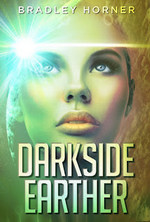
Darkside Earther by Bradley Horner: A Sweet Story of First Love Wrapped in a SF Shell

Darkside EartherDarkside Earther

by Bradley Horner
Series: Darkside Earther, #1

Kindle Edition, 221 pg.
2018
Read: September 1 – 3, 2018

I really didn’t think it could get any better than this.

But as with all tales of happiness, there’s always a floating cloud of crap over our heads just waiting for the touch of gravity to send it falling.

Axel is a not a typical teen, but he’s not a-typical. Hundreds years in the future, he lives on a massive space station in orbit above Earth. His parents are people of influence and importance on the station, and he’s being raised to join them. But that’s not at all what he wants. He’s a middling student, at best, all he really wants to do is make art and fall in love — hopefully with one particular girl from his classes. Maybe play a few video games (they’re far more immersive than anything we can possibly come up with — and are called something else, but they’re essentially what I used to play on an Intellivision).

Helen doesn’t have his artistic inclinations or abilities, but she shares his political apathy, his love of video games, his odd sense of humor and other interests (I was tempted to say that she shares his obsession with her appearance, but that’s not entirely fair to her). Her family is historically (and currently) a pretty Big Deal on Earth. Her immediate family is on this space station in part to work on behalf of the people on Earth. I don’t have as strong of a sense of her as I do Axel — at least not one I could express. That’s primarily on me — but it’s also part of the book, it’s Axel’s story, and we know him much better.

The book begins spending a little time with their courtship after setting the stage — it’s very easy to get caught up in the happiness and forget about that floating cloud of crap. Then they hit a pretty major road-bump — and then just when you get caught up in their clever ways around their obstacles, life for everyone on the station plunges into chaos.

Some bar owner once said, “it doesn’t take much to see that the problems of … little people don’t amount to a hill of beans in this crazy world” with an eye to the horrors of World War II around him. Axel and Helen have a bigger conflict, and more suffering, around them — and their problems are even smaller in comparison. But that won’t stop you from being drawn to their plight (and their joy, determination, and courage, too). What these two (and their friends) go through is enough to derail relationships, families, movements — and while you’d understand why both of them would bail on their romance, you can’t help but root for these crazy kids.

It would’ve been understandable, and so very easy, to turn the parents into the villains of the piece — even just one set. But Horner resisted that, and even has Axel realizing they’re all just doing what they think is right and best — even if that’s diametrically opposed to what their children want/believe.

This isn’t technically YA, but it’s YA-friendly. Maybe even MG-friendly, come to think of it. It’s suitable for SF readers of all ages, let’s just say. Horner writes like the best SF writers used to in a way that’s approachable and appealing to all audiences. I wish more did that. I could say a lot about the science of the space station — and the cultures created by it, both in orbit and on the ground; or the politics; or the technology; the human biology . . . basically the SF-ness of it. I’m not going to, because of time, space required — and frankly, the human elements, the characters are what counts.

I wasn’t that sure this book was going to work for me, but I’m glad I gave it a chance, because this thing won me over (pretty quickly, I should add) — it had to be Axel and his way of looking at life that drew me in and then pretty much everything else kept me there. It’s hopeful, almost optimistic (given the harshness of the reality of humanity’s situation, that’s an accomplishment), you can enjoy huge swaths of it. It’s a love story, it’s the beginning of a SF epic, and you will fall under its spell if you give it half a chance. There are some big ideas here, but it’s a pretty small story, where people and their feelings are more important (and more interesting) than conflict, technological wonders, and everything else.

—–

4 Stars

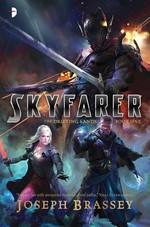
Reposting Just ‘Cuz: Skyfarer by Joseph Brassey

Last night I found myself reading when I “should have been” writing — which meant that by the time I finished, there wasn’t time enough to really get anything ready for today. Well, today, I find myself almost at the half-way point in the sequel to this outstanding book, the possibly more-outstanding (outstandinger?) Dragon Road. But I can’t talk about it yet, which is what I really want to do. So instead, let me once again post this little nugget.

SkyfarerSkyfarer

by Joseph Brassey
Series: Drifting Lands, #1
eARC, 352 pg.
Angry Robot Books, 2017
Read: August 11 – 14, 2017

I’ve read a few interesting mergers of SF and Fantasy this year — some that were just that, interesting, some that were good — a couple that were more than good. Thankfully, Brassey’s Skyfarer was in that latter camp. Even in those early chapters where I was still trying to figure out the world, remember which name lined up with what character, and get a handle on the plot, I had a sense that this was going to be one of those books I talked about very positively — and very often. That sense just only got stronger as the book went on.

I feel like could go on for pages about this book — but won’t let myself (so I can avoid the wrath of Angry Robot and you can actually get something out of reading it yourself — which you have to go do as soon as it comes out).

So you’ve got this group called the Eternal Order — a group committed to death, destruction, power, and plunder. When it comes to numbers, they can’t stand up to the civilizations around them, at least when they ally themselves against the Order. But when they (rarely, it seems) can come in with a quick strike against one people they can wreak much havoc. Which is exactly what they do here — they come in and demand that the rulers of Port Providence hand over the Axiom Diamond, or they will wipe them out — and it’s clear that Lord Azrael, the commander, isn’t being hyperbolic. The royal family responds with armed resistance, which has some measure of success, but is primarily fighting losing battles.

Into the midst of this looming genocide comes a wayward spacecraft, the Elysium. The Elysium is a small carrier with more weapons than one should expect (we’re initially told this, anyway). The crew has just welcomed an apprentice mage, fresh from the academy, to complete her studies with her mentor/professor. Aimee de Laurent has been pushing herself for years to excel, to be the best — if there’s a sacrifice to be made for her studies, she’s made it. All leading up to this day, where her professor, Harkon Bright has taken her as an apprentice on his exploration ship to complete her education. She joins a crew that’s been together for years and is eager to find her place within them.

When the Elysium arrives in the middle of this, it doesn’t take anything approaching calculus for them to figure out what this particular crew is going to do. There’s The Eternal Order on one side, civilians and the remnants of the military on the other. There’s a ravaged civilization on one side and the ravagers on the other. There’s a group trying to prevent The Eternal Order from getting something they want and there’s, well, The Eternal Order. So our band of adventurers tell the remnants of the royal family that they’ll hunt down the Axiom and protect it.

This isn’t exactly a revolutionary idea for a story — but man, it doesn’t matter. There’s a reason everyone and their brother has tried this — it’s a good story. Especially when it’s told well. And, I’m here to tell you that Joseph Brassey tells it really well. Not just because of his hybridization of SF and Fantasy, but because he can take a story that everyone’s taken a shot at and make it seem fresh, he can deliver the excitement, he can deliver the emotion. There is some horrible stuff depicted — either in the present or in flashbacks; there’s some pretty tragic stuff; and yet this is a fun read — the pacing, the tone, everything makes this feel like the adventure films and books that I grew up on. You want to read it — not just to find out what’s going to happen next, but because it’s written in such a way that you just want to be reading the book, like a having a glass of iced tea on a summer’s day.

The characters could uniformly use a little more fleshing out — which isn’t a weakness in the writing. Brassey pretty much points at the places where the reader will more details (especially when it comes to Aimee and Harkon), making us want more than he’s giving us. What we’re given, though, is enough to make you root for or against them, hope that they survive (or are subjected to painful and humiliating defeat), or simply enjoy the camaraderie. The good news is, that there’s more to learn about everyone — about their past and their present — and how those shape their future.

You’ve got magic — various schools of magic, too, each with its own understanding of what magic is and how it can be used; you’ve got swords and lasers (and similar kinds of weapons); you’ve got space ships running of magic (not just hyperspace drives that act like magic); objects and persons of prophecy; beings and intelligences that aren’t explicable — tell me why you wouldn’t want to read this? Especially when you throw in epic sword fights, magic duels, and spacecraft action all written by someone who writes like a seasoned pro. Sign me up for the sequel!

Disclaimer: I received this eARC from Angry Robot Books via NetGalley in exchange for this post — thanks to both for this.

—–

4 1/2 Stars

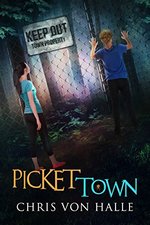
Picket Town by Chris von Halle: An Age-Appropriately Creepy SF for the MG reader in your life

Picket TownPicket Town

by Chris von Halle

PDF, 178 pg.
Clean Reads, 2018
Read: July 31, 2018

Amanda is bored. Every day is the same — her life isn’t bad, she actually likes it. But she wants more. She’s not sure exactly what it is that she wants — but it’ll be found outside the city limits of New Pines (she calls it Picket Town). She and her friend Sam spend their days after school playing a computer RPG, eating with their families, playing the game some more and repeating the whole thing the next day.

Then something starts happening — some of the kids in town come down with some sort of bacterial infection that requires them to be hospitalized while a cure is worked on. Amanda starts to wonder if everyone is going to be okay — no matter how often she’s assured that the grown-ups have everything under control. She wants to strike out, she wants to learn something — and on the way home from school, they pass the same sign forbidding them to enter the forest that they walk by every day. But this day, this particular day she decides she’s had enough — and then she convinces Sam to come with her. They climb over the fence and explore the forest. This is the most thrilling thing they’ve ever done. Right up until the point that they find a what appears to be a flying saucer (well, a saucer that’s landed). Pretty much everything they’ve ever known ends right there. What follows is exciting, dramatic, and unexpected (well, at least for the target audience — Middle Grade — adult readers will have a pretty good chance of seeing what’s around the corner, most of the time).

I wasn’t so sure that I was going to enjoy this at the beginning, I’m not sure why, it just didn’t seem like it clicked. But it honestly didn’t take long before it reminded me of the better SF I read in grade school, and I was in it for the long haul. Although, honestly, I’m not sure any of the books I read when I was that age would’ve gone where von Halle took this. That’s a compliment, by the way, it may not look like one.

I’m not crazy about the conclusion, I have to say, as much as I liked almost everything that came before. There’s a good twist to it — and I really liked it. But the ending itself? I don’t know — it relied too much on a big info-dump, and then the reveal for Amanda and Sam could’ve been executed a little better. But I think those are quibbles, and I really don’t imagine that there’s a Fourth Grader out there that’ll say the same thing.

This isn’t a MG novel that transcends the label and that’ll appeal to adults — in other words, not everyone is J.K. Rowling. I’ll give you a moment to digest that revelation. This is a MG novel that knows its audience and that will deliver what it wants. Were I in that audience, I’d be re-reading this a few times. I’m not, so I’ll tell people to give it to someone who’ll appreciate it more.

Disclaimer: I received a copy of this book from the author in exchange for my honest opinion, given above.

—–

3 Stars

✔ Read a book with a child narrator.

The Long Way to a Small, Angry Planet by Becky Chambers: A charming, earnest and frequently delightful space opera that pretty much matches the hype.

The Long Way to a Small, Angry PlanetThe Long Way to a Small, Angry Planet

by Becky Chambers
Series: Wayfarers, #1

Paperback, 443 pg.
Harper Voyager, 2018
Read: July 18 – 20, 2018

We are all made from chromosomes and DNA, which themselves are made from a select handful of key elements. We all require a steady intake of water and oxygen to survive (though in varying quantities). We all need food. We all buckle under atmospheres too thick or gravitational fields too strong. We all die in freezing cold or burning heat. We all die, full stop.

Ohhhh boy. One of yesterday’s posts was easy — I state the premise, say the book lived up to the premise, and there ya go. A finished post. Today? I’m not sure I could succinctly lay out the premise in 6 paragraphs, much less say anything else about the book. It’s deep, it’s sprawling, it’s fun and full of heart. What isn’t it? Easy to talk about briefly.

So I’m going to cut some corners, and not give it the depth of discussion that I’d like to.

So you know how The Hitchhiker’s Guide to the Galaxy starts off with the Vogon Constructor Fleet constructing a hyperspace bypass right through our Solar System? Well, if the Vogons were the megacorp doing that, the crew of the Wayfarer is your mom & pop-level company doing the same kind of work. But there are no Vogons, and it’s not a hyperspace bypass they’re constructing, but the metaphor works — the Wayfarer is building/cutting/creating ways for spaceships to make it from point A to point B faster — I’ll leave the detailed explanation to Sissix or Kizzy to explain when you read it (I think it was Kizzy, but I could be wrong — my copy is in another state, so it’s hard for me to check things like that).

The Wayfarer is made up of a mix of species — including human (some of which were raised on a planet, others not), the others? Well, they’d fit right in with the customers in the Mos Eisley Cantina (with names like Sissix or Kizzy) — too difficult to explain, but they’re all radically different from pretty much anything you’ve seen or read before. Chambers’ imagination when it comes to their physiology, culture, mannerisms, beliefs is just astounding. Really it’s fantastic. And the crew is a family — when a new crew member joins, they’re greeted with “welcome home.” And that’s just what they mean.

This new crew member is Rosemary Harper, our entry point into this world, too. She’s never been off-planet before, doesn’t understand the science behind the work they do, really only has textbook knowledge of most of the species they run into. As she learns, so does the reader. Phew. Essentially, the plot is this: the captain of Wayfarer gets a chance to make history and make more money than he’s used to — he jumps at it, but his crew has to take a freakishly long trip to get to the (for lack of a better term) construction site (see the title). This long trip is filled with dangers, encounters with family members no one has seen in ages and old friends. And pirates. Even when they get to the construction site, the challenges are just beginning and everyone on board is going to be put through the wringer just to survive.

In the midst of all this is laughter, love, joy, pain, sorrow, and learning. Rosemary becomes part of the family — by the actions of the crew bringing her in, and through her own reciprocal actions. Now, many parts of this book seem slow — but never laboriously slow — it’s the way that Chambers has to construct it so that we get the emotional bonds between the characters — and between the characters and the reader — firmly established, so that when the trials come, we’re invested. I was surprised how much I cared about the outcomes of certain characters at the end — it’s all because Chambers did just a good job building the relationships, nice and slow. The book frequently feels light — and is called that a lot by readers — but don’t mistake light for breezy.

I want to stress, it’s not laboriously slow, it’s not boring. It’s careful, it’s well-thought out. It’s your favorite chili made in the slow cooker all day, rather than dumping the ingredients in a pot an hour or so before dinner. It occasionally bugged me while reading, but by that time, I was invested and had a certain degree of trust for Chambers — and by the time I got to the end, I understood what she was doing in the slow periods and reverse my opinion of them.

I frequently felt preached at while reading this book. There were agendas all around and these characters did what they could to advance them. Most of the speechifying and preaching worked in the Wayfarer Universe, but not in ours. When I read it, I had no problem with it — but the more I think about it, the less I agree and the more annoyed I get. The opening quotation was one of the themes pushed, another had to do with family and/or brothers — but the best lines about those involve spoilers or need the context to be really effective, so go read them yourselves. I don’t want to get into a debate with the various characters in the book, so I’ll bypass the problems I have with just the note that I have them. But in the moment and in the context of the novel, the writing behind the characters’ points/values, the emotions behind them are moving, compelling and convincing — and that’s what you want, right?

It is super, super-easy to see why this won buckets of awards — and probably deserved most (if not all) of those awards. This is one of the better space operas I’ve read in the last few . . . ever, really. It’s easy to see why it got the hype and acclaim it did, and while I might not be as over-the-moon as many readers are with it, I understand their love. I heartily enjoyed it, and can see myself returning to this universe again soon.

As far as the star rating goes? I’ve vacillated between 3-5 a lot over the last week or so (including while writing this post), usually leaning high — so take this one with a grain of salt, it’s how I feel at the moment. (that’s all it ever is, really, but I’m usually more consistent)

—–

4 Stars

Page 21 of 30

Powered by WordPress & Theme by Anders Norén