Tag: SF Page 23 of 32

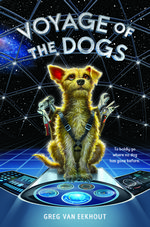
Voyage of the Dogs by Greg van Eekhout: An All-Ages SF that is a sure-fire crowd-pleaser

Voyage of the DogsVoyage of the Dogs

by Greg van Eekhout

Hardcover, 208 pg.
HarperCollins, 2018
Read: October 1, 2018

           Of course, the humans couldn’t go alone. There had to be dogs. Because wherever humans went dogs came along. Like rats, only more helpful. Dogs would herd livestock. Dogs would keep watch against the unknown. And, more importantly, dogs would keep the human crew company during the long spaceflight, and on their new home, far away from Earth.

But first they had to get there.

I guess this is technically a “Middle Grade” book — but forget about that. Call it All-Ages instead — that way, adults and YA readers and . . . everyone can enjoy this SF guilt-free. I should also include this line from The Big Idea post Van Eekhout wrote on Scalzi’s blog: “Spoiler: I don’t kill off any of the dogs in this book. Why not? Because I’m not a monster, that’s why not.” It’s important to get that out of the way.

Let’s start with this: the rationale to bring dogs along on a spaceship. It’s brilliant. It also points to one of the biggest problems with Starfleet, the Colonial Battle Fleet, the Serenity, etc. A lack of animals. Sure, NCC 1701-D had pets (not that we saw them often), but they were sealed up in cabins. And Firefly‘s episode “Safe” had cattle, but that was an oddity. The animals aboard Laika are there for purposes — like the main character, Lopside. He’s there to hunt rats — where there are humans and cargo, there are rats. Something small and fast — and with a good nose — is needed to hunt rats down.

The book will do a better job explaining the roles of the other three dogs and what advances in breeding have led to dogs being capable of being more than the dogs we have today — while still remaining dogs — to become Barkonauts.

These poor, brave dogs go into the hibernation state just before the humans do to complete the voyage to a nearby star system as part of human exploration and colonization, the first mission like this humanity has tried. But when the dogs wake up, they notice something’s wrong — part of the ship is missing, as is the crew.

They’re too far into the mission to turn around, too far away for a rescue mission to reach them. At this point, Lopside and the others have to try to salvage what they can and limp along to their final destination.

Lopside is a terrier mix, he’s brave, he has (understandably) abandonment issues — which are not helped at all by the absence of the humans. He’s a little scatter-brained (like a good terrier) and he’s incredibly loyal and has a great heart. The other barkonauts are as well-drawn and lovable.

Van Eekhout is clearly a dog-lover and it comes out in his characters. He’s also a pretty good story-teller, because even with that spoiler, I was invested in the outcome and really wasn’t sure how he was going to pull things off in a way that was satisfying and that wouldn’t reduce semi-sensitive 5th-graders across the globe to quivering balls of tears (a lesson Wilson Rawls could’ve used, I have to say — no, I’m not still torn up about Old Dan and Little Ann, why do you ask?). He does succeed in that — although some might get a bit misty at a point or two. It’s a fun and creative story, and takes some oft-repeated SF tropes and deals with them in a refreshing way.

Ignore the stars — I can’t bring myself to give it more, I don’t know why. Pay attention to what I have said above and this: read the book. It’ll warm your heart, it’ll make you make you a little sad, it’ll give you something to grin about — and it tells a good story, too. What more do you want?

—–

3.5 Stars

2018 Library Love Challenge

Lost in a Good Book by Jasper Fforde, Emily Gray (Audiobook): A little too zany for me

Lost in a Good BookLost in a Good Book

by Jasper Fforde, Emily Gray (Narrator)
Series: Thursday Next, #2

Unabridged Audiobook, 12 hrs. and 59 mins.
Penguin Audio, 2011

Read: September 4 – 6, 2018
I didn’t post about The Eyre Affair a couple of months ago when I listened to it, because I just didn’t know what to say about it. I was hoping that a second book would help. I’m not sure it did.

Let’s just start with the Publisher’s Summary (because there’s just no way I could do justice to this book):

           The second installment in Jasper Fforde’s New York Times bestselling series follows literary detective Thursday Next on another adventure in her alternate reality of literature-obsessed England—from the author of Early Riser.

The inventive, exuberant, and totally original literary fun that began with The Eyre Affair continues with New York Times bestselling author Jasper Fforde’s magnificent second adventure starring the resourceful, fearless literary sleuth Thursday Next. When Landen, the love of her life, is eradicated by the corrupt multinational Goliath Corporation, Thursday must moonlight as a Prose Resource Operative of Jurisfiction—the police force inside the BookWorld. She is apprenticed to the man-hating Miss Havisham from Dickens’s Great Expectations, who grudgingly shows Thursday the ropes. And she gains just enough skill to get herself in a real mess entering the pages of Poe’s “The Raven.” What she really wants is to get Landen back. But this latest mission is not without further complications.

Along with jumping into the works of Kafka and Austen, and even Beatrix Potter’s The Tale of the Flopsy Bunnies, Thursday finds herself the target of a series of potentially lethal coincidences, the authenticator of a newly discovered play by the Bard himself, and the only one who can prevent an unidentifiable pink sludge from engulfing all life on Earth. It’s another genre-bending blend of crime fiction, fantasy, and top-drawer literary entertainment for fans of Douglas Adams and P. G. Wodehouse.

There’s simply too much going on. This is Douglas Adams (mostly the Dirk Gentley novels) meets Terry Pratchett meets Doctor Who meets . . . something else, but it’s not just those elements — it’s those influences without restraint (not that any of those are known for their restraint). It’s just too zany ,too strange, too unmoored from reality.

There’s cloning to bring back extinct species, time travel, vampires, werewolves, interacting with fictional characters, rabid literary fans, characters walking into novels/other written materials to rewrite them, travel, or just to meet with someone else — and that’s just scratching the surface.

I realize that this is tantamount to complaining that there’s too much of a good thing, and I recently talked about what a foolish complaint that is. But this is different, somehow. The sheer amount of ways that reality can be rewritten/rebooted/changed in this series is hard to contemplate, and seems like too easy for a writer to use to get out of whatever corner they paint themselves into. One of the best emotional moments of this book — is ruined, simply ruined by time travel unmaking it just a few minutes later.

Emily Gray’s narration is probably the saving grace of this audiobook — I’m not sure I’d have rated this as high as I did without it. Her ability to sound sane when delivering this ridiculous text (I mean that as a compliment) makes it all seem plausible.

I enjoyed it — but almost in spite of itself. I can’t see me coming back for more. I do see why these books have a following — sort of. But I’ve got to bail.

—–

3 Stars2018 Library Love Challenge

Darkside Earther by Bradley Horner: A Sweet Story of First Love Wrapped in a SF Shell

Darkside EartherDarkside Earther

by Bradley Horner
Series: Darkside Earther, #1

Kindle Edition, 221 pg.
2018
Read: September 1 – 3, 2018

I really didn’t think it could get any better than this.

But as with all tales of happiness, there’s always a floating cloud of crap over our heads just waiting for the touch of gravity to send it falling.

Axel is a not a typical teen, but he’s not a-typical. Hundreds years in the future, he lives on a massive space station in orbit above Earth. His parents are people of influence and importance on the station, and he’s being raised to join them. But that’s not at all what he wants. He’s a middling student, at best, all he really wants to do is make art and fall in love — hopefully with one particular girl from his classes. Maybe play a few video games (they’re far more immersive than anything we can possibly come up with — and are called something else, but they’re essentially what I used to play on an Intellivision).

Helen doesn’t have his artistic inclinations or abilities, but she shares his political apathy, his love of video games, his odd sense of humor and other interests (I was tempted to say that she shares his obsession with her appearance, but that’s not entirely fair to her). Her family is historically (and currently) a pretty Big Deal on Earth. Her immediate family is on this space station in part to work on behalf of the people on Earth. I don’t have as strong of a sense of her as I do Axel — at least not one I could express. That’s primarily on me — but it’s also part of the book, it’s Axel’s story, and we know him much better.

The book begins spending a little time with their courtship after setting the stage — it’s very easy to get caught up in the happiness and forget about that floating cloud of crap. Then they hit a pretty major road-bump — and then just when you get caught up in their clever ways around their obstacles, life for everyone on the station plunges into chaos.

Some bar owner once said, “it doesn’t take much to see that the problems of … little people don’t amount to a hill of beans in this crazy world” with an eye to the horrors of World War II around him. Axel and Helen have a bigger conflict, and more suffering, around them — and their problems are even smaller in comparison. But that won’t stop you from being drawn to their plight (and their joy, determination, and courage, too). What these two (and their friends) go through is enough to derail relationships, families, movements — and while you’d understand why both of them would bail on their romance, you can’t help but root for these crazy kids.

It would’ve been understandable, and so very easy, to turn the parents into the villains of the piece — even just one set. But Horner resisted that, and even has Axel realizing they’re all just doing what they think is right and best — even if that’s diametrically opposed to what their children want/believe.

This isn’t technically YA, but it’s YA-friendly. Maybe even MG-friendly, come to think of it. It’s suitable for SF readers of all ages, let’s just say. Horner writes like the best SF writers used to in a way that’s approachable and appealing to all audiences. I wish more did that. I could say a lot about the science of the space station — and the cultures created by it, both in orbit and on the ground; or the politics; or the technology; the human biology . . . basically the SF-ness of it. I’m not going to, because of time, space required — and frankly, the human elements, the characters are what counts.

I wasn’t that sure this book was going to work for me, but I’m glad I gave it a chance, because this thing won me over (pretty quickly, I should add) — it had to be Axel and his way of looking at life that drew me in and then pretty much everything else kept me there. It’s hopeful, almost optimistic (given the harshness of the reality of humanity’s situation, that’s an accomplishment), you can enjoy huge swaths of it. It’s a love story, it’s the beginning of a SF epic, and you will fall under its spell if you give it half a chance. There are some big ideas here, but it’s a pretty small story, where people and their feelings are more important (and more interesting) than conflict, technological wonders, and everything else.

—–

4 Stars

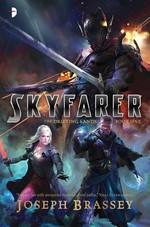
Reposting Just ‘Cuz: Skyfarer by Joseph Brassey

Last night I found myself reading when I “should have been” writing — which meant that by the time I finished, there wasn’t time enough to really get anything ready for today. Well, today, I find myself almost at the half-way point in the sequel to this outstanding book, the possibly more-outstanding (outstandinger?) Dragon Road. But I can’t talk about it yet, which is what I really want to do. So instead, let me once again post this little nugget.
—

SkyfarerSkyfarer

by Joseph Brassey
Series: Drifting Lands, #1
eARC, 352 pg.
Angry Robot Books, 2017
Read: August 11 – 14, 2017

I’ve read a few interesting mergers of SF and Fantasy this year — some that were just that, interesting, some that were good — a couple that were more than good. Thankfully, Brassey’s Skyfarer was in that latter camp. Even in those early chapters where I was still trying to figure out the world, remember which name lined up with what character, and get a handle on the plot, I had a sense that this was going to be one of those books I talked about very positively — and very often. That sense just only got stronger as the book went on.

I feel like could go on for pages about this book — but won’t let myself (so I can avoid the wrath of Angry Robot and you can actually get something out of reading it yourself — which you have to go do as soon as it comes out).

So you’ve got this group called the Eternal Order — a group committed to death, destruction, power, and plunder. When it comes to numbers, they can’t stand up to the civilizations around them, at least when they ally themselves against the Order. But when they (rarely, it seems) can come in with a quick strike against one people they can wreak much havoc. Which is exactly what they do here — they come in and demand that the rulers of Port Providence hand over the Axiom Diamond, or they will wipe them out — and it’s clear that Lord Azrael, the commander, isn’t being hyperbolic. The royal family responds with armed resistance, which has some measure of success, but is primarily fighting losing battles.

Into the midst of this looming genocide comes a wayward spacecraft, the Elysium. The Elysium is a small carrier with more weapons than one should expect (we’re initially told this, anyway). The crew has just welcomed an apprentice mage, fresh from the academy, to complete her studies with her mentor/professor. Aimee de Laurent has been pushing herself for years to excel, to be the best — if there’s a sacrifice to be made for her studies, she’s made it. All leading up to this day, where her professor, Harkon Bright has taken her as an apprentice on his exploration ship to complete her education. She joins a crew that’s been together for years and is eager to find her place within them.

When the Elysium arrives in the middle of this, it doesn’t take anything approaching calculus for them to figure out what this particular crew is going to do. There’s The Eternal Order on one side, civilians and the remnants of the military on the other. There’s a ravaged civilization on one side and the ravagers on the other. There’s a group trying to prevent The Eternal Order from getting something they want and there’s, well, The Eternal Order. So our band of adventurers tell the remnants of the royal family that they’ll hunt down the Axiom and protect it.

This isn’t exactly a revolutionary idea for a story — but man, it doesn’t matter. There’s a reason everyone and their brother has tried this — it’s a good story. Especially when it’s told well. And, I’m here to tell you that Joseph Brassey tells it really well. Not just because of his hybridization of SF and Fantasy, but because he can take a story that everyone’s taken a shot at and make it seem fresh, he can deliver the excitement, he can deliver the emotion. There is some horrible stuff depicted — either in the present or in flashbacks; there’s some pretty tragic stuff; and yet this is a fun read — the pacing, the tone, everything makes this feel like the adventure films and books that I grew up on. You want to read it — not just to find out what’s going to happen next, but because it’s written in such a way that you just want to be reading the book, like a having a glass of iced tea on a summer’s day.

The characters could uniformly use a little more fleshing out — which isn’t a weakness in the writing. Brassey pretty much points at the places where the reader will more details (especially when it comes to Aimee and Harkon), making us want more than he’s giving us. What we’re given, though, is enough to make you root for or against them, hope that they survive (or are subjected to painful and humiliating defeat), or simply enjoy the camaraderie. The good news is, that there’s more to learn about everyone — about their past and their present — and how those shape their future.

You’ve got magic — various schools of magic, too, each with its own understanding of what magic is and how it can be used; you’ve got swords and lasers (and similar kinds of weapons); you’ve got space ships running of magic (not just hyperspace drives that act like magic); objects and persons of prophecy; beings and intelligences that aren’t explicable — tell me why you wouldn’t want to read this? Especially when you throw in epic sword fights, magic duels, and spacecraft action all written by someone who writes like a seasoned pro. Sign me up for the sequel!

Disclaimer: I received this eARC from Angry Robot Books via NetGalley in exchange for this post — thanks to both for this.

—–

4 1/2 Stars

Picket Town by Chris von Halle: An Age-Appropriately Creepy SF for the MG reader in your life

Picket TownPicket Town

by Chris von Halle

PDF, 178 pg.
Clean Reads, 2018
Read: July 31, 2018

Amanda is bored. Every day is the same — her life isn’t bad, she actually likes it. But she wants more. She’s not sure exactly what it is that she wants — but it’ll be found outside the city limits of New Pines (she calls it Picket Town). She and her friend Sam spend their days after school playing a computer RPG, eating with their families, playing the game some more and repeating the whole thing the next day.

Then something starts happening — some of the kids in town come down with some sort of bacterial infection that requires them to be hospitalized while a cure is worked on. Amanda starts to wonder if everyone is going to be okay — no matter how often she’s assured that the grown-ups have everything under control. She wants to strike out, she wants to learn something — and on the way home from school, they pass the same sign forbidding them to enter the forest that they walk by every day. But this day, this particular day she decides she’s had enough — and then she convinces Sam to come with her. They climb over the fence and explore the forest. This is the most thrilling thing they’ve ever done. Right up until the point that they find a what appears to be a flying saucer (well, a saucer that’s landed). Pretty much everything they’ve ever known ends right there. What follows is exciting, dramatic, and unexpected (well, at least for the target audience — Middle Grade — adult readers will have a pretty good chance of seeing what’s around the corner, most of the time).

I wasn’t so sure that I was going to enjoy this at the beginning, I’m not sure why, it just didn’t seem like it clicked. But it honestly didn’t take long before it reminded me of the better SF I read in grade school, and I was in it for the long haul. Although, honestly, I’m not sure any of the books I read when I was that age would’ve gone where von Halle took this. That’s a compliment, by the way, it may not look like one.

I’m not crazy about the conclusion, I have to say, as much as I liked almost everything that came before. There’s a good twist to it — and I really liked it. But the ending itself? I don’t know — it relied too much on a big info-dump, and then the reveal for Amanda and Sam could’ve been executed a little better. But I think those are quibbles, and I really don’t imagine that there’s a Fourth Grader out there that’ll say the same thing.

This isn’t a MG novel that transcends the label and that’ll appeal to adults — in other words, not everyone is J.K. Rowling. I’ll give you a moment to digest that revelation. This is a MG novel that knows its audience and that will deliver what it wants. Were I in that audience, I’d be re-reading this a few times. I’m not, so I’ll tell people to give it to someone who’ll appreciate it more.

Disclaimer: I received a copy of this book from the author in exchange for my honest opinion, given above.

—–

3 Stars

✔ Read a book with a child narrator.

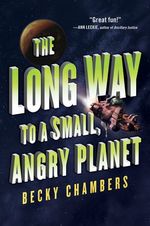
The Long Way to a Small, Angry Planet by Becky Chambers: A charming, earnest and frequently delightful space opera that pretty much matches the hype.

The Long Way to a Small, Angry PlanetThe Long Way to a Small, Angry Planet

by Becky Chambers
Series: Wayfarers, #1

Paperback, 443 pg.
Harper Voyager, 2018
Read: July 18 – 20, 2018

We are all made from chromosomes and DNA, which themselves are made from a select handful of key elements. We all require a steady intake of water and oxygen to survive (though in varying quantities). We all need food. We all buckle under atmospheres too thick or gravitational fields too strong. We all die in freezing cold or burning heat. We all die, full stop.

Ohhhh boy. One of yesterday’s posts was easy — I state the premise, say the book lived up to the premise, and there ya go. A finished post. Today? I’m not sure I could succinctly lay out the premise in 6 paragraphs, much less say anything else about the book. It’s deep, it’s sprawling, it’s fun and full of heart. What isn’t it? Easy to talk about briefly.

So I’m going to cut some corners, and not give it the depth of discussion that I’d like to.

So you know how The Hitchhiker’s Guide to the Galaxy starts off with the Vogon Constructor Fleet constructing a hyperspace bypass right through our Solar System? Well, if the Vogons were the megacorp doing that, the crew of the Wayfarer is your mom & pop-level company doing the same kind of work. But there are no Vogons, and it’s not a hyperspace bypass they’re constructing, but the metaphor works — the Wayfarer is building/cutting/creating ways for spaceships to make it from point A to point B faster — I’ll leave the detailed explanation to Sissix or Kizzy to explain when you read it (I think it was Kizzy, but I could be wrong — my copy is in another state, so it’s hard for me to check things like that).

The Wayfarer is made up of a mix of species — including human (some of which were raised on a planet, others not), the others? Well, they’d fit right in with the customers in the Mos Eisley Cantina (with names like Sissix or Kizzy) — too difficult to explain, but they’re all radically different from pretty much anything you’ve seen or read before. Chambers’ imagination when it comes to their physiology, culture, mannerisms, beliefs is just astounding. Really it’s fantastic. And the crew is a family — when a new crew member joins, they’re greeted with “welcome home.” And that’s just what they mean.

This new crew member is Rosemary Harper, our entry point into this world, too. She’s never been off-planet before, doesn’t understand the science behind the work they do, really only has textbook knowledge of most of the species they run into. As she learns, so does the reader. Phew. Essentially, the plot is this: the captain of Wayfarer gets a chance to make history and make more money than he’s used to — he jumps at it, but his crew has to take a freakishly long trip to get to the (for lack of a better term) construction site (see the title). This long trip is filled with dangers, encounters with family members no one has seen in ages and old friends. And pirates. Even when they get to the construction site, the challenges are just beginning and everyone on board is going to be put through the wringer just to survive.

In the midst of all this is laughter, love, joy, pain, sorrow, and learning. Rosemary becomes part of the family — by the actions of the crew bringing her in, and through her own reciprocal actions. Now, many parts of this book seem slow — but never laboriously slow — it’s the way that Chambers has to construct it so that we get the emotional bonds between the characters — and between the characters and the reader — firmly established, so that when the trials come, we’re invested. I was surprised how much I cared about the outcomes of certain characters at the end — it’s all because Chambers did just a good job building the relationships, nice and slow. The book frequently feels light — and is called that a lot by readers — but don’t mistake light for breezy.

I want to stress, it’s not laboriously slow, it’s not boring. It’s careful, it’s well-thought out. It’s your favorite chili made in the slow cooker all day, rather than dumping the ingredients in a pot an hour or so before dinner. It occasionally bugged me while reading, but by that time, I was invested and had a certain degree of trust for Chambers — and by the time I got to the end, I understood what she was doing in the slow periods and reverse my opinion of them.

I frequently felt preached at while reading this book. There were agendas all around and these characters did what they could to advance them. Most of the speechifying and preaching worked in the Wayfarer Universe, but not in ours. When I read it, I had no problem with it — but the more I think about it, the less I agree and the more annoyed I get. The opening quotation was one of the themes pushed, another had to do with family and/or brothers — but the best lines about those involve spoilers or need the context to be really effective, so go read them yourselves. I don’t want to get into a debate with the various characters in the book, so I’ll bypass the problems I have with just the note that I have them. But in the moment and in the context of the novel, the writing behind the characters’ points/values, the emotions behind them are moving, compelling and convincing — and that’s what you want, right?

It is super, super-easy to see why this won buckets of awards — and probably deserved most (if not all) of those awards. This is one of the better space operas I’ve read in the last few . . . ever, really. It’s easy to see why it got the hype and acclaim it did, and while I might not be as over-the-moon as many readers are with it, I understand their love. I heartily enjoyed it, and can see myself returning to this universe again soon.

As far as the star rating goes? I’ve vacillated between 3-5 a lot over the last week or so (including while writing this post), usually leaning high — so take this one with a grain of salt, it’s how I feel at the moment. (that’s all it ever is, really, but I’m usually more consistent)

—–

4 Stars

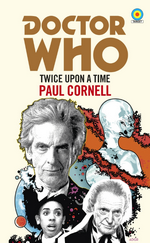
Doctor Who: Twice Upon a Time by Paul Cornell: Saying Good-bye to the Twelfth Doctor All Over Again

Doctor Who: Twice Upon a TimeDoctor Who: Twice Upon a Time

by Paul Cornell
Series: Doctor Who

Paperback, 156 pg.
BBC Books, 2018
Read: July 24, 2018

He sent a wide-beam sonic pulse at exactly the right frequency all the way down that path between him and the tower, and was rewarded with a very satisfying series of detonations. The First Doctor skipped about at every fireball that burst into the sky. Finally, the smoke and flame died down. ‘There you go, all done.’

‘There could have been one right underneath us!’

‘Yeah, but it’s not the kind of mistake you have to live with.’ That was the other thing about his centuries of additional experience, he was a little more willing to roll the dice. Or perhaps it was just at this point he didn’t give a damn. What the hell, his clothes were already ruined, might as well mess up the bodywork too. It wasn’t like he was planning to trade the old thing in.

Okay…if you want to read me ramble on a bit about the place of these Target novelizations of Doctor Who episodes to me as a young’un, you can see my post about Doctor Who: Christmas Invasion by Jenny T. Colgan, one of the other new releases in this old and cherished line. Which means we can just cut to the chase about this one, right?

Cornell was tasked with bringing the Twelfth Doctor’s last Christmas Special to the page — which includes the challenge of dealing with his regeneration in to the Thirteenth Doctor, which is no small feat. But we’ll get to that in a bit. First, he’s got to deal with the challenge of having two Doctors meet up — and the extra fun of telling a story where two characters share the same name (and are sort of the same person, but not really), while not confusing the reader.

Cornell did a great job balancing the two Doctors, both going through some doubts about regenerating; while dealing with the question of Bill’s identity and the soldier from World War I. One thing I appreciated more in the book than in the original episode was the Doctor’s consternation when he realized that there wasn’t actually a bad guy to fight for a change. Not sure what else to say, really.

Now, the regeneration? Wow. He nailed that one, and got me absolutely misty-eyed in the process. I could hear Capaldi very clearly as I read these pages — the narrative added just the right amount of extra depth without taking away any of the original script/performance. It wasn’t my favorite part of the episode, but it was my favorite part of the book — he hit all the notes perfectly. The aside about the pears — great, I loved that so much. And then — a nice little bit with Thirteen, which has got to be so hard because we don’t know anything about her, so even those few seconds of screen-time with her have to be tougher than usual to capture. These few paragraphs, incidentally, made Cornell “the first person to have written for all the Doctors” — which is just cool.

In Twice Upon a Time Cornell has captured the letter and the spirit of the original episode, added some nice new bits and pieces for the fans and generally told a great story in a way that made you feel you hadn’t watched it already. This is what these books should shoot for, and Cornell (no surprise to anyone who’s read any of his previous fiction) hit his target.

—–

3.5 Stars

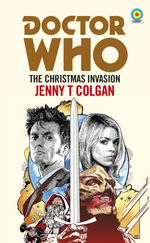
Doctor Who: Christmas Invasion by Jenny T. Colgan: Colgan Captures the 10th Doctor’s First Adventure Perfectly in this adaptation.

Doctor Who: Christmas InvasionDoctor Who: Christmas Invasion

by Jenny T. Colgan
Series: Doctor Who

Paperback, 176 pg.
BBC Books, 2018

Read: July 2, 2018
Back in High School, I remember attending an author event — some SF author that I’d never heard of (you probably haven’t either), but what did I care? He was an actual SF/Fantasy/Horror writer visiting Idaho (it happens a little more now, but back then I hadn’t thought it was possible). He discussed getting to write a novelization of a major Horror film thinking, “How hard can it be? Take the script, throw in some adjectives and verbs — maybe a few adverbs and you’re done!” He then went on to talk about all the things he learned about how hard it was taking a script of whatever quality and turning it into something that works in an entirely different medium. That’s really stuck with me for some reason, and I’ve always respected anyone who can pull it off well (and even those who get close to doing it well).

Before I babble on too much, Colgan is one who can pull it off pretty well.I discovered Doctor Who a couple of years before I saw that unnamed SF author, but didn’t get to watch much of it, mostly because I lived in about the only place in the States where PBS didn’t air old ones. I saw a few Sylvester McCoy episodes (mostly due to the magic of VHS and a friend who lived somewhere with a better PBS affiliate). Other than that, it was the small paperback novelizations of episodes. I owned a few, the same friend owned a few more — so I read those. A lot. Then comes Russel T. Davies, Christopher Eccleston, Billie Piper, etc. and all was better. But I still remembered those novels as being Doctor Who to me.

So when they announced that they were re-launching that series this year, I got excited. I own them all, but I’ve only found time to read one — I started with Jenny T. Colgan, because I know how Paul Cornell writes, and I assume I’ll love his — ditto for Davies and Moffat. Besides, The Christmas Invasion is one of my favorite episodes ever.

I won’t bother with describing the plot much — you know it, or you should. On the heels of regenerating into the 10th Doctor, Rose brings a mostly unconscious stranger into her mother’s apartment to recuperate. At the same time, an alien invasion starts — the British government — under the direction of Harriet Jones, MP — and the Torchwood project tries to respond, but really is pining all their hopes on the resident of the TARDIS.

Colgan does a great job bringing the episode to life — I could see the thing playing out in my mind. But she doesn’t just do that — she adds a nice little touch of her own here and there. Expands on some things and whatnot. In general, she just brings out what was there and expands on it. Adds a few spices to an already good dish to enhance the flavors. Colgan absolutely nails Rose’s inner turmoil about who this stranger in her old friend’s body is.

I particularly enjoyed reading the scene where the Doctor emerges from the TARDIS, finally awake and ready to resume being Earth’s protector — between Rose’s reaction, the already great dialogue, and Colgan’s capturing the essence of Tennant’s (and everyone else’s) performances in her prose. Seriously, I’ve read that scene three times. I never do that.

I’m not particularly crazy about the little addition she made to Harriet Jones’ downfall, but I get it. I’m not scandalized by it or anything, I just didn’t think it was necessary. Other than that, I appreciate everything Colgan did to put her stamp on this story.

If the rest of these books are as good, I’m going to be very glad to read them, and hope that there are more to come soon.

—–

3.5 Stars

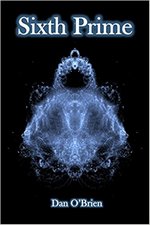
Sixth Prime by Dan O’Brien: The beginning of a sweeping epic that came up snake eyes for me.

Sixth PrimeSixth Prime

by Dan O’Brien
Series: The Prime Saga, Book 1

Kindle Edition, 240 pg.
2016
Read: May 23 – 24, 2018
There’s a danger that most readers have familiarity with — a novelist oversharing the details of their worldbuilding so much so that it drags down the story and characters. The opposite danger isn’t seen as often — the writer withholding the details so much that you spend half your time figuring out what’s happening, rather than paying attention to characters and plot. It’s a tricky balance, no doubt — and sometimes a novel can overcome an author falling into either ditch. Sixth Prime was not one of those success stories — for whatever reason, to be careful, to be coy, because he didn’t notice — this book fell into the “not enough information” ditch, and couldn’t find its way out of it.

There are a few storylines, somewhat connected — it becomes somewhat clearer later how they are — there’s a murder investigation conducted by a corporation that supersedes the local authorities’ own investigation; a high-ranking military official on trial (and the strange aftermath of that); a jail-break leading to another jail-break on its way to an assassination; a scientific exploration goes awry; and a couple of competing treasure hunters hunt for an artifact. Somehow these all connect to an interstellar war and forces as old as creation itself.

The characters were lifeless, little more than names and job titles — with just a couple of exceptions. The characters in the murder investigation had promise — and if this book had just focused on that storyline, this’d be a much different post. At least one of the characters in the treasure hunting story have promise (but the more villainous one was so over-the top that literal mustache twirling wouldn’t have seemed out of place).

This entire novel seemed to be a set-up for the coming series — not a novel that’s part of a series. The various stories didn’t have endings, there wasn’t an overall arc to the novel that I could see — the stories stopped, or “resolved” by authorial fiat, nothing organic. This is a problem — I can accept not tying up everything in a tidy little bow, but there needs to be some sort of closure to a novel, some sort of point to that one thing. I’m not sure I’m being entirely fair here — 1 or two of the stories might actually have had a decent resolution, but by that point, I was out of patience with the entire endeavor. A dynamite ending, or compelling hook could’ve saved it (I think), but they were nowhere to be found.

Nothing about this really worked for me — one storyline came close — but being surrounded by the rest, it never stood much of a chance. A little more restraint, a little more discipline — maybe a longer book — I don’t know. There’s something missing, I’m not sure what it was, really.

Disclaimer: I received this novel from the author in exchange for my honest opinion as reflected above. Sorry about that, Mr. O’Brien, but thanks anyway.

—–

2 Stars

Jimbo Yojimbo by David W. Barbee is strange, bizarre, funny, tragic and will make you say “ew” a lot.

Jimbo YojimboJimbo Yojimbo

by David W. Barbee

Kindle Edition, 154 pg.
Eraserhead Books, 2018
Read: April 14 – 16, 2018

           “Ready to make it official?” said his father.

Jimbo closed his cuttlefish eyes and prayed the revenge vow.

Let me kill ‘em, he thought. Let me exist only to punish them that wronged me, for such is the pain of my life that only the pleasure of their death will weigh it equal. Amen.

“Now that’s what I’m talking about,” his dead father said.

Who doesn’t like a good revenge story? Especially one featuring swords and blood and gladiator-like battles, and surgically-enhanced hybrid warriors, and warlord chefs, and . . . oh, man. I don’t know how to summarize this one, I really don’t. So let me just steal from the publisher:

           From the author of Bacon Fried Bastard and A Town Called Suckhole, comes a countrified samurai epic in the vein of Squidbillies if directed by Akira Kurosawa.

A flood of frogs drowned the cities and gunked up all the guns. Now an evil restaurant chain called the Buddha Gump Shrimp Company rules a finger-licking shogunate of seafood mutants and murderous redneck swordsmen like Jimbo Yojimbo. Jimbo wants revenge on the Company for killing his family and stitching a cuttlefish to his face. After a daring escape, he will hack his way through hordes of crawdad soldiers, a church of quacking gun nuts on a jihad, and Bushido Budnick, the master chef who rules them all. But with every step he takes, Jimbo Yojimbo’s sweet revenge will surely begin to taste like shit gumbo.

JIMBO YOJIMBO is [a] fast-paced post-apocalyptic redneck samurai tale of love, revenge, and a whole lotta mutant sumbitches.

I’ve read plenty of imaginative works over the last couple of years where I asked myself “what did I just read?” Typically, that was because as imaginative as the novel might have been, the author didn’t relay the information too well and I just couldn’t follow it (I usually didn’t feel like I missed much). With this book, every time I asked something like, “Did he just say this cult was called the Holy Quackers?” I’d have to answer with, “Giant figures, wearing tattered camouflage kimonos and rubber boots, with giant duck bills on their face? Yup, he did say that.” As strange, as out there, as bizarre as the trappings got — the story made complete sense. It wasn’t overly complicated, it wasn’t overly messy, it was really a straight-forward revenge tale. Just one that felt like it was the offspring of any two randomly selected sentences from My Cousin, My Gastroenterologist.

Strip away everything and you’re looking at a tale of a guy who was betrayed by his wife and watched his father be butchered by a megalomaniacal dictator, who just wants to rescue his daughter from that dictator’s clutches (and, sure, maybe overthrow the government while he’s at it) while being pursued by his wife and his arch-enemy (who happens to be fixated on his wife, too). It’s a basic story, decently developed and told — effective enough to entertain. But, once you add in the humor, the voice, the panache, the multiple cults, the hybrid warriors, the very strange world all this takes place in — and the tale becomes dazzling.

And you buy it — you buy all of it. Including the fact that Bushido Budnick can create entirely new species in his lab, but can’t figure out how to take guns work anymore because science is hard or something. I’m not even sure it’s that your disbelief is suspended, the book’s just so cool that your disbelief says: “Who cares? I’m not Neil deGrasse Tyson. Just turn the page ‘cuz I want to see what’s next.”

The fight scenes are disturbing, and bloody and . . . you’ll say “ew” frequently. There’s one fight near the end that just might be the grossest thing I read in 2018. There’s another that’s as close as you’ll get to the Bride v the Crazy 88s in The House of Blue Leaves in print (just with robots, warriors with crawdad claws for hands, a samurai with sea anemones attached to his head in place of hair, and so on).

I’m tempted to just list off some of the stranger and/or cooler ideas that are given life in these pages, like the cult that “worshipped ideas and facts, and their relics were strange, ancient items that had mostly turned soggy in the flood: books. . . building a small army of highly literate and lethal fanatics dedicated to discovering and protecting that which would outlive them all: the untouchable truth of knowledge.” But I won’t — just trust me, there are plenty. This book is like the Mos Eisley cantina scene — something strange and interesting to look at everywhere, with a bit of violence and a bit of business going on in the midst of it all.

I’m in danger of going on too long here and I’m pretty sure I’m repeating myself — if you like bizarre settings, stories told with panache and boldness, and don’t mind a good bit of violence along the way — get this. David W. Barbee is the real thing, I’ve got to get more of his work soon.

Disclaimer: I was provided a copy of this in exchange for my honest opinion — I greatly appreciate it (the book wouldn’t have appeared on my radar if not for that), but it didn’t make an impact on my opinion (beyond giving me something to have an opinion about).

—–

4 Stars

Page 23 of 32

Powered by WordPress & Theme by Anders Norén