Tag: Urban Fantasy Page 28 of 44

Opening Lines – Dead Beat

We all know we’re not supposed to judge a book by its cover (yet, publishing companies spend big bucks on cover design/art). But, the opening sentence(s)/paragraph(s) are fair game. So, when I stumble on a good opening (or remember one and pull it off the shelves), I’ll throw it up here. Dare you not to read the rest of the book.

On the whole, we’re a murderous race.

According to Genesis, it took as few as four people to make the planet too crowded to stand, and the first murder was a fratricide. Genesis says that in a fit of jealous rage, the very first child born to mortal parents, Cain, snapped and popped the first metaphorical cap in another human being. The attack was a bloody, brutal, violent, reprehensible killing. Cain’s brother Abel probably never saw it coming.

As I opened the door to my apartment, I was filled with a sense of empathic sympathy and intuitive understanding.

For freaking Cain.

from Dead Beat by Jim Butcher

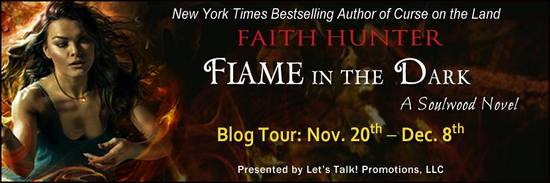
Pub Day Repost: Flame in the Dark by Faith Hunter


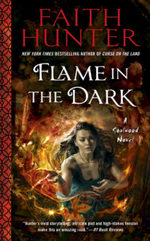
Flame in the DarkFlame in the Dark

by Faith Hunter
Series: Soulwood, #3eARC, 352 pg.
Ace/Roc, 2017
Read: September 22 – 27

Rookie Agent Nell Ingram and her PsyLED team start this novel in a multi-agency investigation into an attack on a political fundraiser — with a focus on one family in particular. There’s no obvious paranormal aspect to the attack, so PsyLED isn’t in the lead, but there’s enough to keep them hanging around the investigation. If for no other reason than the local vampires are interested in what’s going on. Soon, other attacks occur, making it even clearer that one family is the target. As the team starts to investigate that family, more questions are raised and secrets are revealed. But it’s a long while before the secrets and questions lead to anything useful for preventing further loss of life.

The presence of the vampires is a nice bonus — they were present a little in Blood of the Earth, but not really in Curse on the Land. Nell’s still struggling to make up for a faux pas in her initial exposure to the vampires — and a couple of them seem to be enjoying her discomfort. I enjoy seeing Hunter’s particular brand of vampires running around without Jane and her stakes, as long as she doesn’t return to this particular well too much in this series, the Vamps’ presence will be a plus.

The PsyLED case itself is a little on the tepid side — it’s far easier for readers to figure out what’s going on than it is for the characters, and that always hurts the stories somewhat. But — wow. What’s actually going on when the team finally puts all the pieces together? Wow — just wow. It makes putting up with their earlier slowness utterly worth it (also, the reader won’t be as correct as they thought they were for a long time). Basically, if you find yourself getting annoyed with this story, your patience will be rewarded. Probably more than rewarded.

Speaking of patience, Nell needs to exercise a good deal of it with her family, who are still struggling with understanding just what’s going on with her (and they don’t know it all!) and her move for independence from the cult she’s left. It’s clearly, and understandably, difficult to continue to distance herself from the ways and practices she was raised in, while trying to strengthen the ties with the family members still in the church. Meanwhile, the church does seem to be trying to change their practice — moving to orthopraxy, without much of a move towards orthodoxy. That kind of thing isn’t really going to work in the long run — but then again, Hunter’s not writing a realistic account of a movement in a religious group — so it’s not anything to get worked up over. Anyway, Nell puts her foot down on a couple of fronts and draws on some of what she’s learned in working with others, to be able handle her family in a way that hopefully gets through to them. She’s also making some smart moves regarding her sister, Mud/Mindy, who seems to share a lot of abilities and inclinations with Nell. I can’t wait to see what Hunter’s got up her sleeve with this.

While this is really Nell’s book (and series), there’s a great ensemble of characters here. Particularly in the PsyLED team. I’d have preferred a better use of the team, and for the second book in a row, I wondered why Hunter didn’t use some of the characters as well as she did in the first book. Maybe this is just me asking for more for Tandy to do.

There’s some satisfying development on the Brother Ephriam/foreign entity in Soulwood front (that’ll make sense to readers of the series), and regarding the “Vampire Tree.” Which just might be the creepiest floral entity I’ve ever read about — and it’s creepier than a lot of fauna, too. I’m particularly glad about the Brother Ephriam development, I was afraid that things were going to go on too long with that without any real shift in the status quo.

There’s also a stronger look at Nell’s romantic life here — her taking the first steps in exploring a real romantic relationship (in contrast to that marriage she was in), and maybe even getting her first “Improperly Proper Kiss.” There’s just enough romance story allow the reader to see her grow in this way (in addition to all the others she’s growing in), just one more step towards her fulfillment — but not so much that it’s the novel’s focus.

One of the pluses (and minuses) about this series all along has been how hard it is to simply say what Nell Ingram is. With most UF you can summarize things briefly: She can see dead people, he’s a wizard PI, she’s a skinwalker vampire hunter, he’s the world’s oldest living druid, she’s a changeling PI, she’s a ridiculously named werewolf who has a radio talk show, and so on . . . Nell’s a, um. Well. There’s magic, and powers over growing things, but no real spells, per se. See what I mean? This is a pain when trying to describe it to others, or even in knowing what to expect from her stories. And Hunter takes full advantage of this, she’ll have Nell do whatever at any point in time, and as long as it sort of relates to what she started off doing in Book 1, you buy it. By the same token, I can imagine that might be too much of a blank slate for Hunter — there are no well-established strengths/weaknesses/tropes to play with. There are things that Nell does here that just blows me away — and that has a lot to do with Hunter creating this magic creature/race on her own.

When I say that Hunter takes full advantage of this — I should say I thought she had been for the past two books — she really lets loose with it this time.

Let me try to sum up this rambling post: this is a slow burn of a novel — it puts down roots and grows like Nell’s plants, and eventually blossoms into something that’s great to look at. Be patient with it, watch the growth, and you’ll be rewarded. Because when things get going — they really get going, and it’s almost too much to take in. I vacillated a lot about what to rate this — I argued myself into 4-Stars and then into 5 and back into 4 and so on a few times. but because I really don’t place too much weight on the stars, really, I just stopped and split the difference. For those who’ve been around for the previous two books this is a must read — if this was going to be the last in the series, it’d be a decent way to leave (thankfully, Soulwood isn’t a trilogy); for Yellowrock fans who haven’t tried this series yet, you’ll appreciate it; and if you’ve never tried either — take a dip into this world, but I’ll warn you: you’ll end up reading all the others.

Disclaimer: I received this eARC from Berkley Publishing Group via NetGalley in exchange for this post — thanks to both for this. Thanks also to Let’s Talk! Promotions for the opportunity to take part in this book tour. My opinions about the book remain my own.

—–

4 1/2 Stars

The Squirrel on the Train (Audiobook) by Kevin Hearne, Luke Daniels

The Squirrel on the Train (Audiobook) The Purloined Poodle (Audiobook)

by Kevin Hearne, Luke Daniels (Narrator)
Series: Iron Druid Chronicles/Oberon’s Meaty Mysteries, #2
Unabridged Audiobook, 2 hrs, 54 min.
Kevin Hearne, 2017
Read: December 2, 2016


I posted about the text version about a month ago (and reposted last week), but wanted to say a little more about the audiobook — so for the sake of those who just clicked on the Audiobook post, I’ll just repeat everything I said before, but tag on something at the end about Luke Daniels’ work. Can the magic of The Purloined Poodle be recaptured? Yes — maybe even topped. For many, that should be all I need to write. If that’s the case, you’re fine — go ahead and close this, no need to finish this.

If you’re still here, I’ll write a little more — While on a trip to Portland to go sight-seeing, er, sight-smelling, Oberon, Orlaith and Starbuck get away from Atticus (er, I mean, Connor Molloy) while chasing after a suspicious-looking squirrel. That’s a tautology, I realize, if you ask the hounds, but this was a really sketchy-looking squirrel. Anyway, this brought the group into the path of Detective Ibarra. She happens to be at the train station investigating the odd murder of a man who looks just like Atticus.

Naturally, that gets him interested and investigating things as best as he can. Thanks in no small part to the noses of the hounds, Atticus and an old friend are able to uncover what’s going on to help Atticus’ new friend make an arrest.

It’s a whole story in Oberon’s voice, I don’t know what else I can say about the writing/voice/feel of the book. That says pretty much everything. From Oberon’s opening comparison of the diabolical natures of Squirrels vs. Clowns to Orlaith’s judgment that “death by physics” “sounds like justice” to the harrowing adventure at the end of the novella, this is a fine adventure for “the Hounds of the Willamette and their pet Druid!”

No surprise to anyone who’s heard the audiobook for any of Oberon’s other appearances in short stories/novellas/novels, but Luke Daniels killed it here. From the overall characterization and narration he does as Oberon on down to the little details, like Oberon’s particular pronunciation of “Port-LAND,” I just love it. Frankly, how anyone can listen to his rendition of Starbuck’s first steps with words like, “Yes food!” and not giggle like Ron Swanson is beyond me. He gets the serious moments, the anger, the awe, the silliness just right. I just can’t say enough good things about this audio presentation.

There’s a nice tie-in to some of the darker developments in the Iron Druid Chronicles — that won’t matter at all if you haven’t read that far, or if you can’t remember the connection. This was a good sequel that called back to the previous book, and told the same kind of story in a similar way — but didn’t just repeat things. Just like a sequel’s supposed to be, for another tautology. I smiled pretty much the whole time I read it (as far as I could tell, it’s not like I filmed myself). I don’t know if we get a third in this series given the end of the IDC next year. If we do, I’ll be happy — if not, this is a great duology.

—–

4.5 Stars

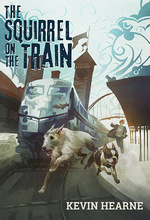
Pub Day Repost: The Squirrel on the Train by Kevin Hearne

The Squirrel on the TrainThe Squirrel on the Train

by Kevin Hearne
Series: Iron Druid Chronicles/Oberon’s Meaty Mysteries, #2eARC, 120 pg.
Subterranean Press, 2017
Read: November 2, 2017

Can the magic of The Purloined Poodle be recaptured? Yes — maybe even topped. For many, that should be all I need to write. If that’s the case, you’re fine — go ahead and close this, no need to finish this.

If you’re still here, I’ll write a little more — While on a trip to Portland to go sight-seeing, er, sight-smelling, Oberon, Orlaith and Starbuck get away from Atticus (er, I mean, Connor Molloy) while chasing after a suspicious-looking squirrel. That’s a tautology, I realize, if you ask the hounds, but this was a really sketchy-looking squirrel. Anyway, this brought the group into the path of Detective Ibarra. She happens to be at the train station investigating the odd murder of a man who looks just like Atticus.

Naturally, that gets him interested and investigating things as best as he can. Thanks in no small part to the noses of the hounds, Atticus and an old friend are able to uncover what’s going on to help Atticus’ new friend make an arrest.

It’s a whole story in Oberon’s voice, I don’t know what else I can say about the writing/voice/feel of the book. That says pretty much everything. From Oberon’s opening comparison of the diabolical natures of Squirrels vs. Clowns to Orlaith’s judgment that “death by physics” “sounds like justice” to the harrowing adventure at the end of the novella, this is a fine adventure for “the Hounds of the Willamette and their pet Druid!”

There’s a nice tie-in to some of the darker developments in the Iron Druid Chronicles — that won’t matter at all if you haven’t read that far, or if you can’t remember the connection. This was a good sequel that called back to the previous book, and told the same kind of story in a similar way — but didn’t just repeat things. Just like a sequel’s supposed to be, for another tautology. I smiled pretty much the whole time I read it (as far as I could tell, it’s not like I filmed myself). I don’t know if we get a third in this series given the end of the IDC next year. If we do, I’ll be happy — if not, this is a great duology.

Disclaimer: I received this eARC from Subterranean Press via NetGalley in exchange for this post — thanks to both for this.

—–

4 Stars

Flame in the Dark by Faith Hunter


Flame in the DarkFlame in the Dark

by Faith Hunter
Series: Soulwood, #3

eARC, 352 pg.
Ace/Roc, 2017

Read: September 22 – 27


Rookie Agent Nell Ingram and her PsyLED team start this novel in a multi-agency investigation into an attack on a political fundraiser — with a focus on one family in particular. There’s no obvious paranormal aspect to the attack, so PsyLED isn’t in the lead, but there’s enough to keep them hanging around the investigation. If for no other reason than the local vampires are interested in what’s going on. Soon, other attacks occur, making it even clearer that one family is the target. As the team starts to investigate that family, more questions are raised and secrets are revealed. But it’s a long while before the secrets and questions lead to anything useful for preventing further loss of life.

The presence of the vampires is a nice bonus — they were present a little in Blood of the Earth, but not really in Curse on the Land. Nell’s still struggling to make up for a faux pas in her initial exposure to the vampires — and a couple of them seem to be enjoying her discomfort. I enjoy seeing Hunter’s particular brand of vampires running around without Jane and her stakes, as long as she doesn’t return to this particular well too much in this series, the Vamps’ presence will be a plus.

The PsyLED case itself is a little on the tepid side — it’s far easier for readers to figure out what’s going on than it is for the characters, and that always hurts the stories somewhat. But — wow. What’s actually going on when the team finally puts all the pieces together? Wow — just wow. It makes putting up with their earlier slowness utterly worth it (also, the reader won’t be as correct as they thought they were for a long time). Basically, if you find yourself getting annoyed with this story, your patience will be rewarded. Probably more than rewarded.

Speaking of patience, Nell needs to exercise a good deal of it with her family, who are still struggling with understanding just what’s going on with her (and they don’t know it all!) and her move for independence from the cult she’s left. It’s clearly, and understandably, difficult to continue to distance herself from the ways and practices she was raised in, while trying to strengthen the ties with the family members still in the church. Meanwhile, the church does seem to be trying to change their practice — moving to orthopraxy, without much of a move towards orthodoxy. That kind of thing isn’t really going to work in the long run — but then again, Hunter’s not writing a realistic account of a movement in a religious group — so it’s not anything to get worked up over. Anyway, Nell puts her foot down on a couple of fronts and draws on some of what she’s learned in working with others, to be able handle her family in a way that hopefully gets through to them. She’s also making some smart moves regarding her sister, Mud/Mindy, who seems to share a lot of abilities and inclinations with Nell. I can’t wait to see what Hunter’s got up her sleeve with this.

While this is really Nell’s book (and series), there’s a great ensemble of characters here. Particularly in the PsyLED team. I’d have preferred a better use of the team, and for the second book in a row, I wondered why Hunter didn’t use some of the characters as well as she did in the first book. Maybe this is just me asking for more for Tandy to do.

There’s some satisfying development on the Brother Ephriam/foreign entity in Soulwood front (that’ll make sense to readers of the series), and regarding the “Vampire Tree.” Which just might be the creepiest floral entity I’ve ever read about — and it’s creepier than a lot of fauna, too. I’m particularly glad about the Brother Ephriam development, I was afraid that things were going to go on too long with that without any real shift in the status quo.

There’s also a stronger look at Nell’s romantic life here — her taking the first steps in exploring a real romantic relationship (in contrast to that marriage she was in), and maybe even getting her first “Improperly Proper Kiss.” There’s just enough romance story allow the reader to see her grow in this way (in addition to all the others she’s growing in), just one more step towards her fulfillment — but not so much that it’s the novel’s focus.

One of the pluses (and minuses) about this series all along has been how hard it is to simply say what Nell Ingram is. With most UF you can summarize things briefly: She can see dead people, he’s a wizard PI, she’s a skinwalker vampire hunter, he’s the world’s oldest living druid, she’s a changeling PI, she’s a ridiculously named werewolf who has a radio talk show, and so on . . . Nell’s a, um. Well. There’s magic, and powers over growing things, but no real spells, per se. See what I mean? This is a pain when trying to describe it to others, or even in knowing what to expect from her stories. And Hunter takes full advantage of this, she’ll have Nell do whatever at any point in time, and as long as it sort of relates to what she started off doing in Book 1, you buy it. By the same token, I can imagine that might be too much of a blank slate for Hunter — there are no well-established strengths/weaknesses/tropes to play with. There are things that Nell does here that just blows me away — and that has a lot to do with Hunter creating this magic creature/race on her own.

When I say that Hunter takes full advantage of this — I should say I thought she had been for the past two books — she really lets loose with it this time.

Let me try to sum up this rambling post: this is a slow burn of a novel — it puts down roots and grows like Nell’s plants, and eventually blossoms into something that’s great to look at. Be patient with it, watch the growth, and you’ll be rewarded. Because when things get going — they really get going, and it’s almost too much to take in. I vacillated a lot about what to rate this — I argued myself into 4-Stars and then into 5 and back into 4 and so on a few times. but because I really don’t place too much weight on the stars, really, I just stopped and split the difference. For those who’ve been around for the previous two books this is a must read — if this was going to be the last in the series, it’d be a decent way to leave (thankfully, Soulwood isn’t a trilogy); for Yellowrock fans who haven’t tried this series yet, you’ll appreciate it; and if you’ve never tried either — take a dip into this world, but I’ll warn you: you’ll end up reading all the others.

Disclaimer: I received this eARC from Berkley Publishing Group via NetGalley in exchange for this post — thanks to both for this. Thanks also to Let’s Talk! Promotions for the opportunity to take part in this book tour. My opinions about the book remain my own.

—–

4 1/2 Stars

A Few Quick Questions With…Faith Hunter


I’ve gotta say, I was pretty intimidated when I got the word that Faith Hunter was going to participate in this, but it ended up being a lot easier to come up with questions to ask her than it was for many other writers. The main problem was cutting them down to five! Anyway, I enjoyed this — hope you do, too.

Ms. Hunter, before we begin, I’d like to thank you for taking the time to provide some A’s to the Q’s here. I’ve been reading the Yellowrock series since 2011 and have been become a big fan of your work. I want to ask about a dozen questions about the last two or three chapters of Flame in the Dark, but I don’t think you’d want to answer them — and if you did, you wouldn’t let me post your answers. Here are their replacements, which should be spoiler-free, and hopefully you haven’t been asked too many times.
Thank you for that. And I am glad to be here!
First off, what’s been the reaction from your fans toward this spin-off? Anything surprising about the reaction (hopefully positive surprises, but I’ve been online long enough to not know to assume that).
I was not expecting the fans to love Nell or the Soulwood series in any great numbers, but the sales figures for the most recent books are nearly the same — Soulwood #2 (Curse on the Land) and Jane Yellowrock #11, (Cold Reign). And they really adore Nell. They root for her and they pull for her and they want her to get that all important Improperly Proper Kiss!
Each book comes with its own particular set of challenges. What were the particular challenges of Flame in the Dark?
Mostly keeping Nell heading in the right direction. She came from a very restrictive background, so while I want her to experience life in all its sensory and emotional delights, I also want to keep her on the straight and narrow in terms of being true to herself. I want to make sure that she doesn’t lose sight of who she is, and what made her strong. She is a multi-faceted character with a lot of depth and I want to make sure she is never a Milquetoast.
For me, one of the highlights of the Soulwood books is Nell’s reaction to the food (mostly of the “junk” variety) her colleagues are introducing her to. It’s such a subtle and effective way to remind/demonstrate just how far away her life was from the world we all know before she joined up with PsyLED (and so fun to watch this farm-to-table type woman revel in processed foods). Assuming I’m not reading too much into that — why food? Why not . . . the Internet or music? Was it a conscious choice, or just something that started that you ran with? Is the research for it just dreadful? How many Krispy Kremes do you have to eat to make sure you get it right? 🙂 [sorry I babbled a bit there . . . ]
(laughing) The Internet was something she had already learned about through the library system in her town of Knoxville. So while her knowledge of the databases has expanded dramatically, the concept wasn’t brand new to her. As to music, Nell grew up listening to mostly old-fashioned acapella church music. I’m honestly not certain what kind of music she would like, so I haven’t gone there yet. I feel that music will need a deft hand for Nell, and I don’t have that yet. But FOOD! Part of the reason why food, is that I can’t eat many kinds of processed foods anymore. I’m allergic to all corn products and so that means I no longer get pizza or commercially made doughnuts. I miss all that great stuff!!! I am living through Nell’s taste buds, while becoming much more the farm-to-table eater myself now.
The religious lives of Jane and Nell play a more significant role in the novels than any other Urban Fantasy series I can think of, where does that come from? How do you approach bringing their faith (understanding that Nell’s is in flux given her past) into the stories in a way that seems authentic?
My dad taught me to look at EVERY subject from EVERY side, and to work to understand why people think and believe as they do. He also made me look at the ways those thought systems and belief systems contributed to their strengths and weakness as individuals and as members of society. He was a wily man, my daddy was. And what I’ve discovered is ALL people are people of faith, whether that faith is a religious one or a rational one, a spiritual one or a physical one, a churchy one or a scientific one. Therefore, addressing faith (for me, as a writer), becomes a part of each story and character on some level. Nell is struggling with faith, because for her, faith is all messed up with sex and abuse and cruelty. For Occam, faith is all tied up with betrayal. For Nell’s mother, faith is all about surviving and growing through life’s difficulties into strength and forgiveness. For Rick, faith is all about forgiving himself for stupidity that led to pain and lost relationships.
What’s the one (or two) book/movie/show in the last 5 years that made you say, “I wish I’d written that.”?
Robin McKinley’s Sunshine was a masterpiece.
Devon Monk makes me intensely jealous. She is SUCH a talent!
Chloe Neill’s Devil’s Isle series is spectacular!
Again, thanks for your time and participation. I hope Flame in the Dark is as successful as it deserves to be, and I can’t wait to see what’s next for either Jane or Nell.

The Squirrel on the Train by Kevin Hearne

The Squirrel on the TrainThe Squirrel on the Train

by Kevin Hearne
Series: Iron Druid Chronicles/Oberon’s Meaty Mysteries, #2

eARC, 120 pg.
Subterranean Press, 2017

Read: November 2, 2017


Can the magic of The Purloined Poodle be recaptured? Yes — maybe even topped. For many, that should be all I need to write. If that’s the case, you’re fine — go ahead and close this, no need to finish this.

If you’re still here, I’ll write a little more — While on a trip to Portland to go sight-seeing, er, sight-smelling, Oberon, Orlaith and Starbuck get away from Atticus (er, I mean, Connor Molloy) while chasing after a suspicious-looking squirrel. That’s a tautology, I realize, if you ask the hounds, but this was a really sketchy-looking squirrel. Anyway, this brought the group into the path of Detective Ibarra. She happens to be at the train station investigating the odd murder of a man who looks just like Atticus.

Naturally, that gets him interested and investigating things as best as he can. Thanks in no small part to the noses of the hounds, Atticus and an old friend are able to uncover what’s going on to help Atticus’ new friend make an arrest.

It’s a whole story in Oberon’s voice, I don’t know what else I can say about the writing/voice/feel of the book. That says pretty much everything. From Oberon’s opening comparison of the diabolical natures of Squirrels vs. Clowns to Orlaith’s judgment that “death by physics” “sounds like justice” to the harrowing adventure at the end of the novella, this is a fine adventure for “the Hounds of the Willamette and their pet Druid!”

There’s a nice tie-in to some of the darker developments in the Iron Druid Chronicles — that won’t matter at all if you haven’t read that far, or if you can’t remember the connection. This was a good sequel that called back to the previous book, and told the same kind of story in a similar way — but didn’t just repeat things. Just like a sequel’s supposed to be, for another tautology. I smiled pretty much the whole time I read it (as far as I could tell, it’s not like I filmed myself). I don’t know if we get a third in this series given the end of the IDC next year. If we do, I’ll be happy — if not, this is a great duology.

Disclaimer: I received this eARC from Subterranean Press via NetGalley in exchange for this post — thanks to both for this.

—–

4 Stars

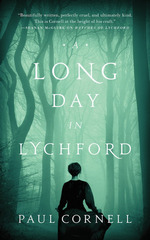
A Long Day in Lychford by Paul Cornell

A Long Day in LychfordA Long Day in Lychford

by Paul Cornell
Series: Witches of Lychford, #3

Kindle Edition, 128 pg.
Tor.com, 2017

Read: October 10, 2017


Lychford’s apprentice witch (not that anyone knows that), and owner of Witches, a magic shop (not that many take it seriously), Autumn has had a bad day. So bad, that a police officer has dropped by the next morning to interrupt an impending hangover with questions about it. She had a fight with her teacher and employee that left both fuming and ready to consider ending the relationships, and then she went to a bar not-really-looking for a fight, but ready for it when it showed up.

But when you’re one of three women responsible for protecting the borders between our world and the rest, and you’re pretty magic-capable, your bad days can have pretty catastrophic consequences. Without getting into the details, she messes up the borders, the protections — the magic that keeps all the things and people and whatevers out of our world that we’re not equipped to deal with (in any sense).

Meanwhile, Judith is dealing with the aftermath of the fight with Autumn in her own way. Which boils down to being crankier than usual, and then dealing with the fallout from Autumn’s error. Judith is primarily concerned with problems that the other two aren’t aware of and have little do to with magic. There were a line or two that I think were supposed to be spooky or creepy in her POV sections that really were just sad (my guess is that Cornell wrote them to work on both levels, but they really only served as the latter for me).

Lizzie got put on the backburner for the most part in this book — not that she’s absent, but she doesn’t have that much to do. Which is fine — she can’t be the center of each entry in this series, but I’d have preferred to have seen a bit more from her. I enjoyed the references to Lizzie’s Fitbit, it was nice to have just the hint of lightness in this otherwise grim story. Actually, the other thing that came close to fun in this book also came from Lizzie’s POV. She’s not the typical source for that, and it’s nice to see that she’s capable of it.

I wish these were longer — I know it’s supposed to be a series of novellas, but this one in particular makes me want for more — more development, more plot, more character interaction. I don’t think I noticed it as much in the previous installments, so maybe it’s something about this one. Still, this is a good story and time spent in Lychford is always rewarding.

In the end, this served primarily to set the stage for Witches of Lychford #4 — and maybe more. Yes, the story was interesting, and it was good to have this look at Autumn, and the whole Brexit tie-in was interesting, but this just didn’t work for me quite the way the others did. I have high hopes for the next, it’s not like I’m done with this or anything, I just wanted more.

—–

3 Stars

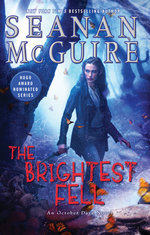
The Brightest Fell by Seanan McGuire

The Brightest FellThe Brightest Fell

by Seanan McGuire
Series: Toby Daye, #11

Hardcover, 289 pg.
DAW, 2017

Read: September 6 – 7, 2017

I still couldn’t see anything, which was unusual. Fae have excellent night vision. We’re like cats, able to see in the slightest trace of light. For it to be this dark, there had to be no light at all-that, or something had been done to my eyes. The thought caused a brief spike of panic, until I blinked several times and confirmed that I could still feel my eyes. No one had removed them or sealed my eyelids shut.

It says something about my life that this was a concern.

Surely, at some point, Toby will stop being lulled into a sense that everything is okay with the world — she starts this book by enjoying life, and a night out with her friends. Which is one of the surest signs that things are going to go horribly awry for her. And they do, before she can finish unwinding after the night out, there’s a knock on her door. Amandine, her mother, has stopped by for a visit.

Well, not really a visit. She wants to hire Toby to go find her older daughter, August. Toby’s never met her sister and really doesn’t want to get mixed up with anything involving August (who’s been missing for over a century) or her mother. Amandine has never been one to take no for an answer, instead, she takes hostages.

So, Toby’s off to find her sister August — which makes preventing war (like she’s been doing lately) look positively run-of-the-mill. I’m going to leave the plot summary at that. Because, like others, I don’t know how to talk about this without spoiling things that shouldn’t be. There are a couple of quotations (one from Toby, one from someone else) that illustrate what’s going on beyond this missing person hunt:

All my chickens were coming home to roost, and while I didn’t want them, I had earned them. I had earned them, every one.

“We are the sum of our actions . . . When desperation sets our course, those actions can blacken with remarkable speed.”

If that doesn’t describe the last couple of Iron Druid Chronicles, Dresden Files, and pretty much every Alex Verus book, I don’t know what does. The best of Urban Fantasy ultimately puts their protagonists in this situation — Toby’s been close to it before, but she’s dancing closer to the line here, sacrificing (or at least being prepared to sacrifice) so much to find her sister — and the number of things she won’t sacrifice is pretty small.

There’s not a whole lot of character growth and development here, there’s no time. We do see many of our old friends and acquaintances being themselves — maybe turned up to 11. One character, who will remain nameless, displays a degree of depth that we haven’t seen before. Toby grows a bit through this experience, if only to find out what extremes she’ll go to. She finds herself capable of changing her mind about someone –not easy for her to do (like most of us).

People are complicated. That’s the problem with people. lt would be so much easier if they could all be put into easy little boxes and left there, never changing, never challenging the things I decided about them.

This was a great read — in more than just the story, or characters — there are just some books where the whole is greater than the sum of its parts. This is one of them (though the sum of its parts was pretty good) — everything just clicked. McGuire drew me in and kept me there between the voice, the fact that we have 10 books of history with these characters, and the drama (and little bit of comedy). There was one point, where Toby does something brave, reckless and potentially stupid (especially if it came back to bite her), where I found myself muttering, “Oh, oak and ash! No!” I figure any book that has you under its spell enough that you end up borrowing oaths and curses from the protagonist is a pretty engrossing read. She didn’t listen to me, and she sure should have.

From the fun as all get out opening scene, to the ominous final sentence that should fill every Toby fan with dread (although it promises some great books), McGuire was firing on all cylinders here. Yeah, plenty came home to roost in The Brightest Fell, and it meant that those closest to Toby suffered, but she found a way to be Toby throughout — she didn’t surrender who she was, and she got things done the best she could. All the while bringing the reader along through her highs and lows with her. Can’t ask for more than that. (well..I guess you could, but why?)

—–

5 Stars

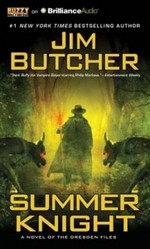
Summer Knight (Audiobook) by Jim Butcher, James Marsters

Summer Knight (Audiobook)Summer Knight

by Jim Butcher, James Marsters (Narrator)
Series: The Dresden Files, #4
Unabridged Audiobook, 11 hrs and 12 mins
Buzzy Multimedia Publishing Corp., 2009

Read: August 23 – 25, 2017


So, we get more information on the White Council (not just the vague references in the first couple of books and our buddy Morgan the Warden), as well as our introduction to the Fae Courts. Throw in everything we learned about Marcone in book 2, vampires in book 3, and what we’re about to learn in book 5 and we’ll have fully established the world of Harry Dresden. And wow, what a world.

But I’m getting ahead of myself. We start off with dealing with the war Harry was tricked into instigating in the last book, he’s got assassins after him — but thankfully, Billy’s got his back. A friendship has developed between Harry, Billy and the rest of Billy’s pack since Fool Moon which is pretty cool to see. Even if Harry’s too blinded by his obsessive need to cure Susan’s vampirism to see things like friendship, self-destructive lifestyle, and whatnot. Billy’s also minding the store for Harry and has made an appointment for him to meet with a new client.

Harry doesn’t want a new client — but he’s about run out of money and is looking at the business end of evictions soon, so he’d better. He doesn’t want this new client either, for reasons you can read/listen to for yourself, but she doesn’t leave him much of a choice.

Before he can get too carried away with dealing with this, he has to attend a meeting of the White Council — where he will be a major topic of conversation, thanks to the vampire war. Which isn’t going too well for the Wizards. We meet some great characters at this meeting, including Harry’s [spoiler] and mentor, Ebenezar McCoy. McCoy is a hoot — Marsters (no surprise) nails his character, by the way — he’s just one of those guys you like from the moment you meet him on the page and your appreciation for him only increases. In the end, the Council basically puts Harry to a test — if he doesn’t pass, they hand him over to the vampires; if he does, things continue on the way they are now — and if he dies in the process, well, that’ll be inconvenient. The test, naturally, involves him taking the above client he doesn’t want.

In a nutshell, a member of one of the Fae Courts has been killed and Harry has a couple of days until the Summer Solstice to find out who did it. Otherwise, the balance of power between the Courts will shift and war break out. A war that’ll pretty much decimate the planet’s climate in ways that Al Gore couldn’t imagine. Which is a bad thing for us humans. So pretty much, Harry has to solve a murder, stop a war/save the earth, while dodging assassins, skeptical wizards, and who knows what else or he’ll be tortured and killed by vampires after being abandoned by his people. In just a couple of days.

Oh, and a long-lost (and assumed dead) person from Harry’s past shows up in the middle of all this, too.

No big deal, right? Poor, poor Harry. It’s a fun adventure (for the reader), the mystery story is decent, the adversaries are fantastic — and the new characters (even those we never see again, sniff) are great additions to what’s just a great cast.

I mentioned the friendship of Billy and Harry earlier — we get a lot of it in this book, Billy’s along for most of the adventure, and he’s really turning into someone Harry can count on. Karrin Murphy gets some great action, too — and Harry finally clues her into what’s going on re: Fae, Vampires, White Council, etc. You know, keeping the promise he made to himself at the end of book 2. Well done, Dresden. I can’t fail to mention Toot Toot — he’s come a long way since we met him in Storm Front, in no small way thanks to Harry.

I’m talking about an audiobook now, so I really should say something about James Marsters’ work. I’m just going to sound like a broken record, though, if I do. I’m trying to think if I wasn’t that impressed with anything, or if there was something in particular that I thought he did well, and I can’t come up with anything. I really enjoyed his Bob in Summer Night — nothing different in the characterization, I don’t think, but it just came to life in a particular way. Also, he captured the very strong sense of fatigue, of being at the end of his rope that so defined Harry in these pages.

This wasn’t my favorite book — although I really enjoyed it on the whole — and really relished reliving the establishment of the Council and Courts in the series. While I thoroughly enjoyed the stuff in Wal-Mart (for example), it went on too long and wasn’t worth it to the story. There were a few too many moments like that in this book for my taste — fun in and of themselves, but ultimately, time wasted, so I’ll knock this down a star. Also, it proves that as much of a mindless fan-boy I can tend to be about this series, I’m a little discerning. A little.

—–

4 Stars

Page 28 of 44

Powered by WordPress & Theme by Anders Norén