Month: November 2017 Page 2 of 4

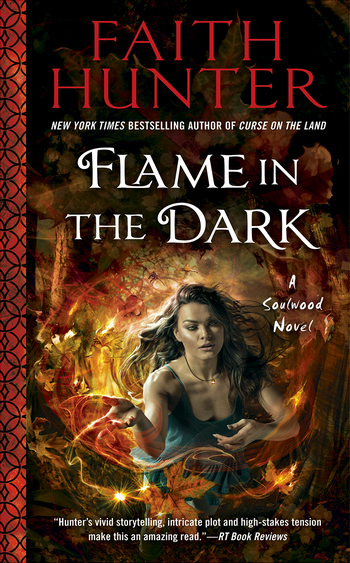
Flame in the Dark by Faith Hunter Book Tour

Welcome to our Book Tour stop for Flame in the Dark. Along with this blurb about the book and author I’ve got A Few Quick Questions with Faith Hunter, coming up in a little bit here. Later this morning, I’ll post my 2¢ about the book.

Be sure to scroll down to the bottom of this post for a chance to win Soulwood books and more!

Book Details:

Book Title:  Flame in the Dark by Faith Hunter
Publisher:  Ace/Roc
Release date:  December 5, 2017
Format: Mass Market Paperback
Length: 352 pages

Book Description:

Nell Ingram has always known she was different. Since she was a child, she’s been able to feel and channel ancient powers from deep within the earth. When she met Jane Yellowrock, her entire life changed, and she was recruited into PsyLED—the Homeland Security division that polices paranormals. But now her newly formed unit is about to take on its toughest case yet.

A powerful senator barely survives an assassination attempt that leaves many others dead—and the house he was visiting burns to the ground. Invisible to security cameras, the assassin literally disappears, and Nell’s team is called in. As they track a killer they know is more—or less—than human, they unravel a web of dark intrigue and malevolent motives that tests them to their limits and beyond.

Author Bio:

Faith HunterNew York Times and USAToday bestselling fantasy author Faith Hunter was born in Louisiana and raised all over the south. Altogether she has 40+ books in print under the names Gary Hunter, Gwen Hunter, and Faith Hunter. As Faith, she writes two contemporary Urban Fantasy series: the Jane Yellowrock series, featuring a Cherokee skinwalker who hunts rogue vampires, and the Soulwood series, featuring earth magic user Nell Ingram. Her Rogue Mage novels are a dark, post-apocalyptic, fantasy series featuring Thorn St. Croix, a stone mage. The role playing game based on the series, is ROGUE MAGE, RPG.

Website: www.faithhunter.net
Facebook: https://www.facebook.com/official.faith.hunter
Twitter: @hunterfaith
Yellowrock Securities: http://www.yellowrocksecurities.com
Gwen Hunter: www.gwenhunter.com

GIVEAWAY!

The tour giveaway is for 3 sets of the 1st 2 Soulwood books (BLOOD OF THE EARTH and CURSE ON THE LAND) and one $50 Amazon gift card (US residents only)!

a Rafflecopter giveaway
https://widget-prime.rafflecopter.com/launch.js
If the handy-dandy Rafflecopter widget isn’t showing up, just click here.

My thanks to Let’s Talk! Promotions for the invitation to participate in this tour and the materials they provided.

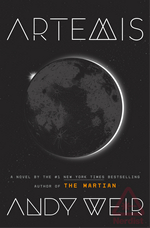
Artemis by Andy Weir

ArtemisArtemis

by Andy Weir

Hardcover, 305 pg.
Crown Publishing Group (NY), 2017

Read: November 16, 2017

“You all right? You look kind of pale.”

I was about ready to puke. Lying to Dad transported me back to my teen years. And let me tell you: there’s no one I hate more than teenage Jazz Bashara. That stupid bitch made every bad decision that a stupid bitch could make. She’s responsible for where I am today.

“I’m fine. Just a little tired.”

We’ll get back to older-than-teenaged Jazz Bashara in a minute, I just wanted to start with that . . .

Can you imagine the pressure that Andy Weir was under following the success of The Martian? Just knowing that whatever he put out would be compared to that phenomenon would cripple most people. Proving that he has the Right/Write Stuff, he was able to put the pressure aside and give us Artemis. I’d like to say I’m not going to compare the two, but why lie to you?

Artemis is the first city on the Moon — made up of 5 domes with levels of living quarters under the surface (by the way, we get some nifty maps in the front of the city and its environs), a small city (for now) that’s primarily a tourist destination. There’s a great pseudo-currency set up to handle things, and a history and raison d’être for Artemis — just part of the wonderful job of world-building that Weir did. Papers should be written about how well he did here, by people who have more time than me. Not only did Weir do a great job of building this world, but he introduces it very well — showing us what he created while introducing us to Jazz Bashara, so we get to know them together. A lot of Hard SF comes across as slow, ponderous, and unapproachable — Weir manages to avoid all that and actually entertains.

It’s not as essential to like Jazz as it was Mark Watney to enjoy this book, but it’s close. She’s a young woman of Saudi descent who grew up on Artemis, and rebelled against the high hopes that her father and teachers had for her and became a petty criminal. Primarily Jazz is a smuggler — getting those creature comforts for residents of the Moon that just can’t get past Artemisian security. She’s crafty, wily, angry, and uses profanity in an incredibly creative way (we don’t have to endure most of that, we’re just treated to the occasional profane neologism, e.g., “fusamitch”). I think you can still think she’s an annoying little twit who should be arrested and enjoy the book — but it’s so much easier to just like her.

Once we meet Jazz and are treated to some pretty cool world-building, Artemis stops being so much a SF novel and focuses on being a Heist/Caper/Thriller (in a hard SF setting). One of Jazz’s regular customers approaches her with a job that she can’t turn down — it’ll make her rich, allow her to pay off all her debt and leave her with a lot of money. She almost has to take the job. Being a heist/caper novel, you know things will get off to a good start and then things will go horribly awry. That’s exactly what happens. The fun is watching things go awry and then watch her (and her eventual allies) react.

Artemis is a pretty small city and it doesn’t take too long for word to spread that she was behind the Big Thing (even if she denies it every chance she gets). The company she tried to interfere with is not the kind of group you want to interfere with, they’re not really that concerned with things like “criminal law” when it comes to protecting their investments. Nor it doesn’t matter if the small law enforcement force is small — so small there’s only one man — if that one man starts investigating you the instant something wrong happens. The list of “the usual suspects” doesn’t necessarily begin and end with Jazz, but she’s sure a large component of that list.

So Jazz is on the run from her victims, the fuzz, and she’s still needs to finish the job. Meanwhile the body count starts to get higher and the pressure is mounting. We’re told that young Jazz had a lot of potential — she might even technically be a genius — and in watching her think on her feet, adapting to the catastrophes that keep befalling her and her schemes we get to see just why that was said about her. I don’t think it’s wrong to see shades of Slippery Jim diGriz here (but she’s not nearly as experienced, or as devoted to crime, as The Stainless Steel Rat).

There are other characters, this isn’t just the Jazz show — she interacts with other people (allies, enemies, antagonists, potential victims, friends — a father that I’m not sure what group he belongs in) — again, compare to Watney. This is done really well — there’s a spark to all of them, they’re all well-rounded and fleshed-out. The emotions are real and relatable, the setting might be as alien as you can get for most of us — but at the end of the day, people are people and we all want pretty much the same things.

One thing we all know that Andy Weir does well is the science. And I’m not just talking about the big things like how to construct a lunar city or how to power it, etc. There’s all the little touches, like:

Lunar dust is extremely bad to breathe. It’s made of teeny, tiny rocks, and there’s been no weather to smooth them out. Each mote is a spiky, barbed nightmare just waiting to tear up your lungs. You’re better off smoking a pack of asbestos cigarettes than breathing that shit.

or the 4-second lag time for Internet traffic to route down to Earth and back before you get your search results., or the efforts of Jazz’s bartender friend to successfully reconstitute whiskey.

I feel like I could keep going (I’ve only used half of my notes at this point), but my point’s been made, why belabor it? This SF/Thriller/Heist with a lot of heart and a lot of laughs is not just a great follow-up to The Martian, but a great read period. One of my favorites of the year, and I’m already looking forward to rereading it soon.

—–

5 Stars

All Hands on Pet! by Susan E. Davis, PT

All Hands on Pet!All Hands on Pet!: Your How-To Guide on Home Physical Therapy Methods for Pets

by Susan E. Davis, PT
Paperback, 216 pg.
Joycare Onsite, LLC, 2017

Read: November 20, 2017


This is not the book you typically see me talk about — and when I was approached to give it a read and review, my initial response was to give it a pass. But we adopted an 11 year-old dog this Spring, and I’ve been thinking a lot about canine health. Which makes me right in the target audience for this book, actually.

I sort of have to assume that the medicine and science behind this book is right and/or responsible. Because really, unless the book called for the use of Windex to treat common maladies or something as useless as “mild doses of physic to work on the bowels,” there’s zero chance I’ll be able to suss out the problem. Instead, I can talk about a couple of things: is it useful? Can it be understood by lay readers?

Yes, to both, thankfully.

Yes, you have to be a dedicated reader — focused and concerned — to get through a little of the language. But what pet owner with an ailing companion isn’t focused and concerned? Yes, there was a lot of what Davis talked about that was Greek to me, but if I had a dog/cat/lizard/whatever that had a problem along the lines she was talking about; or had received [technical term X] as a diagnosis, I’d know right where to go. Part of the problem for me at the moment, is my old girl isn’t a prime candidate for Canine Hip Dysplasia, so it was hard to connect to those pages — it’s not a book to read cover to cover. It’s a resource. But from what I can tell, she gives some pretty decent sounding advice for working with puppies to head off that problem.

Not only some pretty decent sounding advice, there’s some handy photographs with good diagrams added so you know just what to do. There are plenty of nice anecdotes and illustrations from Davis’ casework throughout the book to anchor the instructions. Both of these features cannot be overstressed as valuable.

My favorite part comes from Chapter 8, “Embracing the Warrior Mentality at Home,” discussing the attitude and approach that pet owners should take when helping their ailing/injured pets. I wish this chapter — or at least the initial sections of it — had appeared earlier in the book. I just think it would’ve flowed a little better. But I’m glad it was there.

Was I able to get something to help my girl? Maybe. I definitely know where to look if it comes to it. I can see this as a valuable tool in the toolbox for every pet owner.

Disclaimer: I received a copy of this book in exchange for my honest opinion and this post.

—–

3 Stars

Dead Souls by Ian Rankin

Dead SoulsDead Souls

by Ian Rankin
Series: John Rebus, #10

Hardcover, 406 pg.
St. Martin’s Press, 1999

Read: November 10 – 13, 2017

For the best part of an hour, Rebus had been trying to blink away a hangover, which was about as much exercise as he could sustain. He’d planted himself on benches and against walls, wiping his brow even though Edinburgh’s early spring was a blood relative of midwinter. His shirt was damp against his back, uncomfortably tight every time he rose to his feet.

This might actually be the high point for Rebus in this novel — at least as far as the way he feels goes. The bad news is, this is from Chapter 1. Clearly, Jack Morton’s influence has clearly ended. Rebus is moments away from doing something he’ll regret almost instantly and that will have ramifications on everything he does for the foreseeable future, some of which will likely haunt him for more than that.

Which almost seems par for the course, I realize as I type that.

Anyway, Dead Souls focuses on crimes against children and what that can do to them — not just at the moment they’re victimized, but years later. There are also unintended (and fully intended consequences of crimes against adults throughout the book — Rebus’ own hands aren’t entirely clean here. Rebus’ actions in the opening pages cast enough of a shadow on him that his very brief involvement on another case is used by the defense to cast a shadow on the police’s investigation. He’s also tasked to investigate the apparent suicide of a police detective, informally, anyway. His main task is to work with Siobhan Clarke and a rookie to be a very obvious police presence to a convicted multiple-murderer, recently released and deported from the US back to Scotland. They really can’t do anything other than be visible for a few days until money runs out on the operation, but no one who knows this killer has any doubt that he’ll strike again, and the police are trying to discourage that. Unofficially, Rebus makes things uncomfortable for a pedophile in his new home — an act that will not go well and will spiral out of control — and he’s helping an old girlfriend look for her missing son.

Confused? Yeah, sure, I am — and I wrote that summary. Somehow, Rankin is able to take all that mess and assemble it into a novel that actually makes sense — with all of these stories being tied together, not just with over-lapping themes, but in reality in some sort of 6 degrees of separation fashion — even excluding DI Rebus. It’s really very impressive watching how Rankin weaves every strand of story and character in this novel — it always is, but this web seems more intricate than usual.

The other police in this novel interest me — I won’t go down the list, but those who can’t see why he cares about something, those who can’t understand why he’d do something with so little regard to consequences are on one end — the other end is filled by people (like Clarke) who know exactly what kind of man he is, and without approving or participating in the less-than-savory aspects his methods, can use him and them for good.

…he wondered why it was he was only ever happy on rewind. He thought back to times when he’d been happy, realising that at the time he hadn’t felt happy; it was only in retrospect that it dawned on him. Why was that?

There’s very little light in this novel, there’s introspection, there’s despair, there’s hatred, fear, prejudice, and opportunists taking advantage of all of that. But somehow the book never seems slow or ponderous — just Rebus chugging along, doing his thing. There’s also some strong action — some we see as it happens, but most we hear about after the fact (years or days alter). If you stop and think about how many criminal seem to “get away” with their crimes (as defined by not being charged/tried), it’s not that satisfying. If you think about the book in terms of Rebus (and through him, the reader) understanding what happened and why — it’s satisfying, not really cheerful, but satisfying in that regard.

The souls that are dead here have been killed by various means and methods over time — some realize that’s what they are, some haven’t a clue — some come to realize it in these pages (and some try to revitalize themselves). By and large, they’re dead souls walking, and seem intent on taking others with them. The question is: is DI Rebus among them?

I’m really not sure if I’ve said anything worthwhile about the book — it’s impressive, immersive and will not let you go — even days after finishing it. I don’t know that this is a bad one to be your first Rebus novel — you may be willing to cut him more slack for his questionable actions if you’ve got a history with him than you would be otherwise, however. For me, this is just further proof that Rankin is one of the best and is getting better (or was, at this point in his career anyway)

—–

4 1/2 Stars
2017 Library Love Challenge

Saturday Miscellany – 11/18/17

Odds ‘n ends over the week about books and reading that caught my eye. You’ve probably seen some/most/all of them, but just in case:

    A couple of Book-ish Related Podcast Episodes you might want to give a listen:

  • Hank Garner’s The Author Stories Podcast had two strong episodes this week: Episode 260: Andy Weir was great — he talked about a novel he had to shelve, his one problem with The Martian movie, and the genesis of Artemis.
  • Episode 262: Janet Evanovich — I’ve actually never read/heard an Evanovich interview before (that I recall, anyway). This was great to hear.

    This Week’s New Releases I’m Excited About and/or You’ll Probably See Here Soon:

  • Artemis by Andy Weir — Can Weir follow The Martian with anything but a let down? I finished this last night, and my answer is YES! Also: Phew!! Basically, it’s a heist novel set in the first city on the Moon. And it’s great.
  • Deep Blue Trouble by Steph Broadribb — Lori Anderson, the wonderful single-mom/bounty hunter from Deep Down Dead (and possibly my favorite new character this year) is back for more. I’m pretty sure I knew this was coming out this week, but I’d forgotten it, so seeing it show up on my Kindle really screwed up my reading schedule for the rest of the month. How much do I care? Not one whit.
  • Into the Drowning Deep by Mira Grant — None of Seanan McGuire’s alter ego’s books have appealed to me yet (beyond being written by one of the best around). This one just might get me to give Grant a shot. For those more open to the horror or SF-Horror type of read, you should probably consider this one.

Lastly, I’d like to say hi and welcome to theartdive and M.L.S.Weech for following the blog this week.

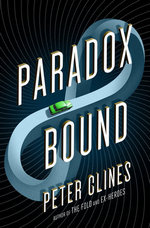
Paradox Bound by Peter Clines

Paradox BoundParadox Bound

by Peter Clines

Hardcover, 369 pg.
Crown, 2017

Read: November 8 – 9, 2017


Sanders is a typical American small-town, so typical, I felt like I grew up there. Thankfully, unlike Sanders, the place I grew up in has moved on, Sanders has not. There’s still a Video Rental Store there, for crying out loud. Those who work with computers, or want to have much of an idea about contemporary pop culture, have to move away — or at least commute.

Eli Teague is just such a person — but before he commutes to his IT job from his apartment above the Video Rental Store, he grows up in a pretty typical way. With one exception: twice while growing up, he encounters a young woman dressed incredibly oddly while working on an old Ford Model A, which seems to be fueled by water. They spend a little time conversing each time — typically leaving Eli more confused than he’d have thought possible — then she drives off and disappears. This instills in him an obsession with historic cars, that spills over into American History in general.

As an adult, he encounters her again and inadvertently puts her in danger. He abandons everything he knows in an effort to save her from this and ends up joining her on a hunt through history. Harry (this mysterious woman) travels through history — she’s not a time traveler, she’ll be quick to point out, she travels in history. She’s not crazy about bringing Eli along with her, but literally has almost no choice in the matter.

Harry . . . she’s a great character, and I would’ve appreciated a lot more focus on her, and getting to see much more of her past. Maybe not getting to actually helps, because it makes the reader more curious about her — but I’d still have rather had a better look at her life before Eli became a regular part of it. She’s tough, loyal, cunning — but no superhero, just a strong person.

Short of spoiling the whole thing, this is one of those I have to be very vague about the details, but then why should you read it? I’ll leave it to you to read the book to get more about the hunt they’re on, but I’ll just say that it’s a great idea, a wonderful concept. The other hunters (and allies) we meet are interesting, but man, I’d love more of all of them — there’s some great historical cameos, too. Naturally, we need an opposing force to make things more tense — and we have one of the creepiest around in these pages. They’re not evil, not corrupt, not anything but driven (and with a skewed way of looking at things).

There’s a nostalgic, hopeful tone throughout — despite the sharp critique of the status quo in America. There’s an evident wit behind the words, too, but this isn’t what you’d call a funny novel. I do think that Clines and I would differ a bit on some of the ways he interprets parts of the national character/psyche, but I can appreciate what he was going for (that’s one of those things that’ll make more sense after you read the book). The characters — whether we like them or not — are very human, very relatable, and pretty sympathetic. Clines has again taken some tropes, concepts, ideas that we’re familiar with — some we know very well, but skewing them just a hair and resulting in something we haven’t seen before.

I expected this to be a pretty good read after The Fold a couple of years ago, but I wasn’t expecting something as fresh feeling as this (but with the skill of someone who’s written a few novels). There’s a dash of civics lessons, some cultural commentary, and a lot of hope — things you don’t always get in light(ish) SF. I “bought into” this book much more quickly than I did The Fold, I’m not sure if that’s because Clines earned my trust in the previous book, or if there’s something more accessible about this one — either way, it’s something for the “Plus” column.

Give this one a whirl — you’ll be glad you did.

2017 Library Love Challenge

—–

4 Stars

Breaking Bad 101 by Alan Sepinwall

Breaking Bad 101Breaking Bad 101: The Complete Critical Companion

by Alan Sepinwall

Hardcover, 281 pg.
Abrams Press, 2017

Read: November 15, 2017


So, I’m pretty sure I don’t need to explain what Breaking Bad is, do I? One of the greatest TV dramas of all time, Mr. Chips turns into Scarface, et cetera, et cetera. This book is a collection of brief essays about each episode, a critical companion, fan resource, and all around handy book.

Most of these chapters started out as episode recaps on Alan Sepinwall’s blog generally posted a day or two after the original airing — a couple were written just for this book because he didn’t recap each episode in season 1 and a later episode deserved a better recap (for reasons Sepinwall explains) — although the original version is included as well. He does take out some of he speculation and whatnot from the original posts to provide a nice, clean look at each episode. It’s more than just an episode recap, he looks at the arcs, the acting, writing, cinematography; in just a few pages he gets to the heart of the episode and helps you see all things that Gilligan et. al. were doing. The real gems are the footnotes and sidebar pieces that dive in a little further to the nitty-gritty details — why was this decision made, where’d actor X come from, and so on. Seriously, fantastic footnotes.

This is a quick and wonderful read if you do it start to finish — or you can just thumb through, stopping at random points to read up on an episode. The book works both ways. I imagine the best way to read it is with a remote in one hand, a DVD/Blu-Ray disc in your player and the book in the other hand. Watch an episode, read the chapter — skipping around in the episode to re-examine shots/sequences, etc. I haven’t done that, but man, I’m tempted to.

A few other things worthy of note: Damon Lindelof wrote a very amusing foreword; Max Dalton provided 12 black and white illustrations that are just perfect; the dust-jacket design is great; but more than that, the actual cover is even better; and lastly, the whole book is so well-designed and pleasing to the eye, it’s nice just to look at without reading. I don’t mention those kind of things enough, and need to get better about it.

Now, I’ve been a fan of Sepinwall’s recaps/writing since the days he posted about NYPD Blue on Usenet. I also read all these posts from Season 2 on within a few hours of their original posting (I didn’t start watching until after the season 1 finale — so I read all of those in a couple of days, still pretty fresh). So I was pretty predisposed to enjoy this book, but I’m pretty sure I would have anyway.

Sepinwall is a fan of Breaking Bad, most of the stories, most of the performances, etc. But he’s a thoughtful fan, not a mindless one — he is critical of some things, this isn’t just someone being a fanboy. I heartily encourage fans of the show to pick this up — or people who’ve been meaning to watch it, but haven’t (this book would be a much better companion than your friends who will be patronizing about you finally getting around to watching it).

—–

4 Stars

Things aren’t looking good

for my backup location:

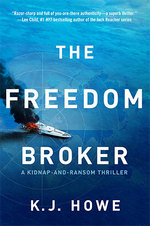
The Freedom Broker by K. J. Howe

The Freedom BrokerThe Freedom Broker

by K. J. Howe
Series: Thea Paris, #1

Hardcover, 361 pg.
Quercus, 2017

Read: November 6 – 7, 2017


Thea Paris is such a cool character — she’s like a combination of Charlie Fox and Vanessa Michael Munroe — but with a very different load of emotional baggage. When she was a child, her brother was sleeping in her room to help her make it through a hard night when he was kidnapped. She’s spent the following decades convinced that the only reason he was kidnapped is that the abductors thought he was Thea. Yes, he eventually made it back safely, but he was (obviously) never the same, and Thea used that to fuel her mission in life. Her father is the tycooniest of American Oil Tycoons, and she could’ve easily rested on his laurels, or followed in the family business.

But no, Thea is in private security, with an emphasis on K&R (Kidnapping and Ransom). She’s the one negotiating with kidnappers/their representatives to get a ransom paid and the victim returned to his home/family/nation/company. When that doesn’t work, Thea will lead the extraction team doing what they can to bring the victim home. She’s one of the best around. She is not perfect, and we see that right off, but she gets the job done well.

Which is good, because on the verge of one of the biggest deals of his life, Thea’s father, Christos, is kidnapped. It’s up to her, some allies and friends to bring him home. There are several candidates for the kidnapper’s identity — there’s the Chinese oil corporations competing with her father, there are representatives of the African nation that kidnapped her brother all those years ago, there’s an arms dealer that has rumors flying, too. In the midst of this hunt, secrets will be revealed (many Thea will regret learning), and virtually everyone in her life will end up divulging something dark and hidden.

One more thing about Thea — she’s diabetic. Which is an interesting character trait — I can’t think of another action hero with something like that: a real physical condition that requires maintenance, but is manageable and will not ordinarily cause anything more than inconvenience. Sure, it does give us what I’m calling Chekhov’s glucose monitor (not a spoiler, that’s what I put in my notes when it was first mentioned).

I liked the other characters, too — but it’s hard to talk about most of them without getting too heavily into the plot. So let’s just say there are a few people I’m really looking forward to seeing again, and a few that I enjoyed enough this time out, but am very glad they’re in no position to show up again. Just about everyone has a believable motivation — no matter what side of the law and/or morality they fall on — which is just great.

Howe’s prose is tight and the pacing is great. There’s a few times that Thea has the same thought over and over — which is probably realistic, but it seems repetitive (and possibly not trusting the reader enough) to read her conclude “X may have done Y” in a chapter, and then “Y may have been done by X” in the next. But it’s nothing to get too worked up over, I didn’t think. Howe does seem to have an “everything including the kitchen sink” approach to story telling — the number of things that go wrong during Thea’s search for her father, and the number of opponents and obstacles in her way is seemingly endless. I love it, every time you think she’s on a roll and things are going to start going her way, a problem that the reader should’ve seen coming (but almost never does) shows up to derail things again. Sure, eventually, that comes to an end — the book doesn’t go on forever — but not until Howe’s good and ready for it to end. She’s probably getting a new kitchen constructed to hurl at Thea in the next book.

There’s a great mix of action and intrigue, putting clues together and smacking heads, emotional growth and uncovering the past. Like it’s protagonist, The Freedom Broker isn’t perfect, but it gets the job done well. Sign me up for the upcoming sequel, too.

—–

3.5 Stars

2017 Library Love Challenge

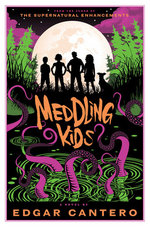
Meddling Kids (Audiobook) by Edgar Cantero, Kyla Garcia

Meddling KidsMeddling Kids

by Edgar Cantero, Kyla Garcia (Narrator)

Unabridged Audiobook, 12 hrs and 53 mins
Random House Audio, 2017

Read: October 27 – November 11. 2017


Going to be brief here, this is one of those books that’s all about the concept, if it’s up your alley, you’ll like the book.

The Blyton Summer Detective Club was a group of kids who met up on school breaks in a small Oregon town from their various homes/schools who solved mysteries à la the Hardy Boys, Three Investigators, Nancy Drew and most importantly, Scooby and the gang. Time after time, they’d uncover the solution to a mystery plaguing the community — usually resulting in finding a man in a rubber suit, explaining everything. Meddling Kids asks the question: what if the solution to the mystery wasn’t (just) a man in a rubber suit? What if the kids stumbled on to something actually mystical, real monsters, etc.?

Following their last case, the gang’s lives went in separate ways — mostly downhill. Incarceration, mental health treatment, academic struggles, addiction, and so on. Finally, more than a decade later, the Detective Club reunites to return to the scene of their last triumph to see just what they missed (or suppressed).

Cantero’s execution of this premise was spot-on, early on he left the satirical component/pop culture commentary behind (pretty much), and just told the story, using that as a foundation. Really not much more to say then that.

Kyla Garcia’s narration was pretty good. A time or two I had a little trouble following it, but I think that’s reflective of the text — which doesn’t seem like the easiest to translate to this medium (not a slight on Cantero or Garcia’s talents there). On the whole, though, she did a fine job bringing this book to life and I’d enjoy hearing another book she narrated.

An entertaining celebration of the genre, a rousing adventure, and a pretty creepy story. Pretty much all you could ask for.

—–

3 Stars

Page 2 of 4

Powered by WordPress & Theme by Anders Norén