Month: September 2019 Page 2 of 4

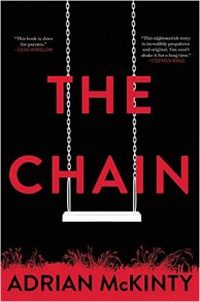
The Chain by Adrian McKinty: Move Over, Stanley Milgram, The Chain is here

The Chain

The Chain

by Adrian McKinty

Hardcover, 357 pg.
Mulholland Books, 2019

Read: July 17-18, 2019

The house is musty and empty. A thin layer of dust coats the kitchen surfaces. No one has been in here since early September. She closes the kitchen door behind her and explores the home.

Three uninteresting levels and a very interesting basement with brick walls and a concrete floor and nothing in it but a washing machine, a dryer, and a boiler. The house is held up by a series of concrete pillars and she could, she thinks in disgust, chain someone to one of those pillars. She checks out the little window above the dryer. She’ll cover that with a board she’ll get from the hardware store in town.

Rachel shivers With a mixture of fascination and revulsion. How can she think about this sort of thing so glibly? Is that what trauma does to you?

Yes.

It reminds her again of the chemo days. The numbness. The feeling of plunging into the abyss and falling, falling, falling forever.

How do I add anything to the discussion about The Chain? How do I say something that hasn’t been said by (seemingly) everyone this side of the English Channel? Honestly, how do I say anything about this book that left me speechless, reeling, and nigh-despairing multiple times? How can I say anything meaningful about this book without giving anything away?

In order: Probably can’t. Forget that. Good question—very carefully and with a focus on brevity, I guess. Here goes.

A lot of this first paragraph is well-known, this book has been talked a lot about. But even knowing this, I wasn’t prepared for the first few chapters as McKinty put flesh on the premise.

Rachel O’Neill, nearly a year into remission, is on her way to see her oncologist about some blood test results. It can’t be good news that he’s making her come in for, right? On her way, she gets a phone call that will change her life—her daughter has been kidnapped. To get her back, she has to do a few things: 1. Pay an almost impossibly high ransom (note the use of “almost”); 2. Kidnap some other child; and 3. Wait for that child’s parents to kidnap someone and then Kylie will be released unharmed. If Law Enforcement (of any kind) is involved or any of the three steps are violated, Kylie will die. If not, she’ll be free to go straightaway. It’s clearly understood, but not really stated (immediately, anyway)—once Kylie is home Rachel will do anything the Chain tells her to do in the future—or . . .

That’s pretty much the high point of the book for Rachel. The first part of the book concerns itself with this horrible scenario. What corners will she cut? What laws (actual written laws, or the understood conventions of society) will she bend and break? What lengths will she go to in order to save her daughter? In the end, she takes all the necessary steps to secure her daughter’s release, because what other choice does she have? And as she thinks as she stalks a potential kidnapping victim:

She looks at her watch. Not yet five o’clock. This morning when she woke up, she had been a completely different person. As J. G. Ballard pointed out, civilization is just a thin, fragile veneer over the law of the jungle: Better you than me. Better your kid than my kid.

(I should point out, she’s not being pretentious, nor is McKinty taking liberties to force allusions into the character. Rachel’s a philosophy instructor, that’s how she thinks—a brilliant bit of characterization because she can retreat to thoughtful insights as a way of dealing with the stark reality she finds herself in)

During this part, while Kylie is (rightly) terrified, I generally actually felt worse for Rachel than her daughter. Which I hope doesn’t say something horrible about me—I think it says more about where McKinty puts the reader: smack-dab in the middle of Rachel’s perspective while seeing Kylie from the outside.

The second part of the book picks up months later, showing us the fall-out of the encounter with The Chain in the lives of those we met in Part One. For good reasons as well as convention, this is something that Crime Fiction does too rarely. It’s not just a murder, it’s the shattered lives of those close to the victim that will not fully recover; it’s not just a burglary, it’s the loss of a feeling of personal security that takes people years to come to grips with; and so on. McKinty allows us to see the repercussions of all the choices made and actions taken by Rachel (and The Chain regarding her).

Which is just devastating, really. Again, the panic and terror that assaulted her in the first few minutes after receiving the phone call is the high point for this poor mother.

We also get a little—not exhaustively, but enough—backstory concerning those running The Chain in this part. McKinty doesn’t make any effort to glamorize them or explain away their evil. Yes, there might have been things in their pasts that shaped them, but they chose this atrocious path knowing full well what they were doing.

I don’t want to talk too much about the book or the characters—I’ll end up ruining something if I do. We get to know Rachel pretty well—she’s intelligent, caring, and tenacious. She’s also tired, emotionally worn out after the medical and personal events of the years immediately before this. You can usually say this about the victim of crime (in reality or in fiction), but she really didn’t deserve any of this. It’s easy to second guess what she does, the compromises she makes and what she abandons. But it’s impossible not to empathize with her.

On the cover, there’s a quotation from Don Winslow, calling this “Jaws for parents.” Before he wrote Say Nothing, someone gave Brad Parks some advice that he should write about what terrifies him the most. I don’t know if anyone gave McKinty that advice or something like it, but it sure reads that way. I can’t imagine there’s not a parent alive who can read this without worrying about their kids, and reconsidering how closely to track their movements and activities.

Before executing her kidnapping plan, Rachel says:

“But even if it all goes right, . . . it’ll still be absolutely terrible.”

For her, that’s true. For the reader? It’s absolutely false. The tension is dialed up to 11, the pacing is relentless, the stakes are high enough that the reader should make sure their blood pressure prescriptions are filled. The Chain is as compelling and engrossing as you could want. It’s a near-perfect thriller that doesn’t let up. If you haven’t read it yet, you need to fix that pronto.


4 1/2 Stars

2019 Library Love Challenge 2019 Cloak & Dagger Challenge

Saturday Miscellany—9/21/19

Been a busy, busy day, just now had time to sit down and list off the odds ‘n ends over the week about books and reading that caught my eye. You’ve probably seen some/most/all of them, but just in case:

    This Week’s New Releases I’m Excited About and/or You’ll Probably See Here Soon:

  • Land of Wolves by Craig Johnson—I’m looking forward to seeing how life is doing for Walt back in Wyoming. After the (IMHO) less-than-successful Depth of Winter, I think this could be a turning point for the series.
  • System Failure by Joe Zieja—The Epic Failure trilogy concludes. I’m expecting to laugh a whole lot when I start this (hopefully Wednesday). Some of the best humorous SF, I’ve ever read.
  • A Little Hatred by Joe Abercrombie—the generation after The First Law seems to be just as messed up as their forefathers. Gotta be a blast.
  • Kopp Sisters on the March by Amy Stewart—Constance leaves the jail behind and trains for WWI service

Lastly, I’d like to say hi and extend a warm welcome to agnieszkaweiner
(say that fives times fast) and Bill for following the blog this week. Don’t be a stranger, and use that comment box, would you?

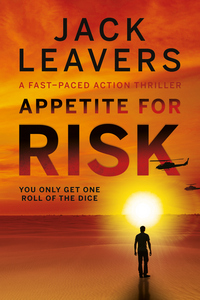
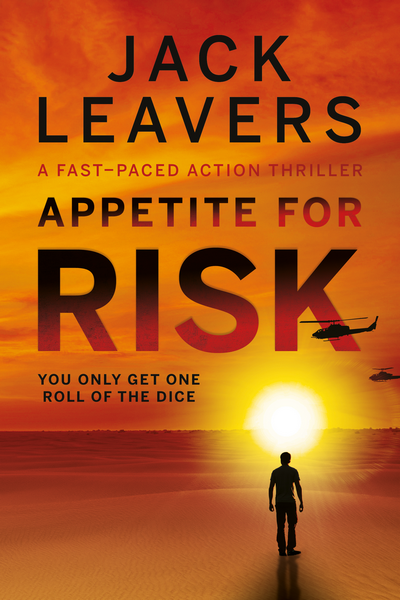
Appetite for Risk by Jack Leavers: An Unusually Realistic Thriller

Appetite for Risk

Appetite for Risk

by Jack Leavers
Series: John Pierce, #1

Kindle Edition, 352 pg.
Book Guild, 2019

Read: September 13-16, 2019

It’s 2004, Saddam Hussein is out of power and the focus is shifting to rebuilding Iraq (few have any idea of the insurgency just around the corner), which sounds great to John Pierce. He’s a former Royal Marine trying to support his wife and two kids. He’s done the typical security/investigations work, but that isn’t really satisfying to him. He does have a few good contacts in or related to Iraq and decides to try to build a business there.

I intended to provide consultancy services to international companies, using local support and knowledge to help them win a share of the reconstruction contracts. Iraq needed everything after the West had sanctioned and bombed it to a ruin over the previous decade.

It’s not a safe place to be at the moment, but it seems to all that stability is just around the corner, and even after an eventful first trip that might dissuade some from following that path, we’re told:

Despite the risks, there was never any real doubt I would go back. The siren call of adventure was drawing me inextricably to Baghdad. Now I’d started down this road, I remained determined to see where it would lead, hoping desperately that success would be quick to arrive.

The book follows Pierce’s endeavor to find that success from January 2004-December 2005. We travel with him to various locations in Iraq (and surrounding nations) and back home in England. As with most fledgling businesses, there’s a lot of ups and downs, signs of success and trouble alike—when you consider the risks involved in trying to start something in Iraq in 2004-05, the typical struggles of a new venture pale in comparison. Quite inadvertently, Pierce gets the attention of both British and American intelligence and they secure his aid with little regard to the effect that’ll have on his livelihood.

It’s hard to think of this as a novel—it really doesn’t read like one. It reads like a memoir. It may be fiction, but it reeks of authenticity and bears few of the marks of a thriller (or any other kind of novel). This is both a fantastic achievement and a frustration for a reader who expects certain kinds of things from a thriller.

The level of detail is intense—I wouldn’t have thought I’d ever learn anything about how one goes about finding contacts or establishing working relationships in the middle of a war, relying largely on translators and practical strangers to help navigate through the city/populace. On the one hand, it was intriguing and I quite enjoyed being exposed to this kind of thing. On the other hand, there were large stretches where it seemed like nothing was happening—like the dominoes were being set up and instead of knocking them down, the line kept getting longer and more twisty.

I never got bored, but I spent a lot of time wondering “where is this going?” While not every detail or anecdote ended up paying off, enough did to justify reading it and again, the level of detail made it really seem like you were reading the recollection of someone who’d been there. And while the initial 50-60% of the book could be called slow (after the initial chapters, anyway, which dropped the reader into a tense situation before backtracking a few months to establish things), once things picked up, they really picked up.

I don’t know that I ever really made any emotional connection to Pierce—I was pretty unmoved by his marital or financial woes or triumphs. I still wanted to keep reading about what he was going through, but any trouble or danger he encountered didn’t grab me (other than as an obstacle to whatever he was trying to accomplish). I don’t know if this is something Leavers was trying to accomplish, or if it’s the sign of a new author—I tend to think it’s due to the non-fiction-y feel of the work, and I rarely get that connected to actual people I’m reading about.

I think I’m safe when I say that you haven’t read a thriller like this before—it’s a slow burn, but it’s consistently interesting and you certainly feel the imminent threat constantly around Pierce. Once the action kicks into a higher gear, it’s a pretty fast read, but you’ve got to work a little before then. It’s a satisfying read, and one that will reward the time you put in. I recommend it for someone open to an atypical read where the suspense comes from sources you’re not used to encountering (and a few that everyone is used to).


3 Stars

My thanks to damppebbles blog tours for the invitation to participate in this tour and the materials (including a copy of the novel) they provided.

EXCERPT from Appetite for Risk by Jack Leavers: South of Baghdad

From Chapter 10 South of Baghdad

Taken from the start of Chapter 10, this extract sees John Pierce sharing one of my entertaining days in Iraq that occurred exactly as written. It concerned me that editors might want the chapter cut, whereas I think it show in a microcosm the hope, mistrust and deep-rooted anger that permeated Baghdad back then.

‘Look at his face. Can you see his face? He hates you.’ Mr Saleh had suddenly turned from an urbane, confident businessman into an excited Willy Wonka as we’d driven through the gates of his factory to the south of Baghdad. It made a striking change from the recent days spent with the cagey Faris and his crew.

General Imad had introduced the two of us over a phone call from his place the previous day and we’d met up that morning and spent the day together. Instead of focusing on the business set-up, it gave me a chance to spend time with a wealthy businessman and discuss discernible business opportunities.

Lunch had been delicious fish cooked over hot coals in a tented restaurant with an open fire pit by the banks of the Tigris. And Mohammed was right: masgouf was delicious. The place was hired for our exclusive use and his private goon squad sat in a car immediately outside, watching over us and the superbly maintained vintage black Mercedes we’d arrived in.

This wasn’t just for my protection. Local kidnappings were rampant and anyone with money was fair game as were their families. During the war the previous year, most of the prison inmates had ended up free to roam the city and get back to business. With the economy shot to pieces and the scarcity of jobs, crime was about the only sector showing rocketing expansion. Mr Saleh wasn’t taking any chances.

As I checked out the faces of the workers in the compound, I wasn’t feeling the love from any of them. A good job the goon squad were following right behind us or this might have got unpleasant. An especially furious-looking individual with wild hair and wilder eyes stood out. If there was anyone looking angrier than this guy, then I probably needed to be drawing the Makarov.

‘All his family were killed in an American air strike. He hates the Americans. He hates you. If I wasn’t here, he’d try to kill you.’

Why this was said in such an enthusiastic manner I couldn’t quite grasp.

‘Well let’s keep him at a distance. I don’t think it will help productivity if I have to shoot him.’

Mr Saleh’s head turned so fast I thought he had to have done himself an injury. ‘Of course. You have nothing to worry about. I apologise. You are safe here.’

That remained to be seen.

We were about half an hour south of Baghdad at Mr Saleh’s drinks factory. He was giving me the grand tour after I’d explained to him over lunch how I was looking to bring leading Western brands into Iraq and here on the search for suitable local partners.

‘Bring me Coca Cola and all our dreams will be realised,’ he’d told me.

As I inspected the dusty compound, run-down buildings, and forlorn production line, it was difficult to envisage the Coca-Cola quality control people ripping his hand off to sign on the dotted line.

I tried to introduce a diplomatic reality check. ‘Coca-Cola is likely to already have partners here or in Jordan.’ Drinks manufacturing was a sector I knew precious little about and, with no advance warning about the type of business he owned, I’d had zero time to conduct any background research.

Mr Saleh swept my negativity aside. ‘I want you to find me a new production line in the UK or Germany. Send me some details and we can refurbish this factory and make it fit for the big companies. Anyway, we shall expand our water production and become the best brand in Iraq.’

He was thinking big. Provided he had the money, then this could be worth a closer look.

***

‘He’s outraged I brought you here.’

Mr Saleh reverted to being Willy Wonka as we headed back out through the gates. He drove the highly polished Mercedes himself with only me in the car alongside, the goon squad bringing up the rear in the other Merc. Not exactly low profile but the goons bristled with weapons and ammunition, ready for a fight rather than just for show.

The dirt road leading from the factory wound through some undulating terrain on its way to the main road. We rounded a sandy hillock to be confronted by a pickup truck manned by four armed balaclava-clad men bearing down on us. As it slewed to the right, I could see a fifth balaclava behind a large pintle-mounted anti-aircraft gun, a 12.7mm (.50 cal) DShK, or ‘Dushka’. My eyes must have popped out of my head like something from a Looney Tunes cartoon.

I drew the Makarov and hoped they hadn’t spotted me through the tinted windows. Mr Saleh put his arm across.

‘No, Mr John. It’s okay, these are security forces.’

He stopped the car and opened the window to shout a greeting to the vehicle commander as I tried to bring my heart rate back under control. I was going to need a drink tonight.


Read the rest in Appetite for Risk by Jack Leavers.

My thanks to damppebbles blog tours for the opportunity to participate in this tour and the materials (including the book) they provided.

BOOK SPOTLIGHT: Appetite for Risk by Jack Leavers

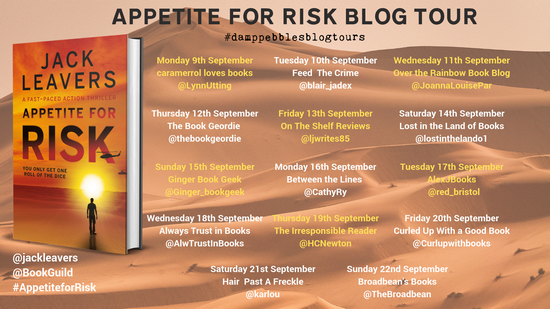
Today I welcome the Book Tour for the unconventional Appetite for Risk by Jack Leavers. Along with this spotlight post, I’ve got a nice little excerpt from the novel posting soon and then I’ll be giving my take on the novel. But before I get to talking about the book, let’s start by learning a little about this here book, okay?


Book Details:

Book Title: Appetite for Risk by Jack Leavers
Release date: July 28, 2019
Publisher: Book Guild
Format: Paperback/Ebook
Length: 352 pages

Book Blurb:


A fast-paced action thriller inspired by real events in the aftermath of the Iraq War.

With Saddam Hussein deposed and an entire country in need of rebuilding, former Royal Marine John Pierce hears the siren call of adventure and opportunity. His fledgling UK business is struggling to support his young family and he has connections in the Iraqi capital – fate seems to point one way.

In early 2004, Pierce rolls the dice when he jumps into a taxi in Jordan and heads for the turmoil of postwar Baghdad to grab a share of the reconstruction gold rush. But when Iraq spirals into the hell of a full-blown insurgency, he must rely on his wits and his local friends if he’s to evade the rampant bloodshed.

As the action rolls across the blood-stained Iraqi landscape and embraces London’s seedy underbelly, Pierce tangles with the authorities at home and finds himself thrust into the heart of British and American covert operations against Al-Qaeda in Iraq.

Having set out with little more than ambitious goals and an appetite for risk, can a determined ex-bootneck survive the mounting chaos unscathed and succeed in hitting the jackpot?

About Jack Leavers:

Jack LeaversJack Leavers is a former Royal Marine with over thirty-years’ experience spread across the military, private security, corporate investigations, maritime counter-piracy, and risk management. His varied career has included numerous deployments to conflict zones around the world such as Northern Ireland, Bosnia, Iraq, Afghanistan, trouble spots in Africa, and the Somali pirate-infested waters of the Indian Ocean.

Jack continues to work in challenging environments and has now begun to pen novels inspired by some of the more enterprising projects that got the green light, and other audacious plans that didn’t.

The current WIP is a follow up to Appetite for Risk that sees ex-bootneck John Pierce return to face a ruthless enemy in Africa.

Jack is normally based in London, UK, but finds he’s at his most productive writing-wise when deployed overseas. Trips to Iraq and Africa beckon, so the follow up should be finished soon.

Jack Leavers’s Social Media:

Twitter ~ Facebook ~ Website

Purchase Links:

Amazon UK ~ Amazon US ~ Waterstones ~ Foyles ~ Nook ~ Google Books


My thanks to damppebbles blog tours for the invitation to participate in this tour and the materials (including a copy of the novel) they provided.

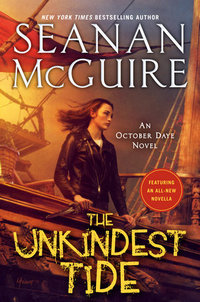
The Unkindest Tide by Seanan McGuire: The Luidaeg takes Center Stage in this Water-filled Adventure

The Unkindest Tide

The Unkindest Tide

by Seanan McGuire

Series: Toby Daye, #13

Hardcover, 301 pg.
DAW Books, 2019

Read: September 10-11, 2019

I finally took my eyes off the water, peering at her through the disheveled curtain of my hair. “Are you just babbling at me until I start feeling better?”

“Yup!” Marcia beamed. “Is it working?”

My stomach was no longer roiling. I didn’t trust myself to stand up on my own, but I also didn’t feel like I was about to introduce the barnacles to my breakfast. Again. I blinked. “Actually, yes.”

“Sometimes you need to take peoples’ minds off their problems if you want those problems to resolve themselves,” said Marcia. “Focusing on things can make them worse.”

“Not all problems go away if you ignore them. Most don’t.”

“No, but not all problems can be fixed. Sometimes you have to wait until the situation changes.” She smiled sympathetically. “Like if you’re on a boat and you get seasick.”

Yup. Toby’s on a boat—a sailing ship, to be precise—just the place for someone who hates water. Why is she there? Well, that has something to do with the debt she owes the Luidaeg. The Luidaeg has decided that time is up and it’s now time to pay that mysterious bill she told the Selkies was coming due. And Toby has to come along to help her collect. A couple of months ago, when I listened to the audiobook of One Salt Sea, I wondered what happened to that ominous future event, so that was nice to see. On the other hand, we’re told that this was nearly three years ago, which means it takes only three-ish years for books 6-12 to occur? That’s an eventful life right there.

Because they’re apt to be useful, and because Toby isn’t likely to come nicely without them, the Luidaeg also brings Tybalt and Quentin along on their trip to the Duchy of Ships, where a convocation of Selkies will be held to pay this bill. Due to the significance of this happening, a few other dignitaries come, too—delegations from the Kingdom of the Mists, the Duchy of Saltmist, and Goldengreen—oh, and Gillian (which makes sense for people who’ve read the previous book, Night and Silence).

So we’ve got a group of Toby’s friends, a new Duchy for most of them to visit, a bunch of debts the Luidaeg is collecting, and the fate of an entire race in the balance. What could go wrong?

Naturally, that’s the wrong question. SOmething better to ask is: how many pints of blood will Toby lose while trying to fix what goes wrong and how many others will die? Obviously, I’m not going to answer those, but we need to get our thinking straight.

Something I want to mention before I forget: Before the Sea Witch shows up at her door, Toby’s narration gives a very thorough and succinct recap of the entire series (one of the best of those I’ve read lately, it’s a tricky thing to accomplish) before noting

…there’s a lot of history around here, and sometimes it doesn’t summarize very well.

It’s a small thing, but it made me smile—McGuire excels at those.

The Luidaeg has got to be just about the most popular character in this series, and we really get to know her so much better here than we have before—and it made me so happy to see this. I’d gladly take another Luidaeg-centric book or three any day of the week. Seeing her at this turning point in all her power and all her grief is just stunning. I don’t think I’d ever felt bad for her (at least not for long), but watching her being resolute in carrying out the duty she was bound to here—while clearly not wanting to go through with it—was moving. Early in the book, there’s a scene between her and a little girl that just about broke my heart. At the same time, she has plenty of great lines and made me chuckle a lot, too. Her interactions with Quentin (and vice versa) might be my favorite parts of the book.

The Luidaeg/Selkie story was strong enough that I don’t care so much about the rest of the book, which is good, because I think it’s one of her weakest. There’s an adventure in Saltmist that seemed pretty perfunctory and while the ending is very clever—and gives Toby a chance to embrace the technicalities of Faerie in a way she usually doesn’t (that is, keeping the letter of the law, but doing a tap dance all around the intent)— it seemed anti-climatic. We have a great build-up and then an almost let-down of a conclusion.

A few quick bullet points that I don’t have the time to expand on (nor do I think I could do them justice without talking too much about them):

  • No one expected, I trust, that things between Toby and Gillian would get better after Night and Silence, but it was tough (yet understandable and believable) to read Gillian’s reactions to Toby here.
  • There are repeated references to the weakness/susceptibility to harm of one member of Toby’s group—McGuire hit that note so often that I really feared for that character. One that I didn’t realize I liked as much as I did when I feared for their safety and longevity.
  • We get to meet another Firstborn! She’s just fantastic and I hope we get to see more of her. Also, the reactions of various members of her descendant races to meeting her in the flesh were priceless.
  • Someone’s blind fosterage is getting harder to maintain. That could prove interesting (and in the Toby-verse, interesting usually is defined as calamitous)
  • Clearly, Toby’s reputation as someone who topples monarchies has spread far and wide. This isn’t good for her, but will be good for us readers.
  • Marcia continues to show more depth and ability than I gave her credit for when we met (which surprises me almost every time we see it)
  • What we’re told about future books here (in terms of Toby’s future obligations) is enough to get long-term readers excited (not that we needed the encouragement, really, but it’s nice to know)

This isn’t one of the best in the series—but it features some of the best moments, scenes, events. It’s not a trade-off I’m entirely pleased with, but I can live with it (and thankfully the good far outweighed the less-good). It’s safe to say that a lot won’t be the same again in this world or for many of these characters. Any time I spend with Toby, Tybalt, Quentin, the Luidaeg, etc. is a good time, and I thoroughly enjoyed the read, I just wanted a bit more from an author who usually brings more than you could realistically ask for.


4 Stars

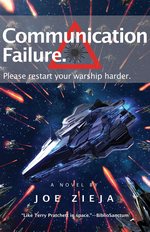
Reposting Just Cuz: Communication Failure by Joe Zieja

Communication FailureCommunication Failure

by Joe Zieja
Series: Epic Failure, #2

ARC, 325 pg.
Saga Press, 2017

Read: October 31 – November 2, 2017


So, Captain Rogers has escaped with his life after saving the 331st Meridian Fleet from a takeover from almost all the droids on board, now he’s been made acting admiral and is faced with a potentially bigger threat: the Thelicosan fleet — the very fleet that Rogers’ ships are to keep on their side of the border — has informed him that they are about to invade. Given the size of the fleets facing off, this is an invasion that will not go well for the 331st.

So how is this would-be con-man, former engineer, and current CO going to survive this? He hasn’t the foggiest idea.

Clearly, for those who read Mechanical Failure (and those who haven’t have made a mistake that they need to rectify soon), whatever solution he comes up with is going to rely heavily on Deet and the Space Marines (the Viking/Captain Alsinbury and Sergeant Malin in particular) will be heavily involved. Malin has taken it upon herself to help Rogers learn some self-defense (even if that’s primarily various ways to duck), the Viking is questioning every decision her new CO is making, and Deet is continuing his exploration into human behavior/consciousness (he’s exploring philosophy and spirituality at the moment — which is pretty distracting). Basically, if Rogers is looking for a lot of support from them, he’s going to be disappointed.

It turns out that the Thelicosans didn’t intend to send that message at all, what they were supposed to communicate was very different, actually. But before Rogers and his counterpart can find a way to de-escalate the situation, shots are fired, milk is spilled, and events start to spiral out of control. Which isn’t to say that everyone is doomed and that war is inevitable, it’s just going to take some work to keep it from happening. There are forces, groups, entities — whatever you want to call them — hawkish individuals who are working behind the scenes to keep these cultures at odds with each other, hopefully spilling over into something catastrophic. Which is something too many of us are familiar with, I fear — and something that someone with Zieja’s military background is likely more familiar with. The Thelicosans and Meridians discover who these people are — and how they are attempting to manipulate the fleets — and the big question is how successful they’ll be.

We focus on three Thelicosans, but spend almost as much time on their flagship (The Limiter) as we do the Meridian flagship (Flagship). Grand Marshall Alandra Keffoule is the commander of the border fleet — at one time, she was a star in the special forces, and now she’s been assigned to the border fleet as a last chance. She fully intends on taking full advantage of this opportunity to make history and restore herself to her position of prominence in the military. Her deputy, Commodore Zergan, has fought alongside her since the special forces days and is now trying to help her rebuild her reputation. Secretary Vilia Quinn is the liaison between the Thelicosan government and the fleet. Quinn’s development through the book is a lot of fun to watch — and is probably a bigger surprise to her than it is to the reader, which just makes it better. Thelicosan culture is saturated in science and math, and is full of rituals that are incredibly binding and incredibly difficult for outsiders to understand. In many ways, the culture is hard to swallow — how a society develops along those lines seems impossible. But if you just accept that this is the way their society functions, it ends up working and stays consistent (and entertaining).

Lieutenant Lieutenant Nolan “Flash” “Chillster” “Snake” “Blade” Fisk, the best pilot the 331st has is a great addition to the cast — yeah, he’s probably the most cartoonish, least grounded, character in Rogers’ fleet — but man, he’s a lot of fun (and I think it’s pretty clear that Zieja enjoys writing him). think Ace Rimmer (what a guy!), but dumber. Mechanical Failure‘s most cartoonish character, Tunger, is back — the would-be spy/should-be zookeeper finds himself in the thick of things and is well-used (as a character) and is well-suited to his activities. Basically, I put up with him in the last book, and enjoyed him here. I’d like to talk more about Deet and the other characters here — I’ve barely said anything about Rogers (he develops in some ways no one would’ve expected) — but I can’t without ruining anything, so let’s just say that everyone you enjoyed in the previous installment you’ll continue to enjoy for the same reasons.

Mechanical Failure didn’t feature a lot of world-building outside life on the ship. Zieja takes care of that this time — we get a look at the political situation between the various governments, and the history behind the four powers. Which isn’t to say that we’re drowning in details like George R. R. Martin would give us, it’s still breezy and fast-paced. Still, there’s a handle you can grab on to, some context for the kind of madness that Rogers finds himself in the middle of.

One of my personal criteria for judging books that are heavy on the humor in the midst of the SF or mystery or fantasy story is judging what the book would be like without the jokes. The Hitchhiker’s Trilogy, for example, would fall apart in seconds (and few rival me for their devotion to that series). Magic 2.0 would hold up pretty well, on the other hand. The Epic Failure series would be another one that would hold up without the jokes. I’m not saying it’d be a masterpiece of SF, but the story would flow, there’d be enough intrigue and action to keep readers turning pages. However, you leave the humor, the jokes and the general whackiness in the books and they’re elevated to must-reads.

There are too many puns (technically, more than 1 qualifies for that), there’s a series of jokes about the space version of The Art of War that you’d think would get old very quickly, but doesn’t — at all; and Rogers has a couple of bridge officers that make the pilot Flash seem subtle. Somehow, Zieja makes all this excess work — I thought the humor worked wonderfully here, and I think it’ll hold up under repeated readings.

I thoroughly enjoyed this book and can’t wait to see where Zieja takes us next.

Disclaimer: I received this book ARC from the author, and I can’t thank him enough for it, but my opinion is my own and wasn’t really influenced by that act (other than giving me something to have an opinion about).

—–

4 Stars

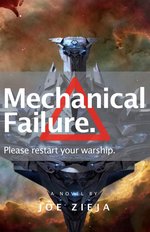
Reposting Just Cuz: Mechanical Failure by Joe Zieja

Oddly tired today, so I can’t get my post for 9/17 finished. So, I’ll dig up a couple of blasts from the past in honor of volume 3 of the Epic Failure trilogy’s release today. There are a few sentences here that I wish I could rewrite, but oh, well…This is one of the funniest books I’ve read in years, and I can’t wait to dive into System Failure.

Mechanical FailureMechanical Failure

by Joe Zieja
Series: Epic Failure, #1

Hardcover, 343 pg.
Saga Press, 2016

Read: August 17 – 18, 2016

No duty was too great that R. Wilson Rogers couldn’t find a way to shirk it.

This is the essence of R. Wilson Rogers (don’t ask what the R. stands for) compressed into one sentence — an engineer for the Galactic Navy during the longest peacetime in Galactic Memory. As a result of all the peace, there’s not a whole lot for a Naval ship to do — nor for the men assigned to it. So, Rogers and his fellow crew members got up to a lot of nonsense — drinking, gambling and worse. Eventually, Rogers finds himself leaving under less than auspicious circumstances. Not long after that, under even less auspicious circumstances (which I’ll leave for you to read about and chuckle over) he finds himself back on the appropriately named Flagship which has transformed in his brief absence in to a serious-minded place, full of random inspections, wartime preparations (despite centuries of peace), and odd assignments.

Before long, Rogers finds himself getting promotions, leading a group of battle droids, and seriously considering suicide and desertion (favoring the the latter, I assure you) — and that’s when things really start to get interesting.

This is pretty decent Military SF with a twist of humor, a dollop of irony, a pinch of satire, and so on — I don’t want to compare it to Adams. But I’ll compare it to a mix of Scalzi, Harry Harrison, Jack Campbell, Grant Naylor and Peter David. There’s a sense of play, even when he’s not going for the comedy, which makes the whole thing fun to read.

Best ‘droid since Marvin, best malfunctioning human personality software since Marvin (or Lore — but not as creepy or murderous), funniest ‘droids since Kryten. I could keep those comparisons going — essentially, I really liked all of the Droids on Flagship (especially Deet). The CO that reminded me of some sort of hybrid between the pointy-haired boss and Douglas Reynholm is great comic relief, but there’s more to him than that.

Honestly, I could go on and on, Zieja assembled a great cast of characters — real enough that you can like them, outlandish enough that you don’t take them terribly seriously. Not just the obviously comedic characters either, there are a few “straight (wo)men” characters scattered throughout, keeping the rest grounded. Rogers is the best of the bunch — there’s a little personal growth to him (no one’s more surprised and dismayed by that than him), I enjoyed seeing that come out. I liked how despite himself he learns to set aside prejudices, take things seriously, and even act a little heroically. I as amused by (and occasionally disturbed by) his attraction to/fascination with the Amazonian Marine Captain. Rogers’ way of looking at the world is pretty relatable (I’m not saying that he’s the kind of guy you spend time with, he’s the guy you want to spend time with), and he’ll win you to his side pretty quickly.

One thing that I really appreciated was the respect that Zieja showed to the military personnel throughout this — too often everyone (with a maximum of a couple of exceptions) in a book like this is depicted as a moron — think of Richard Hooker’s classic for a moment. It’s just one example, but it’s a good one. You’ve got Jones, the Painless Pole, Hawkeye, Trapper, Duke, and a couple of nurses here and there who are competent, if not great, doctors. Who else? Everyone else is a “regular Army” schmuck ho shouldn’t be allowed in an operating theater or near anything where life and death decisions come into play.

Zieja doesn’t play it this way — these Navy and Marine men and women (with one or two exceptions, because there are always exceptions) are treated as competent, equipped and dedicated people whose greatest problem is that they have nothing to do, so things get a little loopy from time to time. But you give then an enemy, you give them a goal, you give them some way to target their talents and energy — good things happen. Even the really incompetent turn out to be quite competent when put in the right spot, doing what they’re good at (even if that’s not what they want to be good at). Problems are solved, crises averted, and enemies thwarted. That’s just not seen often enough, and I appreciate Zieja doing that.

That doesn’t mean he can’t find ways to make fun of the dedicated, the competent, and equipped — but he doesn’t make them into buffoons to do so (mostly).

I knew that I was going to like this book by page 3, I was audibly chuckling by page 4. The rest was just gravy. I laughed, chortled, and grinned my way through this — practically from beginning to end. The story as pretty good, the story plus the comedy made this gold. If I could think of stronger words to use to endorse this, I’d probably slap them here. But I can’t — just get your hands on this one. Meanwhile, I’m already looking forward to the sequel.

Disclaimer: I received a copy of this from the Publisher in exchange for my honest comments on it — sorry for the delay, I greatly appreciate the book.

—–

4 Stars

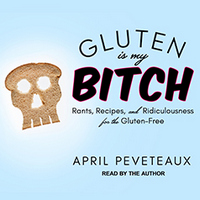
Gluten Is My Bitch: Rants, Recipes, and Ridiculousness for the Gluten-Free (Audiobook) by April Peveteaux: Laughing through the Pain of Gluten Deprivation

Gluten Is My Bitch

Gluten Is My Bitch: Rants, Recipes, and Ridiculousness for the Gluten-Free

by April Peveteaux

Unabridged Audiobook, 3 hrs., 44 min.
Tantor Media, 2017

Read: September 6-9, 2019

Here’s the thing about going gluten-free, whether you’ve been given a celiac disease diagnosis or just know you feel better when you’re not enjoying cinnamon rolls for breakfast, flatbread pizza for lunch, and a pile of spaghetti Bolognese for dinner: It’s f******g hard. I won’t sugarcoat that for you . . . Smiling through the pain of watching your friends enjoy unlimited breadsticks while your plate sits empty does not change the intensity of our shared gluten-free torment. Let’s own that pain and complain about it until we’re asked to leave the party. It’s not all about wallowing in self-pity, though plenty of that is certainly in order. You are giving up chocolate croissants, after all.

This was a fun, fun, book that I’m glad I gave a shot to. I stumbled onto it while browsing my library’s audiobook collection. I don’t have Celiac disease or gluten intolerance or anything beyond a strong tendency to over-indulge, but I do have a child who was recently diagnosed with Celiac disease—and she has not enjoyed the last 10 months at all because of it. I thought I’d try the book to see if I could find any tips for her.

What I found was a laugh-out-loud (multiple times) funny book about the trials and tribulations—plus the occasional triumph—of having Celiac disease or a gluten intolerance, or in her words:

a little guidance, maybe some crazy delicious recipes, and a whole lot of poop jokes.

We haven’t had the chance to use the supplement, “Recipes for the Downtrodden (AKA The Gluten Free)” but they look good. But I can say she takes care of the other two goals just fine.

Starting with talking about her own diagnosis, and some signs that others might look out for, as a way of establishing that she’s coming at this from someone who needs to be gluten-free and understands the plight of her readers, Peveteaux then moves on into the life of the gluten-free eater. She covers a lot of the changes that people have to make—including ones that are not obvious—the struggles to eat at a restaurant or a friend’s/relative’s house, where gluten can hide (on ingredient lists as well as the kitchen), how to raise a gluten-free kid (whether or not the parent is), travel tips (largely based on her own trip to Paris, I can’t imagine trying that), and a look at some of the treatments that are being worked on by medical researchers (and some loons). She closes with some thoughts on gluten-free resources/foods/sources, to help the reader out.

One of the chapters I enjoyed the most was where she discussed the overlap between the gluten-free crowd and Vegan, Crossfit and Paleo eaters (if the book was written now, she’d also include Keto, I think). She manages to poke fun at the groups as well as embrace them as allies and co-belligerents in the restrictive eating trenches. The other thing I appreciated was the encouragement to advocate to yourself without being obnoxious (or realize you’re coming across as obnoxious and at least be aware of it to diminish its impact) in various spheres of life—when it comes to something as vital as the food you put in your mouth, and the ubiquity of gluten, you’ve got to.

Peveteaux is serious about the disease/intolerance, but not about anything else. She makes fun of herself, her inclinations and suffering—helping her readers to do the same for their struggles. The book is a great mix of advice and laughs, guidance and goofiness.

It’s read by the author, and she does a great job with it (as is so often the case). She comes across as the friendly guide to the life sentence that is a gluten-free life from someone walking the same path, so she knows where the potholes are as well as where the best views can be found.

Yeah, it’s a bit dated—thankfully, there are more options in the market now than there were at publication (conversely, there’s a lot more hidden gluten sources, too)—and once or twice it steps over the tasteful line (and does the cha-cha down it most of the time), which makes it hard for Dad to hand to his daughter (who probably hears worse multiple times before her first class starts, but is wise enough not to tell her Old Man). But, I am going to buy a copy of this and put it in her hand. I think she’ll like the approach to the subject, the voice, and tips, but most of all just knowing that she’s not alone in her suffering—but seeing that you can laugh at it, too. I know I did.


3.5 Stars

2019 Library Love ChallengeHumor Reading Challenge 2019

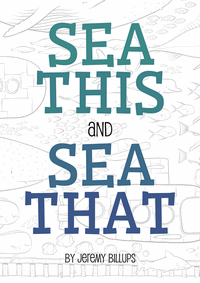
Sea This and Sea That by Jeremy Billups: Plenty of Goodness for the Picture Book Reader to Sea

Sea This and Sea That

Sea This and Sea That

by Jeremy Billups

Hardcover, 44 pg.
2017

Read: September 12, 2019


Off the top of my head, there are essentially three types of Picture Books:

  1. ABCs/123s
  2. Stories told simply (usually with pictures helping the text tell that story)
  3. Odd little collections of interesting/goofy pictures with some text to tie them together.

Myself, I prefer the stories—I’m always on the side of a narrative. But from my observation of my kids, niece, and other children, the third seems to be the most popular. They don’t need a grown-up around to “read” the book on their own, they can just pick it up and flip through the pictures, and the text (usually rhyming) sounds entertaining enough, even if they don’t really get what’s being said. I really know that’s true for my kids, they’d request demand them far more frequently—I can still probably rattle off Boynton’s But Not the Hippopotamus with only a prompt or two, despite not having picked up the book for 12-13 years.

It’s also the kind of book that Billups provides here—it’s set in a “crowded, hectic and gruff” city under the sea, with one quiet spot—The Sea This and Sea That Below the Seashore. Missus Bluffington gives a couple of kids (and the reader) a through her very unusual place, full of all sorts of sea creatures, sea plants, fish, and an octopus that shows up in some unusual places.

The rhyming text is fun, and I can imagine a good parent/adult/caregiver can get a good rhythm going while reading it to entertain their audience, but the star of the show is Billups’ illustrations. They’re just great—there’s plenty of color, while still feeling like you’re looking through blue-green water. The octopus’ tentacle alone is great to keep an eye out for, and I love Missus Bluffington’s glasses. But there’s plenty for a child’s eyes to take in while listening to the text being read to/at them.

I can’t forget to mention that it also includes some great back cover book blurbs that’ll amuse the parent/reader, as well as a couple of visual jokes.

This is a fun little book that’ll appeal to kids who love the look of Finding Nemo/Dory and aren’t quite ready for that other city under the sea, Bikini Bottom. I had fun with it, and I bet adult readers for those kids will, too.


3.5 Stars

Page 2 of 4

Powered by WordPress & Theme by Anders Norén