Month: May 2023 Page 2 of 6

The Ballad of Bonaduke—Episode 23: Grift or Die by R. T. Slaywood: Without a Paddle

The Ballad of BonadukeThe Ballad of Bonaduke—
Episode 23: Grift or Die

by R.T. Slaywood

DETAILS:
Series: The Ballad of Bonaduke, #23
Format: Kindle Vella Story
Read Date: May 25, 2023

I was reminded of the one time my father took me to a natural park…We had been walking for nearly 20 minutes in silence before we heard it shuffle through the underbrush ahead. A bear. Larger than life than [sic] and certainly bigger than any TV picture could have prepared me for. There was a switch in my head that knew immediately how dangerous it was.

The Story So Far…

A drunken Michael Bonaduke decides to use a grift (with maybe some sort of magic/magic-like “help”) to win on a scratch-off lottery ticket so he has money to buy more to drink. He pulls off whatever he did, gets his money and some booze and stumbles off into the darkness to drink himself into oblivion so he can start again the next day. He’s hit by dark memories (probably what’s driving him to the drinking) of fire, pleading, and screaming. There’s going to be a price to pay for his grift, and he’s trying to be ready.

Before then, he gets himself drunk and we get some of his tragic backstory. As he ponders this, he decides to use some of his ill-gotten-gains to buy more booze and walks into a liquor store robbery. He foils it in some sort of magical fashion, gets some more to drink, and heads off to the park to drink until he’s arrested (probably for the failed robbery). At least that’s his plan, but it gets interrupted by being hit by a car. He wakes up on some sort of short, metal bed and is unsure what’s going on. It turns out that some group is subjecting him to a test—if he passes, everything will be explained to him (and hopefully the reader, too). He passes—and is brought somewhere for answers, or maybe training, or maybe another test. Time will tell (or things are going to get really annoying). Answers aren’t quick to come—but the mysteries and questions keep piling up.

Things get hairy and Bonaduke leaves and finds himself back in the neighborhood he started from. Taking refuge in a homeless encampment, Bonaduke has to make some decisions. He starts to get his thoughts in order when the police begin a raid at the camp. During the raid, he’s apprehended by…well, we need to find out. But first, the interrogation kicks off—Bonaduke tries to work his grift to get him out, and while that effort starts off promisingly…it didn’t quite go the way he’d intended.

What’s Grift or Die About?

Er. Whoops. Yeah, he’s out of the police station, seeming free and clear. But he doesn’t have any of his possessions. No jacket, no keys, a wet shirt, and…it’s cold and rainy. Also, he has nowhere to go with the police crackdown on places that the homeless usually go to tonight. Nor can he remember where the apartment Alan and Om were in is. He has one idea but who knows if it’ll work.

So, what did I think about Grift or Die?

Okay, not a lot happens in this episode. But it’s the way that things don’t happen that saves it. The next episode is set up well here, and it kept the reader’s attention.

If it’d gone on longer and got to something beyond where it ended, I might have been happier (and have had something to say), but it wasn’t and I don’t.


3 Stars

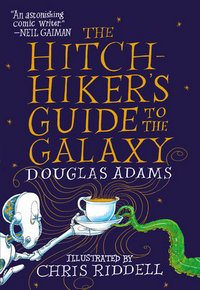
The Friday 56 for 5/26/23: The Hitchhiker’s Guide to the Galaxy: The Illustrated Edition by Douglas Adams

The Friday 56This is a weekly bloghop hosted by Freda’s Voice.

RULES:
The Friday 56 Grab a book, any book.
The Friday 56 Turn to Page 56 or 56% on your ereader. If you have to improvise, that is okay.
The Friday 56 Find a snippet, short and sweet.
The Friday 56 Post it.

I’m stuck in Towel Day mode, apparently…
from Page 56 (and tiny bit of 57) of:
The Hitchhiker's Guide to the Galaxy

The Hitchhiker’s Guide to the Galaxy by Douglas Adams

Away in front of them a huge white dome that bulged against the sky cracked down the middle, split, and slowly folded itself down into the ground. Everyone gasped although they had known perfectly well it was going to do that because they’d built it that way.

Beneath it lay uncovered a huge starship, one hundred and fifty metres long, shaped like a sleek running shoe, perfectly white and mindbogglingly beautiful. At the heart of it, unseen, lay a small gold box which carried within it the most brain-wrenching device ever conceived, a device which made this starship unique in the history of the galaxy, a device after which the ship had been named – the Heart of Gold.

‘Wow,’ said Zaphod Beeblebrox to the Heart of Gold. There wasn’t much else he could say.

He said it again because he knew it would annoy the press.

‘Wow.’

Towel Day ’23: Scattered Thoughts about Reading The Hitchhiker’s Guide to the Galaxy Trilogy


I’ve been trying for a few years now to come up with a tribute to Adams. This isn’t quite what I had in mind, but it’s a start. In my mind, this is a work in progress, but I’m posting it anyway. Next year’s version will be better—or at least more complete.


Some time in 7th or 8th grade (I believe), I was at a friend’s house and his brother let us try his copy of the text-based Hitchhiker’s Guide game, and we were no good at it at all. Really, it was embarrassing. However, his brother had a copy of the first novel, and we all figured that the novel held the keys we needed for success with the game (alas, it did not help us one whit). My friends all decided that I’d be the one to read the book and come back in a few days as an expert.

I fell in love with the book almost instantly and I quickly forgot about the game. Adams’ irreverent style rocked my world—could people actually get away with saying some of these things? His skewed take on the world, his style, his humor…and a depressed robot, too! It was truly love at first read. As I recall, I started re-reading it as soon as I finished it—the only time in my life I’ve done that sort of thing.

It was one of those experiences that, looking back, I can say shaped my reading and thinking for the rest of my life (make of that what you will). Were my life the subject of a Doctor Who or Legends of Tomorrow episode, it’d be one of those immutable fixed points. I got my hands on the next three books as quickly as I could (the idea of a four-volume trilogy was one of the funniest ideas I’d encountered up to that point), and devoured them. I do know that I didn’t understand all of the humor, several of the references shot past me at the speed of light, and I couldn’t appreciate everything that was being satirized. But what I did understand I thought was brilliant. Not only did I find it funny, the series taught me about comedy—how to construct a joke, how to twist it in ways a reader wouldn’t always expect, and when not to twist but to go for the obviously funny idea. The trilogy also helped me to learn to see the absurdity in life.

I read the books (particularly the first) so many times that I can quote significant portions of them, and frequently do so without noticing that I’m doing that. I have (at this time) two literary-inspired tattoos, one of which is the planet logo* featured on the original US covers. In essence, I’m saying that Adams and the series that made him famous have had an outsized influence on my life and are probably my biggest enduring fandom. If carrying around a (massively useful) piece of cloth for a day in some small way honors his memory? Sure, I’m in.

So, Happy Towel Day You Hoopy Froods.

* I didn’t know it at the time, but Adams didn’t like that guy. Whoops.

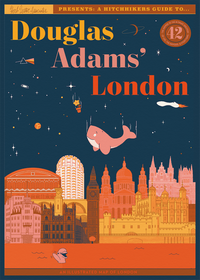
Douglas Adams’ London by Yvette Keller: The Map of London I Never Knew I Needed

Douglas Adams’ London Douglas Adams’ London

by Yvette Keller

DETAILS:
Publisher: Herb Lester Associates
Publication Date: April 15, 2023
Length: 2 pgs.
Read Date: May 6, 2023


What’s Douglas Adams’ London?

This is a map of important locations (42 of them, of course) in London for Douglas Adams, the Dirk Gently series, and/or the Hitchhiker’s Guide series.

The reverse side explains why the locations were selected and gives some biographical information about Adams’ relation to each spot. I loved learning something about Hotblack Desiato, Fenchurch’s apartment, the pizza place Dirk Gently talked about, and so on.

The Design/Art

The map itself has some nice little bits of art scattered throughout—cartoonish little sketches of things like a dolphin, a sperm whale, and a certain depressed android. Just fantastic illustrations that made an already interesting map into something you want to come back to time and again.

The people at Herb Lester Associates who put this together did a simply wonderful job.

So, what did I think about Douglas Adams’ London?

I’ve already given up on my dream of wandering around London—but, boy, howdy, this makes me want to go even more.

Keller is described as “the planet earth authority on Douglas Adams literary tourism,” and will soon publish a travel guide to London. Who better to put something like this together?

Douglas Adams’ London is a gem—even if you never get the chance to put this information into action, it’s great to have.

This post contains an affiliate link. If you purchase from it, I will get a small commission at no additional cost to you. As always, the opinions expressed are my own.

Towel Day ’23: Some of my favorite Adams lines . . .

(updated 5/25/23)

There’s a great temptation here for me to go crazy and use so many quotations that I’d get in copyright trouble. I’ll refrain from that and just list some of his best lines . . .*

* The fact that this list keeps expanding from year to year says something about my position on flirting with temptation.

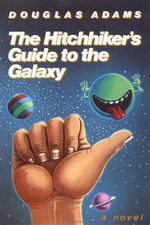
The Hitchhiker's Guide to the Galaxy

The Hitchhiker’s Guide to the Galaxy

Time is an illusion. Lunchtime doubly so.

This must be Thursday. . . I never could get the hang of Thursdays.

“You’d better be prepared for the jump into hyperspace. It’s unpleasantly like being drunk.”

“What’s so unpleasant about being drunk?”

“You ask a glass of water.”

(I’m not sure why, but this has always made me chuckle, if not actually laugh out loud. It’s just never not funny. It’s possibly the line that made me a fan of Adams)

He had found a Nutri-Matic machine which had provided him with a plastic cup filled with a liquid that was almost, but not quite, entirely unlike tea.

In those days spirits were brave, the stakes were high, men were real men, women were real women and small furry creatures from Alpha Centauri were real small furry creatures from Alpha Centuari. And all dared to brave unknown terrors, to do mighty deeds, to boldly split infinitives that no man had split before . . .

“Look,” said Arthur, “would it save you a lot of time if I just gave up and went mad now?”

The ships hung in the sky in much the same way that bricks don’t.

For a moment, nothing happened. Then, after a second or so, nothing continued to happen.

He attacked everything in life with a mix of extraordinary genius and naive incompetence, and it was often difficult to tell which was which.

He felt that his whole life was some kind of dream and he sometimes wondered whose it was and whether they were enjoying it.
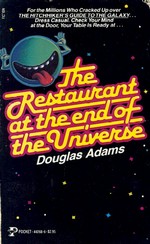

The Restaurant at the End of the Universe

The Restaurant at the End of the Universe

It is a curious fact, and one to which no one knows quite how much importance to attach, that something like 85 percent of all known worlds in the Galaxy, be they primitive or highly advanced, have invented a drink called jynnan tonnyx, or gee-N-N-T’Nix, or jinond-o-nicks, or any one of a thousand or more variations on the same phonetic theme. The drinks themselves are not the same, and vary between the Sivolvian “chinanto/mnigs” which is ordinary water served at slightly above room temperature, and the Gagrakackan “tzjin-anthony-ks” which kills cows at a hundred paces; and in fact the one common factor between all of them, beyond the fact that the names sound the same, is that they were all invented and named before the worlds concerned made contact with any other worlds.

Reality is frequently inaccurate.

Life is wasted on the living.
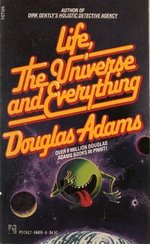

Life, The Universe and Everything

Life, the Universe, and Everything

The Hitchhiker’s Guide to the Galaxy has this to say on the subject of flying. There is an art, it says, or rather, a knack to flying. The knack lies in learning how to throw yourself at the ground and miss.

(It goes on for quite a while after this—and I love every bit of it.)

“One of the interesting things about space,” Arthur heard Slartibartfast saying . . . “is how dull it is?”

“Dull?” . . .

“Yes,” said Slartibartfast, “staggeringly dull. Bewilderingly so. You see, there’s so much of it and so little in it.”
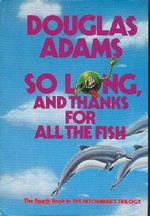

So Long, and Thanks For All The Fish

So Long, and Thanks for All the Fish

Of course, one never has the slightest notion what size or shape different species are going to turn out to be, but if you were to take the findings of the latest Mid-Galactic Census report as any kind of accurate guide to statistical averages you would probably guess that the craft would hold about six people, and you would be right. You’d probably guessed that anyway. The Census report, like most such surveys, had cost an awful lot of money and told nobody anything they didn’t already know—except that every single person in the Galaxy had 2.4 legs and owned a hyena. Since this was clearly not true the whole thing eventually had to be scrapped.

Here was something that Ford felt he could speak about with authority. “Life,” he said, “is like a grapefruit.”

“Er, how so?”

“Well, it’s sort of orangy-yellow and dimpled on the outside, wet and squidgy in the middle. It’s got pips inside, too. Oh, and some people have half a one for breakfast.”

“Is there anyone else out there I can talk to?”

Arthur had a swordfish steak and said it made him angry. He grabbed a passing waitress by the arm and berated her. “Why’s this fish so bloody good?” he demanded, angrily.

“Please excuse my friend,” said Fenchurch to the startled waitress. “I think he’s having a nice day at last.”
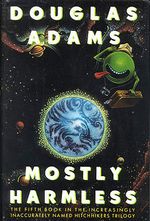

Mostly Harmless

Mostly Harmless

A common mistake that people make when trying to design something completely foolproof is to underestimate the ingenuity of complete fools.

Fall, though, is the worst. Few things are worse than fall in New York. Some of the things that live in the lower intestines of rats would disagree, but most of the things that live in the lower intestines of rats are highly disagreeable anyways, so their opinion can and should be discounted.
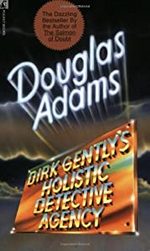

Dirk Gently's Holistic Detective Agency

Dirk Gently’s Holistic Detective Agency

There is no point in using the word ‘impossible’ to describe something that has clearly happened.

If it looks like a duck, and quacks like a duck, we have at least to consider the possibility that we have a small aquatic bird of the family anatidae on our hands.

Let’s think the unthinkable, let’s do the undoable. Let us prepare to grapple with the ineffable itself, and see if we may not eff it after all.

(I’ve often been tempted to get a tattoo of this)
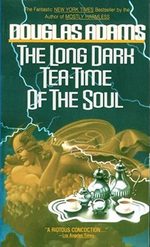

The Long Dark Tea-Time of the Soul

The Long Dark Tea-Time of the Soul

There are some people you like immediately, some whom you think you might learn to like in the fullness of time, and some that you simply want to push away from you with a sharp stick.

It can hardly be a coincidence that no language on earth has ever produced the expression, ‘As pretty as an airport.’

The impossible often has a kind of integrity to it which the merely improbable lacks.

She stared at them with the worried frown of a drunk trying to work out why the door is dancing.

It was his subconscious which told him this—that infuriating part of a person’s brain which never responds to interrogation, merely gives little meaningful nudges and then sits humming quietly to itself, saying nothing.

As she lay beneath a pile of rubble, in pain, darkness, and choking dust, trying to find sensation in her limbs, she was at least relieved to be able to think that she hadn’t merely been imagining that this was a bad day. So thinking, she passed out.
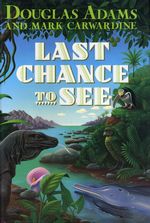

The Last Chance to See

The Last Chance to See

“So what do we do if we get bitten by something deadly?” I asked.

He looked at me as if I were stupid. “You die, of course. That’s what deadly means.”

I’ve never understood all this fuss people make about the dawn. I’ve seen a few and they’re never as good as the photographs, which have the additional advantage of being things you can look at when you’re in the right frame of mind, which is usually around lunchtime.

I have the instinctive reaction of a Western man when confronted with sublimely incomprehensible. I grab my camera and start to photograph it.

Human beings, who are almost unique in having the ability to learn from the experience of others, are also remarkable for their apparent disinclination to do so.

The aye-aye is a nocturnal lemur. It is a very strange-looking creature that seems to have been assembled from bits of other animals. It looks a little like a large cat with a bat’s ears, a beaver’s teeth, a tail like a large ostrich feather, a middle finger like a long dead twig and enormous eyes that seem to peer past you into a totally different world which exists just over your left shoulder.

One of the characteristics that laymen find most odd about zoologists is their insatiable enthusiasm for animal droppings. I can understand, of course, that the droppings yield a great deal of information about the habits and diets of the animals concerned, but nothing quite explains the sheer glee that the actual objects seem to inspire.

I mean, animals may not be intelligent, but they’re not as stupid as a lot of human beings.
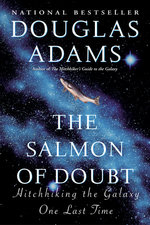

The Salmon of Doubt

The Salmon of Doubt: Hitchhiking the Galaxy One Last Time

I’ve come up with a set of rules that describe our reactions to technologies:
1. Anything that is in the world when you’re born is normal and ordinary and is just a natural part of the way the world works.
2. Anything that’s invented between when you’re fifteen and thirty-five is new and exciting and revolutionary and you can probably get a career in it.
3. Anything invented after you’re thirty-five is against the natural order of things.


And a couple of lines I’ve seen in assorted places, articles, books, and whatnot

I love deadlines. I love the whooshing noise they make as they go by.

A learning experience is one of those things that says, “You know that thing you just did? Don’t do that.”

The fact is, I don’t know where my ideas come from. Nor does any writer. The only real answer is to drink way too much coffee and buy yourself a desk that doesn’t collapse when you beat your head against it.

Solutions nearly always come from the direction you least expect, which means there’s no point trying to look in that direction because it won’t be coming from there.

Towel Day ’23: Do You Know Where Your Towel Is?

(updated and revised this 5/25/23)

The Hitchhiker’s Guide to the Galaxy has a few things to say on the subject of towels.

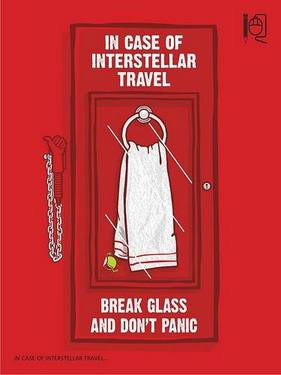
A towel, it says, is about the most massively useful thing an interstellar hitchhiker can have. Partly it has great practical value. You can wrap it around you for warmth as you bound across the cold moons of Jaglan Beta; you can lie on it on the brilliant marble-sanded beaches of Santraginus V, inhaling the heady sea vapors; you can sleep under it beneath the stars which shine so redly on the desert world of Kakrafoon; use it to sail a miniraft down the slow heavy River Moth; wet it for use in hand-to-hand-combat; wrap it round your head to ward off noxious fumes or avoid the gaze of the Ravenous Bugblatter Beast of Traal (such a mind-bogglingly stupid animal, it assumes that if you can’t see it, it can’t see you); you can wave your towel in emergencies as a distress signal, and of course dry yourself off with it if it still seems to be clean enough.

More importantly, a towel has immense psychological value. For some reason, if a strag (strag: non-hitch hiker) discovers that a hitch hiker has his towel with him, he will automatically assume that he is also in possession of a toothbrush, face flannel, soap, tin of biscuits, flask, compass, map, ball of string, gnat spray, wet weather gear, space suit etc., etc. Furthermore, the strag will then happily lend the hitch hiker any of these or a dozen other items that the hitch hiker might accidentally have “lost”. What the strag will think is that any man who can hitch the length and breadth of the galaxy, rough it, slum it, struggle against terrible odds, win through, and still knows where his towel is is clearly a man to be reckoned with.

Hence a phrase that has passed into hitchhiking slang, as in “Hey, you sass that hoopy Ford Prefect? There’s a frood who really knows where his towel is.” (Sass: know, be aware of, meet, have sex with; hoopy: really together guy; frood: really amazingly together guy.)

Towel Day, for the few who don’t know, is the annual celebration of Douglas Adams’ life and work. It was first held two weeks after his death, fans were to carry a towel with them for the day to use as a talking point to encourage those who have never read HHGTTG to do so, or to just converse with someone about Adams. Adams is one of that handful of authors that I can’t imagine I’d be the same without having encountered/read/re-read/re-re-re-re-read, and so I do my best to pay a little tribute to him each year, even if it’s just carrying around a towel.

In commemoration of this date, here’s most of what I’ve written about Adams. I’ve struggled to come up with new material to share for Towel Day over the years, mostly sticking with updating and revising existing posts. But I do have a couple of new things coming today. But let’s start with the old material. A few years back, I did a re-read of all of Adams’ (completed) fiction. For reasons beyond my ken (or recollection), I didn’t get around to blogging about the Dirk Gently books, but I did do the Hitchhiker’s Trilogy:
bullet The Hitchhiker’s Guide to the Galaxy
bullet The Restaurant at the End of the Universe
bullet Life, The Universe and Everything
bullet So Long, and Thanks For All The Fish
bullet Mostly Harmless
bullet I had a thing or two to say about the 40th Anniversary of The Hitchhiker’s Guide to the Galaxy
bullet I took a look at the 42nd Anniversary Illustrated Edition of The Hitchhiker’s Guide to the Galaxy

Also, I should mention the one book Adams/Hitchhiker’s aficionado needs to read is Don’t Panic by Neil Gaiman, David K. Dickson and MJ Simpson. If you’re more in the mood for a podcast, I’d suggest The Waterstones Podcast How We Made: The Hitchhiker’s Guide to the Galaxy—I’ve listened to several podcast episodes about this book, and generally roll my eyes at them. But this is just fantastic. Were it available, I’d listen to a Peter Jackson-length version of the episode.

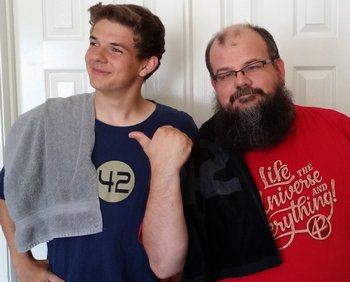
I’ve only been able to get one of my sons into Adams, he’s the taller, thinner one in the picture from a few years ago.
(although I did get he and his younger siblings to use their towels to make themselves safe from the Ravenous Bugblatter Beast of Traal a few years earlier:)

You really need to check out this comic from Sheldon Comics—part of the Anatomy of Authors series: The Anatomy of Douglas Adams.

Lit in a Nutshell gives this quick explanation of The Hitchiiker’s Guide:

TowelDay.org is the best collection of resources on the day. One of my favorite posts there is this pretty cool video, shot on the ISS by astronaut Samantha Cristoforetti.

Even better—here’s an appearance by Douglas Adams himself from the old Letterman show—I’m so glad someone preserved this:

Love the anecdote (Also, I want this tie.)

WWW Wednesday, May 24, 2023

Time for WWW Wednesday!

This meme was formerly hosted by MizB at A Daily Rhythm and revived on Taking on a World of Words—and shown to me by Aurore-Anne-Chehoke at Diary-of-a-black-city-girl.

The Three Ws are:

What are you currently reading?
What did you recently finish reading?
What do you think you’ll read next?

Easy enough, right?

What are you currently reading?

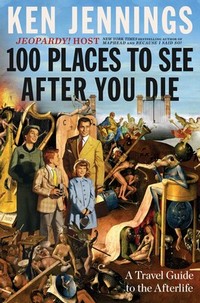
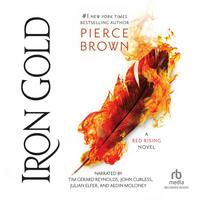
I’m going for a little light reading with 100 Places to See After You Die: A Travel Guide to the Afterlife by Ken Jennings and am listening to Iron Gold by Pierce Brown, Narrated by: Tim Gerard Reynolds, John Curless, Julian Elfer, and Aedin Moloney on audiobook (I’m not crazy about adding the three new narrators, but Reynolds is probably relieved for the help).

100 Places to See After You DieBlank SpaceIron Gold

What did you recently finish reading?

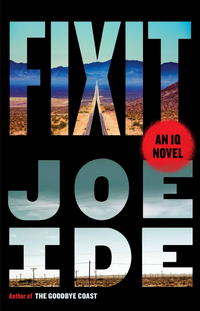
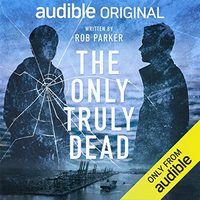
I just finished two great thrillers: Joe Ide’s Fixit and The Only Truly Dead by Rob Parker, Warren Brown (Narrator) on audio.

FixitBlank SpaceThe Only Truly Dead/p>

What do you think you’ll read next?

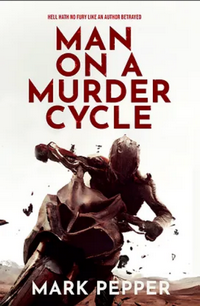
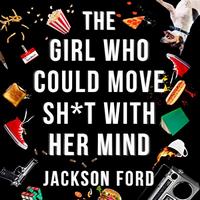
My next book should be Man on a Murder Cycle by Mark Pepper (which is hopefully at least half as good as the premise) and my next audiobook should be a revisit of The Girl Who Could Move Sh*t with Her Mind Narrated by Lauren Patten and Graham Halstead.

Man on a Murder CycleBlank SpaceThe Girl Who Could Move Sh*t with Her Mind

What about you—gearing up for the long weekend (or regular-sized weekend outside of the US)?

GUEST POST: Grave Cold: A Cover Story by Shannon Knight

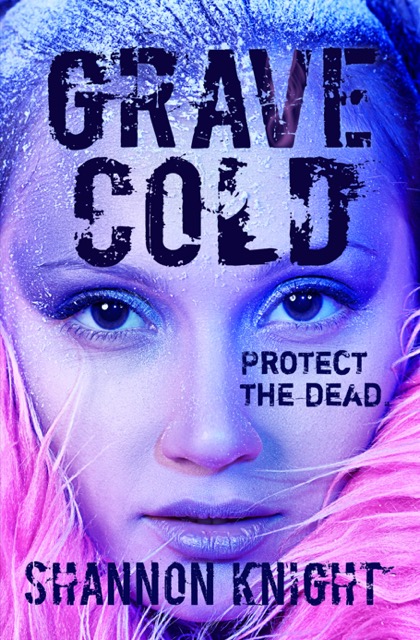
Grave ColdI started talking last week to Shannon Knight about her writing something for this blog and I was wowed by the cover of her book Grave Cold.

Before I knew what was happening, she’d volunteered to write a guest post about cover design. Longtime readers know that this is one of those things that I can read about any day of the week, so I jumped at the opportunity. Here’s the result. I hope you enjoy.

By the way, click on that cover image for a larger version, so you can see the great details that Knight put into this.


Grave Cold: A Cover Story
by Shannon Knight

Books are first judged by their covers. In trad pub, authors have little to no say in what their covers will look like. For self-pub, it’s a big part of the job. Without the marketing and distribution of the Big Five, a strong cover is paramount. Furthermore, without the genre-specific recognition of a major imprint, the need for genre clarity in a glance is also more important. Therefore, self-pub authors have the freedom of artistic chaos on their covers, but choosing the traditional cover hallmarks of their genre still makes the most marketing sense.

What do cover hallmarks even mean? If you peruse any bookstore, you’ll see patterns amongst cover styles. These patterns denote both genre and target age range. In a glance, readers should be able to see if a novel is middle grade, young adult, or adult. Likewise, they should know if it’s non-fiction, romance, mystery, literary fiction, fantasy, etc. Within fantasy, we’d also like to see if it’s epic fantasy, urban fantasy, steampunk, and so on. For example, fantasy tends to use paintings for some sub-genres and manipulated photos for others. The art style of the paintings change for the different age groups. If you haven’t really noticed before, take a look next time you’re in a book store. Additionally, we should get the mood of the book. Is it dark fantasy? Is it comedic? And, of course, there’s the story. What aspect of the story will we depict to pull prospective readers in?

All we need to do is grab the right readers’ attention. Then the cover copy or opening pages can take the next step.

There are different types of artists and graphic designers that an author can hire to create their covers. Some use stock photos and design software. Authors can look through stock photo libraries for the base images they’d like to incorporate and present those choices to the designers. The graphic designers will work to seamlessly layer images and add special effects. Often, these graphic designers will also offer pre-made covers for sale as a way of showcasing their skills. Otherwise, an author can hire an artist to paint a commissioned piece specifically designed for their book cover. After that painting is complete, a graphic artist can incorporate the typography work that transforms the painting into a book cover. Simple, right?

The rising “AI” debacle has created major waves in the book cover arena. Suddenly, generative AI is swamping stock photo sites and graphic designers’ portfolios. Where did this “new” art come from? The stolen labor of artists, degenerated into an amalgamation of mediocrity. These swindlers have broken the art down into components small enough that they hope no one will be able to say where the original art pieces were lifted from. We’re supposed to happily clap our hands and snatch the resold merchandise. We are even encouraged to claim that we’ve created the art ourselves by feeding the machine suggestions. No one has issued laws yet to try and stop us. Guess what, folks? I write sci-fi. I know a dystopian product when I see one! AI enthusiasts mean to carve away the artist from the art till all we have left is a cheap commodity tech bros can make bank on. Even the name “AI,” “artificial intelligence,” is part of the head trip we’re supposed to buy into so that we can pretend a machine and not a human was the source of the work. AI generative wpriting is the same. No special intelligence is involved. It’s a plagiarism machine built on stolen labor. Nope. Not a chance.

My book Grave Cold, which released in May 2023, is biopunk, a sub-genre of sci-fi that often uses altered photos on the covers. Therefore, I went to Shutterstock to look around. I can’t tell you how many hours over how many weeks I spent exploring the options at Shutterstock. I collected a folder of possibilities. Multiple were from the photographer I eventually chose for my cover. Kiselev Andrey Valerevich shoots dramatic photographs. By purchasing a license to use the photo, I was getting Kiselev’s work, the model’s work, whoever did her hair and make-up—multiple human artists were involved. (Dear world, please note how many artistic minds contribute to a finished artwork and the damage to our artistic ecosystem that the mass theft of AI generative products invites. Please decline that invitation. In fact, set it on fire and howl into the night that you refuse to be party to it.) For this step, I had to consider each photo, what it would reveal or suggest about Grave Cold, and what I could add to it with the typography. My runner-up photos had more of a gothic vibe, and I considered pairing them with typography designed to appear like neon lights. The photo I chose already had the color elements that the neon lights would convey. The part of my story my selected art didn’t show was the death theme within Grave Cold. That’s why I chose to place the tagline, “Protect the dead,” right across the model’s cheekbone. With her violet make-up, one might even wonder if the character depicted was alive. Perfect.Grave Cold

Biopunk tends to use sans serif fonts. I initially tried that—boring!—and then switched to a tombstone type font, feeling clever because of the cemetery connection in the story. I confess my cover looked like a fashion magazine and no one but me saw the tombstone link. Fellow author feedback concurred that the typography was a problem. So I decided to lean into the punk with a distressed font. Boycott by Ryoichi Tsunekawa of Flat-it is the title and author font, while Shortcut by Eduardo Recife of Misprinted Type, a clearer font, is the tagline type. These fonts have so much character! They emanate dystopian distress! I was an absolute fool to consider anything else! But the typography still needed a little something. After inserting half a dozen different options into the font face—frost texture, icicles, biohazard symbols—I settled on one wispy trail of spectral smoke in the V of “Grave,” and a whole column of ghostly swirl up the book spine. Unfortunately, that turned into a headache with the printer, as the printed cover wasn’t showing all of the on-screen art on the spine. Cue multiple color adjustments and reprints because the spine is what everyone sees when the book is shelved. It’s gotta look good!

The back of the book went through several changes. Initially, I’d minimized the pink. Feedback suggested that pink was code romance or YA. (This annoys me tremendously. Pink is so punk!) The back was deep blue, surrounded by frost. However, yet again, the print job did not favor the artwork. I switched to a wraparound of the front picture because a) Kiselev’s photo looks great! and b) pink is punk as hell! I drew DNA strands in a style meant to match the distressed fonts. DNA is a giant biopunk signal. I also added a light glow to the back tagline. Nice! Finally, it was done!

In a self-pub power move, I went back into my text and changed my character’s outfit to match the pink faux fur shown on the front. I knew exactly where in the story I wanted to do it. Just like that, the cover image became an excellent story match.

The Grave Cold cover contains hallmarks of biopunk sci-fi and the artistry to make you stop and stare. I love it! I think it’s a great cover. It’s my story’s job to sell the rest.

Next, I have my covers with commissioned paintings. One is space opera and the other epic fantasy. The artists are still working on them, so I’ll write about those another day, but they should release in June and July. Pretty exciting!


Shannon Knight is a science fiction and fantasy author living in the Pacific Northwest.

Grave Cold is a biopunk novel about the value of life and the power of taking a stand in a grim near-future world of exploitation and authoritarianism.

E-books are available on: Amazon, Apple Books, Barnes & Noble, Google Play, Kobo, Palace Marketplace, Scribd, Smashwords, Thalia, Vivlio.

If physical copies are more your thing: Paperback, Hardcover

The Only Truly Dead (Audiobook) by Rob Parker, Warren Brown: This Trilogy Ends as Strongly as it Started

The Only Truly DeadThe Only Truly Dead

by Rob Parker, Warren Brown (Narrator)

DETAILS:
Thirty Miles Trilogy, Book 3
Publisher: Audible  
Publication Date: May 18, 2023
Format: Audible Original
Length: 7 hrs., 3 min.
Read Date: May 19-22, 2023

What’s The Only Truly Dead About?

The ending of And Your Enemies Closer has changed the scene for this series—DI Iona Madison is clinging to her career by her fingernails—under investigation from the events on that roof, as anyone officer should be. But also, thanks to her old boss’ (now exposed) corruption, she has to clean her reputation, too. Those same events reshaped the criminal landscape of Manchester and Liverpool, with new leadership trying to solidify their places.

Rumors are flying about something called the Twilight Express. But no one knows what it could be—other than big. Career-making (or saving) for the police officer who derails it.

It’s risky, but Madison sees only one way to put a stop to Liverpool’s newest crime lord—bring her former DI, his brother, Brendan, in as a consultant. Brendan resists—until his teenage son starts spending too much time with his uncle.

Find out what the Twilight Express is. Stop it. Extract Dan Foley from his uncle. Clear Madison’s name. Any of those would be enough to fuel a book. All four? That’s a daunting prospect. But Foley and Madison are probably the right people for the job.

Poor Red Shirts

Throughout this series, Parker displayed a real knack for introducing (or re-introducing) a character in such a way that you just knew they might as well be wearing a security red shirt from the original Star Trek (he’d also frequently tip his hat in dialogue sometimes so you’d know someone just changed into that uniform). Frequently it annoys me when an author does that—oh, okay, I can stop caring about this character and just wait until it happens.

Parker (with an assist from Brown), however, consistently got me invested in these Red Shirts—and usually surprised me when they were killed. The fact that he did that when I was expecting it here was even more impressive.

I don’t mean to say that he does this with every character’s death—there were characters who died—or survived—that I didn’t expect. And plenty of other surprising turns and twists along the way.

A Pleasant Bonus

Readers of Parker’s Ben Bracken series will see some old friends here—Salix and his NCA team get involved, which was fun.

If you’ve never read the Bracken books, it won’t hurt your appreciation of the characters—you’ll just see them as more people working alongside Madison and Foley. It’s just nice to see some familiar faces in this setting.

What About the Narration?

It’s always important to get a good narrator for an audiobook, doubly (or triply) so when it’s an Audible Original. This is the way that audiences get to experience the book*, so it needs to be great.

Warren Brown was a perfect choice for this trilogy—and you can hear that from the opening of Far from the Tree to the close of The Only Truly Dead. I’ve failed the previous two times to have something more to say about Brown’s work, so at least I’m consistent as I struggle here—he just does a fantastic job and there’s nothing to add to that.

He seems pretty busy with the whole TV thing, but I hope he finds the time for more audiobooks—he’s great at it.

* At least for several months before Red Dog Press can put it out in print.

So, what did I think about The Only Truly Dead?

This book just didn’t stop moving—sure, it was a little slow at the beginning as Parker was setting the stage—but even then, between moving between POV characters and scenes the book had momentum. And it kept accelerating and building up energy until it became unputdownable. (circumstances required I do that with about 90 minutes to go on Friday, and the only reason I didn’t delay any longer is that I knew it was only going to get worse—it was a long weekend waiting for a chance to dive back in)

The ending was as gripping as you could want. A character or two says that it had to end this way, and they were right. As satisfying dramatically as that is—it didn’t necessarily make it easier, or less tense, to read.

The only thing I want to call foul on is the final conversation between Madison and her Acting Chief Superintendent. I want to say that it’s nonsense and that as skeptical as he is of her, no decent officer is going to act that way. But…I can’t. Because it’s probably the most authentic moment in this procedural, if only for it being full of infuriatingly bureaucratic nonsense. You’ll know the scene when you get to it.

Even if the first two books in this trilogy hadn’t hooked me—this one would’ve and would’ve impressed me (incidentally, it’s not vital to have read the previous two to enjoy this). As with the sequel, this isn’t just a repeat of the first novel—new crimes, new characters to enjoy, new and surprising levels of depravity, and a few people stepping up to do what needs to be done to push back against the darkness. A mix of hope and darkness, and a reminder that both have lasting effects.


4 Stars

MUSIC MONDAY: Journey of the Sorcerer by Eagles

Music Monday
Music Monday’s originated at The Tattooed Book Geek‘s fantastic blog and has shown up here and there since then.

Seems fitting for this week…just makes you want to grab your Sub-Etha Sens-O-Matic, a towel, and get off this rock, doesn’t it?

The Irresponsible Reader Metallica Logo

Page 2 of 6

Powered by WordPress & Theme by Anders Norén