

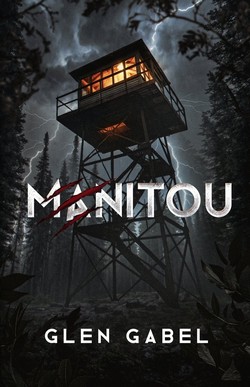
 Manitou
by Glen Gabel
DETAILS:
Publication Date: March 21, 2026
Format: Paperback
Length: 367 pg.
Read Date: June 23-25, 2026


Roy glanced at Tahney. He looked feeble in the firelight, but his eyes were sharp and knowing, flashing a final warning that gave Roy pause. Even with every assurance and every answer in place, an icy dread still pricked at him. As they slowly pulled away from the cabin in Jess’s jeep, he could hear Tahney’s final warning linger in his mind.
“It will go badly.”
What’s Manitou About?
A (mostly) functional alcoholic forest ranger interrupts his attempt at ending his life to go to the site of a small plane crash in the forest. What he finds when he gets to the crash site is a pile of cocaine and a severed arm from the pilot. It’s never easy to see a human like that—but something strikes Roy Farmer as odd about the scene.
It doesn’t matter, the local sheriff chases him off so he and his people can take care of things until the DEA shows up. Roy can’t let it go, though, he believes the sheriff is corrupt and that the drugs may not end up with the DEA. So he starts to do some unofficial digging by talking to a local drug dealer.
It turns out that there’s a local motorcycle club that seems to be trying to expand its business and take on partners from south of the border. But there’s another source for narcotics in the small mountain town, too.
And then more people start dying deaths as grizzly as the pilot did (if not more so). It almost seems impossible for a human to do what the killer is doing—but the only other option isn’t one that Roy Farmer is prepared to believe possible.
Why did I pick this up? Why did I keep reading?
I picked this up because I keep running into Gabel at local events and he seems like a good guy—one that I want to read. And he’s been talking about working on this since we first met, so when it was in front of me finally, I had to try it.
I kept at it because it moved fast and I couldn’t stop asking “what’s next?” Either one of those is generally enough to keep me invested—you add both together—along with a subtle garnishing of “is Character X going to make it?”—and of course I’m staying with it.
What does this book tell us about humanity?
I’m not sure it has a lot to say about humanity or the human condition, really. The book isn’t quite focused on that sort of thing.
But there is a strain of—where did it go wrong? (well, with a couple of the characters that’s not the question, they’re very aware). This marriage, that career, this lifestyle, this dream…something happened that turned it from something good, positive, successful into a struggle to keep going. Into crime, addiction, corruption, or something worse.
Something similar could be said of the small town that this all takes place in. Once it was a thriving—or at least healthy—community where people could raise kids, see them start their adult lives, maybe start families of their own—and so on. Now, it’s a place that kids want to leave when they can. It’s a place that adults want to leave if they could. Or just to wait until their eventual death, stuck in one place because of inertia or loss of hope.
I’m not going to say that anyone comes out of this book whole and ready. I’m not going to say that anyone comes out of this book at all. But somewhere along the line some of these characters realize that they need to make a change, they might even have a glimmer of an idea how to fill that hole in their lives that was created when things started to go wrong.
So, what did I think about Manitou?
This one is a little out of my genre-preferences. It’s near the border of Fantasy and Horror. I think maybe half a foot crosses the border into Horror (maybe more). But it also feels like something that someone trying to C.J. Box would come up with. Actually, replacing the Manitou with a drug-crazed serial killer (or cult of them) would make it look like someone trying to do Joe Pickett, but edgy.*
I joked in a WWW post that there were too many characters in the book, but given the mortality rate, I expected it to get to a manageable level soon. It’s actually not much of a joke—that’s a pretty good way to think of the book. It was too, too crowded with promising characters that would be killed shortly (or several chapters) after their introduction. Some took me completely by surprise when and how it happened. But most were clearly coming from miles away—that didn’t make them less horrific, it just made it easier to take.
I will note that there is one death that I think I understand the reasoning behind, but I will be chastising Gabel about next time I see him.
If the criminal activities in the book were more of a focus, I think I’d have a quibble or two about the depiction of it—it seems a little too easy and obvious. But given the role of them is just to propel certain characters along—and to provide a red herring (for the characters, not the readers) into what’s going on. I’m going to hold my fire on them. Again, if you take out the Manitou, there’s a decent crime novel here after a couple of editing passes.
From the beginning, Gabel focuses on two characters—and it’s pretty obvious that he’s doing so. They’re clearly the protagonists and are going to survive the novel—or at least up to the climactic scene so that you’ll be extra outraged when they meet a violent end. I’m not going to say which way(s) that Gabel goes with them in the end. But keep your eyes on them, everything that Gabel wants to say is there.
Well, at least everything he wants to say about people is there. The overall message of the book—be careful who you don’t give several pounds of cocaine to—comes through without them. And really, who doesn’t need to hear that? Yes, it’s stupid to feed a deer; it’s dangerous to feed a bear—but it’s asking for wanton destruction when you give coke to an unknown.
I’ve gotten off the path here—this is a solidly entertaining novel. The story moves quickly, the action is fierce, and the twists are enough to keep you near the edge of your seat.
* Actually, I think the book might belong in Horror if only because it violates a “rule” that I’ve heard even hard-core noir and/or serial killer novelists won’t touch.
This post contains an affiliate link. If you purchase from it, I will get a small commission at no additional cost to you. As always, the opinions expressed are my own.
Visit the SPAAW 2026 Hub to see what other Self-Published Appreciation Posts are out there.


Image by OpenIcons from Pixabay
The 2026 Self-Published Authors Appreciation Week Logo was made by Witty and Sarcastic Book Club
1 Pingback