Author: HCNewton Page 447 of 633

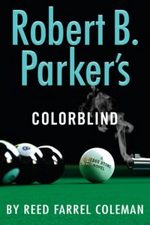
Colorblind by Reed Farrel Coleman: Jesse Stone is Clean, Sober and in Dire Straits

ColorblindRobert B. Parker’s Colorblind

by Reed Farrel Coleman
Series: Jesse Stone, #17

eARC, 368 pg.
G. P. Putnam’s Sons, 2018
Read: July 18, 2018

This is Coleman’s fifth Jesse Stone novel, the seventeenth in the series overall and Coleman has really put his stamp on the character here. He’s made the series his own already, adding depth and shades of color to characters that’ve been around for years, don’t get me wrong. But everything he’s done could be changed, dropped, or ignored in the next — like an old Star Trek or Columbo episode. But following up from the closing pages of The Hangman’s Sonnet, in Colorblind he’s enacted permanent change on Jesse — yeah, things might not go smoothly from this point — he may stumble. But things won’t be the same — cannot be the same without some sort of Star Wars Expanded Universe level retcon. But I’m getting ahead of myself.

First we need to start with the crime part of the novel — it’s ostensibly what people are buying this for, and the novel’s focus. I can absolutely see this happening in Real Life ™ — a white supremacist group from New York is attacking mixed race couples (and by “mixed,” I obviously mean one white person and one person from another race — they wouldn’t care if an Asian man and a Hispanic woman were together) and spreading propaganda in Paradise, of all places. There’s a reason Paradise was chosen — several, actually, and it actually makes sense in context — it’s not just a convenient way to get it into a Jesse Stone novel. Only one of the crimes involved is technically something that Jesse is supposed to be investigating.

Once one of his officers becomes embroiled in this series of crimes — and the possible target of an elaborate frame job — Jesse stops really caring about things like jurisdictions, and will stop at nothing to find the truth. If there’s a connection between the different crimes, he’ll find it. The question he has no answer to is: for what end? Why are these people in Paradise? What do they have to gain from framing his officer?

Yes, certain elements of this story stretch credulity a bit — but in context it absolutely works. And while I say something stretches credulity, I can’t help but wonder if it really does. The actions of this particular supremacist group might not be that much different from the dreams of too many. Also, the race-based crimes, the murders, the vandalism — everything that Paradise or Massachusetts can prosecute people for — are not the biggest evil perpetrated by the members of that group. There’s a deeper darkness working here, something that people with radically different views can also perpetrate — Coleman could’ve gone the easy route and made it all about “Them,” but he points at something that everyone can and should recoil from.

While Jesse works to prevent things from getting out of hand in Paradise, he is struggling to prevent himself from doing what he’s so often done before — retreat to the bottle. He has several reasons to, several excuses to — and decades of experience telling him to do so. Fresh (Very, very fresh) off a stint at rehab, Jesse starts attending AA meetings (in Boston, nothing local that could cause problems for himself or anyone else in the meeting). I absolutely loved this part of the book — I think Coleman’s treatment of Jesse’s drinking (and his various attempts to limit/stop it) has been so much better, realistic and helpful than anything that came before. Colorblind takes that another step up, and sets the character on a path that he needs to be on. Jesse’s not a rock, but he’s working on becoming one when it comes to this addiction. I don’t know (don’t want to know) where Coleman is going with this — but I love it. Character growth/development, an actual healthy approach, and Coleman’s own stamp on the series. Even if Jesse relapses in the future, he’s actually been sober (not just taken a break from drinking) — I love it (have I mentioned that?). It may have been a little too on-the-nose to have Jesse’s new AA friend be named Bill, but, it made me smile.

As for the regulars — we’ve got some good use of Healy (retirement can’t stop him!); Lundquist is settling in nicely to this world (very glad about that, I’ve liked him since his intro back that other Parker series, whatever it was called); Molly was outstanding (it’s hard to mis-write Molly, but it’s very nice when it’s done correctly); and Suit is still the guy you want riding shotgun when things get harry (ignoring the fact that someone else was actually carrying the shotgun when it came to it — it’s a metaphor, folks!). Surprisingly enough, given the B-Story, Dix doesn’t make an appearance — but Jesse can’t stop thinking about him, so he’s here, he’s just “offscreen.” That was a nice touch (and hopefully not too much of a spoiler), it’d have been very easy to have almost as much Dix in this book as Jesse. Coleman has not only got the original cast of characters done well, he’s introduced a few of his own regulars and has merged them into this world well (e.g., Mayor Walker, Monty Bernstein). And it’s not just characters he’s blending, this book is full (not overstuffed) of call-backs to the oldest Stone novels as well as Coleman’s — this universe is alive and well and whole.

As far as the writing — it’s Reed Farrel Coleman, I really don’t need to say anything else. I will say a little bit, though, he balances the various stories and tones of these stories well — the book feels like a natural outgrowth of every book that came before, however minor the stylistic choices and depth have changed over the last few years. Parker could have written this. I don’t think (especially in the latter years) he would have, but he could have. Yet, it’s undeniably a Coleman book. It’s impressive the way that Coleman can do this (see almost everyone that’s tried a Bond novel [honestly haven’t tried one in years, maybe someone has], or Robert Goldsborough to see that not everyone is capable of it). There is one moment, I thought, that Coleman faltered a bit and got into some pretty heavy editorializing — if this was a first person book, it would have worked; or if he had been obviously channeling one of the characters, I wouldn’t have said anything; but when your omniscient third-person narrator gets that opinionated, it’s not good.

A solid crime story that resonates near the too-close-for-comfort zone given the cultural events (which probably is how some people felt with 1970’s Parker), some great character development — and plenty of fodder for Coleman’s next (I ignored one storyline above because I don’t think I can talk about it without ruining it). This is a must for Jesse Stone fans and a decent entry point for new readers, too — it’ll get you to go back and read at least a few older books (I’m more than willing to help a new reader with an “Essential Jesse Stone” reading list — just let me know). Give this one a look folks, it deserves it.

Disclaimer: I received this eARC from Putnam Books via NetGalley in exchange for this post — thanks to both for this.

—–

4 1/2 Stars

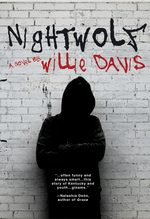
Nightwolf by Willie Davis: A beautifully written book about some horrible people

NightwolfNightwolf

by Willie Davis

Kindle Edition, 286 pg.
7.13 Books, 2018
Read: July 12 – 16, 2018

The police thought they collared Nightwolf. The newspapers kept cagey about it, saying the cops book a person of interest in a “prolonged vandalism case.” Prolonged vandalism–like the tagger had writers block and agonized for weeks, and then returned to the scene of the crime to erase a comma.

In the first three paragraphs, our narrator, Milo Byers sets the stage and the tone for what is to follow — a killer introductory section that is irreverent (at best, cynical, jaded, and — simultaneously — honestly optimistic.

We are then thrown into a giant mess surrounding the culture of runaways and poor teens in Lexington, KY. Dropouts, petty criminals, not-so-petty criminals with aspirations of greater crimes, drug dealers, addicts, users, the mentally ill, the ignored, the abused, and their friends create an interesting cultural web for Milo and his associates to move in. At this time, I’m not sure Milo actually has any friends (at least not to his knowledge), but he is constantly surrounded by people.

Milo’s not technically a runaway — he goes home to his mother frequently, but his mother’s dealing with dementia and other problems, so Milo’s practically orphaned. He had (has?) an older brother who left home a few years before, and no one’s heard from him since. Theoretically, that’s why Milo spends time with some of the criminal class — they knew his brother, and he’s sure that he’ll get a clue if he just hangs around enough.

Also running around the city is Nightwolf. He’s a graffiti artist who dabbles in vigilantism (and not wholly successfully) — a folk hero of sorts. For reasons I’ll let Milo explain, he’s got a theory that Nightwolf is his brother. Now he just needs to meet him to unmask him, hopefully finding his brother — and everything will make sense for him. Despite the book’s title, Nightwolf is a relatively minor character — but his presence (or lack thereof) hovers over just about everything we see Milo do.

Now, all this time — I don’t like Milo. He’s not got a lot going for him as a character, he’s a weasel, he lies to himself and everyone else in his life constantly (and frequently without reason) — it’s not that he’s a criminal, there’s at least something defining the character then. I just didn’t care about him, or about what happened to him. Honestly, he’s the best of the bunch — among this cast of characters he’s the most sympathetic, the most reliable, and the most tolerable. Frankly, I spent a lot of time wondering just what the point of this book was — I didn’t dislike the book, just everyone in it and just about everything they did.

(Small spoiler) Now, at 60% there’s a pretty big time jump. I was totally unprepared for that — and enjoyed someone saying, “Time moves too fast” two chapters later. I was initially annoyed because in many ways this jump ended things before I was ready for them to be ended. But it didn’t take me too long to figure out that pretty much everything before was setting the stage for Part Two. Yes, you could argue that sixty percent of a novel is too long to spend on the introduction — and typically you’d be right. But Davis makes it work. The characters have matured enough, have enough distance from the acts of the first part, and have seen what’s happened since then to those involved, etc. The last forty percent of the novel worked for me in ways that the first didn’t, but it wouldn’t have been able to without the foundation laid.

Whenever I’d brush up against “Southern” fiction in my lit classes in college — those stories/novels became my favorite in the course, and I’ve often intended on taking a year or so to do some sort of deep dive into that tradition — but I haven’t gotten around to it. I should see if there’s an iTunesU (or equivalent) covering that. Anyway, I’ve gotten distracted here. My point is that I can see a direct line from Faulkner and Flannery O’Connor to Willie Davis — particularly the latter. She’d be disappointed in Davis’ attitude toward religion, I think, but she’d note a kindred spirit, I think. That should give you a spirit of the flavor of the novel — agnostic, 21st century O’Connor-ish.

Better yet? Davis has the talent to pull that off. Even when I didn’t like the characters (and I mean “actively disliked” not “didn’t appreciate yet”) and wasn’t sure I wanted to know more about what was happening to them — I could not stop reading the writing. When I didn’t mind the characters and felt a certain apathy toward the plot, I couldn’t stop reading the writing. When I sorta kinda maybe liked one or two of the characters and was curious where things were going — I could not stop reading Davis’ writing. I think you get what I’m saying here. Davis’ writing is worth the hassle. I’m not going to try to explain it really — I don’t think I could. Just go with me on this. At the 9% mark, my notes read “horribly ugly world — beautiful prose.”

The book is funny (not really because of events, it’s largely in the narration), sad, thoughtful, mournful, provocative, visceral, offensive and strange (in the most positive sense of the word). It’s not one for a quick casual read, but will reward the effort. For most of the book — and maybe even now (I’m unconvinced) — I didn’t care what happened, ultimately, I just wanted to see what Davis would do with ideas and language (not that I wasn’t ultimately pulling for a few things to happen plot-wise). I’m not wholly satisfied with the novel — not that I can fully articulate why (beyond really not liking anyone or what they were doing for most of the book) but I have a nagging suspicion that the problems are within me, not the text. I will be keeping an eye out for Davis in the future, and suggest you do the same — but read Nightwolf first.

Disclaimer: I received a copy of this novel from the author in exchange for my honest opinion and this post.

—–

4 Stars

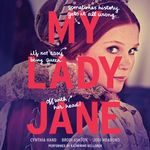
My Lady Jane (Audiobook) Cynthia Hand, Brodi Ashton, Jodi Meadows, Katherine Kellgren: This YA Romance/Alt-History/Fantasy is simply delightful

My Lady JaneMy Lady Jane

by Cynthia Hand, Brodi Ashton, Jodi Meadows, Katherine Kellgren (Narrator)
Series: The Lady Janies, #1

Unabridged Audiobook, 13 hrs., 47 min.
HarperAudio, 2016
Read: July 2 – 5, 2016

           You may think you know the story. It goes like this: once upon a time, there was a sixteen-year-old girl named Jane Grey, who was forced to marry a complete strange (Lord Guildford or Gilford or Gifford-something-or-other), and shortly thereafter found herself ruler of a country. She was queen for nine days. Then she quite literally lost her head.

Yes, it’s a tragedy, if you consider the disengagement of one’s head from one’s body tragic. (We are merely narrators, and would hate to make assumptions as to what the reader would find tragic.)

We have a different tale to tell.

Pay attention. We’ve tweaked minor details. We’ve completely rearranged major details. Some names have been changed to protect the innocent (or not-so-innocent, or simply because we thought a name was terrible and we liked another name better). And we’ve added a touch of magic to keep things interesting. So really anything could happen.

This is how we think Jane’s story should have gone.

So begins the Prologue to this wonderfully fun book. It’s that second paragraph — but specifically the parenthetical sentence — that locked in my appreciation for the book. Thankfully, it continued to be as good as that paragraph, but I was going to be a fan of anything that happened from that point on.

The advantage you have with historical figures that no one knows anything about, is historical novelists — particularly those who like to play with their history — can do pretty much what they want. Lady Jane Grey is probably the English monarch that people know the least about (if they know about her at all) making her perfect fodder for this story.

This is one of those books that I can’t figure out how to summarize, so I’m just going to steal the publisher’s blurb, as much as I hate doing that, but my attempts have a mess, and theirs worked:

           In My Lady Jane, coauthors Cynthia Hand, Brodi Ashton, and Jodi Meadows have created a one-of-a-kind YA fantasy in the tradition of The Princess Bride, featuring a reluctant king, an even more reluctant queen, a noble steed, and only a passing resemblance to actual history—because sometimes history needs a little help.

At sixteen, Lady Jane Grey is about to be married off to a stranger and caught up in a conspiracy to rob her cousin, King Edward, of his throne. But those trifling problems aren’t for Jane to worry about. Jane gets to be Queen of England.

Like that could go wrong.

The characters are wonderful — no one’s perfectly good, or perfectly evil (although there are a few that come close in both directions). The authors keep things moving well, never letting the story detract from the characters, or one part of the narrative take over (there’s plenty of action, romance, friendship, espionage for everyone). Yes there’s magic, yes there’s comedy, but there’s also a lot of heart — a lot of joyful storytelling. This has it all. I really can’t point to a favorite bit, or favorite theme or anything. This is just one of those books I enjoyed all of.

Inside this novel is a love letter to books — and Jane is the representative book lover par excellence (though she could like poetry and novels a bit more) — there’s a treasure trove of quotations about reading, books, and related topics in these pages. All of them delightful.

The novel is clearly clever, witty, with a lot of heart, etc., but what sealed the deal for me was Katherine Kelgren’s outstanding performance. I would’ve enjoyed the novel pretty much no matter who wrote it (I’m not sure Scott Brick or Dick Hill could’ve pulled if off, but you never know), but Kelgren absolutely sold it. Her accent work was outstanding, the life and verve she brought to the project just wowed me.

I’m blathering on, I realize — yet I’m not sure I’ve actually said anything. Bah — just grab the book or audiobook. I don’t care if you’re YA or just A, if you like romance or not, male or female — if you like a fun story that’s well told and never takes itself too seriously (but never makes a joke out of anything important), read it. You’ll have a blast.

—–

4 Stars2018 Library Love Challenge

Saturday Miscellany – 7/21/18

I didn’t spend much time on social media this week — or anything really (see Wednesday’s Programming Note or this longer post on my other blog for details), but I was still able to find a decent list of odds ‘n ends over the week about books and reading that caught my eye. You’ve probably seen some/most/all of them, but just in case:

    This Week’s New Releases I’m Excited About and/or You’ll Probably See Here Soon:

  • The Sinners by Ace Atkins — the 8th Quinn Colson/Tibbehah County novel is sure to be a good one. Sadly, my copy is hundreds of miles away from me, I’ll get to it when I can.
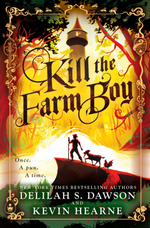
  • Kill The Farm Boy by by Delilah S. Dawson and Kevin Hearne — Part fantasy satire, part celebration of fantasy tropes, all fun and strong fantasy. I blogged about it a few weeks back.
  • Constance Verity Saves the World by A. Lee Martinez — I’ve never read a Martinez sequel before, I don’t know what to expect. But…it’s going to be good.
  • The Annotated Big Sleep by Raymond Chandler; edited by Owen Hill, Pamela Jackson and Anthony Rizzuto — This is also hundreds of miles from me, but one of my kids opened the box and described it to me. Sounds like so much fun.
  • Rescued by David Rosenfelt — Andy Carpenter defends a man he wants to be very far from Here’s what I had to say about it.
  • The Wild Dead by Carrie Vaughn –the sequel to Bannerless a Vaughn book that has somehow not moved from by TBR Tower, this dystopian mystery novel looks just as good as its predecessor.
  • Degrading Orbits by Bradley Horner — another sequel is out before I’ve had the opportunity to read the first in the series. Whoops.

Lastly, I’d like to say hi and extend a warm welcome to figlia dei fiori, Deb / Being Aunt Debbie, Dog Training Guidance, Cristian Mihai, pitchstory,and Jordan Peters for following the blog this week.

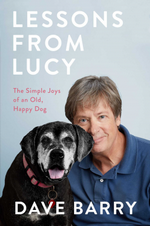
Lessons From Lucy by Dave Barry: America’s Funniest Human Tries to Learn a Few New Tricks from an Old Dog

Lessons From LucyLessons From Lucy: The Simple Joys of an Old, Happy Dog

by Dave Barry

eARC, 208 pg.
Simon & Schuster, 2018
Read: July 19, 2018

Before I say anything else, Barry has set up an Instagram page (well, probably not him, actually — he states in the book he doesn’t understand Instagram) for his dog, Lucy. You should absolutely check it out and then come back to read what I have to say about the book. Dog Pictures > my blog. Pretty near always.

With that out of the way . . . Dave Barry has been a dog person for most of his life, one of the many reasons I like him. I distinctly, and fondly, remember columns and/or references to Earnest and Zippy (the emergency backup dog) years ago. Those two make a brief appearance in this book, but they aren’t the focus. The focus (if you can’t tell from the title) is his dog, Lucy. At the time of writing, Barry and Lucy are the same age — 70 (or 7 times 10 in her case), which means that both of them have many fewer days ahead of them than behind — which sounds awfully morbid for Dave Barry to talk about, but he does so frequently and purposefully.

As they’re at similar stages in life, Barry notices a huge difference between the two — Lucy is far happier and seemingly better adjusted than he is. So he sets out to try to learn a few lessons about life from her, which he passes on to his readers. Things like Pay Attention to the People You Love; Don’t Let Your Happiness Depend on Things; and Don’t Stop Having Fun. None of these, Barry knows, are original or ground-breaking — they’re pretty much common sense. Yet, they’re the kind of common sense things that he (like many/most humans) doesn’t actually do a great job at.

The result is a mixture of a Self-Help book and a Humor book — humor about himself, his life, as well as dogs. Sometimes the swing between the two genres can be jarring, but that’s pretty rare. For the most part, he moves easily between the two, taking the readers along with him on this ride. I can’t tell you how many times I went from grinning, chuckling or laughing out loud to getting misty-eyed within a couple of pages. It seems that Barry has learned a little bit about writing over the decades.

I’ve loved Barry’s humor longer than either of us would probably care to admit. One of his strengths is finding a way to take an old joke, or at least a joke everyone’s made before — like, say, I dunno, dogs sniffing each other’s hind-quarters — and make it feel fresh and new. More importantly, funny. He’s also able to make jumps from premise to punchline that no one expects. There is, for example, a Hugh Hefner joke where one doesn’t even come close to belonging — and it works perfectly. Even knowing that, you won’t see it coming until you’re snickering at it.

As for the heart-felt material? It works pretty well, too. I don’t think anyone will walk away from this book thinking “Wow! That was insightful. I never would have thought of it on my own!” Nor do I think Barry was trying for it. But, readers will appreciate the reminders to live like Lucy (or their own dog), and the way Barry phrases things might add some freshness to the concept. Which is all anyone can really ask.

I really don’t know if this is Barry’s best — but it’s up there. The ratio of Attempted Joke to Funny Joke is pretty high, I’m not sure if I can think of a higher one in his ouvre. Lessons From Lucy is, without a doubt, his most mature, thoughtful and touching work (that’s a pretty low bar, I realize — a bar he’s worked hard to keep low, too). Couple that with me being a sucker for a Dog Book — even if it is a semi-Self Help book — and I can’t help but give it 5 Stars. This is a winner, no matter what.

—–

5 Stars

Disclaimer: I received this eARC from Simon & Schuster via NetGalley in exchange for this post — which is my honest opinion and pleasure to give — thanks to both for this.

Programming Note

Not sure when I will be able to get anything posted here. I’m away from home for a few weeks while my son gets, and then recovers from, a kidney transplant. I expect I’ll be reading a lot (it’s how I deal with…everything), and will likely get some written, too. But I can’t promise a regular schedule, except for those things I actually promised a schedule for.

This morning I was excited, I’d figured out how to talk about 2 books that had flummoxed me for a week, too. Just hope I remember.

Stay tuned, true believers.

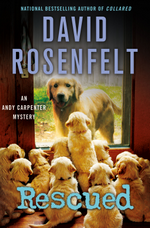
Pub Day Repost: Rescued by David Rosenfelt: A tale of self-defense, an old flame and a truckfull of dogs

RescuedRescued

by David Rosenfelt
Series: Andy Carpenter, #17
eARC, 304 pg.
Minotaur Books, 2018
Read: May 4, 2018

At an early age, Andy Carpenter discovered that he couldn’t hit a curve-ball and therefore had to give up on his dreams of playing in the majors and fall back to following in his father’s footsteps and becoming a lawyer. His father, a lifelong prosecuting attorney, probably wished for something else, but for the many people that he’s defended in court, they wouldn’t have it another way.

This is the seventeenth novel in this series — I’ve talked here about nine of the previous sixteen. There’s part of me wondering just what I could possibly have to say about this one that I haven’t said at least once before.

Andy Carpenter is called to a nearby rest area — a truck containing sixty-one dogs was discovered with the driver shot. Andy and Willie were called out to help the police retrieve the dogs and care for them. The police are really not happy to see him there — Andy Carpenter at a crime scene? Not a welcome sight. But then he’s called away, there’s a prospective new client waiting for him at home.

Not that surprisingly, the potential client was also at that rest area earlier in the day. He actually tells Andy that he shot the driver — in self-defense, mind you. Sure, there’s a history between the two — Kramer (the client) had assaulted the victim and threatened to kill him, in fact. But that was years ago, and he had no current reason to. He just needs some help with the inevitable arrest. Andy believes him — he has to. Kramer is Laurie’s ex and she vouches for him — so much so that Andy pretty much has to take the case for her sake.

Honestly, Andy really isn’t that interested in helping tall, hunky and dangerous Kramer — ex-Military, ex-police, ex-licensed investigator. But it’s not long before he starts to believe that there’s something more afoot. And what was the deal with all the dogs?

All the regulars are along for this ride — Pete Stanton brings the law and order, we get a little more about the fun side of Hike that was introduced in the last book, Sam and his hacking crew dig up plenty of information, Marcus is his typical imposing self, Tara is as loyal as ever — and Andy gets a lot of courtroom time in. There’s a new prosecuting attorney for him to face off against — I liked her, and would like to see her against Andy again.

I don’t think it’s much of a spoiler here, because it’s pretty much the default in this series, but there’s a conspiracy behind the murder and they men behind it have decided to frame Kramer. This is one of the better — or at least one of the more grounded — conspiracies featured in these books. Up to a point, some of it was pretty hard to swallow — it just went a little over the top for my taste (but many of them do in this series). Also, this one features the best code names this side of Reservoir Dogs. Still, it was one of the more clever solutions that we’ve been treated to lately.

A thought about the series as a whole at this point: I would appreciate it if Rosenfelt would shake things up a little bit — I’m not talking about killing Hike or splitting up with Laurie or anything — just dial down the super-criminals a bit, maybe spend some more time with the client again. But there’s little reason for him to do that — the series moves like clockwork and is reliably entertaining. I only say this because I’m a fan — Rosenfelt is in danger of becoming a parody of himself (at worst) or just putting out cookie-cutter books (at best), I don’t want Andy Carpenter to become a Stephanie Plum.

This is not to say that I didn’t enjoy the book — because I did. Andy, Sam, Pete, Vince, Laurie, Tara and the rest are old friends that I enjoy getting together with every few months. Rosenfelt’s latest demonstrates what’s been true for years — this series is at the point where you can reliably count on each book for an entertaining read, a puzzling mystery, some good comic moments, a nice dog or two and maybe even a tug on the heart strings. They’re still charming enough to win over a new reader (and any of the books serve just fine as entry points) as well as satisfying the long-term reader. Rescued delivered just what I expected and left me satisfied — satisfied and ready to read number 18.

Disclaimer: I received this eARC from St. Martin’s Press via NetGalley in exchange for this post — thanks to both for this, it was a real pleasure.

—–

3.5 Stars

Pub Day Repost: Kill the Farm Boy by Delilah S. Dawson and Kevin Hearne: A Comedic Fantasy Tells a Good Story While Playing with Too-Familiar Tropes

Kill the Farm BoyKill the Farm Boy

by Delilah S. Dawson and Kevin Hearne
Series: The Tales of Pell, Book #1
eARC, 384 pg.
Del Rey, 2018

Read: June 5 – 12, 2018
Ugh. I wish the eARC didn’t say I needed to hold off any quotations until I could compare it with the final copy — or maybe, I wish I had noticed that very tiny print before I got half a draft of this finished. On the other hand, I was having trouble narrowing down which of my lengthy options to use, because, if nothing else, this is one of the more quotable books I’ve read in the last couple of years.

Kill the Farm Boy is a comedic fantasy, a satirical look at fantasy and even a parody of the genre. But what makes it effective is that for all the comedy, there’s a decent story and some solid characters throughout. It’s be easy for it to be a collection of jokes, with no story; or a tale full of character types, not characters. But Dawson and Hearne avoid those pitfalls.

The titular farm boy, Worstley, is going about his typical day, full of drudgery when an inebriated pixie shows up to announce that he is a Chosen One — one who is destined to save, or at least change, the world. To demonstrate her power, the pixie gives one of his goats, Gustave, the power of speech. The goat isn’t too happy about being able to speak, but since he was destined to end up in a curry in a few days, decides to travel with the newly appointed Chosen One, his former Pooboy. The pixie, having Chosened Worstley, disappears. Worstley the Pooboy (hey, Taran, worse things to be called than Assistant Pig-Keeper, eh?) and Gustave head off on a quest for glory.

Despite the book’s title, we don’t spend that much time with Worstley — instead the focus shifts (for good reason) to a band of hero–well, a group of companions. There’s Fia — a fierce warrior from a distant land, who just wants to live a life of peace with some nice roses — and some armor that would actually protect her (not that there’s anyone who minds seeing here in her chain-mail bikini). Argabella, a struggling bard who is cursed to be covered in fur — she’s basically Fflewddur Fflam and Gurgi combined (last Prydian reference, probably). Every adventuring party needs a rogue/thief, this one has to settle for the klutzy and not necessarily bright, Poltro, and her guardian, the Dark Lord magician, Toby (though some would only consider him crepuscular), of dubious talents. I can’t forget Grinda the sand witch (no, really), Worstley’s aunt and a magic user of considerable talent.

There are no shortage of villains — and/or antagonists to this party. There are some pretty annoying elves; a hungry giant; Løcher, the King’s chamberlain and mortal enemy of Grinda; Staph, the pixie behind the Chosening; as well as several magical traps, Lastly, there’s Steve. We don’t meet him (I’m betting it’ll be in Book 3 when we do), but throughout these adventures we how much this world, and our heroes lives, have been turned upside down my the worst Steve since one (allegedly) unleashed the preposterous hypothesis that Jemaine was a large water-dwelling mammal. Steve . . .

The writing is just spot-on good. Dawson and Hearne have taken all these various and disparate themes, tropes, characters and surrounded them with a lot of laughs. There’s some pretty sophisticated humor, some stuff that’s pretty clever — but they also run the gamut to some pretty low-brow jokes as well. Really, these two are on a tight comedic budget, no joke is too cheap. The variation ensures there’s a little something for everyone — and that you can’t predict where the humor will come from. I will admit that early on I got annoyed with a few running jokes, but I eventually got to the point that I enjoyed them — not just in a “really? they’re trying it again?” sense, either.

For all the comedy — Kill the Farm Boy hits the emotional moments just right. There’s a depiction of grief towards the end (spoiler?) that I found incredibly affecting and effective. There are smaller moments — less extreme moments — too that are dealt with just right. Maybe even better than some of the bigger comedic moments. This is the reward of populating this book with fully-realized characters, not just joke vehicles.

I have a couple of quibbles, nothing major, but I’m not wholly over the moon with this (but I can probably hit sub-orbital status). There was a bit about a fairly articulate Troll being taken down by a female using (primarily) her wits that could’ve used a dollop or five of subtly. Clearly they weren’t going for subtle, or they’d have gotten a lot closer to it. But it bugged me a bit (while being funny and on point). Secondly, and this is going to be strange after the last 2 posts — but this seemed to be too long. Now, I can’t imagine cutting a single line, much less a scene or chapter from this, but it just felt a little long. I do worry that some of Poltro’s backstory is too tragic and upon reflection makes it in poor taste (at best) to laugh about her — which is a shame, because she was a pretty funny character until you learn about her.

This is probably the best comedic/parody/satire fantasy since Peter David’s Sir Apropos of Nothing — and this doesn’t have all the problematic passages. I’ve appreciated Dawson’s work in the past, and you have to spend 30 seconds here to know that I’m a huge Hearne fan, together they’ve created something unlike what they’ve done before. Well, except for their characteristic quality — that’s there. I cared about these characters — and they made me laugh, and giggle, and roll my eyes. This is the whole package, folks, you’ll be glad you gave it a chance.

Disclaimer: I received this eARC from Random House Publishing Group – Ballantine via NetGalley in exchange for this post — thanks to both for this.

—–
4 Stars

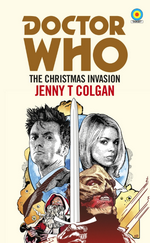
Doctor Who: Christmas Invasion by Jenny T. Colgan: Colgan Captures the 10th Doctor’s First Adventure Perfectly in this adaptation.

Doctor Who: Christmas InvasionDoctor Who: Christmas Invasion

by Jenny T. Colgan
Series: Doctor Who

Paperback, 176 pg.
BBC Books, 2018

Read: July 2, 2018
Back in High School, I remember attending an author event — some SF author that I’d never heard of (you probably haven’t either), but what did I care? He was an actual SF/Fantasy/Horror writer visiting Idaho (it happens a little more now, but back then I hadn’t thought it was possible). He discussed getting to write a novelization of a major Horror film thinking, “How hard can it be? Take the script, throw in some adjectives and verbs — maybe a few adverbs and you’re done!” He then went on to talk about all the things he learned about how hard it was taking a script of whatever quality and turning it into something that works in an entirely different medium. That’s really stuck with me for some reason, and I’ve always respected anyone who can pull it off well (and even those who get close to doing it well).

Before I babble on too much, Colgan is one who can pull it off pretty well.I discovered Doctor Who a couple of years before I saw that unnamed SF author, but didn’t get to watch much of it, mostly because I lived in about the only place in the States where PBS didn’t air old ones. I saw a few Sylvester McCoy episodes (mostly due to the magic of VHS and a friend who lived somewhere with a better PBS affiliate). Other than that, it was the small paperback novelizations of episodes. I owned a few, the same friend owned a few more — so I read those. A lot. Then comes Russel T. Davies, Christopher Eccleston, Billie Piper, etc. and all was better. But I still remembered those novels as being Doctor Who to me.

So when they announced that they were re-launching that series this year, I got excited. I own them all, but I’ve only found time to read one — I started with Jenny T. Colgan, because I know how Paul Cornell writes, and I assume I’ll love his — ditto for Davies and Moffat. Besides, The Christmas Invasion is one of my favorite episodes ever.

I won’t bother with describing the plot much — you know it, or you should. On the heels of regenerating into the 10th Doctor, Rose brings a mostly unconscious stranger into her mother’s apartment to recuperate. At the same time, an alien invasion starts — the British government — under the direction of Harriet Jones, MP — and the Torchwood project tries to respond, but really is pining all their hopes on the resident of the TARDIS.

Colgan does a great job bringing the episode to life — I could see the thing playing out in my mind. But she doesn’t just do that — she adds a nice little touch of her own here and there. Expands on some things and whatnot. In general, she just brings out what was there and expands on it. Adds a few spices to an already good dish to enhance the flavors. Colgan absolutely nails Rose’s inner turmoil about who this stranger in her old friend’s body is.

I particularly enjoyed reading the scene where the Doctor emerges from the TARDIS, finally awake and ready to resume being Earth’s protector — between Rose’s reaction, the already great dialogue, and Colgan’s capturing the essence of Tennant’s (and everyone else’s) performances in her prose. Seriously, I’ve read that scene three times. I never do that.

I’m not particularly crazy about the little addition she made to Harriet Jones’ downfall, but I get it. I’m not scandalized by it or anything, I just didn’t think it was necessary. Other than that, I appreciate everything Colgan did to put her stamp on this story.

If the rest of these books are as good, I’m going to be very glad to read them, and hope that there are more to come soon.

—–

3.5 Stars

Planet Funny by Ken Jennings: Chortling Towards Bethlehem? or We Are Amusing Ourselves to Death

Planet FunnyPlanet Funny: How Comedy Took Over Our Culture

by Ken Jennings

Hardcover, 320 pg.
Scribner, 2018
Read: June 21 – July 6, 2018
This is going to be much shorter — and much more vague –than it should have been, because I was in a rush to get out the door on the day I took this back to the library and therefore forgot to take my notes out of the book. Which is a crying shame because I can’t cite some of my favorite lines (on the other hand, I don’t have to pick from my favorites). I’m actually pretty annoyed with myself because of this — I spent time on those notes.

I’m going to try to save a little time here and just copy the Publisher’s synopsis:

           From the brilliantly witty and exuberant New York Times bestselling author Ken Jennings, a history of humor—from fart jokes on clay Sumerian tablets all the way up to the latest Twitter gags and Facebook memes—that tells the story of how comedy came to rule the modern world.

For millennia of human history, the future belonged to the strong. To the parent who could kill the most animals with sticks and to the child who could survive the winter or the epidemic. When the Industrial Revolution came, masters of business efficiency prospered instead, and after that we placed our hope in scientific visionaries. Today, in a clear sign of evolution totally sliding off the rails, our most coveted trait is not strength or productivity or even innovation, but being funny. Yes, funniness.

Consider: presidential candidates now have to prepare funny “zingers” for debates. Newspaper headlines and church marquees, once fairly staid affairs, must now be “clever,” stuffed with puns and winks. Airline safety tutorials—those terrifying laminated cards about the possibilities of fire, explosion, depressurization, and drowning—have been replaced by joke-filled videos with multimillion-dollar budgets and dance routines.

In Planet Funny, Ken Jennings explores this brave new comedic world and what it means—or doesn’t—to be funny in it now. Tracing the evolution of humor from the caveman days to the bawdy middle-class antics of Chaucer to Monty Python’s game-changing silliness to the fast-paced meta-humor of The Simpsons, Jennings explains how we built our humor-saturated modern age, where lots of us get our news from comedy shows and a comic figure can even be elected President of the United States purely on showmanship. Entertaining, astounding, and completely head-scratching, Planet Funny is a full taxonomy of what spawned and defines the modern sense of humor.

In short, Jennings is writing about the way that humor — the entertainment culture in general, really, but largely through humor — has taken over the cultural discourse in this country, so much so that you can’t make a serious point about anything anymore without injecting a smile or a laugh. This could be subtitled, Neil Postman was right. Jennings looks at this phenomenon through a historical lens (mostly over the last century) and a contemporary lens — analyzing and commenting on both.

The initial chapters on defining humor, the history of humor and academic humor studies are probably the best part of the book — not just because of their scope and subject matter, but because how Jennings is able to be amusing and insightful while informing. (although the amusing part is problematic given the thesis of the book). I enjoyed learning about the use of humor in the 20th Century — who doesn’t associate the two? I don’t remember a time when the best advertisements/commercials weren’t the funniest (other than things like the crying Native American anti-litter AdCouncil stuff). But there was actually a time when that was looked down on? Who knew?

I also particularly liked the history of Mystery Science Theater 3000 and then pivoting that into a look on the way even entertainment changed in the last few decades because of the funny-ification of all things. Jennings gives a pretty decent defense of Alanis’ “Ironic” (while enjoying a few shots at it, too) — and the ensuing discussion of Irony the cultural waves embracing and shying away from Irony, Enjoying things Ironically, and a need for sincerity was excellent.

Politics, obviously, has fallen prey to this comedy-take over as well. From Nixon shocking everyone by showing up on Laugh-In to Clinton (pre-presidential candidate) on The Tonight Show to then-candidate on The Arsenio Hall show to every political player doing Late Night shows. Obama appearing on Maron’s podcast and Between Two Ferns (crediting that appearance with saving ObamaCare?) and onto the entire Trump campaign. At this point, the book got derailed — I think — by getting too political. If Jennings had kept it to Trump’s embracing/exploiting the comedy takeover, I probably would have enjoyed it — but he spent too much on Trump’s politics (while having ignored Nixon’s, Clinton’s, Obama’s), enough to turn off even Never-Trump types.

I’m pretty sure that the book was almost complete about the time that Louis CK’s career was felled by allegations of sexual misconduct — which is a shame, because Jennings had to go back and water-down a lot of insightful comments from Louis CK by saying something about the allegations while quoting the comedian. At the same time, it’s good that the book wasn’t completed and/or released without the chance to distance the man from the points used — otherwise I think Jennings would’ve had to spend too much time defending the use of those quotations.

I think Jennings lost his way in the last chapter and a half or so — and I lost a lot of my appreciation for the book as a whole at that point. On the whole, it’s insightful writing, peppered with a good amount of analysis, research, interviews, and laughs — outside of his weekly trivia newsletters, I haven’t read Jennings and he really impressed me here. In short, it’s a fun book, a thought-provoking book, and one that should get more attention and discussion than it is. I may quibble a bit with some of the details, but I think on the whole Jennings is on to something here — and I fear that it’s something that not enough people are going to take seriously until it’s too late.

—–

3.5 Stars2018 Library Love Challenge

Page 447 of 633

Powered by WordPress & Theme by Anders Norén