Author: HCNewton Page 45 of 603

Towel Day ’25 (observed): Some of my favorite Adams lines . . .

(updated 5/26/25)

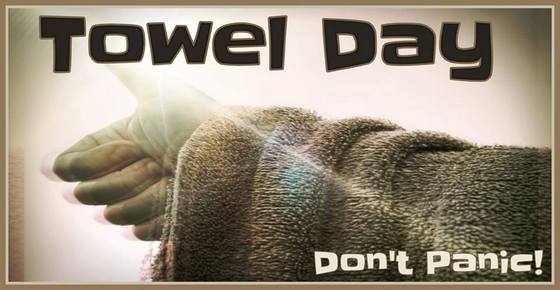
A Blue towel with the words Towel Day on it

There’s a great temptation here for me to go crazy and use so many quotations that I’d get in copyright trouble. I’ll refrain from that and just list some of his best lines . . .*

* The fact that this list keeps expanding from year to year says something about my position on flirting with temptation.
The Hitchhiker's Guide to the Galaxy

The Hitchhiker’s Guide to the Galaxy

Time is an illusion. Lunchtime doubly so.

This must be Thursday. . . I never could get the hang of Thursdays.

“You’d better be prepared for the jump into hyperspace. It’s unpleasantly like being drunk.”

“What’s so unpleasant about being drunk?”

“You ask a glass of water.”

(I’m not sure why, but this has always made me chuckle, if not actually laugh out loud. It’s just never not funny. It’s possibly the line that made me a fan of Adams)

He had found a Nutri-Matic machine which had provided him with a plastic cup filled with a liquid that was almost, but not quite, entirely unlike tea.

“You know,” said Arthur, “it’s at times like this, when I’m trapped in a Vogon airlock with a man from Betelgeuse, and about to die of asphyxiation in deep space that I really wish I’d listened to what my mother told me when I was young.”

“Why, what did she tell you?”
“I don’t know, I didn’t listen.

In those days spirits were brave, the stakes were high, men were real men, women were real women and small furry creatures from Alpha Centauri were real small furry creatures from Alpha Centuari. And all dared to brave unknown terrors, to do mighty deeds, to boldly split infinitives that no man had split before . . .

“Look,” said Arthur, “would it save you a lot of time if I just gave up and went mad now?”

The ships hung in the sky in much the same way that bricks don’t.

For a moment, nothing happened. Then, after a second or so, nothing continued to happen.

<

blockquote>“Space,” [The Guide] says, “is big. Really big. You just won’t believe how vastly, hugely, mindbogglingly big it is. I mean, you may think it’s a long way down the road to the chemist’s, but that’s just peanuts to space, listen…”

He attacked everything in life with a mix of extraordinary genius and naive incompetence, and it was often difficult to tell which was which.

He felt that his whole life was some kind of dream and he sometimes wondered whose it was and whether they were enjoying it.

The Restaurant at the End of the Universe

The Restaurant at the End of the Universe

It is a curious fact, and one to which no one knows quite how much importance to attach, that something like 85 percent of all known worlds in the Galaxy, be they primitive or highly advanced, have invented a drink called jynnan tonnyx, or gee-N-N-T’Nix, or jinond-o-nicks, or any one of a thousand or more variations on the same phonetic theme. The drinks themselves are not the same, and vary between the Sivolvian “chinanto/mnigs” which is ordinary water served at slightly above room temperature, and the Gagrakackan “tzjin-anthony-ks” which kills cows at a hundred paces; and in fact the one common factor between all of them, beyond the fact that the names sound the same, is that they were all invented and named before the worlds concerned made contact with any other worlds.

Reality is frequently inaccurate.

Life is wasted on the living.

Life, The Universe and Everything

Life, the Universe, and Everything

The Hitchhiker’s Guide to the Galaxy has this to say on the subject of flying. There is an art, it says, or rather, a knack to flying. The knack lies in learning how to throw yourself at the ground and miss.

(It goes on for quite a while after this—and I love every bit of it.)

“One of the interesting things about space,” Arthur heard Slartibartfast saying . . . “is how dull it is?”

“Dull?” . . .

“Yes,” said Slartibartfast, “staggeringly dull. Bewilderingly so. You see, there’s so much of it and so little in it.”
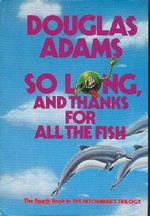

So Long, and Thanks For All The Fish

So Long, and Thanks for All the Fish

Of course, one never has the slightest notion what size or shape different species are going to turn out to be, but if you were to take the findings of the latest Mid-Galactic Census report as any kind of accurate guide to statistical averages you would probably guess that the craft would hold about six people, and you would be right. You’d probably guessed that anyway. The Census report, like most such surveys, had cost an awful lot of money and told nobody anything they didn’t already know—except that every single person in the Galaxy had 2.4 legs and owned a hyena. Since this was clearly not true the whole thing eventually had to be scrapped.

Here was something that Ford felt he could speak about with authority. “Life,” he said, “is like a grapefruit.”

“Er, how so?”

“Well, it’s sort of orangy-yellow and dimpled on the outside, wet and squidgy in the middle. It’s got pips inside, too. Oh, and some people have half a one for breakfast.”

“Is there anyone else out there I can talk to?”

Arthur had a swordfish steak and said it made him angry. He grabbed a passing waitress by the arm and berated her. “Why’s this fish so bloody good?” he demanded, angrily.

“Please excuse my friend,” said Fenchurch to the startled waitress. “I think he’s having a nice day at last.”
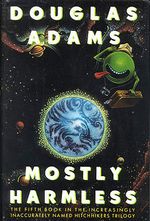

Mostly Harmless

Mostly Harmless

A common mistake that people make when trying to design something completely foolproof is to underestimate the ingenuity of complete fools.

Fall, though, is the worst. Few things are worse than fall in New York. Some of the things that live in the lower intestines of rats would disagree, but most of the things that live in the lower intestines of rats are highly disagreeable anyways, so their opinion can and should be discounted.
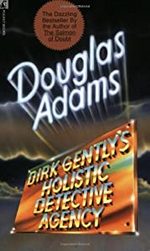

Dirk Gently's Holistic Detective Agency

Dirk Gently’s Holistic Detective Agency

There is no point in using the word ‘impossible’ to describe something that has clearly happened.

If it looks like a duck, and quacks like a duck, we have at least to consider the possibility that we have a small aquatic bird of the family anatidae on our hands.

Let’s think the unthinkable, let’s do the undoable. Let us prepare to grapple with the ineffable itself, and see if we may not eff it after all.

(I’ve often been tempted to get a tattoo of this)


The Long Dark Tea-Time of the Soul

The Long Dark Tea-Time of the Soul

There are some people you like immediately, some whom you think you might learn to like in the fullness of time, and some that you simply want to push away from you with a sharp stick.

It can hardly be a coincidence that no language on earth has ever produced the expression, ‘As pretty as an airport.’

The impossible often has a kind of integrity to it which the merely improbable lacks.

She stared at them with the worried frown of a drunk trying to work out why the door is dancing.

It was his subconscious which told him this—that infuriating part of a person’s brain which never responds to interrogation, merely gives little meaningful nudges and then sits humming quietly to itself, saying nothing.

As she lay beneath a pile of rubble, in pain, darkness, and choking dust, trying to find sensation in her limbs, she was at least relieved to be able to think that she hadn’t merely been imagining that this was a bad day. So thinking, she passed out.
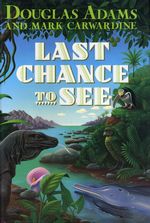

The Last Chance to See

The Last Chance to See

“So what do we do if we get bitten by something deadly?” I asked.

He looked at me as if I were stupid. “You die, of course. That’s what deadly means.”

I’ve never understood all this fuss people make about the dawn. I’ve seen a few and they’re never as good as the photographs, which have the additional advantage of being things you can look at when you’re in the right frame of mind, which is usually around lunchtime.

I have the instinctive reaction of a Western man when confronted with sublimely incomprehensible. I grab my camera and start to photograph it.

Human beings, who are almost unique in having the ability to learn from the experience of others, are also remarkable for their apparent disinclination to do so.

The aye-aye is a nocturnal lemur. It is a very strange-looking creature that seems to have been assembled from bits of other animals. It looks a little like a large cat with a bat’s ears, a beaver’s teeth, a tail like a large ostrich feather, a middle finger like a long dead twig and enormous eyes that seem to peer past you into a totally different world which exists just over your left shoulder.

One of the characteristics that laymen find most odd about zoologists is their insatiable enthusiasm for animal droppings. I can understand, of course, that the droppings yield a great deal of information about the habits and diets of the animals concerned, but nothing quite explains the sheer glee that the actual objects seem to inspire.

I mean, animals may not be intelligent, but they’re not as stupid as a lot of human beings.
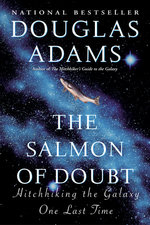

The Salmon of Doubt

The Salmon of Doubt: Hitchhiking the Galaxy One Last Time

We are stuck with technology when what we really want is just stuff that works.

I’ve come up with a set of rules that describe our reactions to technologies:
1. Anything that is in the world when you’re born is normal and ordinary and is just a natural part of the way the world works.
2. Anything that’s invented between when you’re fifteen and thirty-five is new and exciting and revolutionary and you can probably get a career in it.
3. Anything invented after you’re thirty-five is against the natural order of things.


And a couple of lines I’ve seen in assorted places, articles, books, and whatnot

I love deadlines. I love the whooshing noise they make as they go by.

A learning experience is one of those things that says, “You know that thing you just did? Don’t do that.”

The fact is, I don’t know where my ideas come from. Nor does any writer. The only real answer is to drink way too much coffee and buy yourself a desk that doesn’t collapse when you beat your head against it.

Solutions nearly always come from the direction you least expect, which means there’s no point trying to look in that direction because it won’t be coming from there.

Don't Panic

Towel Day ’25 (observed): Scattered Thoughts about Reading The Hitchhiker’s Guide to the Galaxy Trilogy

(updated and revised this 5/26/25)

A Blue towel with the words Towel Day on it
I’ve been trying for a few years now to come up with a tribute to Adams. This isn’t quite what I had in mind, but it’s a start. In my mind, this is a work in progress (a multiple-year project), but I’m posting it anyway. Next year’s version will be better—or at least more complete.


Some time in 7th or 8th grade (I believe), I was at a friend’s house and his brother let us try his copy of the text-based Hitchhiker’s Guide game, and we were no good at it at all. Really, it was embarrassing. However, his brother had a copy of the first novel, and we all figured that the novel held the keys we needed for success with the game (alas, it did not help us one whit). My friends all decided that I’d be the one to read the book and come back in a few days as an expert.

I fell in love with the book almost instantly, and I quickly forgot about the game. Adams’ irreverent style rocked my world—could people actually get away with saying some of these things? His skewed take on the world, his style, his humor…and a depressed robot, too! It was truly love at first read. As I recall, I started re-reading it as soon as I finished it—the only time in my life I’ve done that sort of thing.

Also, I finally understood that song, “Marvin, I Love You,” that I kept hearing on Dr. Demento.

It was one of those experiences that, looking back, I can say shaped my reading and thinking for the rest of my life (make of that what you will). Were my life the subject of a Doctor Who or Legends of Tomorrow episode, it’d be one of those immutable fixed points. I got my hands on the next three books as quickly as I could (the idea of a four-volume trilogy was one of the funniest ideas I’d encountered up to that point), and devoured them. I do know that I didn’t understand all of the humor, several of the references shot past me at the speed of light, and I couldn’t appreciate everything that was being satirized. But what I did understand, I thought was brilliant. Not only did I find it funny, the series taught me about comedy—how to construct a joke, how to twist it in ways a reader wouldn’t always expect, and when not to twist but to go for the obviously funny idea. The trilogy also helped me to learn to see the absurdity in life.

Years later, when the final volume (by Adams) was released, I’d already cemented what I thought about the books from these frequent re-reads. I’m not sure that Mostly Harmless changed things much (except for making me think for the first time that maybe I didn’t want him to write more in this series). His non-Hitchhiker’s work illustrated that he was capable of making you see things in a new light–either with a smile or a sense of regret—even when he wasn’t writing the trilogy, even when he was writing non-fiction. It was never the setting or the genre—it was Adams.

But here on Towel Day—as with most of the time I talk about Adams (but I need to change that), it comes down to where I started—the Trilogy. I read the books (particularly the first) so many times that I can quote significant portions of them, and frequently do so without noticing that I’m doing that. I have (at this time) two literary-inspired tattoos, one of which is the planet logo* featured on the original US covers. In essence, I’m saying that Adams and the series that made him famous have had an outsized influence on my life and are probably my biggest enduring fandom. If carrying around a (massively useful) piece of cloth for a day in some small way honors his memory? Sure, I’m in.

So, Happy Towel Day, You Hoopy Froods.

* I didn’t know it at the time, but Adams didn’t like that guy. Whoops.

Don't Panic

Towel Day ’25 (observed): Do You Know Where Your Towel Is?

(updated and revised this 5/26/25)

A Blue towel with the words Towel Day on it

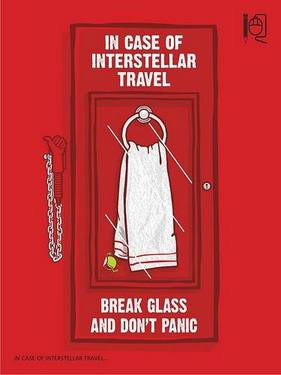
The Hitchhiker’s Guide to the Galaxy has a few things to say on the subject of towels.

A towel, it says, is about the most massively useful thing an interstellar hitchhiker can have. Partly it has great practical value. You can wrap it around you for warmth as you bound across the cold moons of Jaglan Beta; you can lie on it on the brilliant marble-sanded beaches of Santraginus V, inhaling the heady sea vapors; you can sleep under it beneath the stars which shine so redly on the desert world of Kakrafoon; use it to sail a miniraft down the slow heavy River Moth; wet it for use in hand-to-hand-combat; wrap it round your head to ward off noxious fumes or avoid the gaze of the Ravenous Bugblatter Beast of Traal (such a mind-bogglingly stupid animal, it assumes that if you can’t see it, it can’t see you); you can wave your towel in emergencies as a distress signal, and of course dry yourself off with it if it still seems to be clean enough.

More importantly, a towel has immense psychological value. For some reason, if a strag (strag: non-hitch hiker) discovers that a hitch hiker has his towel with him, he will automatically assume that he is also in possession of a toothbrush, face flannel, soap, tin of biscuits, flask, compass, map, ball of string, gnat spray, wet weather gear, space suit etc., etc. Furthermore, the strag will then happily lend the hitch hiker any of these or a dozen other items that the hitch hiker might accidentally have “lost”. What the strag will think is that any man who can hitch the length and breadth of the galaxy, rough it, slum it, struggle against terrible odds, win through, and still knows where his towel is is clearly a man to be reckoned with.

Hence a phrase that has passed into hitchhiking slang, as in “Hey, you sass that hoopy Ford Prefect? There’s a frood who really knows where his towel is.” (Sass: know, be aware of, meet, have sex with; hoopy: really together guy; frood: really amazingly together guy.)

Towel Day was yesterday, May 25, but I’m going to observe it today (in the tradition of all Weekend Holidays in the U.S>0

Towel Day, for the few who don’t know, is the annual celebration of Douglas Adams’ life and work. It was first held two weeks after his death, fans were to carry a towel with them for the day to use as a talking point to encourage those who have never read HHGTTG to do so, or to just converse with someone about Adams. Adams is one of that handful of authors that I can’t imagine I’d be the same without having encountered/read/re-read/re-re-re-re-read, and so I do my best to pay a little tribute to him each year, even if it’s just carrying around a towel.

In commemoration of this date, here’s most of what I’ve written about Adams. I’ve struggled to come up with new material to share for Towel Day over the years, mostly sticking with updating and revising existing posts. And, this year is no exception A few years back, I did a re-read of all of Adams’ (completed) fiction. For reasons beyond my ken (or recollection), I didn’t get around to blogging about the Dirk Gently books, but I did do the Hitchhiker’s Trilogy:
bullet The Hitchhiker’s Guide to the Galaxy
bullet The Restaurant at the End of the Universe
bullet Life, The Universe and Everything
bullet So Long, and Thanks For All The Fish
bullet Mostly Harmless
bullet I had a thing or two to say about the 40th Anniversary of The Hitchhiker’s Guide to the Galaxy
bullet I took a look at the 42nd Anniversary Illustrated Edition of The Hitchhiker’s Guide to the Galaxy

I should also point to a posts I wrote about Douglas Adams’ London by Yvette Keller and 42: The Wildly Improbable Ideas of Douglas Adams edited by Kevin Jon Davies—both are great ways of filling out one’s understanding of Adams and his work. I have to mention the one book that Adams/Hitchhiker’s aficionado needs to read is Don’t Panic by Neil Gaiman, David K. Dickson and MJ Simpson.

If you’re more in the mood for a podcast, I’d suggest The Waterstones Podcast How We Made: The Hitchhiker’s Guide to the Galaxy—I’ve listened to several podcast episodes about this book, and generally roll my eyes at them. But this is just fantastic. Were it available, I’d listen to a Peter Jackson-length version of the episode.

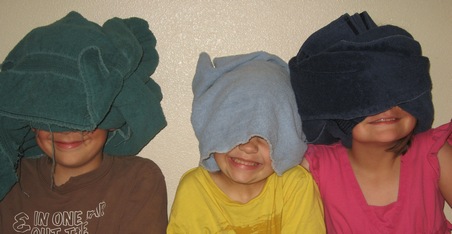
I’ve only been able to get one of my sons into Adams, he’s the taller, thinner one in the picture from a few several years ago.
(although I did get he and his younger siblings to use their towels to make themselves safe from the Ravenous Bugblatter Beast of Traal a few years earlier:)

You really need to check out this comic from Sheldon Comics—part of the Anatomy of Authors series: The Anatomy of Douglas Adams.

Lit in a Nutshell gives this quick explanation of The Hitchiiker’s Guide:

TowelDay.org is the best collection of resources on the day. One of my favorite posts there is this pretty cool video, shot on the ISS by astronaut Samantha Cristoforetti.

Even better—here’s an appearance by Douglas Adams himself from the old Letterman show—I’m so glad someone preserved this:

Love the anecdote (Also, I want this tie.)

Don't Panic

Saturday Miscellany—5/24/25

Before I get into things today, I’m curious–does anyone have a good recommendation for a bookmark app? I use Pocket to store the ideas for this post (and some other things, too). It was announced it’s going away recently, and I’m looking for a replacement.

Odds ‘n ends about books and reading that caught my eye this week. You’ve probably seen some/most/all of them, but just in case:
bullet It May Be Too Late for Rural Libraries to Weather the IMLS Storm
bullet Can indie novels save our minds? A renaissance takes brave authors—There’s a snobbishness/elitism/pretentiousness to this piece that grates my teeth. But if you can put up with it, there’s something worth reading, too.
bullet How to Make a Living as a Writer
bullet Forget chatbots: research suggests reading can help combat loneliness and boost the brain
bullet When memories from fiction become part of who you are
bullet 14 Million Books Later, Jim Butcher Thinks His Wizard Detective Needs a Hug—my read of the week
bullet Magic Doesn’t Have to Make Sense: In praise of fantasy that embraces rebellious, lawless, and delightfully un-rulebound magic.
bullet Gods of Disasters and Wish Givers—another week, another great guest post from Shannon Knight
bullet In Challenging Times, I Turn to Cozy Reads
bullet Book Recommendations From My Dog—who could possibly be a more trustworthy source of recommendations? (also, the World’s Worst Book post linked to in the first sentence is almost as good a read)
bullet Benefits of Book Club
bullet When Fantasy Meets Mystery: Fantasy-mysteries that Everyone Should Read
bullet @shinjutnt.bsky.social‬/Adam Rowan posted about a great word we all need to add to our working vocabularies—particularly in bookstores

A Book-ish Related Podcast episode (or two) you might want to give a listen to:
bullet SFF Addicts Ep. 155 Evan Leikam talks Anji Kills A King, Crappy Jobs, Video Games & More—While I’m not allowing myself to put Leikam’s novel on my TBR right now (I need to make progress on things before I allow myself to do that sort of thing), this was a fun episode (and I might have added a book to a certain list in light pencil).

To help talk about backlist titles (and just for fun), What Was I Talking About 10 Years Ago Week?
bullet “Concussion Cover-Up” & “NSA Priest” by Carac Allison—I periodically check to see if he’s done anything else, would really like to read more from Allison
bullet Kickback by Ace Atkins
bullet The Worst Class Trip Ever by Dave Barry
bullet Woof by Spencer Quinn
bullet And I mentioned the release of Kickback by Ace Atkins; Uprooted by Naomi Novik; Seveneves by Neal Stephenson; and Boo by Neil Smith

This Week’s New Releases that I’m Excited About and/or You’ll Probably See Here Soon:
bullet Kaua’i Storm by Tori Eldridge—is a thriller with a lot of heart. “Returning to Kaua’i, park ranger Makalani finds her family divided and their way of life at risk in this rich and emotional adventure.” The culture of Kaua’i is brought to life here.
bullet Nightshade by Michael Connelly—Oh, phew, Connelly has a new series. He really needed another. Didn’t stop me from buying this debut about a LASD Detective on Catalina Island.
bullet Food Person by Adam Roberts—”a delectable comedy of manners about cooking, ambition, and friendship set in the food world as a young and socially awkward writer takes a job ghostwriting the cookbook for a famous (and famously chaotic) Hollywood starlet.”
bullet An Ethical Guide to Murde by Jenny Morris—”Thea has a secret. She can tell how long someone has left to live just by touching them. Not only that, but she can transfer life from one person to another–something she finds out the hard way when her best friend, Ruth, suffers a fatal head injury on a night out. Desperate to save her, Thea accidentally kills the man responsible and lets his life flow directly into Ruth…How can she really know who deserves to live and die, and can she figure out her own rules before Ruth’s borrowed time runs out? “

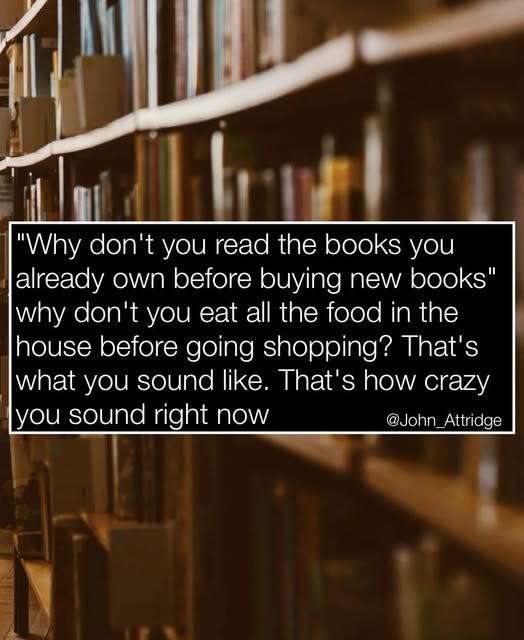
'Why don't you read the books you already own before buying new books' why don't you eat all the food in the house before going shopping? That's what you sound like. That's how crazy you sound right now (original tweet)

REPOSTING: Breaking Bread with the Dead by Alan Jacobs: Interacting with the Classics from a Contemporary Perspective in Order to Learn and Critique

Earlier this year, I re-read three books by Alan Jacobs in what he styles as a trilogy of sorts (my paraphrase), with the intention of writing new, longer, posts about them all–or maybe one mega-post about all three. Neither of those happened, and I’m pretty sure it’s not going to happen this year–as much as they deserve it. But I still wanted to reflect on them a bit and call your attention to them. So, I’m just going to repost what I’ve said before–this one, in particular, deserves much more than I gave it. I maybe should try again next year.


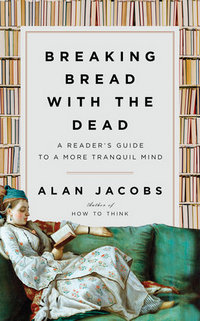
Breaking Bread with the Dead

Breaking Bread with the Dead: A Reader’s Guide to a More Tranquil Mind

by Alan Jacobs

Hardcover, 192 pg.
Penguin Press, 2020

Read: September 26-October 15, 2020
Grab a copy from your local indie bookstore!

What’s Breaking Bread with the Dead About?

If I tried to summarize this book (unless I read it 3-4 more times), it would be out-of-control, just me blathering on for 4+ pages. So, let’s have mercy on us all and just appropriate what’s on the publisher’s site:

From the author of HOW TO THINK and THE PLEASURES OF READING IN AN AGE OF DISTRACTION, a literary guide to engaging with the voices of the past to stay sane in the present

W. H. Auden once wrote that “art is our chief means of breaking bread with the dead.” In his brilliant and compulsively readable new treatise, Breaking Bread with the Dead, Alan Jacobs shows us that engaging with the strange and wonderful writings of the past might help us live less anxiously in the present–and increase what Thomas Pynchon once called our “personal density.”

Today we are battling too much information in a society changing at lightning speed, with algorithms aimed at shaping our every thought–plus a sense that history offers no resources, only impediments to overcome or ignore. The modern solution to our problems is to surround ourselves only with what we know and what brings us instant comfort. Jacobs’s answer is the opposite: to be in conversation with, and challenged by, those from the past who can tell us what we never thought we needed to know.

What can Homer teach us about force? How does Frederick Douglass deal with the massive blind spots of America’s Founding Fathers? And what can we learn from modern authors who engage passionately and profoundly with the past? How can Ursula K. Le Guin show us truths about Virgil’s female characters that Virgil himself could never have seen? In Breaking Bread with the Dead, a gifted scholar draws us into close and sympathetic engagement with texts from across the ages, including the work of Anita Desai, Henrik Ibsen, Jean Rhys, Simone Weil, Edith Wharton, Amitav Ghosh, Claude Lévi-Strauss, Italo Calvino, and many more.

By hearing the voices of the past, we can expand our consciousness, our sympathies, and our wisdom far beyond what our present moment can offer.

So, what did I think about Breaking Bread with the Dead?

Really, what I want to do at this point is to write a series of posts about this book (probably not one per chapter, I could probably combine a couple of chapters together). But really, they’d be the equivalent of those old Chris Farley SNL interviews, “So, you remember X? Yeah…that was cool.”

I’m not saying this book is perfect, but it’s insightful, it’s thought-provoking, and it’s impossible to read without feeling a whole lot more well-read than you are* and (simultaneously) be inspired to read more and more widely. This is essentially true of everything Jacobs writes, I have to admit, so that’s not news. But it’s accurate.

* This is not necessarily true for you, just me.

At the end of the day, you may not agree with every way that Jacobs applies his principles for reading outside your time/culture/perspective, but those principles he enumerates are pretty sound—and at the very least provide a starting point. I think Jacobs is right more than he’s not, and even when I’m not convinced by him, I still find a lot to value.

Get it, chew on it, see if you can apply it yourself.


4 1/2 Stars

2020 Library Love Challenge

This post contains an affiliate link. If you purchase from it, I will get a small commission at no additional cost to you. As always, opinions are my own.

REPOSTING: How to Think by Alan Jacobs

Earlier this year, I re-read three books by Alan Jacobs in what he styles as a trilogy of sorts (my paraphrase), with the intention of writing new, longer, posts about them all–or maybe one mega-post about all three. Neither of those happened, and I’m pretty sure it’s not going to happen this year–as much as they deserve it. But I still wanted to reflect on them a bit and call your attention to them. So, I’m just going to repost what I’ve said before–oh, man…after the last few years, this book is needed more than ever.


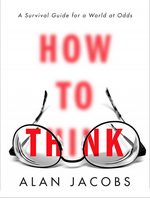
How to Think: A Survival Guide for a World at OddsHow to Think: A Survival Guide for a World at Odds

by Alan Jacobs
Uncorrected Proof, 156 pg.
Convergent Books, 2017

Read: October 3, 2017

I haven’t read any of them, but over the last few years I’ve seen a pretty good number of books about human thinking processes — how it works, how it can/can’t be changed, and how this can/may/should change the way we approach decision-making, etc. (it’s not that I’m uninterested, there’s only so much time). Unlike me, Alan Jacobs has read many of these — and one thing he notes, that while these books are great on the science of human cognition, there’s also an art to it. Enter this book.

The sub-title is “A Survival Guide for a World at Odds.” Now, while it’s clear that our society is quite divided, I honestly don’t think that the world is really all that much more divided than we’ve been before — even in this society. However, I think it’s safe to say that we’re much more open and aggressive about the divisions that exists, and far less inclined to listen to the other side(s). Jacobs’ writing can help his readers bridge some of the divisions with those they interact with (not every one will want to, I’m sure, but they could try if they want to). I almost think that this book could be called How to Disagree instead, because so much of the book (but not all of it) is about how to disagree with others like civil, empathetic, adults, looking to change minds (or have our own be changed); not simply to attack someone or win an argument.

Jacobs begins by showing what strategies, devices, etc. we all already use in our thinking (taken largely from common sense/experience or all the science-y books mentioned above), and then as we’re aware of these, he shows how we can improve them. Building on ideas from one chapter to the next and showing how something we learned already can inform what he’s discussing now, these are not individual essays, but a cumulative case. I find it difficult to give examples for just that reason — his is a carefully laid out argument, and summarizing some of my favorite components would do little justice to those parts and not work that well out of context. So, I’ll keep it vague. He addresses how the idea of “thinking for oneself” is impossible, how it’s problematic to have an “open mind” always, the importance of waiting, of not having to address everything, and how it’s vital to keep a diverse selection of thoughtful people in your life.

Jacobs doesn’t only draw from social sciences and philosophers (but he does, and frequently — in an accessible way), he cites and draws from Robin Sloan, Walter White, C. S. Lewis, George Orwell and many others. He does so in a way that illustrates his points, strengthens and furthers his arguments. (I point this out, because I just finished a book that seemed only to do this kind of thing to lengthen chapters — no light was added, just space taken up). While readers from High School on up can feel as if the ideas are stretching their minds, the writing will not — Jacobs (as always) is good at convincing the reader they can handle bigger ideas.

Frankly, I wish this book (or one much like it) was required reading for anyone wanting a social media account — I’ve been telling all sorts of people to read it for a few days now, and I probably won’t stop anytime soon. How to Think is helpful, insightful, entertaining, wise, and — dare I say? — thought-provoking. Go get it.

Disclaimer: I received this copy from a Goodreads Giveaway.

—–

4 Stars

REPOSTING: Reread Project: The Pleasures of Reading in an Age of Distraction by Alan Jacobs: A very different model of what reading can be all about.

Earlier this year, I re-read three books by Alan Jacobs in what he styles as a trilogy of sorts (my paraphrase), with the intention of writing new, longer, posts about them all–or maybe one mega-post about all three. Neither of those happened, and I’m pretty sure it’s not going to happen this year–as much as they deserve it. But I still wanted to reflect on them a bit and call your attention to them. So, I’m just going to repost what I’ve said before–which, yes, means two posts about this book.


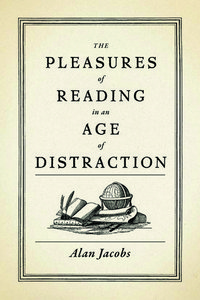
The Pleasures of Reading in an Age of Distraction

The Pleasures of Reading in an Age of Distraction

by Alan Jacobs

Hardcover, 150 pg.
Oxford University Press, 2011

Read: January 2-3, 2020
Grab a copy from your local indie bookstore!

Read what would give you delight—at least most of the time—and do so without shame. And even if you are that rare sort of person who is delighted chiefly by what some people call Great Books, don’t make them your study intellectual diet, any more than eat at the most elegant of restaurants every day. It would be too much. Great books are great in part because of what they ask of their readers: they are not readily encountered, easily accessed. The poet W. H. Auden once wrote, “When one thinks of the attention that a great poem demands, there’s something frivolous about the notion of spending every day with one. Masterpieces should be kept for High Holidays of the Spirit”—for our own personal Christmases and Easters, not for any old Wednesday.

I picked this up as my first book of the year as a way to refresh the mind, come into the year with a reminder of what kind of reader I want to be. As I write this, I’m deliberately not looking at what I wrote last time I read this, but you may find it interesting. Maybe not. I don’t know if I’ll end up repeating myself.

I remember this book being as close to a mission statement for my approach to reading as you could hope for—particularly because I came to it late in life. It’s not like this is a book I read in college and it shaped me/my thinking, but it’s something that I came to a couple of years ago and it was as if a more erudite and thoughtful version of myself had written it.

The beginning of the book is the heart of it, he sets forth his central theses, core argument:

one dominant, overarching, nearly definitive principle for reading: Read at Whim.

Reading shouldn’t be about self-improvement (primarily), it isn’t the mental equivalent of eating Brussels Sprouts. It should be for pleasure. And to maximize that, Jacobs will argue—read at whim.

Following that, Jacobs talks about many aspects of reading for pleasure—note-taking, thinking about what we read, focus (and how to expand it), the role of ereaders (he’s surprisingly pro-ereader), fighting distractions, evaluating what we read and more.

I was particularly struck this time through by his section on re-reading. For growing in appreciation for, or understanding of a work. Or because you enjoy escaping into a well-known and beloved world for a period.

Jacobs frequently quotes Auden, at one point he cites Auden’s five ratings for a book—I think we should maybe replace the standard 5-Star system with this:

For an adult reader, the possible verdicts are five: I can see this is good and I like it; I can see this is good but I don’t like it; I can see this is good, and, though at present I don’t like it, I believe with perseverance I should come to like it; I can see that this is trash but I like it; I can see that this is trash and I don’t like it.

Most of all, this is a celebration of/appreciation of reading. Jacobs is a kindred spirit to us readers as well as a humanities professor. Reading is both a passion and a profession—and both (particularly the former) are clearly seen in these pages.

Our goal as adults is not to love all books alike, or as few as possible, but rather to love as widely and as well as our limited selves will allow.

Hear, hear. That’s a good reminder.


5 Stars

This post contains an affiliate link. If you purchase from it, I will get a small commission at no additional cost to you. As always, opinions are my own.

REPOSTING: The Pleasures of Reading in an Age of Distraction by Alan Jacobs

Earlier this year, I re-read three books by Alan Jacobs in what he styles as a trilogy of sorts (my paraphrase), with the intention of writing new, longer, posts about them all–or maybe one mega-post about all three. Neither of those happened, and I’m pretty sure it’s not going to happen this year–as much as they deserve it. But I still wanted to reflect on them a bit and call your attention to them. So, I’m just going to repost what I’ve said before–which, yes, means two posts about this book. I like all of this, except the rating–what was I thinking?


The Pleasures of Reading in an Age of DistractionThe Pleasures of Reading in an Age of Distraction

by Alan Jacobs

Hardcover, 150 pg.
Oxford University Press, USA, 2011

Read: December 21 – 25, 2015

A while back my teenage son drifted into the room where I was reading, tilting his head to catch the title of the book in my hands. It was that venerable classic How to Read a Book, by Mortimer Adler and Charles van Doren. “Oh man, he said, “I had to read that in school last year. Maybe I learned something about how to read a book, but after that I never wanted to read a book again.”

Oh, I hear ya, brother! I endured Adler/van Doren for a graduate-level course and thought it was one of the most pointless books I’d ever read. Now, Jacobs finds more profit in the tome than I do, but he’s clearly not a fan.

The book starts with a call to read what you want, reading based on whim, rather than thinking of it as a self-improvement program (which it is, in a way, but it doesn’t have to be followed like one). In fact, Alden, Harold Bloom, etc. turn

reading into the intellectual equivalent of eating organic greens. . . That sort of thing is not reading at all, but what C. S. Lewis once called “social and ethical hygiene.”

Instead, Jacobs calls for people to:

Read what gives you delight–at least most of the time–and so without shame. And even if you are that rare sort of person who is delighted chiefly by what some people call Great Books, don’t make them your steady intellectual diet, any more than you would eat at the most elegant of restaurants every day.

Jacobs is a Professor of the Humanities at Baylor University, and author of many books and articles on books, reading, and authors. He’s one of those guys I’ve seen the name of everywhere, and associated with insight, but if push came to shove, I couldn’t tell you why. But now he’s the professor I wish I had (nothing against most of the early ’90s English department at the University of Idaho, most).

Reading on a whim doesn’t mean you can’t stretch yourself, read above your comfort level, or to better yourself — but you do it because it interests you, because you want to (and when you want to), rather than subjecting yourself to someone’s checklist.

After that, Jacobs moves into trying to understand how reading works, how it captures so many imaginations — and sure, he cites some studies that explain how we take black marks on paper and make them ideas in our head, at some point even the professionals have to stop and say, “it just works.” (but Jacob puts it better).

We also get discussion about the “iron-clad Law of Diminishing Returns” regarding rereading too soon (and yet, why we should reread). An interesting defense of/encouragement of fanfic. I was surprised, quite surprised, at his advocacy for e-Readers — I fully expected him to be solidly Dead Tree Edition Only, whoops — I don’t use my Kindle the way he does, but I can see where it’d work for him (or Nook, either). Why a lot of the doomsayers about the state of reading/publishing are wrong.

But mostly this is advice and guidance for the reader trying to recapture the same joy that he had before (or never had), encouragement for the active reader to keep at it, the person who still can’t get poetry, etc., etc.

I can’t resist another quotation. Towards the end of the book, he talks about the joy of finding a book by Serendipity:

serendipity is the near relation of Whim; each stands against the Plan.

Plan once appealed to me, but I have grown to be a natural worshiper of Serendipity and Whim; I can try to serve other gods, but my heart is never in it. I truly think I would rather read an indifferent book on a lark than a fine one according to schedule and plan.

Charmingly written, full of allusions (that most of us can get even without reading the works), witticisms and research — a book to entertain and edify. This one really speaks to me as a reader — it’s practically a mission statement for this blog. I expect I’ll come back to this one soon (maybe even annually). Still, for this time, I’m rating it 4-Stars, though I expect it’s a 5-Star book. I think it’s because I read it in 2-5 page spurts (one of those weeks, y’know?) after I got to page 70. Which doesn’t do the thing any favors. Towards the end of the book, Jacobs says:

All books want our attention, but not all of them want the same kind of attention.

I didn’t give this the right kind, and I’ll regret that for awhile.

If you like this blog, you’ll dig this book.

—–

Big Thanks to Aman Mittal for pointing me to this book — I haven’t read his take on it in a couple of months, so I don’t know how much we agree, but I know his post made me look for the book.

—–

4 Stars

Quarter Year Crisis Book Tag—2025

Quarter Year Crisis Book Tag 2025
Yes, I realize that 2/3 of the second of 2025 is over, but better late than never, right? I started all this a month or so ago, and…whatever. Thanks to A Literary Escape for reminding me to do this (although that post went up on time).

How many books have you read so far?

At the end of March, the number was 66 (was 92 at the time I finally finished this post)

Have you already found a book you think might be a 2025 favorite?

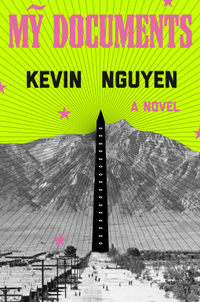
Cover of My Documents by Kevin Nguyen
My Documents
by Kevin Nguyen

My Documents really got under my skin in a way that not enough books do (which is probably good for my mental health, actually).
I could probably name another 5-6, too, the year started strong. But Nguyen’s was the first that came to mind, so let’s stick with it.

If not what was your favorite book you read that wasn’t quite five-star?

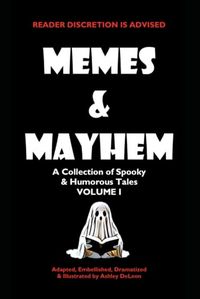
Cover of Memes & Mayhem by Ashely DeLeon
Memes & Mayhem
by Ashley DeLeon

I’ve alluded to others that were as good as My Documents, so let me just mention Memes & Mayhem, which was just ridiculous and fun.

Any 1-star books / least favorite book of the year?

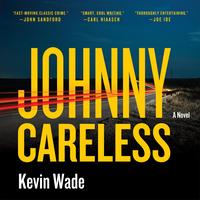
Cover of Johnny Careless by Kevin Wade
Johnny Careless
by Kevin Wade, read by John Pirhalla

While there’s some competition for this one (alas!), I’m going to go with Johnny Careless. Lazy writing, predictable, too-reliant on Dickensian coincidences, and a little causal racism that just chafed me.

Most read genre so far?

As of the end of the first quarter, it was Mystery/Thriller. I’d have guess Fantasy, honestly. If it weren’t for the table, I wouldn’t believe it.

Genre Year to Date
Children’s 4 (6%)
Fantasy 8 (12%)
General Fiction/ Literature 7 (11%)
Mystery/ Suspense/ Thriller 14 (22%)
Non-Fiction 1 (17%)
Science Fiction 8 (12%)
Theology/ Christian Living 8 (12%)
Urban Fantasy 5 (8%)
“Other” (Horror/ Humor/ Steampunk/ Western) 0 (0%)

A book that surprised you?

Three jumped to mind:

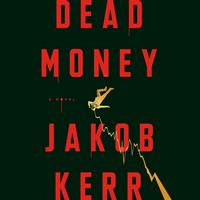
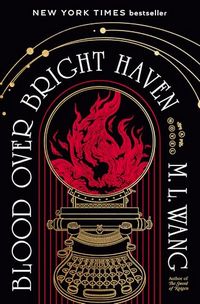
Cover of Dead Money by Jakob Kerr Cover of Blood Over Bright Haven by M. L. Wang Cover of The Price of Power by Michael Michel
Dead Money
by Jakob Kerr
Blood Over Bright Haven
by M. L. Wang
The Price of Power
by Michael Michel

Dead Money, becuase of the ending and I’m still trying to decide what I think of it. (the rest of the book was great! I’m just trying to decide what I think of the resolution)
Blood Over Bright Haven, because of the ending–it really upped my appreciation for what Wang was doing.
The Price of Power. I assumed I was going to like it–just not as much as I ended up liking it. I’m seriously close to camping out on Michel’s doorstep waiting for the rest of them.

A Book that’s come out in 2025 already that you want to read but haven’t yet?

Ooooh…too many. But the 6 that are bugging me the most are:

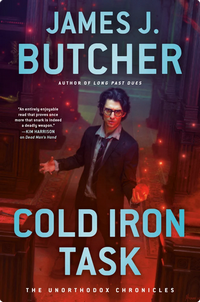
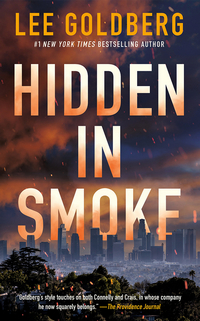
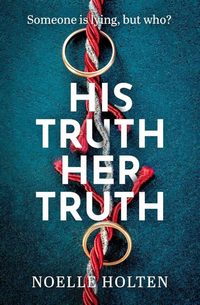
Cover of Cold Iron Task by James J. Butcher Cover of Hidden in Smoke by Lee Goldbert Cover of His Truth Her Truth by Noelle Holten
Cold Iron Task
by James J. Butcher
Hidden in Smoke
by Lee Goldberg
His Truth Her Truth
by Noelle Holten
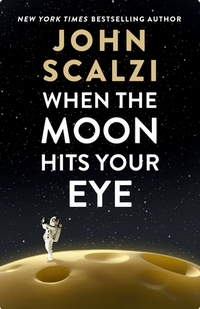
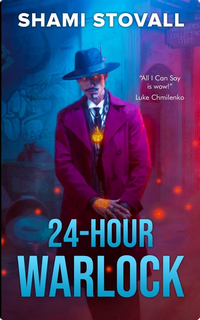
Cover of Death Rights by Shannon Knight Cover of When the Moon Hits Your Eye by John Scalzi Cover of 24-Hour Warlock by Shami Stovall
Death Rights
by Shannon Knight
When the Moon Hits Your Eye
by John Scalzi
24-Hour Warlock
by Shami Stovall

One goal you made that you’re succeeding at?

I don’t really think I’m doing that great on any of my goals, really. I’m not failing, per se. But I’m not feeling bullish.

One goal you made you need to focus on?

My 25 in 25, if I have to pick one. I haven’t even touched it. Maybe writing more? That’s a better goal.

New to you Booktubers/bookstagrammer/booktokers for 2025 you recommend?

Book’d Out Badge
Blogging with Dragons logo
I’m going to go with Book’d Out and Blogging with Dragons. I like their style, what they cover, and their site’s impression. Also, I’m a little envious of both of their names.


As usual, I’m not tagging anyone in this—but I’d like to see what you all have to come up with. You know, in case, you, too have been let a couple of months slip by.

Why Haven’t I Replied to Your Comment(s)?/Why Do I Take Days/Weeks to do So?

That’s a fantastic question–and one I ask myself often. Particularly on Wednesdays and Saturdays when I receive the most comments.

The reasons are multi-faceted, but rooted in distraction. (actually, my daughter has been trying to convince me that I have some sort of undiagnosed Attention-Deficit Disorder, and there might be something to it)

    1. I thought I did.
    2. I started to and a metaphorical squirrel popped-up in front of me (a dog, a grandchild, my wife saying something, an email/text)
    3. I forgot to check the comments.
    4. Poor time management (when I’m not at work)
    5. Worse organization skills (ditto)
    6. I’m super-busy and or tired, and things like being polite and attentive to readers falls off my radar.
    7. There is NOOOOO reason 7.
    8. I desperately want to, but I’m trapped under something heavy.

I do actually read them all within minutes of getting a notification (even when I tell myself I should wait until I have time to respond), and I generally mentally compose a response that I can’t make until later in the day. This is a significant problem leading to Number 1 above. I really do think I did respond in a timely fashion. Then I realize I didn’t when I’m back in a situation where I can’t. And then the guilt ferrets come.

I’m not saying I’ll do better–but I’m trying. But now you might understand.

Irresponsible Reader Pilcrow Icon

Page 45 of 603

Powered by WordPress & Theme by Anders Norén