
Music Monday's originated at The Tattooed Book Geek's fantastic blog and has shown up hither, thither, and yon since then.


Music Monday's originated at The Tattooed Book Geek's fantastic blog and has shown up hither, thither, and yon since then.
Well, I ran out of time to finish a post about a book I read this year about the Commandments, so…let’s dust this off.
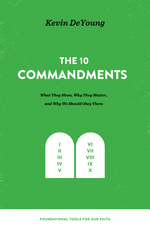 The Ten Commandments: What They Mean, Why They Matter, and Why We Should Obey Them
by Kevin DeYoung
eARC, 208 pg.
Crossway, 2018
Read: September 23, 2018

My initial thought when I saw this book was: do we need another popular-level work on The Ten Commandments? We’ve got so many already, like: Ryken’s Written in Stone, Horton’s The Law of Perfect Freedom, Packer’s Growing in Christ. We’ve got Douma’s, Watson’s and Durham’s (newly republished) on the heavier end of the spectrum, too. Why bring out a new book by DeYoung? Still, I was intrigued, so I requested a copy.
Not too surprisingly, I’m glad I did. This is typical DeYoung: a strong, affectionate, orthodox take on the Law delivered in a very accessible and affable manner. He made me think, he made me reconsider a thing or two, and he reminded me of a few things I needed reminding of.
He begins this work against the framework of the secular “anything goes” point of view, where everything certainly does not go — as much as we as a culture might rail against an external source of morality — there are things that simply cannot be said or done. Giving us a choice between humanity’s unwritten, assumed code — or God’s revealed will. DeYoung then goes on to list reasons for the study as well as the following of God’s Law.
The other important groundwork comes from the midst of his very strong chapter on the First Commandment in which he describes the role of the Law for New Covenant believers. It’s still applicable, still binding — just in a different manner. I think this could’ve been developed more — maybe in its own chapter, but what we got here was good. I do particularly appreciate his metaphor of transposition. The Law in the New Covenant is the same for believers as it was in the Old, it’s just in a different key.
Following the introduction where he lays out his framework, DeYoung turns to consider the commandments individually. This is the bulk of — and the heart of — the book, with a chapter devoted to each commandment. If the book has any value, it’ll be found here, and there’s a lot of it to be found. I briefly considered summarizing each chapter, but why steal his thunder. Also, he’s not carving out anything new here, so there’s little need. What’s new is his expression of the timeless truths, his way of explaining and applying them. If you want a quick summary of what he’ll say about each commandment read The Heidelberg Catechism questions 92-115 or the Westminster Shorter Catechism questions 39-85, and you’ll get a pretty good idea.
Instead, I’ll just comment on a few highlights and a couple of problems I had (your mileage may vary). I found his comments regarding the Fourth Commandment to be helpful, but hesitant — in his effort to not be legalistic, or overly dogmatic, he comes across as wishy-washy. I appreciated most of what he had to say about the Second Commandment, but again, he’s hesitant enough in some of his application to stumble a bit. Which is not to say that the bulk of those chapters weren’t good and helpful — they were. I think he could’ve been more consistently so.
Conversely, the chapters on the Eighth and Tenth commandments were incredibly helpful. If you ask me, these two are where the American Church and American Christians stumble more often than we realize (or care about). Publicly, Protestants are expounding so much energy on certain applications of the Sixth and Seventh commandments that one would be tempted to think that 8-10 are concerns of the past. DeYoung doesn’t let the reader think that for an instant, and if you don’t come away from these chapters with a good dose of conviction of your own sin, you probably didn’t read it too closely.
The chapter on the Third Commandment was invaluable also. It’s far too easy for Western Christians to reduce this to “don’t be a potty mouth” and far too hard for us to really get what the importance of “name of the Lord” is. DeYoung does a yeoman’s job on both fronts and does a good job expounding the meaning of this commandment.
You’ll never walk away from any of these chapters thinking that DeYoung is writing a hellfire and brimstone jeremiad against the Church, you, or anyone. He’s sharply critical of a lot of general culture, and individual inclinations, but that’s to be expected. There’s conviction and inspiration both to be found in these pages — all delivered in DeYoung’s warm, almost conversational, style — a strong blend of wit and charm with the steel in his words. I won’t get into it, but his chapter on the Third Commandment contains one of the funniest anecdotes (more in the telling than the story) I’ve read from him. Ignoring his content for a moment, his writing style is what will keep me coming back to DeYoung’s books for years to come.
I think I’ve said before, I’m not a big one for study/discussion questions in books — I like to think the engaged reader doesn’t need them and someone leading a discussion/study of a book will be clever enough to come up with their own. But, I’m obviously swimming against the tide on this because publishers keep printing them. That said, on the whole, this is a pretty good set of questions and would help someone who likes those kind of questions for their own use or for those using the book in Family Worship, Sunday School, or Bible Study.
In the end, my question, do we need another popular-level book on The Ten Commandments? Is answered yes: we need frequent — constant — reminders of the revealed will we’ve been called to obey, so we never stop striving for that perfection and never cease calling on the Spirit’s assistance. We also need to remember how great our sin and misery are so that we constantly live lives of repentance. So bring on DeYoung’s good summary. And others as well — and we need to read them, as well as the older popular-level works. And then we need to push ourselves and read some of the less-popular level ones as well.
This is a good, short set of meditations and reflections on the perfect law, the law of liberty for a contemporary audience. It’s approachable, it’s warm, it’s pointed, and it’s Gospel-centered. It’s not perfect, but it’s good. It functions well as a refresher for those who need one, and a good starting point for their own study of The Ten Commandments. I’m buying a copy (at least one) for my personal library and will be encouraging my household to read it — and anyone else who asks.
Disclaimer: I received this eARC from Crossway via NetGalley in exchange for this post — thanks to both for this.
—–

Odds ‘n ends about books and reading that caught my eye this week. You’ve probably seen some/most/all of them, but just in case:
 Gatsby @ 100: American Classrooms, American Dreams?
Fitzgerald’s Great Gatsby Turns 100. Time To Admit It’s Crime Fiction.—I’m not sure that I buy this, but I can’t argue against it.
Mark Twain Died Famous, Not Happy—this review of a new biography of Twain really makes me want to carve out a couple of weeks to get it
The Joy of Inefficiency: Teaching My Kids How to Read—wish I’d done it in a way more like this. Good read even without the whole “road not taken” vibe.
Why Being the Child of a Crime Writer Made It Inevitable I Would Become One—Abbi Waxman on her new (and very good) crime novel, her first in the genre
Digging Up Sam Spade: What’s the point of writing ‘your take’ on a famous character?—I get his point—and agree with it, but I’ll probably keep buying some books that fall into this category (I’m a sucker for certain characters).
I skipped this week’s Top 10 Tuesday because I didn’t think I could come up with ten Unpopular Bookish Opinions, but after reading the lists that Damppebbles and Carol put together, I really probably could’ve (especially if I’d done the post late in the day and “borrowed” about half of each of theirs). Give ’em a read! (for bonus points*, guess where I agree with them)
I really appreciate Beth Tabler posting this recipe: The Pan-Galactic Gargle Blaster from The Hitchhiker’s Guide to the Galaxy—I have enough time to assemble ingredients by Towel Day.
* Not redeemable for cash or goods, just the warm glow of self-satisfaction.

A Book-ish Related Podcast episode (or two) you might want to give a listen to:
The Thriller Zone Episode 220: From Celebrity Journalist to Crime Thriller Writer: Meet Nick Kolakowski
To help talk about backlist titles (and just for fun), What Was I Talking About 10 Years Ago Week?
Dead Heat by Patricia Briggs
Dark Digital Sky by Carac Allison—(if Allison is out there using a pen name now, I’d love to find out)
The Commitments by Roddy Doyle—I just love this book, I could probably write a post about it now without picking up a copy
I talked about the releases of Hit by Delilah S. Dawson (a gritty, violent read that’ll stick with you–in a good way) and The Prom Goer’s Interstellar Excursion by Chris McCoy
This Week’s New Releases that I’m Excited About and/or You’ll Probably See Here Soon:
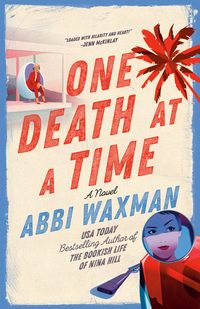
One Death at a Time by Abbi Waxman—Think Hacks plus Rebel (the Katey Segal show), and you’ll have the gist of this. “A cranky former actress teams up with her Gen Z sobriety sponsor to solve the murder that threatens to send her back to prison.” I had a blast with this, and hope to tell you more about it soon.
The Fact Checker by Austin Kelly—1. Great cover. 2. Promising premise: “Mirthful, laugh-out-loud funny, and surprisingly philosophical, The Fact Checker is a brilliant debut novel featuring a missing woman who might be perfectly fine, and a single-minded investigator yearning for meaning, morality, and accuracy in an increasingly post-truth world.”
Benny on the Case by Wesley King—”A boy with Mosaic Down syndrome navigates entering a mainstream classroom, making new friends, and standing up to bullies all while trying to catch a thief and save his home in this thrilling middle grade mystery.” I was rather charmed by King’s OCDaniel, betting this will be pretty good, too.
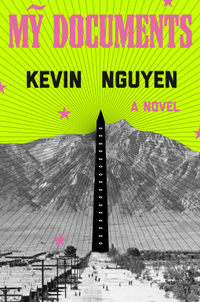 My Documents
by Kevin Nguyen
DETAILS:
Publisher: One World
Publication Date: April 8, 2025
Format: eARC
Length: 352 pg.
Read Date: April 7-9, 2025

Soon after the fall of Saigon, but not soon enough, a woman named Bà Nội manages to escape Vietnam with her four-year-old son—she’d been able to send two of her children to the U.S. earlier. Sadly, her husband was unable to leave with them. As the novel opens in the mid-2010s, we meet four of this son’s children—Ursula, Alvin, Jen, and Duncan.
These siblings and cousins are on the cusp of adulthood. Ursala is trying to make it as a journalist in NYC, Alvin is starting an internship (that will hopefully/likely turn into something more) at Google, Jen is enjoying the freedom that comes from being away from home at NYU, and Duncan’s passion is playing on his high school football team—and he’s pretty successful at it. All in all, this is a pretty good realization of Bà Nội’s American Dream (even if most of the family had hoped for something more lucrative for Ursala than being a writer).
Then the U.S. is rocked by a series of coordinated terrorist attacks that result in the overwhelming majority of Vietnamese-Americans being placed in various internment camps. Jen, Duncan, and their mother are placed in Camp Tacoma, while Ursula and Alvin are able to get exemptions.
The novel traces the lives of these four (as well as some of their relatives) through this dark time—showing how technology, business, the media, the government, and prejudice collude to create and maintain this system, as well as the public reaction and eventual distraction (with sporadic moments of attention and protest). But beyond that, we see how those most impacted by these policies survive this—and how they try to adjust, cling to their humanity, and try to do more than survive.
First, I should note that we also get some time with their shared father (who was not really involved in their lives growing up), Dan. Without getting into it, Dan took a very different path than his children—or the majority of Vietnamese-Americans—during this time. His actions—which we check in on sporadically—serve to contrast what the rest go through.
But I want to focus on—as the book does—the cousins. These are fantastically drawn, deeply flawed, and relatable characters. They all react very differently to their circumstances, and grow (or at least develop) through them in ways that are completely believable. In much the same way that the fall of Saigon and escape to the U.S. shaped the lives and psyches of their grandmother and father, this period does that to them.
In the beginning—even for those outside the camps—it’s just about survival. You do what you’re told, you make sure to obey the men with guns, you keep your head down and just hold on to whatever you can. But in time, you find ways to breathe, to relax, to find community and support, you even find ways to help others.
The guards organize football games for the detainees, which are attended by most of those in the camp. It allows Duncan to thrive. Jen gets work on the camp’s official newspaper—which, yes, is basically a propaganda machine (everyone knows this), but it helps her hone her writing and gets her exposure to most of the camp, as well as access. Because of her access, she’s brought into the circle of a smuggling operation that brings in some forms of food, life-saving medicine that the camp won’t bring in, and even digital copies of TV, movies, and music.
It’s through these temporary escapes from their daily circumstances—authorized or not—that the detainees are able to remember that there’s more to living than existing. There are flashes of joy and relief in the midst of their tense, precarious, and tragic circumstances.
It’s in this part of the novel that the reader is able to find more than just a frighteningly possible dystopia; it’s what elevates this.
One of the more chilling aspects of this book is how most Americans move on from the internment. It makes headlines and creates some scandal for a bit, and then the attention of the public shifts to something else. Every now and then, something will come up that gets people riled up a little bit, but nothing sticks for most of the public. This is a dystopia—but not for everyone. Not that many people suffer. And while things could be better for people like Ursula and Alvin, outside of their own missteps and failings, their lives are pretty good.
The more I think about that, the more terrifying it is. The more realistic and possible it seems, too.
There’s a moment toward the beginning of the book where Ursula is attending a lecture from a working journalist, who says that a good story tells us something about people—how they live and how they are self-deluded. It seemed like a pretty obvious spotlight on one of Nguyen’s themes. And it happens so early, I don’t feel bad getting that specific. Not only is that a good way to think about stories (true and fictional) in general—it’s a key to this work.
Every person we spend extended time with—and several that we don’t—are under one or more forms of delusion—some external, but many come from within. This, too, is Nguyen’s realism shining forth. The way these four fool themselves is so relatable and so pitiable. It may sound like I’m criticizing the characters (and maybe I am a little), but this is a testimony to the way Nguyen depicts them, they come alive in their failings more than in their strengths.
I would’ve liked to see a little more of the relationship between Duncan and Alvin. But the way we—and they—were denied that is one of the stronger elements, the more I think about it. Once they’re unable to communicate after the internment (which, naturally, comes with a total lack of mobile phone/internet access), they themselves think about the ways they missed out.
I do think some readers will be put off by how fun this book sometimes is. Jen has a similar thought when the underground starts distributing TV shows and people get so into them—but her smuggler acquaintance assures her that this is good. There’s a little bit of enjoyment in these people’s lives now—they’re doing more than just existing.
Also, the moments of lightness do a great job of setting you up for the next gut-punch of a development. Nguyen’s is good at lulling his readers into that.
This is a gripping, well-plotted read that keeps moving along, too. There’s a momentum that slowly builds, almost like a thriller, until you’re barreling toward the conclusion.
This is a powerful, haunting, uncomfortable (purposefully) read that will also charm you. I’ve been having a hard time moving on from this book in the days since I read it. I keep finding ways to talk about it or think about it—and the more I do either, the more I appreciate this work. This is definitely one of the best—both affective and effective—books I’ve read in some time.

Disclaimer: I received this eARC from Random House Publishing Group – Random House via NetGalley in exchange for this post which contains my honest opinion—thanks to both for this.
This post contains an affiliate link. If you purchase from it, I will get a small commission at no additional cost to you. As always, the opinions expressed are my own.
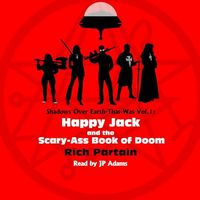 Happy Jack and the Scary-Ass Book of Doom
by Rich Partain, JP Adams (Narrator)
DETAILS:
Series: Shadows Over Earth-That-Was, Book 1
Publication Date: December 17, 2024
Format: Unabridged Audiobook
Length: 12 hrs., 50 min. (I made it 3.5 hours )
Read Date: April 16-17, 2025
From Audible:
What happens when the geeks inherit the Earth? For starters, things get a little weird.
In the year 2475, the remnants of humanity have taken to the skies, inhabiting massive domed cities that hover five miles over the ruined ecological disaster of old Earth. The Powers That Be, in their infinite wisdom, decided that the few million people left deserved to live their best lives, so they gave each sub-orbital platform its own theme and legally enforced tech level. Named for afterlives and sacred places from all of the world’s great cultures, Elysia, A’Aru, Valhalla, Tian and the other orbitals range from cyberpunk metropolises to Tolkienesque medieval fantasy lands; from Victorian steampunk cities of glass and copper to snowbound Viking kingdoms.
Not content with merely cosplaying their days away, a significant portion of the population have become transhuman “cybernaturals,” electing to transform into creatures from myth through cybernetic enhancements and advanced genetic therapies; orcs, dwarves, elves, vampires and werewolves now exist through super-scientific means, not supernatural ones.
In the middle of this madness, Daniel Davidson, a pop culture archaeologist and mercenary of dubious repute and his band of foul-mouthed friends are charged with tracking down an ancient book that could, in the wrong hands, erase all of reality. It could be a huge payday and might even involve saving the known universe as a tidy bonus. That is, if they manage to NOT die at the hands of cannibal sex cultists, swashbuckling rogue vampires, prankster demigods, Templar knights, horrifying biblical angels, the angry star-spawn of elder things, and Satan himself. And possibly food and/or alcohol poisoning. Or suffocation in a sex dungeon.
It’s a filthy, hilarious, epic journey through an off-kilter future filled with bullets, blades, beasts, and boat drinks. If you like your profane sci-fi action comedies with a side order of urban and traditional fantasy, look no further.
Daniel Davidson makes too many late 20th/early 21st Century references. He uses the slang of these eras, talks about music, books, TV, movies, video games of this era. Yes, he explaines it. But I can’t buy that this kind of a geek–no matter his specialty–doesn’t make references to things outside of this time. Something from the intervening 300+ years would’ve snuck in.
His complaints about Evangelical Christians are also very 2020+–there’s no way that they wouldn’t have moved on to other ways to provoke the culture around them.
Listen, it makes sense for the Bobiverse’s clones to be stuck in contemporary references. That absolutely works. This just doesn’t. John Crichton might be full of references to Earth, but he also picks up the lingo and culture of those he interacts with once he joins Moya’s crew (see also Buck Rogers).
It just never grabbed me. It was occasionally amusing. I thought the blue language was overdone, but it wasn’t as offensive as the Author’s Note at the beginning made it sound like it’d be. If you’re going to overuse some or all of The Nine Nasty Words be interesting with it, otherwise it just fades into the background like a dialogue tag.
I’m leaving the door open to returning to this–it didn’t anger me, offend me, or bore me. Like I said, I found bits of it amusing–even entertaining. But it just left me apathetic. I’d rather be annoyed by a book than totally uninterested. I’ll stick with a book to see if the author can make something good/decent out of something bad. But I can’t stick with something to see if I ever have a reaction.
I have no opinion on JP Adams, either. I don’t think James Marsters, Lorelei King, or Ray Porter could’ve done more with the material. So, I’m absolutely open to something else by him, too.
So, I’ll check out of this for now, and maybe return to in later.

as told to Melaney Taylor Auxier
DETAILS:
Publication Date: June 28, 2024
Format: Paperback
Length: 39 pgs.
Read Date: April 9, 2025
We meet this very good-looking dog, Titan, at the shelter when he meets his human, she “fell in love instantly because I’m so loveable.” Titan decides to keep her.
We get a couple of pages showing Titan adjusting to his new home and friends, making some mistakes and then Titan teaches some life lessons. He teaches about friends, making mistakes, eating well, being grateful, that sort of thing.
The art consists totally of home photographs of Titan—and occasionally some other good-looking dogs—and a couple of human feet.
On the one hand, these are not studio-quality pictures. They’re just candids of Auxier’s dog, likely her phone is loaded with them (like any person who has pets and a phone). She took the best—sometimes goofiest—of these to illustrate Titan’s lessons.
Are they the best dog photos you’ll see? No. But they’re taken and shared with love for the subject—and that’s more than enough to justify looking at them. Also, little kids are not known for being discerning when it comes to pictures of handsome doggies.
This is a great tribute to a great dog.
My grandson isn’t ready for Lessons From Lucy by Dave Barry, Lessons from Tara by David Rosenfelt, or even The Teachings of Shirelle by Douglas Green. But he is ready for this one (pretty much). Many of the lessons/perspectives/thoughts in this book match those books for older readers, so even if he has a decade or so before I can introduce him to Lucy, Tara, or Shirelle, I can introduce him to Titan and his wisdom.
Also, this one has far more pictures. And who doesn’t want that?
It’s short, sweet, and to the point. It’ll win over young dog lovers, and even bring a smile to us older ones when we need a quick fill of puppy love.
For a few years, April 15 was the apex of my professional life–months of effort led up to it, weeks of effort spent dealing with it, and then we had a couple of months of reprieve before starting the cycle again. I left that employer almost 4 years ago, but it’s still in the back of my mind to be stressed right now. It’s always such a relief when I realize I don’t have a reason to be, even if my subconscious is convinced I should be. I do feel bad for former coworkers who are still there, and the long hours they “get” to work.
I can’t remember where I was going with that, but I can’t think of another introduction for this. So pretend I had a punchline, and let’s get on with today’s WWW.

This meme was formerly hosted by MizB at A Daily Rhythm and revived on Taking on a World of Words—and shown to me by Aurore-Anne-Chehoke at Diary-of-a-black-city-girl.
The Three Ws are:
What are you currently reading?
What did you recently finish reading?
What do you think you’ll read next?
Seems easy enough, right? Let’s take a peek at this week’s answers:
 |
 |
|
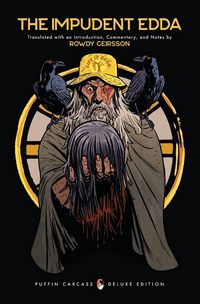
| The Impudent Edda by Rowdy Geirsson |
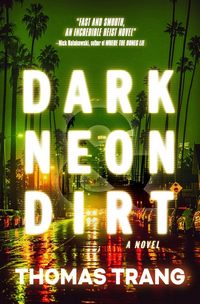
Dark Neon & Dirt by Thomas Trang |
Happy Jack and the Scary-Ass Book of Doom by Rich Partain, read by JP Adams |
The Impudent Edda bills itself as a translation of the last Edda, this time made by a Bostonian. It is ridiculously fun. It’s also hard to take in large chunks, so I also started Trang’s debut, which is almost the complete opposite–it’s fun, but only because it’s gritty LA noir done right. Assuming I survive the mental whiplash between these two, the next couple of days are going to be great.
Yeah, it’s a couple of weeks after I said I was going to listen to the Rich Partain book but Library holds came a calling.
 |
 |
| One Death at a Time by Abbi Waxman |
Everything Is Tuberculosis: The History and Persistence of Our Deadliest Infection by John Green |
It felt like Waxman turned her comedy up a few notches with this one–while delivering a strong mystery novel filled (as you expect from Waxman) with fantastic characters.
I learned far, far more about Tuberculosis than I ever expected to (including how much I have yet to learn–and it’ll likely stay that way). In the midst of this history/social commentary is the (true) story of a very sick teenager. It’ll surprise no one to learn that Green is very good at talking about sick teenagers.
 |
 |
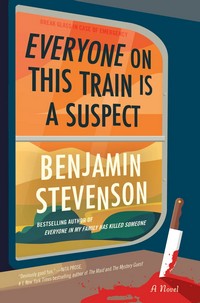
| Everyone on This Train Is a Suspect by Benjamin Stevenson |
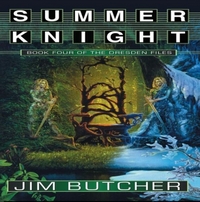
Summer Knight by Jim Butcher, read by James Marsters |
Why did it take me so long to get to Stevenson’s sequel? No one will ever know. But I’m hoping to take care of it by the end of this week.
My Dresden Files re-listen got derailed last year, so I might as well get back on track, right?
This seems like a good day to revisit this (sort of a shame there were no sequels)
 Death and Taxes
by Mark David Zaslove
Series: Tales of a Badass IRS Agent, #1ARC, 219 pg.
Aperient Press, 2018
Read: August 13 – 14, 2018
I’m not sure I can go this book justice with a hand-crafted synopsis, I’ll just copy and paste from Zaslove’s site:
| Death and Taxes follows Mark Douglas, an ex-Marine turned IRS agent, who, along with auditing the weird and the profane, also spearheads weekend raids with his locked-and-loaded gang of government-sanctioned revenuers, merrily gathering back taxes in the form of cash, money order, or more often than not, the debtor’s most prized possessions.
Things turn ugly when Mark’s much-loved boss and dear friend Lila is tortured and killed over what she finds in a routine set of 1040 forms. Mark follows a trail dotted with plutonium-enriched cows, a Saudi sheik with jewel-encrusted body parts, a doddering, drug sniffing, gun-swallowing dog named The Cabbage, a self-righteous magician with a flair for safecracking, a billionaire Texan with a fetish for spicy barbecue sauce and even spicier women, and an FBI field agent whose nickname is “Tightass.” All of which lead to more and bloodier murders – and more danger for Mark. Enlisting his IRS pals – Harry Salt, a 30-year vet with a quantum physical ability to drink more than humanly possible; Wooly Bob, who’s egg-bald on top with shaved eyebrows to match; Miguel, an inexperienced newbie with a company-issued bullhorn and a penchant for getting kicked in the jumblies – Mark hunts down the eunuch hit man Juju Klondike and the deadly Mongolian mob that hired him as only an angry IRS agent can. There will be no refunds for any of them when April 15th comes around. There will only be Death and Taxes. |
This is hyper-violent (not that filled with blood and guts, really — there is some), a lot of guns, bombs, more guns. Sometimes played for comedic effect, sometimes it’s the good guys vs. the bad guys. Sometimes, it’s a little of both. It never got to the overkill point for me, probably because this felt more like a cartoon than a “realistic” thriller.* What was overkill for me was the hypersexualization of every woman under the age of sixty. I didn’t need to hear that much about every woman’s physical appearance — there are more gorgeous women with perfect (sometimes surgically enhanced) bodies in this guy’s life than an episode of Miami Vice.
But man, is this funny. There are sections — sometimes a sentence or two, sometimes several paragraphs long — that are the literary equivalent of a shot of espresso, they are so taught with action, cultural references, and humor that you just revel in them. This reminds me a lot of the John Lago Thrillers by Shane Kuhn — I think Kuhn shows more discipline in his plots and characters, but on the whole, these two are cut from the same cloth. The same energy, a similar style, similar sense of humor — and frankly, that stuff is catnip to me. I think the plot got a little convoluted, a little confusing — but it was worth working through.
* Really, what thriller is realistic?
Disclaimer: I was provided with a copy of this novel in exchange for my honest opinion, which you see above.
—–

This year is speeding by, the way they do more and more…let’s take a quick look at the challenges and goals I set for the year
I’d hoped to keep charging ahead with Grandpappy’s Corner and Literary Locals, and while those haven’t completely died off, I haven’t done that much with them. I think the next couple of months should bear fruit along those lines, though. We’ll see. HC Chats are plugging around.
How’s the perennial, “Cut down on my Goodreads Want-to-Read list and the unread books that I own” goal going? Well, I bought very few books in February, so that helped, but overall…?
| Audio | E-book | Physical | Goodreads Want-to-Read |
NetGalley Shelf/ARCs/Review Copies |
|
|---|---|---|---|---|---|
| End of 2024 | 3 | 68 | 78 | 167 | 10 |
| End of 1st Quarter | 5 | 72 | 77 | 172 | 11 |
| End of 2nd Quarter | – | – | – | – | – |
| End of 3rd Quarter | – | – | – | – | – |
2025 Book Challenges
Goodreads Challenge
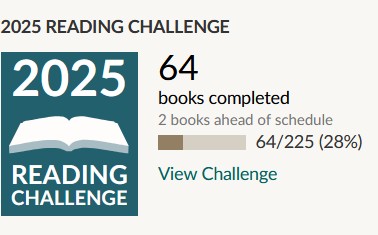
This actually looked better at the first of the month, but I forgot to get the image. Still, I’m on track.
Read Every Day in February for the American Cancer Society

Nailed it. Even better, raised a couple hundred dollars.
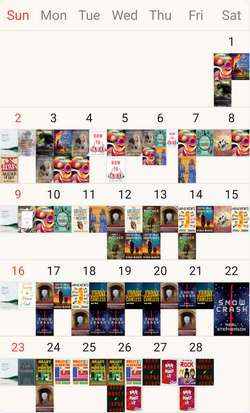
Reading with Wrigs
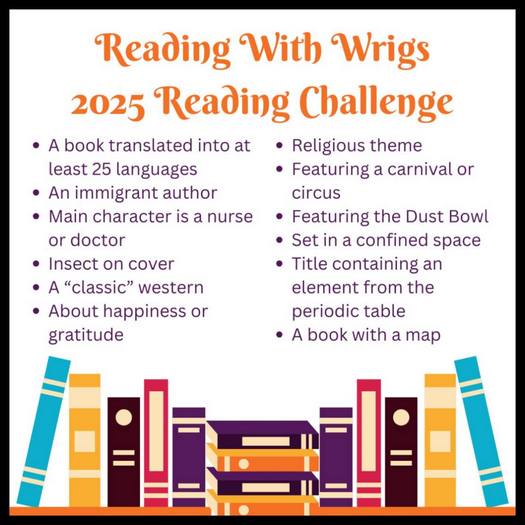 I missed completing this one last year, but have done some pre-planning on it and am about on schedule.
The 2025 Booktempter’s TBR Challenge
January–First steps: You have my permission to read the last book you added to the TBR pile: Sword & Thistle by S.L. Rowland
February: Short and Sweet: Read 28 short stories – they can be in magazine, anthology or collection form. You don’t even have to finish the books! Just 28 tales to read: Promise by Christi Nogle and Passageways edited by Rebecca Carey Lyles
March – Ready Steady Go!: Start a series, or the next book in a series that has been lingering on those shelves: Bloody Rose by Nicholas Eames
Further Up and Further In
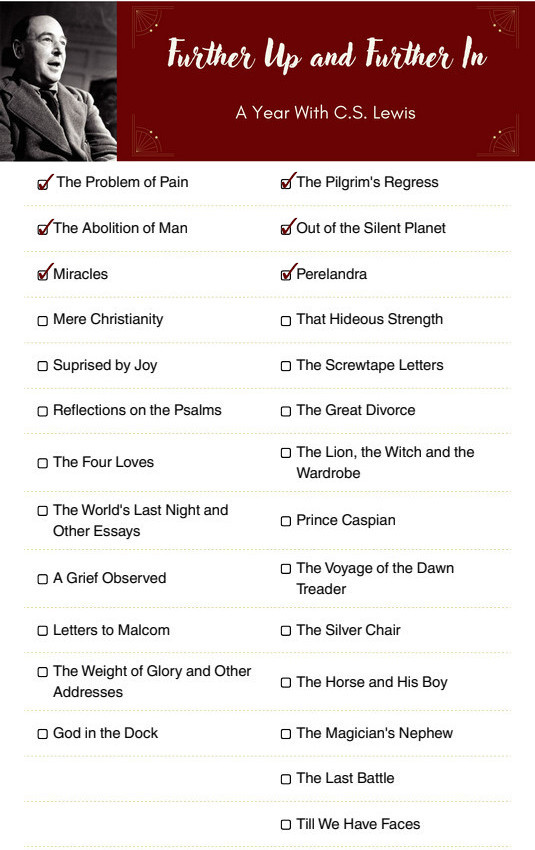
I’m on track here
25 in ’25
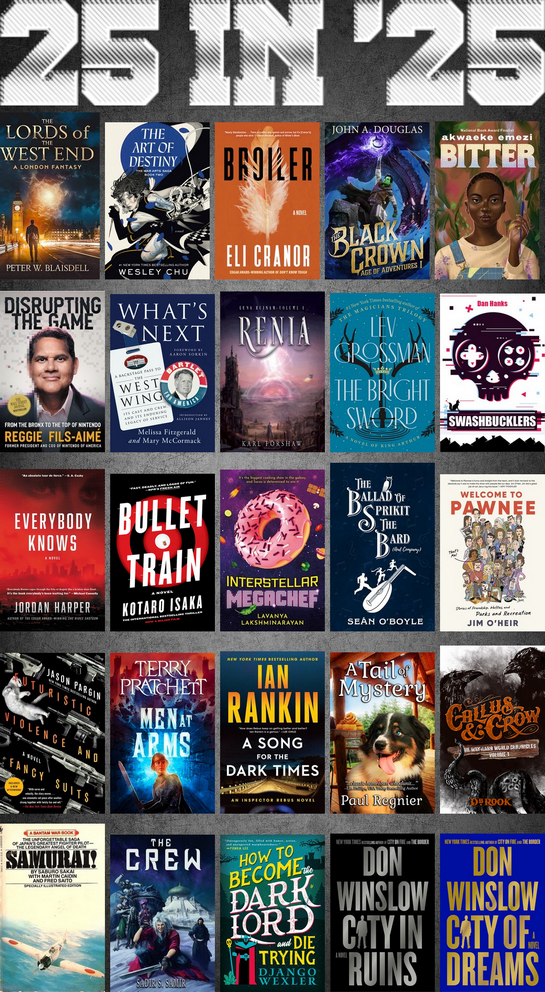
Ouch. Drawing a blank here.
Auditing Challenges
I’m not sure that I want to commit to these, but I saw them on Bookforager’s page, and wanted to give them a shot–they look fun. So I’m going to track them, and if I happen to do well with them, great. If not…oh, well.
(yeah, that’s true with all of these, but I’m sort of calling my shot with the above)
Alphabet Reading Challenge
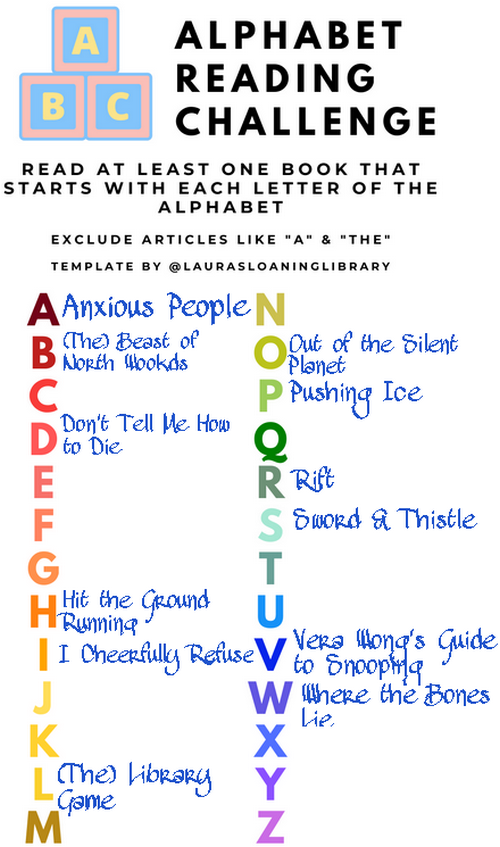
Not bad…
Picture Prompt Book Bingo Challenge for 2025
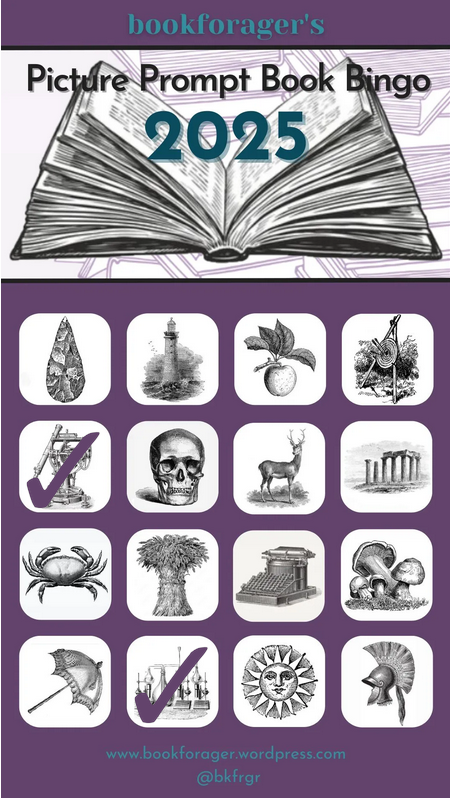
| 1. A prehistoric flint knapped stone knife | 2. A lighthouse | 3. An apple on a leafy branch | 4. An archery target with three arrows in it |
| 5. A very large mechanical telescope Pushing Ice |
6. A human skull | 7. A stag | 8. The ruins of a temple-like structure |
| 9. A crab | 10. A sheaf of wheat | 11. An old mechanical typewriter | 12. A cluster of four mushrooms |
| 13. A fringed umbrella / parasol | 14. A chemistry set-up of bottles and tubes A Drop of Corruption |
15. A stylized sun with a human face | 16. A Roman helmet |
Not bad…have one more finished already, maybe two.
I’m in decent shape, overall…
I can’t tell you when this became a (largely) annual thing for me to post, but it was on a blog that pre-existed this one. As always, it seems like a good day to post it.
 A man condemning the income tax because of the annoyance it gives him or the expense it puts him to is merely a dog baring its teeth, and he forfeits the privileges of civilized discourse. But it is permissible to criticize it on other and impersonal grounds. A government, like an individual, spends money for any or all of three reasons: because it needs to, because it wants to, or simply because it has it to spend. The last is much the shabbiest. It is arguable, if not manifest, that a substantial proportion of this great spring flood of billions pouring into the Treasury will in effect get spent for that last shabby reason.
–Nero Wolfe
from And Be a Villain
Powered by WordPress & Theme by Anders Norén