Category: A-B Page 19 of 23

Authors A-B

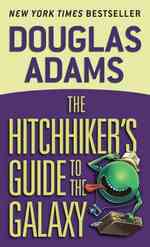
Reread Project: The Hitchhiker’s Guide to the Galaxy by Douglas Adams

The Hitchhiker's Guide to the GalaxyThe Hitchhiker’s Guide to the Galaxy

by Douglas Adams
Series: The Hitchhiker’s Guide to the Galaxy Trilogy, #1

Mass Market Paperback, 216 pg.
Del Rey Books, 1995 (originally, 1979)
Read: January 14 – 15, 2015

If I’m not really careful, this will be the longest thing I ever post here. Let’s see how much restraint I have, shall we?

I think I read The Hitchhiker’s Guide to the Galaxy for the first time in 1987 (maybe 1988), and have read it countless times since then. I quote it all the time (frequently unconsciously and unintentionally) — I think I’ve even plagiarized it a couple of times (really unintentionally). The only reason that my PIN isn’t 4242 is because it seems to be too obvious. I love this book. Rereading it is still fun. Even though I have paragraphs committed to memory, I can hear large portions of it in the voices of the original radio play actors, still the act of reading it is enjoyable, it’s like coming home after a long day at work.

The fixation on digital watches seems so quaint. It starts in the first paragraph and doesn’t really let up until late in the book. I so wish Adams was with us to see what he’d do with our smartphone addictions.

So much of what Adams does here has been repeated by others that he inspired, it’s tough to see some of it as fresh anymore, but he didn’t so much break the mold as ignored it and accidentally created a new one.

The Vogons are fantastic creatures. From the description of their evolutionary process — abandoned though it may be — their anatomy, their inherent meanness, to the commentary on civil servants. Just a fun alien race to read about. But is Adams satisfied with that? No. He adds the monstrosity that is their poetry (and the swipe at the old schoolmate) and they near perfection.

The Babel fish, what can you say about that? They are inspired. They take care of a problem that every space-bound Science Fiction story has to deal with in a way that’s actually more believable than technology-based solutions (Doctor Who does the same thing a bit less convolutedly, but less amusingly, too).

The Python-esque dialogue of the representatives of the Amalgamated Union of Philosophers, Sages, Luminaries and Other Thinking Persons. Is just a delight and picks up what could be a lull in the story.

Another little bonus that’s easy to over look is cop ex machina appearance of the Blagulon Kappa police officers — they’re a great commentary on law enforcement, notions of masculinity, depictions of both in the media — and how all three were undergoing a change at the time.

Strip away all the laughs, the jokes, the satire, the general zaniness and you still have a decent story — not a great one, mind you, but a decent one. There’s some good character work here, too — but it’s hard to see. The reactions of both Arthur and Trillian to the destruction of Earth are a lot deeper and real then Adams needed to make them. Unfortunately, that’s about all the good that Adams does with Trillian. Arthur still has some good treatment in his future.

It’s not perfect, don’t get me wrong — there are some problems with the characters (see Trillian), it being an adaptation of the radio program makes things a bit episodic with clunky transitions, and other hiccups (like the multiple introductions of Ford Prefect). Still, the highs are higher than the lows are low and there are a lot more of them.

    I stopped taking notes of particular lines on page 5 this time, there are just too many to count, and far too many to list. Still, there are a few I have to note:

  • “Time is an illusion. Lunchtime doubly so.”
  • “This must be Thursday. . . I never could get the hang of Thursdays.”
  • “You’d better be prepared for the jump into hyperspace. It’s unpleasantly like being drunk.”
    “What’s so unpleasant about being drunk?”
    “You ask a glass of water.”
    (I’m not sure why, but this has always made me chuckle, if not actually laugh out loud. It’s just never not funny)
  • “He had found a Nutri-Matic machine which had provided im with a plastic cup filled with a liquid that was almost, but not quite, entirely unlike tea.”
  • “In those days spirits were brave, the stakes were high, men were real men, women were real women and small furry creatures from Alpha Centauri were real small furry creatures from Alpha Centuari. And all dared to brave unknown terrors, to do mighty deeds, to boldly split infinitives that no man had split before . . . “
  • “Look,” said Arthur, “would it save you a lot of time if I just gave up and went mad now?”
  • Slartibartfast
    (okay, not technically a line, but that name…c’mon)

It’s a classic, you just need to read it if you haven’t. If you have, is it time for a re-read?

—–

5 Stars
(only because I don’t have time to make a 6-star graphic) 6 out of 5 stars, easy.

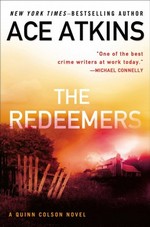
The Redeemers by Ace Atkins

The RedeemersThe Redeemers

by Ace Atkins
Series: Quinn Colson, #5

Hardcover, 370 pg.
G.P. Putnam’s Sons , 2015
Read: August 7 – 10, 2015

The first thing you want to do after being shot is make sure you are not shot again.

That sentence just makes me grin. Which, honestly, is not something that someone spends a lot of time doing while reading a Quinn Colson novel. But The Redeemers is not your typical Quinn Colson novel.

We start off with Quinn on one of his last days as sheriff — Johnny Stagg, the man Boss Hogg wanted to be, finally worked his magic and got the election result that he worked so hard for — Quinn’s out and a man of his backing is in. Most readers are going to instinctively prefer Colson. and want to not like his successor, Rusty Wise. Rusty was most recently an insurance salesman, although he did work as a police officer for a time (nothing to noteworthy in his career — or at least not that Stagg didn’t bury). The problem with being anti-Rusty is that he’s actually a decent guy (sorry, Johnny), who honestly thought he could do a better job than Colson — and gets thrown into the fire on his first day (hours before it, really). Now, we all know — and Lillie Virgil will tell you — Wise is no Colson, not even close. But he’s trying.

On the other end of the spectrum, are a few idiotic criminals — you’ve got the so-called master safe cracker and his University of Alabama Football-obsessed nephew/apprentice, hired by a local to help he and his friend get revenge on a crooked businessman. I’m fairly certain these criminals had noticed that they had no place to live without Elmore Leonard, so they dropped by to see how they’d fare in Tibbehah County. Short answer: they were better off before. If you don’t chuckle at these numbskulls at least one, call your doctor and get your funny bone checked. Lille and Wise have the lead on this investigation, but the wife of their victim gets Colson to check into it a bit, too.

He gets pulled in because that woman is the aunt of Anna Lee — who has definitively left her husband, who has definitively left town, so she and Quinn can definitively do something about their old flame. Which is just one of the balls that Quinn has to keep in the air on the personal side — his father’s moving into Quinn’s house and bringing his horses on to Quinn’s land; his sister Caddy has fallen way off the wagon again; and Quinn’s unemployed — unless he wants to get a job at the new Wal-Mart, he’s going to have to do something about that. There’s an element of “oh, this again?” with Caddy’s struggles with drug addiction. But what do you want from that kind of thing? And with Quinn’s father, I felt a strong, “ugh, how long are we going to out up with this guy?” (I think Quinn agrees with me),

You have to ask (and people do), why does Quinn stay in Jericho? For that matter, why does Caddy (not just because Quinn drags her back), why does Lillie? Part of it is because it’s where they grew up, where they are home. Part of it, is hard to pin down, but Quinn touches on it while talking with the federal agent, undercover in Stagg’s business:

“There’s more to the place than the ugliness,” Quinn said. “Maybe someday I can take you out hunting and fishing and you can know more than just that . . . truck stop. Get out on Choctaw Lake and out into the National Forest.”
“I’d like that.”
“Folks like Stagg and Cobb haven’t ripped all the guts out of the place,” Quinn said. “There’s still a lot left.”

I do fear that Assistant Sheriff Lillie Virgil is given short shrift again. Yes, every time she’s used, she’s: competent, dangerous, smarter than most people in the room with her. She just seems to get the short end of the stick when it comes to story, to emotional arcs, and the like. I want more for her — professionally, personally, and narratively. Now, along the same lines, but perhaps more importantly: can someone arrange a novel/short story/something where Lille and Vic Moretti team up? Yes, it’s possible that would be just too much feminine toughness and gunplay for audiences. But surely, it has to be tried.

For the most part the book keeps trudging along — interesting, occasionally funny — but nothing special — Stagg’s up to his thing, Quinn’s figuring out his next move, the Leonard refugees are seemingly trying to get caught. But nothing that really grabs you. Until you get to the last 60± pages, that is. After lulling the reader into a false sense of security, Atkins packed a while lotta happenings, and loose ends being tied up and bodies being dropped into these pages. Action, and emotion, and a dream sequence that seems straight out of Craig Johnson.

In interviews, Atkins states that the next novel is going to be dark (which is part of why this is so light) — I’m a little worried about what that means. I’m pretty sure the only one who’s safe is the guy who’s name is in the series title (though it wouldn’t surprise me if he got really banged up — but he’ll survive).

—–

4 1/2 Stars

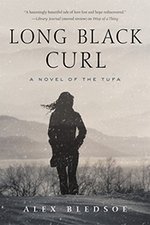
Long Black Curl by Alex Bledsoe

Long Black CurlLong Black Curl

by Alex Bledsoe
Series: Tufa, #3

Hardcover, 377 pg.

Tor Books, 2015

Read: June 11 – 13, 2015

5 Stars
This book was practically un-put-downable. Not because I was driven to find out what happens next — like a Finder, or Child etc. This is one of those kind of books you don’t want to put down because you don’t want to leave that world, not for a minute, to step back into this one, as nice as it is — filled with your stuff, and your great wife and frequently tolerable children. But this book’s little corner of Appalachia that touches another world (in more ways than one) is a place you just want to exist in. Granted, I’d rather be in one of the earlier books than this one (not a reflection of the quality of the book, just the events portrayed).

Not all that long ago, especially by Tufa standards, Bo-Kate Wisby and her beau, Jefferson Powell wreaked all sorts of havoc. They were so terrible that they were banished from the community, unable to return — or, worst of all, make music. WHen you think of some of the despicable things that have happened or have been described in the previous two novels by citizens in good standing, you get an idea just how bad this was. Both have spent decades yearning to return, to play music — but have had to settle for incredibly successful careers in the music business. Which would be a special kind of torture and pleasure — being that close but not able to partake, still being able to appreciate it though. Somehow, however, this curse was lifted without anyone realizing it.

Well, anyone but Bo-Kate. She returns to get revenge and bow the Tufa to her will, destroying their heritage, their way of life and instituting her own. Her approach is not subtle, she clearly learned a little bit from the “Shock and Awe” tactics of a recent war. My jaw almost dropped when i saw the first step that was taken by Bo-Kate. I — like most of the Tufa — didn’t think that was possible, or at least likely. Although there was something to appreciate about that action, there wasn’t in the rest of what she did to the community — I can’t think of any fictional character I’ve had such a visceral reaction to (especially this quickly) this side of Joffrey Lannister Baratheon, first of his name.

It should go without saying with this world, the way the rest of the Tufa respond and defend themselves isn’t how you’d expect. Which goes double for how things play out.

Thankfully, I did really enjoy the rest of the Wisbys — especially Bo-Kate’s sister. I hope to spend more time with them. Actually, I liked getting to know all the new characters — including Bo-Kate’s allies (or those characters who weren’t new, but we hadn’t really spent time with). The characters in this community are so well drawn, so real that you almost don’t need a plot to enjoy a book about them.

As always, I’m jealous of the relationship between these people and music. I don’t have it — a couple of my kids do, at least. I think the way the two banished Tufa react to their returning musical ability tells you almost everything you need to know about them. These are books that need to come with their own score, their own soundtrack. Sadly, I don’t think humans are capable of putting out anything worthy of the books. As good as some of the music inspired by this series has been, it’s not good enough to live up to Tufa standards.

Two things that detracted from the book for me. First is the sex. Not that Bledsoe’s a model of Victorian attitudes toward sex before this, but Long Black Curl is pretty sexually explicit — moreso and more often than before (I’m reasonably sure, but am not interested enough to go back and check). I don’t think it was necessary, but don’t think it hurt things. It was just one of those things that seemed to stick out to me.

Secondly, this is absolutely the most straight-forward of the series, which is both a strength and a weakness. It’s more accessible. There’s almost no doubt whatsoever whats going on. The previous two books haven’t been exactly subtle about the magic and how it works out in the lives of the Tufa — but (and I’m struggling to express this the way I want to) they mostly just let us see what happened and say “hey, that’s magic.” There’s some winking and nudging, but primarily the reader has to do the heavy lifting. To switch metaphors, Bledsoe gave us all the numbers and equations, but we had solve for x on our own. But here? It’s all spelled out. It’s somewhat refreshing, but a little disappointing, too.

But that’s just a little tarnish to the series. It’s still one of the best out there. This book changes the world, but not so much that you won’t recognize it — this is all about growth, development. It does my heart good to know that Bledoe is writing #5 at the moment, so we’ve got at least a few hundred more pages of this world to come.

You can absolutely start here, but I think you’d be better off starting with the first, The Hum and the Shiver to you can catch all the nuance and atmosphere and all that. What it means that character X shows up and does Y. That kind of thing. Either way, dive into this world.

—–

4 1/2 Stars

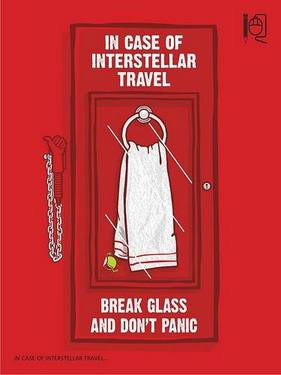
Towel Day ’15

The Hitchhiker’s Guide to the Galaxy has a few things to say on the subject of towels.

A towel, it says, is about the most massively useful thing an interstellar hitchhiker can have. Partly it has great practical value. You can wrap it around you for warmth as you bound across the cold moons of Jaglan Beta; you can lie on it on the brilliant marble-sanded beaches of Santraginus V, inhaling the heady sea vapors; you can sleep under it beneath the stars which shine so redly on the desert world of Kakrafoon; use it to sail a miniraft down the slow heavy River Moth; wet it for use in hand-to-hand-combat; wrap it round your head to ward off noxious fumes or avoid the gaze of the Ravenous Bugblatter Beast of Traal (such a mind-bogglingly stupid animal, it assumes that if you can’t see it, it can’t see you); you can wave your towel in emergencies as a distress signal, and of course dry yourself off with it if it still seems to be clean enough.

More importantly, a towel has immense psychological value. For some reason, if a strag (strag: non-hitch hiker) discovers that a hitch hiker has his towel with him, he will automatically assume that he is also in possession of a toothbrush, face flannel, soap, tin of biscuits, flask, compass, map, ball of string, gnat spray, wet weather gear, space suit etc., etc. Furthermore, the strag will then happily lend the hitch hiker any of these or a dozen other items that the hitch hiker might accidentally have “lost”. What the strag will think is that any man who can hitch the length and breadth of the galaxy, rough it, slum it, struggle against terrible odds, win through, and still knows where his towel is is clearly a man to be reckoned with.

Hence a phrase that has passed into hitchhiking slang, as in “Hey, you sass that hoopy Ford Prefect? There’s a frood who really knows where his towel is.” (Sass: know, be aware of, meet, have sex with; hoopy: really together guy; frood: really amazingly together guy.)

One of my long-delayed goals is to write up a good all-purpose Tribute to Douglas Adams post, and another Towel Day has come without me doing so. Next year . . . or later. Adams is one of those handful of authors that I can’t imagine I’d be the same without having encountered/read/re-read/re-re-re-re-read, and so I do my best to pay a little tribute to him each year, even if it’s just carrying around a towel (I’ve only been able to get one of my sons into Adams, he’s the taller, thinner one below).

TowelDay.org is the best collection of resources on the day, this year were able to post this pretty cool video, shot on the ISS by astronaut Samantha Cristoforetti.

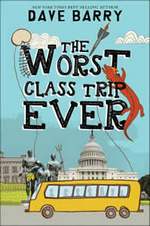
The Worst Class Trip Ever by Dave Barry

The Worst Class Trip Eve

The Worst Class Trip Eve http://www.davebarry.com/book-page.php?isbn13=9781484708491
by Dave Barry

Hardcover, 211 pg.
Disney-Hyperion, 2015

Read: May 19, 2015

There’s not a whole lot to say about this one — this is the story of some of clever (and yet dopey) 8th grade students from Miami on a field trip to Washington, D. C., who fall into a strange predicament involving international intrigue, kidnapping, an attack on the White House/President and very, very petty theft. The only other thing you need to know is that Dave Barry wrote it, so it’s goofy and very funny.

The humor is juvenile — even for Barry. Adults who remember the target audience, and can adjust their standards appropriately, should be able to chuckle at this few times. At the very least, you can appreciate the jokes. It’s perfect for the Middle Grade crowd, probably leaning towards the male perspective (or whatever the demographic is that appreciates flatulence-based humor). This is not to say that all kids won’t enjoy it — it’s just that it’ll score better with kids with a particular sense of humor.

It’s silly, fast-paced, some good action, and some ridiculous characters/plotlines. A lot of fun, definitely what anyone who read Big Trouble should expect from the author writing to MG audience. I’m glad I read it, but I suspect that my 11-year-old will enjoy it more than I did.

—–

3 Stars

Kickback by Ace Atkins

KickbackKickback

by Ace Atkins
Series: Spenser, #43

Hardcover, 292 pg.
G.P. Putnam’s Sons , 2015
Read: May 20, 2015

As you may have noticed yesterday, I read Ace Atkin’s latest novel featuring Robert B. Parker’s Spenser. Now, with Ace Atkins/Reed Farrel Coleman taking over Robert B. Parker’s characters it’s really hard for me to be dispassionate/critical — unless they annoy me — or worse (see Michael Brandman, or — <a href="https://irresponsiblereader.com/2014/01/28/murder-in-the-ball-park-by-robert-goldsborough” target=”_blank”>Robert Goldsborough doing that for Rex Stout). I am capable of actual critical thought, I think. I’m pretty sure. But it takes time, and I just want to get this up. Soooo, I’m going to try to throw up some quick thoughts/impressions on Kickback

It started off strong — a couple pages of intro material from a third-person point of view that established a hopeless, inevitable tone. And then we turn the page and get something that might as well be vintage Parker. I smiled like a goofball throughout the note-perfect first chapter. It was like visiting an old, dear friend. Speaking of old friends, loved the callback to The Godwulf Manuscript (which, because I’m that kind of nerd, I feel compelled to point out I recognized before Atkins spelled it out). Atkins has been, and continues to be, skilled at dropping in these bits of Spenser’s background — enough to demonstrate that he knows the world and to satisfy fans like me — but not so much to clutter up things. Still, it’s time for Paul to show up.

As this is the 43rd installment of this series, it’s going to be reminiscent of a few others — there’s a little bit of Small Vices in this, and a couple of others, but this is primarily a new Ceremony, but without the moral ambiguity. In this case, we have judicial (and police) corruption tied to a private prison (in all but name) for adolescents in a small town. Some people have tried to fight this, but it only serves to make things worse — fatally so in some cases. This isn’t anything new to Spenser or crime fiction, in fact, it’s borderline cliché. But Atkins treats it with respect, and uses the tried and true story to reflect on current problems with the prison industry.

Hearkening back to Crimson Joy (maybe others that I’m not remembering), we have some third-person intercalary chapters — more successful than the serial killer’s POV in the earlier work. These trace the arrest, court appearance and detention of one of the town’s youth. Not Spenser’s client — but someone he befriends. The knot in my stomach got tighter and tighter each time. Really well done.

I continue to like Susan à la Atkins, she’d gotten boring during Parker’s later years, but she’s back and fun. Hawk is still Hawk, but Atkins has turned back the clock a bit on him, too. I’m going to stop here before I mention how Belson, Quirk, and so on have received similar treatment. This has reinvigorated the series, renewed my interest (and, from what I’ve seen) and the interest of others — this is just what Spenser needed. Yes, I’d rather Parker had done this — but I’m glad Atkins has in his place.

I do think the last fifty pages or so were rushed — things outside the detention center seemed rushed — another chapter or two spent gathering evidence might have helped me accept things. Still, so many other things in this one worked so well, I was able to overlook it (I might have harsher things to say later on, or with future re-reads).

I’m giving this 5 Stars. I’m not utterly convinced it earned it — if it was another author with another P.I., I might not. At the same time, from page 1 on, I was hooked and only put this down for a few seconds at a time when work required it until I was done. I laughed, I worried about a couple of clients, I had fun — I was thoroughly engaged the whole time. Which pretty much equals 5 Stars no matter who wrote it and who starred in it. I really, really liked it — but I could’ve told you that was probably going to be the case months ago when I ordered it.

—–

5 Stars

Opening Lines – Kickback

We all know we’re not supposed to judge a book by its cover (yet, publishing companies spend big bucks on cover design/art). But, the opening sentence(s)/paragraph(s) are fair game. So, when I stumble on a good opening (or remember one and pull it off the shelves), I’ll throw it up here. Dare you not to read the rest of the book

On the first day of February, the coldest day of the year so far, I took it as a very good omen that a woman I’d never met brought be a sandwich. I had my pair of steel-toed Red Wings kicked up on the corner of my desk, thawing out, when she arrived. My morning coffee and two corn muffins were a distant memory.

She laid down the sandwich wrapped in wax paper and asked if my name was Spenser.

“Depends on the sandwich.”

“A grinder from Coppa in the South End,” she said. “Extra provolone and pickled cherry peppers.”

“Then my name is Spenser,” I said. “With an S like the English poet.”

“Rita said you were easy.”

“If you mean Rita Fiore, she’s not one to judge.”

from Kickback by Ace Atkins


(technically, not the opening lines, but this is the beginning of Chapter 1, so it sorta counts)

Gone Readin’ – Robert B. Parker’s Kickback by Ace Atkins

Just as soon as I start to make headway on my backlog, I pull something like this…

No post today, unless something big happens — yesterday, I received the latest Spenser novel, Kickback by Ace Atkins and well…nothing’s happening ’til I’m done with that.
Kickback
Even if you don’t like Spenser, or Atkins, if you’re reading this blog, I trust you understand the impulse.

See you tomorrow.

add atkins to the authors, tag this with current reading, etc.

Dead Heat by Patricia Briggs

Dead HeatDead Heat

by Patricia Briggs
Series: Alpha and Omega, #4


Hardcover, 324 pg.
Ace Books, 2015
Read: March 6 – 7, 2015
One of the biggest difficulties I have here on this ol’ blog is coming up with something to say about later books in a series. What (barring a significant shift in quality) can I say that I haven’t already said? I’m honestly not sure here, but I’ll give it a try.

It’s been three years since the jaw-dropping conclusion of Fair Game, and we’re finally able to get back to Brigg’s Alpha and Omega series. Things seem to have been pretty quiet for these two. We’re not given a lot (or any, as far as I can recall) of information about what’s been going on in the lives of Charles and Anna since then, but we can guess — they’ve grown closer, Charles has done a little enforcing for his father, Anna’s. . . well, honestly, I don’t know, she’s been doing her own thing.

Hunting Game is a nice departure from the typical setup for these books. There’s no assignment, no renegade werewolf, no investigation — just Charles trying to get a gift for Anna and introducing her to an old friend. Sure — something supernatural comes up, there’s something/someone that needs to be stopped before people die. Thankfully, conveniently, fortuitously, Charles and Anna are in town and they (with the help of the local pack) can take charge to protect those who need it the most.

There’s not a lot here that will progress the story of either series, no dramatic character growth or supernatural threat that will shake things up. It’s about spending time with these people, understanding them a bit better — at least in a new light. Seeing Charles away from his family — but amidst friends that might as well be, sheds a good deal of light on his character — not just his past. It’s also interesting seeing the way this particular pack acts together (as opposed to Bran’s or Adams’s).

There’s a warmth to this book, even when things got hairy and tense — which fits a novel about an Omega — the same way that Mercy’s books have a very different feel. A welcome addition to the growing Brigg’s world.

—–

4 Stars

Saturday Miscellany – 2/7/15

Grawlix! If I didn’t know better, I’d say that The Universe, The Matrix, Loki, Coyote, Murphy’s Law or the Greek ghost Thespis was messing with me and keeping me from getting anything written or posted here. I’m a little stunned that I got this compiled, really. Hopefully, next week will be better.

Here are some odds ‘n ends over the week about books and reading that caught my eye. You’ve probably seen some/most/all of them, but just in case:

    This Week’s New Releases I’m Excited About and/or You’ll Probably See Here Soon:

  • Funny Girl by Nick Hornby — Hornby continues to explore celebrity, this time in the 1960’s with an up and coming actress. Not really what I’d have expected from him next, but I’m not sure what I did expect.
  • The Way Into Darkness by Harry Connolly — the Third and final installment in The Great Way saga. Hearing so many good things about this one already!
  • Covenant’s End by Ari Marmell — bittersweet — a new Widdershins Adventure, but sadly, it’s the last.

Lastly, I’d like to say hi and welcome to abhinavmajumder for following the blog this week. Thanks to Theinexorablenerd for the interaction.

Page 19 of 23

Powered by WordPress & Theme by Anders Norén