Category: A-B Page 18 of 23

Authors A-B

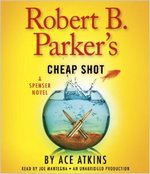
Cheap Shot (Audiobook) by Ace Atkins, Joe Mantegna

Cheap Shot (Audiobook)Robert B. Parker’s Cheap Shot

by Ace Atkins, Joe Mantegna (Narrator)
Series: Spenser, #42

Unabridged Audio, 7 Hours and 30 Minutes

Random House Audio, 2014
Read: June 7 – 9, 2016


This is a very mixed bag of an audiobook. I loved the novel 3 years ago, and enjoyed reliving it. But man, the narration was just not my thing. But I’ll get back to that in a bit.

I stand by pretty much everything that I said 3 years ago (although, I seem to have missed/underrated one plot point last time — I totally bought it this time). Here’s some of what I said before that still applies:

On the one hand, this is not Atkins’ best Spenser. But it’s the one that feels like Parker more than the rest (make of that what you will). The banter, the poking around and stirring things up until you get a break, the fisticuffs, the donuts, the gun fight, the needling of underworld players, and so on — he captures Parker’s voice and pacing better here than he’d managed before (yet doesn’t come across as pastiche). Spenser’s sniffing around the big money and big boys (and a few men) in sports, which serve as a good place for Spenser to reflect how men are to act. Parker did this Mortal Stakes and Playmates (and to lesser extents elsewhere — like Early Autumn), and Atkins is able to do that here (arguably he does so with a subtlety that Parker didn’t achieve).

Kinjo Heywood’s a fun character — slightly more grounded than Mortal Stakes‘ Marty Rabb, far more mature and grounded than Playmates‘ Dwayne Woodcock. One advantage Heywood has is his son, Akira (who’s plenty of fun on his own) — he has someone to provide a good example to, and he strives to. Heywood also seems to have thought ore about life and how one should live it. Marty seemed to think only about Linda (his wife) and baseball, Dwayne was all about his girlfriend (Chantel) and basketball, too — but with less self-examination, it’s just that’s all he had the chance to think about (although Chantel would see that changed, and his horizons broadened if she had anything to say about it). Heywood’s got a kid, he’s been through a divorce, and is fully aware of his place in the limelight (including social media) and his own shortcomings. This alone saves the book from being a reworking of Parker.

I should add that Sixkill has a lot of perspective here (with the assistance of Atkins’ own background in football) — he was close to Heywood’s level, and if he’d made one or two better choices, he would’ve been at this level. He has a better idea what’s going on in Heywood’s mind than Spenser and his brief stint in the boxing world would.

The book begins with Spenser doing bodyguard duty — and as always (Stardust, Looking For Rachel Wallace, A Savage Place, Rough Weather) things don’t go well. You’d think people’d stop hiring him for this kind of work. Spenser turns to investigating — and unearthing lie after lie from his client — while getting Hawk and Sixkill to pitch in on the bodyguard front.

In addition to the main characters, Hawk, Susan, Sixkill, Tony Marcus, and so on; Atkins continues to show a command and familiarity with the impressive gallery of supporting characters in the Spenser-verse. And the new characters fit into the ‘verse just fine, nothing that Parker wouldn’t have created.

Not only did Atkins give us a good story this time, he appeared to be planting and/or watering seeds for future books at the same time — something Parker never bothered with, but I’m glad to see.

About the only thing I’d like to add on this front is that I think I liked the story more this time around.

So much for the lovefest. I just didn’t like Mantegna’s work. I know, I know — he’s done many, many of the Spenser Audiobooks; Parker loved his work with Spenser (even getting him cast in those semi-regrettable movies); and he’s Joe bleepin’ Mantegna. Still, it didn’t work for me. When he was reading the narrative parts — Spenser describing what he was doing, what he was seeing, etc., even making smart aleck asides — I dug it. He did a perfectly entertaining job — maybe even more.

But the strength of Parker’s work was his dialogue, and Mantegna fell flat (at best) on this front. Spenser sounds like Fat Tony, which just should not be. Ever. Kinjo sounds like a stereotypical old blues man, not a young NFL linebacker. Hawk sounds like a slightly younger blues man. And don’t get me started on Zee. That was just embarrassing. Most of the other characters were pretty poorly done, as well. And when the book is so reliant on dialogue, so reliant on the charm of the characters, that missing with just about all of them hurts.

So, like I said, great writing, mediocre (when not disappointing) narration. Please note this rating is for the Audiobook — the whole experience, the narration as well as the writing — still love the book, and would recommend the novel in a heartbeat. This? Eh. It was entertaining enough, but that’s it. Still, any time with Spenser is time well spent.

—–

3 Stars

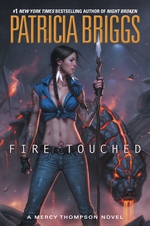
Fire Touched by Patricia Briggs

Fire Touched Fire Touched

by Patricia Briggs
Series: Mercy Thompson, #9

Hardcover, 342 pg.
Ace, 2016

Read: March 23 – 24, 2016

How is this only the 2nd Mercy Thompson book to appear on the blog?!?! Seriously, what is my problem? (other than reading all but the last two before I started this thing, I guess)

If Chapter 1 doesn’t include the funniest scene that Briggs has ever written, I’ll eat my hat. Naturally, after cracking me up, I figured she’d be taking us to a pretty dark place. And while there was a good deal of darkness — and potential for big, dark happenings down the road (but I’ve thought that before, like with Fair Game) — it didn’t get as bad as I feared.

There’s a scene fairly early on here that reminded me of the big ” …it is defended!” speech from Doctor Who‘s “The Christmas Invasion” — the moment that the new Doctor defined himself. Mercy does something a lot like that not realizing just how far her message will go (thanks to the Internet, smartphones, and 25-hour news cycles), and just how much trouble she’s created for Adam and the rest of their pack — as well as Bran and pretty much every werewolf in the U.S.

Part of the immediate fallout of this moment is that a human child who has been abducted by the Fae at some point that no one (including him) remembers comes to Mercy for help. He doesn’t quite fit in to this world any more, but he doesn’t want to be with the Fae, either. With a big emphasis on the latter. So, with she gives him sanctuary of a sort — at least temporarily. This brings attacks, threats, and destruction — with more to come if she doesn’t hand the boy over.

You can imagine how that goes over with everyone’s favorite shape-shifting mechanic.

There’s a lot more going on, but the fate of the boy is the centerpiece.

There’s a major loss in this novel that moved me more than I could’ve expected. On the one hand, I think it’ll be good for the long-term health of the series. But man, it’s going to be strange opening the next Mercy book without seeing ____.

I’ve seen some people disappointed with this book, but I’m not sure why. There was plenty of action — but it wasn’t as epic (for lack of a better word) as Night Broken or River Marked, maybe that’s it. You’ve got some really solid scenes — in the comedic and the action veins, Mercy makes a strange new friend, plenty of Fae politics, internal pack politics and Mercy as David Tennant. Not the best in the series (but they can’t all be), but a very satisfying installment in a really good series. That’s more than I can ask for.

Again, Mercy as David Tennant. Need I say more?

—–

4 Stars

15 Years Ago

I distinctly remember where I was sitting, and who was around, when I read the news 15 years ago that Douglas Adams, a mere 49 years old, had died of a heart attack. I’m not usually one who reacts when a celebrity dies (usually), but this one shook me.

Adams’ wit, style, perspective, and books had a formative impact on my adolescence — for good or ill — and my adulthood.

I hadn’t realized this year was the 15th anniversary of his death when I decided to do my big re-read of his works this year, but I’m glad I’m doing it. I’ll talk about him a little bit more in a couple of weeks (and when I get around to reading the next books on my list), but for now, I just wanted to take a brief moment to reflect on his death.

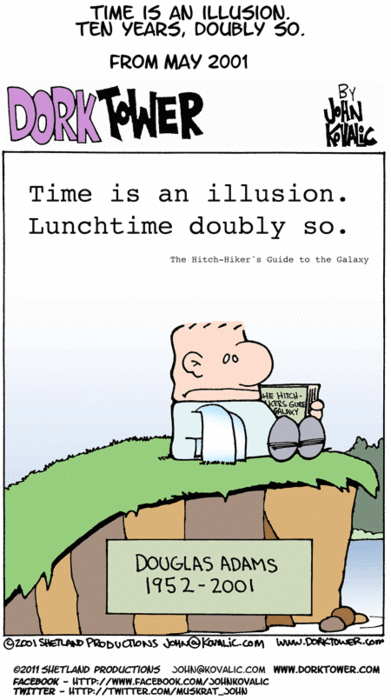
A couple of days later, John Kovalic’s Dork Tower ran this comic (tweaked 5 years ago) which pretty much summed things up for me.

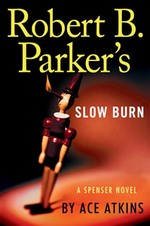
Slow Burn by Ace Atkins

Slow BurnRobert B. Parker’s Slow Burn

by Ace Atkins
Series: Spenser, #44

Hardcover, 304 pg.
G.P. Putnam’s Sons, 2016

Read: May 5, 2016

On the Greenway, a carousel turned to calliope music. The two men approached me. They tried to act like they were shopping, but they were as unobtrusive as a couple of linebackers at a Céline Dion concert.

Say what you will about the relative merits of Atkins’ two current series, but you won’t get lines like that from Quinn Colson (maybe from Lille Virgil). (That’s not really the best line of the book — it’s just the one that requires the least setup)

We’re introduced to a new world here — the Boston Fire Department, and the Arson investigators in particular (but not exclusively). It’s a little harder for Spenser to work his magic here, at least at first, being very much a duck out of water. But, he keeps at it, and eventually things start falling into place — even if he makes one serious (and perhaps life-threatening) mistake early on. There’s a series of suspected arsons, but the proof is minimal, and it doesn’t push the investigators in the right direction — or any direction, really. The usual motives (fascination with fire, insurance money) don’t seem to be involved here.

I should add that the motive for the crimes is interesting, if misguided. I’d almost like to see a bit more of it explored by the good guys, but that’s not what this book is about.

Spenser and his allies do their thing, the way they always do (but fueled by a different donut source). The same ol’ charm, wise cracks, and fists eventually do their job. I think this one is a notch above Atkins’ last — a couple of notches below Atkins or Parker at their best, but better than Parker’s average. The fact that I have to work this hard to decide where exactly in the 40+ this one lies says something — it’s on the good end, I should stress — but it’s hard to distinguish this from the master himself, Robert B. Parker.

There’s some good fodder for long-time fans here — Marty Quirk has a new job, Frank Belson has a new boss (one not particularly taken with Spenser). Not only do we get a callback to Mattie Sullivan, but we get a couple from the more distant parts of Spenser’s past — A Catskill Eagle and Promised Land, one of my least favorites and one of Parker’s best. Atkins’ ability to use for the current narrative, comment on, and tap into fanboy nostalgia all at the same time is really something to watch.

Atkins is again feeling confident enough in his role here to make significant moves in Spenser’s life — not to mention Pearl’s and Sixkill’s. I’m not sure I’m crazy about the latter two, but I’m trusting Atkins. I’m pretty sure he has a plan regarding our favorite disgraced athlete that’ll pay off. Can’t help but wonder what Parker had in store for him, though.

Speaking of plans and things in store — it’s pretty clear that Atkins has a plan for Jackie DeMarco, too. I hope it takes a few books to pull it off, but I fear it won’t.

I’m very glad to hear that we’ve got at least two more of these coming, Atkins is really helping me stay in touch with an old, old friend. I smiled, I chuckled, I even laughed a couple of times, and I reminisced a little, while wondering just how Spenser was going to save the day. All in all, a good way to spend a couple of hours. Now I’ve just got to count down the months until #45.

—–

4 Stars

Reread Project: Life, The Universe and Everything by Douglas Adams

Life, The Universe and EverythingLife, The Universe and Everything

by Douglas Adams
Series: The Hitchhiker’s Guide to the Galaxy Trilogy, #3

Paperback, 232 pg.
Del Rey, 2005

Read: April 18, 2016

“One of the interesting things about space,” Arthur heard Slartibartfast saying . . . “is how dull it is?”

“Dull?” . . .

“Yes,” said Slartibartfast, “staggeringly dull. Bewilderingly so. You see, there’s so much of it and so little in it.”

Between General Busy-ness and having a hard time locating a reading copy of this book (I have one leather-bound edition of the “trilogy” pre-Mostly Harmless that I’m trying not to further abuse and a 1st edition that I really don’t want to abuse at all), I didn’t get to reading this one on schedule. I was briefly tempted to write this up from memory — and I think I’d have hit 80% of the same things, but that seemed dis-honest, somehow.

Also, I really wanted to read the Belgiuming thing (if you’ll pardon the expression)

Thankfully, the Nampa Library came through. So, yeah, a little late and without further ado…

Sigh. This one just doesn’t work as well as its predecessors, does it? You can sense how hard Adams is trying to recapture the sensibility of the previous two novels — but it just comes across like someone trying (or locked in a hotel room by his editor until he’s done, which I believe is what happened here). For example, look at the concept of Bistromathic Drive, if that’s not a desperate attempt to remake the Infinite Improbability Drive, I’m a frood who doesn’t know where his towel is. And then the whole Krikkit saga? Don’t get me started with that.

Which is not to say that this doesn’t have some good moments — most of Ford’s dialogue is great. The whole thing with Agrajag is both a great call-back and a fun diversion. The best part of the book (both in concept and execution) has to be:

The Hitchhiker’s Guide to the Galaxy has this to say on the subject of flying.

There is an art, it says, or rather, a knack to flying.

The knack lies in learning how to throw yourself at the ground and miss.

It goes on for quite a while after this — and I love every bit of it.

I had forgotten Marvin’s arc in this — I enjoyed that more than the rest (even if it wasn’t as good as his arc in Restaurant). It’s the best use of Trillian in the series, bar none. So, it wasn’t a total wash. Still, it felt forced, his heart didn’t seem to be in it. Which made us even, I guess, my heart sure wasn’t. Still, Adams on an off-day is better than most things.

—–

3 Stars

Morning Star by Pierce Brown

Morning StarMorning Star

by Pierce Brown
Series: Red Rising, #3

Hardcover, 518 pg.
Del Rey, 2016

Read: February 24 – March 3, 2016

“There is no pain. Only joy,” they chant, deep in the embrace of the god’s bread. Sefi begins the war bellow. Her voice higher than Ragnar’s. Her two wing-sisters join her. Then their wing-sisters, until dozens fill the com with their song, giving me a sense of grandeur as my mind tells my body to flee. This is why the Obsidians chant. Not to sow terror. But to feel brave, to feel kinship, instead of isolation and fear.

Sweat drips down my spine.

Fear is not real.

Holiday deactivates her safety.

“Njar la tagag . . . ”

My razor goes rigid.

PulseWeapon shudders and whines, priming.

Body trembles. Mouth full of ashes. Wear the mask. Hide the man. Feel nothing. See everything. Move and kill. Move and kill. I am not a man. They are not men.

The chanting swells. . . “Syn tir rjyka!”

Fear is not real.

If you’re watching, Eo, it’s time to close your eyes.

The Reaper has come. And he’s brought hell with him.

And when The Reaper, Darrow of Lykos, says he’s brought hell with him, you’d best believe it.

With books that come later in a series — especially with the last volume — there are huge expectations and hopes. Sometimes the book’s a disappointment; sometimes it’s as good as you hoped — every now and then, it’s better than you’d hoped. And then there are the times you get something like Morning Star. I want to avoid hyperbole, and I don’t want to over-sell, so let me just say that Pierce Brown delivered. I’m not sure how to talk about this book — one of my most anticipated reads of 2016 — other than to say it did not disappoint in the slightest, and if it doesn’t find its way to my favorite reads of 2016, I’d be flummoxed (although that would mean we have an unbelievably good 9 months ahead).

We pick up about a year after Golden Son — well, that’s not true. We start off with one of those aggravating teases for events later in the book before starting the actual story. If I’m going to complain about it in Freedom’s Child a couple of weeks ago, I’d better complain about it here. Thankfully, it’s a brief tease and you can forget it quickly because Chapter 1 doesn’t wait too long to get to the brutality that this series is so capable of bringing, making you forget about trivial things like bad ways to start a novel. I’m not going to get into the plot — if you’re curious, start with Red Rising and catch up. If you’ve read one or two of these books, I just want to assure you that you should grab this.

Red Rising was like the love child of Ender’s Game and The Hunger Games hopped up on amphetamines, steroids and too much Red Bull. Golden Sun was a roller coaster of stomach-lurching twists and turns and shattered hopes. Morning Star has elements of both, but it also reads like a series of climatic scenes from epic novels and movies stacked on top of one another — Jackson’s The Lord of The Rings + Gladiator + The Patriot + a few more things like that on the day that Michael settles all family business. Somehow, Brown keeps the tension mounting from chapter to chapter, in a way that every battle, every encounter feels like it could be the novel’s climax. Yet when the actual climax happens you’re not prepared.

Having been trained by Golden Son, I spent a lot of time expecting a betrayal, waiting for the sucker punch I knew was coming. But it wasn’t that kind of book* — it was a book of hard choices — even compromises (the good kind) — of people doing the right thing, to the best of their understanding. Not always the best for themselves, but the best for their principles, their loved ones, their people. Family — biological family, extended family, found family — is a major theme throughout. It shouldn’t be surprising considering that this all started with a husband and wife, but when you think of The Red Rising Trilogy, family isn’t one of the first words that come to mind. Well, after you read this, it might be.

Lieutenant Commander Worf, son of Mogh, would’ve approved of so much of the action here (on both sides). The pages dripped with honor and nobility (in both classic and more modern understandings of the concepts). Despite it being a mainstay in fiction, I have a hard time buying the concept of noble deaths, but man . . . there’s one roughly midway through the that got me in just the right way. The dying was a little more protracted than Brown’s typical practice, giving him time to do more with it narratively. It was such a good piece of writing (even if all the individual elements in the scene were cliché), it’s one of the most effective parts of the series. Once it starts, you know what’s happening, you know how the effects of it will play out, but it still works. It’s like the da da da dummm at the beginning of the 5th — everyone knows it, but if an orchestra does it right? It’s powerful stuff.

Like a good general — Brown’s always a few steps ahead of the reader, well, me. As before, he surprised me all the time. There were a couple of times that I came close to seeing his play — technically — but his actual move was so much better than I’d guessed, I might as well have been moving checkers around his chess board.

Before I came across the section I quoted in my opening, I was going to use:

Now I remember hate.

I’m glad I didn’t. Morning Star isn’t about that. After Golden Son (or after Eo’s death), that’s what you expect: Darrow going all John Wick/Beatrix Kiddo/Frank Castle, but that’s not what the book is. Darrow is much more than a vengeance-machine. He’s more than rage, more than hatred — he’s full of both, no mistake. But that’s not all that’s driving him.

And because there’s more to him, the book — the series — is elevated to something beyond a great SF/Action romp. When Darrow, his friends and/or his army say something, do something to send a message, more often than not, it’s inspiring, at the very least, stirring. In the end, Darrow’s mission isn’t about destroying the Golds (although there is plenty of destruction), it’s something more.

The question is, can he fulfill this mission? What would that look like? It is so close to the final page when you get the actual answers to those (and all the other) questions you have.

Oh yeah, and Brown made me laugh out loud once. There were heartwarming moments, moments of joy, moments of awe. In the midst of the chaos, the violence, the destruction, and all the blood? Rays of humanity everywhere.

Simply put, this is the perfect conclusion for this fantastic series. I can’t think of a more fitting way for Brown to have concluded things. If you liked Red Rising and Golden Son, you’ll love this.


* Which isn’t to say that there aren’t gut punches.

—–

5 Stars

Opening Lines – Morning Star

We all know we’re not supposed to judge a book by its cover (yet, publishing companies spend big bucks on cover design/art). But, the opening sentence(s)/paragraph(s) are fair game. So, when I stumble on a good opening (or remember one and pull it off the shelves), I’ll throw it up here. Dare you not to read the rest of the book.

Deep in darkness, far from warmth and sun and moons, I lie, quiet as the stone that surrounds me, imprisoning my hunched body in a dreadful womb. I cannot stand. Cannot stretch. I can only curl in a ball, a withered fossil of the man that was. Hands cuffed behind my back. Naked on cold rock.

All alone with the dark.

It seems months, years, millennia since my knees have unbent, since my spine has straightened from its crooked pose. The ache is madness. My joints fuse like rusted iron. How much time has passed since I saw my Golden friends bleeding out into the grass? Since I felt gentle Roque kiss my cheek as he broke my heart?

Time is no river.

Not here.

In this tomb, time is the stone. It is the darkness, permanent and unyielding, its only measure the twin pendulums of life — breath and the beating of my heart.

In. Buh . . . bump. Buh . . . bump.

Out. Buh . . . bump. Buh . . . bump.

In. Buh . . . bump. Buh . . . bump.

And forever it repeats.

from Morning Star by Pierce Brown

Talking to the Dead by Harry Bingham

Talking to the DeadTalking to the Dead

by Harry Bingham
Series: Fiona Griffiths, #1

Hardcover, 337 pg.
Delacorte Press, 2012

Read: February 16 – 17, 2016

One thing I need to do a better job of is remembering how I found out about a book/series/author that I need to try, this novel is a great example of why. I remember putting it on my TBR, and that there was something about it that made me move it ahead of the others — but I can’t tell you when or why I did so. Sometimes, like with this book, that drives me crazy. I just had to trust that I knew what I was doing when I picked it up. Thankfully, it didn’t take long to convince me that Fi Griffiths had something special going on — mostly it was the voice, the attitude, her humor as seen when she’s going through stacks and stacks of financial documents to make a case air-tight (before the inevitable guilty plea for ripping off a private school):

My desk is covered with paper. I loathe all banks and credit card companies. I hate every digit between 0 and 9. I despise every dopily run Catholic boys’ school in South Wales. If Brian Penry were in front of me now, I would try to force-feed him my calculator, which is as large and chewable as Bakelite phone.

It didn’t take too long before the merits of the case drew me in (not the drudgery of the case above, but the one that drove the novel’s action), and would have even without Fi’s narration. But it was a lock with her as a character. The grim nature of the killings grip the reader, the way they do Griffiths’ colleagues and superiors. What really impressed me was that it is one of the sickest, grossest descriptions of a corpse this side of a Bones episode — and Bingham doesn’t dwell on it — oh, he could’ve, and most authors would have. It’s there stark enough to give the reader the willies, in a just-the-facts-fashion, but Bingham doesn’t exploit the nature of the killing or the state of the body.

To put it charitably, Fi is quirky. To be more accurate, she’s suffering from a serious mental condition — she’s (mostly) got it under control, however. Social skills aren’t really in her wheelhouse — at least not automatically — which presents an additional challenge for her work. Early on, I kept picturing Diane Kruger’s performance from The Bridge, it diminished eventually, but I think Fi will always be Kruger-esque to me. We do eventually get actual information about her condition — which is nice, but we don’t need it to understand her enough to empathize with her. There’s an Author’s Note at the end with more details about the actual condition — don’t read it until the end. Get to know her absent the condition first.

Bingham creates a good bench of supporting characters — a potential boyfriend, a couple of supervisors (who have differing levels of concern for her), a former therapist, an old friend (former trainer/sensei-type), parents, sisters, and a few other detectives. One or more of these can be summoned from the bench with ease in the future, but we don’t get to spend a lot of time with any of them here — just enough to establish them. We spend some good time with her potential boyfriend, old friend/trainer/sensei and dad — I like them all and want to see more of them. But this is really Fi’s book and the narrative weight falls on her troubled, yet capable shoulders.

We hardly get an idea for what kind of men the bad guys are here — it’s just shadowy criminals, up to shadowy criminal things. I like the idea that we only get things through law enforcement eyes, not through the killer’s — that happens far too often for my taste. Like Fi says, I know this way we don’t get the full story, but I prefer not being in the mind of the sickos at work here. We, and the police, get most of the story in the end, and that’s good enough for me.

The book closes with a couple of the most heartfelt, moving scenes that I can think of in Detective Fiction (give me time, and I could probably make a decent list of competitors, still pretty sure this would be near the top — sure, that scene in Gone, Baby, Gone has this beat, but not many others would). I had a hard time believing that it would work as effectively given the fact this is a first novel for the character — but Bingham has laid a lot of ground work to get us ready for these moments, and it paid off well.

Talking to Strangers grabbed me in just the right way. I want to devote the next few days to just reading the rest if this series (I won’t, I know I need to pace myself, but… Oh, I really want to just binge). Fi is an early leader for favorite character of the year (a thing I just decided to do).

—–

4 Stars

Reread Project: The Restaurant at the End of the Universe by Douglas Adams

I think WordPress’ spell-check might explode if I add another sentence or two to this….

The Restaurant at the End of the UniverseThe Restaurant at the End of the Universe

by Douglas Adams
Series: The Hitchhiker’s Guide to the Galaxy Trilogy, #2

Mass Market Paperback, 245 pg.
Ballantine Books, 1995

Read: February 13-15, 2016

If you’ve done six impossible things this morning, why not round it off with a breakfast at Milliways, the Restaurant at the End of the Universe?

I think in the past, I’ve enjoyed The Restaurant at the End of the Universe more than this time, but I’m not sure why. Which is not to say that I didn’t have a blast, I just usually have more fun. From the intricate — and death-defying — difficulty of making a good cup of tea; to the extreme lengths some people will go to for a dining experience; to perspective that a little cake can give; to considering what color a wheel should be or whether fire should be nasally-inserted — this book covers all the bases. While still episodic in nature, it seems less so than its predecessor — and far less so than its successor. It’s a stronger novel, not quite as funny, but still better than most “funny” or “light” SF than you’ll find.

[Gargravarr] had rather liked Zaphod Beeblebrox in a strange sort of way. He was clearly a man of many qualities, even if they were mostly bad ones.

Most of this book showcased the ex-President of the Galaxy, Zaphod Beeblebrox the First (how is great-grandfather was Zaphod the Fourth lies in one of the best lies Adams ever penned). Now Zaphod’s not my favorite character — actually, I typically dislike him as a character. As a joke-generator, a font of one-liners? He’s great. Probably most of the quotable lines in this book are his (even Arthur’s best line is immediately denigrated by him “Yeah, and don’t you wish you hadn’t?”).

We see the reason for his stealing of The Heart of Gold in the last book, we’re taken on a wild and twisty ride for him to complete his quest and then . . . it just stops. I’m sure it’s supposed to be in an absurd way or something, but it seems pointless (probably the point).

And then we’re off to Milliways. Ahhh, Milliways — this is an absolutely perfect part of the book. That this is the book’s title is absolutely fitting. There’s nothing about it I don’t like here — Max Quordlepleen’s banter (the oddly bittersweet introduction of him), Hotblack Desiato (and his tax plan), the Dish of the Day . . . I’m going to shut up before I just copy and paste the whole thing.

The rest of the book focuses on Arthur (and Ford, but, a little less), who I like, but don’t laugh at nearly as much.

“Poor Arthur, you’re not really cut out for this life are you?” [Trillian asked]
“You call this life?”

Something I’ve been thinking about this read-through is this: why Arthur? He’s one of Ford’s oldest friends on Earth — but we know he has multiple friends, he could’ve picked any of them — why Arthur? Surely, Ford would’ve had at least an inkling that Arthur would turn into the whiny Monkey-man that Zaphod can’t stand. It’s easy to see why Tricia McMillan would go off with Zapod as Phil over this wet blanket, well, towel. Trillian here has the same thought — and if we’re given a good explanation for that, I don’t remember it. Any of you have a guess (or a quotation) to justify Ford’s improbable choice?

Now, I may have sounded less that totally satisfied with this book — which is oddly true. I do think the Golgafrinchan Ark Fleet Ship B story is pretty “blah” and goes on far too long (into the next book). But it gives us gems like this:

It is a curious fact, and one to which no one knows quite how much importance to attach, that something like 85 percent of all known worlds in the Galaxy, be they primitive or highly advanced, have invented a drink called jynnan tonnyx, or gee-N-N-T’Nix, or jinond-o-nicks, or any one of a thousand or more variations on the same phonetic theme. The drinks themselves are not the same, and vary between the Sivolvian “chinanto/mnigs” which is ordinary water served at slightly above room temperature, and the Gagrakackan “tzjin-anthony-ks” which kills cows at a hundred paces; and in fact the one common factor between all of them, beyond the fact that the names sound the same, is that they were all invented and named before the worlds concerned made contact with any other worlds.

making it hard to complain too much.

There are a lot of laughs to be had here — I didn’t even mention Marvin’s contributions, which were just gold. And any time with Adams is worth it. A must-read follow-up to the classic, Hitchhiker’s Guide to the Galaxy.

—–

4 Stars

Reread Project: The Hitchhiker’s Guide to the Galaxy by Douglas Adams

The Hitchhiker's Guide to the GalaxyThe Hitchhiker’s Guide to the Galaxy

by Douglas Adams
Series: The Hitchhiker’s Guide to the Galaxy Trilogy, #1

Mass Market Paperback, 216 pg.
Del Rey Books, 1995 (originally, 1979)
Read: January 14 – 15, 2015

If I’m not really careful, this will be the longest thing I ever post here. Let’s see how much restraint I have, shall we?

I think I read The Hitchhiker’s Guide to the Galaxy for the first time in 1987 (maybe 1988), and have read it countless times since then. I quote it all the time (frequently unconsciously and unintentionally) — I think I’ve even plagiarized it a couple of times (really unintentionally). The only reason that my PIN isn’t 4242 is because it seems to be too obvious. I love this book. Rereading it is still fun. Even though I have paragraphs committed to memory, I can hear large portions of it in the voices of the original radio play actors, still the act of reading it is enjoyable, it’s like coming home after a long day at work.

The fixation on digital watches seems so quaint. It starts in the first paragraph and doesn’t really let up until late in the book. I so wish Adams was with us to see what he’d do with our smartphone addictions.

So much of what Adams does here has been repeated by others that he inspired, it’s tough to see some of it as fresh anymore, but he didn’t so much break the mold as ignored it and accidentally created a new one.

The Vogons are fantastic creatures. From the description of their evolutionary process — abandoned though it may be — their anatomy, their inherent meanness, to the commentary on civil servants. Just a fun alien race to read about. But is Adams satisfied with that? No. He adds the monstrosity that is their poetry (and the swipe at the old schoolmate) and they near perfection.

The Babel fish, what can you say about that? They are inspired. They take care of a problem that every space-bound Science Fiction story has to deal with in a way that’s actually more believable than technology-based solutions (Doctor Who does the same thing a bit less convolutedly, but less amusingly, too).

The Python-esque dialogue of the representatives of the Amalgamated Union of Philosophers, Sages, Luminaries and Other Thinking Persons. Is just a delight and picks up what could be a lull in the story.

Another little bonus that’s easy to over look is cop ex machina appearance of the Blagulon Kappa police officers — they’re a great commentary on law enforcement, notions of masculinity, depictions of both in the media — and how all three were undergoing a change at the time.

Strip away all the laughs, the jokes, the satire, the general zaniness and you still have a decent story — not a great one, mind you, but a decent one. There’s some good character work here, too — but it’s hard to see. The reactions of both Arthur and Trillian to the destruction of Earth are a lot deeper and real then Adams needed to make them. Unfortunately, that’s about all the good that Adams does with Trillian. Arthur still has some good treatment in his future.

It’s not perfect, don’t get me wrong — there are some problems with the characters (see Trillian), it being an adaptation of the radio program makes things a bit episodic with clunky transitions, and other hiccups (like the multiple introductions of Ford Prefect). Still, the highs are higher than the lows are low and there are a lot more of them.

    I stopped taking notes of particular lines on page 5 this time, there are just too many to count, and far too many to list. Still, there are a few I have to note:

  • “Time is an illusion. Lunchtime doubly so.”
  • “This must be Thursday. . . I never could get the hang of Thursdays.”
  • “You’d better be prepared for the jump into hyperspace. It’s unpleasantly like being drunk.”
    “What’s so unpleasant about being drunk?”
    “You ask a glass of water.”
    (I’m not sure why, but this has always made me chuckle, if not actually laugh out loud. It’s just never not funny)
  • “He had found a Nutri-Matic machine which had provided im with a plastic cup filled with a liquid that was almost, but not quite, entirely unlike tea.”
  • “In those days spirits were brave, the stakes were high, men were real men, women were real women and small furry creatures from Alpha Centauri were real small furry creatures from Alpha Centuari. And all dared to brave unknown terrors, to do mighty deeds, to boldly split infinitives that no man had split before . . . “
  • “Look,” said Arthur, “would it save you a lot of time if I just gave up and went mad now?”
  • Slartibartfast
    (okay, not technically a line, but that name…c’mon)

It’s a classic, you just need to read it if you haven’t. If you have, is it time for a re-read?

—–

5 Stars
(only because I don’t have time to make a 6-star graphic) 6 out of 5 stars, easy.

Page 18 of 23

Powered by WordPress & Theme by Anders Norén