Category: K-O Page 13 of 22

Fahrenbruary Repost: A Mint-Conditioned Corpse by Duncan MacMaster: I run out of superlatives and can’t stop talking about this Mystery that filled me with joy.

Kirby Baxter is possibly my favorite new-to-me character from 2018, you can probably tell that from these next two reposts…And, yes, I’m sticking with the classic cover, although the paperback I bought myself last year has a niftier cover.

This is one of those times that I liked something so much that I just blathered on for a bit, and I’m not sure how much sense it made. The first and last paragraphs are coherent, I’m not really sure the rest is…

A Mint Condition CorpseA Mint Condition Corpse

by Duncan MacMaster
Series: Kirby Baxter, #1
Kindle Edition, 275 pg.
Fahrenheit Press, 2016
Read: July 27, 2018

Is this the best-writing I’ve encountered in a Detective Novel this year? Nope. Is this the most compelling, the tensest thrill-ride of a Mystery novel this year? Nope. Is this full of the darkest noir, the grittiest realism, the starkest exposure of humanity’s depths? Good gravy, no! This is, however, a joy to read; full of characters you’ll want to spend days with, that you’ll want to have over for Thanksgiving dinner just to lighten things up and distract you from Aunt Martha’s overcooked yams and dry turkey; a completely fun time that’s very likely most I’ve enjoyed a book in 2018. It is escapist. It is silly. It is clever.

Think Monk at it’s best. Psych at its least annoying. Castle at it’s most charming. Moonlighting season 1 — I’m going to stop now.

So Kirby Baxter is a comic book writer/artist who breathed new life into a stagnant character which led to the revitalizing of an entire comic book company (not quite as old as DC, nowhere near as successful as Marvel — and somehow hadn’t been bought out by either). He was unceremoniously fired just before he became incredibly well-off (and investments only improved that). Following his new wealth, a thing or two happened in Europe and he gained some notoriety there helping the police in a few countries. Now, he’s coming back to North America to attend OmniCon — a giant comic con in Toronto — returning to see a mentor rumored to attend and maybe stick his toe back in the industry that he loves.

While there we meet his colorist and friend, Mitch — a diminutive fellow, convinced he’s God’s gift to the ladies (most of whom hope he comes with a gift receipt), and just a riot to read about. Molly, a fan, former coworker and friend of Kirby’s who wears her heart on her sleeve (it’s not her fault if people don’t notice it). That needs to be better. Erica is many a dream-come-true — an impossibly good-looking model and would-be actress who is sincere and sweet. Her assistant Bruce is a pretty good guy, too. Her best friend and former mentor, Andi is almost as too-good-to-be-true, and married to a renowned DJ who is providing some of the entertainment at OmniCon. There’s comic dealers, a film director, a crazy actress, Kirby’s former boss, and so many other colorful characters that my notes include a joke about a cast the size of Game of Thrones.

And then there’s Gustav. Words I don’t know how to describe Gustav. Imagine having Batman as your Jeeves. He’s a valet/driver/bodyguard that Kirby picked up in Europe, combining the cool and lethal factor of Spenser’s Hawk, Plum’s Ranger and Elvis’ Pike (except he makes Pike seem chatty). I’d include Wolfe’s Saul Panzer, but Saul isn’t the lethal type that the rest are — but Gustav has the effortless magic about him that makes Saul a winner. If the rest of the book was “meh” and Gustav was still in it? I’d tell you to read the book.

At some point, a corpse shows up — and like the comic book world’s answer to Jessica Fletcher, Kirby identifies the death as a murder — not the accident it appears to be to many. For various and sundry reasons — starting with him being correct, and continuing on to the incidents in Europe — Kirby is roped into helping the police with the investigation. Also, like Fletcher, he’s uniquely gifted to help the police in these circumstances. He’s smart, he has a eidetic memory, can catch a tell or a microexpression like nobody’s business. You throw him into a consulting role with the police, with his friends along for the ride and I’m telling you, you’ve got the most entertaining mystery novel I’ve read this year.

This book’s look at comic conventions reminded me of A Hundred Thousand Worlds by Bob Proehl. But where this one is played for laughs, Proehl was serious — but both show an appreciation for, an affection for the culture that surrounds the cons and the people involved. After reading this, I was ready to buy tickets for the OmniCon.

It’s a funny, fast, romp — a very contemporary take on a Golden Age-mystery. Lots of twists and turns, more crimes than you think are happening and more villains than you can shake a stick at. I thought (and still do) that Duncan MacMaster’s Hack showed that he was an author to keep an eye on — this is better.

A Mint-Conditioned Corpse hit the sweet spot for me — a convergence of so many of my likes told with just the right tone (another one of my likes), while maintaining a pretty decent whodunit at the core. I probably smiled for the entire time I spent reading it — well, at least the last 90% once I started to get a feel for things — at 8% I made a note about Kirby “I’m really going to like him,” and a few paragraphs later, I wrote “I already really like him” about Mitch. And I was right about Kirby, and kept liking Mitch — the rest of the characters are about as good as them, and the story is as good as the people in it are. Is everyone going to enjoy this one as much as me? Nope. But I can’t imagine someone not having a ball reading this. Probably the 5-Star-est 5-Stars I’ve given this year.

—–

5 Stars

Fahrenbruary Repost: A Few Quick Questions With…Duncan MacMaster

Not only did the good people at Fahrenheit Press provide me with Duncan MacMaster’s Hack (which I just posted about), I got an interview with Mr. MacMaster as well! As usual, this is short and sweet, he’s got better things to do than come up with clever answers for me, y’know? Seriously, loved his answers. Give this a read and then scurry out to buy his book.

Would you like to give the elevator pitch for Hack? (for that matter, if you want to throw one in for A Mint Condition Corpse, that’d be fine, too)
The elevator pitch for Hack would be: A desperate man is hired to ghostwrite the autobiography of a washed up TV star with scandal in his past and murder in his future.

The pitch for A Mint Condition Corpse would be: A semi-retired artist’s trip to his favourite comic book convention is spoiled by murder, and only he can solve it.

Do you have experience as a Ghost Writer? Is Hack your way working out some demons? Or does it have a much more benign genesis?
I never specifically worked as a ghostwriter. I did do things like selling jokes to comedians (no one you ever heard of) so I know a bit about doing something that someone else gets credit for.

There is a certain amount of exorcism in the genesis of Hack. By the time I got to writing it I had spent a very long time getting metaphorically kicked in the head by the writing business. The joke market had dried up, and I spent years enduring rejections that ranged from the incoherent to the callous, and some career setbacks that were downright ridiculous.

As you could guess, those experiences left some demons that needed to be exorcised, and Jake Mooney, the hack writer of the title, did it for me. Jake’s had a life defined by setbacks and it’s made him bitter, cynical, and lonely. He sees being a credited author as a step towards some redemption as a writer, and solving the crimes as an attempt at redeeming himself as a human being.

Of course none of this was conscious while I was writing it. While putting down that first draft all I could think about was the plot, the characters and making sure everything made sense. I didn’t discover what I had done with Jake’s and my own hunger for redemption and validation until working on later drafts.

It was different with my first crime novel A Mint Condition Corpse. That started with a conscious decision to make Kirby Baxter, card-carrying comics geek, the Sherlockian hero instead of the comedy relief sidekick, and to use him as a vehicle to combine mystery with a satire of pop culture and the people who run it. Hack, has a lot more of my id running amok in it.

You’ve done a little in other genres, but your publications seem to be predominately in the Crime/Mystery genre. What is it about the genre that brings you back? Is there a genre you particularly enjoy, but don’t think you could write?
I’ve dabbled in science fiction, fantasy, and even horror, and I do plan to do more in those genres in the future, but mystery/crime does seem to have a grip on me. Probably because it deals with people who are at the extremes of their emotions, and also because it’s a genre that’s is still a wide open field when it comes to narrative possibilities.

I always credit my narrative style to SCTV. It was a sketch comedy show I watched as a child that parodied television and movies, and it taught me that popular culture is loaded with tropes and cliches that create expectations in the audience. If you know them and understand them, then you can use them to manipulate expectations to misdirect, surprise, amuse, and hopefully amaze the audience.

When I started reading crime fiction in my teens I began to see the patterns inherent in the genre, and started seeing how they could be manipulated to create something new and entertaining.

As for a genre I enjoy, but don’t think I could write….well, I’m not sure. I’m sure readers would tell me if I really screwed up. My bet would be on straight up horror without any sort of mystery to solve inside it.

What’s the one (or two) book/movie/show in the last 5 years that made you say, “I wish I’d written that.”?
Don Winslow’s The Power of the Dog, a relatively slim volume that contains an epic inside. It sets a high standard that I hope to come close to some day. For the most part I tend to avoid reading fiction while I’m writing. I have a bad habit of inadvertently imitating whoever I’m reading. I wrote some truly dreadful pastiches while I was on a Lovecraft reading binge in my early twenties. All sorts of gooey overwrought eldritch nonsense.
This one’s not about you directly, but what is it about Fahrenheit Press that seems to generate the devotion and team spirit that it does (or at least appears to)? I don’t know that I’ve seen as many authors from the same publisher talk about/read each other’s books — or talk about the publisher — as much as you guys seem to. Is it simply contractual obligation, or is there more?
There’s no contractual obligation for camaraderie at Fahrenheit Press, or the House of Love, as our fearless leader likes to call it.

I can sum it up this way: Joining Fahrenheit is like joining a punk band in the mid-70s.

We don’t know what the future holds, or what we will achieve in the end. All we do know is that we are a band of misfits who are all doing what we love, we’re breaking rules and conventions that some thought were inviolate, and that we are all in this wild ride together.

Fahrenheit has been the best experience I’ve ever had in publishing, and I’m sure my fellow authors will agree with me on that.

What’s next for Duncan MacMaster?
I just finished the first draft of a sequel to A Mint Condition Corpse, called Video Killed The Radio Star, and the brutal editing/rewrite process awaits me. I’m also developing a more experimental project examining male archetypes in crime fiction and the concept of the unreliable narrator. I am even outlining a potential sequel to Hack called Hacked, where Jake goes Hollywood. I’m hoping to complete all these projects and make them worthy of publication as soon as possible.

What happens after that, is anyone’s guess.

Thank you for having me on your blog.

Thanks for your time — I really appreciate it, and hope that the Hack‘s release is successful (as it deserves).

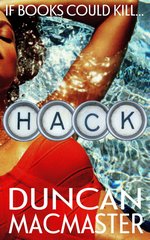
Fahrenbruary Repost: Hack by Duncan MacMaster

We’re focusing on Duncan MacMaster for the next few days of Fahrenbruary. Which means that things are going to be a lot of fun.

This feels a bit rushed to me — and more than a little vague. I guess it should, it was a little rushed, I liked this book enough that I pounded it out a couple of hours after finishing it, I didn’t want to sit on it for a while. And if the post is vague, it’s because this is the kind of mystery difficult to talk about without cracking open all the secrets, and because a lot of what I really liked about this is in the little details MacMaster gave. You need to experience it yourself to get what I’m saying.

HackHack

by Duncan MacMaster
Series: Jake Mooney, #1

Uncorrected Proof
Fahrenheit Press, 2017

Read: February 28 – March 1, 2016

Little victories, since they’re all I can hope for, they’re what I live for.

Jake Mooney used to be a pretty good reporter — good reputation, good results — but he got out of that game and got into a more lucrative field, even if it was more distasteful. Events transpired,  and that goes away — I’ll let you read it for yourself, but it involves lawyers and an ex-wife. Nowadays, he gets by being a ghost-writer for established authors who don’t have the time or ability to write their own material. Out of the blue, he gets an offer to help a former TV star, Rick Rendell, write his autobiography. He’ll even get credited for it. Credit — and a nice cash bonus. How can he say no?

Before you can say “Jessica Fletcher,” someone tries to kill Jake and then Rick is shot in front of a handful of witnesses, including Jake. Between his affection for (some of) the people in Rick’s life, worry over his own safety, curiosity, and his own sense of justice, Jake dives in and investigates the murder himself.

Jake finds himself knee-deep in a morass involving unscrupulous agents (I’m not sure there’s another kind in fiction), wives (current and ex-), Hollywood politics, an IRS investigation, a Drug Cartel, former co-stars, hedge fund managers, hit men, and a decades-old mysterious death. And a few more fresh deaths. . The notes he’s already taken for the book gives Jake fodder for his investigation — but the combination of notes and his continuing work provides the killer a constant target (and threat). As long as Jake’s working on the mystery/mysteries — and doing better than the police at uncovering crimes and suspects — the killer can’t just escape, Jake has to be stopped.

The voice was great, the mystery had plenty of twists and turns, Jake’s ineptitude with firearms was a great touch and served to keep him from being a super-hero. I really can’t think of anything that didn’t work. There’s not a character in the book that you don’t enjoy reading about. I had three strong theories about what led to Rick’s death and who was responsible — the one I feared the most wasn’t it (thankfully — it was a little too trite). My favorite theory was ultimately right about the who, but was absolutely wrong about everything else. I take that as a win — I felt good about my guess and better about the very clever plotting and writing that outsmarted me.

That’s more about me than I intended it to be, so let me try this again — MacMaster has set up a great classic mystery — a la Rex Stout or Agatha Christie. A dogged investigator with a personal stake in the case, supporting characters that you can’t help but like (or dislike, as appropriate), a number of suspects with reasons to kill the victim (with a decent amount of overlap between those two groups), and a satisfying conclusion that few readers will see coming. Hack is funny, but not in a overly-comedic way, it’s just because Jake and some of the others he’s with have good senses of humor. I chuckled a few times, grinned a few more.

I bought MacMaster’s previous book, A Mint Condition Corpse, when it came out last year — sadly, it’s languishing in a dark corner of my Kindle with a handful of other books from Fahrenheit Press (I’m a great customer, lousy reader, of that Press).  Hack wasn’t just an entertaining read, it was a great motivator to move his other book higher on my TBR list. Get your hands on this one folks, you’ll have a great time.

Disclaimer: I received a copy of this from the publisher, nevertheless, the opinions expressed are my own.

—–

4 Stars

A Few (more) Quick Questions With…Nick Kolakowski

Nick Kolakowski’s back for another round of questions (feel free to check out the last round while you’re here), to commemorate the kick-off to Main Bad Guy (which I just posted about), the conclusion to his trilogy of Love & Bullets Hookups.

Since we covered a lot of the basics last year, I dove deeper into this trilogy than I usually do. I hope you enjoy this as much as I did and that it spurs you to check these books out.

Was A Brutal Bunch of Heartbroken Saps always supposed to kick-off a series, or did that idea come during/after writing it? It’s not your everyday way to start a trilogy about a couple, why this approach?
“A Brutal Bunch of Heartbroken Saps” was originally going to be a standalone. After it was finished (but before publication), I found myself still jotting down bits of Fiona and Bill—scraps of dialogue, the outline of an action scene, etc. So I realized I wasn’t done with either of them, at least on a subconscious level. But where to take the story next? I didn’t want it to become an open-ended series, so I needed to figure out a way to climax it, to resolve all the dangling plot threads I began weaving in “Brutal Bunch.” And that meant taking Fiona and Bill back to New York City, where everything began.
Why the Elvis suit? It was absolutely a great idea — but I’ve spent weeks coming back to this question, why did you pick that?
The suit is iconic and ludicrous, but it’s also (to me, at least) a symbol of courage. Can you imagine what it took for Elvis to suit up in that thing every night, step in front of hundreds of people, and belt out something like “Suspicious Minds”? In any case, the suit has so much power, it felt like the perfect thing for a character who’s emotionally wounded and more than a little insane to slip into—he draws enough from it to keep going.

I (very) briefly considered making it a John Wayne thing, and having him put on a vest and a cowboy hat, but that didn’t really work—as a costume, it didn’t pack the same ludicrous punch as a sparkly Elvis jumpsuit.

Two things in particular made me realize that Main Bad Guy was going to be the best of the trilogy early on — Fiona’s “origin story” and Walker. I love it when we get a mysterious figure like him and are given juuuuuuust enough information to buy into the character, but are left with a billion questions. Where did Walker come from, and have you considered doing more with him?
“Aging Badass” is a noir/thriller trope that I particularly love—the older guy who’s seen and done too much to get particularly bothered over anything that happens, even if what’s happening is really ludicrous and bloody and crazy (think James Caan in “Way of the Gun,” or Jonathan Banks in “Better Call Saul”). I’ve wanted to do my own variation on that type of character for years, but I needed him to be a bit more flawed and human. Walker is a badass but his skills are rusty; he’s a tactical genius but he has a certain impulsiveness—mirrored by his daughter—that leads him to do things that get him into trouble.

I do want to do more with Walker in the future. Writing him was an enormous amount of fun, especially the scene in “Main Bad Guy” where he walks into his favorite bar and finds it’s been converted into a hipster hellhole, complete with paintings of pugs on the walls. Maybe I’ll do a novella where he comes back and wrecks it.

There’s this great thread running throughout the trilogy, chronicling the rise and evolution of The Rockaway Mob. Some authors would devote a novel or three to this saga, you make it something that can be overlooked. How intentional was that, and what was your reasoning?
It was pretty intentional. I wanted the books to be as fast as possible, and as much as I loved (briefly) tracing out the rise and fall of this very weird gang (and its very weird leaders), I felt it would distract a bit from the core of the story, which is the incredible flight of Fiona and Bill.
Is there a genre that you particularly enjoy reading, but could never write? Or are you primarily a mystery/suspense/thriller reader?
I’ve wanted to write a historical novel for years, but haven’t quite had the courage (or the time to plunge into extensive research). Maybe I’ll get to it—I just need to really commit myself to such a massive effort.
Thanks for your time — and thanks for these Hookups.

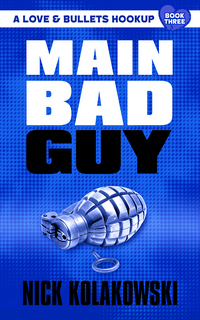
Main Bad Guy by Nick Kolakowski: A Blast of an Ending to this Trilogy

Yeah, weird day for me to post something like this, but it’s what Kolakowski asked for — and he wasn’t a jerk about it like the last guy who wanted a Saturday post.

Main Bad GuyMain Bad Guy

by Nick Kolakowski
Series: A Love & Bullets Hookup, #3

Kindle Edition, 152 pg.
Shotgun Honey, 2019
Read: January 28 – 29, 2019

           Bill could tell you all about things going haywire.

Like Fiona’s plan, for instance.

How the hell had he agreed to this insanity?

The answer was obvious: They had no choice.

It had to come down to this, didn’t it? After being on the run for a book to a book and a half (depending on the character), Bill and Fiona have to face off with the Dean, the Rockaway Mob leader who put out the hits on them both. They really don’t much choice, the whole starting over quietly thing didn’t work too well. Or at all.

This picks up right after Slaughterhouse Blues, the pair are having a difficult time getting out of New York, and ultimately find themselves locked in a panic room at the top of a skyscraper, surrounded by Crow Man — “a stellar chemist, and a better botanist” — his crew, and his product. Which is a pretty awkward place to be. Unsurprisingly, Crow Man works for the Dean (don’t you love these names?). The Dean had been having a pretty lousy day up until this point — and when the Dean has a bad day, a lot of people suffer. Then things start looking up, and the Dean is handed two of his most wanted on a silver platter.

Meanwhile, a mysterious figure named Walker is making his way from Canada to New York. He’s seen that the pair found some trouble in Oklahoma and assumed Fiona wold need help. By the time that word got out that they were in New York, he was already on the way, knowing that’d be the case. Walker is one of those classic aged “been there, done that” characters. The old pro who’s tried to retire and ends up having to get back into action one more time — which is good, because they really don’t do well with the quiet life anyway. I’d sign up for a series focusing on him in a heartbeat. I’d almost say this is worth reading just for Walker — even if you know nothing about Bill, Fiona, the Dean, etc. Eh, I’ll go ahead and say it, read this just for Walker. But you’ll like it more if you’ve read the others.

Walker’s travel is beset by trouble from uneasy allies, his age, and just how much the city has changed. One of the best scenes with him starts with Walker revisiting a favorite dive bar that had been “gentrified into a monstrosity” where he felt like he was “attending a wake for someone that nobody in the room had liked” in the middle of the velvet art, sky-blue walls and pop music. Kolakowski grounds this with reflections on September 11 and the effect it had on the City and its citizens — making it more than just a fun moment in the book. The intelligence he picks up in the bar justifies his brush with gentrification and enables him to come to Fiona’s aid. Hopefully in time.

Bill and Fiona are great together, their dialogue crackles. Watching these two try to get out of Dodge is so much fun, you find yourself wishing that Kolakowski had figured out way to stretch this into a quatrology. One of the problems I had, I now realize, with Slaughterhouse Blues was how little Bill and Fiona were together. They spent a lot of A Brutal Bunch of Heartbroken Saps apart, too — but that was different. Bill’s a better character with her around, and Fiona works better too — if for no other reason than she has to be a bad-ass and watch out for him, instead of just being pure bad-ass all the time. I’m not sure that makes sense to anyone not living in my head. Hopefully it does.

There’s excitement, there’s gunplay, there are explosives, violence, witty dialogue and a whole lot of bad-ass characters facing off with each other (and Bill’s around, too). This is the literary equivalent of a Martin McDonagh film (when he’s in a more playful mood) — or, if that doesn’t work for you, think Fargo meets Tarantino, but not as long-winded. Kolakowski ties this to A Brutal Bunch so well (and in ways you won’t expect), providing a perfect ending to this saga. There are so many quote-worthy lines in this brief novella that it’s driving me crazy that I can’t work more of them into this.

A lot of novella-series can be read in a clump, like one big novel. This is not one of them. Each novella has its own feel, its own themes and structure — while being one story. Last year, Kolakowski impressed me with his novel, Boise Longpig Hunting Club, this series has shown me that wasn’t a fluke at all and that I need to read anything I can by him.

I can’t tell you what’s holding me back from making this a full 5 Star, but something is. It’s close enough, though (and on Amazon/Goodreads, I round up), so I don’t feel too bad about chopping off that half-star here. But focus on the important things here — it’s a great read, a great conclusion and about as much fun as you’ll have in a thriller this year. Bill and Fiona are a great couple (at least in fiction, they’d probably crash and burn in real life) — and a lot of fun to read about.

Disclaimer: I received a copy of this book from the author in exchange for my honest opinion.

—–

4 1/2 Stars

2019 Cloak & Dagger Challenge
LetsReadIndie Reading Challenge

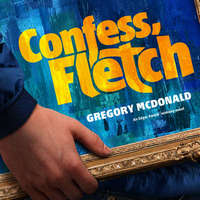
Confess, Fletch (Audiobook) by Gregory Mcdonald, Dan John Miller: Fletch, Flynn, A Murder or two and a Heist. What more can you want?

Confess FletchConfess Fletch

by Gregory Mcdonald, Dan John Miller (Narrator)
Series: Fletch, #2 (#6 Chronologically)

Unabridged Audiobook, 6 hrs., 23 min.
Blackstone Audio, 2018
Read: January 25 – 30, 2019

           Fletch dialed “0”.

“Get me the police, please.”

“Is this an emergency?”

“Not at the moment.”

The painting over the desk was a Ford Maddox Brown – a country couple wrapped against the wind.

“Then please dial 555-7523.”

“Thank you.”

He did so.

“Sergeant McAuliffe speaking.”

“Sergeant, this is Mister Fletcher, 152 Beacon Street, apartment 6B.”

“Yes, sir.”

“There’s a murdered girl in my living room.”

“A what girl?”

“Murdered.”

Francis. Xavier. Flynn.

Those three words are really all I have to say. This is a clever book, with a few good mysteries and Fletch doing his thing. There are antics galore, witty dialogue, yada, yada, yada. As much as I love I. M. Fletcher, Gregory Mcdonald’s greatest creation was Flynn — Blackstone Audio will be releasing those soon and I’ll talk more about him then — but for now, let’s just say that I loved meeting him again and Dan John Miller nailed the character. I was worried about Flynn, really, but I was so relieved that the character came to life as he should.

But let’s put Reluctant Flynn aside for a minute. Fletch is visiting Boston — taking part in a home-share kind of program, staying in a nice apartment while the owner is staying in Fletch’s Italian villa (you know there’s a story behind that, but we don’t really get it at this point). He comes home from dinner the first night to find body lying on his rug. She’s very naked and very dead.

Naturally, Fletch is the prime suspect.

Meanwhile, Fletch is trying to track down some stolen art work on behalf of his fiancé, the daughter of a recently kidnapped and (apparently) murdered near-destitute Count. His recently stolen art collection is the only real inheritance she’ll get. Assuming her current step-mother isn’t named in the will. Fletch is working with the owner of a private gallery to track down what he can of this collection while his fiance and her step-mother wrangle. Fletch’s interest in, affinity for and expertise in art is established here and will show up again a few times in the series.

Of course, Fletch is also busy investigating the murder and reconnects with a former editor of his, from before he worked for Frank Jaffe. He uses this connection to dig u information on the man whose apartment he’s in, the gallery owner, and just about everyone else he comes across in Boston. Inspector Flynn of the Boston PD makes plenty of investigative headway, too — but he and the rest of the police are too focused on Fletch as suspect to do much beyond that. So Fletch uncovers the other viable suspects, if for no other reason than to give Flynn someone else to look at.

This is the first mention of I.M. being from Seattle, incidentally. I never remember that.

It’s a great plot, with all the twists that you can want. There’s so much to enjoy in this book — Fletch’s observations, odd way of approaching his investigation, and banter with Flynn, his editor-friend and anyone else he cares to befuddle is the kind of thing that led me to read this book a few dozen times before now.

As I said, Miller does a great job — he’s good with every character, with the narration and everything. I do think he’s a bit slow, but at 1.25 speed his rhythms match what I expect from Mcdonald. This guy is rapidly becoming one of my favorite audiobook narrators — I expect by the end of this series, he’ll be near the top.

—–

5 Stars

2019 Cloak & Dagger Challenge

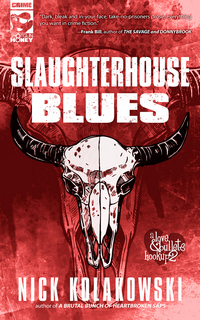
Slaughterhouse Blues by Nick Kolakowski: Broken Antiheroes on a Last Chance Power Drive

Slaughterhouse BluesSlaughterhouse Blues

by Nick Kolakowski
Series: A Love & Bullets Hookup, #2

Kindle Edition, 172 pg.
Shotgun Honey, 2018
Read: January 21, 2018

“What’d you put in there?” Don said, nodding at the soiled duffel bag in the backseat.

“About twenty pounds of tobacco, but don’t worry, no leaves, just the little bits. I asked the sweepers to give me the scraps.”

Don laughed. “A couple years back, we tried taking those scraps, making cigarettes out of them. They sold, but not enough. You can’t fight Big Tobacco.”

“You know what’s a good rule for life?” Fiona said. “Don’t fight groups dedicated to killing millions of people.”

It didn’t take long for Bill and Fiona to realize that the business relationship they found themselves in at the end of the last novella to be just as unpleasant as the one they’d just left. They hadn’t jumped into the fire per se, more like they’d jumped from one frying pan into another. And their new associates took a similar approach to their older associates to their exit — they wanted them dead. So now the pair are trying to avoid two large-scale criminal enterprises bent on revenge, while trying to secure enough of a nest-egg to retire and disappear.

That doesn’t sound fun. At least not for them, for readers on the other hand…

Fiona is off doing a small — but hopefully profitable — job for a couple of brothers she’s worked for before. They’re cigar manufacturers in Nicaragua, where the competition might just be getting lethal. Bill, on the other hand, is in another country trying to hide out among the throngs of tourists. Let’s just say that neither of them meet with a lot of success — but Fiona does manage to get a lead on what should be an easy heist. The catch is, it’s in New York. Right in their old backyard.

So we have an easy heist, an uneasy alliance between the couple and a less-than-trustworthy man who can lead them to a big pay, assassins on their tail and some others who discovered that the couple has delivered themselves to their city. Chaos ensues.

It’s action-packed, but with a smaller body count than the previous novel. But at least one of the deaths happens in a way that will stay with you. Not in a haunting way — but in a “wow, what a cool visual” way (something you can appreciate in fiction — in real life, it’d be horrific and witnesses would likely need therapy).

There’s an interesting tie-in here to some things that happened at the end of World War II, reminding the reader just how much moral gray area existed for US troops in those last days of the War in Europe. Well, a lot of gray existed, and some of it might have been made. Either way, it was there.

At the end of the day, I didn’t enjoy Slaughterhouse Blues nearly as much as A Brutal Bunch of Heartbroken Saps, but I think it says more about the latter than the former. It’s a solid piece of writing, expanding and deepening the universe of these characters a tad. It gives us another opportunity to see them in action while doing some important things for Fiona’s character. If nothing else, Slaughterhouse Blues sets up the third novella (which is better than either of the other two). But most importantly, it tells a good, entertaining story on its own. If I’d read this one not knowing who Bill, Fiona or Nick Kolakowski were — I’d have sought out more about them and by him. That’s good enough for me.

Disclaimer: I received a copy of this book from the author in exchange for my honest opinion.

—–

3 Stars

2019 Cloak & Dagger Challenge

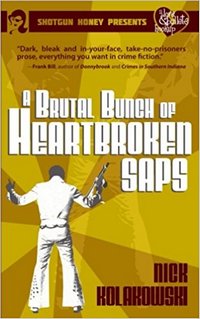
A Brutal Bunch of Heartbroken Saps by Nick Kolakowski: A fast, fun, and bullet-ridden adventure

A Brutal Bunch of Heartbroken SapsA Brutal Bunch of Heartbroken Saps

by Nick Kolakowski
Series: A Love & Bullets Hookup, #1

Kindle Edition, 128 pg.
Shotgun Honey, 2017

Read: January 17, 2019


Bill is a con man, a hustler, a grifter with a gift — one that has been put to good use by the Rockaway Mob until the day that Bill has had enough. He just can’t keep going the way he’s been going. So he leaves New York and heads off on his secret plan to leave the country. Of course, before he left town, he helped himself to a large amount of the Mob’s money to fund his retirement. Which is as popular a choice as you can expect.

Only . . . his plan isn’t as secret as he thinks and people are on his tail immediately. A pair of employees are sent to take care of Bill and retrieve the cash. And then another is shooter is sent before those first two have even had a chance to fail. And it’s a good thing that happened.

Which is all I should probably say about the plot. Very little goes the way you think it’ll go once things get rolling. What follows is fast, fun and violent. It’s the least subtle critique of civil forfeiture possible — and a whole host of other things.

The backup assassin is our entry into this world, these characters — .he’s notorious, he’s infamous, he’s “that guy.” And . . . he’s kind of falling apart — his wife can’t handle his vocation any more and is divorcing him. His point of view chapters are a mix of attitude, a little snark, mayhem and despondency. Somehow, that mix is a blast.

On the other hand, we have Bill — who you somehow can’t believe was ever brought into the fold by the Rockaway Mob, but he’s clearly good at what he does. But little else, it seems. He has a real knack for moving from fire to fireplace to somewhere hotter yet. One of the other assassins sent after him was the one who brought him to the Rockaway Mob, who vouched for him. Her name is Fiona, and she’s one of the fiercest, deadly, aggressive characters you’ve met recently — and at least until recently, was in love with Bill (not that he treated her too well in his exit, and probably cooled her affections as a result).

This is a novella — and there’s not a lot of space for character development, for fully drawing out a character — and while these three aren’t as well drawn as Kolakowski has in other work, they’re good enough for what he’s wanting to accomplish here. (I hope that doesn’t sound like a slight — it’s not supposed to be). They may not be fully drawn, but they’re a lot of fun — and there’s some intriguing emotional beats between them and some of the other characters in these pages.

This book is primarily an exercise in violence — there’s a hint of torture, just a hint (but most of it happens off-screen). What’s not hinted at are explosions and gunfire. There’s a lot of it — the literary equivalent of so much of the stylized cinematic violence inspired by Tarantino in the 90’s. It’s adrenaline set to music — think Edgar Wright action scenes, but more lethal — to skip a couple of decades (actually, I bet this novella would pair well with much of the Baby Driver soundtrack).

I had a hard time accepting how the last few chapters went, because I had the wrong idea about what Kolakowski was up to with this book (and, I bet, the next two books that follow). But I had a blast with it — even the last chapters, once I gave up my preconceptions.

This is a fast, lean novella — there’s not an ounce of fat, not one unnecessary sentence to this. Kolakowski has a story to tell and he tells it. I knew going in that this was going to be a fast read, but I couldn’t believe how quickly I got through it — between the lean prose, the fast pace of the book and the action scenes, this was just a bullet train of a read (no pun intended).

Disclaimer: I received a copy of this book from the author. My opinions expressed above are my own. I appreciate the book, but I didn’t sell out my opinions because of that..

—–

3.5 Stars

LetsReadIndie Reading Challenge
2019 Cloak & Dagger Challenge

Opening Lines – A Brutal Bunch of Heartbroken Saps by Nick Kolakowski

Head & Shoulders used to tell us that, “You never get a second chance to make a first impression.” That’s true for wearing dark shirts, and it’s especially true for books. Sometimes the characters will hook the reader, sometimes the premise, sometimes it’s just knowing the author — but nothing beats a great opening for getting a reader to commit. This is one of the better openings I’ve read recently. Would it make you commit? How can you not?

Listen.

At some point, a poor sap will look at you and say, “This is the worst day of my life.”

But as long as you have breath in your lungs to say those words, you’re not having your worst day. You haven’t even hit rock bottom, much less started to dig. You can still come back from a car wreck, or that terrifying shadow on your lung X-ray, or finding your wife in bed with the well-hung quarterback from the local high school. Sometimes all you need to solve your supposedly world-ending problems is time and care, or some cash, or a shovel and a couple of garbage bags.

If you see me coming, on the other hand, I guarantee you’re having your worst day. Not to mention your last.

Let me show you how bad it can get. How deep the hole goes. And the next time your idiot friend says something about worst days, as the two of you stand there watching his house burn down with his pets and one-of-a-kind porn collection inside, you can tell him this story. It might even shut him up.

Let me tell you about Bill, my last client.

from A Brutal Bunch of Heartbroken Saps by Nick Kolakowski

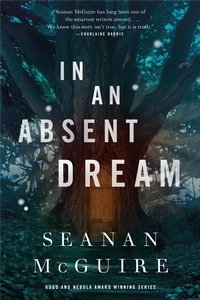
In an Absent Dream by Seanan McGuire: Another Wayward Child’s story — magical, enchanting, heartbreaking. You know the drill.

In an Absent DreamIn an Absent Dream

by Seanan McGuire
Series: Wayward Children, #4

Hardcover, 204 pg.
Tor Books, 2018
Read: January 9, 2019

           …the worst she was ever called where anyone might here was “teacher’s pet,” which she took, not as an insult, but rather as a statement of fact. She was Katherine, she was the teacher’s pet, and when she grew up, she was going to be a librarian, because she couldn’t imagine knowing there was a job that was all about books and not wanting to do it.

Here’s a quick recap of this series for those of you who haven’t heard about it yet/have ignored everything I’ve said about the series these last few years: Imagine Children who go off to a magical kingdom for a bit from our world — Narnia, Fillory, the Lands Beyond, Neverland, Lyrian, whatever you call that land on the other side of the fourteenth door in Coraline, etc. — and then return home. Some will go on to live “normal” lives — others can’t forget or outgrow their attachment to the magical world — some of those, those who want more than anything to return to whatever was on the other side of the door wind up at Eleanor West’s Home for Wayward Children. This series is about some of those children.

There’s a basic outline to these books — McGuire introduces you to a Child and a new world. Her language will be lyrical, playful and enchanting. She’ll draw you in with the awe and wonder and while you’re not looking, she’ll set the hook, and you will be as emotionally tied to her characters as you are close family members*. Then something devastating will happen to those characters, and you will feel horrible, yet love the experience. No matter what kind of resolution is found in the book (death, rescue, brokenness), when you close the book you’ll almost instantly start waiting until the next book comes out, because McGuire is just that good.

In this book we meet Katherine — Katherine’s never been good at making friends her age (there are justifiable reasons for this), but she likes talking to adults more, she likes rules, and she loves reading. There’s something about each Wayward Child that readers can identify with, but Katherine is more relatable to readers than the others have been. One day, Katherine comes upon a tree that hadn’t been there before. This tree had a door in it, and before she realized what was happening — she was on the other side of the door, walking down a hall, on her way to a Goblin Market. In the last book, we saw a nonsense world — this is a logic world, through and through. There are rules, enforced by everyone who lives there — and somehow, by the world itself.

Unlike that (mostly) tongue-in-cheek outline above, each of these books are so different from the rest, it’s hard to compare them — so I’ll try not to. But the structure of this seems more different than the others have. So I’m not going to tell you any more about the plot than I have — I’ll just say it’s a great story, incredibly well told — and even when the narration tells you the ending is not going to be “kind”, you keep expecting/hoping/wanting for things to work out for Katherine and her loved ones.

I’ve made the ending sound bad — it’s not “happy,” but I’m not complaining, I’m not criticizing, I’m most definitely not warning a reader away. It’s the right ending for this story, it’s absolutely how things needed to go — but this is not the Feel-Good Novella of the Year. It is wonderfully written, beautifully written, imaginative, awe-inspiring, delightful, and eventually heartbreaking. McGuire’s one of the best at work today — and this is proof of it.

Yes, you can read these out-of-order — but I don’t recommend it. And hey, were talking 200 pages or less each, you’ve got time for that. You’ll be glad you did (once you stop feeling horrible)


  • That might be a bit hyperbolic.

—–

5 Stars

Page 13 of 22

Powered by WordPress & Theme by Anders Norén