Category: P-U Page 20 of 36

My Favorite 2017 New (to me) Characters

A few weeks ago, I started to describe someone as one of the best characters I met this year. Which got me to thinking about and honing this list. I’m limiting myself to characters I met this year, otherwise I don’t think there’s be much room for anyone — Spenser, Hawk, Scout, Harry Dresden, Toby Daye, Ford Prefect etc. wouldn’t really allow anyone else to be talked about. These might not be my favorite people in their respective books (although most are), but they’re the best characters in terms of complexity, depth and story potential I doubt I’d like most of them in real life (and can’t imagine that any of them would enjoy me), but in novels? I can’t get enough of them.

(in alphabetical order by author)

  • Aimee de Laurent from Skyfarer by Joseph Brassey (my post about the book)– she’s smart, she’s driven, she’s compassionate, she’s powerful, she’s fallible. She also flies around in a spaceship and does magic.
  • Lori Anderson from Deep Down Dead by Steph Broadribb (my post about the book)– She’s more than Stephanie Plum without the Lucy Ricardo DNA. She’s a tough lady, a dedicated mom, and more. This bounty hunter will impress you with her guts, get your sympathy with her plight, and make you cheer as she bests her opponents (I should probably add “make you wince as she takes some brutal beatings).
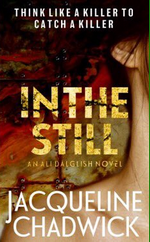
  • Ali Dalglish from In the Still by Jacqueline Chadwick (my post about the book)– Ali is a certified (and possibly certifiable) genius. She’s a criminal profiler working in Vancouver, BC after nearly a couple of decades away to raise her kids. But when a serial killer’s victim is found near her home, she’s drug back into the professional world she left with the investigation. She has the most creative swearing this side of Malcom Tucker, a fantastic and fast mind, a jaded look at life, and a sense of humor that’s sure to please. Early in In the Still, she asks questions of a police officer in a public forum and pretty much ruins the poor guy — it’s one of the best scenes I read all year. If you can read that far in the book and not become a Ali fan at that point, there’s something wrong with you. If I was ranking these, I’m pretty sure she’d be #1.
  • Nick Mason from The Second Life of Nick Mason by Steve Hamilton (https://wp.me/p3z9AH-2NI)– A convicted non-violent criminal gets released early from an Illinois prison only to find himself in a different type of prison to work off his debt for being released, making him lose the “non-” in front of violent. He’s a great character, on the verge (always on the verge) of redemption and falling further.
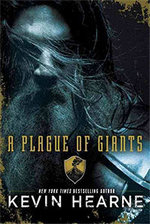
  • Dervan du Alöbar from A Plague of Giants by Kevin Hearne (my post about the book is forthcoming) — I could’ve named about half of the point-of-view characters from this book, but Dervan eked out a win. He’s a widower in mourning. A former soldier, wounded in duty, turned scholar, turned . . . well — that’s a long story. There’s something about his coming to grips with the new reality, his new vocation, his self-awareness and growth in his personal life just really clicked with me. He’s basically an unqualified fantasy hero, forced to step up and play a role in saving civilization (which actually describes many people in this book, but that’s for another day).
  • Isaiah Quintabe from IQ by Joe Ide (my post about the book)– South-Central LA’s answer to Sherlock Holmes. We meet IQ early in his career and, via flashbacks, see him begin to develop the gifts that will make him the super-detective he’s destined to become. He’s such a great take on this character, I can’t believe no one beat Ide to the punch.
  • Anci from Down Don’t Bother Me by Jason Miller (my post about the book) — yeah, her dad, Slim, is the series start and protagonist. He’s the one that goes trough all the hardship, the beatings, the investigative moves, not his 12-year-old daughter (who isn’t a young Veronica Mars clone, or Rae Spellman). But Anci is the heart and soul of the books — she’s why Slim goes to work in this field, and why he comes back. She’s smarter and wittier than any 12-year-old has any right to be (but believably so), she’s Slim’s conscience, and his reason for doing what he does.
  • LeAnne Hogan from The Right Side by Spencer Quinn (my post about the book)– comes back from Afghanistan after near-fatal injuries, and isn’t fit for the civilian life she’s thrown back into. She begins to deal with her grief and anger while hunting for the child of a dead friend with the help of a stray dog. She’ll break your heart.
  • John Rebus from Knots & Crosses by Ian Rankin (my post about the book)– Wow. How do I sum up Rebus? 2017 was the 30th anniversary of Rebus’ creation and the first year I read him. He’s a wonderful, complex character. He smokes too much, he drinks too much, he ignores the rules and regulations (and maybe even the laws) in his ongoing effort to forget about himself and his life by pouring himself into his work. Tenacious with a capital “T”, he may not be the smartest police detective you ever read, but he makes up for it through not giving up (although he’s pretty smart — especially when not drinking).
  • Hob Ravani from Hunger Makes the Wolf by Alex Wells (my post about the book)– Tough does not begin to describe this biker. She’s all about surviving on this planet that’s not at all conducive to survival — from the environment, to the economics, to the politics — there’s just nothing on the planet that wants her or her fellow Ghost Wolves to survive. But somehow she does.

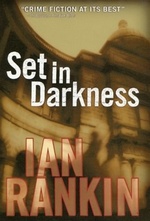
Set in Darkness by Ian Rankin

Set in DarknessSet in Darkness

by Ian Rankin
Series: John Rebus, #11

Hardcover, 414 pg.
Minotaur Books, 2000

Read: December 8 – 12, 2017


This has all the elements of a good Rebus novel — and then some.

We’ve got a murder that took place so long ago that there are almost no living witnesses or suspects, a very contemporary murder, Rebus in political trouble, Rebus being self-destructive, and a couple of cases that have nothing whatsoever to do with the murders — oh, and Big Ger Cafferty shows up to do something horrible (and something helpful).

Farmer John is near retirement and comes up with an assignment to keep Rebus out of his hair — he’s part of a task force overseeing security on the construction for the impending Parliament. This construction uncovers a murder victim and Rebus and the rest of the task force begin investigating. They can barely get started when another corpse shows up. This one is very fresh, and very connected to a prominent family — politically and culturally. I’m not going to get into this much more than that — there’s a lot of good stuff in these cases, most of which we’ve seen variations of before. This doesn’t make it bad, it’s very Rebus-y material, told the way we’ve come to expect.

The part of the book that fascinated me were the crimes that had little to do with the murders. Siobhan Clarke starts off the book doing some work on a sexual assault case that isn’t really hers, and then witnesses a suicide of a homeless man. This homeless man turns out to have plenty of money in the bank and a history that cannot account for that. Clarke threatens at times to take over the book with her investigations. Not just from her investigation, but the way that one uniformed officer describes her as “one of Rebus'” and the introspection, speculation and reaction to that observation causes in Clarke’s life and work. (Incidentally, Clarke taking over the novel would be fine with me)

One of the storylines is perfect — there’s almost no interaction with any police characters, and resolves largely off-screen. Basically the way that most storylines actually resolve in the world. There are payoffs in the novel as a whole, but not in the way you’d expect.

Really well-constructed with almost no dull moments, puzzles that you can’t suss out at first glance, and a whole lot of great characters. There’s not a lot for the courts to deal with at the end of this book, but that doesn’t mean that there’s no justice found for any victims.This isn’t the best Rebus novel I’ve read, but it’s really, really good.

—–

4 Stars

2017 Library Love Challenge

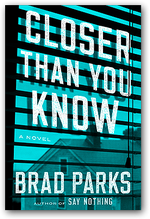
Closer Than You Know by Brad Parks

I’m afraid this comes across as a collection of backhanded compliments — I hope I’m wrong about that. If so, I didn’t mean it.

Closer Than You KnowCloser Than You Know

by Brad Parks

eARC, 416 pg.
Dutton Books, 2017

Read: December 6 – 8, 2017


When you read a book about a dog — from Marley & Me to Where the Red Fern Grows — you’ve got a pretty good idea what’s going to happen near the end. Same goes for a Nora Ephron movie. Or a Horror flick. But you still read or watch them, and you cry, or laugh and “awww”, or jump in your seat when you’re supposed to. Even on repeat reads/viewings. But when done right, those things just work. Similarly, think of a roller coaster — you may stand outside the fence watching the thing go around the track while standing in line (some lines give you plenty of opportunity to study), and armed with that study, as well as the your own eyes, you know that track is going to drop from in front of you in a couple of seconds — or the coaster is about to hit the loop — that doesn’t stop your stomach from lurching when it does.

Why do I bother with that? It’s a thought that kept running through the back of my mind while reading Closer Than You Know. By the time I hit the 10% mark, if you’d made me write down what I expected to happen — the reveals, the twists, the story beats, etc. — I’d have gotten an A. I’m not saying I’m smarter than the average bear or anything, anyone who’s read/watched a handful of thrillers would’ve been able to, too. And it worked. It absolutely worked. How Parks pulls it off, I do not know, but he does. He’s just that good.

And all the stuff that I didn’t guess? Oh, man, it was just so sweet when Parks delivered it, there were a couple of scenes that just left me stunned. And, I should rush to note, the way Parks made a couple of reveals that I’d seen coming from the start were so well done, it was like I hadn’t called the shot.

In his previous stand-alone, Parks said that he wanted to write about the thing that scares him the most — his children being kidnapped. Closer Than You Know taps into a very similar fear — Child Protective Services taking your child from you, leaving you to the mercies of the machine where you’re presumed guilty. This time instead of “the bad guys,” faceless criminals, taking someone’s kids, this time it’s the forces of justice, of law and order, taking the child — they’re celebrated for it, they’re doing it “for the best interests of the child.”

What’s worse is that no one will tell Melanie Barrick why her infant son had been taken from his daycare. Melanie spent most of her childhood in the Foster Child system, and most of that time in the worse situations that system has to offer. This isn’t the stuff of nightmares for Melanie, mostly because I don’t think she has enough imagination for her subconscious to cook this up. And then she’s arrested for possession of cocaine and paraphernalia suggesting distribution — a felony that will guarantee she’s about to lose her little Alex for good.

Melanie is a “good person” — she’s one of the success stories that we don’t see as often as we’d like from the Foster Child system. She worked to put herself through college; has a great, supportive husband; a lousy job (but with benefits) — but one that will help her family get somewhere; and is a devoted, doting, loving mother. The kind of person we all want to think we’re surrounded by, but fear we probably aren’t.

From this point on, it’s a cyclone for despair as every part of her life — her job, her husband, her brother, her friends, her finances, her sense of privacy and security — is affected, is under siege during this ordeal. Can Melanie maintain her hope, maintain her innocence, maintain her conviction that she’ll hold her baby boy again?

In charge of prosecuting “Coke Mom” (the press is always so quick with these nicknames), is Amy Kaye. Amy Kaye could easily be the protagonist in any legal thriller, she’s just the kind of character you want to read in that kind of thing. She’s smart, dedicated and driven — at the moment, she’s primarily concerned with a serial rape investigation that she’s doing pretty much on her own. Amy starts to make progress for the first time in years when she’s put on this prosecution (largely for political reasons) — which she’s more than willing to do, but she hates to take away time and attention from the rape investigation. What really makes this difficult for Kaye is that Melanie is one of the most recent victims in this investigation.

So basically, things are not going well for these two women. There are occasional moments where there is hope, where there is a hint of humor, or life for them and it’s just enough to get you to let your guard down before the gears turn again and life gets bad. Melanie seems to be a living embodiment of Murphy’s Law — things just never go her way in this book. As she notes herself, addicts talk about hitting rock bottom — she isn’t like them, she keeps finding new bottoms. It’s during this part of the book, where the gears keep grinding away, where the Justice System seems most like a machine, and least like a method for determining (not presupposing) guilt, that things will really get to you. That stomach lurching I mentioned earlier? That image came from somewhere. It feels so real, it feels like this is something that actually happened to someone that Parks spent hours interviewing. I don’t know how you read these parts of the book and not get demoralized — but unable to put the book down, because you just have to, have to know what happens next.

As I’ve said before, I’ve been a Brad Parks fan since the first time I read his debut novel — and I miss Carter Ross, the star of his series. The bad thing for me reading Say Nothing and Closer Than You Know is that these are so good, he’s going to spend years doing books like this and I don’t know if he’ll be able to get back to Carter. On the other hand, I can’t complain really if he’s putting out reading that’s this compelling. Yeah, I said the book was largely predictable — and you’ll likely find it the same. But you will be wrong about some things and you won’t know how he’ll show you that you’re right. Think of a NASCAR race — we all know that it’s basically a series of guys going fast and turning left — but it’s how they go fast and turn left that makes all the difference. Parks delivers the goods — the word riveting doesn’t do this book justice. It’s compelling, riveting, gripping, exciting, and will make you rethink so much of what you may believe of the Criminal Justice and Child Protective systems. You will laugh, you will be stunned (in good and bad ways), you will give up hope for this poor mother.

And you will hate when the book ends — as much as you breathe a sigh of relief as you know you have some degree of closure.
Disclaimer: I received this eARC from Dutton Books via NetGalley in exchange for this post — thanks to both for this.

—–

4 1/2 Stars

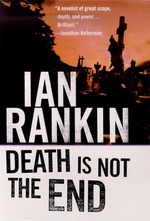
Death is Not the End by Ian Rankin

Death is Not the EndDeath is Not the End

by Ian Rankin
Series: John Rebus, #10.5

Hardcover, 73 pg.
St. Martin’s Minotaur, 1998

Read: December 4, 2017


I used Goodreads’ ordering of the Rebus series to determine when I read this novella — other sites might have led me to read this before Dead Souls, as it was published. I might have gotten more out of this book if I’d read it in that order, but it might have hurt the novel. I’m not sure.

Basically, this is one of the subplots of Dead Souls — Rebus’ looking for the missing son of a people he knew in school — in its original form. It’d be modified, expanded, and given a different ending in the novel. There’s a subplot, mildly related, involving organized crime and gambling — in much the same way that other crimes were associated with the missing person’s case in Dead Souls.

It is interesting to see how Rankin wrote something, and then came back a couple of years later and repurposed it. But that’s about all I have to say for this. It was interesting — but the version in the novel is better. The subplot didn’t do much for me, either. It was okay, but it really didn’t seem necessary.

The completist in me is glad I read it, but I think I’d have been okay with missing it, too.

—–

3 Stars

2017 Library Love Challenge

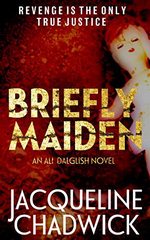
In Medias Res: Briefly Maiden by Jacqueline Chadwick

as the title implies, I’m in the middle of this book, so this is not a review, just some thoughts mid-way through.

—–

Briefly Maiden
Briefly Maiden

by Jacqueline Chadwick

Ali Dalglish, the best criminal profiler this side of Will Graham or Tony Hill, with a Tarantino twist is back. She’s not an amateur like she was in In the Still, and has a couple of more cases under her belt.

Then she’s called in to help with what seems like a lay-up of a case. Which is the biggest signal to a reader that this will be horrible — and boy howdy, this is. I’m at 49% and this is already one of the darkest, most twisted books I’ve ever read. And somehow, don’t ask me how, Chadwick has me loving this — I’m not getting a kick out of the depravity, mind you — but Ali and her interaction with her team and everyone else, I just can’t get enough of. But man . . . this book will eradicate any lingering suspicions you might have had about the reality and force of human depravity.

Actually, that reminds me: I could use a lot more of Marlene (Ali’s friend/assistant/Watson-y figure).

At this point, I’m sort of rooting for the killer — at least who Chadwick is making us think is the killer. The victims/intended victims thus far could be the primary antagonists in a book from just about every other crime series. I’m pretty sure I’ve figured out one of the mysteries — I’m fully prepared to be proven wrong, though.

Anyway, I’ll finish this tomorrow, so you can expect to see a full post early next week. But you should really read this book — and its predecessor, if you haven’t yet. I practically guarantee that you’ll love it.

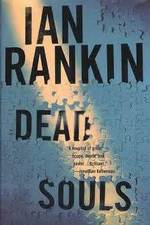
Dead Souls by Ian Rankin

Dead SoulsDead Souls

by Ian Rankin
Series: John Rebus, #10

Hardcover, 406 pg.
St. Martin’s Press, 1999

Read: November 10 – 13, 2017

For the best part of an hour, Rebus had been trying to blink away a hangover, which was about as much exercise as he could sustain. He’d planted himself on benches and against walls, wiping his brow even though Edinburgh’s early spring was a blood relative of midwinter. His shirt was damp against his back, uncomfortably tight every time he rose to his feet.

This might actually be the high point for Rebus in this novel — at least as far as the way he feels goes. The bad news is, this is from Chapter 1. Clearly, Jack Morton’s influence has clearly ended. Rebus is moments away from doing something he’ll regret almost instantly and that will have ramifications on everything he does for the foreseeable future, some of which will likely haunt him for more than that.

Which almost seems par for the course, I realize as I type that.

Anyway, Dead Souls focuses on crimes against children and what that can do to them — not just at the moment they’re victimized, but years later. There are also unintended (and fully intended consequences of crimes against adults throughout the book — Rebus’ own hands aren’t entirely clean here. Rebus’ actions in the opening pages cast enough of a shadow on him that his very brief involvement on another case is used by the defense to cast a shadow on the police’s investigation. He’s also tasked to investigate the apparent suicide of a police detective, informally, anyway. His main task is to work with Siobhan Clarke and a rookie to be a very obvious police presence to a convicted multiple-murderer, recently released and deported from the US back to Scotland. They really can’t do anything other than be visible for a few days until money runs out on the operation, but no one who knows this killer has any doubt that he’ll strike again, and the police are trying to discourage that. Unofficially, Rebus makes things uncomfortable for a pedophile in his new home — an act that will not go well and will spiral out of control — and he’s helping an old girlfriend look for her missing son.

Confused? Yeah, sure, I am — and I wrote that summary. Somehow, Rankin is able to take all that mess and assemble it into a novel that actually makes sense — with all of these stories being tied together, not just with over-lapping themes, but in reality in some sort of 6 degrees of separation fashion — even excluding DI Rebus. It’s really very impressive watching how Rankin weaves every strand of story and character in this novel — it always is, but this web seems more intricate than usual.

The other police in this novel interest me — I won’t go down the list, but those who can’t see why he cares about something, those who can’t understand why he’d do something with so little regard to consequences are on one end — the other end is filled by people (like Clarke) who know exactly what kind of man he is, and without approving or participating in the less-than-savory aspects his methods, can use him and them for good.

…he wondered why it was he was only ever happy on rewind. He thought back to times when he’d been happy, realising that at the time he hadn’t felt happy; it was only in retrospect that it dawned on him. Why was that?

There’s very little light in this novel, there’s introspection, there’s despair, there’s hatred, fear, prejudice, and opportunists taking advantage of all of that. But somehow the book never seems slow or ponderous — just Rebus chugging along, doing his thing. There’s also some strong action — some we see as it happens, but most we hear about after the fact (years or days alter). If you stop and think about how many criminal seem to “get away” with their crimes (as defined by not being charged/tried), it’s not that satisfying. If you think about the book in terms of Rebus (and through him, the reader) understanding what happened and why — it’s satisfying, not really cheerful, but satisfying in that regard.

The souls that are dead here have been killed by various means and methods over time — some realize that’s what they are, some haven’t a clue — some come to realize it in these pages (and some try to revitalize themselves). By and large, they’re dead souls walking, and seem intent on taking others with them. The question is: is DI Rebus among them?

I’m really not sure if I’ve said anything worthwhile about the book — it’s impressive, immersive and will not let you go — even days after finishing it. I don’t know that this is a bad one to be your first Rebus novel — you may be willing to cut him more slack for his questionable actions if you’ve got a history with him than you would be otherwise, however. For me, this is just further proof that Rankin is one of the best and is getting better (or was, at this point in his career anyway)

—–

4 1/2 Stars
2017 Library Love Challenge

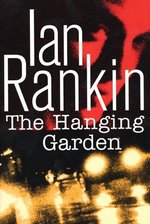
The Hanging Garden by Ian Rankin

The Hanging GardenThe Hanging Garden

by Ian Rankin
Series: John Rebus, #9

Hardcover, 335 pg.
St. Martin’s Press, 1998

Read: October 4 – 6, 2017

Rebus couldn’t get so excited. The whole enterprise had shown him a simple truth: no vacuum. Where you had society, you had criminals. No belly without an underbelly.

It’s just that kind of chipper optimism that keeps readers coming back to the Rebus books, isn’t it? The events in The Hanging Garden sure aren’t going to change his mind. There are three investigations at the core of this book (although another is referred to repeatedly) — but far more than 3 crimes.

The first is an investigation into an older gentleman who is suspected to be a former Nazi officer who was involved in the slaughter of an entire town in the waning days of WWII. Because of Rebus’ penchant for taking historical deep-dives when most police officers wouldn’t, he’s assigned to investigate this man. There are individuals from various organizations, governmental entities, and the press who are pressuring the accused and Rebus on this front.

The second involves an up and coming gangster — Tommy Telford’s smarter, quicker, and crueler than Rebus and the rest are used to dealing with — he’s also a genuine rival to Big Ger Cafferty (especially since Cafferty’s in prison). There’s a prostitute, a victim of human trafficking, that Rebus focuses on, trying to get her out of Telford’s control while using her to take him down. This becomes laden with some personal baggage (see below) and Rebus takes some risky moves that have some devastating consequences.

Lastly, Rebus’ daughter, Sammy is struck by a car in a hit and run and spends days in a coma. Based on a witness’ statement, Rebus becomes convinced that she was targeted thanks to her involvement with the prostitute and/or being his daughter. Either way, Rebus is out for blood — if only he knew who he was after. He strikes a deal to get criminals looking for the perpetrator while he’s helping/prodding the official police investigation. It really doesn’t matter which side of the law finds the driver, as far as he’s concerned, the end is the only important thing.

I’m not sure we needed the Nazi storyline — which by the way, is based on a real atrocity — but it serves to muddy the waters for Rebus and distract him. So it did play its part, and was good enough that I’m not complaining. Telford is a wonderful (fictional) criminal — I don’t want this guy walking around in my world, but in a novel? Love him. And the Sammy story — obviously, this is the emotional core to the book and is really well done.

When you have that many plates spinning, it’s hard to keep them going — and to do so in a way that balances the story telling to keep the reader engaged and not confused. Throwing in the personal aspects make it all the harder for Rankin — Clarke and Templar are involved with the police actions, and Jack Morton plays a significant role, too (and I finally liked him). Plus you have Sammy (mostly seen in flashbacks), Rhona (her mother) who comes to look after her comatose daughter. Patience Aitken is around as well — what she ever sees in Rebus, I’ll never know, it’s clearly a horrible match.

The way that Rankin has put this one together made it very difficult for me to talk about (I’ve tried to get this post written at least a dozen times). But that doesn’t mean it was hard to read — once I was in 10 pages or so in, there was no stopping. It’s a heckuva read, and I really can’t express more than that.

Rebus — mostly sober throughout, for a change — has some strong moments of self-assessment and self-examination, and is able to see/express things about himself and his approach to his work that many readers probably have intuited but it’s nice to have the man himself realize. Including one insight into himself that enabled me to finally figure out what makes Rebus and Harry Bosch different — something I’ll hopefully return to soon.

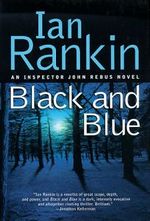
I didn’t expect that this would live up to Black and Blue, and it didn’t. But it wasn’t a let-down in any sense — it was a different kind of story, a different kind of crime, and different motivations for John Rebus. Still, the essentials are there: Rebus, his outlook, his tenacity, his humor, and his demons. Crime fiction doesn’t get much better than this.

—–

4 Stars

2017 Library Love Challenge

Happy Birthday, Archie!

My annual tribute to one of my favorite fictional characters (if not my all-time favorite).

On Oct 23 in Chillicothe, Ohio, Archie Goodwin entered this world–no doubt with a smile for the pretty nurses–and American detective literature was never the same.

I’m toasting him in one of the ways I think he’d appreciate most–by raising a glass of milk in his honor.

Who was Archie? Archie summed up his life thusly:

Born in Ohio. Public high school, pretty good at geometry and football, graduated with honor but no honors. Went to college two weeks, decided it was childish, came to New York and got a job guarding a pier, shot and killed two men and was fired, was recommended to Nero Wolfe for a chore he wanted done, did it, was offered a full-time job by Mr. Wolfe, took it, still have it.” (Fourth of July Picnic)

Long may he keep it. Just what was he employed by Wolfe to do? In The Black Mountain he answers the statement, “I thought you was a private eye” with:

I don’t like the way you say it, but I am. Also I am an accountant, an amanuensis, and a cocklebur. Eight to five you never heard the word amanuensis and you never saw a cocklebur.

In The Red Box, he says

I know pretty well what my field is. Aside from my primary function as the thorn in the seat of Wolfe’s chair to keep him from going to sleep and waking up only for meals, I’m chiefly cut out for two things: to jump and grab something before the other guy can get his paws on it, and to collect pieces of the puzzle for Wolfe to work on.

In Black Orchids, he reacts to an insult:

…her cheap crack about me being a ten-cent Clark Gable, which was ridiculous. He simpers, to begin with, and to end with no one can say I resemble a movie actor, and if they did it would be more apt to be Gary Cooper than Clark Gable.

I’m not the only Archie fan out there:

  • A few months back, someone pointed me at this post, The Wit and Wisdom of Archie Goodwin. There’s some really good stuff here that I was tempted to steal, instead, I’ll just point you at it.
  • Robert Crais himself when writing an introduction to a Before Midnight reprint, devoted it to paying tribute to Archie. — one of the few pieces of anything written that I can say I agree with jot and tittle.

In case you’re wondering if this post was simply an excuse to go through some collections of Archie Goodwin quotations, you wouldn’t be totally wrong…he’s one of the fictional characters I like spending time with most in this world–he’s the literary equivalent of comfort food. So just a couple more great lines I’ve quoted here before:

I would appreciate it if they would call a halt on all their devoted efforts to find a way to abolish war or eliminate disease or run trains with atoms or extend the span of human life to a couple of centuries, and everybody concentrate for a while on how to wake me up in the morning without my resenting it. It may be that a bevy of beautiful maidens in pure silk yellow very sheer gowns, barefooted, singing “Oh, What a Beautiful Morning” and scattering rose petals over me would do the trick, but I’d have to try it.

I looked at the wall clock. It said two minutes to four. I looked at my wrist watch. It said one minute to four. In spite of the discrepancy it seemed safe to conclude that it would soon be four o’clock.

She turned back to me, graceful as a big cat, and stood there straight and proud, not quite smiling, her warm dark eyes as curious as if she had never seen a man before. I knew damn well I ought to say something, but what? The only thing to say was ‘Will you marry me?’ but that wouldn’t do because the idea of her washing dishes or darning socks was preposterous.)

“Indeed,” I said. That was Nero Wolfe’s word, and I never used it except in moments of stress, and it severely annoyed me when I caught myself using it, because when I look in a mirror I prefer to see me as is, with no skin grafted from anybody else’s hide, even Nero Wolfe’s.

If you like Anglo-Saxon, I belched. If you fancy Latin, I eructed. No matter which, I had known that Wolfe and Inspector Cramer would have to put up with it that evening, because that is always a part of my reaction to sauerkraut. I don’t glory in it or go for a record, but neither do I fight it back. I want to be liked just for myself.

When a hippopotamus is peevish it’s a lot of peeve.

It helps a lot, with two people as much together as he and I were, if they understand each other. He understood that I was too strong-minded to add another word unless he told me to, and I understood that he was too pigheaded to tell me to.

I always belong wherever I am.

The Dark Prophecy by Rick Riordan, Robbie Daymond

The Dark ProphecyThe Dark Prophecy

by Rick Riordan, Robbie Daymond
Series: Trials of Apollo, #2

Undabridged Audiobook, 12 hrs, and 31 min.
Listening Library, 2017

Read: October 5 – 11, 2017


I’m not sure how to give a plot synopsis here — basically, it’s the continuation of the Trials of Apollo. He has another task to accomplish — another of the new emperors to take down before the third one, in the next book. It’s the same ol’ set up that has served Riordan so well — and will continue to do so for years to come.

Basically, Apollo/Lester has to go and find another Oracle. To do so, really, he has to face a lot of people that he’s hurt/disappointed over the millennia. He learns a lot about himself, matures a bit. That part was good — and the whole thing was entertaining. But it felt stale. I liked The Hidden Oracle a lot and was excited to see where this series went. Now, I’m not so sure. I’ll finish the series, but with greatly diminished expectations.

Not that it got into details, but there was a lot more intimated/flat-out said Apollo’s sexual history than I’m comfortable with for a MG book. The previous books in the Percy-verse suggested sexual orientation and activity, there was some romance, but this went much further than any of those. Honestly, it went a step too far. If this wasn’t a part of the Percy-verse, or was clearly marketed toward older readers, it wouldn’t have been that bad and I wouldn’t have said anything about it. But that’s not the case here.

As far as the audiobook goes, it was rough. Robbie Daymond was very aware that he was reading amusing material and he read it like each line was a punchline. It was the vocal equivalent of mugging for the camera, if you will. Now, there were a couple of serious and poignant moments, and Daymond pulled those off well, but otherwise it was tough to listen to.

I didn’t like the narration, and didn’t think the story/writing was as crisp as the first book in the series. But it was still entertaining enough. This isn’t the one to start reading Riordan. But it’ll do for his older readers.

—–

3 Stars

Ghost Hero by S. J. Rozan

Ghost HeroGhost Hero

by SJ Rozan
Series: Lydia Chin & Bill Smith, #11

Hardcover, 325 pg.
Minotaur Books, 2011

Read: October 13 – 16, 2017


So, Lydia Chin is approached by a potential client who is clearly lying about his identity about some paintings that are rumored to be in New York, and potentially on sale soon. This client really wants to establish a name for himself in Contemporary Chinese Art, and owning these paintings — preferably before they go on sale — will go a long way toward that. Here’s the trick, no one knows if they really do exist, or where they might be. Still the rumors persist, and in the “where there’s smoke, there’s fire” kind of thinking, they’ve got to exist. The trick is that the artist was killed in the Tiananmen Square protests of 1989. The client wants her to find them, prove they’re real (ideally), and help him get the leg up on the competition.

Like I said, Lydia doesn’t trust the man, and doesn’t understand why he picked her, but his cash is good and she’s curious (about him, the paintings, why he might want the paintings). So she takes the case, but doesn’t know where to start. Luckily, her partner, Bill Smith knows just the guy to talk to — another Chinese PI. Second generation ABC, from the Midwest, Jack Lee has an art degree and mostly looks into stolen and questionable art. Really, he’s the ideal PI to look for these paintings — and it turns out that someone else thought so, too and already hired him to do that. The three decide to work together on this, each playing to their own strengths.

From there, they dive deep into the New York Art Scene — at least those that brush up against Chinese Art — there are people who care about art, people who care about influence and money, and those who really, really care about art. Some care so much that Jack Lee gets shot at more than once. There are other threats as well — the idea that Chau might still be alive is a pretty hot political topic, and various governmental entities seem interested in what Lydia is up to.

The case is pretty interesting — and the various people that the trio interacts with are so interesting, so colorful, occasionally so despicable. The solution that Lydia cooks up is worthy of Blackadder’s Baldrick, but I kind of liked it. It works as a solution in a novel (I hope nothing like this would happen in real life). The ultimate reveal was a bit too obvious, but I still enjoyed it — and the rest of the mystery made up for it.

I’ve said time and time again, I love reading the back-and-forth between Lydia and Bill — adding Jack to that seems like a gamble. Thankfully, it worked wonderfully, he fits in with the two of them so wonderfully well that you wish he’d been around for a couple of novels previously to this. It almost doesn’t matter if the plot behind the book was entertaining, just get the three of these guys around a beverage or two and it’s worth it.

On the one hand, I’m kind of with Lydia in not understanding why someone would come to her to look for this — art isn’t her thing. On the other hand, she dealt with art dealers in China Trade, Chinese heirlooms in Reflecting the Sky, missing jewels in The Shanghai Moon (which yeah, is sort of precious minerals, but the art aspect of the Moon seems as/more important than the gems). So it’s not like she’s an utter novice. Sure, going to Bill Smith or Matt Scudder would seem like a bad move — but Lydia’s a good choice for this case (not as obvious a choice as Jack Lee, I grant you). And how could I not think of another PI in New York?

There was one thing I was disappointed in: I was truly hoping/expecting that this book would contain a clue (if not more) about why this was the last book to be published in the series — and given the 6 years that have passed since then, it seems pretty likely that this was it for the series. I’m assuming that it wasn’t planned, but can’t find any information about it (which means that someone’s going to come along in half an hour with a link to 15,000 words about the reason for this.) Update: A few hours after posting this, Rozan assured me that the series is not over, which is great to hear

A fun, fast-paced read that is enjoyable, engaging and all around entertaining — which is pretty much a great way to describe any novel from Lydia Chin’s point of view. Give this one a shot and then pick up the others (or pick up the others, and then this one — either way).

—–

4 Stars

2017 Library Love Challenge

Page 20 of 36

Powered by WordPress & Theme by Anders Norén