Category: Authors Page 19 of 124

REPOSTING JUST CUZ: The King of the Crows by Russell Day: Prescient. Gripping. Haunting. Unpredictable. What stories should be.

Things have gotten away from me today, so I don’t have anything new to share. But I’ve been thinking a lot about this book this week (I think about this book frequently, to be honest, but several times a day this week), so I figured I’d try to get others thinking about it, too. If you haven’t read this yet, you should strongly consider doing so, as I argue below. Incidentally, re-reading this now serves as a really good argument for me to adopt the current format of my posts using section headers and whatnot (I’d been rethinking them last week, but after this post? They’re sticking around)

King of the Crows

King of the Crows

by Russell Day

Kindle Edition, 456 pg.
Fahrenheit Press, 2020

Read: April 28-May 9, 2020

… for me at least, the first week of the Lockdown was the worst.

Knowing it had happened to me. I hadn’t escaped, I wasn’t one of the lucky ones. Lucky to be safe or lucky to be dead. Take your pick. I was neither.

That right there gives you a pretty good idea what kind of light and fluffy read this is going to be.

There are two timelines in this story—the primary focuses on a post-pandemic London, while the other shows what happened to a couple of the characters mid-pandemic (with plenty of material describing what the pandemic was like for others). In the primary timeline, Europe is a disaster—a “wasteland”—and eight years after the Outbreak, it’s beginning to put itself back together. But it’s going to take a long, long time to recover from this. Don’t let the fact that “eight years after” this fictional outbreak is 2028 bother you at all.*

* Good luck with that. I’ll get back to this in a bit.

I’m not going to try to list all the various ways that Day uses to tell this story: I’m certainly going to forget several. So here’s a partial list: here’s a third-person 2028 narrator describing a police investigation, a first-person perspective on the same investigation; a first-person account of that same detective’s life during the Outbreak; selections from a screenplay made about a group of Londoners during the Outbreak; selections from the Outbreak-memoir of one of those Londoners; and third-person narration of the same (N.B.: these three will vary in telling ways); redacted 2028 prison correspondence about the Outbreak; excerpts from scholarly works on aspects of the Outbreak (including a very illuminating work on the slang of the time); graffiti from 2021; internet message boards. Day weaves these together to tell his story, build the world, and help you to understand it. Frequently, I read something from the 2028 timeline, and understood it—only to find a new depth to it several pages later after getting another piece of the puzzle from 2020/2021. It’s hard to juggle that many narrative forms/voices/perspectives/calendars as a reader or a writer—Day pulled it off better than I did (any problems I had following things I attribute to myself, and it was pretty easy to clear out my misunderstanding with a minimum of backtracking*). It definitely helps paint the picture of the scope and variety of effects the sickness had on the world more efficiently than a consistent first- or third-person narrative would be able to.

* This would be easier in hardcopy than on an e-reader in my opinion. But that’s just a guess.

There are times (several of them) when I felt that the characters were getting lost amongst the plot and worldbuilding and sickness. But when I stopped and thought about it—and eventually got to the point where I didn’t have to—I realized I had a pretty solid idea about who these people were and was more invested in them than I expected. I thought there was so much going on that the people were getting hidden, but really, Day’s work was subtle—working in the characters into my subconscious like you give a dog its medicine. Normally, this isn’t something I require (or would like)—and it’s not Day’s usual M. O. (quite the opposite), but I think this approach really fit the novel and the story/world.

“They weren’t zombies,” he says, softly. “Don’t call them zombies.”

No one who was involved in the Outbreak for real uses the zee word.

So exactly what was the sickness?

I remember reading a couple of years ago about these ants that would succumb to a fungus which would short-circuit their brain and make them do certain things before killing them—or something like that, vague memories here. Then there were stories about parasites controlling the host’s actions—both of these stories had their 15 seconds of fame on social media around the same time (I may be messing the details up a little bit, but I’m not writing history here).

In Day’s world, one of these kinds of parasites will reside—asymptomatically, I should stress—in cats, who would pass it on to humans. Skipping the details, the humans would get very sick and then, survivors would maybe succumb to a psychosis that would make them violent. This sickness, HV-Tg (Human Variant-Toxo gondii), in a little more than a year would kill more than 20 million in Europe (at least 33% of France’s population) Et voilà!—an easy to believe pandemic that results in Zombie-like people wandering around.

Now, if one of those who’d “switched” and become violent infected you during an assault, well, you were likely to succumb. There were enough of these (“psychos” or “Gonzos”), and the sickness was so widespread, that the police and military couldn’t keep up, that civilians were forced to take action and defend themselves, their family and neighbors. People quickly forming into gang-like associations for mutual protection. It was a literal kill-or-be-infected (and likely killed) situation.

One such association became known as The Crows or The Kings of the Crows. They developed a legendary status mid-and post-Outbreak—and are the subjects of the memoir and film mentioned above. One of their number who happened to survive (and gain notoriety enough to get a publishing deal for a memoir) is the subject of the 2028 investigation. They survived the worst of the worst in one of the hardest-hit cities. They did so via means and methods that many (including their own) would find deplorable, but under circumstances that not only permitted, but required, those actions.

We also see what happens to an American in Paris for work when the Outbreak reaches the point that International travel is canceled (particularly to the U.S.). Her allies will never be considered the Kings of anything, and the contrast between how she survives to what the Crows do is pretty striking.

In 2028…eh…you know what? You should read that for yourself. I’m going to say something I’ll regret.

The biggest killer in those days wasn’t the disease or the psychos, it was stupidity.

However, it has been pointed out by many historians, logic was one of the first casualties of the Outbreak.

Some of the best moments of this book have nothing to do with advancing the plot, they’re little bits showing what the world of the Gondii-pandemic looks like. The man telling the story about taking his girlfriend to the ER because of a burn—how they were treated, and how she became infected. The soldiers coming back from a Middle East deployment being completely unprepared for what had happened to their home country. The mother and son who traveled with the Crows for awhile.

Ultimately, it’s not the story you think you’re getting…or is it? The marketing tag line is, “Ocean’s Eleven meets 28 Days Later.” It is, all things considered, a good, catchy line. I’m not sure it’s all that accurate a description of the novel (but it’s not inaccurate). What it is, really slides up on you—and when you see it it feels like it was obvious all along (even if you wouldn’t have said that 20 pages earlier). There’s a straightforward crime story at the heart of this novel—it’s just surrounded by so many layers, that you can miss it—there’s the sickness, there’s the horrible social and political context (both mid- and post-Outbreak), there’s what the characters are going through otherwise—and the whole thing is drenched in social commentary about 2020 society, e.g., sexism, economics, medical care.

And that’s not even touching the context we’re reading it in now. I truly wonder what I’d think of this book if I’d read it last Fall. I’d still like it, I’d still be impressed by it—but I don’t know if it would resonate with me the same way. There’s almost nothing about Gondii that’s comparable to COVID-19. But the way that people and governments respond—well, that’s pretty different, too. but if you can’t see what’s going on around us reflected in this novel? You’re not paying attention. That Day appears so prescient says something about his skill and observation (and a lot about Western culture, too).

I can see why people cling to the idea that the Gonzos were trying to tell us something. Something’s out there trying to get a message through: there’s a plan. Compared to the idea that it was all just chance, it’s a comfort of a type. Chance doesn’t care and can’t be appeased and can’t be reasoned with. Chance means it could all happen again.


5 Stars

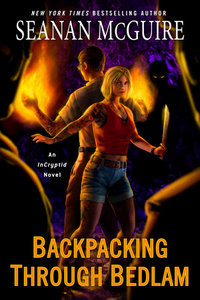
The Friday 56 for 1/13/23: Lost in the Moment and Found by Seanan McGuire

The Friday 56This is a weekly bloghop hosted by Freda’s Voice.

RULES:
The Friday 56 Grab a book, any book.
The Friday 56 Turn to Page 56 or 56% on your ereader. If you have to improvise, that is okay.
The Friday 56 Find a snippet, short and sweet.
The Friday 56 Post it.

from Page 56 of:
Lost in the Moment and Found

Lost in the Moment and Found by Seanan McGuire

On the other side of the door, where the shop should have been, a jungle stretched all the way to the horizon, fat, round-trunked trees dripping with vines and flowers, their twisting branches reaching for the sky like the spread fingers of enormous hands. Something moved in the deep foliage, and brightly colored birds perched on the vines, clacking their beaks and calling to each other at the sight of her.

It wasn’t possible. It wasn’t logical. It wasn’t real. It couldn’t be real.

Antsy stepped through the door. Only one foot; she was at least clever enough to leave her other foot solidly on the wooden floor of the thrift store. One of the vast, bright-petaled flowers was close enough for her to lean over and pluck it before retreating back through the door and closing it behind her. The flower didn’t disintegrate when pulled into the thrift store. It remained in her hand, bright and blooming, petals almost the same color as a good, ripe watermelon.

She stared at it, trying to understand how this could be happening.

My Favorite Non-Crime Fiction of 2022

2023 Favorite Non-Crime
Back when I started this site, I knew the content would be largely “genre”-oriented. I’d have wagered the content would be roughly 1/3 Mystery/Detective fiction, 1/3 Urban Fantasy, and slightly less than 1/3 SFF, with “non-genre” fiction, humor, and non-fiction being enough to make my one-thirds just an approximation (honestly, if you asked me what I read regularly, that’s pretty much how I’d describe it today). Actual numbers show that’s wrong—it’s almost 40% Crime/Thriller Fiction, the rest of fiction is around 30% combined. Which is just a long-winded way to get to these two points: because Crime Fiction takes such a big chunk of my reading, it gets its own “Favorite” list, but none of the others really garner enough numbers for their own.

When it comes to this list of favorites, I had to choose—top five or top eleven. There are six I just couldn’t choose between—but hey, it’s my list, so here are my favorite 11 non-Crime Fiction Novels of 2022. It took me very little time to regret trying to write anything new about these books—I’m supposed to cover these in a measly paragraph? I borrow from my original posts, and really say less than I wanted to (or this post would be about 5 times as long as it is).

As always, re-reads don’t count—only the works that were new to me.

(in alphabetical order by author)

Amongst Our WeaponsAmongst Our Weapons

by Ben Aaronovitch

My original post
Any installment in this series is a strong contender for a favorite of the year even before I open it, and this one is a great example of why. While telling a pretty strong story, Aaronovitch expands this world and the reader’s understanding of it, a whole new magic system, and seemingly introduces the next major story arc for the series. We get to see almost every major (and more than a few minor) characters, too. For a fan, this book was a heckuva treat.

4 1/2 Stars

Wistful AscendingWistful Ascending

by JCM Berne

My original post
This novel—a Space Opera/Super-Hero mashup—hit just about every button I have and probably installed a couple of new ones (talking space bears, for example). If I try to expand on that I’m not going to shut up anytime soon. Read my original post—or just read the book.

4 1/2 Stars

The Veiled Edge of ContactThe Veiled Edge of Contact

by James Brayken

My original post
Brayken’s debut surprised me more times than I thought was possible. Every time I thought I knew what direction Brayken was taking for the story, the protagonist (or major characters), tone, or even genre—he’d make a sharp turn and make the book better than I thought it was. I have questions and qualms about some aspects of the novel—but this is going down as a highlight of 2022 anyway.

4 Stars

The Art of ProphecyThe Art of Prophecy

by Wesley Chu

My original post
In my original post, I said, “I don’t know that I can really express how excited I am about this book. The last time I was this enthusiastic about a Fantasy novel was Kings of the Wyld, and I’ve read some really good Fantasy since then. But this is a whole different level.” It features my favorite new-to-me-character of the year. It’s just a glorious read. I’ve read (and enjoyed) a lot of Chu’s previous work and this is so far beyond those that it’s hard to describe.

5 Stars

The Iron GateThe Iron Gate

by Harry Connolly

My original post
Every Twenty Palaces novel is better than the last—and The Iron Gate is no exception. This novel is a better version of everything Connolly has delivered before. We get character growth in a character I’d have considered pretty unchangeable, a dynamite plot (two, actually), and a disturbing monster to boot. There’s just so much to commend here—both for this novel and what it promises for the future.

4 1/2 Stars

The Part About the Dragon Was (Mostly) TrueThe Part About the Dragon Was (Mostly) True

by Sean Gibson

My original post
This is not a book to read if you’re in a “find out what happened and get to the end of the story” frame of mind. This is a “enjoy the trip, not the destination”/”stop and smell the roses” kind of book. The destination/what happens is fully satisfying, but the getting-there is so much better. This Fantasy/Comedy sends up and celebrates so many Fantasy mainstays that fans (and detractors) of the genre will have a blast on that front alone. The cast of characters is a blast and the protagonist, the bard Heloise, is even better.

4 Stars

Final HeirFinal Heir

by Faith Hunter

My original post
The fifteenth Jane Yellowrock novel was the series finale and the series went down the way it should—with a lot of heart, a lot of love, a lot of violence, and so many buckets of blood. I’ve been reading these for so long that I really didn’t want to see the series end (but it was time). From the jaw-dropping first chapter to the last lines that genuinely made me misty, Final Heir was a great ride.

5 Stars

Kaiju Preservation SocietyThe Kaiju Preservation Society

by John Scalzi

My original post
This book delivers all the ridiculous fun that the title (and premise) promises. Scalzi calls it a pop song, I tend to compare it to a popcorn movie. It’s not meant to provoke thought, to be pondered over, or analyzed. It’s meant to be enjoyed, it’s meant to be light and entertaining. Consider this me writing on the literary equivalent of a bathroom stall, “For a good time…”

5 Stars

Station EternityStation Eternity

by Mur Lafferty

My original post
A Murder Mystery set on a living Space Station with only three human characters surrounded by some of the strangest alien species you’ve seen (those three humans are pretty odd, too). This novel is one for mystery fans open to aliens walking around, SF fans interested in a different kind of story, and readers who like good things. Social commentary, a twisty narrative, a clever mystery, and more chuckles than I expected to get from this. An inventive read that’ll leave you wanting more.

4 Stars

Theft of SwordsTheft of Swords

by Michael J. Sullivan

My original post
Multiple people over the years have told me to read this book (some multiple times). I finally did, and regret not paying attention to them earlier. It’s more “traditional” Fantasy than the others on this list, there’s almost nothing that someone who’s read/watched a handful of fantasy series hasn’t been exposed to before. It’s the way that Sullivan has assembled these tried and true elements that is going to make you happy. The sword fights are fantastic. The imagination showed in the magic system, the magical creatures, and the politics—between races, within the remnants of the human empire, and the ecclesiastical politics—are really well conceived and effectively portrayed. I can’t wait to dive into the rest of the trilogy.

4 1/2 Stars

Adult Assembly RequiredAdult Assembly Required

by Abbi Waxman

My original post
This novel starts in the same bookstore that Nina Hill works in, and she’s around a lot—but this isn’t her book. It’s the story of a woman who moved across the country to start her life over, and the results aren’t what she expected. Adult Assembly Required is funny, it’s sweet, it’s heartwarming, and will make you feel good all over. It’s full of the Waxman magic.
5 Stars

The Neil Gaiman at the End of the Universe (Audiobook) by Arvind Ethan David, Neil Gaiman, Jewel Staite: Let’s Keep this Short and Sweet

The Neil Gaiman at the End of the UniverseThe Neil Gaiman at the End of the Universe

by Arvind Ethan David, Neil Gaiman (Narrator), Jewel Staite (Narrator)

DETAILS:
Publisher: Audible
Publication Date: March 18, 2021
Format: Audible Original
Length: 29 min.
Read Date: December 28, 2022


This is a short story, so I’m not going to keep this short and sweet. Let’s go with a Pros and Cons list:

Pros Cons
Satisfying SF Story
Jewel Staite
Neil flippin’ Gaiman
Sound effects that are effective,
but a little too loud

It’s 29 minutes of entertaining goodness.

’nuff said.


4 Stars

Scattered Showers: Stories by Rainbow Rowell: Some People Want to Fill the World with Silly Love Stories

Scattered ShowersScattered Showers: Stories

by Rainbow Rowell, Jim Tierney (Illustrator)

DETAILS:
Publisher: Wednesday Books
Publication Date: November 7, 2022
Format: Hardcover
Length: 282 pg.
Read Date: December 26-27, 2022
Support Independent Bookstores - Visit IndieBound.org

He huffed out a laugh. “I thought you said no to prom because you didn’t want to ruin everything.”

“What’s everything?” She was still whispering.

“You and me. Friendship.”

“I don’t,” she said. “But I’d rather we ruin it together than you ruin it with somebody else.”

What’s Scattered Showers About?

This is the first collection of short stories by Rainbow Rowell—nine stories, four of which had been previously published.

They are, at their core, love stories—the beginning of a relationship, the change of a relationship, the maintaining of one—and a couple that are harder to define. Rowell’s signature style and sweetness fills these pages—her light humor and propensity for happy endings, too. (propensity, not universal practice)

Checking In On Old Friends

With three of these stories, Rowell revisits characters from previous novels. We get to see some of the primary characters from Attachments in “Mixed Messages,” and a character from Fangirl in “If the Fates Allow,” and some of the characters from the Simon Snow trilogy (and, I guess, from Fangirl, too?).

I didn’t get into the Simon Snow stuff in Fangirl (and even skipped most of it) and didn’t bother with those books—but I liked the fact that Rowell did revisit some of her previous work. (I do wish we’d gotten to see Eleanor and/or Park, but am pretty sure that I’d have been annoyed at whatever she told us about them, so I’m glad she didn’t include anything about them).

Now, it’s not essential that you’re familiar with the characters in these stories to enjoy them. I don’t honestly remember who Reagan was from Fangirl (hey, it was 9 years ago, cut me some slack), but I quite enjoyed this story featuring her. I did remember the characters from Attachments, but I don’t think it enhanced my appreciation of that story—but it was nice to see a little about what’s gone on with them.

The Illustrations

Opposite the first page of each story is a full-page illustration, sort of a cover image. There are also some accent illustrations scattered throughout the stories. They were attractive and fitting to the stories. I’m not sure that they added much to the book, but I did think they were nice touches.

So, what did I think about Scattered Showers?

I’m a sucker for Rowell’s love stories, and had a lot of fun with these.* When she’s not writing about teen wizards, I have a hard time resisting her work (and don’t find much inclination to try).

* Okay, true to form, I skipped “Snow for Christmas” after the first page and a half didn’t intrigue me at all.

Out of her norm were two stories: one that’s a strange fairy-tale of sorts that I found strangely appealing, but I’m not sure how to talk about it. The closing story is about some characters who’ve taken up residence in an author’s subconscious or imagination, while they wait for the author to put them into a story or novel. I thought this was a fantastic story—Pirandello-esque, but with a Rowell-twist.

All in all, this was a very pleasant way to spend a couple of hours.


3.5 Stars

This post contains an affiliate link. If you purchase from it, I will get a small commission at no additional cost to you. As always, the opinions expressed are my own.


Radio Radio by Ian Shane: A Tom Petty Song in Novel Form

Radio RadioRadio Radio

by Ian Shane

DETAILS:
Publication Date: July 17, 2008
Format: eBook
Length: 253 pg.
Read Date: December 7-8, 2022

And there goes the last DJ
Who plays what he wants to play
And says what he wants to say
Hey hey hey
And there goes your freedom of choice
There goes the last human voice
And there goes the last DJ

Sure, that’s Tom Petty and not Ian Shane. But I had that song stuck in my head for almost the entire novel, they might as well be writing about the same guy.

What’s Radio Radio About?

Erik Randall is a DJ—that’s all he’s ever wanted to do. He loves being on the radio, sharing music with whatever corner of the world he can. He comes alive on the microphone, he seems to be good at the technical bits, and he loves the medium. What it has been, what it is, what it could be—but he’s very much not a fan of what it’s becoming.

He’s a True Believer, though, and is convinced that if given the opportunity, radio can still be great. He’s even formulating a plan so that one day, he can make at least one station great.

We don’t meet him on that day—in fact, shortly after we meet him, his station comes under the thumb of a corporation that makes cookie-cutter stations all over the country. In the same way you know what you’re going to be served at an Olive Garden in a different state from home, you know what you’re going to hear on the radio in your rental car once you hear a familiar station tagline. That’s what they’re going to turn his radio station into.

About the same time, he meets a local singer/songwriter, Myra. Erik’s still reeling from a semi-recent breakup and isn’t in the right frame of mind to think about romance—but she’s the kind of woman he’s dreamed about. His co-worker/friend, Shakespeare, has been pushing him for months to date again, and once Shakespeare meets Myra, he increases the pressure.

His professional life is falling apart, his personal life is looking promising for the first time in forever—can Erik handle it?

So, what did I think about Radio Radio?

I thought there was something grating—something blindly immature about Erik’s attitude and antics at work. Yes, he’s firmly in the model of the rebel DJ who cares more about the art than the business side. And as such, I can enjoy the character. Maybe it’s because I’m reading this through the eyes of someone in 2022 so I have 14 years of insight to know just how Quixotic Erik is being and how reality is going to hit him hard. Shakespeare, on the other hand, I could get behind—he’s a realist. There’s a romantic streak in him—he wants Erik and his vision to have a chance, but he knows better. I was enjoying the novel, but I really wasn’t on board with it. Which isn’t to say I didn’t find Erik amusing—I just found him a grating sort of amusing.

But then, Myra comes on the scene and two things happen. Erik starts to change, the bits of his personality that grate on me get pushed to the background.* Secondly, Ian Shane writes this stuff really well—like the way that Erik and Myra interact, the way that Erik makes an utter fool of himself because of her, the way that Myra and Shakespeare interact—this is where Shane’s later novels shine, and you can see him building that ability here. If this was the first Ian Shane book I read, shortly after Myra comes on the scene is where I’d order his next two books.

* I am fine with a protagonist grating on me—as long as there’s something about them or their story I can get behind. But I prefer the alternative.

I should also note, that some of Erik’s work attitudes and behaviors remind me of other characters in similar situations—the works of Adam Shaw, Matthew Hanover, and Andy Abramowitz jump to mind—so I’m not trying to say that Shane messed up by having Erik be this way. I just find it grating. What he does and says are, by and large, what an immature twenty-something would think and do. As he is an immature twenty-something, he’s spot-on.

Speaking of needing to grow up a little—a lot of the ways he approaches the big changes he needs to make, the conversations around them, and the way he reacts to people like Shakespeare making those changes himself, displays that immaturity. In those cases, I find it endearing and relatable.

Maybe I’m just the office crank? Out of the office issues don’t bother me as much.

One other challenge for me is that like with Postgraduate, I felt like Shane was judging me for my musical taste. And he probably should—because my musical taste not the kind of thing that Erik Randal (or anyone at Championship Vinyl) would approve of—very I’m fairly plebian, really. Frankly, I’m okay with that—and I did make a note or two to follow up on some music. I do wish I could hear Myra’s stuff, because I think I could get into it. That’s not a reflection on the novel, I just wish Shane would write a character with mainstream taste who is seen in a positive light.

This is a sweet book—there’s good character development, a strong cast of supporting characters (most of whom I didn’t mention) that I would love to see again in some form, great banter, solid comedy in a variety of forms, insight into an industry I know practically nothing about, and a sweet and well-told romantic story. It’s not as strong as his later novels, but it’s easy to see that he’ll be capable of greatness. Buy this book, it’ll make you happy.


4 Stars

No Plan B by Lee Child and Andrew Child Is Good Enough

No Plan BNo Plan B

by Lee Child, Andrew Child (Narrator)

DETAILS:
Series: Jack Reacher, #27
Publisher: Delacorte Press
Publication Date: October 24, 2022
Format: Hardcover
Length: 357 pg.
Read Date: December 1-3, 2022
Support Independent Bookstores - Visit IndieBound.org

…maybe the others were right. With Reacher running around out there, maybe the full ceremony isn’t the smart way to go. Maybe It’s time we switched to Plan B.”

“We don’t have a Plan B, We’ve never needed one.”

“Maybe it’s time to think of one.”

What’s No Plan B About?

Reacher sees something in a newspaper about a museum display nearby, so he goes to check it out. This leads to him being in just the right neighborhood to see someone being pushed in front of a bus. While others are calling 911 and trying to tend to the victim, Reacher pursues the pusher. This leads to a confrontation where Reacher’s size works against him for once, and with the help of his partner, the man gets away (a Tom Cruise-sized character probably would’ve got at least one of them). Before they slipped away, Reacher got a glimpse of something the man took off the victim that made him curious.

That glance starts a whole machine working—that man, his partner, and their bosses can’t have what he saw become public. They don’t know how much time he got with the information, how much he read/understood—but if he saw anything, it could make things go very wrong for them. So they dispatch another team to take care of Reacher (the two that escaped aren’t in any shape to do anything after tangling with our hero).

Meanwhile, Reacher tries to convince the police that the woman had been pushed. But there’s already a witness who’d been swearing she jumped, and no one confirms what Reacher saw. The detective in charge sympathizes with Reacher and wants to follow up on his statement, but his superiors like the tidy answer a suicide brings. He feeds Reacher a bit of information, and the former M.P. is off on his own investigation. When the new team tries to take him out, Reacher knows he’s on to something and digs in for the long haul. This will take him from Colorado to a small town in Georgia, home to a prison the murder victim worked at.

Two other parties are making a trip to that same town. One is a teen who just learned that his father is imprisoned there—in the same conversation that he learned his father’s identity from his dying mother. He steals some money from his foster mother (money that should’ve been used to care for him, I should note) and buys a bus ticket from LA. He’s in over his head, and as we follow him on his journey it becomes clear that the fact that he survives long enough to get to Georgia is a sign of divine blessing or dumb luck.

We also track a father out for revenge. He’s a professional arsonist—actually, he employs professional arsonists at this point in his career. Something happened that killed his son—the details are kept vague for the reader. The grieving father backtracks the supply chain that provided the product, determined to destroy the man at the top.

So, what did I think about No Plan B?

After last year’s Better Off Dead, I was prepared to put this collaboration/Reacher 2.0 in the “Not for Me” category. I’m glad that the brothers continue to have success, and that many, many readers are satisfied, but it might be time for me to disembark. I wanted to give them one more chance—everyone has an off-novel, right?—but I’d decided that this would be my last Reacher novel. This was good enough to get the brothers another. I guess my fandom is no longer a long-term lease, but the equivalent of a month-to-month rental.

One strategy I employed going into this was ignoring half of the names on the cover—this is an Andrew Grant/Child take on Reacher, not a Lee Child*. That adjustment to my expectations, helped a bit, too.

* I’ve heard and seen multiple interviews/features on the pair describing how they work together, so I know it’s not entirely true. But, it helped me.

The action was good—but hallway fights might be better left to Daredevil than print. I wondered for most of the book if they had one too many storylines, but I ended up buying into the idea. The first hundred pages were great (at least the Reacher vs. conspirators storyline, and maybe the foster kid)—particularly the first couple of chapters, it was a very effective hook. Pages 100-300 were good enough—some “meh” bits, enough good bits to keep me engaged and to push the narrative along, with a really nice uptick over the last chapter or two. The last 50 pages were rushed—you want things to move quickly in the end of the thriller, you need fast action to go along with the adrenaline of the big finish—but this was just too much happening, and it was hard to appreciate it all. There’s a fast momentum, and there’s careening out of control, and this came close to that.

Still, it was in those pages that I came around to liking the revenge storyline and getting why the Childs went with it.

This was a decent thriller with some really good moments featuring a character that reminded me a lot of that guy from 61 Hours, The Hard Way, and One Shot. It’s a fast, entertaining read that will do the job.


3 Stars

This post contains an affiliate link. If you purchase from it, I will get a small commission at no additional cost to you. As always, the opinions expressed are my own.

Dead Lions by Mick Herron: An Overdue Read for Me, the Best of Both Worlds for Spy Fiction Fans

Dead LionsDead Lions

by Mick Herron

DETAILS:
Series: Slough House, #2
Publisher: Soho Crime
Publication Date: May 7, 2013
Format: Paperback
Length: 347 pg.
Read Date: November 21-24, 2022
Support Independent Bookstores - Visit IndieBound.org

…whatever we’re here for, Lamb’s not being punished. Or if he is, he’s enjoying it.”

“So what’s your point?”

He said, “That he knows where some bodies are buried. Probably buried a few himself.”

“Is that a metaphor?”

“I failed English. Metaphor’s a closed book to me.”

“So you think he’s handy?”

“Well, he’s overweight and drinks and smokes and I doubt he takes much exercise that doesn’t involve picking up a phone and calling out for a curry. But yeah, now you mention it, I think he’s handy.”

“He might’ve been once,” Shirley said. “But there’s not much point in being handy if you’re too slow to be any good at it.”

But Marcus disagreed. Being handy was a state of mind. Lamb could wear you down just standing in front of you, and you wouldn’t know he was a threat until he was walking away, and you were wondering who’d turned the lights out. Just Marcus’s opinion, of course. He’d been wrong before.

“I suppose,” he said, “if we stick around long enough, we might find out.”

Squirrel!

I read the first book in this series over 2 1/2 years ago. Since then, my friend Paul has been hounding me, nagging me, and generally pushing me to keep reading them. Insisting that I’m missing out. Etc. Etc. Etc. While I suspected he was right—and even if he wasn’t, I wanted to based on Slow Horses and everything I’d heard from Paul, Jeff at Barbican Station, and from several other fronts.

But we all know how easily distracted I can be. So…here we are 45 months later. And I know when I post this I’m going to get at least one text from Paul, saying things like: “I told you so!” and “It’s about time.”

I deserve both of those messages because he did tell me so; and yes, it is.

What’s Dead Lions About?

Jackson Lamb gets suspicious when an old, low-ranking spy from the Cold War era dies on a public bus. He follows Dickie Bow’s last movements and finds reason to indulge that hunch a little longer, bringing in one of Slough House’s new additions to do some more legwork. What they find doesn’t make him any happier—a bogey-man from the old days might be back. And that can’t be good.

Meanwhile, Spider—pardon me, James—Webb recruits Louisa Guy and Min Harper to help him with a little project he’s got going on. He’s trying to recruit a Russian oligarch—one with political aspirations—as an asset, and he needs some security work done by people who won’t get the attention of any of the bigwigs in MI5. Neither wants to work with Webb, but if they do, there’s a chance…not much of one…but a chance that at least one of them will be the first Slow Horse to move back to Regent’s Park. Both of them are ready to be that one—even at the expense of the other, no matter what relationship might be budding between the two of them.

Best of Both Worlds

While I have an appreciation for British Cold War Spy novels—they’re really not my thing. I’ve tried, both in print and on film—and they just don’t work. But that’s the kind of world that River’s grandfather, O.B., represents—and that Tavener and Lamb represent the end of. They have one foot in that world still, it defines them—but they’re both (especially Tavener) also part of the War on Terror, financial crimes/terrorism, etc. of our current moment. River, Ho, and the rest of the Slow Horses belong to the latter.

What this book does so well is to marry the two schools—we have a very Cold War holdover storyline, and a Putin-era storyline. Now, I can’t imagine that Herron is going to be able to pull this off regularly, but getting to do it in the second novel, solidifying the series’ identity as being able to work in both eras. I thought that was a great move that welcomes in fans of both eras of British Spy Fiction.

So, what did I think about Dead Lions?

So, back in 2019 when I read Slow Horses, I liked it and was impressed by it, but I only gave it 3 Stars. When I listened to the audiobook last year, I think I “got” what Herron was doing a little more. But I still wasn’t as impressed with this as everyone I knew seemed to be. I’m fine with that, but I wondered a bit if I was missing something.

I think I found whatever it was in the pages of Dead Lions. Because…wow. Herron does it all here—there’s some satire, there’s commentary on human existence, on the politics (and espionage) of the Cold War, on the politics (and espionage) of the 2000s, a real and slowly-building tension, there’s subtle wit, less-than-subtle wit, a plot that is impossible to predict, characters that are the most human you’ll find in spy fiction, dialogue and narration that are impossible not to endlessly quote…and fart jokes.

One lesson that readers of the first book should’ve picked up is that they shouldn’t get attached to anyone—look at the number of people assigned to Slough House at the beginning of the book and then at the end. Percentage-wise, it’s safer to be a George R.R. Martin character. Herron ensures that no reader of Dead Lions thinks that’s a fluke. Right now (and I’m ready to be disproven), I figure the only safe characters are Jackson Lamb and (sadly) James Webb—he seems to have the survival capabilities of a hardy cockroach.

Herron surprised me on multiple occasions—I think at this point, I’m going to just permanently suspend my reflex to predict what’s coming when I spend time with him. They weren’t just surprises—they were the kind that I absolutely didn’t even think of expecting—and then in retrospect, I don’t know how I could’ve imagined anything else happening at all.

From time to time, TV Critic Alan Sepinwall will recap an episode saying things like “if we only got X, that would be enough. If we only got Y, that would be enough,” and so on. I felt like that while thinking about this book. If we only got Lamb tracking the final movements of Dickie Bow, that would’ve been enough. If we only got the Louisa Guy/Min Harper storyline, that would’ve been enough. If we only got the Diana Tavener/Jason Webb scene, that would’ve been enough. If we only got River Cartwright going undercover, and everything he goes through…you see where I’m going. Any one of those would’ve been enough for me to realize I need to take this series seriously and get on with reading them all. You combine these points with all those that I decided not to list for space/spoiler reasons? I’m on the verge of being rabid.

Everything I thought was a bug about Slow Horses was a feature, and I see that now. Everything I thought was a fluke about Slow Horses wasn’t. Everything I thought was good about Slow Horses was at least a little bit great. How do I know that? I see all of those elements here and have a much better appreciation for them in Dead Lions so I can better understand its predecessor.

I had other things in my notes that I really wanted to cover. But…I’ve said the essentials, and am at the point where I’m trying to gild an already gilded lily. So, I’m going to leave all that unsaid. Yes, I may have overhyped this and doomed you to not appreciate it. I get that and apologize in advance. Just chalk this up to a new and rabid fanboy—go into this series expecting something good. And then when you’re ready to join the rabid throng, I’ll be waiting for you.

And now, I’ve got to start waiting for messages from Paul.


5 Stars
This post contains an affiliate link. If you purchase from it, I will get a small commission at no additional cost to you. As always, the opinions expressed are my own.

Little Ghost by Chris McDonald: Women and Money—The Deadliest Combo

Little GhostLittle Ghost

by Chris McDonald

DETAILS:
Publisher: Red Dog Press
Publication Date: November 25, 2022
Format: eBook
Length: 151 pages.
Read Date: November 28-29, 2022

I’d enjoyed snooping around people’s lives. Poking at their secrets and unearthing dirty little details that earned me my payday. It wasn’t honest work, but it was fun.

Mostly.

The beatings weren’t, and I’d taken a few in my time.

Asked the wrong question to the wrong person. Asked the right question to the wrong person. Wisecracked at an inappropriate time. My crooked nose and the waxy scar on my cheek would be the lasting reminders.

What’s Little Ghost About?

Irving Ash is a Denver PI on rough times. His divorce is about final, this most recent romantic relationship (note the distinction) is over, and thanks to some recent headlines, he’s having a hard time getting work. He’s about to be evicted from his office, and it probably won’t be long before he’s out of a home, too. On the plus side, his cat, Cleo, seems to like him.

A friend connects him with a job. Well, not really a friend, an acquaintance. Okay, technically the bartender of his regular stop—Ash calls him an “enabler.” This may be out of the goodness of his heart, but it’s more likely that he’d like Ash to be able to pay his growing tab. The job is doing security work for Roxie Pictures—a porn studio (the owner, Gordon Rock, describes their work as “art…Beautifully shot videos, made by passionate people for passionate people,”*). Cleo apparently has some qualms about the job, but the pay is good enough he can’t pass on it.

* That sentence alone gives you everything you need to know about the character. You can feel the sleeze dripping off of him. The next sentence of his description will make you want to wash your hands before picking the book up again.

It’s not too long before Ash finds the studio’s biggest star, Brandi Dyvine, in a confrontation with someone. Then she goes missing, potentially kidnapped. Rock’s in love with her and is willing to fork over ransom money—Ash talks him into trying to buy some time instead. Ash figures finding and rescuing her is far more likely to result in Dyvine and Rock not being killed at the end of the transaction.

Ash starts combing through the details of Brandi’s life—and well, things get messy from there. In the world that Ash finds himself in, women and money are the deadliest combination—and he learns that the hard way.

Brother John

Like any good PI who finds themselves near the morally gray areas, Ash has a friend who is far more comfortable in the gray—maybe even the black. The Hawk/Joe Pike/Bubba Rogowski/Mel Frost role.

For Irving Ash, that friend is a man named Brother John. Brother John is the kind of friend you want when things get hard—he’s resourceful, dedicated, and willing to go the extra mile. I’m unwilling to say more about him because Ash should be the one to introduce him to you (I’d just ruin it). But I couldn’t not say something about him.

So let me say this—I’ll be the first backer for a Kickstarter for a novella or two about Brother John before Ash moved to town (or be the first to pre-order). I don’t see McDonald doing that, but if he did…

Pesky Britishisms

I really hate to pick at these nits. Truly. But my biggest fear when I heard that McDonald was going to write this was that it was going to sound like someone from the British Isles pretending to be an American. Sadly, that fear was realized.

And I get it—we still owe a debt for Dick Van Dyke’s Bert. I’m not sure how much longer we need to atone for this (but it’s a while)—and there are several other lesser offenses we need to make up for, too.

But, no one in the US uses a biro to make notes on pages of A4, gets aspirin from a chemist, or plugs an address into a car’s sat nav. (there are smaller examples, but let’s stick with some of the more egregious ones). Do I—like many/most readers–know what’s being said there? Sure. But when I come across something like that it jars me, takes me out of the moment. And I really don’t like that when I’m enjoying the moment so much. I was in Ash’s head, I was fully invested, and then McDonald slips and throws ice water on my face. Yes, I’m able to get back into the moment, back into Ash’s voice, etc.—but this whole experience would’ve been so much richer if I didn’t have to get back into it, but could’ve just stayed there.

Now, this all goes away if Irving was someone who grew up in England and moved to the States, eventually to Denver, instead of going to University or something along those lines. Then these slips are character moments, not the jarring errors they become as he’s a guy from the East Coast who moved to Denver.

Is any of this that big of a deal? Not really. Is it unforgivable? Of course not. Did I lose some appreciation for the novel because of it? Yes. It’s something that could’ve been explained away, or reduced with another editing pass or two. When the rest of the novel is so good, the tiny flaws really stand out.

So, what did I think about Little Ghost?

‘So, what’s the plan?’

‘Whoever it is has Brandi, I’m sure of that. So, we hit them, and we hit them hard.’

‘Revenge?’

‘Absolutely.’

‘I love revenge,’ Brother John smirked.

I know I was supposed to think of classic PI types when I read this novel—and I did to an extent. But really what this made me think of more than Chandler or Hammett was Stephen Mack Jones and Walter Mosley’s Down the River Unto the Sea.* Both of those were very much in the classic PI mold, but incredibly contemporary, too. That’s what Irving Ash felt like to me, a 21st-Century PI, and regular readers know what kind of catnip that is to me.

* I also want to mention Michael Koryta. I’m not sure why, every example I can think of from Koryta fails to match up. But I can’t shake the feeling that Little Ghost shares some DNA with something he did or would write.

I saw the bigger elements of the final reveal coming—but not all of them, and the ones I missed were the more important and disturbing ones (if you ask me). So I was able to feel good about myself and be taken unawares at the same time. I really can’t ask for more than that. Along the way, McDonald hit me with at least four moments where I couldn’t believe I read what was on the page, and had to go back to verify. After the second moment, it became clear to me that McDonald wasn’t playing around, no punches were going to be pulled here.

McDonald has crafted a compelling story with a central character that will get you invested and hoping he’ll come out on top–even while he’s doing things that most of the time you’d find abhorrent. The writing is crisp and terse–McDonald gets his money’s worth out of each syllable. Ash is a damaged man, and you can sense it–and you can see when it gets worse, just because the text isn’t verbose, doesn’t mean you’re not going to find a lot of emotion and depth in the scenes. McDonald has given us both.

This says something about his talent. If you gave this to me without an author’s name on it and told me it was someone I’d read before, I don’t know that McDonald would be in my first five guesses. I think that’s true of his DI Erika Piper series, too–I wouldn’t have picked the Stonebridge Mystery author for those. So far, that’s three distinct voices and styles he’s displayed in three subgenres. You’ve got to wonder a little what he’s not capable of at this point.

I strongly encourage PI fans to pick this up–and soon. Maybe if enough of us do it, we can convince him to keep this from being a stand-alone.


4 Stars

I Have Far Too Many Things to Say about Wistful Ascending by JCM Berne (But I Try)

Wistful Ascending Tour Banner

Wistful AscendingWistful Ascending

by JCM Berne

DETAILS:
Series: Hybrid Helix, #1
Publisher: The Gnost House
Publication Date: September 5, 2020
Format: eBook
Length: 395 pg.
Read Date: November 24-28, 2022
Support Independent Bookstores - Visit IndieBound.org

A Word About this Post

If I approached this novel the way I typically would, you wouldn’t read it. I wouldn’t blame you, because I wouldn’t either. It would just be too long to bother with. There’s just too much that I want to talk about here. So I’m going to do this differently, I’ll provide a little setup, give a couple of pros and cons in bullet points (many of these bullet points would be 2-3 paragraphs otherwise), and then a wrap-up thought.

There’s still a good chance that this is going to be too long, but I tried.

What’s Wistful Ascending About?

For some time, Rohan was one of the most feared warriors in the il’Drach Fleet. As a human/il’Drach Hybrid, he had powers and abilities beyond what most are capable of—flight, super strength, speed, stamina, healing, etc. He tires of that way of life and retires to the space-station Wistful, just outside the empire, and gets a fairly menial job. Work, a couple of beers, and sleep—before starting it again the next day. That’s the kind of life he wants.

And it works for a while. Then a previously dormant wormhole opens up and refugees from the other side of the galaxy (or further) show up. Then scientists from the Empire arrive to study that wormhole. Dangers, soldiers, spies, and assassins are suddenly all over Wistful and Rohan is called upon to defend his home, his friends, and himself.

The Cons

This is going to be a short list:
bullet The Title. Yeah, it’s fitting. But it’s not really an eye-catcher, is it?
bullet The Prologue is one of those action-packed intros that stops just before something major happens before giving us “X Hours Earlier,” “Y Days Before,” etc. Twelve Days, in this particular case. I don’t get the appeal of this kind of introduction, and while I can’t say that I’ve never seen it done well, the percentage is pretty low. I don’t understand why writers keep going back to that device, someone must like it.

The Pros

Basically everything else.

However accurate, that’s probably not that helpful. So let me share some highlights.
bullet In the tradition of William Munny, John Rambo, John Wick, Clay Cooper, and countless others, you have a man of war, a man of violence who has made a conscious decision to leave that to pursue a quiet life, a peaceful life—a life of no notoriety. Then circumstances compel them to return (hopefully temporarily) to that life they had forsaken. Who doesn’t like this kind of story?
bullet Before he joined the il’Drach Fleet, Rohan was a super-hero on earth—or tried to be, he apparently didn’t get much attention due to being on the weaker side. Which is just a great idea for an origin. If nothing else, it makes Rohan instantly accessible to the reader—we get his humor, his references, and have heard stories like his before. Also, by “weaker” think Invincible/Mark Grayson compared to Omni-Man/Nolan Grayson. So technically weaker, but not a major downgrade. Also, hold on to that Invincible comparison—we’ll be coming back to it.
bullet So his father was an alien, but his mother was from India and she relocated to Canada when he was very young. That’s a lot of cultures to draw from, it explains his tastes in food—and it keeps Rohan from being a Clark Kent/Mark Grayson/etc. clone.
bullet Not only does Rohan have nifty superpowers (as do some of his opponents)—the way that Berne describes their use is just fantastic—really. If it’s not the best description of super-powers in prose that I’ve read in the decades I’ve been reading them, it’s so close as to be negligible (and I’m too lazy to dig up the couple of contenders that I’m thinking of to do the comparison).
bullet Beyond that—his explanation for the source of the powers in the metaphysical sense? Think of the Force in episodes 4-6, and then do a better job of explaining it.
bullet (there’s a later explanation of how those abilities manifest themselves in the Hybrids that’s pretty clever, too)
bullet There are kaiju. Or kaiju-esque creatures.
bullet Wistful, the space station Rohan lives on and works for, is the kind of multi-species hive of activity and commerce that’s catnip for Space Opera/SF junkies. And the alien races/cultures that are represented there are well-designed and interesting. Really, if Berne gave us an illustrated guide to his aliens, I’d snap it up.
bullet Wistful is a sentient space station (I’m on a roll with these lately), who actually has legal jurisdiction over the solar system she occupies. Can be a party to treaties, etc. How cool is that?
bullet It’s not just space stations, either. Ships of a certain size are sentient, too. They grow and develop. They have wills and desires of their own—for example, there’s a ship that got tired of being a troop transport and changed themselves (with the appropriate approvals, etc., I’m sure) into a science vessel because they wanted to learn and explore. I’d take a novel just about that ship.
bullet The explanation behind the way the ships/stations act and have sentience, etc. in contradistinction to those of other cultures is interesting and fits in with the world that Berne created so well.
bullet I don’t know how I’ve made it this long in this list (which is longer than I anticipated and makes me all the more certain I shouldn’t have tried a traditional post) without mentioning the humor. Think Jim Butcher. Think Invincible. Think Peter Parker at his best. Think MCU’s Guardians of the Galaxy. Think Nicholas Eames. You get that humor throughout the novel and it’s shown through all the characters in some way (at least those not trying to kill someone at the moment), but it’s particularly expressed in Rohan’s point of view and the way he talks to himself.
bullet But more particularly Rohan’s banter with just about everyone—it’s almost at the level of the Giffen/DeMatteis Justice League
bullet Most of the characters—from Wistful’s security chief to the staff at Rohan’s favorite place to get breakfast are so well-developed and distinctive, with such interesting points of view and characteristics that you almost want every scene to be twice as long just to spend time with them.
bullet This is related to the depiction of super-abilities. But these fight scenes are dynamite. One of the problems a lot of writers have with Superman, for example, is when someone like him lets loose and say punches a guy—bad things happen. I remember an old DC role-playing game when I was a kid—no one wanted to be Supes because it was too easy to kill someone. Now, people like Robert Kirkman embraced that, and the pages of Invincible (I told you to hang on to that) are dripping with blood, gore, bits of bone, and the debris of buildings/mountains everywhere. We get the same kind of power on display here with the same kind of consequences (also, several displays of Rohan not letting that happen).
bullet Related to those fights. Seriously. Don’t make Rohan angry. You wouldn’t like him when he’s angry (he sure doesn’t—see the first bullet point in this list)
bullet One more Invincible note—doesn’t that cover kind of look like Chris McGrath did a take on a Ryan Ottley cover? I don’t know who the cover artist was, but I loved it.
bullet Lastly, aside from the Prologue issue (which is my personal taste, but it’s my blog so I get to call it an issue), the way Berne plotted this thing, constructed the story, doled out information, and everything else along those lines was so well done, so impressive that you have to believe that he’s been at this a long time.

Okay, I lied. I have one more point:
bullet Talking bears in space. Well, an alien species that happens to look like sentient, talking bears, who have the strength of large bears, and enjoy catching/eating fish. So….close enough. I’ll say it again: talking bears in space.

So, it’s pretty clear already, but what did I think about Wistful Ascending?

I want to say more—believe it or not. I don’t think I’ve captured how excited I was reading this and am now while trying to talk about it.

I was talking to a friend about Wistful Ascending the other day, or maybe I was just trying to—like with this post, I struggled. I said, “It’s like he’s doing “Scenes from a Hat” from Who’s Line is it Anyway?, but instead of transitioning from one idea to the next, it’s like Berne takes each idea as it’s pulled out and adds it to the story. He says ‘Yes, And’ to everything.—’Sentient Space Station? Okay. Golden-Age Super-Hero Sidekicks who’ve become old scientists? Fine. Kaiju? Sure thing!'” I’d honestly love to know what he thought wouldn’t work in this novel.

And the maddening thing, the thing I can’t wrap my brain around is that it somehow all works. Because that was my friend’s first reaction—”oh, that’s just way too much for one book, the guy needs to edit.” I had to say no, it somehow all comes together just fine, “I don’t understand how, but it’s working great. I’m loving it. I want to become his new best friend.”

And readers, I was at the 52% point when we had that chat. I still didn’t know everything he could do with the book. I wasn’t kidding when I listed two things as cons to this book. I couldn’t think of anything else that I didn’t like.

I’m not saying this is the best thing I’ve read this year (but it might be). I’m definitely not suggesting everyone’s going to relish it the way I did. But, boy howdy, this hit all the right spots for me. I couldn’t get enough of this. And yeah, I want to be JCM Berne’s new friend.

Nevertheless, it’s getting 4.5 stars from me because of the Prologue, because I round up for Goodreads and Amazon, and because I like to give an author room to get more stars as a series progresses and they get better at their craft. And if that half a star dissuades anyone from reading the book, they weren’t paying attention to anything I said above.


4 1/2 Stars

This post contains an affiliate link. If you purchase from it, I will get a small commission at no additional cost to you. As always, the opinions expressed are my own.



My thanks to Escapist Book Tours for the invitation to participate in this tour and the materials (including the novel) they provided. The opinions expressed by me are honest and my own.

Escapist Book Tours

Page 19 of 124

Powered by WordPress & Theme by Anders Norén