Category: Authors Page 71 of 123

My Favorite 2017 New (to me) Characters

A few weeks ago, I started to describe someone as one of the best characters I met this year. Which got me to thinking about and honing this list. I’m limiting myself to characters I met this year, otherwise I don’t think there’s be much room for anyone — Spenser, Hawk, Scout, Harry Dresden, Toby Daye, Ford Prefect etc. wouldn’t really allow anyone else to be talked about. These might not be my favorite people in their respective books (although most are), but they’re the best characters in terms of complexity, depth and story potential I doubt I’d like most of them in real life (and can’t imagine that any of them would enjoy me), but in novels? I can’t get enough of them.

(in alphabetical order by author)

  • Aimee de Laurent from Skyfarer by Joseph Brassey (my post about the book)– she’s smart, she’s driven, she’s compassionate, she’s powerful, she’s fallible. She also flies around in a spaceship and does magic.
  • Lori Anderson from Deep Down Dead by Steph Broadribb (my post about the book)– She’s more than Stephanie Plum without the Lucy Ricardo DNA. She’s a tough lady, a dedicated mom, and more. This bounty hunter will impress you with her guts, get your sympathy with her plight, and make you cheer as she bests her opponents (I should probably add “make you wince as she takes some brutal beatings).
  • Ali Dalglish from In the Still by Jacqueline Chadwick (my post about the book)– Ali is a certified (and possibly certifiable) genius. She’s a criminal profiler working in Vancouver, BC after nearly a couple of decades away to raise her kids. But when a serial killer’s victim is found near her home, she’s drug back into the professional world she left with the investigation. She has the most creative swearing this side of Malcom Tucker, a fantastic and fast mind, a jaded look at life, and a sense of humor that’s sure to please. Early in In the Still, she asks questions of a police officer in a public forum and pretty much ruins the poor guy — it’s one of the best scenes I read all year. If you can read that far in the book and not become a Ali fan at that point, there’s something wrong with you. If I was ranking these, I’m pretty sure she’d be #1.
  • Nick Mason from The Second Life of Nick Mason by Steve Hamilton (https://wp.me/p3z9AH-2NI)– A convicted non-violent criminal gets released early from an Illinois prison only to find himself in a different type of prison to work off his debt for being released, making him lose the “non-” in front of violent. He’s a great character, on the verge (always on the verge) of redemption and falling further.
  • Dervan du Alöbar from A Plague of Giants by Kevin Hearne (my post about the book is forthcoming) — I could’ve named about half of the point-of-view characters from this book, but Dervan eked out a win. He’s a widower in mourning. A former soldier, wounded in duty, turned scholar, turned . . . well — that’s a long story. There’s something about his coming to grips with the new reality, his new vocation, his self-awareness and growth in his personal life just really clicked with me. He’s basically an unqualified fantasy hero, forced to step up and play a role in saving civilization (which actually describes many people in this book, but that’s for another day).
  • Isaiah Quintabe from IQ by Joe Ide (my post about the book)– South-Central LA’s answer to Sherlock Holmes. We meet IQ early in his career and, via flashbacks, see him begin to develop the gifts that will make him the super-detective he’s destined to become. He’s such a great take on this character, I can’t believe no one beat Ide to the punch.
  • Anci from Down Don’t Bother Me by Jason Miller (my post about the book) — yeah, her dad, Slim, is the series start and protagonist. He’s the one that goes trough all the hardship, the beatings, the investigative moves, not his 12-year-old daughter (who isn’t a young Veronica Mars clone, or Rae Spellman). But Anci is the heart and soul of the books — she’s why Slim goes to work in this field, and why he comes back. She’s smarter and wittier than any 12-year-old has any right to be (but believably so), she’s Slim’s conscience, and his reason for doing what he does.
  • LeAnne Hogan from The Right Side by Spencer Quinn (my post about the book)– comes back from Afghanistan after near-fatal injuries, and isn’t fit for the civilian life she’s thrown back into. She begins to deal with her grief and anger while hunting for the child of a dead friend with the help of a stray dog. She’ll break your heart.
  • John Rebus from Knots & Crosses by Ian Rankin (my post about the book)– Wow. How do I sum up Rebus? 2017 was the 30th anniversary of Rebus’ creation and the first year I read him. He’s a wonderful, complex character. He smokes too much, he drinks too much, he ignores the rules and regulations (and maybe even the laws) in his ongoing effort to forget about himself and his life by pouring himself into his work. Tenacious with a capital “T”, he may not be the smartest police detective you ever read, but he makes up for it through not giving up (although he’s pretty smart — especially when not drinking).
  • Hob Ravani from Hunger Makes the Wolf by Alex Wells (my post about the book)– Tough does not begin to describe this biker. She’s all about surviving on this planet that’s not at all conducive to survival — from the environment, to the economics, to the politics — there’s just nothing on the planet that wants her or her fellow Ghost Wolves to survive. But somehow she does.

The Wanted by Robert Crais

The WantedThe Wanted

by Robert Crais
Series: Elvis Cole, #15

Hardcover, 322 pg.
G.P. Putnam’s Sons, 2017

Read: December 27 – 28, 2017


A single mom has worries about the way that her teen-aged son is behaving — and when you add in flashy clothes, a Rolex, and more money in his pocket than most book bloggers have in their checking account. So, she hires Elvis to figure out what the bad news is.

It takes The World’s Fastest Detective just a couple of hours to figure out what Tyson has been up to, and it’s not good: Tyson and a couple of friends have been breaking into empty homes and making off with all sorts of high-end merchandise. Think The Bling Ring, but without anything for Emma Watson to do. Multiple security companies, insurance investigators as well as the police have been hunting for them, and Elvis has stumbled onto the trail.

Of all those on the hunt for this crew, one team is closer to finding them than Elvis is — and these two seem to be leaving a lot of bodies in their wake. They’re identified right from the get-go, so I don’t mind talking about them too much. They’ve clearly been partners for a long time — the give and take between the pair is enough to almost make you forget they’re horrible people. At one point, the two get into a discussion about the appropriateness of the word “retard” in conversation, another conversation is about the depiction of women in moves/fiction, and they get into a big argument about annoying ringtones that one of them is using. If they weren’t going around killing people for mysterious, yet clearly nefarious, reasons, I could really like them (or, if Crais was going for a Tarantino/Leonard thing with them).

The pacing on this is relentless — well, it’s obvious to the reader right off that the clock is ticking, but once Elvis catches up to what we know, things are almost non-stop. It’s similar to Taken, but without the jumping around in time, Crais knows how to handle the tension and momentum just right so the suspense is genuine. It also reminded me of The Watchman, in that you have Elvis and Cole trying to protect a self-involved teen (or two) on the run from some very determined killers.

In so many ways this is classic Elvis Cole: Joe Pike doesn’t do much — it’s almost like the early books, he shows up does his Batman kind of thing, and vanishes. It was a nice way to deal with him — we don’t want to get too chummy with Pike, he looses a bit of the mystique that way. When he does act — we get our money’s worth. John Chen is very John Chen-y, which is always fun (as long as we don’t get too much of him). We get some quick visits with some other old friends, too. Elvis cooks like hosts on Food Network aspire to. All the mainstays are there.

Slipping in every now and then between the adrenaline from the chase and the fan service is a solid emotional grounding that was as effective as it was unexpected.

Time with a couple of old favorites, an almost perfectly constructed thriller, and some solid emotional moments — who could ask for more? From the hitting-the-ground-running beginning through to the very touching ending, this is a heckuva read that should please fans new and old.

—–

4 1/2 Stars

The Crossing by Michael Connelly

The CrossingThe Crossing

by Michael Connelly
Series: Harry Bosch, #18

Mass Market Paperback, 384 pg.
Vision, 2016

Read: December 23 – 25, 2017


Harry Bosch has been forced into retirement, but he hasn’t lost sense of his mission — to find killers and make sure they are brought to justice. But he’s trying to fill his day with rebuilding and restoring an old Harley-Davidson. Which basically means that his half-brother, Mickey Haller, doesn’t have much work to do when he tries to convince Bosch to do some investigative work for his defense of an innocent man.

There is one huge hurdle — Bosch feels it’s a betrayal of everything he spent his career doing. Haller assures him that anything that hurts his case that they find they’ll turn over to the prosecution, which helps. But what really gets Bosch on board is his mission — if Haller is correct and his client is innocent, that means the guilty are going free and that just doesn’t sit well with him. So after meeting with client and reading through the file, Bosch jumps to the other side, something he knows he’ll never be able to live down, and that will burn some bridges with his former colleagues.

Bosch has to learn to work without the badge — how to access people, places and information (and parking!) without the LAPD standing behind him. But the essence is still the same, follow the evidence, make sure there are no loose ends, and adapt quickly — but now there’s less bureaucracy, and less of a need to justify following a hunch.

I loved seeing Bosch fighting his instincts to open up to the police, to want to hand things over to them whenever he can, rather than to keep information for Haller to use at trial. Bosch just can’t think of defending someone, his focus is all offense. I had a little trouble believing how little communication there was between the two during Bosch’s work — and, really, I wanted to see more of Haller — but I think a lot of that had to do with Bosch’s guilt over working for the accused and his different perspective about what to do with his suspicions about someone else.

There’s some great stuff with Maddie — Bosch is trying so hard to be a good father, but just doesn’t understand everything his daughter’s going through on the verge of high school graduation. He knows exactly how to get a witness (however reluctant) or a suspect to talk, he understands just what makes them tick, but his daughter is so frequently a mystery to him. I know some didn’t like Maddie’s addition to the series, but I love the interaction between the two.

At this point, I don’t need to talk about Connelly’s skill — that’s more than evident to anyone who’s read more than 20 pages of one of his 30-ish books. What we have here is the latest way he’s found to keep Bosch fresh, to keep the series from repeating itself. And it works so well — crisp writing, perfectly paced, not a word wasted, and a resolution that’ll satisfy fans of Bosch and Haller. I’ve been kicking myself for not getting to The Crossing when it was first released, and I’m more than happy I’ve found the time to read it — it’s so good to spend time with Bosch again. This will work for readers new or old — as long as they’re looking for a strong detective story.

—–

4 Stars

Set in Darkness by Ian Rankin

Set in DarknessSet in Darkness

by Ian Rankin
Series: John Rebus, #11

Hardcover, 414 pg.
Minotaur Books, 2000

Read: December 8 – 12, 2017


This has all the elements of a good Rebus novel — and then some.

We’ve got a murder that took place so long ago that there are almost no living witnesses or suspects, a very contemporary murder, Rebus in political trouble, Rebus being self-destructive, and a couple of cases that have nothing whatsoever to do with the murders — oh, and Big Ger Cafferty shows up to do something horrible (and something helpful).

Farmer John is near retirement and comes up with an assignment to keep Rebus out of his hair — he’s part of a task force overseeing security on the construction for the impending Parliament. This construction uncovers a murder victim and Rebus and the rest of the task force begin investigating. They can barely get started when another corpse shows up. This one is very fresh, and very connected to a prominent family — politically and culturally. I’m not going to get into this much more than that — there’s a lot of good stuff in these cases, most of which we’ve seen variations of before. This doesn’t make it bad, it’s very Rebus-y material, told the way we’ve come to expect.

The part of the book that fascinated me were the crimes that had little to do with the murders. Siobhan Clarke starts off the book doing some work on a sexual assault case that isn’t really hers, and then witnesses a suicide of a homeless man. This homeless man turns out to have plenty of money in the bank and a history that cannot account for that. Clarke threatens at times to take over the book with her investigations. Not just from her investigation, but the way that one uniformed officer describes her as “one of Rebus'” and the introspection, speculation and reaction to that observation causes in Clarke’s life and work. (Incidentally, Clarke taking over the novel would be fine with me)

One of the storylines is perfect — there’s almost no interaction with any police characters, and resolves largely off-screen. Basically the way that most storylines actually resolve in the world. There are payoffs in the novel as a whole, but not in the way you’d expect.

Really well-constructed with almost no dull moments, puzzles that you can’t suss out at first glance, and a whole lot of great characters. There’s not a lot for the courts to deal with at the end of this book, but that doesn’t mean that there’s no justice found for any victims.This isn’t the best Rebus novel I’ve read, but it’s really, really good.

—–

4 Stars

2017 Library Love Challenge

Turbo Twenty-Three by Janet Evanovich

Turbo Twenty-ThreeTurbo Twenty-Three

by Janet Evanovich
Series: Stephanie Plum, #23

Mass Market Paperback, 319 pg.
Bantam, 2017

Read: December 14 – 15, 2017


While trying to apprehend an habitual hijacker, Lula finds herself behind the wheels of a recently stolen refrigerated truck — which she promptly runs into a Trenton Police Car, much to Stephanie’s chagrin. Both the police and the bounty hunters are surprised to find a corpse in the back of the truck — covered in chocolate and sprinkled with nuts, just like a Bogart bar.

Coincidentally enough, Ranger just got hired to handle security for the Bogart ice cream factory and wants to send Stephanie undercover to help dig up some holes in the security there. She doesn’t find a murderer straight off, but she does find a lot of problems with the security. Joe’s not handling this case for the PD, but he’s still able to provide a little intel when needed.

Speaking of coincidences, Grandma Mazur has a new fella in her life, who happens to tend bar where one of the prime suspects regularly drinks himself into a stupor. Which works out nicely for everyone.

About the only person not coincidentally connected to these crimes is Lula. She spends most of the book working on audition videos to reality shows. She and Randy Briggs make a couple of videos for Naked and Afraid-esque shows. Thankfully, there are no illustrations to this book or I’d have to bleach my eyes.

The comedy is a little dialed back from what it has been recently — which is good. Although it is there — once I saw that Stephanie was put undercover at the plant, I wrote in my notes, “we’d better get a Lucy [Ricardo] moment.” Thankfully, we did, shortly after I’d given up hope and was prepared to devote a paragraph or two to ranting about how Evanovich missed the obvious and nigh-obligatory move. Outside the Lula stuff, I enjoyed the rest of the comedic beats (and, actually, the Lula stuff wasn’t as annoying as it could’ve been).

The mystery itself was pretty easy for the reader to solve, but it’s a pretty clever bit of criminal activity that Stephanie and Ranger eventually uncover — and the way the story unfolds is entertaining enough that you don’t mind seeing the solution more than 100 pages before Stephanie does.

This is a solid entry in this long-running and still (generally) entertaining series. It’d be a decent jumping on point as well as a pleasant reunion with old friends (new readers might find it more entertaining than I did, actually, running jokes being a bit fresher for them). As a story this might actually work a bit better than some of the books do, and it looks like Evanovich has the humor/plot ratio just right, nothing to complain about here.

—–

3 Stars

The Twisted Path by Harry Connolly

I had a hard time writing this one up — I’m not sure why. I tossed out 98% of what I prepared to post yesterday and came up with this instead. I think the book deserves something better, but this is what I have.

The Twisted PathThe Twisted Path

by Harry Connolly
Series: Twenty Palaces, #4

Kindle Edition, 109 pg.
Radar Ave Press, 2017

Read: December 20, 2017


Annalise Powliss is a powerful sorcerer who travels through the US on behalf of the Twenty Palace Society keeping magic out of the wrong hands — generally by killing the owners of those hands (and anyone standing too close to them). Ray Lilly is her Wooden Man — an assistant whose primary responsibility is to distract her foes, draw their fire, and die in her stead. It’s not the world’s best gig, but he’s an ex-con and doesn’t have a lot of prospects (there are other reasons, but you should read them for yourself). The thing is, Ray’s worked a lot with Annalise without dying, which makes him a remarkable example of a Wooden Man.

So the two of them have been called to the Society’s HQ in Europe so The Powers That Be can meet Ray, examine him and . . . well, he’s not really sure what to expect. Naturally, while they’re there, the pair have an opportunity to take out a supernatural bad guy in their spare time.

This is a very different kind of story for this series, the focus isn’t on the magical threat, but on the Society itself. Yes, there are Predators to be dealt with — but that’s almost a side-note. The Twisted Path gives Ray, as well as the reader, a much greater understanding of the Society. Not that I ever had a complaint about the focus in the earlier stories, but reading this pointed out what I wasn’t seeing before. Initially, you care about the Society’s mission in that, 1. they’re saving the world, blah, blah, blah; but primarily, 2. because you want Ray to succeed (or at least survive) and therefore you want to see the Society’s goals met. Now, I think I have a greater investment in the whole organization.

There’s just so many things I loved about this — Ray, the small-time crook from the Western U.S. being in Europe, trying to cope with all the differences that he never realistically expected to see. Just his reaction to walking on stairs that have existed for longer than the U.S. was a great paragraph. Ray’s initial response to the peers he’s called was so perfect, that I know it brought a smile to my face. Connolly did all the little things right, and that makes it so much easier for the reader to care about the bigger things. He’s probably done that throughout the series, but in a full novel, it’s easier to not pay attention to those details so you can get on with the story — so you can find out what’s going on. In a novella, you can feel like you can take your time.

Not only that, Connolly structured this novella in an atypical fashion — it allowed him to do some things with the story that were natural, organic, and not-cheating, but were able to take the reader by (some degree of) surprise that he wouldn’t have been able to in a straight-forward beginning-to-end structure. It’s possible, really, that this is the best writing of Connolly’s career — he’s had books that I liked a bit more, but I don’t know if he’s written anything better.

Short, fast, action-driven, but with a lot of things to chew on — this is a great UF novella for readers of this series. I don’t know how it’d work as an introduction to the series, maybe fine, but I think you’d be better off with Circle of Enemies. I bought it within minutes of hearing that The Twisted Path had been released and re-shuffled my week’s plans to read it as soon as I could — which were probably the best moves I made this week.

It’s been years since I last read one of the novels (or the novelette), so I spent a little more time than I’d have liked trying to remember why we encountered some of these characters before or how this compared to the style of the others. I’ve got to add the series to my re-read pile, I want to revisit this world soon. If you haven’t spent time with it — go grab Circle of Enemies (don’t read the prequel until after you’ve read #3, if you ask me), there are few, if any UF worlds like this.

4 1/2 Stars

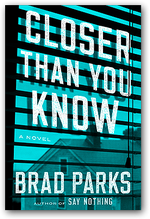
Closer Than You Know by Brad Parks

I’m afraid this comes across as a collection of backhanded compliments — I hope I’m wrong about that. If so, I didn’t mean it.

Closer Than You KnowCloser Than You Know

by Brad Parks

eARC, 416 pg.
Dutton Books, 2017

Read: December 6 – 8, 2017


When you read a book about a dog — from Marley & Me to Where the Red Fern Grows — you’ve got a pretty good idea what’s going to happen near the end. Same goes for a Nora Ephron movie. Or a Horror flick. But you still read or watch them, and you cry, or laugh and “awww”, or jump in your seat when you’re supposed to. Even on repeat reads/viewings. But when done right, those things just work. Similarly, think of a roller coaster — you may stand outside the fence watching the thing go around the track while standing in line (some lines give you plenty of opportunity to study), and armed with that study, as well as the your own eyes, you know that track is going to drop from in front of you in a couple of seconds — or the coaster is about to hit the loop — that doesn’t stop your stomach from lurching when it does.

Why do I bother with that? It’s a thought that kept running through the back of my mind while reading Closer Than You Know. By the time I hit the 10% mark, if you’d made me write down what I expected to happen — the reveals, the twists, the story beats, etc. — I’d have gotten an A. I’m not saying I’m smarter than the average bear or anything, anyone who’s read/watched a handful of thrillers would’ve been able to, too. And it worked. It absolutely worked. How Parks pulls it off, I do not know, but he does. He’s just that good.

And all the stuff that I didn’t guess? Oh, man, it was just so sweet when Parks delivered it, there were a couple of scenes that just left me stunned. And, I should rush to note, the way Parks made a couple of reveals that I’d seen coming from the start were so well done, it was like I hadn’t called the shot.

In his previous stand-alone, Parks said that he wanted to write about the thing that scares him the most — his children being kidnapped. Closer Than You Know taps into a very similar fear — Child Protective Services taking your child from you, leaving you to the mercies of the machine where you’re presumed guilty. This time instead of “the bad guys,” faceless criminals, taking someone’s kids, this time it’s the forces of justice, of law and order, taking the child — they’re celebrated for it, they’re doing it “for the best interests of the child.”

What’s worse is that no one will tell Melanie Barrick why her infant son had been taken from his daycare. Melanie spent most of her childhood in the Foster Child system, and most of that time in the worse situations that system has to offer. This isn’t the stuff of nightmares for Melanie, mostly because I don’t think she has enough imagination for her subconscious to cook this up. And then she’s arrested for possession of cocaine and paraphernalia suggesting distribution — a felony that will guarantee she’s about to lose her little Alex for good.

Melanie is a “good person” — she’s one of the success stories that we don’t see as often as we’d like from the Foster Child system. She worked to put herself through college; has a great, supportive husband; a lousy job (but with benefits) — but one that will help her family get somewhere; and is a devoted, doting, loving mother. The kind of person we all want to think we’re surrounded by, but fear we probably aren’t.

From this point on, it’s a cyclone for despair as every part of her life — her job, her husband, her brother, her friends, her finances, her sense of privacy and security — is affected, is under siege during this ordeal. Can Melanie maintain her hope, maintain her innocence, maintain her conviction that she’ll hold her baby boy again?

In charge of prosecuting “Coke Mom” (the press is always so quick with these nicknames), is Amy Kaye. Amy Kaye could easily be the protagonist in any legal thriller, she’s just the kind of character you want to read in that kind of thing. She’s smart, dedicated and driven — at the moment, she’s primarily concerned with a serial rape investigation that she’s doing pretty much on her own. Amy starts to make progress for the first time in years when she’s put on this prosecution (largely for political reasons) — which she’s more than willing to do, but she hates to take away time and attention from the rape investigation. What really makes this difficult for Kaye is that Melanie is one of the most recent victims in this investigation.

So basically, things are not going well for these two women. There are occasional moments where there is hope, where there is a hint of humor, or life for them and it’s just enough to get you to let your guard down before the gears turn again and life gets bad. Melanie seems to be a living embodiment of Murphy’s Law — things just never go her way in this book. As she notes herself, addicts talk about hitting rock bottom — she isn’t like them, she keeps finding new bottoms. It’s during this part of the book, where the gears keep grinding away, where the Justice System seems most like a machine, and least like a method for determining (not presupposing) guilt, that things will really get to you. That stomach lurching I mentioned earlier? That image came from somewhere. It feels so real, it feels like this is something that actually happened to someone that Parks spent hours interviewing. I don’t know how you read these parts of the book and not get demoralized — but unable to put the book down, because you just have to, have to know what happens next.

As I’ve said before, I’ve been a Brad Parks fan since the first time I read his debut novel — and I miss Carter Ross, the star of his series. The bad thing for me reading Say Nothing and Closer Than You Know is that these are so good, he’s going to spend years doing books like this and I don’t know if he’ll be able to get back to Carter. On the other hand, I can’t complain really if he’s putting out reading that’s this compelling. Yeah, I said the book was largely predictable — and you’ll likely find it the same. But you will be wrong about some things and you won’t know how he’ll show you that you’re right. Think of a NASCAR race — we all know that it’s basically a series of guys going fast and turning left — but it’s how they go fast and turn left that makes all the difference. Parks delivers the goods — the word riveting doesn’t do this book justice. It’s compelling, riveting, gripping, exciting, and will make you rethink so much of what you may believe of the Criminal Justice and Child Protective systems. You will laugh, you will be stunned (in good and bad ways), you will give up hope for this poor mother.

And you will hate when the book ends — as much as you breathe a sigh of relief as you know you have some degree of closure.
Disclaimer: I received this eARC from Dutton Books via NetGalley in exchange for this post — thanks to both for this.

—–

4 1/2 Stars

Opening Lines – Dead Beat

We all know we’re not supposed to judge a book by its cover (yet, publishing companies spend big bucks on cover design/art). But, the opening sentence(s)/paragraph(s) are fair game. So, when I stumble on a good opening (or remember one and pull it off the shelves), I’ll throw it up here. Dare you not to read the rest of the book.

On the whole, we’re a murderous race.

According to Genesis, it took as few as four people to make the planet too crowded to stand, and the first murder was a fratricide. Genesis says that in a fit of jealous rage, the very first child born to mortal parents, Cain, snapped and popped the first metaphorical cap in another human being. The attack was a bloody, brutal, violent, reprehensible killing. Cain’s brother Abel probably never saw it coming.

As I opened the door to my apartment, I was filled with a sense of empathic sympathy and intuitive understanding.

For freaking Cain.

from Dead Beat by Jim Butcher

Pub Day Repost: Flame in the Dark by Faith Hunter


Flame in the DarkFlame in the Dark

by Faith Hunter
Series: Soulwood, #3eARC, 352 pg.
Ace/Roc, 2017
Read: September 22 – 27

Rookie Agent Nell Ingram and her PsyLED team start this novel in a multi-agency investigation into an attack on a political fundraiser — with a focus on one family in particular. There’s no obvious paranormal aspect to the attack, so PsyLED isn’t in the lead, but there’s enough to keep them hanging around the investigation. If for no other reason than the local vampires are interested in what’s going on. Soon, other attacks occur, making it even clearer that one family is the target. As the team starts to investigate that family, more questions are raised and secrets are revealed. But it’s a long while before the secrets and questions lead to anything useful for preventing further loss of life.

The presence of the vampires is a nice bonus — they were present a little in Blood of the Earth, but not really in Curse on the Land. Nell’s still struggling to make up for a faux pas in her initial exposure to the vampires — and a couple of them seem to be enjoying her discomfort. I enjoy seeing Hunter’s particular brand of vampires running around without Jane and her stakes, as long as she doesn’t return to this particular well too much in this series, the Vamps’ presence will be a plus.

The PsyLED case itself is a little on the tepid side — it’s far easier for readers to figure out what’s going on than it is for the characters, and that always hurts the stories somewhat. But — wow. What’s actually going on when the team finally puts all the pieces together? Wow — just wow. It makes putting up with their earlier slowness utterly worth it (also, the reader won’t be as correct as they thought they were for a long time). Basically, if you find yourself getting annoyed with this story, your patience will be rewarded. Probably more than rewarded.

Speaking of patience, Nell needs to exercise a good deal of it with her family, who are still struggling with understanding just what’s going on with her (and they don’t know it all!) and her move for independence from the cult she’s left. It’s clearly, and understandably, difficult to continue to distance herself from the ways and practices she was raised in, while trying to strengthen the ties with the family members still in the church. Meanwhile, the church does seem to be trying to change their practice — moving to orthopraxy, without much of a move towards orthodoxy. That kind of thing isn’t really going to work in the long run — but then again, Hunter’s not writing a realistic account of a movement in a religious group — so it’s not anything to get worked up over. Anyway, Nell puts her foot down on a couple of fronts and draws on some of what she’s learned in working with others, to be able handle her family in a way that hopefully gets through to them. She’s also making some smart moves regarding her sister, Mud/Mindy, who seems to share a lot of abilities and inclinations with Nell. I can’t wait to see what Hunter’s got up her sleeve with this.

While this is really Nell’s book (and series), there’s a great ensemble of characters here. Particularly in the PsyLED team. I’d have preferred a better use of the team, and for the second book in a row, I wondered why Hunter didn’t use some of the characters as well as she did in the first book. Maybe this is just me asking for more for Tandy to do.

There’s some satisfying development on the Brother Ephriam/foreign entity in Soulwood front (that’ll make sense to readers of the series), and regarding the “Vampire Tree.” Which just might be the creepiest floral entity I’ve ever read about — and it’s creepier than a lot of fauna, too. I’m particularly glad about the Brother Ephriam development, I was afraid that things were going to go on too long with that without any real shift in the status quo.

There’s also a stronger look at Nell’s romantic life here — her taking the first steps in exploring a real romantic relationship (in contrast to that marriage she was in), and maybe even getting her first “Improperly Proper Kiss.” There’s just enough romance story allow the reader to see her grow in this way (in addition to all the others she’s growing in), just one more step towards her fulfillment — but not so much that it’s the novel’s focus.

One of the pluses (and minuses) about this series all along has been how hard it is to simply say what Nell Ingram is. With most UF you can summarize things briefly: She can see dead people, he’s a wizard PI, she’s a skinwalker vampire hunter, he’s the world’s oldest living druid, she’s a changeling PI, she’s a ridiculously named werewolf who has a radio talk show, and so on . . . Nell’s a, um. Well. There’s magic, and powers over growing things, but no real spells, per se. See what I mean? This is a pain when trying to describe it to others, or even in knowing what to expect from her stories. And Hunter takes full advantage of this, she’ll have Nell do whatever at any point in time, and as long as it sort of relates to what she started off doing in Book 1, you buy it. By the same token, I can imagine that might be too much of a blank slate for Hunter — there are no well-established strengths/weaknesses/tropes to play with. There are things that Nell does here that just blows me away — and that has a lot to do with Hunter creating this magic creature/race on her own.

When I say that Hunter takes full advantage of this — I should say I thought she had been for the past two books — she really lets loose with it this time.

Let me try to sum up this rambling post: this is a slow burn of a novel — it puts down roots and grows like Nell’s plants, and eventually blossoms into something that’s great to look at. Be patient with it, watch the growth, and you’ll be rewarded. Because when things get going — they really get going, and it’s almost too much to take in. I vacillated a lot about what to rate this — I argued myself into 4-Stars and then into 5 and back into 4 and so on a few times. but because I really don’t place too much weight on the stars, really, I just stopped and split the difference. For those who’ve been around for the previous two books this is a must read — if this was going to be the last in the series, it’d be a decent way to leave (thankfully, Soulwood isn’t a trilogy); for Yellowrock fans who haven’t tried this series yet, you’ll appreciate it; and if you’ve never tried either — take a dip into this world, but I’ll warn you: you’ll end up reading all the others.

Disclaimer: I received this eARC from Berkley Publishing Group via NetGalley in exchange for this post — thanks to both for this. Thanks also to Let’s Talk! Promotions for the opportunity to take part in this book tour. My opinions about the book remain my own.

—–

4 1/2 Stars

The Squirrel on the Train (Audiobook) by Kevin Hearne, Luke Daniels

The Squirrel on the Train (Audiobook) The Purloined Poodle (Audiobook)

by Kevin Hearne, Luke Daniels (Narrator)
Series: Iron Druid Chronicles/Oberon’s Meaty Mysteries, #2
Unabridged Audiobook, 2 hrs, 54 min.
Kevin Hearne, 2017
Read: December 2, 2016


I posted about the text version about a month ago (and reposted last week), but wanted to say a little more about the audiobook — so for the sake of those who just clicked on the Audiobook post, I’ll just repeat everything I said before, but tag on something at the end about Luke Daniels’ work. Can the magic of The Purloined Poodle be recaptured? Yes — maybe even topped. For many, that should be all I need to write. If that’s the case, you’re fine — go ahead and close this, no need to finish this.

If you’re still here, I’ll write a little more — While on a trip to Portland to go sight-seeing, er, sight-smelling, Oberon, Orlaith and Starbuck get away from Atticus (er, I mean, Connor Molloy) while chasing after a suspicious-looking squirrel. That’s a tautology, I realize, if you ask the hounds, but this was a really sketchy-looking squirrel. Anyway, this brought the group into the path of Detective Ibarra. She happens to be at the train station investigating the odd murder of a man who looks just like Atticus.

Naturally, that gets him interested and investigating things as best as he can. Thanks in no small part to the noses of the hounds, Atticus and an old friend are able to uncover what’s going on to help Atticus’ new friend make an arrest.

It’s a whole story in Oberon’s voice, I don’t know what else I can say about the writing/voice/feel of the book. That says pretty much everything. From Oberon’s opening comparison of the diabolical natures of Squirrels vs. Clowns to Orlaith’s judgment that “death by physics” “sounds like justice” to the harrowing adventure at the end of the novella, this is a fine adventure for “the Hounds of the Willamette and their pet Druid!”

No surprise to anyone who’s heard the audiobook for any of Oberon’s other appearances in short stories/novellas/novels, but Luke Daniels killed it here. From the overall characterization and narration he does as Oberon on down to the little details, like Oberon’s particular pronunciation of “Port-LAND,” I just love it. Frankly, how anyone can listen to his rendition of Starbuck’s first steps with words like, “Yes food!” and not giggle like Ron Swanson is beyond me. He gets the serious moments, the anger, the awe, the silliness just right. I just can’t say enough good things about this audio presentation.

There’s a nice tie-in to some of the darker developments in the Iron Druid Chronicles — that won’t matter at all if you haven’t read that far, or if you can’t remember the connection. This was a good sequel that called back to the previous book, and told the same kind of story in a similar way — but didn’t just repeat things. Just like a sequel’s supposed to be, for another tautology. I smiled pretty much the whole time I read it (as far as I could tell, it’s not like I filmed myself). I don’t know if we get a third in this series given the end of the IDC next year. If we do, I’ll be happy — if not, this is a great duology.

—–

4.5 Stars

Page 71 of 123

Powered by WordPress & Theme by Anders Norén