Category: Authors Page 70 of 123

My Little Eye by Stephanie Marland

My Little EyeMy Little Eye

by Stephanie Marland
Series: Starke & Bell, #1

eARC, 351 pg.
Trapeze Books, 2018

Read: March 9 – 12, 2018

They say I was dead for three thousand and six seconds. They say that when I woke I was different, but I don’t know if that’s true. What I do know is that my world became a different place once every one of those precious seconds had expired.

No matter how gripping the prologue might have been, when those’re the first words you get from a character’s POV, you sit up and pay attention.

The Lover is a serial killer just beginning to plague London, and a semi-distracted DI Dominic Bell with his team are making little progress in apprehending him (he’s trying his level best not to be distracted by the press and the brass won’t let him leave his last operation in the dust). Given that the Lover’s technique is improving as the time between kills is decreasing, the pressure is mounting for Bell and the police. One group dissatisfied with their achievements are the members of True Crime London — a group of True Crime aficionados from (duh) London. Some of them have decided to take matters into their own hands so they’ll investigate these crimes themselves — some for the thrill, some to show up the Police, some to draw attention to the fact that the Police are understaffed and underfunded. Clementine has her own reasons — she’s spent some time studying these people as part of her doctoral work in psychology; she hopes to get a better understanding of online communities through this group and she has a theory about “crowd-sourcing justice” she’d like to establish.

We meet both groups (through Dom’s POV and Catherine’s) as they begin to look into the third victim of The Lover. The race is on (even if only one group realizes there’s a race) to find and put a stop to The Lover. I wouldn’t mind more time getting to know the individuals in the respective teams as this goes along — we do get to know some of the people involved in the investigation a bit, but this book focuses on Dom, Clementine and their hunts — everyone else doesn’t matter as much. I could talk a little more about the context for Dom, Clementine and the hunt for the killer — but you don’t want to know more until you get into this book.

The killer? We learn exactly as much as we need to in order that we know that the right guy has been taken care. He is not the most interesting character in the novel — I guess he might be, but Marland didn’t give us enough detail. This is such a great change from serial killer novels that dwell on the obsessions/fetishes/compulsions/methods of the killer, that seem to relish the opportunity to revel in the depravity. Marland shows us enough to be disturbed and utterly sickened by him, to believe that he’s capable of the heinous acts he’s guilty of — and no more. I’m not saying everyone has to write a serial killer this way, but I love that approach.

The protagonists are far more interesting — possibly more damaged even — than the killer. They are wonderfully flawed characters and repeatedly — and I do mean repeatedly — do things that readers will not want them to — because it’s unwise, stupid, dangerous, unethical, immoral, or all of the above. And as much as I was saying “No, no, don’t do that,” I was relishing them do that because it meant great things for the book. At times it’s almost like Marland wants you to not like Dom or Clementine, maybe even actively dislike them. Set that aside, because you will like them, because they are the protagonists hunting for a serial killer; because despite themselves they are likeable characters; and because they’re so well written, with so many layers, and nuances that it’s impossible for Marland to fully explore them and you want to know more. Both are in the middle of professional and personal crises as the book opens — and all of those crises are going to get worse before we leave them (yeah, Dom’s professional life is in worse shape than Clementine’s and Clementine’s been in crisis since just before those 3,006 seconds, so they’re not exactly parallel).

Sometimes the police investigation and the True Crime London’s investigation dig up the same information at about the same time, but on the whole the two follow very different approaches — one more methodical, careful and predictable. The other is haphazard, reckless and (at times) criminal. But both get results, and for the reader, we get a full-orbed view of the investigation which is almost as engrossing as the protagonists carrying it out.

The book is able to say a lot about online communities, True Crime (and some of those who love it as a genre), public acts of grief, criminal investigations and the media — and even a little about memory. All while telling a great story.

While I enjoyed the whole thing, the last quarter of the book was full of surprises that kept me leaning forward in my chair and completely glued to my screen as the plot raced from shock to shock to reveal to [redacted]. There’s a reveal that took me utterly by surprise, but made sense when you stopped and thought about it. There’s another reveal at the end that seemed fitting but wasn’t what you expected — and it followed an event that I never would’ve predicted. Oh, and that last sentence? I can’t tell you how many times I swiped my Kindle screen trying to get what comes next, unwilling to believe that was it.

I was a fan (almost instantaneously) of Marland’s alter ego’s Lori Anderson and that series. My Little Eye has made me a fan of the author — Broadribb, Marland, whatever names she’s publishing under, it’s an instabuy. This book got its hooks into me straightaway and didn’t let go, I resented work and family as they distracted me (however good or pressing the reason) from Clementine and Dom’s quests. I can confidently say that I’ve not read a mystery novel like this one — and that’s not easy this many decades into my love of the genre. I have no idea how Marland’s going to follow this one up — there’s no way that book 2 is a repeat of My Little Eye, but beyond that? No clue what she’ll be able to do. I don’t care — I just want to read it soon.

Disclaimer: I received this eARC from Orion Publishing Group via NetGalley in exchange for this post — thanks to both for this.
N.B.: As this was an ARC, any quotations above may be changed in the published work — I will endeavor to verify them as soon as possible.

—–

4 1/2 Stars

The Armored Saint by Myke Cole

The Armored SaintThe Armored Saint

by Myke Cole
Series: The Sacred Throne, #1

Hardcover, 203 pg.
Tor Books, 2018

Read: February 28, 2018

“My strength is the Emperor and His Holy Writ.”

“Aren’t you pious for one who is so green at the sight of the Order?”

“The Emperor is divine. The Order are just men. You don’t fault a whole faith just because some of its agents take to brigandage. My faith kept me through the war, and it hasn’t failed me after.”

I’ve tossed out a couple of drafts of a paragraph of synopsis, and am tired of trying, so I’m just going to cite the jacket copy:

In a world where any act of magic could open a portal to hell, the Order insures that no wizard will live to summon devils, and will kill as many innocent people as they must to prevent that greater horror. After witnessing a horrendous slaughter, the village girl Heloise opposes the Order, and risks bringing their wrath down on herself, her family, and her village.

Lord Acton famously wrote to Bishop Creighton, “Power tends to corrupt, and absolute power corrupts absolutely.” This idea drips from almost every page of this book. Not that there was a whole lot of absolute power funning around — one member of The Order was close, and one other liked to act like it. But there’s a lot of people with enough power (of various kinds) that their tendency to corruption is problematic for everyone around them. It’s not the prettiest of worlds, but it’s a good setting for a conflict-filled read.

In the midst of this is a nation(?) ruled by a religion — including a scripture that may or may not be correctly interpreted by the religious authorities (who have plenty of civic and martial authority), although there’s no doubt that their application could use some work. They rule (and protect, if you use the term generously) this region through fear and intimidation. But you have to admit, what they’re doing works. Which doesn’t excuse the terror they inflict, but it suggests that somewhere there is an orthodoxy at work.

There are no really likeable characters here, everyone is flawed, but you cannot help but hope for the best for some of them — because they are unlikable, flawed people. Most of them are just trying to make it the best that they can for themselves and their family — and their neighbors, if possible. There are plenty of characters that you never want the best for (aside from repentance), and a couple of characters who jump from “hope for the best” to “hope they die horribly” column. This includes the protagonist — honestly, the more time we spent with her, the less I was that interested in her survival. Really, I liked her about as much as you can like Anakin in Attack of the Clones — thankfully, I like her friends and family.

Whether the Military Fantasy that we’re used to from him or this traditional Fantasy, Myke Cole knows how to write fight scenes (and other scenes of violence). This is seen particularly in the final climactic battle — it was so exciting that I found myself racing through it and having to pause and go back to make sure I understood what happened and hadn’t missed any details. Visceral is really the only word to use there.

I don’t understand how in the middle of this pretty generic Middle-Ages Europe-y fantasy we get war machines. They’re like what Tony Stark would’ve come up with a couple hundred years ago. They absolutely don’t belong to the setting — but neither does magic, so if the reader can buy one, you might as well buy both. Especially when the exosuits are so cool.

Still, at the end of the day, I was underwhelmed. It’s a rich world with characters that a reader can really sink their teeth into. But you just don’t get enough. Two hundred pages isn’t enough — The Armored Saint almost seems more like a 200 page set-up and/or advertisement for the sequel. Am I planning on reading The Queen of Crows and (most likely) The Killing Light? Yeah, I think I’ve even ordered the second one. But I’m not as excited for them as I should’ve been.

I expect my opinion to be in the minority here, so fill up that comment section with all the ways I’m wrong about Cole’s latest (or at least some of the ways).

—–

3 Stars

Pub Day Repost: Closer Than You Know by Brad Parks

I’m afraid this comes across as a collection of backhanded compliments — I hope I’m wrong about that. If so, I didn’t mean it.

Closer Than You KnowCloser Than You Know

by Brad Parks
eARC, 416 pg.
Dutton Books, 2017
Read: December 6 – 8, 2017

When you read a book about a dog — from Marley & Me to Where the Red Fern Grows — you’ve got a pretty good idea what’s going to happen near the end. Same goes for a Nora Ephron movie. Or a Horror flick. But you still read or watch them, and you cry, or laugh and “awww”, or jump in your seat when you’re supposed to. Even on repeat reads/viewings. But when done right, those things just work. Similarly, think of a roller coaster — you may stand outside the fence watching the thing go around the track while standing in line (some lines give you plenty of opportunity to study), and armed with that study, as well as the your own eyes, you know that track is going to drop from in front of you in a couple of seconds — or the coaster is about to hit the loop — that doesn’t stop your stomach from lurching when it does.

Why do I bother with that? It’s a thought that kept running through the back of my mind while reading Closer Than You Know. By the time I hit the 10% mark, if you’d made me write down what I expected to happen — the reveals, the twists, the story beats, etc. — I’d have gotten an A. I’m not saying I’m smarter than the average bear or anything, anyone who’s read/watched a handful of thrillers would’ve been able to, too. And it worked. It absolutely worked. How Parks pulls it off, I do not know, but he does. He’s just that good.

And all the stuff that I didn’t guess? Oh, man, it was just so sweet when Parks delivered it, there were a couple of scenes that just left me stunned. And, I should rush to note, the way Parks made a couple of reveals that I’d seen coming from the start were so well done, it was like I hadn’t called the shot.

In his previous stand-alone, Parks said that he wanted to write about the thing that scares him the most — his children being kidnapped. Closer Than You Know taps into a very similar fear — Child Protective Services taking your child from you, leaving you to the mercies of the machine where you’re presumed guilty. This time instead of “the bad guys,” faceless criminals, taking someone’s kids, this time it’s the forces of justice, of law and order, taking the child — they’re celebrated for it, they’re doing it “for the best interests of the child.”

What’s worse is that no one will tell Melanie Barrick why her infant son had been taken from his daycare. Melanie spent most of her childhood in the Foster Child system, and most of that time in the worse situations that system has to offer. This isn’t the stuff of nightmares for Melanie, mostly because I don’t think she has enough imagination for her subconscious to cook this up. And then she’s arrested for possession of cocaine and paraphernalia suggesting distribution — a felony that will guarantee she’s about to lose her little Alex for good.

Melanie is a “good person” — she’s one of the success stories that we don’t see as often as we’d like from the Foster Child system. She worked to put herself through college; has a great, supportive husband; a lousy job (but with benefits) — but one that will help her family get somewhere; and is a devoted, doting, loving mother. The kind of person we all want to think we’re surrounded by, but fear we probably aren’t.

From this point on, it’s a cyclone for despair as every part of her life — her job, her husband, her brother, her friends, her finances, her sense of privacy and security — is affected, is under siege during this ordeal. Can Melanie maintain her hope, maintain her innocence, maintain her conviction that she’ll hold her baby boy again?

In charge of prosecuting “Coke Mom” (the press is always so quick with these nicknames), is Amy Kaye. Amy Kaye could easily be the protagonist in any legal thriller, she’s just the kind of character you want to read in that kind of thing. She’s smart, dedicated and driven — at the moment, she’s primarily concerned with a serial rape investigation that she’s doing pretty much on her own. Amy starts to make progress for the first time in years when she’s put on this prosecution (largely for political reasons) — which she’s more than willing to do, but she hates to take away time and attention from the rape investigation. What really makes this difficult for Kaye is that Melanie is one of the most recent victims in this investigation.

So basically, things are not going well for these two women. There are occasional moments where there is hope, where there is a hint of humor, or life for them and it’s just enough to get you to let your guard down before the gears turn again and life gets bad. Melanie seems to be a living embodiment of Murphy’s Law — things just never go her way in this book. As she notes herself, addicts talk about hitting rock bottom — she isn’t like them, she keeps finding new bottoms. It’s during this part of the book, where the gears keep grinding away, where the Justice System seems most like a machine, and least like a method for determining (not presupposing) guilt, that things will really get to you. That stomach lurching I mentioned earlier? That image came from somewhere. It feels so real, it feels like this is something that actually happened to someone that Parks spent hours interviewing. I don’t know how you read these parts of the book and not get demoralized — but unable to put the book down, because you just have to, have to know what happens next.

As I’ve said before, I’ve been a Brad Parks fan since the first time I read his debut novel — and I miss Carter Ross, the star of his series. The bad thing for me reading Say Nothing and Closer Than You Know is that these are so good, he’s going to spend years doing books like this and I don’t know if he’ll be able to get back to Carter. On the other hand, I can’t complain really if he’s putting out reading that’s this compelling. Yeah, I said the book was largely predictable — and you’ll likely find it the same. But you will be wrong about some things and you won’t know how he’ll show you that you’re right. Think of a NASCAR race — we all know that it’s basically a series of guys going fast and turning left — but it’s how they go fast and turn left that makes all the difference. Parks delivers the goods — the word riveting doesn’t do this book justice. It’s compelling, riveting, gripping, exciting, and will make you rethink so much of what you may believe of the Criminal Justice and Child Protective systems. You will laugh, you will be stunned (in good and bad ways), you will give up hope for this poor mother.

And you will hate when the book ends — as much as you breathe a sigh of relief as you know you have some degree of closure.
Disclaimer: I received this eARC from Dutton Books via NetGalley in exchange for this post — thanks to both for this.

—–

4 1/2 Stars

Resurrection Men by Ian Rankin

Resurrection MenResurrection Men

by Ian Rankin
Series: John Rebus, #13

Hardcover, 436 pg.
Little Brown and Company, 2002

Read: Rebruary 26 – 27, 2018

Another ghost in need of justice. Rebus had confessed to her once, after too many late-night drinks in the Oxford Bar, that he saw ghosts. Or didn’t see them so much as sense them. All the cases, the innocent — and not so innocent — victims . . . all those lives turned into CID files . . . They were always more than that to him. He’d seemed to see it as a failing, but Siobhan hadn’t agreed.

We wouldn’t be human if they didn’t get to us, she’d told him. His look had stilled her with its cynicism, as if he were saying that “human” was the one thing they weren’t supposed to be.

Thanks to sickness, a little bit of travel, and general increased busy-ness in my non-blog life, I almost missed my monthly check-in with John Rebus. Thankfully, for my Bookish-OCD, I made it just in time. Even better? This was one of the best in the series.

Rebus’ drinking and displeasure at Gill Templar’s handling of a murder investigation results in him being sent back to school. Literally. There’s a “retraining” course at the Police College for long-serving officers with discipline problems — sort of a last chance before the end of the road. These detectives are pretty similar, they’ve (mostly) been at this for years and aren’t going to change, no matter what happens in the course. Most of them know each other by reputation, Rebus is well-known, apparently — and he knows another classmate by reputation, he’s “the Glasgow Rebus.” After some counseling sessions, and some class lectures, the detectives are given a cold case to work to help learn something about teamwork. A couple of the detectives were associated with the original investigation in Glasgow, and even Rebus brushed up against it in Edinburgh. It’s not so clear how much teamwork is being learned, it’s clear that there are people who know things about the case that aren’t in the files — and they’re not sharing.

There is something about the case that could involve Big Ger, so guess who gets volunteered to talk to him? Rebus is not the only one talking to Cafferty, Siobhan Clarke (now a DS) has a couple of conversations with him. Watching Cafferty try to treat the two of the similarly, with different results, was quite entertaining — Clarke reacts to him differently than Rebus, but she doesn’t take the same angle with him that I think most would. I look forward to seeing the two of them lock horns in the future.

Speaking of Siobhan — never call her Shiv, by the way — once again, she threatened to take over the book for the first half or so. Rebus’ drinking with the other problem police and their cold case just didn’t grab my attention at first. But Siobhan’s dealing with the investigation — without her mentor to bounce ideas off of — and the various and sundry male detectives around her. Some of which work with her just fine, others . . . not so much — at the end of the day, DS Clarke is the one who puts the case together, and in a pretty compelling way. Did I enjoy things a little bit more when Rebus came along to interact with a bit? Yeah, but it wasn’t necessary. I also like the way that Rebus and Templar were the ones (along with Siobhan herself) noticing her doing things like Rebus this time, not just other police. He’s clearly left his stamp on her — for good or ill, the trick is watching her approach things the way he would, but remaining her own person. Which she has so far — and, I bet, will continue to do so.

But this is a Rebus novel, at the end of the day, and he does get the better material — as I mentioned, he interacts with Siobhan some because he and the others come to Edinburgh to follow a pretty shaky lead (mostly, it’s an excuse to get away from the college and drink somewhere else). Around this point, that storyline became more intriguing — and it did end up being the better part of the novel.

No one will ever say that the Rebus novels are a fun romp, but there was something about Rankin’s writing in Resurrection Men that seemed darker than usual — not a darkness because of violence or anything, just in the telling. Everything seemed worse, everything seemed sinister — it’s hard to put my finger on it exactly, but there was something grim going on. Yeah, I laughed a couple of times, smiled more often than that, but overall, the noir in this book was blacker. We see areas of Rebus’ psyche we haven’t seen much of before — ditto for Clarke — we also get some good Rebus/Cafferty backstory.

The structure of this novel is the real star — it was just perfect — we get a couple of mysteries to watch our detectives solve, plus a couple of other things go on. It even seems like Rankin doles out the information in an unusual way, only telling us what we need to know when we need to know it — there are times when we’re more in the dark than Rebus because he’s hiding the information from his fellow Last-Chancers and us (what does that say about Rankin’s readers?), but it works — this isn’t a case of a mystery writer cheating, it’s a deliberate attempt to build suspense. Complex without being complicated, brilliantly plotted but not in a way that feels totally organic. At a certain point, the way that all the storylines end up seem inevitable (even when you’re still not sure who the various killers are going to be), yet you’re surprised when the inevitable happens. But along the way, each step in the stories, each reveal, each development catches you off guard. Just fantastic structure to the book.

I thought it was strange that Rankin started this one off (I’m guessing for the American edition only) with a little description of the Scottish Police’s organization and rankings, which was nice (but most readers can figure it out on their own). Also included was a list of the cast of characters — organized by storyline. That was helpful, too. Unnecessary, but very nice. I’m not sure why these were used, but I’ll take them.

This one checked almost every one of my boxes — at least once, and never didn’t hold my interest. Rankin clearly knows what he’s doing and you should read this one — and the twelve before it.

—–

5 Stars
2018 Library Love Challenge

The Strange Death of Fiona Griffiths by Harry Bingham

The Strange Death of Fiona GriffithsThe Strange Death of Fiona Griffiths

by Harry Bingham
Series: Fiona Griffiths, #3

Kindle Edition, 470 pg.
Sheep Street Books, 2015

Read: February 16 – 17, 2018


From the instant that it was mentioned in Love Story, With Murders that Fi Griffiths had signed up for a course in Undercover work, every reader knew that she’d end up doing some deep undercover work soon. Thankfully, Bingham didn’t make us wait too long because here comes both the course and the assignment. But before we get to the assignment, Fi gets this wonderful reality check after her course:

I’m tasked to process paperwork on a couple of cases that are coming to court. Someone assigns me to help on a team that is developing advice on how to avoid thefts from vehicles. The first of our meetings takes an hour and forty minutes and the gist of our advice will be, ‘Lock your car and hide your valuables.’ Or, to simplify further, ‘Don’t be a bloody idiot.’

I suggest that as a slogan and everyone looks at me.

I just loved that. Anyway, this seems like a perfect idea — there’s a real sense in which everyday life is an undercover assignment for Fi, letting her do it as part of her job seems like a no-brainer. Not that her superiors really understand that, but her readers do.

The case started off as a simple payroll fraud investigation — a clever and ambitious fraud, make no mistake, but not the kind of things that excites any police detective (especially one like Fi). But then, she ties one suspicious death into this crime — and then a particularly gruesome murder as well. These discoveries are enough to get The Powers That Be to take this seriously enough to put Fi and another officer undercover as payroll clerks to infiltrate this scheme. Eventually, Fi is recruited by the people they’d hoped recruit her and the game is afoot. Fi does things that will surprise the reader as much as they do to her targets in her efforts to bring some justice to the situation.

At some point, Fi is going over the results of her work thus far with our friend, DCI Jackson, and her handler from Organized Crime

Brattenbury says, ‘Fiona, this is remarkable work. You—’

Jackson interrupts him. ‘Don’t flatter her. She’ll cock everything up. Or start shooting people.’

Which is essentially the outline for every Fiona Griffiths novel, really.

Watching Fi go deeper into her cover and into the fraud activity is gripping — and also very different from the earlier books. Fiona doesn’t get to spend as much time with the dead as she likes, she can’t have their pictures on display without ruining her cover. It doesn’t stop her from doing what she can along those lines, but it gives Strange Death a different feel from its predecessors.

Fi’s investigation of the deaths isn’t the focus of this novel, it’s her undercover work — how she does it, how she embodies her cover, how as her cover she contributes to the community, how she learns things that can help her (both the fictional her and the real). Like too many who go undercover, Fi arguably gets too close to her targets (it’s not much of an argument, really), and lines between the detective and the felonious payroll clerk blurred more than they should’ve. The same kind of focus, the same kind of attachment she makes to the victims in the other books (and cases we don’t have record of) is brought to the people and work she encounters here.

At the same time, Fi’s desire — need — for the emotional, familial and romantic connections she’s made has never been stronger. Those things that she wanted, so she can be more like a citizen of “Planet Normal,” act as an anchor to reality in a way that has to surprise her. Not only that, she forges new relationships as DC Griffiths through these events. Minor spoiler: the Fiona Griffiths that emerges from this assignment is a noticeably different, more well-rounded, and changed in other (less pleasant) ways.

It was good to see DCI Jackson at work again. The other police officers (particularly Brattenbury and his team) were more interesting than we’ve gotten before. The same could and should be said for the other supporting characters we encounter in these pages — criminal and civilian alike. I hope that Bingham is able to find ways to bring many of these characters back in future novels (or he can just give us new characters that are as well constructed, but I like so many of these I’d prefer to see them).

I’m a sucker for undercover cop stories — since the first time I saw Ken Wahl’s Vinnie Terranova (when I was too young to be seeing such things) and what his work did to him. This was no exception — and a strong sample of the type. This story of Fiona Griffiths’ UC work is just as gripping, just as surprising as you could want and a sure sign that this character is more than a one-trick pony (if anyone was still wondering) and that Bingham is a writer to watch.

—–

4 1/2 Stars

Iron Gold by Pierce Brown

Iron GoldIron Gold

by Pierce Brown
Series: Red Rising, #4

Hardcover, 600 pg.
Del Rey Books, 2018

Read: February 5 – 13, 2018

. . . We didn’t prepare for this.”

“How do you prepare for a kick in the balls?” I say. “You don’t. You suck it up.”

“That supposed to inspire me?. . .

Darrow’s words about the mission he and the Howlers are ill-prepared for also apply to readers of Pierce Brown books. At some point, you have to suck it up and keep moving. I typically considered Brown’s writing to be full of gut-punches, but Darrow’s anatomical metaphor applies, too. Yeah, we love the books, and Brown makes sure the experience is almost as harrowing for the readers as it is for the characters.

After President Snow dies, after Tris finishes with the Factions, after The Matrix reboots, after The Emperor Dies and the teddy bears sing, “Yub nub, eee chop yub nub,” what happens? (well, thanks to J. J. Abrams, we have an idea about that last one) Iron Gold lets us see what happens 10 years after the events of Morning Star.

The Republic is still at war, trying to finish off the remnants of the old order — the Senate isn’t rubber stamping Darrow’s requests and that is proving problematic. The people are tired of the bloodshed and want the focus to move to strengthening the fledgling government. Driving Darrow to a last-ditch and dramatic gesture. The lives of the Reds on Mars is technically better, they’re technically free, but things aren’t much better — in fact, they may be less safe. Criminals on Lune are doing well, but those who served during the War are still trying to deal with the trauma they survived. Meanwhile, on the far end of the solar system, some exiles from Lune are looking to regain some prominence. Brown jumps around from story to story, between various perspectives, surveying the wreckage of the Society and the birth of the Republic.

Each character is as well-drawn, and fully developed, as sympathetic as those who came before in the series — even those who are critical of Darrow/the Republic (if not downright opposed to it). This is a more complicated world than the one we last saw. I’m going to keep things pretty vague and not go further than this, because half of the joy of this book is in the exploration.

Jumping from perspective to perspective, between storylines that have almost nothing to do with each other make for a lesser novel than the previous books in the series. When I was following a character — their story was gripping, I was interested and invested — but the instant the perspective shifted? It was all about the new story/perspective and I pretty much forgot about the previous. Darrow’s story was the exception, but I attribute that to my long-standing connection to Darrow, Sevro and the rest. I loved the conclusion of Darrow’s story — because of what it means for Darrow and the rest, and what it means for the next book in the series (saga?).

I’m glad we got this look at the aftermath of the Rising — if we were going to get anything at all — it seems right for things to be this way. I wasn’t as invested in this novel as I was in the previous ones, but I’m just as invested in this world. I hope the next one will grab me better, but until then I wait on tenterhooks and with hope that Darrow and the rest will deliver the goods. This is not the place to jump on the series — go back toe Red Rising and start from the beginning, it’s worth it. For those who’ve been with man from his harrowing beginning through his even more harrowing and devastating triumphs, this is a must read.

—–

4 Stars

2018 Library Love Challenge

The Falls by Ian Rankin

The FallsThe Falls

by Ian Rankin
Series: John Rebus, #12

Hardcover, 395 pg.
Minotaur Books, 2001

Read: January 15 – 16, 2018

If anyone can do it, John, you can. I’ve always had confidence in your sheer pig-headedness and inability to listen to your senior officers.

After the last few novels which were characterized by several interlocking stories, The Falls centers on the disappearance of a young woman — Philippa Balfour. Flip is the daughter of an important banker, a student of sorts, and frequently the girlfriend of one of the least appealing young men you’ve met lately. She never showed up for a night of drinking with friends and her father’s influence got the police involved much more quickly than they would have otherwise. There are few that hold out much hope for a happy resolution to this case, but until a body shows up, that’s how they have to proceed.

Now, just because I said there’s only one case at the core of this book, that doesn’t mean it’s just one story. There’s the typical investigation, undertaken by a large number of detectives and under media scrutiny. Then there’s something that catches Rebus’ eye, which leads him on one path. Siobhan Clarke finds another loose strand to pull at, and uses much of her off-the-clock time following that. The two are aware of what the other is doing, but neither is all that interested in it. Readers, of course, know that one or both of them are going to make more progress than the rest of the Force and can just enjoy watching them.

That’s the strength of this book — Rebus finds some evidence that might tie this crime to others throughout Scotland over the past few decades. He clearly specializes in historical investigations, and it’s clearly a good idea for him to go down that path. Siobhan’s got a more tech-savvy take on it (and she doesn’t have all the skills necessary for that kind of work, but she’s able to stumble along with some help. Watching both of these two mavericks at work was such a blast (Siobhan once again is confronted with her colleagues pointing out her methods and focus approximating Rebus’). The actual solution to the mystery of Flip’s appearance was very satisfying and well-executed.

I spent a good deal of time missing Brian Holmes during the early pages — the DS that Siobhan is partnered up with just stressed how much isn’t Brian. And it goes downhill from there. Brian might not have been my favorite supporting character, but wow — he’s so much better than everyone else Siobhan has worked with (other than DI Rebus, of course). Maybe it helps that he was involved with that librarian, so he wasn’t trying to start something with her (minor spoiler, sorry).

The book starts with Watson’s retirement (not the last we see of him, which is nice), and newly-minted DCS Gill Templar has her work cut out for her. Not only does she need to lead the search for the missing daughter of an important Edinburgh banker, but she has to establish her authority. The way she goes about it rubs some the wrong way, and you have to wonder how long she can maintain things. Siobhan’s take on her new boss shows a good amount of discernment. One thing’s for sure, Rebus is going to miss Farmer Watson (but not his coffee).

Speaking of Gill, Rebus has a new romantic interest in The Falls, Jean Burchill. I liked Jean more than I ever liked Gill, Patience (low bar, there) or any of the others that have graced these pages. Her husband had been an alcoholic (of a different sort than Rebus), and sees Rebus’ vices in a very different light than other have. She doesn’t approve, but she can approach them more realistically than Patience ever did. I fear she won’t be around long, but that’s hopefully just cynicism on my part. (feel free to leave me in the dark on that front down in the comment box, folks).

Not just Farmer’s retirement, but Rebus has to deal with loss and a greater sense of mortality at points here. He and his contemporaries can’t help but sense their own retirement days approaching/looming. Also, Rebus may not add to his enemies list within the Police, but he’s deepened the antagonism a few have toward him. At one point, he goes out of his way to cultivate that — for a good reason, in his mind at least. But I’m not sure if he’s ever come closer to losing his job. Who knows what’d happen to him if that day comes.

This is one of those covers that makes you wish cover designers had to read the book — an inconsequential point, but when Rebus actually got to the titular location, I had to shake my head. (Other cover images I’ve seen for this aren’t as misleading).

This might not be as powerfully told, or as sweeping as some of the recent books have been. But I’m not sure I’ve enjoyed reading a Rebus novel more than this one — and could’ve easily read it in one sitting. This will be sure to please Rebus fans and could easily make some, too.

—–

4 Stars

2018 Library Love Challenge

Beneath the Sugar Sky by Seanan McGuire

Beneath the Sugar SkyBeneath the Sugar Sky

by Seanan McGuire
Series: Wayward Children, #3

Hardcover, 174 pg.
Tor Books, 2018

Read: January 11, 2018

Children have always tumbled down rabbit holes, fallen through mirrors, been swept away by unseasonal floods or carried off by tornadoes. Children have always traveled, and because they are young and bright and full of contradictions, they haven’t always restricted their travel to the possible. Adulthood brings limitations like gravity and linear space and the idea that bedtime is a real thing, and not an artificially imposed curfew. Adults can still tumble down rabbit holes and into enchanted wardrobes, but it happens less and less with every year they live. Maybe this is a natural consequence of living in a world where being careful is a necessary survival trait, where logic wears away the potential for something bigger and better than the obvious. Childhood melts, and flights of fancy are replaced by rules. Tornados kill people: they don’t carry them off to magical worlds. Talking foxes are a sign of fever, not guides sent to start some grand adventure.

But children, ah, children. Children follow the foxes, and open the wardrobes, and peek beneath the bridge. Children climb the walls and fall down the wells and run the razor’s edge of possibility until sometimes, just sometimes, the possible surrenders and shows them the way to go home.

So begins Beneath the Sugar Sky, the third installment of McGuire’s Wayward Children series. If you’d asked me why I was excited about this book before reading it, I could’ve given you a list of reasons — but I’d forgotten just how magical the books are. By the time I got to “ah, children” not only did I remember the magic, I was under its spell.

Sometime after the events of Every Heart a Doorway, two residents of Eleanor West’s Home are down at the pond (they returned from water-worlds, and this is the best they can get), when a naked girl lands in the pond (falling from apparently nowhere), demanding to see her mother, or at the very least, someone in charge. It turns out that this girl is Sumi’s daughter — the problem there is that Sumi died during Every Heart, so she didn’t get to mature a bit, go back to her world, defeat the evil Queen, get married and have Rini. Now, the Timeline is catching up to her, and faster than you can say Marty McFly, Rini is starting to disappear, finger by finger, limb by limb. This doesn’t sit well with her, as you can imagine.

I like existing. I’m not ready to unexist just because of stupid causality. I didn’t invite stupid causality to my birthday party, it doesn’t get to give me any presents.

So, four of the residents set off on a quest to bring Sumi back to life. This takes them across the U. S., into one of the worlds of the dead, and all around Sumi/Rini’s nonsense world. There’s heroism, mystery, sacrifice, triumph and cleverness all around, without which none of this would work, but with it all — and a healthy dose of magic — it’s a plan so crazy that it just might work.

I don’t want to talk too much about the characters apart from what I’ve already said (which is essentially nothing). In addition to Rini — we have a nice mix of new to us and returning friends — with one character that’s new to the Home as well as to us. I absolutely enjoyed getting the bonus time with the returning characters, the new (to us) characters were exactly the kind of kids you hope to find in these books. Also, some of the revelations about some secondary characters serve to explain a lot about the way this particular multiverse came to be and it’s pretty cool. So, basically, the character material in this novella is almost perfect.

I wasn’t as taken with Down Among the Sticks and Bones as I was with Every HeartEvery Heart was a wonderful mix of tragedy and violence with a sense of play (especially in the ideas and words) — there was hope throughout the book, even when it was dark for everyone and there was little reason for it. Down Among was about dashed hope and tragedy in a world of tragedy, dashed hopes and violence; yes, there as a little play with the language, and some moments of triumph, but they were all overshadowed. Which was fine, it was the story that needed to be told, and I’m not complaining, but Beneath the Sugar Sky was more of a return to the tone of Every Heart, so I liked it more than Down Among — I think it was a better book, too, but I could be wrong about it. I just know it was easier to like. There’s definitely tragedy, there are hard choices to be made — and I did say something about sacrifice — but there’s a strand of hope throughout that makes it so much easier to carry on.

One thing that has been on display throughout this series is a sense of play, a sense of fair tale worlds and logic reflected in the language McGuire uses — you’ve seen bits of it already above, just one more and I’ll call it good:

There was a door there, tall and imposing, the sort of door that belonged on a cathedral or a palace; the sort of door that said “keep out” far more loudly than it would ever dream of saying “come in.”

You know exactly what that door looks like, and you have a great sense of the environment around it, too. Just from that one sentence. McGuire has a great sense of style on display in the Toby Daye and InCryptid books, which is turned up in the Indexed serials, but is probably best seen in these books — capturing the feel of preternatural worlds has pushed her to unleash all of her pent-up linguistic magic. Even if I disliked the characters and stories she’s telling in this series, I think the language would bring me back.

I’m obviously a pretty big Seanan McGuire fan — just a quick glance at the archives will tell you that. But I’m willing to bet that even if I wasn’t predisposed to like her work, this series would’ve made me one — Beneath the Sugar Sky is a slice of literary perfection and I can’t encourage you enough to try it.

—–

5 Stars

Love Story, With Murders by Harry Bingham

Love Story, With MurdersLove Story, With Murders

by Harry Bingham
Series: Fiona Griffiths, #2

Kindle Edition, 449 pg.
Sheep Street Books, 2016

Read: January 4 – 8, 2018

For me, these things aren’t only about finding the killers, but about giving peace to the dead. It’s not primarily a question of justice. The dead don’t care about that. The murder investigation, arrest and conviction are just part of the funeral rite, the final acts of completion. Gifts I bring the dead in exchange for the peace they bring me.

The peace of the dead, which passeth all understanding.

DC Fiona Griffiths continues her efforts to act normal, maybe even feel normal, getting along with her boyfriend and staying out of trouble with her superiors. Basically, things are going as well as they possibly can following the events of Talking to the Dead. But we know that’s going to come to an end, otherwise, this would be a really dull series. It comes to an end when Fiona and a colleague stop off on their way home to look at a case of illegal rubbish. In this particular case, the rubbish is a body part in a chest freezer. It’s a significant enough body part to make the detectives sure they’re looking for something more serious than illegal rubbish.

Over the next few days, the police are able to find some more of the woman, as well as start to understand how long ago she was killed and dismembered — which leads to an identification. Shortly thereafter, the police find pieces of a fresher corpse in the same area. While most detectives look for connections between the victims and hunt for clues to identify the killer, Fi begins learning more about the victims as individuals (not that she’s alone in this, it’s just she’s alone in her approach), what their lives were like, and what would lead someone to kill them. Fi investigates things in a way no other fictional detective — private or police — does. I’m not sure I can express it clearly, but when you read it, you’ll notice. When she starts to put the pieces together about what was going on the whole time, I was flummoxed — it’s nothing like where I expected things to go.

Aside from that are the relationships with her boyfriend, family and fellow police officers. The romance between Buzz and Fi is very strange, but sweet. She’s dealing with a different superior for these investigations. It’s not just Fi up to the same antics with a different boss — similar antics, yes, but Fi understands herself better now, and is able to do what she does in a way that her superiors are able to accept and use. As for her family? I’m not even going to try to talk about it.

Some people are better as corpses. They’re easier to like.

On the one hand, I really like watching Fi’s subconscious at work, making the connections, deductions, and guesses she needs to be making to solve the crime/find what she’s looking for, while she interprets it as “the dead” talking to her. Well, that’s one way to read it, anyway. It really could be that there’s something on the verge of supernatural going on. I like the hint of ambiguity that Bingham has given this world and Fi’s understanding of what’s going on.

I was, I don’t want to say surprised, but it was something like it by the ending. Maybe I’ve just been reading too many Mysteries lately with pretty ambiguous endings, but this one had a very satisfying ending with most of the loose ends tied up. This doesn’t mean that everything ended happily (for want of a better term), but that Fi’s fully able to satisfy her curiosity and need to know (at least about those things that came up in her professional life — her personal life is only slightly more settled by the book’s end than it was when it started).

A murder mystery — with, yes, a love story — that had some fantastic character moments, a really strong puzzle, all very well told. Fiona Griffiths impresses again. This is the best kind of sequel — the same kind of things that filled the first book in the series, but seen differently by everyone (including the protagonist) and with different results — Fi’s grown a bit (I want to stress “a bit,” she’s still basically the same person, which is good, I don’t want everything to be “normal” for this character), and is building on the events from the previous novel, not just repeating them. I’m truly annoyed with myself for waiting so long to get back to this series, and will not make the same mistake.

—–

4 Stars

My Favorite Fiction of 2017

Is he ever going to stop with these 2017 Wrap Up posts? I know, I know…I’m sick of them. But I’ve already done most of the work on this one, I might as well finish…Also, it was supposed to go up Friday, but formatting problems . . .

Most people do this in mid-December or so, but a few years ago (before this blog), the best novel I read that year was also the last. Ever since then, I just can’t pull the trigger until January 1. Also, none of these are re-reads, I can’t have everyone losing to my re-reading books that I’ve loved for 2 decades.

I truly enjoyed all but a couple of books this year (at least a little bit), but narrowing the list down to those in this post was a little easier than I expected (‘tho there’s a couple of books I do feel bad about ignoring). I stand by my initial ratings, there are some in the 5-Star group that aren’t as good as some of the 4 and 4½-Star books, although for whatever reason, I ranked them higher (entertainment value, sentimental value…liked the ending better…etc.). Anyway, I came up with a list I think I can live with.

(in alphabetical order by author)

In The StillIn The Still

by Jacqueline Chadwick
My original post

Chadwick’s first novel is probably the most entertaining serial killer novel I’ve ever read. Without sacrificing creepiness, suspense, horror, blood, guts, general nastiness, and so on — she gives us a story with heart, humor and humanity. The second novel, Briefly Maiden is arguably better, but I liked this one a teensy bit more — and I’m genuinely nervous about what’s going to happen in book 3 (not that I won’t read it as soon as I possibly can).

4 1/2 Stars

The Hangman's Sonnet Robert B. Parker’s The Hangman’s Sonnet

My original post

How do you possibly follow-up 2016’s Debt to Pay, especially with that ending, without dramatically altering the Jesse Stone flavor? I’m still not sure how Coleman did it, but he did — Jesse’s dealing with Debt to Pay in a typically self-destructive way, but is keeping his head mostly above water so he can get his job done, mostly by inertia rather than by force of will. Reflexes kick in however, and while haunted, Jesse can carry out his duties in a reasonable fashion until some friends and a case can push him into something more.

Coleman’s balancing of long-term story arcs and character development with the classic Jesse Stone-type story is what makes this novel a winner and puts this one on my list.

4 1/2 Stars

A Plague of GiantsA Plague of Giants

by Kevin Hearne

This sweeping — yet intimately told — epic fantasy about a continent/several civilizations being invaded by a race nobody knew existed is almost impossible to put into a few words. It’s about people stepping up to do more than they thought possible,more than they thought necessary, just so they and those they love can survive. It’s about heroes being heroic, leaders leading, non-heroes being more heroic, leaders conniving and failing, and regular people finding enough reason to keep going. It’s everything you want in an epic fantasy, and a bunch you didn’t realize you wanted, too (but probably should have).

5 Stars

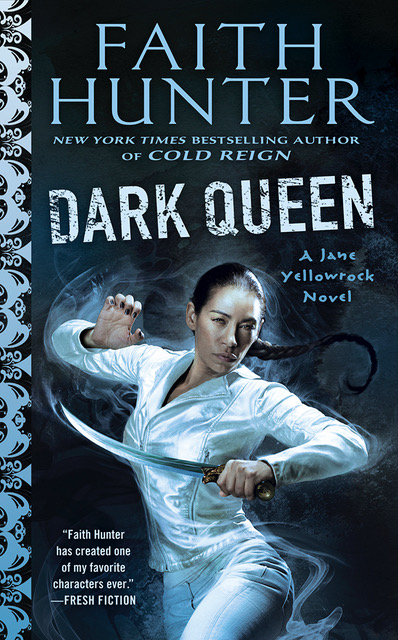
Cold ReignCold Reign

by Faith Hunter

My original post
Hunter continues to raise the stakes (yeah, sorry, couldn’t resist) for Jane and her crew as the European Vamps’ visit/invasion gets closer. Am not sure what’s more intriguing, the evolution in Jane’s powers or the evolution of the character — eh, why bother choosing? Both are great. The growth in the Younger brothers might be more entertaining — I appreciate the way they’ve become nearly as central to the overall story as Jane. I’m not sure this is the book for new readers to the series, but there are plenty before it to hook someone.

5 Stars

Once Broken FaithOnce Broken Faith

by Seanan McGuire
My original post

Poor planning on my part (in 2016) resulted in me reading two Toby Daye books this year, both just excellent, but this one worked a little bit better for me. Oodles and oodles of Fae royalty and nobility in one spot to decide what they’re going to do with this elf-shot cure leading to a sort-of closed room mystery (it’s just a really big, magical room) with peril on all side for Toby and her found family.

5 Stars

A Monster CallsA Monster Calls

by Patrick Ness
My original post

There were so many ways this could’ve been hacky, overly-sentimentalized, brow-beating, or after-school special-y and Ness avoids them all to deliver a heart-wrenching story about grief, death, love, and the power of stories — at once horrifying, creepy and hopeful.

4 1/2 Stars

Black and BlueBlack and Blue

by Ian Rankin
My original post

Rankin kicked everything into a higher gear here — there are so many intricately intertwining stories here it’s hard to describe the book in brief. But you have Rebus running from himself into mystery after mystery, drink after drink, career-endangering move after career-endangering move. Unrelenting is the best word I can come up with for this book/character/plot — which makes for a terrific read.

5 Stars

SourdoughSourdough

by Robin Sloan
My original post

This delightful story of a programmer turned baker turned . . . who knows what, in a Bay Area Underground of creative, artisanal types who will reshape the world one day. Or not. It’s magical realism, but more like magical science. However you want to describe it, there’s something about Sloan’s prose that makes you want to live in his books.

Do not read if you’re on a low carb/carb-free diet. Stick with Sloan’s other novel in that case.

4 1/2 Stars

The Hate U Give (Audiobook)The Hate U Give

by Angie Thomas, Bahni Turpin (Narrator)

My original post

This was a great audiobook –and I can’t imagine that the text version was as great, I just didn’t have time for it. It’s the story about the aftermath — socially, personally, locally, nationally — of a police shooting of an unarmed black male as seen through the eyes of a close friend who was inches away from him at the time.

I think I’d have read a book about Starr Carter at any point in her life, honestly, she’s a great character. Her family feels real — it’s not perfect, but it’s not the kind of dysfunctional that we normally see instead of perfect, it’s healthy and loving and as supportive as it can be. The book will make you smile, weep, chuckle and get angry. It’s political, and it’s not. It’s fun and horrifying. It’s . . . just read the thing. Whatever you might think of it based on what you’ve read (including what I’ve posted) isn’t the whole package, just read the thing (or, listen to it, Turpin’s a good narrator).

5 Stars

The ForceThe Force

by Don Winslow
My original post

There may be better Crime Fiction writers at the moment than Don Winslow, but that number is small, and I can’t think of anyone in it. In this fantastic book, Winslow tells the story of the last days of a corrupt, but effective (in their own corrupt and horrible way), NYPD Task Force. Denny Malone is a cop’s cop, on The Wire he’s be “real police” — but at some point he started cutting corners, lining his pockets (and justifying it to himself), eventually crossing the line so that he’s more “robber” than “cop.” Mostly. And though you know from page 1 that he’s dirty and going down, you can’t help get wrapped up in his story, hoping he finds redemption, and maybe even gets away with it.

But the book is more than that. In my original post I said: “This book feels like the love child of Tom Wolfe’s The Bonfire of the Vanities and Nicholas Pileggi’s Wiseguy. You really feel like you understand how the city of New York is run — at least parts of it: the police, elements of the criminal world, and parts of the criminal justice system. Not how they’re supposed to run, but the way it really is. [Winslow] achieves this through a series of set pieces and didactic pericopes.”

A police story, a crime thriller, a book about New York — oh, yeah, possibly the best thing I read last year.

5 Stars

There were a few that almost made the list — almost all of them did make the Top 10 for at least a minute, actually. But I stuck with the arbitrary 10 — these were all close, and arguably better than some of those on my list. Anyway, those tied for 11th place are: <

Skyfarer by Joseph Brassey (my original post), Deep Down Dead by Steph Broadribb (my original post), Briefly Maiden by Jacqueline Chadwick (yes, again) (my original post), The Twisted Path by Harry Connolly (my original post), Bound by Benedict Jacka (my original post), The Western Star by Craig Johnson (my original post), The Brightest Fell by Seanan McGuire (see? Another Toby Daye) (my original post), The Blinds by Adam Sternbergh (my original post), Hunger Makes the Wolf by Alex Wells(my original post).

Page 70 of 123

Powered by WordPress & Theme by Anders Norén