Category: Fantasy Page 41 of 47

Every Heart a Doorway (Audiobook) by Seanan McGuire, Cynthia Hopkins

Every Heart a Doorway (Audiobook) Every Heart a Doorway

by Seanan McGuire, Cynthia Hopkins (Narrator)
Series: Wayward Children, #1

Unabridged Audiobook, 4 hrs., 44 min.
2016, Macmillan Audio

Read: November 17 – 18, 2016


When I get to considering my favorites of 2016, there’s no way that Every Heart a Doorway doesn’t make the Top 10 (see my initial post), so when I saw it available on the library’s audiobook site when I needed something to end the week with, I grabbed it, certain I was going to have a lot of fun.

Wow, was that a mistake. The story was just as good, the characters as rich, the world(s) just as fascinating — the writing, the wordplay, the language . . . it was just as good as I remembered. But man, the narration just didn’t work for me at all. The book is creepy, funny, spooky, beautiful — and remains so despite the narration. The jokes don’t land, most of the characters seem to lack affect. Actually, I have a list of problems, but I don’t want to get nasty, so I’ll just leave it at that.

I did pick up a bit of a William Ernest Henley’s “Invictus”-vibe towards the end this time that I hadn’t picked up the first time — but I still like it, regardless. I noticed more details, and appreciated the examination of the ideas of what’s home and what’s real maybe a little more this time, so it wasn’t a wasted effort. But it was a disappointing one.

I do want to make it clear that I don’t think Hopkins couldn’t turn in a good performance — I don’t have enough information to say that. I do think that she was wrong for this project, didn’t understand it, or had an off day. I’m not sure. But a novella as exceptionally good as Every Heart a Doorway deserves the best, and this wasn’t it. So for this audiobook (not the text version), I’ve gotta go with 4 stars (and even that feels a little generous).

—–

4 Stars

The Lost Child of Lychford by Paul Cornell

The Lost Child of LychfordThe Lost Child of Lychford

by Paul Cornell
Series: Witches of Lychford, #2

Kindle Edition, 144 pg.
Tor.com, 2016

Read: November 2 – 3, 2016


It’s been a few months since Reverend Lizzie Blackmore, Judith (the elderly witch), and Autumn (now her apprentice and her employer) fought off the supernaturally corrupt megastore (and probably mundanely corrupt, too, come to think of it) and life has moved on in a relatively normal way. The three have forged some sort of alliance — easy for Autumn and Lizzie, already close, but learning new things about each other; not so easy for Judith to be accepted and to accept them, I don’t think. Autumn’s learning from Judith, while getting some help in her shop (which seems like a small town version of Atticus O’Sullivan’s and Alex Verus’ shops combined). Judith’s got something to do, a way to pass on her knowledge, and Lizzie is super-busy with pre-Christmas activities in the church.

But given everything we learned about Lychford, it’s not terribly surprising that things won’t stay that way, it’s just a question of what kind of other-worldly strangeness will come calling first.

In this case, it’s a ghost — or ghost-like apparition — that came to Lizzie at church. A small child looking frightened and worse for wear, with a simple request of: “No hurting.” Now, our trio can’t all agree on what the apparition is, but they can all get behind the idea of “No hurting.” They just have to figure out if that’s something they can stop — and then they’ll worry about the how. Neither piece of that plan works the way that it’s supposed to, but it seems these three are pretty good at improvising. Autumn, in particular, seems particularly adept at that.

I appreciated the fact that each of these women make one significant mistake (and probably some smaller ones) — two that come from inexperience, one that proves that experience doesn’t equal infallibility. They’re all believable, they do more than just advance the plot, they are honest with the characters and situation. Too often in novels you’re left wondering why a protagonist would be so stupid as to do X — when really it comes down to they have to do X or the really cool Y thing can’t happen at the end. That doesn’t happen here — sure, the attentive reader might be able to see the blunder coming around the corner, but there’s no reason to think that our protagonists should until it’s too late. Because while these three are fictional characters, Cornell imbues them with a genuineness, a substantial-ness that’s fitting for a real person (sadly, not always present with them, however).

Man, I had to use DuckDuckGo a lot to get all the cultural details in these pages — I know next to nothing about Anglican Christmas festivities, and less about British Christmas Pop Music. I’m not sure how much I’ll benefit long-term from this research, but it was interesting. I might have been better off not knowing anything about Greg Lake and his song, though.

If there was such a thing as magic, it wouldn’t look like anything from Harry Potter, Harry Dresden or some other fantasy series starring a Harry. It’d look like this, I wager. Quiet; shadowy; right out in the open, yet somehow unseen. All substance, no flash. Oh, yeah, and creepy — can’t forget creepy and inexplicable. Which is pretty much everything that happened in this book — up to and including most of the things the trio does to prevent things from getting really out of hand. It’s hard to talk about realism in a fantasy novel, but Cornell’s one of those that make you do that.

The Witches of Lychford was thoroughly entertaining and did a great job of establishing this world. This novella took full advantage of that to tell a more compelling story. I don’t think it’s absolutely necessary to read Witches first, but it’d help a lot. “I Believe in Father Christmas,” notwithstanding, I thought The Lost Child of Lychford lived up to its predecessor and left me eager to return to this little village.

—–

4 Stars

This Damned Band by Paul Cornell and Tony Parker

This Damned BandThis Damned Band

by Paul Cornell, Tony Parker (Artist)

Trade Paperback, 160 pg.
Dark Horse, 2016

Read: October 12, 2016


I’ve struggled for a couple of days now trying to figure out what I can say about this. It’s all about the premise when it comes to this book (a collection of issues from a limited-run series).

This is a comic about one of the biggest bands of 1974, Motherfather, on what could be their last world tour — complete with a documentary crew, a gaggle of groupies, and a manager who could be the hybrid of Wilson Fisk and Colonel Tom Parker. Like many rock artists of the time, Motherfather makes a big deal about worshiping the devil as part of their stage persona. While on this tour (possibly with some psychopharmacological help), they discover they’ve actually been worshiping the devil.

Oops.

Things don’t go all that well from there.

If you like that hook, you’ll like this book. Otherwise, just skip it.

Paul Cornell wrote this, so right off that tells you this is going to be well-written. A little humor, some real people and real emotions, and some seriously messed up supernatural elements. Cornell delivers on the promise of the premise — and a little more. It’s exactly what you want to read given the hook.

As for Tony Parker? I don’t think I’ve seen his stuff before — but I’m going to keep an eye out for it. I honestly can’t think of anyone who could’ve matched the style and story of this book like he did — either in the film sections, the visions/hallucinations, or the rest. Really great work.

I should throw in a quick note here, if it’s not obvious from the subject matter, this is not for kids.

It’s not for everyone, but it’s pretty entertaining. If the concept strikes you as up your alley, it probably is — give this one a shot.

—–

3 Stars

Venators: Through the Arch by Devri Walls

Venators: Through the ArchVenators: Through the Arch

by Devri Walls
Series: Venators, #1

Kindle Edition, 300 pg.
Superstorm Productions, 2016
Read: October 7 – 10, 2016

So this is a strange double-portal fantasy — six years ago Tate and some other creatures come into our world and run into Grey Malteer and some others, and disappear soon afterwards. Tate (and some others) comes back to check up on Grey and let him know about his destiny. In the meantime, Grey’s discovered he has some strange supernatural abilities — and has been teaching himself to use them in secret — he’s also been doing some research into the supernatural in the open, which is not such a great idea for a socially awkward teen — he might as well attach a “Kick Me” sign to his back himself.

About the same time, Rune’s twin, Ryker starts acting a little strange (and definitely takes advantage of the metaphorical “Kick Me” sign). Rune starts to feel differently about her brother and the supernatural, but there’s nothing she can put her finger on — so she bows to parental pressure and devotes herself to three things: academics, sports, and keeping Ryker from self-destruction. She excels at all three.

Six years later, the three are in college and Tate returns to bring Rune and Grey back to his world. A world where they are Venators (hunters) — keeping the vampires, werewolves, goblins, elves, fae, dragons, etc. in line. Eon is home to pretty much every mythological creature you can think of — and a few that Walls has invented on her own. The Venators are a line of human hunters supernaturally immune to the various abilities and magics of them all, whose duty it is to keep order in the land.

For various and sundry (largely undisclosed) reasons, most of the Venators are dead and gone — only these two remain. Tate and some of his allies, under the watchful (and not entirely corrupt) eye of the Council will train them to fulfill their destiny and restore the Venators to their rightful place.

Throw in a distrustful populace, a mysterious and powerful enemy, and a couple of super-powered impetuous and idealistic youths and you’ve got yourself a heckuva story.

Walls writes with a confidence and flair that helps the reader trust that she’ll be able to make sense of a fairly jumbled beginning (not bad, but could’ve been easier to navigate). Once we get into Eon, she balances plot, character work and worldbuilding to create a foundation for a promising series. I wondered a couple of times if the characters could’ve been developed a little more fully, but the work as a whole was strong enough that I was willing to roll with it and assume she’ll give us fuller characters next go around.

A quick-moving introduction to an interesting new reality. Give this one a shot — Walls will entertain you.

—–

3.5 Stars

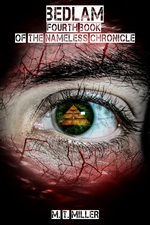
Ascent by M. T. Miller

AscentAscent: Second Book of the Nameless Chronicle

by M. T. Miller
Series: The Nameless Chronicle, #2

Kindle Edition, 316 pg.
2016

Read: September 3, 2016


Can you read this without having read Risen? Yeah, but it’d be better if you didn’t (and Risen is short enough that you might was well). I’m not sure how much time has passed since the last page of the first book, but we find Nameless pretty much how we left him — wandering along, on the verge of . . . whatever exactly would happen to him if he didn’t get more energy. Like before, almost as soon as he gets to town, he falls victim to a gang of sorts and is mugged. Of course, his first order of business (after recuperating from the beating) is revenge, which will give him the energy he needs to move around the Pyramid to search for the explanations he needs to understand his abilities, his nature and identity.

What’s the Pyramid, you ask? It’s a city in a giant 4-tiered structure (each tier housing a different caste). Nameless adopts a name, makes a little money on the lowest level — full of crime, poverty and menial labor — and buys himself access to the next level. Where he finds a new — and legal — way to use his fighting abilities to make money. Things go haywire from there.

There’s a lot more going on in this book than there was in its predecessor, Risen — if for no other reason than it’s almost 3 times as long. It’s still the same kind of book — full of violence, some pretty good fight scenes, and a post-apocalyptic culture that’s foreign, yet all-too familiar. There are many more characters, relating to Nameless in a variety of ways — friendship, camaraderie, betrayal, exploitation, to name a few.

The way things went in Book One, I assumed that we were going to learn Nameless’ origins, etc. over the course of a handful of books. Nope — we get almost every question we had about where he came from answered — and almost all of them are just dumped on us. There was no slow and steady learning here, just BAM! here are your answers. And it worked — much better than a slow reveal, a giant dropping of information (which I usually am opposed to) took care of everything (while still leaving me with almost as many questions as Nameless had).

I shouldn’t neglect to say that just because Nameless has almost all of his questions answered here, that he knows what to do with this information. I’m guessing part (or all of that) will be revealed in Book Three.

I don’t normally do this, but I while writing this I went back to my post about Risen and chuckled because what I said there as a lot like the next point on my outline: “My one complaint is length — just about everything is too short. The story is too short, most of the scenes are, too. But I’m pretty sure that’s just my wanting more for myself — to give us longer scenes would ruin the pacing, would mess with the way Miller’s constructing the series. And really, when you get down to it “I wanted more!” is more of a compliment than a complaint — but I’m calling it one nonetheless.” His scenes aren’t too short this time, but everything else I said there is still true. A lot of the action (especially the violence) is given to us in summary form — we see the “important” fights, the ones that shape the story, but the rest is given in something like a re-cap mode (ditto with the flirting, with his conversations with others, and so on). So clearly, this is the kind of thing that’s 1. Miller’s style and/or 2. The style of this series. Either are perfectly acceptable. And honestly? If he’d given us more of the fights, more about Nameless’ days in the new society he’d encountered, etc. I’d likely be complaining that he’s reveling in the violence, bogging down the story with the details. So what do I know?

Ascent is a book that kept you guessing and leaves you in a very different world than you thought you were in at the beginning — with a status quo that is so far from what it initially was that it’ll leave you reeling. Taut, well-paced, with some pretty good hand-to-hand combat scenes — and it won’t let you go until the very end. Miller’s really got something going here.

Disclaimer — I received a copy of this book from the author in exchange for my honest opinion. I appreciate that, Mr. Miller — and thanks for being so cool about me forgetting the date.

—–

3.5 Stars

Harry Potter and the Cursed Child by J.K. Rowling, John Tiffany & Jack Thorne

Harry Potter and the Cursed ChildHarry Potter and the Cursed Child – Parts One and Two (Special Rehearsal Edition)

by J.K. Rowling, John Tiffany & Jack Thorne
Series: Harry Potter, #8

Hardcover, 308 pg.
Scholastic, Inc., 2016
Read: September 2, 2016

I went into this with low expectations for a few reasons (negative buzz being one of many), and sadly had them all met — I don’t think anything were exceeded.

This is fan-fiction, pure and simple. Sure, it’s official fan-fiction written in conjunction with Rowling — but it’s not the same series, it doesn’t feel the same. It feels like someone’s trying to recapture what they had, in just a slightly different form. I’m fine with that — if people want to throw money at Rowling, Tiffany and Thorne for doing this? Let them. Let’s just not pretend it’s more than what it is.

The story primarily focuses on Harry and Ginny’s middle child, Albus. Albus is pretty uncomfortable living in the shadow of the Boy Who Lived — he doesn’t like the notoriety or pressure that comes with that territory. Which is absolutely understandable — especially now that he’s at Hogwarts, where Harry’s legend is strongest. Between that, and typical teenager strife with Dad leads Albus to take some really big risks with banned magical technology.

These risks center on time travel — and this is where it lost me. I just can’t stand the kind of stories where someone goes back in time with perfectly good intentions and messes things up, changing the future so much that it’s not recognizable. So then they (or someone else) have to go back in time again to prevent/minimize the damage. And magically, this second (or third) intervention restores everything back to the way it was before the time travelers left. Sure, this is a series in which magical things like that are clearly possible. But there’s possible and too-incredible. It almost doesn’t matter how good this story/execution was, I wouldn’t be crazy about it.

The writing was . . . okay. Nothing spectacular, nothing that had the same …”magic” as the other books in the series. It’s not as bad as many claim — but it’s not as good as others claim either. How some of this can be staged, I just can’t imagine. I’m not saying it can’t be — but wow, that’s a real technical challenge, I’d think.

There were some nice moments, some great fan-service stuff — and I’m very glad I got to meet Scorpius Malfoy. I’d rather spend time with him than any of the rest of the descendants of the original series, there’s something very cool about this kid. I should also mention that there’s some nice father-son moments with Harry and Albus.

On the whole, I’m glad I read this, but I really can’t get crazy about it.

—–

3 Stars

The Hidden Oracle by Rick Riordan

The Hidden OracleThe Hidden Oracle

by Rick Riordan
Series: Trials of Apollo, #1

Hardcover, 361 pg.
Disney-Hyperion, 2016

Read: August 31, 2016


Only 361 pages? Riordan is taking it easy on his readers. And maybe himself.

Anyway, following the events of The Heroes of Olympus, Zeus is a little displeased with Apollo and demonstrates this by turning him into a human teen (read: YA/MG novel star) and casting him to earth. He appears to be fully human — not even a demigod like Percy and the rest. Speaking of Percy, as soon as Apollo figures out what happened to him and where he is, he makes a beeline for Percy’s apartment to get help. Smart move. Percy gets him to Camp Halfblood and disappears back to NYC to do homework.

Once there, Apollo begins trying to figure out what quest he’ll have to do to return his status to quo. Along the way, he’ll make some friends, get a better perspective on himself and his offspring (yeah, that’s not weird), and maybe go through some of that personal growth. Note that I said, “some” personal growth and “better” perspective — that’s not saying much, basically Apollo comes across as a teenaged-Gilderoy Lockheart with a conscience. Instead of the large number of missions that we’ve become accustomed to in these books, there’s really just one (plus the series-arc mission) — such a nice change.

A lot of people from the Percy Jackson and The Heroes series are name-dropped and discussed, not to mention the few that we see — there’s even a nod to the Magnus Chase series — thankfully, my favorite is one of those who shows up in the flesh. There’s also a good amount of in-jokes to please the long-time fans. But readers new to this universe shouldn’t be put off by any of this — it’s absolutely approachable, maybe even moreso than anything since The Lightning Thief.

This is told in the typical breezy style that characterized non-adult mystery Riordan novels, but given the different protagonist, feels a little fresher. A little briefer, a little change of pace — still full of that Riordan magic. The Hidden Oracle is a sold first-entry in yet another adventure in this world. Give it a shot.

—–

3.5 Stars

The Key to the Coward’s Spell by Alex Bledsoe

The Key to the Coward's SpellThe Key to the Coward’s Spell

by Alex Bledsoe
Series: Eddie LaCrosse, #?

Kindle Edition, 27 pg.
Tor Books, 2016

Read: September 3, 2016


This over-before-you-realize-it short story is a welcome dip of the toe back into the world of Eddie LaCrosse, sword jockey (i.e., medieval private eye). Bledsoe’s Tufa series is one of the best things around, but man, I enjoy this series so much.

LaCrosse has been hired by a local blacksmith to find his kidnapped son. LaCrosse is sporting a broken arm, so he’s going to need a little more help than normal, Jane Argo, for one — and some new faces, too. There’s really not a lot to say, here — half of the action takes place before the story starts. LaCrosse gets a little more intel, and then jumps into action.

The action is brief and to the point — with a nice twist or two along the way. Nothing special, but it’s a good couple of sequences. And a brief reminder that no matter what you dress it up in — modern time/tech/clothing, generic fantasy tropes, SF, whatever — there are some forms of evil that transcend those details and are just evil that need to be fought in whatever little way we can.

Yeah, it was fun to spend some time in this world and with LaCrosse and everyone. But man, just as you get into it, the story’s over. Just not enough to really satisfy, but it was a fun taste. I don’t know that this is a good intro to the character (it might be), but it’s a good reminder for those who’ve met him before that they want to read more about him.

—–

3 Stars

The Shadow Bearers on Inkshares

Friend of the blog, Jayme Beddingfield, and her co-writer, Rebecca Clark have a neat looking novel they’re trying to get published. The Shadow Bearers — an expansion of a short-story they co-wrote — is up for funding on Inkshares.

Countless Huditra villages demolished by a darkness spreading throughout the lands. Thousands slain by the falling shadows. Hate looms over the forgotten lands like heavy fog stifling the little life that’s left. Over the years the Nafarat have been casting their magic, destroying all that’s natural. The War From Nowhere forced those who’ve survived the initial attacks into hiding. Nothing alive was safe. Both Tag, the leader of the Nari, river, people and Athea, the future chief of Dagee, the tribe behind the mountains, are all that’s left standing of their kind. With their home grounds no longer safe Tag and Athea hit the traveler’s road, each with individual missions. When their paths cross, they reluctantly team up to seek the answers that will lead them to free the land of shadows.

Once they hit the magic number of 750 preorders, Inkshares will publish and distribute the novel — and if that’s not enough, they’re competing in the Inkshares/Geek & Sundry Fantasy Contest — which just puts the whole Inkshares thing into overdrive. Follow the project over on Inkshares to help them in the contest, and if you can spare a dime, preorder the novel. I bet you’ll (we’ll, actually) be glad you did.

Every Heart a Doorway by Seanan McGuire

Every Heart a DoorwayEvery Heart a Doorway

by Seanan McGuire
Series: Wayward Children, #1

Hardcover, 169 pg.
Tor.com, 2016

Read: April 16, 2016

“. . . we went through. We came out on this moor that seemed to go on forever, between the mountains and the angry sea. And that sky! I’d never seen so many stars before, or such a red, red moon. The door slammed shut behind us. We couldn’t have gone back if we’d wanted to — and we didn’t want to. We were twelve. We are going to have an adventure if it killed us.”

“Did you? asked Nancy. “Have an adventure, I mean?”

“Sure,” said Jack bleakly. “It didn’t even kill us. Not permanently anyway. But it changed everything.”

One of my favorite book bloggers to read (and not just because our tastes are similar) began his take on Every Heart a Doorway by saying:

Sometimes we either meet a book (or a novella, in this case,) that is precisely the right fit for your soul, (at the moment,) or just happens to be original enough right when you need it, that it fills your life and your mind with brightness and joy.

For me, this is one of those pieces. To muddy the waters even more, I’m an unabashed fan of the author and I’m likely to pick up all of her writings without even checking the subject matter because I simply trust the woman to steer me to any shore.

If I didn’t start off by quoting that, I’d end paraphrasing/plagiarizing it.

So here’s the deal in a world where portal fantasies are possible, and children all over the world are going through them — à la Lucy Pevensie et al., Dorothy Gale, September, Quentin Coldwater, Alice, Jason Walker, etc. — and, sadly (?) most of these children end up back home. Some of them are glad to be back in this world and want to put their adventures behind them — a lot of them don’t want to be here anymore and want to return to wherever it was they went. Both kinds of children have a hard time coping in this world and need help. Eleanor West’s Home for Wayward Children is for the latter kind.

Nancy is a girl recently returned, and is very different than the girl her parents have been missing. They want her fixed, they want their daughter back — not whoever this person is with different attitudes, actions, clothes, etc. — West doesn’t promise that (but she may have allowed them to think she’ll do that, just so she can help Nancy), but she can help Nancy adjust to this world. So she joins the small student body at the private school/treatment center. The last thing Nancy wants is to be fixed, to be that girl again — which just means she fits in here, with returned kids from all over the country, who’ve been in all sorts of worlds. As Nancy begins to understand the nature of these other worlds, the effects they have on children, and why many of them want to leave again, so do we.

It turns out, all of the residents of West’s Home are going to learn that you can have plenty of adventures here, too. And that’s all I’m going to say about that.

I really liked all of these children — the adults we met, too, actually — Jack in particular. But every one of them — even the less-than-nice ones — are great characters and I’d have gladly spent another 200 pages with them, easy.

The writing is incredible — not that I’ve ever had any real problems with McGuire before, but she kicked it up a notch here — and is writing a different kind of story than I’m used to, so she writes differently. This book took me longer to read than it should’ve, because I had to go back and reread several sentences/lines/paragraphs — not because I needed to read them again for clarification, but because they were so perfect, so quotable, so . . . something. I’m not going to start quoting beyond what I opened with, because I don’t know if I could stop — Laura got two of them I made notes about. You could literally be amused, melancholy, horrified, feeling whimsy, and nervous within a couple of paragraphs — only to turn the page and start all over again. Not because she was jerking you around or anything, it’s just that kind of story, that kind of playing with language, just that kind of broken reality.

McGuire gave us such a satisfying ending — complete, tidy, fitting, bittersweet, heartwarming — and then I read another paragraph or so, and it’s so much better (and all of the above to the next degree) once you got to the actual ending. Then I closed the book and I teared up a little — for no reason at all, really, but it felt really appropriate.

Can I say this is positively Gaiman-esque without making it sound like McGuire’s derivative in any way? I don’t want to even hint at suggesting that — but man, if you like Neil Gaiman’s stuff — get this. If you’ve ever read a portal fantasy and wondered what happened to the kids afterwards– get this. If you like things that are good, and don’t mind magic in your reading — get this.

—–

5 Stars

Page 41 of 47

Powered by WordPress & Theme by Anders Norén