Category: Mystery/Detective Fiction/Crime Fiction/Thriller Page 97 of 154

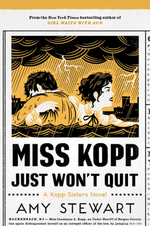
Miss Kopp Just Won’t Quit by Amy Stewart: Deputy Kopp faces her biggest challenges yet — a new Sheriff and an Uncertain Future

Miss Kopp Just Won't QuitMiss Kopp Just Won’t Quit

by Amy Stewart
Series: The Kopp Sisters, #4

eARC, 320pg.
Houghton Mifflin Harcourt, 2018
Read: August 8 – 9, 2018

So it’s been roughly a year for Constance Kopp working as the ladies’ matron for the Bergon County Jail. In that time she has investigated crimes, tracked down murderers, sought justice for women of all walks of life, and put her life on the line more than a few times. She’s gained nationwide notoriety, and caused more than a few scandals at home. About now, some of those scandals are coming back and are in the forefront of local elections.

Because of New Jersey law, Sheriff Heath, Constance’s boss and chief defender, cannot run for another term of office without taking one off — so no matter what, after Election Day, Constance will have a new boss. Heath’s former Sheriff is running for the position again, and is the expected winner. He finds the idea of a female deputy silly, and while he won’t take Constance seriously, he’ll probably leave her alone. His opponent is a current detective in the Prosecutor’s office who has been opposing Constance’s position and person since Day 1, he’s essentially running a campaign against Heath (even if Heath isn’t the opponent), and Constance is the easiest way to do that. Clearly, the future isn’t bright for Deputy Kopp.

While this is going on, Constance makes a couple more headlines — she runs down a burglar single-handedly, she jumps into a river to apprehend a potential escapee under their custody when another deputy is injured. Constance has to take a woman to an insane asylum, after her husband and doctor get a judge to commit her for a while. This isn’t the first time this has happened to the woman, and it seems clear to Constance that this woman is as sane as anyone. So Constance attempts to find out what’s behind this commitment so she can free this woman. She’s very aware of the trouble that this could cause for herself and for Sheriff Heath, she tries to do this under the radar. Under the radar isn’t something that comes naturally to her, and her results aren’t stellar (but better than one would expect).

The story was a bit flat, honestly. A lot of things seemed to be foregone conclusions (not necessarily the way that various characters saw them working, either). The one case that she really gets herself into is really pretty tidy and doesn’t take a lot of effort — although she does take plenty of risks. So really, the novel isn’t about Constance sinking her teeth into a case, into helping a woman through some sort of problem, or any of the usual things. This is primarily about Constance worrying that she’ll do something to jeopardize Sheriff Heath’s Congressional campaign by giving his opponents something to harp on, while contemplating her future in the jail under the upcoming term of office for either candidate. Which is fine, really — it’s just not what I’ve come to expect from these books — I expected the case of the poor committed woman to take the bulk of the attention, so the problem is my own. But it comes from being conditioned by the previous books.

Constance’s sisters have a background role in this book — Fleurette in particular, she’s around frequently, but she plays a very small role. I appreciate that she seemed to have her head on straight and wasn’t the cause for trouble (inadvertently or purposely). Norma seemed to primarily be a conduit for comic relief in this novel. But it never feels right to laugh at her, she’s the most practical, she’s the only realist in the family — it’s her blood, sweat and tears that’s kept the family going. On the other hand, her obsessive nature does lead her into some strange preoccupations.

This is not to say it’s a bad book — Stewart is probably incapable of writing a bad book. Miss Kopp Just Won’t Quit feels very different than the others in the series (although, really, each has felt different than the others), and it left me feeling dissatisfied. Still, it was an entertaining and compelling read. The ending is likely the best the series has had thus far — we just have to go through some meandering passages, and some dark times for our favorite Deputy before we get to it. I don’t know what comes next for Constance Kopp (I’m deliberately not consulting anything to tell me, either) — but it’s going to be very interesting to see what Stewart does next.

Disclaimer: I received this eARC from Houghton Mifflin Harcourt via NetGalley in exchange for this post — thanks to both for this.

—–

3.5 Stars

A Few Quick Questions With…Nick Kolakowski

Little backstory to this Q&A, in my never-ceasing attempts to get organized, I’ve started noting when a book post is due, what I’m doing associated with it, etc on my reading log (nothing special, just an up-to-current date Excel spreadsheet, with a couple of blank lines and then a list of upcoming reads). I’d put a note on with Boise Longpig Hunting Club with the release date and a note “read early for Q&A.” Before I sent my list of Questions, I looked over my correspondence with Kolakowski and realized we hadn’t actually discussed it — thankfully, he was gracious enough to answer my questions (beer’s on me next time you’re in town) — and here they are.

Could you tell us a little about your “path to publication”? What got you into writing and what did you do to take it from an aspiration to a reality?
I’ve always wanted to be a writer. My love of crime fiction also started at a very young age, when my Dad gave me his yellowed copy of Chandler’s “Trouble Is My Business.” I’d written crime fiction since I was a teenager but I only got serious about producing a novel in my late 20s. I wrote three “trunk novels” before “A Brutal Bunch of Heartbroken Saps,” which was picked up by Shotgun Honey and published in 2017. Other novels followed.

I suspect my process mirrors that of other folks: you write a lot, query agents, send manuscripts around, and generally struggle in a very crowded market. And when you finally begin publishing books, that kicks off a whole new game: marketing, publicity, trying to get the word out. The grind never stops. Good thing it’s fun.

Why Boise, of all places? In the Acknowledgements you mention the time you’ve spent in Idaho — other than just soaking up the culture, what kind of research did you do? (I’ve got to say, as someone who’s lived most of his life in the Boise-area, you do a really good job of capturing the feel, the geography, etc. Just hopefully not the crime)
My wife was born and raised in Boise, and so I started going there with her, sometimes a couple times a year. She has friends and family all over the state, and so we spend a lot of time driving around. That’s the bulk of the research I did for the novel—with the exception of the book’s final act, which is set in a wilderness of my own invention, I don’t think there’s a location that isn’t grounded in reality. I’m sometimes startled by the changes when I come back every eight months or so—the money pouring into the state is producing seismic changes, especially in the Boise area.

I chose Boise because it’s not a place usually covered by crime fiction; I’m a little tired of novels always being set in New York, or Los Angeles, or Chicago. And for years, I’d wanted to write a thriller set in someplace more isolated and rural—which Idaho definitely provides, along with a unique texture all its own.

What’s the one (or two) book/movie/show in the last 5 years that made you say, “I wish I’d written that.”?
“Breaking Bad.” I can say that without putting too much thought into it. It’s a masterpiece.
(I might have to retire that question — between the answer, and the way you put it, I don’t know if that can be topped.)

I’ve often heard that writers (or artists in general) will forget hundreds of positive reviews but always remember the negative — what’s the worst thing that someone’s said about one of your books, and has it altered your approach to future books?

Ooof, that’s a tough one. My sense of humor is rather bleak, and at one point, an Amazon reviewer suggested that they “didn’t appreciate the crudeness and [my] choice of words at times.” And when I read that, I thought, “Well, okay, but you should have seen the first draft. That was even worse.” I do try to restrain myself a little bit more, at moments, because I realize that some readers might not appreciate when I go deliriously over-the-top.

The same goes with violence; I’m trying to be a little bit more judicious in my moments of kinetic action. If you structure it right, you can pack a lot of emotional and thematic “oomph” into just a single gunshot.

What’s next for Nick Kolakowski? (Bonus points if it involves anyone who survives Boise Longpig Hunting Club)
I’m actually writing the sequel to “Boise Longpig” right now! It’s called “Voodoo Potato,” and it’s set in New Orleans. It deals heavily with the privatization of public security, and the dangers that stem from that. When we were in New Orleans last, someone casually mentioned to us that it takes 20 minutes for the cops to arrive if you call 911, and that some local millionaire had set up a private security force in the French Quarter that can respond more quickly. Sounds like a potential Pandora’s Box to me.
Oh, that sounds great (the book, not the terrifying reality behind it).

Thanks for taking the time to answer these, and I hope that Boise Longpig Hunting Club finds all sorts of success!

Pub Day Post — Boise Longpig Hunting Club by Nick Kolokowski: A Gritty, Violent Visit to Idaho

Boise Longpig Hunting ClubBoise Longpig Hunting Club

by Nick Kolakowski

eARC, 320 pg.
Down & Out Books , 2018
Read: July 28, 2018
Jake Halligan is a bounty hunter — more in the Lori Anderson/JT mold, than a Stephanie Plum-type — in Boise, Idaho and the immediate environs. He’s got a kid, an interesting relationship with his daughter’s mother, and a sister that . . . well, you just have to meet her. But think Bubba Rogowski without the size and clinical diagnosis.

Jake’s a Vet, having served in some of the worst conditions Iraq has to offer. He’s smart, he’s careful — he has people he cares about, so he has to be — and he has a conscience. It doesn’t stop him from doing his job, but it can stop him from enjoying it. Early on in the novel, we find Jake after a rough week at work — and a less-than-friendly exchange with the local police — on the whole, his life is looking pretty good, even if Janine (his ex-wife, fiancé and mother of his child) made him pay a social call on some neighbors. When they get home, Jake finds a dead woman in his gun safe. This plunges Jake into a hunt for a killer — as well as an explanation. He’ll find both, and probably wish he didn’t. It’s a violent, nasty hunt full of crazy characters, drug dealers, Aryan assassins, corrupt police — and people who are even worse than them.

Along for the ride are Janine — I can’t say enough about Janine as a character. From her attitude towards a house without books, to her hidden strength and anxieties — and all points in between. Then there’s Frankie, his sister — she’s cocky, funny, and vicious — she’s the biggest gun dealer in Idaho, not even close to legal, and the law can’t touch her. The law can’t even find her. She’s surrounded by associates/employees who are almost as colorful as she is (some even more so) — and is definitely the person you want at your side (or back) in a firefight.

Which is good — because they’re going to find themselves in a few.

Kolakowski has a great way with his characters — they’re real, they’re human — and they’re larger than life in a way that you’ll absolutely buy, as well as enjoy. When the action starts, it is gripping and exciting — you’ll keep turning pages. When there’s a lull in the action, you can bask in the character moments. I’m not really sure what else can I say beyond that. This is the whole package, you get to spend time with interesting people being interesting, and when they take a break from that, it’s because fists or bullets are flying — or maybe something explodes.

My one gripe — and it’s not much of one, before we get back to me saying nice things. The ending is abrupt. I’m not sure if I can think of a well-known book/movie to compare it to. You’re just reading along, hoping that Jake, Frankie, Janine and the rest survive this mess and then before you really realize what happened, it’s over. You know who survives — and who doesn’t — and the book ends with very little wrap-up (actually the wrap up happens before the ending — that remark will make sense when you read it). Kolakowski had a story to tell and he didn’t drag out the ending, much like his protagonist would approach things, I expect. He got the job done and moved on. I would’ve preferred a little more time after the main events are over — there are things I want to know about the immediate aftermath. There aren’t loose ends left untied, I’d just like to see what they look like after they’re taken care of. You can make a strong case that this is the way to end a book — when things are done.

It’s not often that I can evaluate an author’s use of geography — I know that Robert B. Parker and Dennis Lehane have tweaked Boston, I understand that Butcher goofs re: Chicago’s neighborhoods, etc. but I don’t know that reading the books, I learn that later. It’s rare when I’ve been somewhere a book has been set — a little bit with the Mercy Thompson books (but I’m better at noting pronunciation on the audiobooks that no resident would recognize), I noted that Wesley Chu fumbled a smidge Eastern Oregon in the third Tao book, and that Marilynne Robinson’s Housekeeping was creative with the facts, etc. But by and large, this book takes place in the area I’ve lived in most of my life, so I feel that I can actually comment. — and Kolakowski nailed it. Not just the details, but he’s got the feel, he’s got the atmosphere, the attitude toward change and the out-of-state money that’s bringing the change. he’s changed business names and whatnot, but I can still recognize them — I love seeing this kind of detail brought to life. I’m trusting that his depiction of local crime is hyperbolic, however.

I’m a little worried that it’s as accurate as the rest, actually . . . but we’ll move on.

There’s a visceral feel to this novel and these characters — people in places most don’t think about showing skills, interests, and circumstances that you don’t normally associate with that area. Just a guy trying to make a decent life for his family and himself, who finds himself in dangerous situations. I couldn’t help but think of Jason Miller’s Slim in Little Egypt series while reading his. Jake’s far more capable than Slim, and is far less likely to end up on the wrong end of a beating. But there’s a very similar ethos in the books, and fans of one should grab the other right away.

I’m not going to belabor the point any more, I think it’s clear that I enjoyed the heck out of this — it’s fast, it’s energetic, it’s fun. Go grab a copy of it.

Disclaimer: This book was provided to me by the author in exchange for my honest opinion, which I greatly appreciate.

—–

4 Stars

BOOK BLITZ: The Ephemeral File by Henry Hoffman

 photo The Ephemeral File_zpsdzkveigx.jpg

Adam Fraley Mystery Series
Mystery
Date Published: July 2018
Publisher: Melange Books
 
 photo add-to-goodreads-button_zpsc7b3c634.png
What begins as a simple lost love case for private investigator Adam Fraley quickly escalates into something of far greater magnitude during the course of his investigation. Not only is it a potential felony he stumbles across but one of the rarest in the catalog of crimes, all due to a critical piece of information having been withheld by his client, a terminally ill World War II vet. The job eventually takes Fraley to remote stretches of Florida’s Withlacoochee River and events that occurred over a half century ago. At the center of the case are teenage twin sisters, Staci and Kati Carew, whose conflicting friendships, loves, and ambitions rise far above normal sibling rivalry, ultimately leading to a grievous injustice and major cover-up.
 photo The Ephemeral File on tablet 2_zpsj3ut2tve.jpg
Excerpt
 As he watched the scene unfold before them, with his daughter riding the shoulders of her teammates, Adam could not help but be reminded of another time and place long ago when a young girl stood with her arms raised in triumph, a time when first loves were forever, summers endless, and young lives full of promise; of a bridge over the Withlacoochee River and Kati Carew, the backflip girl, whose summer of life was never to be.
     Oh, Staci…if only it had been a thumbs-up you had giver you sister…
 photo The Ephemeral File print front and back_zps15ibctwq.jpg
About the Author

 photo The Ephemeral File Author Henry Hoffman_zpsdwllgbbu.jpg

Henry Hoffman is a former newspaper editor and public library director whose works have appeared in a variety of literary and trade publications. He is the author of the Adam Fraley Mystery Series and is a past recipient of the Florida Publishers Association’s Gold Medal Award for Florida Fiction.


Contact Links
Purchase Links
RABT Book Tours & PR

Ways to Die in Glasgow by Jay Stringer: Three distinct and entertaining voices take you on a tour of Glasgow’s underbelly

Ways to Die in GlasgowWays to Die in Glasgow

by Jay Stringer
Series: Sam Ireland Mysteries, #1

Kindle Edition, 289
Thomas & Mercer, 2015
Read: July 21 – 22, 2018

Inside the front door of the building, I checked the directory, looking to see which floor the firm was on, only to find that they used all of it. The recession hadn’t reached this far up the street. The reception area was decorated in muted shades of black and tan. Anything that didn’t share that colour scheme was made of glass. A woman who was far too young and far too skinny greeted me. She took my name and waved me into a large waiting area.

She didn’t whisper that she was a child slave or beg for help.

She didn’t ask if I could sneak her a cheeseburger.

So we are just dropped into the action here, no background, no setup, no idea who this guy narrating things is — the very definition of in media res, and, come to think of it — we are also dropped into the very definition of coitus interruptus. In this particular case the interruptus takes the form of a couple of guys trying to kill our narrator. Somehow, Mackie (the narrator) escapes — though injured — and seeks shelter at his Uncle’s place — which turns out to have been recently tossed by persons unknown (the people that came after Mackie?), and his Uncle Rab is nowhere to be found. Mackie gets patched up by his therapist and the two head out to search for Rab.

Once that’s underway, we jump back a couple of hours in time to meet our second narrator, Sam Ireland. Sam’s a newish Private Investigator who made a little splash in the news recently and is working enough to keep going, but not enough to pay rent on the office. So the office is now her apartment. It’s her father’s firm, but he’s in a retirement home and Sam’s trying to keep it alive — with a little help from her brother. Sam’s got an appointment with a potential new client, who insists on very strange meeting times (e.g., 11:23) — it’s the law office described in the quotation above. They’d read about her in the papers and wanted to hire her for some things, but first they want a test run — they’d like her to deliver some legal papers to a local celebrity author. As Sam says “…a Glasgow celebrity. . . is one way of saying dangerous.” He’s writing true crime memoirs now, and there’s a problem with his latest book so they need to serve him with papers — but can’t find him, can Sam? For the price they’re willing to pay, yes, yes she can. The celebrity’s name? Rab Anderson.You begin to see the fun here.

It turns out that our third narrator, DI Lambert, also has a vested interest in finding Rab. But there’s the tiny little thing called a job that is interfering. There’s a suspicious death that he really wants to write off as a suicide, but the guys from the Lab won’t let him. He also has connections to our other narrators. He’s a friend of Sam’s and will occasionally bend a rule or two to help her with some information. He’d also arrested Mackie some years back on a pretty serious charge.

The novel is told bouncing back and forth through each of these narrators (sometimes the same scene is retold from a different perspective) — there’s a little bit of shifting back and forth through time to keep everyone at about the same point, but it’s easy to follow. Each of these narrators has a great and distinctive voice — you really don’t need the chapters to tell you who is “speaking” you get it within a sentence (not that I mind the help). I could easily read an entire novel from one of their perspectives — Lambert’s wouldn’t be as entertaining as either Mackie’s or Sam’s, but it’d still hold up. Bringing these three voices — from radically different backgrounds, education, age, experience, vocation — but all representing Glasgow. Mackie’s a great, great character — he’s the first we get to know in this book, and in many ways, he’s the heart. But Sam’s the star — she’s stubborn, reckless, clever, and resourceful. That doesn’t quite make up for the fact that she’s a small woman with little ability to defend herself — but she frequently has her large brother along to offset that.

One of my favorite parts of John Wick was how we’re dropped into this extensive underground world with relationships, rules, alliances and whatnot — as the film goes on we grow to understand them. Something very similar is at work in this novel — we don’t have a point of entry character, really (Sam’s close), we have nothing really to get us oriented in this reality other than what happens when the characters interact and what we learn from that. This is a rich world full of many colorful, dangerous people. It’s not long before we move beyond the hunt for Rab and dive deep into the murky waters surrounding him, Mackie and Lambert — and hope that at least someone is able to survive before Sam gets drug under as well.

That metaphor may have gotten away from me. But oh well . . .

This is a violent book — make no mistake. It’s a visceral blood bath at times — and its disturbing. But honestly? The hard scene to get through had no blood, no guns, knives or anything. It was a chapter where a father thinks about the trouble his daughter is in and what he can do to help her — it’s a couple of pages long, helps build the tension, it deepens the mystery, and just breaks your heart. Give me a dozen bloody corpses any day over that.

If there’s one thing I’ve learned from Kate McCall and Sam Ireland, it’s that daughters should not take over their father’s PI business unless they’re ready to learn a lot about their father that they didn’t want to know. It’s possible that’s true for daughters taking over any business of their father’s — I’m not sure, I should probably read more about them, but I don’t recall a lot of novels being written about daughter’s taking over for their father’s CPA firm or pizza parlor or dry cleaning business. There’s a pretty big difference between these two ladies (there are plenty of similarities, now that I think about it, too). Kate is surrounded by oddballs, eccentrics, and actors up for anything who are generally good-natured and willing to help her. Sam is surrounded by people she can’t trust, people she shouldn’t trust, a brother who has to be harassed into helping her out, a maverick cop, and a whole lot of shady characters — all of whom (except the brother and probably the cop) would be just as likely to drop her in a grave as they would be to lend her a helping hand.*

I thoroughly enjoyed this book and am definitely coming back for more from Stringer. It’s twisty, it’s violent, it’s got a lot of heart, it’ll put a smile on your face and get you to come back for more. Check out this unique look into Glasgow.

* This isn’t to knock McCall & Co. — I actually rather enjoyed the book, and plan on reading the rest of the series soon. It was just a parallel I thought of when reading this.

—–

4 Stars

The Blue Kingfisher by Erica Wright: Kat Stone — and her wonderful wigs — are back for more danger

The Blue KingfisherThe Blue Kingfisher

by Erica Wright
Series: Kathleen Stone, #3
eARC, 320 pg.
Polis Books, 2018
Read: August 1, 2018

So, Kat Stone, private investigator, is trying something new — she’s being herself. No disguise, no wig, no fake name (well, most of the time). There’s no need, the person she was hiding from has found her. He hasn’t done anything about it — but there’s no need to go to extra effort. But she’s not used to just being Kat Stone anymore — and that’s going to take a little work.

One morning, Kat finds a body — a body in horrible shape in the shadow of the George Washington Bridge. While waiting for the police, she recognizes the body — the maintenance man from her apartment building, Tambo Campion. The police are quick to dismiss the death as a suicide, but Kat’s unconvinced. Why would someone trying to kill themselves miss the water so completely?

This, of course, isn’t enough. So she ignores paying customers for a bit to launch her own investigation, trying to find more evidence. She doesn’t necessarily have to find the murderer, she just needs more evidence to get anyone in the NYPD to take her seriously enough to investigate his death. She plunges into Tambo’s life — partially driven by guilt that she didn’t pay him enough attention in life. It turns out that Tambo is a kingfisher, someone who finds jobs for people who aren’t in the country legally or who are wanting to stay off-the-radar, for a fee. This alone provides several avenues of investigation. But there are others, too, don’t get me wrong. All of these take her into all sorts of corners of NYC society — and gives her an excuse to dabble in different identities.

The NYPD requirement of “more evidence” is a trigger of sorts for her. It reminds her of the constant refrain from her superiors during her undercover days at the NYPD. They always wanted more evidence — even when she becomes concerned for her own safety, they say she hasn’t done enough, she needs more evidence to bring down Salvatore Magrelli. Between the Magrelli knowing where she is now, and this requirement, Kat spends a lot of time ruminating on the times she felt most threatened by Magrelli — and the things she didn’t provide enough evidence on. While she has several other things going on in her life, these are the thoughts that dominate her attention.

As interesting as the murder case is, obviously, it’s the Magrelli (past and present) stories that provide the major emotional hook for this novel. Even while she’s meeting with success at Kat Stone, even when she finds evidence of a crime — multiple crimes, actually. She can’t get out of the shadow of her past or the threat of the present.

I failed to get around to reading the first book in this series, after reading The Granite Moth, which really bugs me, so I can’t really comment between the ties between it and this book, but I’m reasonably certain there are some. Characters from The Granite Moth show up here and events from it are discussed as well, which is always nice, too many PI novels ignore what happened before. I don’t know (but I can’t imagine) that too many people from The Blue Kingfisher will show up down the road, but I’ll be happy to see any of them that do. But several events from this book will show up soon.

I remembered liking Kat Stone – I didn’t remember how much or why I did, and I’m very glad I got to rediscover her. Kat is clever, very clever when she’s not distracted. She’s resourceful. She may not have the skills of Lori Anderson or even Charlie Fox when it comes to weapons or hand-to-hand, but she’s got a mental toughness that’s hard to beat. And I really hope to see how she moves forward — because there’s just no way that what comes next is going to look too much like what’s come before, and I’m very curious about that. The New York she travels in isn’t the one I’m used to seeing (it’s not so different that I don’t recognize it) in Crime Fiction, and the way she sees the world is a fresh perspective.

The writing in this one — and this is not a knock on The Granite Moth — feels more disciplined, the plot more controlled. I took it as a sign of growth, that whatever Wright intended to accomplish in this book was clear to her and she executed things to that end. I’m almost more curious about what she’ll do next than what Kat will do next. Almost.

This isn’t a criticism, this is more of a wonderment: There is a lot of time spent on Kat’s affection for New York City. Do people spend a lot of time doing that, really? Thinking about how much they love/appreciate the town they live in (assuming they do)? Her leaving town was brought up once — indirectly — but it wasn’t like anyone was really suggesting that to her — and even after she made it clear that it wouldn’t happen, there it is again, her love for NYC. I could see it fitting in if people were actively trying to get her to move, or if she’d just returned after some time away (on a job, in self-appointed exile, etc.) — but given her situation, it felt forced. Now, I liked the way she expressed it, and I can understand her affection (theoretically, anyway, I’ve never been there). It just seemed out-of-place and/or unnecessary.

This is a good, satisfying PI novel with a protagonist that you will definitely enjoy. Like its predecessor, it’s a decent jumping on point for a new reader, and a welcome return to the world for someone who’s met Kat before. I’m eagerly awaiting the next book in this series already.

Disclaimer: I received this eARC from Polis Books via NetGalley in exchange for this post — thanks to both for this.

—–

3.5 Stars

True Fiction by Lee Goldberg: A Writer on the Run

True FictionTrue Fiction

by Lee Goldberg
Series: Ian Ludlow Thrillers, #1

Kindle Edition, 248 pg.
Thomas & Mercer, 2018
Read: July 20 – 21, 2018

“Sorry I’m late,” Ian said. “I’ve been on the run all morning.”

It was a line worthy of Clint Straker and Ian knew it. He couldn’t stop being a writer, always thinking of the next line in one of his thrillers. But he was living a thriller now and it was no thrill at all.

This is one of those books that’s super easy to write about — if you like the premise of the book, you’ll like the book. It’s just that simple. The tricky part is finding someone who wouldn’t like this premise.

Ian Ludlow, television writer turned thriller novelist, can’t believe his eyes — a terrorist attack in Hawaii went exactly the way that he designed and he’s pretty sure that someone is trying to kill him. Ludlow was part of a group of writers (movie, TV, novelists) that came up with some scenarios for the CIA that terrorists might use, so the CIA could design counter-measures. This is a thing that actually happened (maybe still does) following 9/11, because writers have much better imaginations than government employees do. One of those scenarios is playing out in real life and Ludlow doesn’t know what to do. Clearly someone out there doesn’t want Ludlow spreading the word that he’s the source for this attack.

Before he realizes what’s happening, Ludlow is running for his life and has dragged Margo along with him. Margo’s a dog-sitter, house-sitter, aspiring musician, and occasionally drives authors visiting Seattle to their signings. That’s how this poor girl gets sucked into Ludlow’s mess — she saves his life (and then he returns the favor), dooming her to having to run with him.

Add in some over-the-top villains (I hope, see below), and Goldberg’s signature wit and solid writing, and you’ve got yourself a winner.

This is a fast fun ride featuring about the most unlikely of all thriller protagonists. Ian Ludlow isn’t really in any kind of shape; he has no skills with hand-to-hand combat, cars, or weapons — his people skills are suspect, really; all he has going for him is a pretty agile mind. Margo’s a little better off, but not much. They quickly run to the home of one of Ian’s friends who lives off of the grid and is paranoid enough he’ll believe their story. Which may not really be the strongest of qualifications, but they can’t afford to be choosy. The three of them will have to figure out a way to survive — and possibly stop whoever it was behind the attack.

Does anyone else remember Condorman? The Disney film about a comic book writer/artist who accidentally (very accidentally) becomes a super-spy? I was 7 or 8 when it came out and loved it. Anyway, I had a flash-back to that when Ludlow stumbles his way into taking out one of the many assassins that come after him — one of the many times I had an honest audible response to this book (not a book I recommend reading in an ICU ward, for what it’s worth, people tend not to like noises there).

Now, I called the villains over-the-top. I’m not really sure they are — they seem over the top, but there’s a little part of me wonders how hard it really would be for someone to pull off something like this. John Rogers, of Leverage, frequently talked about how some of their over-the-top bad guys were watered down versions of the real thing (because no one would believe the real thing). Take my word for it, I don’t have time to track him down saying it. Let’s put it this way — they’re perfect for this book, and like just about every thriller villain ever, it’s best that they stay inside the book.

While he’s telling a very fun story, Goldberg takes a little bit of time to satirize thrillers, thriller writings, and thriller heroes — I loved every bit of that. It helps that Goldberg writes and reads the same books he’s satirizing, so you know he does it with love and honesty. Some of the excerpts from Ludlow’s books are just awful, it must’ve been hard to write (but so much fun). Ditto for the TV shows that Ian’s friend Ronnie starred in, I really hope that those are things that Goldberg made up for this book (and fear they aren’t).

This feels like Goldberg and Evanovich’s Fox & O’Hare books, or maybe The Man with the Iron-On Badge (which features a protagonist only slightly more likely than Ian) — not his more serious work like King City. The story moves quickly, deftly and will leave you smiling — I can’t imagine Goldberg writing a disappointing book at this point, I just don’t think he can. Pick this up, you will be entertained.

—–

4 Stars

Colorblind by Reed Farrel Coleman: Jesse Stone is Clean, Sober and in Dire Straits

ColorblindRobert B. Parker’s Colorblind

by Reed Farrel Coleman
Series: Jesse Stone, #17

eARC, 368 pg.
G. P. Putnam’s Sons, 2018
Read: July 18, 2018

This is Coleman’s fifth Jesse Stone novel, the seventeenth in the series overall and Coleman has really put his stamp on the character here. He’s made the series his own already, adding depth and shades of color to characters that’ve been around for years, don’t get me wrong. But everything he’s done could be changed, dropped, or ignored in the next — like an old Star Trek or Columbo episode. But following up from the closing pages of The Hangman’s Sonnet, in Colorblind he’s enacted permanent change on Jesse — yeah, things might not go smoothly from this point — he may stumble. But things won’t be the same — cannot be the same without some sort of Star Wars Expanded Universe level retcon. But I’m getting ahead of myself.

First we need to start with the crime part of the novel — it’s ostensibly what people are buying this for, and the novel’s focus. I can absolutely see this happening in Real Life ™ — a white supremacist group from New York is attacking mixed race couples (and by “mixed,” I obviously mean one white person and one person from another race — they wouldn’t care if an Asian man and a Hispanic woman were together) and spreading propaganda in Paradise, of all places. There’s a reason Paradise was chosen — several, actually, and it actually makes sense in context — it’s not just a convenient way to get it into a Jesse Stone novel. Only one of the crimes involved is technically something that Jesse is supposed to be investigating.

Once one of his officers becomes embroiled in this series of crimes — and the possible target of an elaborate frame job — Jesse stops really caring about things like jurisdictions, and will stop at nothing to find the truth. If there’s a connection between the different crimes, he’ll find it. The question he has no answer to is: for what end? Why are these people in Paradise? What do they have to gain from framing his officer?

Yes, certain elements of this story stretch credulity a bit — but in context it absolutely works. And while I say something stretches credulity, I can’t help but wonder if it really does. The actions of this particular supremacist group might not be that much different from the dreams of too many. Also, the race-based crimes, the murders, the vandalism — everything that Paradise or Massachusetts can prosecute people for — are not the biggest evil perpetrated by the members of that group. There’s a deeper darkness working here, something that people with radically different views can also perpetrate — Coleman could’ve gone the easy route and made it all about “Them,” but he points at something that everyone can and should recoil from.

While Jesse works to prevent things from getting out of hand in Paradise, he is struggling to prevent himself from doing what he’s so often done before — retreat to the bottle. He has several reasons to, several excuses to — and decades of experience telling him to do so. Fresh (Very, very fresh) off a stint at rehab, Jesse starts attending AA meetings (in Boston, nothing local that could cause problems for himself or anyone else in the meeting). I absolutely loved this part of the book — I think Coleman’s treatment of Jesse’s drinking (and his various attempts to limit/stop it) has been so much better, realistic and helpful than anything that came before. Colorblind takes that another step up, and sets the character on a path that he needs to be on. Jesse’s not a rock, but he’s working on becoming one when it comes to this addiction. I don’t know (don’t want to know) where Coleman is going with this — but I love it. Character growth/development, an actual healthy approach, and Coleman’s own stamp on the series. Even if Jesse relapses in the future, he’s actually been sober (not just taken a break from drinking) — I love it (have I mentioned that?). It may have been a little too on-the-nose to have Jesse’s new AA friend be named Bill, but, it made me smile.

As for the regulars — we’ve got some good use of Healy (retirement can’t stop him!); Lundquist is settling in nicely to this world (very glad about that, I’ve liked him since his intro back that other Parker series, whatever it was called); Molly was outstanding (it’s hard to mis-write Molly, but it’s very nice when it’s done correctly); and Suit is still the guy you want riding shotgun when things get harry (ignoring the fact that someone else was actually carrying the shotgun when it came to it — it’s a metaphor, folks!). Surprisingly enough, given the B-Story, Dix doesn’t make an appearance — but Jesse can’t stop thinking about him, so he’s here, he’s just “offscreen.” That was a nice touch (and hopefully not too much of a spoiler), it’d have been very easy to have almost as much Dix in this book as Jesse. Coleman has not only got the original cast of characters done well, he’s introduced a few of his own regulars and has merged them into this world well (e.g., Mayor Walker, Monty Bernstein). And it’s not just characters he’s blending, this book is full (not overstuffed) of call-backs to the oldest Stone novels as well as Coleman’s — this universe is alive and well and whole.

As far as the writing — it’s Reed Farrel Coleman, I really don’t need to say anything else. I will say a little bit, though, he balances the various stories and tones of these stories well — the book feels like a natural outgrowth of every book that came before, however minor the stylistic choices and depth have changed over the last few years. Parker could have written this. I don’t think (especially in the latter years) he would have, but he could have. Yet, it’s undeniably a Coleman book. It’s impressive the way that Coleman can do this (see almost everyone that’s tried a Bond novel [honestly haven’t tried one in years, maybe someone has], or Robert Goldsborough to see that not everyone is capable of it). There is one moment, I thought, that Coleman faltered a bit and got into some pretty heavy editorializing — if this was a first person book, it would have worked; or if he had been obviously channeling one of the characters, I wouldn’t have said anything; but when your omniscient third-person narrator gets that opinionated, it’s not good.

A solid crime story that resonates near the too-close-for-comfort zone given the cultural events (which probably is how some people felt with 1970’s Parker), some great character development — and plenty of fodder for Coleman’s next (I ignored one storyline above because I don’t think I can talk about it without ruining it). This is a must for Jesse Stone fans and a decent entry point for new readers, too — it’ll get you to go back and read at least a few older books (I’m more than willing to help a new reader with an “Essential Jesse Stone” reading list — just let me know). Give this one a look folks, it deserves it.

Disclaimer: I received this eARC from Putnam Books via NetGalley in exchange for this post — thanks to both for this.

—–

4 1/2 Stars

Pub Day Repost: Rescued by David Rosenfelt: A tale of self-defense, an old flame and a truckfull of dogs

RescuedRescued

by David Rosenfelt
Series: Andy Carpenter, #17
eARC, 304 pg.
Minotaur Books, 2018
Read: May 4, 2018

At an early age, Andy Carpenter discovered that he couldn’t hit a curve-ball and therefore had to give up on his dreams of playing in the majors and fall back to following in his father’s footsteps and becoming a lawyer. His father, a lifelong prosecuting attorney, probably wished for something else, but for the many people that he’s defended in court, they wouldn’t have it another way.

This is the seventeenth novel in this series — I’ve talked here about nine of the previous sixteen. There’s part of me wondering just what I could possibly have to say about this one that I haven’t said at least once before.

Andy Carpenter is called to a nearby rest area — a truck containing sixty-one dogs was discovered with the driver shot. Andy and Willie were called out to help the police retrieve the dogs and care for them. The police are really not happy to see him there — Andy Carpenter at a crime scene? Not a welcome sight. But then he’s called away, there’s a prospective new client waiting for him at home.

Not that surprisingly, the potential client was also at that rest area earlier in the day. He actually tells Andy that he shot the driver — in self-defense, mind you. Sure, there’s a history between the two — Kramer (the client) had assaulted the victim and threatened to kill him, in fact. But that was years ago, and he had no current reason to. He just needs some help with the inevitable arrest. Andy believes him — he has to. Kramer is Laurie’s ex and she vouches for him — so much so that Andy pretty much has to take the case for her sake.

Honestly, Andy really isn’t that interested in helping tall, hunky and dangerous Kramer — ex-Military, ex-police, ex-licensed investigator. But it’s not long before he starts to believe that there’s something more afoot. And what was the deal with all the dogs?

All the regulars are along for this ride — Pete Stanton brings the law and order, we get a little more about the fun side of Hike that was introduced in the last book, Sam and his hacking crew dig up plenty of information, Marcus is his typical imposing self, Tara is as loyal as ever — and Andy gets a lot of courtroom time in. There’s a new prosecuting attorney for him to face off against — I liked her, and would like to see her against Andy again.

I don’t think it’s much of a spoiler here, because it’s pretty much the default in this series, but there’s a conspiracy behind the murder and they men behind it have decided to frame Kramer. This is one of the better — or at least one of the more grounded — conspiracies featured in these books. Up to a point, some of it was pretty hard to swallow — it just went a little over the top for my taste (but many of them do in this series). Also, this one features the best code names this side of Reservoir Dogs. Still, it was one of the more clever solutions that we’ve been treated to lately.

A thought about the series as a whole at this point: I would appreciate it if Rosenfelt would shake things up a little bit — I’m not talking about killing Hike or splitting up with Laurie or anything — just dial down the super-criminals a bit, maybe spend some more time with the client again. But there’s little reason for him to do that — the series moves like clockwork and is reliably entertaining. I only say this because I’m a fan — Rosenfelt is in danger of becoming a parody of himself (at worst) or just putting out cookie-cutter books (at best), I don’t want Andy Carpenter to become a Stephanie Plum.

This is not to say that I didn’t enjoy the book — because I did. Andy, Sam, Pete, Vince, Laurie, Tara and the rest are old friends that I enjoy getting together with every few months. Rosenfelt’s latest demonstrates what’s been true for years — this series is at the point where you can reliably count on each book for an entertaining read, a puzzling mystery, some good comic moments, a nice dog or two and maybe even a tug on the heart strings. They’re still charming enough to win over a new reader (and any of the books serve just fine as entry points) as well as satisfying the long-term reader. Rescued delivered just what I expected and left me satisfied — satisfied and ready to read number 18.

Disclaimer: I received this eARC from St. Martin’s Press via NetGalley in exchange for this post — thanks to both for this, it was a real pleasure.

—–

3.5 Stars

The Death Pictures by Simon Hall: A Solid Sequel featuring a Procedural and a Puzzle

The Death PicturesThe Death Pictures

by Simon Hall
Series: The TV Detective, #2

Kindle Edition, 282 pg.
Fahrenheit Press, 2018
Read: July 10 – 11, 2018
So here we are a few months after the events of The TV Detective, and while Dan Groves, TV reporter, and DCI Adam Breen aren’t working together any more, their friendship has grown and both of the careers are improving from their collaboration. So when there’s a serial rapist on the loose — one who made a point of leaving a calling card at the crime scenes to get public attention — both of their bosses are interested in them renewing their partnership (even if no one ever gets to hear about his calling card).

Around the same time, there’s a famous artist dying of cancer who is using his impending death as a launching pad for a contest of sorts — it raises money for charity, and raises his public profile a bit, too (not that it needed much). Dan has been tapped by his producer and the artist’s wife to help with the final part of the contest, and to do his final interview — most to be aired upon his death. This is so far from the rape case that it seems odd to spend time on it — until the artist dies under mysterious circumstances. A murder inquiry into a celebrity’s death obviously gets the police’s and public’s attention — although it’s really seen as more of a distraction from protecting women who are prospective targets of the rapist by Adam and his team. For the most part at this point, Adam and Dan tackle the murder investigation and his team handle the rapes, and Dan pretty much only covers the case as a reporter (with an inside track, of course), but not as an investigator.

Arrests are made pretty early on in both cases — it’s in the aftermath of the murder investigation and the contest that the latter part of the novel focuses on. The puzzle’s solution is clever, but the reader can see it coming (we do have a little more information than all the characters), but that only adds to the sense of drama leading up to the Reveal. I thoroughly enjoyed watching Dan through this story — both his official work as a reporter or with the police and his unofficial personal obsession with the puzzle.

As for the rape story? I don’t mean to sound cold, but there was something very cookie-cutter about the motivation and perpetrator. Horrible, yes; disturbing, yes, but nothing that hasn’t been on Law & Order: SVU an estimated 3,709 times — I’m not saying badly written or boring, just something I’ve seen before. But when Adam gets him in the interview room and he starts laying out his defense? That was utterly chilling. As I write this, I imagine the accused’s approach is not completely novel in Crime Fiction, but man . . . the way that Hall depicts this guy? Chilling.

Dan’s frequent work on the contest is reminiscent of his search for the Ted Hughes Memorial in The TV Detective, but is obviously tied more closely to the plot of this novel. I don’t recall another series doing something like this in book after book — I hope Hall continues it.

There’s something that happened to Dan in the past that was alluded to in the previous book and is talked around a good deal here. We’re not going to get more details on that in Book 3 (I bet), but I expect to see it wreak havoc on Dan’s life and various relationships soon. Similarly, there’s something that happens in this book to Adam — that will possibly do worse pretty soon. Both of these guys are ticking psychological bombs.

I have one gripe: the formatting. There are occasional — maybe even rare — white space breaks between sections of the story, but by and large they are conspicuously absent. Which is problematic when the perspective changes from character to character — what’s worse is when the perspective change introduces an entirely new character and you don’t know how this new name connects with anything. It honestly only caused a real problem for me once, but was frequently annoying.

I should stress when your complaint about a book has to do with Kindle layout (who knows what the paperback looks like), there’s a lot that’s working pretty well.

The Death Pictures is a solidly entertaining mystery novel that recaptures a lot of the high points of its predecessor, but isn’t just a repeat of it. This series has legs, that’s obvious, and I look forward to returning to it to see what happens next.

.

—–

3.5 Stars

Page 97 of 154

Powered by WordPress & Theme by Anders Norén