Category: Fiction Page 162 of 341

BOOK SPOTLIGHT: San Diego Dead by Mark Nolan

Today I’m pleased to welcome the Book Tour for San Diego Dead by Mark Nolan. Along with this spotlight post, I’ll be giving my take on the novel here in a bit. But let’s start by learning a little about this here book, okay?


Book Details:

Book Title: San Diego Dead by Mark Nolan
Release date: August 31, 2019
Format: Ebook/Paperback
Length: 348 pages

Book Blurb:

Danger awaits Marine-turned-lawyer Jake Wolfe on his vacation to sunny San Diego and Cabo San Lucas. There he finds sugary white sand beaches, warm turquoise water, boat trips among gray whales, and … cold blooded murder.

It was meant to be a relaxing holiday for Jake and his adopted war dog, Cody, but violence erupts when he crosses paths with a criminal cartel urgently seeking to reclaim a deadly package.

Jake learns the missing item is a threat to US citizens and vows to stop the cartel from possessing it, no matter what vigilante justice actions he might have to take.

Time is running out and thousands of innocent lives are at risk. Will the two combat veterans be able to retrieve the dangerous item before the killers do? The clock is ticking, but Jake hopes that if anybody can help find the package, it has to be his highly-trained and ultra-intelligent dog, Cody.

Find out what happens next. Start reading the latest Jake and Cody thriller right now and enjoy another fast-paced stand-alone story by author Mark Nolan.

About Mark Nolan:

Mark NolanMark Nolan has spent much of his life near the seashore. He loves dogs and has often been called a “dog whisperer.” These interests are reflected in his novels where the main character lives on a boat with his highly intelligent former war dog.


Social Networks:

Facebook ~ Twitter ~ Goodreads

Purchase Links:

Amazon UK ~ Amazon US

My thanks to damppebbles blog tours for the invitation to participate in this tour and the materials (including a copy of the novel) they provided.

Be Frank With Me by Julia Claiborne Johnson, Tavia Gilbert (Narrator): An Unusual Mother and Son are at the center of this charming family drama.

Be Frank With Me

Be Frank With Me

by Julia Claiborne Johnson, Tavia Gilbert (Narrator)

Unabridged Audiobook, 8 hrs, 37 mins.
Harper Audio, 2016

Read: January 16-22, 2020
Grab a copy from your local indie bookstore!


A few decades ago, M. M. Banning took the literary world by storm with her first (and, so far, only) novel, married a movie star just before his career died, and then vanished from the public eye. Her novel is still imposed upon students throughout the country/taught in High School.

Banning’s recently hit some financial woes and has reluctantly contracted with her publisher to produce a second novel. To help Banning, her editor sends his personal assistant, Alice, out to L.A. to live with her, digitize her pages, do some minor cleaning, and help out with Banning’s son, Frank.

Alice quickly learns that there’ll be no discussion of (much less seeing and/or digitizing) the book’s progress, but essentially she’ll be Frank’s caretaker, freeing Banning to work on the novel.

The thing is, Frank’s . . . um, a handful. The word “Autism” is never used (I’m 97% sure), nor is any other diagnostic term. But I’d be willing to bet he’s on the spectrum somewhere—think Don Tillman (from the Rosie books). He has a lack of affect, trouble sleeping, an almost encyclopedic knowledge of classic Hollywood films (1930s-60s, let’s say)—which is where all his slang and fashion sense comes from, an amazing memory for things outside of films, and no sense of humor. Frank’s social circle consists of his mother, his school’s secretary (he eats lunch in her office and talks movies with her), his therapist, and a piano teacher/handyman who sporadically appears at the house. How Banning made it through the first nine years of his life is beyond Alice’s comprehension, and she’s not sure how she’ll survive however long it’ll take Frank’s mother to write her book.

Banning herself is pretty socially awkward (whether this is due to constant exposure to Frank, hiding from the rabid public, or just the way she’s been her whole life) and rarely treats Alice like anything but a pest. This whole endeavor is a real trial for Alice, who handles it fairly well (better than I would have, I can say with a great deal of certainty).

The novel is essentially about Alice trying to navigate the mine-field that is dealing with Banning and struggling to connect with Frank and help him develop a social skill or three.

I enjoyed Frank’s character—he’s like Bernadette Fox without the dangerous wit (in a way, so is his mother) mixed with the aforementioned Don Tillman. Banning herself grates a little bit, but I’m almost positive she’s supposed to. Alice is a strong character, as well—she’s not sure what her role is supposed to be, but she keeps trying to do what’s needed. Her response to the imposed social isolation is both realistic, understandable and relatable. I really enjoyed spending time with Alice and Frank, particularly once Frank warmed a little to her.

There’s a good deal of foreshadowing throughout the book to a calamitous event, and once it happens the novel resolves fairly quickly. I don’t think the novel concludes as much as it stops, and that bothered me (it still does, actually)—I’d prefer a better sense of what will happen to any of the characters after the book ends (whether one day, one year, or a decade after—I’m clueless all around).

Gilbert’s narration was impressive—it’d be impressive if only for her delivery of Frank’s dialogue. She perfectly grasps his lack of affect, patterns (and speed) of speech, as well as the ineffable charm that’s part of his character.

Be Frank With Me is a charming novel that faltered a little at the end, but the pleasures of the journey was still worth the time. I’ll keep my eyes out for something else by both Johnson and Gilbert and will gladly give them another try. I expect most readers will enjoy their time with Frank and Alice (and many won’t agree with me about the ending).


3.5 Stars

2020 Library Love Challenge

This post contains an affiliate link. If you purchase from it, I will get a small commission at no additional cost to you. As always, opinions are my own.


The History of Tom Jones, a Foundling by Henry Fielding: BOOK I., ix.-Book II., iii.

After a imposed-break last week, we’re back with a double-length post.
Fridays with the Foundling

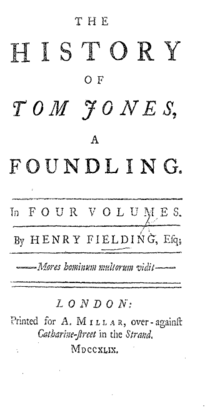
Tom Jones Original CoverInfants, it seems, are pretty dull. Dull enough that in a book calling itself a history of a person, we’re going to ignore that person for a while, because he’s just lying around in cribs, crying, and soiling clothes (I guess). It makes sense, because we’ve got to set up problems for him to deal with when he’s of age.

The problem in these chapters is represented by a Captain Blifil, his brother, a Doctor who had some strong feelings toward Mr. Allworthy’s sister:

The doctor found himself so agreeable to Miss Bridget, that he now began to lament an unfortunate Accident which had happened to him about ten Years before; namely, his Marriage with another Woman, who was not only still alive, but, what was worse, known to be so by Mr. Allworthy.

Therefore, in an act of logic that I don’t quite grasp, the Doctor introduces his brother to her for the purposes of marriage.

To deal plainly with the Reader, the Captain, ever since his Arrival, at least from the Moment his Brother had proposed the Match to him, long before he had discovered any flattering Symptoms in Miss Bridget, had been greatly enamoured; that is to say, of Mr. Allworthy’s House and Gardens, and of his Lands, Tenements, and Hereditaments; of all which the Captain was so passionately fond, that he would most probably have contracted Marriage with them, had he been obliged to have taken the Witch of Endor into the Bargain.

He’s clearly a real keeper, right? He does discover a flattering Symptom or two in Miss Bridget, and she’s smitten, too. They get married and soon produce a child—an heir for Mr. Allworthy. I predict this will become a problem for Tom.

By the way, we see him a little bit here—and he’s given a name! We learn that he’s named Thomas after Mr. Allworthy, who spends time with the tyke daily and defends his affection for the boy against Blifil’s antagonism toward Thomas. The child then promptly disappears, and we get some more speculation into his paternity.

The narrator takes a moment to comment on his method. He’s not going to get into every detail about Tom Jones’ life the same way:

When any extraordinary Scene presents itself (as we trust will often be the Case), we shall spare no Pains nor Paper to open it at large to our Reader; but if whole Years should pass without producing anything worthy his Notice, we shall not be afraid of a Chasm in our History; but shall hasten on to Matters of Consequence, and leave such Periods of Time totally unobserved…

My Reader then is not to be surprised, if, in the Course of this Work, he shall find some Chapters very short, and others altogether as long; some that contain only the Time of a single Day, and others that comprise Years; in a word, if my History sometimes seems to stand still, and sometimes to fly.

Once again, I love the narrator’s voice, particularly when the reader is being addressed directly. I’d like a little more to be going on in the book—but Fielding’s sentences are rambling and circuitous, I’ve got to expect his novel will, too. I’m willing to wait for something to happen, but I’ll enjoy the book more when it does.

EXCERPT: The Children of Never by Christian Warren Freed—The Grey Wanderer

The Grey Wanderer

Mist hovered over the near empty fields. Stands of cedar and black pine broke the monotony of what many considered the endless boredom of the grass plains. Pastures and farmlands stretched as far as a man might walk in a day and beyond. Folks here kept to themselves and preferred others to do the same.

Spring was just beginning, and the early bloom of wild flowers peppered the ground beneath the roiling mists. Tombstones and other crude burial markers filled the small field outside of the village of Fent. Generations were buried within the field’s confines, though modernity demanded fresh bodies be burned atop a pyre so that their ashes might get to the next realm quicker than the slow rot the earth offered.

Still, the old ways, however antiquated, remained strong in many of the older generations still toiling. Their reward, that final rest, had yet to come, leaving them in the unenviable position of becoming the stewards of what once was. A gloomy task on the best of days. Not all the dead were given the flame. Many continued to be thrown into the long, cold sleep of the ground.

Dawn was breaking, the first thin tendrils of pale light stretched across the darkened skies. Roosters crowed. Farmers rose and readied for the long day. Had any been in the fields, they might have caught a glimpse of an old man, crooked and dressed in faded grey robes, stalking down the dirt road leading to the cemetery. He carried a small lantern that swung with every step. The Grey Wanderer some named him. Others simply chose a more apt name: The Soul Stealer.

Whistling as he went, the Grey Wanderer sniffed the air for the scent of those freshly dead. Some whispered he was once a king of men. Others suggested he had been a sorcerer of great power who’d made a deal with fell powers. Most didn’t care; they avoided all mention of him. Wherever the Grey Wanderer went, bad things followed.

He paused at the cemetery gates and raised his lantern high. A wash of light fell over the tombstones, showing him what he’d come to find. Fresh earth cast over the recently deceased. His smile was thin and insidious. The Grey Wanderer began to whistle. It was a ghastly sound, unfit for mortal ears. A cry to the ones in the deep beyond whose very existence threatened the sanity of the masses.

Once he finished his task, the Grey Wanderer lowered his lantern and continued walking. He avoided passing through the sleepy village, choosing instead to disappear back into the mists of time and space. His work here was finished.

Read the rest in The Children of Never by Christian Warren Freed.

My thanks to damppebbles blog tours for the invitation to participate in this tour and the materials they provided.

BOOK SPOTLIGHT: The Children of Never by Christian Warren Freed

Today I welcome the Book Tour for The Children of Never by Christian Warren Freed. I didn’t have time to read it for the Tour, but it looked like the kind of thing I’d like to promote and many of my regulars might want to read. So, along with this spotlight post, I’ve got a nifty excerpt to whet your appetite here in a bit. But let’s start by learning a little about this here book, okay?


Book Details:

Book Title: The Children of Never by Christian Warren Freed
Release date: July 30, 2018
Format: Ebook/Paperback
Length: 342 pages

Book Blurb:

The war priests of Andrak have protected the world from the encroaching darkness for generations. Stewards of the Purifying Flame, the priests stand upon their castle walls each year for 100 days. Along with the best fighters, soldiers, and adventurers from across the lands, they repulse the Omegri invasions.

But their strength wanes and evil spreads.

Lizette awakens to a nightmare, for her daughter has been stolen during the night. When she goes to the Baron to petition aid, she learns that similar incidents are occurring across the duchy. Her daughter was just the beginning. Baron Einos of Fent is left with no choice but to summon the war priests.

Brother Quinlan is a haunted man. Last survivor of Castle Bendris, he now serves Andrak. Despite his flaws, the Lord General recognizes Quinlan as one of the best he has. Sending him to Fent is his best chance for finding the missing children and restoring order. Quinlan begins a quest that will tax his strength and threaten the foundations of his soul.

The Grey Wanderer stalks the lands, and where he goes, bad things follow. The dead rise and the Omegri launch a plan to stop time and overrun the world. The duchy of Fent is just the beginning.

The follow up to the L Ron Hubbard Writers of the Future award winning short: The Purifying Flame, the Children of Never is an all new novel set in a world of raw imagination. Get your copy today!

About Christian Warren Freed:

Christian Warren FreedChristian W. Freed was born in Buffalo, N.Y. more years ago than he would like to remember. After spending more than 20 years in the active duty US Army he has turned his talents to writing. Since retiring, he has gone on to publish over 20 military fantasy and science fiction novels, as well as his memoirs from his time in Iraq and Afghanistan, a children’s book, and a pair of how to books focused on indie authors and the decision making process for writing a book and what happens after it is published.

His first published book (Hammers in the Wind) has been the #1 free book on Kindle 4 times and he holds a fancy certificate from the L Ron Hubbard Writers of the Future Contest. Ok, so it was for 4th place in one quarter, but it’s still recognition from the largest fiction writing contest in the world. And no, he’s not a scientologist.

Passionate about history, he combines his knowledge of the past with modern military tactics to create an engaging, quasi-realistic world for the readers. He graduated from Campbell University with a degree in history and is pursuing a Masters of Arts degree in Digital Communications from the University of North Carolina at Chapel Hill.

He currently lives outside of Raleigh, N.C. and devotes his time to writing, his family, and their two Bernese Mountain Dogs. If you drive by you might just find him on the porch with a cigar in one hand and a pen in the other. You can find out more about his work by following him @ https://www.facebook.com/ChristianFreed or on Twitter @christianwfreed.

Social Networks:

Twitter ~ Facebook ~ Blog ~ Goodreads ~ Amazon

Purchase Links:

Amazon UK ~ Amazon US

My thanks to damppebbles blog tours for the invitation to participate in this tour and the materials (including a copy of the novel) they provided.

Stone Cold Magic by Jayne Faith, Amy Landon (Narrator): Meet The City of Trees’ Resident Demon Hunter

Stone Cold Magic

Stone Cold Magic

by Jayne Faith, Amy Landon (Narrator)
Series: Ella Grey, #1

Unabridged Audiobook, 8 hrs., 28 mins
Tantor Audio, 2017

Read: January 23-25, 2020

In 2001, a dimensional rift opens up in New York City, and all sorts of strange things come from out of it—demons, a virus that turns people into vampires, a zombie virus, and other assorted supernatural strangeness.

Thirty years later, Ella Gray is a Demon Patrol officer with modest magical ability. Her role is to keep her patrol area clean of minor demons that are little more than annoyances—there are more powerful officers in charge of taking down bigger threats. One day she and her partner try to take out some small demons only to find out there’s a much bigger and more powerful demon in the building, too. In the following fracas, Ella and her partner are mortally wounded. Her partner dies, and Ella does, too. But her death doesn’t stick and she wakes up in the morgue.

A few weeks later, she’s back to work—she’s having strange visions, has a new partner (with a mysterious past and more magical power than she’s ever seen), a supervisor that seems pretty antagonistic to her and, well…life has become stranger than she thought possible. She finds herself investigating what seems to be a gargoyle possessed by a demon and somehow the gargoyle has imprisoned a human inside it, too. (don’t worry if you can understand it, no one in the book can at first, either).

Ella enlists help from a very human PI with all sorts of nifty gadgets that can help on the supernatural front; a political activist always in search of a new cause to take up; her best friend, a pretty powerful mage; and a supernaturally-inclined mutt. No, really. The dog is a lot like Walt Longmire’s Dog, just with freaky eyes and an apparent talent for protecting Ella from magical attacks. (some anyway). Such things ought to be encouraged whenever they’re encountered, and I hope this will work in the dog’s favor.

The novel’s focus is setting up the world and looking at the tensions between various aspects of Ella’s life and the characters around her. Although Faith tells a pretty good story along the way, I just can’t help but think that it comes in second to setting up the overarching series stories.

I really enjoyed Faith’s take on vampirism and zombies. It’s a nice blend of vaguely-science-y with the supernatural. I have many questions (that I assume will be answered in the ensuing books) about the demons and magic—and just about everything that goes bump in the night, I guess—in this particular world, but initially I’m buying in

I’m not saying that Faith borrowed (intentionally, anyway) from other UF series, but I had an impulse throughout to say “Oh, she got X from Kim Harrison,” “And that bit is from Sarah Kuhn,” “Is that Butcher or Strout there?” and so on. If she did, more power to her—she picked some good influences—and she took those elements, shuffled them up and put her spin on them. If she didn’t, all the better—fans of the things I think were influences will find plenty to like here. My gut instinct is to say that Faith is a student of Urban Fantasy and has read widely within it so she can produce something that draws from the best. Ignore the voice of the cynic and enjoy this book.

To be honest, I wasn’t looking for a new UF series (I’m always open to one, however), but a friend at work emailed me, wondering if I was familiar with this Urban Fantasy series that appears to be set in Boise of all places. This piqued my interest, and as I’d just finished an audiobook, I figured I’d take this one out for a spin. Now, this may come as a surprise to you, but Boise (and the general area) isn’t exactly a popular setting for fiction. I can think of a tiny handful of books that have a character stepping foot in the town, but only two (this and Kolokowski’s Boise Longpig Hunting Club) that actually portray the city in a recognizable fashion. Faith clearly knows Boise—her use of local names and locations testifies to that, and for those familiar with the city, we can easily see the action and movement of characters in it. Which is an added bit of fun, if only for the novelty. This isn’t to say that people who don’t know Boise will be lost or won’t be able to enjoy it—it’s like any other novel set in a city that’s not commonly used. Who doesn’t like getting to see a novel set somewhere that’s not NYC, Washington DC, Chicago, LA, SF, etc? Briggs’ use of the Tri-Cities in Washington, Vaughn’s Denver, Carey’s Pemkowet, Michigan; Hearne’s (all-too-brief) use of Tempe, AZ, and, now, Faith’s use of Boise.

(If—and this is a big if—Jayne Faith happens to be reading this, I’d love the opportunity to ask you a few questions about your choice of—and use of—Boise. Feel free to drop me a line!)

Landon does a fine job with the narration. I can’t really think of much more to say—I didn’t hear anything remarkably good (nor, remarkably bad) Simply a strong, capable narration to help listeners to get invested into the characters and story.

I really enjoyed this introduction to the Ella and the rest, the magic and the world Faith has put them in. I have a pretty good idea where some of the stories she’s set up are going, and am looking forward to watching them develop. At the same time, I also look forward to Faith showing me that she has a better idea for them than I assume. It’s a solid Urban Fantasy story with an unconventional setting. You should give it a shot.


3.5 Stars
2020 Library Love Challenge

In Medias Res: A Beginning At The End by Mike Chen

As the title implies, I’m in the middle of this book, so this is not a review, just some thoughts mid-way through.

—–

A Beginning At The End

by Mike Chen

Book Blurb:

Six years after a global pandemic wiped out most of the planet’s population, the survivors are rebuilding the country, split between self-governing cities, hippie communes and wasteland gangs.

In postapocalyptic San Francisco, former pop star Moira has created a new identity to finally escape her past—until her domineering father launches a sweeping public search to track her down. Desperate for a fresh start herself, jaded event planner Krista navigates the world on behalf of those too traumatized to go outside, determined to help everyone move on—even if they don’t want to. Rob survived the catastrophe with his daughter, Sunny, but lost his wife. When strict government rules threaten to separate parent and child, Rob needs to prove himself worthy in the city’s eyes by connecting with people again.

Krista, Moira, Rob and Sunny are brought together by circumstance, and their lives begin to twine together. But when reports of another outbreak throw the fragile society into panic, the friends are forced to finally face everything that came before—and everything they still stand to lose. Because sometimes having one person is enough to keep the world going.

I’m a couple of chapters shy of the halfway point, but I’m pretty excited about this book and want to get something out there about it—also, I have to take a break because I forgot about a book tour I have next week, and I really should read that book first.

So, like last year’s Here and Now and Then, Chen uses SF trappings to tell the kind of story that you don’t normally associate with Science Fiction (especially if you’re an anti-genre fiction snob).

I’m a chapter or two past a Speed Dating scene. On the one hand, it’s like every other Speed Dating scene you’ve seen from TV or the movies and/or read before. On the other hand, this is after most of the population of the earth is gone and people are trying to rebuild a facsimile of their lives in the midst of tragedy, so you’ve got the awkwardness, the insanity of the whole speed dating thing, and people dealing with unspeakable trauma at the same time. Chen makes this feel incredibly familiar and incredibly alien (yet relatable) at the same time, mildly humorous and miserable, tinged with hope and despair. And that’s just one scene. The book is full of stuff like this.

At its core (I think), this is a novel about how our past defines us, even after the apocalypse. Two characters here want to redefine themselves from the pre-pandemic lives, and somehow still can’t (at least not totally). Two characters need to redefine themselves from their post-pandemic past, and can’t seem to find the will to. It’ll take no time at all before you’re invested in these characters—you’ll want what the former two want, and hope that the latter two can somehow make things work.

Also, you’ll find you have some pretty strong feelings about Moira’s father. And they won’t be at all positive. But that’s all I’m going to say about that.

I have a few ideas where the stories are going/may end up, yet I’m reasonably certain that Chen’s ideas are better. Regardless, these are all building toward a satisfying pay-off or three. Maybe late next week I’ll have a chance to talk about this more, but for now, let me say I’m digging this and expect that about 80% of the people who read this blog on a semi-regular basis will, too.

Pub Day Repost: When We Were Vikings by Andrew David MacDonald: A Contemporary Legend in the Making

When We Were Vikings

When We Were Vikings

by Andrew David MacDonald

eARC, 336 pg.
Gallery/Scout Press, 2020

Read: December 9-13, 2019
Grab a copy from your local indie bookstore!


We meet our protagonist, Zelda, as she turns 21. It’s a pretty big day for most Americans, and it certainly is for Zelda. Things are going well for her—she has a boyfriend, her meetings with her therapist are going well, the brother (Gert) she lives with is taking college classes as a way to make their lives better, and Zelda’s friend/Gert’s ex gave her an actual small sword.

Zelda, you see, is a major fan of Viking culture and wants to be a Viking hero—and this sword is another step on her way to becoming a Viking legend. She also was born on the Fetal Alcohol Spectrum—as she says her Mom accidentally poisoning her resulted in Zelda being short, with trouble sitting still and thinking.

She has a fantastic therapist, Dr. Laird, who helps both her and Gert (when Gert will let him) navigate her challenges and Gert’s own issues. He’s a few years older than his sister, and once their mother died (their father disappeared years prior to that), he took on the responsibility of taking care of her.

This is a good thing for Zelda, incidentally, they’d been placed with an Uncle after their mother’s death—and he’s about as worthless a character as you can imagine. Gert does some business with people he shouldn’t to get them out of that situation and into their own apartment. This comes back to haunt him around the time of her birthday and old debts and favors need repayment. Meanwhile, his ex had convinced him to take courses at a Community College and helped him get the funding to start.

Gert’s ex/Zelda’s sword provider is known as AK47, by the way. Which says a lot about their neighborhood, I think. She’s actually the moral center of this novel and provides most of the wisdom displayed (although Zelda is a close second on both fronts, especially with AK47’s help).

While Gert’s trying to improve their station in life, Zelda goes to classes at a community center with similarly-aged people with developmental disabilities There, in addition to spending time with friends (including her boyfriend), Zelda learns behavioral and life skills. The staff there are fantastic and really impressed me with the way they interacted with everyone.

Honestly, though the deck seems stacked against these two—they’re taking care of each other and making their way in the world. Things are going as well for them as they could realistically hope (not that Zelda’s great at realistic expectations, she’s convinced she’ll be a Viking legend, for example). Except for that thing I’d said earlier about old debts and favors. And the expenses related to Dr. Laird (even on a sliding scale) and other ways Gert has to take care of Zelda. Oh, and maybe school isn’t going too well, either.

Gert tries to insulate Zelda from all that, but it doesn’t go too well. Zelda doesn’t try to insulate Gert from the fact that she and her boyfriend want to progress their relationship to physical intimacy, but man, he wishes she would (and that she’d drop the idea in general. Spoiler: she doesn’t).

We watch Zelda navigate these changing times, while she deliberately tries to mature and take on added responsibilities to help Gert. And Gert’s life gets out of control.

There are threats of violence. Actual violence. Relationship troubles. A new job for Zelda. And pressures on the two siblings that test their bonds.

The attentive reader is always aware that Gert’s in trouble and that he’s not being all that honest with Zelda—don’t misunderstand me, he’s trying his best to take care of her, but he’s hiding things from her and taking advantage of the fact that she can’t understand everything that’s happening. AK47 is a great character and I wish we’d gotten more time with her—things would’ve gone much better if Gert had stuck with her and listened to her.

Zelda’s an unintentionally unreliable narrator (but man, she tries), and MacDonald does a wonderful job putting us in her head while she navigates these obstacles along the way to becoming a legend. Obviously, your appreciation for the novel will hinge on how much you relate to/connect with/root for/like Zelda. I didn’t really get invested in Zelda as a character until the last 15-20% of the book, despite being hooked almost instantly and enjoying the novel. I think if I’d become invested early on, I would be jumping up and down excited about it.

But, I didn’t. So all I can really say is that MacDonald did yeoman’s work here and I have nothing but respect for the voice and craft displayed here. But I’m not able to muster the excitement that I think this book just might deserve. Part of that might be because I felt that I was supposed to find a lot of this amusing (and it did have its moments), and it is marketed as humorous, but it felt too much like laughing at Zelda, not with her (not that MacDonald ever mocked her).

I can’t tell you why this really didn’t click for me, but I didn’t like it as much as I wanted to (or thought I should). I imagine that I’m going to be in the minority with this and that most readers will rave. I liked the characters, I liked the story, I admire the way MacDonald wrote this—capturing Zelda’s voice and thought-process in a way that is both sympathetic and realistic. It’s a good book, one that will earn fans by the truckload, I expect—if the story/characters sound interesting to you at all, go read it. You’ll probably like it. Do me a favor though, and come back and tell me why I’m wrong not to swoon.


3.5 Stars

Disclaimer: I received this eARC from Gallery, Pocket Books via NetGalley in exchange for this post—thanks to both for this opportunity.

This post contains an affiliate link. If you purchase from it, I will get a small commission at no additional cost to you. As always, opinions are my own.

Lost Hills by Lee Goldberg: A Dynamite Beginning to a New Series from One of the Most Reliable Scribes Around

Lost Hills

Lost Hills

by Lee Goldberg
Series: Eve Ronin, #1

Kindle Edition, 237 pg.
Thomas & Mercer, 2020

Read: January 23-25, 2019
Grab a copy from your local indie bookstore!

Mulholland Drive. It was an intersection that generated lots of confusion, and not only because of the nearly identical street names. It was also the intersection of two cities, three neighborhoods, two law enforcement jurisdictions, and on this hot, smoggy Thursday afternoon in December, life and death.

So begins Lee Goldberg’s new series—a story of a young, talented, fallible, inexperienced woman detective in the LA County Sheriff’s Department. Eve Ronin is in this position thanks to being in the wrong place at the right time, and getting herself plastered all over social media just when the Department needed any good publicity it could get. Capitalizing on this, the Sheriff puts her in the high-profile Robbery-Homicide Division where she faces a lot of sexist backlash—and some that’s not sexist, but based on the way she got the job and how unprepared she is for it. Still, Eve knows a good opportunity when she gets it and is determined to rise to the occasion, as hard as it will be.

That’s the novel (and probably the series) in a nutshell—everything else is just window dressing. But man, I tell you, it’s great window dressing.

First off, you’ve got this case. A single mother of two (no longer romantically involved with the man she’s living with, but unable to move out), her kids and their dog are missing. What’s present in their home is a lot of blood. I mean a lot. Enough that there’s little hope that any of them are still alive, but Eve can’t rule out the possibility. So she really has two investigations to get into—the multiple murder case, and a missing persons case. Given the grizzly nature of the crime scene, there’s a lot of public attention on this case, and a lot of pressure on the rookie detective. That there is enough for most novels, but we get more.

What I loved about this book (and, from what I hear in interviews, the series to come), is how it displays that everyone in the L.A.-area is in or adjacent to the entertainment industry. Eve’s mother and the probable victim are chasing stardom, the likely victim’s ex-boyfriend works on a film crew (as does his alibi). There are detectives shopping script ideas around, and clearly will jump on new “material.” You’d think that with the sheer number of police procedurals/PI novels set in LA that this would be well-trodden territory, but it really isn’t. How is that possible? I’m so glad that Goldberg committed to this idea.

At the end of the court was a poorly maintained, unfenced ranch home with two cars in the driveway— an old Ford Taurus with oxidized paint and a Nissan Sentra. A woman in her early thirties paced anxiously in front of the house.

“She’s keyed up,” Duncan said as Eve pulled up to the driveway. “You better talk to her, woman- to- woman.”

“Good idea, because you know we don’t even have to speak to each other,” Eve said, putting the car into park. “Our uteruses can communicate telepathically.”

“I think the correct term is ‘uteri.’”

But what makes this (and any series) work are the characters. Eve is a great character, while her mom was off chasing stardom (and primarily finding work as an extra), she did the heavy lifting when it came to raising her younger siblings. Now she’s taken that sense of responsibility to her career and those she comes into contact with.

Eve’s mom is still in pursuit of the Hollywood dream, if not for her (though that’d be her preference), than for Eve. When Eve shows up on TV being cornered by a reporter, Jen is more focused on how Eve looks than the case in question. When she does think about the case, it’s in relation to how Eve can turn it into a movie deal. I cracked up at Eve’s first conversation with her (and enjoyed the rest), but can easily see where she could be overused on the long-term, and she could easily turn into a one-note joke. I know Goldberg can do something interesting with her if he wants to, I just hope he does.

Meanwhile, Eve’s younger sister, Lisa is a delight. She’s a nurse as well as Eve’s main source of emotional support (and ice cream). The cynic in me thinks she might as well be named Nurse Bechdel Test. But let’s ignore him—she’s a great character for Eve to bounce off of—a sounding board for the emotional beats and struggles that Eve endures thanks to her promotion and career—as well as something that humanizes Eve. She’s not just a cop, she’s a sister with strong maternal instincts/reflexes, who needs someone to take care of her occasionally. I thoroughly enjoyed their interaction and the way they fed off each other, and her continuing presence in the series bodes well for it (and, yeah, probably makes sure these books pass that particular test).

Then there are Eve’s colleagues (who get more real estate in the book than her family does, but I’m going to cover briefly here because I’m rambling). I’ll start with her partner, Duncan—a jaded veteran detective nearing retirement. That gives him a certain detachment from Eve’s catapulting into Homicide, as long as her presence doesn’t interfere with his exit, what does he care. In the meantime, he’ll pass on some wisdom and cynicism. I loved his character and really hope that retirement stays away for a while.

Almost every other detective (both in the Sheriff’s department and the LAPD) doesn’t share his detachment, and will not actively try to derail Eve, but will be skeptical and antagonistic to her. The nicest thing anyone will say about her is that she’s starved for attention and fame. The Sheriff on the other hand, will exploit Eve whenever he can (he needs her to be a star to deflect attention away from serious problems in the department). It’s hard to tell if he has any real confidence in her, or if it’s all opportunistic. I’m not sure it matters much.

I would’ve liked a little more depth to this story, but just a tad. Any more and it would’ve slowed down the fast, driving pace and tension—which wouldn’t have been worth the trade-off. I’d also have liked to gone a bit more in-depth here myself, but if I do, I’d probably not get this posted for two more months, so we’ll call this good.

I haven’t read every novel Goldberg has written, but I have read 26 of them (so far), so I feel like I have a pretty decent idea of what kind of writer he is. There is something distinctly Goldberg-esque about Lost Hills and Eve. At the same time, there’s a freshness and verve to them that is new—it felt like Goldberg has stretched himself to try something in these pages and it worked—a reward for both author and readers. Eve Ronin is a fantastic character that I hope to spend many years reading and exploring the world of. You should, too.


4 1/2 Stars

This post contains an affiliate link. If you purchase from it, I will get a small commission at no additional cost to you. As always, opinions are my own.

Opening Lines: The Godwulf Manuscript by Robert B. Parker

We all know we’re not supposed to judge a book by its cover (yet, publishing companies spend big bucks on cover design/art). But, the opening sentence(s)/paragraph(s) are fair game. So, when I stumble on a good opening (or remember one and pull it off the shelves), I’ll throw it up here. Dare you not to read the rest (plus the 39 novels to follow by Parker (not to mention the 8+ by Ace Atkins)).

from The Godwulf Manuscript by Robert B. Parker:

The office of the university president looked like the front parlor of a successful Victorian whorehouse. It was paneled in big squares of dark walnut, with ornately figured maroon drapes at the long windows. There was maroon carpeting and the furniture was black leather with brass studs. The office was much nicer than the classrooms; maybe I should have worn a tie.

Bradford W. Forbes, the president, was prosperously heavy—reddish face; thick, longish, white hair; heavy white eyebrows. He was wearing a brown pin-striped custom-tailored three-piece suit with a gold Phi Beta Kappa key on a gold watch chain stretched across his successful middle. His shirt was yellow broadcloth and his blue and yellow striped red tie spilled out over the top of his vest.

As he talked, Forbes swiveled his chair around stared at his reflection in the window. Flakes of the season’s first snow flattened out against it and dissolved and trickled down onto the white brick sill. It was very gray out, a November grayness that is peculiar to Boston in late fall, and Forbes’s office seemed cheerier than it should have because of that.

He was telling me about the sensitive nature of a college president’s job, and there was apparently a lot to say about it. I’d been there twenty minutes and my eyes were beginning to cross. I wondered if I should tell him his office looked like a whorehouse. I decided not to.

“Do you see my position, Mr. Spenser,” he said, and swiveled back toward me, leaning forward and putting both his hands palms down on the top of his desk. His nails were manicured.

“Yes, sir,” I said. “We detectives know how to read people.”

Forbes frowned and went on.

“It is a matter of the utmost delicacy, Mr. Spenser”—he was looking at himself in the glass again—”requiring restraint, sensitivity, circumspection, and a high degree of professionalism. I don’t know the kind of people who usually employ you, but…”

I interrupted him.

“Look, Dr. Forbes, I went to college once, I don’t wear my hat indoors. And if a clue comes along and bites me on the ankle, I grab it. I am not, however, an Oxford don. I am a private detective. Is there something you’d like me to detect, or are you just polishing up your elocution for next year’s commencement?”

Forbes inhaled deeply and let the air out slowly through his nose.

“District Attorney Frale told us you were somewhat overfond of your own wit.”

Page 162 of 341

Powered by WordPress & Theme by Anders Norén