Category: Fiction Page 21 of 339

Towel Day ’25 (observed): Scattered Thoughts about Reading The Hitchhiker’s Guide to the Galaxy Trilogy

(updated and revised this 5/26/25)

A Blue towel with the words Towel Day on it
I’ve been trying for a few years now to come up with a tribute to Adams. This isn’t quite what I had in mind, but it’s a start. In my mind, this is a work in progress (a multiple-year project), but I’m posting it anyway. Next year’s version will be better—or at least more complete.


Some time in 7th or 8th grade (I believe), I was at a friend’s house and his brother let us try his copy of the text-based Hitchhiker’s Guide game, and we were no good at it at all. Really, it was embarrassing. However, his brother had a copy of the first novel, and we all figured that the novel held the keys we needed for success with the game (alas, it did not help us one whit). My friends all decided that I’d be the one to read the book and come back in a few days as an expert.

I fell in love with the book almost instantly, and I quickly forgot about the game. Adams’ irreverent style rocked my world—could people actually get away with saying some of these things? His skewed take on the world, his style, his humor…and a depressed robot, too! It was truly love at first read. As I recall, I started re-reading it as soon as I finished it—the only time in my life I’ve done that sort of thing.

Also, I finally understood that song, “Marvin, I Love You,” that I kept hearing on Dr. Demento.

It was one of those experiences that, looking back, I can say shaped my reading and thinking for the rest of my life (make of that what you will). Were my life the subject of a Doctor Who or Legends of Tomorrow episode, it’d be one of those immutable fixed points. I got my hands on the next three books as quickly as I could (the idea of a four-volume trilogy was one of the funniest ideas I’d encountered up to that point), and devoured them. I do know that I didn’t understand all of the humor, several of the references shot past me at the speed of light, and I couldn’t appreciate everything that was being satirized. But what I did understand, I thought was brilliant. Not only did I find it funny, the series taught me about comedy—how to construct a joke, how to twist it in ways a reader wouldn’t always expect, and when not to twist but to go for the obviously funny idea. The trilogy also helped me to learn to see the absurdity in life.

Years later, when the final volume (by Adams) was released, I’d already cemented what I thought about the books from these frequent re-reads. I’m not sure that Mostly Harmless changed things much (except for making me think for the first time that maybe I didn’t want him to write more in this series). His non-Hitchhiker’s work illustrated that he was capable of making you see things in a new light–either with a smile or a sense of regret—even when he wasn’t writing the trilogy, even when he was writing non-fiction. It was never the setting or the genre—it was Adams.

But here on Towel Day—as with most of the time I talk about Adams (but I need to change that), it comes down to where I started—the Trilogy. I read the books (particularly the first) so many times that I can quote significant portions of them, and frequently do so without noticing that I’m doing that. I have (at this time) two literary-inspired tattoos, one of which is the planet logo* featured on the original US covers. In essence, I’m saying that Adams and the series that made him famous have had an outsized influence on my life and are probably my biggest enduring fandom. If carrying around a (massively useful) piece of cloth for a day in some small way honors his memory? Sure, I’m in.

So, Happy Towel Day, You Hoopy Froods.

* I didn’t know it at the time, but Adams didn’t like that guy. Whoops.

Don't Panic

Towel Day ’25 (observed): Do You Know Where Your Towel Is?

(updated and revised this 5/26/25)

A Blue towel with the words Towel Day on it

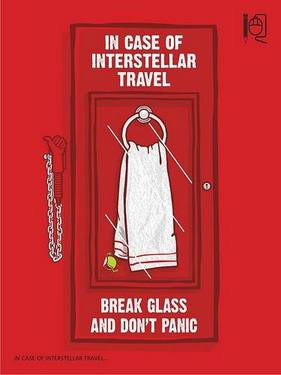
The Hitchhiker’s Guide to the Galaxy has a few things to say on the subject of towels.

A towel, it says, is about the most massively useful thing an interstellar hitchhiker can have. Partly it has great practical value. You can wrap it around you for warmth as you bound across the cold moons of Jaglan Beta; you can lie on it on the brilliant marble-sanded beaches of Santraginus V, inhaling the heady sea vapors; you can sleep under it beneath the stars which shine so redly on the desert world of Kakrafoon; use it to sail a miniraft down the slow heavy River Moth; wet it for use in hand-to-hand-combat; wrap it round your head to ward off noxious fumes or avoid the gaze of the Ravenous Bugblatter Beast of Traal (such a mind-bogglingly stupid animal, it assumes that if you can’t see it, it can’t see you); you can wave your towel in emergencies as a distress signal, and of course dry yourself off with it if it still seems to be clean enough.

More importantly, a towel has immense psychological value. For some reason, if a strag (strag: non-hitch hiker) discovers that a hitch hiker has his towel with him, he will automatically assume that he is also in possession of a toothbrush, face flannel, soap, tin of biscuits, flask, compass, map, ball of string, gnat spray, wet weather gear, space suit etc., etc. Furthermore, the strag will then happily lend the hitch hiker any of these or a dozen other items that the hitch hiker might accidentally have “lost”. What the strag will think is that any man who can hitch the length and breadth of the galaxy, rough it, slum it, struggle against terrible odds, win through, and still knows where his towel is is clearly a man to be reckoned with.

Hence a phrase that has passed into hitchhiking slang, as in “Hey, you sass that hoopy Ford Prefect? There’s a frood who really knows where his towel is.” (Sass: know, be aware of, meet, have sex with; hoopy: really together guy; frood: really amazingly together guy.)

Towel Day was yesterday, May 25, but I’m going to observe it today (in the tradition of all Weekend Holidays in the U.S>0

Towel Day, for the few who don’t know, is the annual celebration of Douglas Adams’ life and work. It was first held two weeks after his death, fans were to carry a towel with them for the day to use as a talking point to encourage those who have never read HHGTTG to do so, or to just converse with someone about Adams. Adams is one of that handful of authors that I can’t imagine I’d be the same without having encountered/read/re-read/re-re-re-re-read, and so I do my best to pay a little tribute to him each year, even if it’s just carrying around a towel.

In commemoration of this date, here’s most of what I’ve written about Adams. I’ve struggled to come up with new material to share for Towel Day over the years, mostly sticking with updating and revising existing posts. And, this year is no exception A few years back, I did a re-read of all of Adams’ (completed) fiction. For reasons beyond my ken (or recollection), I didn’t get around to blogging about the Dirk Gently books, but I did do the Hitchhiker’s Trilogy:
bullet The Hitchhiker’s Guide to the Galaxy
bullet The Restaurant at the End of the Universe
bullet Life, The Universe and Everything
bullet So Long, and Thanks For All The Fish
bullet Mostly Harmless
bullet I had a thing or two to say about the 40th Anniversary of The Hitchhiker’s Guide to the Galaxy
bullet I took a look at the 42nd Anniversary Illustrated Edition of The Hitchhiker’s Guide to the Galaxy

I should also point to a posts I wrote about Douglas Adams’ London by Yvette Keller and 42: The Wildly Improbable Ideas of Douglas Adams edited by Kevin Jon Davies—both are great ways of filling out one’s understanding of Adams and his work. I have to mention the one book that Adams/Hitchhiker’s aficionado needs to read is Don’t Panic by Neil Gaiman, David K. Dickson and MJ Simpson.

If you’re more in the mood for a podcast, I’d suggest The Waterstones Podcast How We Made: The Hitchhiker’s Guide to the Galaxy—I’ve listened to several podcast episodes about this book, and generally roll my eyes at them. But this is just fantastic. Were it available, I’d listen to a Peter Jackson-length version of the episode.

I’ve only been able to get one of my sons into Adams, he’s the taller, thinner one in the picture from a few several years ago.
(although I did get he and his younger siblings to use their towels to make themselves safe from the Ravenous Bugblatter Beast of Traal a few years earlier:)

You really need to check out this comic from Sheldon Comics—part of the Anatomy of Authors series: The Anatomy of Douglas Adams.

Lit in a Nutshell gives this quick explanation of The Hitchiiker’s Guide:

TowelDay.org is the best collection of resources on the day. One of my favorite posts there is this pretty cool video, shot on the ISS by astronaut Samantha Cristoforetti.

Even better—here’s an appearance by Douglas Adams himself from the old Letterman show—I’m so glad someone preserved this:

Love the anecdote (Also, I want this tie.)

Don't Panic

Hive by D. L. Orton: A Wild Time Travel Ride

Hive Tour Banner

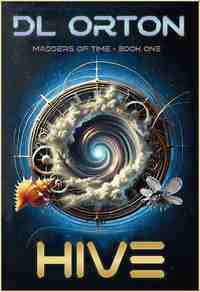
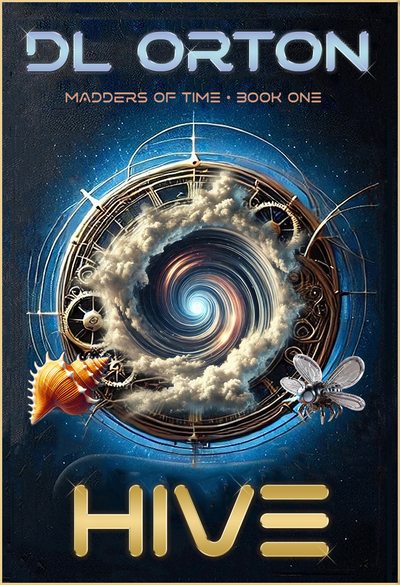
Cover of Hive by D. L. OrtonHive

by D. L. Orton

DETAILS:
Series: Madders of Time, Book One
Publisher: Rocky Mountain Press
Publication Date: May 6, 2025
Format: ARC
Length: 350 pg.
Read Date: May 8-9, 2025
Buy from Bookshop.org Support Indie Bookstores

What’s Hive About?

We open on a semi-functional (less so by the day) biodome some 30 years in the future (it’s vague, but safe to put it in the 2040s-2060s largely depending from when the reader picks this up)—there are two living humans, and an AI of sorts trying to keep going. There are some other biodomes out there, and hopefully, they’re doing better. The land outside the biodome is not fit to sustain human life—or much in the way of animal or vegetable life, either.

They have enough energy to use a spacetime bridge one more time as a last-ditch effort to go back and stop things from getting to this point. The target day was a fateful day for the two of them as individuals, and apparently one for the timeline as well (probably for different reasons, I’m not suggesting history pivots on them). They can send one person back with the sole idea of preventing their present.

I’m being as vague on details as the characters are here—you’ll get an idea about the particulars later.

We spend the rest of the book watching how this plays out from the point of view of some pivotal individuals (earlier versions of these characters in one way or another), with some observations from that AI about how well it’s working and the chances their mission holds of success.

A Quick Look at the Characters

Our primary characters (in the 2010s-2030s) are Matthew, Diego, and Isabel. Matthew and Diego did some work together in the past, and have some loose connections in the book’s “present”—but they’re not great pals or anything, and their stories don’t intertwine much (in Hive, anyway—I expect that to change). Matthew is a physicist of some repute and his expertise will be important.

When we meet Isabel, her divorce has just been finalized and she is excited and free from her husband (well, as free as you can be from an egomanical technocrat that you happen to work for and who owns your research). Diego is the would-be do-gooder scientist/entrepreneur who’s trying to do his part to help poorer countries with their water supply. Diego is also the one who got away, for Isabel. Through some unlikely coincidences (probably shaped by their future selves), they reconnect and try to start over/make up for lost time.

Also, they’ve received prompting from future-Isabel to stop Dave. It’s unclear what they’re supposed to stop him from doing, but they’re all in.

Dave is the kind of character that the reader is primed and ready to hate, or at least really dislike, from his first line of dialogue—and your impression of him goes downhill from there. There are a few sycophants in his company that we don’t get to know too well, but their devotion to him really solidifies your impression of them.

Meanwhile, Matthew is pretty much kidnapped by a couple of representatives of the U.S. government to work on a mysterious artifact, presumably (to the reader) something sent back to the past from the biodome. The senior member of this pair is easily as dislikable as Dave—almost irrationally so. And while he might be one of the “good guys,” or at least is working to help people, he’s definitely one of those envisioned by the coiners of the phrase, “Who needs enemies with friends like this?”

I’m focusing on these two here to be efficient—other than these two jackwagons, 99% of the rest of the characters (from very minor on up) are kind, pleasant, smart (if not brilliant), and are working to improve things. They’re the kinds of characters you want to spend time with—they’ve got good senses of humor, are optimistic and determined to keep going. Reading about them while there’s some sort of apocalypse around them is actually pleasant. Even if only you and the AI knew how bad things were going to get for them, you would like their chances and be pleased every time the AI mentioned their chances of improving their chances of success.

A Focused Armageddon

It’s hard to judge the scope of this/these calamity/calamities—our view is of Denver and the surrounding area. We get some hints that conditions are the same in other parts of the country as things get worse. But we really don’t know what things are like outside the U.S.

Given how bad it is 30+ years into the future when we first see things, it makes sense to think this happened globally. But it’s also possible that the devastation was limited to North America (or just the U.S.) and the rest of the world was able to protect itself, or weren’t exposed to the effects. During the bulk of our time with Diego and Isabel, some forms of communication work and some don’t for them, so it’s believable that they just have no clue what’s happening outside of Colorado. Communications around Matthew seem a lot more reliable, but he’s kept so much in the dark that it really doesn’t get the reader anywhere.

I’m not sure how much it matters for the story—particularly at this point. But I think it’s fun to speculate about while you’re reading and afterwards. Has the rest of the world moved on, fairly intact, waiting for things to calm down in North America so they can come over and try to rebuild? Or are they, so far removed from the three events, suffering just as much?

Crossing in Time

Feel free to skip this part and move on—I’m not sure this adds much to the overall post, but I can’t stop thinking about this.

This is a reworked version of Orton’s novel Crossing in Time. I listened to that book back in 2021 and enjoyed it—try as I might not to, I inevitably kept what was different about this version. The little voice in the back of my head just wouldn’t shut up. To make things worse—I think I have some details of Crossing in Time conflated with one or more other time travel books involving a strong love story.*

What I think she did here was lop off some later chapters, I assume to move them to Book Two. And introduce and/or beef up some of the chapters and subplots. I’m more sure about the former than the latter, if I’m right, that makes the ending more of a cliff-hanger that will springboard you into wanting Book Two in your hands straightaway.

I also think Orton removed what could be described as convolutions—making the novel more streamlined and fast-paced. Overall, I get her choices, and I do think it makes the book a stronger read.

But again, I could be wrong—but I couldn’t stop thinking about it as I read the book, or as I think about it now—so I had to get this out.

* With apologies to the author, there have been 800 or so books between now and then, details get fuzzy.

So, what did I think about Hive?

This is a fast-paced, propulsive read filled with amiable characters who aren’t afraid to joke around even when things are tense or confusing. The hook gets set pretty early, and the pages melt away as you plunge ahead to follow the events. It’s exactly the kind of popcorn read that helps you escape after a long day.

The tech is very cool—both the stuff that Isabel developed and the items that Matthew talks about and develops. Orton gives you enough to understand how it all works and to visualize it clearly without bogging down the pace with paragraphs and paragraphs of details. The plausibility of it all? Eh, it’s SF, it’s plausible enough if you come with a standard level of suspension of disbelief needed for time travel (especially, in this case, when the time travel comes with a side order of multiverse story).

Because of the pacing, Orton’s able to get away with a few things that maybe she couldn’t in a slower-moving book. I don’t actually see the grounding of the romance between Diego and Isabel—he’s carried a torch for years, she regrets making the choice years ago to walk away. But…that’s it. We don’t see many sparks, just have to take it because we’re told that. There’s no reason for the senior agent involved with Matthew to be such an ass to everyone, all the time, especially when just a sentence from him now and then would be enough to get people to work with him instead of his threats (and I don’t care how instinctive and characteristic his brusqueness is, you don’t move up in an organization simply be being mule-headed, there has to be at least an insincere level of cooperativeness expressed occasionally). All the depth of the characters that could be brought out are merely nodded to, or you have to assume them.

Actually, this all might be necessary because of her pacing. If so, I understand the choice (as much as I disagree with it).

I want to stress, however, in the moment, you don’t think about this (and if you do, you brush it off because you don’t want to step out of the movement). Everything works, everything clicks while you’re reading and speeding off to the next twist/revelation. It’s only after you get to the ending that leaves you holding onto the cliff’s edge with your fingers that this might occur to you if you stop and think about it. Mostly, you’re going to be thinking about how long it will be until you can get your hands on Book Two.

It’s easily enjoyable, engrossing, and entertaining. You should give it a try.

This post contains an affiliate link. If you purchase from it, I will get a small commission at no additional cost to you. As always, the opinions expressed are my own.


My thanks to The Write Reads for the invitation to participate in this tour and the materials they provided, including the ARC.

BOOK SPOTLIGHT: Hive (Madders of Time #1) by D.L. Orton

I’m very pleased today to welcome The Write Reads Ultimate Blog Tour for Book One in D.L. Orton’s Madders of Time series, Hive! If you take a look at the feed for https://twitter.com/WriteReadsTours over the next week, you’ll see what several other bloggers have had to say about it. My $.02 will be coming along in a little bit.

Hive Tour Banner

Book Details:

Title: Hive by D. L. Orton
Genre: Madders of Time, Book One
Genre: Science Fiction
Age Category: Adult
Format: Hardcover/Paperback/Ebook
Length: 350 pages
Publication Date: May 6, 2025
Hive Cover

About the Book:

What if saving the future meant rewriting the past?

In a dying world overrun by microdrones, humanity’s last survivors cling to life inside the Eden-17 biodome. Isabelle Sanborn knows her time is running out, but one desperate plan might give humanity a second chance. With the help of Madders, an enigmatic AI built from the memories of a brilliant physicist, Isabelle sends Diego Nadales—the love of her life—35 years into the past. His mission? To change the course of history and prevent their world’s collapse.

When Diego arrives in the vibrant yet fragile Main Timeline, he’s forced to confront ghosts of the past, including a younger, ambitious version of Isabelle. As he battles to shape a better future, Diego must navigate a delicate web of relationships and events without destroying the very fabric of time.

Brimming with suspense, heart-pounding action, and a poignant love story that transcends time, Madders of Time – Book One is a breathtaking science fiction adventure. Award-winning author DL Orton weaves a tale that explores sacrifice, resilience, and the timeless power of love.

Fans of The Time Traveler’s Wife and Dark Matter will find themselves captivated by this unforgettable journey through parallel worlds and intertwining destinies.

The clock is ticking. Can love survive the collapse of time itself?

Prepare to lose yourself in the first installment of the Madders of Time series—a story that will keep you turning pages and leave you hungry for more.

Book Links:

Amazon Canada ~ Amazon US ~ Amazon UK ~ Goodreads ~ The StoryGraph

About the Author:

Forest Issac JonesThe BEST-SELLING AUTHOR, DL ORTON, lives in the foothills of Colorado where she and her husband are raising three boys, a golden retriever, two Siberian cats, and an extremely long-lived Triops. Her future plans include completing the books in the BETWEEN TWO EVILS series followed by an extended vacation on a remote tropical island (with a Starbucks).

When she’s not writing, playing tennis, or helping with algebra, she’s building a time machine so that someone can go back and do the laundry.

Ms. Orton is a graduate of Stanford University’s Writers Workshop and a past editor of “Top of the Western Staircase,” a literary publication of CU, Boulder. The author has a number of short stories published in online literary magazines, including Literotica.com, Melusine, Cosmoetica, The Ranfurly Review, and Catalyst Press.

Her debut novel, CROSSING IN TIME, has won numerous literary awards including an Indie Book Award and a Publishers Weekly Starred Review. It was also selected as one of only 12 Great Indie Stars by BookLife’s Prize in Fiction.


My thanks to The Write Reads for the invitation to participate in this tour and the materials they provided.

One Death at a Time by Abbi Waxman: You’ll Laugh All the Way to the Morgue

(not that you actually go to a morgue in this book, I was just struggling with that headline)


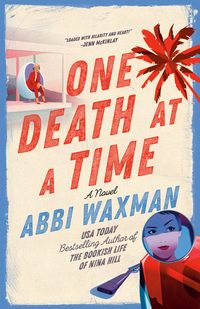
Cover of One Death at a Time by Abbi WaxmanOne Death at a Time

by Abbi Waxman

DETAILS:
Publisher: Berkley
Publication Date: April 15, 2025
Format: eARC
Length: 400 pg.
Read Date: April 11-15, 2025

Buy from Bookshop.org Support Indie Bookstores

What’s One Death at a Time About?

Natasha Mason is a twenty-something still trying to figure out what to do with her life—her alcoholism led to her leaving law school, and now she’s paying bills by delivering food and doing other gig economy standbys in L.A., and making sure she makes at least one meeting a day.

At one of these meetings, a vaguely familiar-looking woman shows up—and is not the friendliest of people. She seems—well, is—more concerned about getting her court-mandated signature than in anything else. Mason volunteers to be this woman’s interim sponsor. Now this older woman had been sober before, but on the night that led to the court-mandated meetings had a blood-alcohol level that stunned a rowdy twelve-step meeting into silence. She’d also come out of a blackout next to the dead body of a former lover/decades-long antagonist and what was probably the murder weapon. For a night she couldn’t remember—it’d clearly been eventful.

The next morning, Mason shows up at the gate of her obviously well-off sponsee. Thanks to some time on the internet, Mason knows her to be Julia Mann—a former box office star, now a lawyer taking on cases for as many Davids as she can in a city of Goliaths. Oh, and in between careers, she’d been in prison due to the death of her husband—the former business partner of the dead man she’s currently suspected of killing.

This meeting didn’t go the way Mason suspected—for one, Julia Mann’s housekeeper is an amazing cook, as Mason learned. Also, the two kept butting heads—Mason wanted to talk about Julia’s sobriety, but Julia was rather fixated on the murder. And yet…something clicked between the two. In between verbal jousts,* Julia ends up hiring Mason to be her personal assistant and help with the investigation. Mason justifies this to herself as a way to stay near Julia and keep her sober. The chance to eat more of Claudia’s cooking and make more money than an app can pay doesn’t hurt.**

Before you know it, these two have got themselves involved in a separate murder investigation (another David for Juila to work for), arson, tensions around Julia’s former career in the film industry, tensions around Julia’s future career in the film industry (she wants none of it, but no one seems to care), brushes with organized crime, multiple reasons for both or either of them to ditch their sobriety, and more things that I can fit into this rambling sentence.

* The back-and-forth between these two is reason enough to try this book. Waxman will supply several others, it should be noted.
** Yes, this makes two books in as many months about an LA-based delivery driver turning amateur investigator.

The Murder Mystery(ies)

Murder mysteries surrounding the film industry tend to have a few things in common—secrets, petty grievances that get nurtured into full-blown rivalries (or worse), scandals (for an industry reputed to be filled with amoral hedonists, there really are a lot of moral scandals), and organized crime.

One Death at a Time ticks all of these boxes—and a few others that I should’ve listed above, but forgot to. This may be Waxman’s first mystery, but she clearly understands the genre and knows how to construct a classic whodunit in a contemporary setting.

You get all the twists, turns, red herrings, and layers upon layers of competing motives for multiple suspects that you need—doled out in just the right pacing with dollops of shocks and action along the way. The final reveal is satisfying, and every loose plotline is tied up. It’s a textbook example of the genre—pleasing in every way.

The Humor/Tone/Relationships

This might be a clumsy way to tackle these ideas, but it’s where I am.

Yes, Waxman is known for Rom Coms—or Rom Com-adjacent—books, so we all know she’s funny. This seemed to me to be more overtly comedic. There are jokes—many of them—not just funny situations and loveable, quirky characters doing goofy things. Don’t get me wrong, there are plenty of those (as well as non-lovable, quirky characters).

This reads like Dave Barry’s kind of crime novel, with the restraint of a Richard Osman. The verbal jousting is great, and the physical comedy is almost as good. The situations are frequently ridiculous, but never so much so that you get taken out of the moment.

The technical term that best describes Mason is “wiseass,” and one with poor impulse control. Someone who doesn’t know how to keep her trap shut, powered by Waxman’s wit is a fun character to read. Julia’s no slouch in that department either, but she’s more mature, she knows that she should pick her targets with care—and is therefore usually more effective.

The rest of Julia’s team (I will not tell you about them, so you can meet them properly) and some of the other characters the reader encounters have drier wits, largely fitting into the typical Waxman model. Oh, except this one actress…nope. You wouldn’t believe me if I tried to describe her.

Mason’s support system consists of the meetings she attends, her sponsor, and her cat. Julia has a strong team of employees and friends (the Venn diagram there has a large area of overlap)—they’re just not that effective on the sobriety front, but they make up for that with their loyalty. Julia also has a pretty strong network of former friends, employers, and employees in and around the film industry. These are loyal to their grudges against her and their own self-interest—however, they (or at least most of them) want her to succeed in her search for the killer, so they can move on with their lives and careers.

You combine all of this—with a (slowly) growing relationship of affection, trust, and appreciation between our protagonists—and you’ve got yourself a great basis for comedy with heart.

Sobriety

One thing that Waxman never made light of in all of this was the sobriety of the characters. Yes, Julia would mock Mason’s approach to being her sponsor, but that was about the characters’ personality differences—both of them took it seriously.

Not all of the characters appreciated the struggle and what the characters did to preserve it—but none of the comedy was about the drinking.

The opening meeting did get me to chuckle frequently, but that was character-based humor. The book never gets preachy at the reader, just to each other.

So, what did I think about One Death at a Time?

I had a blast with this—if you couldn’t tell. This is my fifth Waxman novel, so I went into it expecting that I would. I just wasn’t sure how much I’d enjoy it, because of the genre. But if I didn’t know who she was before I picked this up, I’d be scouring the library for her Abbi Waxman now.

It does—as it should—feel very different than her previous works. I’d say this is closer to last year’s Christa Comes Out of Her Shell than the rest, but even saying that, this is different. The stakes are (obviously) higher for these characters; there are potentially lethal consequences for failure. Which might explain the more heavy-handed approach to the comedy.

I think I’ve said everything I wanted to above—the mystery part is really well done; the characters are well-designed and well-excecuted, the relationships between them are strong and obvious—you like the people you’re supposed to like enough that you wish you sat around the room with them, watching them go back and forth while eating whatever wonderful treat/meal Claudia has prepared. Also, it’s funny. That’s a one-two-three combination that I’ll always enjoy and recommend.

This feels like a standalone, but it could easily spawn a sequel or more. If it does, I’ll be first in line. If it doesn’t…well, that’s okay, too. It works really well either way.

Basically, reader, if any of the above tickles your fancy—you need to add this to your TBR. I practically guarantee you’ll have a great time.

Disclaimer: I received this eARC from Berkley Publishing Group via NetGalley in exchange for this post, which contains my honest opinion—thanks to both for this.


5 Stars

This post contains an affiliate link. If you purchase from it, I will get a small commission at no additional cost to you. As always, the opinions expressed are my own.

Irresponsible Reader Pilcrow Icon

My Documents by Kevin Nguyen: Who will survive in America?

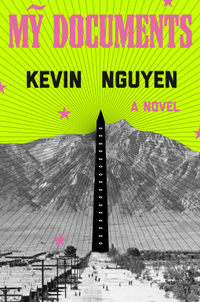
Cover of My Documents by Kevin NguyenMy Documents

by Kevin Nguyen

DETAILS:
Publisher: One World
Publication Date: April 8, 2025
Format: eARC
Length: 352 pg.
Read Date: April 7-9, 2025
Buy from Bookshop.org Support Indie Bookstores

What’s My Documents About?

Soon after the fall of Saigon, but not soon enough, a woman named Bà Nội manages to escape Vietnam with her four-year-old son—she’d been able to send two of her children to the U.S. earlier. Sadly, her husband was unable to leave with them. As the novel opens in the mid-2010s, we meet four of this son’s children—Ursula, Alvin, Jen, and Duncan.

These siblings and cousins are on the cusp of adulthood. Ursala is trying to make it as a journalist in NYC, Alvin is starting an internship (that will hopefully/likely turn into something more) at Google, Jen is enjoying the freedom that comes from being away from home at NYU, and Duncan’s passion is playing on his high school football team—and he’s pretty successful at it. All in all, this is a pretty good realization of Bà Nội’s American Dream (even if most of the family had hoped for something more lucrative for Ursala than being a writer).

Then the U.S. is rocked by a series of coordinated terrorist attacks that result in the overwhelming majority of Vietnamese-Americans being placed in various internment camps. Jen, Duncan, and their mother are placed in Camp Tacoma, while Ursula and Alvin are able to get exemptions.

The novel traces the lives of these four (as well as some of their relatives) through this dark time—showing how technology, business, the media, the government, and prejudice collude to create and maintain this system, as well as the public reaction and eventual distraction (with sporadic moments of attention and protest). But beyond that, we see how those most impacted by these policies survive this—and how they try to adjust, cling to their humanity, and try to do more than survive.

The Cousins

First, I should note that we also get some time with their shared father (who was not really involved in their lives growing up), Dan. Without getting into it, Dan took a very different path than his children—or the majority of Vietnamese-Americans—during this time. His actions—which we check in on sporadically—serve to contrast what the rest go through.

But I want to focus on—as the book does—the cousins. These are fantastically drawn, deeply flawed, and relatable characters. They all react very differently to their circumstances, and grow (or at least develop) through them in ways that are completely believable. In much the same way that the fall of Saigon and escape to the U.S. shaped the lives and psyches of their grandmother and father, this period does that to them.

More than Survival

In the beginning—even for those outside the camps—it’s just about survival. You do what you’re told, you make sure to obey the men with guns, you keep your head down and just hold on to whatever you can. But in time, you find ways to breathe, to relax, to find community and support, you even find ways to help others.

The guards organize football games for the detainees, which are attended by most of those in the camp. It allows Duncan to thrive. Jen gets work on the camp’s official newspaper—which, yes, is basically a propaganda machine (everyone knows this), but it helps her hone her writing and gets her exposure to most of the camp, as well as access. Because of her access, she’s brought into the circle of a smuggling operation that brings in some forms of food, life-saving medicine that the camp won’t bring in, and even digital copies of TV, movies, and music.

It’s through these temporary escapes from their daily circumstances—authorized or not—that the detainees are able to remember that there’s more to living than existing. There are flashes of joy and relief in the midst of their tense, precarious, and tragic circumstances.

It’s in this part of the novel that the reader is able to find more than just a frighteningly possible dystopia; it’s what elevates this.

So, what did I think about My Documents?

One of the more chilling aspects of this book is how most Americans move on from the internment. It makes headlines and creates some scandal for a bit, and then the attention of the public shifts to something else. Every now and then, something will come up that gets people riled up a little bit, but nothing sticks for most of the public. This is a dystopia—but not for everyone. Not that many people suffer. And while things could be better for people like Ursula and Alvin, outside of their own missteps and failings, their lives are pretty good.

The more I think about that, the more terrifying it is. The more realistic and possible it seems, too.

There’s a moment toward the beginning of the book where Ursula is attending a lecture from a working journalist, who says that a good story tells us something about people—how they live and how they are self-deluded. It seemed like a pretty obvious spotlight on one of Nguyen’s themes. And it happens so early, I don’t feel bad getting that specific. Not only is that a good way to think about stories (true and fictional) in general—it’s a key to this work.

Every person we spend extended time with—and several that we don’t—are under one or more forms of delusion—some external, but many come from within. This, too, is Nguyen’s realism shining forth. The way these four fool themselves is so relatable and so pitiable. It may sound like I’m criticizing the characters (and maybe I am a little), but this is a testimony to the way Nguyen depicts them, they come alive in their failings more than in their strengths.

I would’ve liked to see a little more of the relationship between Duncan and Alvin. But the way we—and they—were denied that is one of the stronger elements, the more I think about it. Once they’re unable to communicate after the internment (which, naturally, comes with a total lack of mobile phone/internet access), they themselves think about the ways they missed out.

I do think some readers will be put off by how fun this book sometimes is. Jen has a similar thought when the underground starts distributing TV shows and people get so into them—but her smuggler acquaintance assures her that this is good. There’s a little bit of enjoyment in these people’s lives now—they’re doing more than just existing.

Also, the moments of lightness do a great job of setting you up for the next gut-punch of a development. Nguyen’s is good at lulling his readers into that.

This is a gripping, well-plotted read that keeps moving along, too. There’s a momentum that slowly builds, almost like a thriller, until you’re barreling toward the conclusion.

This is a powerful, haunting, uncomfortable (purposefully) read that will also charm you. I’ve been having a hard time moving on from this book in the days since I read it. I keep finding ways to talk about it or think about it—and the more I do either, the more I appreciate this work. This is definitely one of the best—both affective and effective—books I’ve read in some time.


5 Stars

Disclaimer: I received this eARC from Random House Publishing Group – Random House via NetGalley in exchange for this post which contains my honest opinion—thanks to both for this.

This post contains an affiliate link. If you purchase from it, I will get a small commission at no additional cost to you. As always, the opinions expressed are my own.

Irresponsible Reader Pilcrow Icon

Happy Jack and the Scary-Ass Book of Doom (Audiobook) by Rich Partain, read by JP Adams: DNF’d Without Prejudice (or any interest)

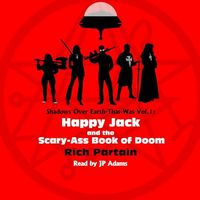
Cover of Happy Jack and the Scary-Ass Book of Doom by Rich PartainHappy Jack and the Scary-Ass Book of Doom

by Rich Partain, JP Adams (Narrator)

DETAILS:
Series: Shadows Over Earth-That-Was, Book 1
Publication Date: December 17, 2024
Format: Unabridged Audiobook
Length: 12 hrs., 50 min. (I made it 3.5 hours )
Read Date: April 16-17, 2025

What’s Happy Jack and the Scary-Ass Book of Doom About?

From Audible:

What happens when the geeks inherit the Earth? For starters, things get a little weird.

In the year 2475, the remnants of humanity have taken to the skies, inhabiting massive domed cities that hover five miles over the ruined ecological disaster of old Earth. The Powers That Be, in their infinite wisdom, decided that the few million people left deserved to live their best lives, so they gave each sub-orbital platform its own theme and legally enforced tech level. Named for afterlives and sacred places from all of the world’s great cultures, Elysia, A’Aru, Valhalla, Tian and the other orbitals range from cyberpunk metropolises to Tolkienesque medieval fantasy lands; from Victorian steampunk cities of glass and copper to snowbound Viking kingdoms.

Not content with merely cosplaying their days away, a significant portion of the population have become transhuman “cybernaturals,” electing to transform into creatures from myth through cybernetic enhancements and advanced genetic therapies; orcs, dwarves, elves, vampires and werewolves now exist through super-scientific means, not supernatural ones.

In the middle of this madness, Daniel Davidson, a pop culture archaeologist and mercenary of dubious repute and his band of foul-mouthed friends are charged with tracking down an ancient book that could, in the wrong hands, erase all of reality. It could be a huge payday and might even involve saving the known universe as a tidy bonus. That is, if they manage to NOT die at the hands of cannibal sex cultists, swashbuckling rogue vampires, prankster demigods, Templar knights, horrifying biblical angels, the angry star-spawn of elder things, and Satan himself. And possibly food and/or alcohol poisoning. Or suffocation in a sex dungeon.

It’s a filthy, hilarious, epic journey through an off-kilter future filled with bullets, blades, beasts, and boat drinks. If you like your profane sci-fi action comedies with a side order of urban and traditional fantasy, look no further.

I Do Have One Issue

Daniel Davidson makes too many late 20th/early 21st Century references. He uses the slang of these eras, talks about music, books, TV, movies, video games of this era. Yes, he explaines it. But I can’t buy that this kind of a geek–no matter his specialty–doesn’t make references to things outside of this time. Something from the intervening 300+ years would’ve snuck in.

His complaints about Evangelical Christians are also very 2020+–there’s no way that they wouldn’t have moved on to other ways to provoke the culture around them.

Listen, it makes sense for the Bobiverse’s clones to be stuck in contemporary references. That absolutely works. This just doesn’t. John Crichton might be full of references to Earth, but he also picks up the lingo and culture of those he interacts with once he joins Moya’s crew (see also Buck Rogers).

So, why didn’t I finish Happy Jack and the Scary-Ass Book of Doom?

It just never grabbed me. It was occasionally amusing. I thought the blue language was overdone, but it wasn’t as offensive as the Author’s Note at the beginning made it sound like it’d be. If you’re going to overuse some or all of The Nine Nasty Words be interesting with it, otherwise it just fades into the background like a dialogue tag.

I’m leaving the door open to returning to this–it didn’t anger me, offend me, or bore me. Like I said, I found bits of it amusing–even entertaining. But it just left me apathetic. I’d rather be annoyed by a book than totally uninterested. I’ll stick with a book to see if the author can make something good/decent out of something bad. But I can’t stick with something to see if I ever have a reaction.

I have no opinion on JP Adams, either. I don’t think James Marsters, Lorelei King, or Ray Porter could’ve done more with the material. So, I’m absolutely open to something else by him, too.

So, I’ll check out of this for now, and maybe return to in later.

Irresponsible Reader Pilcrow Icon

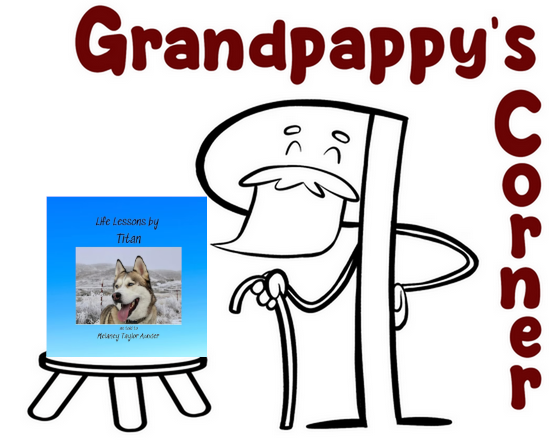
Grandpappy’s Corner: Life Lessons by Titan as told to Melaney Taylor Auxier: Wise Words from a Noble Dog

Grandpappy's Corner Logo with the Cover of Life Lessons by Titan by Melaney Taylor Auxier

Life Lessons by Titan

as told to Melaney Taylor Auxier

DETAILS:
Publication Date: June 28, 2024
Format: Paperback
Length: 39 pgs.
Read Date: April 9, 2025

What’s Life Lessons by Titan About?

We meet this very good-looking dog, Titan, at the shelter when he meets his human, she “fell in love instantly because I’m so loveable.” Titan decides to keep her.

We get a couple of pages showing Titan adjusting to his new home and friends, making some mistakes and then Titan teaches some life lessons. He teaches about friends, making mistakes, eating well, being grateful, that sort of thing.

Let’s Talk about the Art for a Minute

The art consists totally of home photographs of Titan—and occasionally some other good-looking dogs—and a couple of human feet.

On the one hand, these are not studio-quality pictures. They’re just candids of Auxier’s dog, likely her phone is loaded with them (like any person who has pets and a phone). She took the best—sometimes goofiest—of these to illustrate Titan’s lessons.

Are they the best dog photos you’ll see? No. But they’re taken and shared with love for the subject—and that’s more than enough to justify looking at them. Also, little kids are not known for being discerning when it comes to pictures of handsome doggies.

So, what did I think about Life Lessons by Titan?

This is a great tribute to a great dog.

My grandson isn’t ready for Lessons From Lucy by Dave Barry, Lessons from Tara by David Rosenfelt, or even The Teachings of Shirelle by Douglas Green. But he is ready for this one (pretty much). Many of the lessons/perspectives/thoughts in this book match those books for older readers, so even if he has a decade or so before I can introduce him to Lucy, Tara, or Shirelle, I can introduce him to Titan and his wisdom.

Also, this one has far more pictures. And who doesn’t want that?

It’s short, sweet, and to the point. It’ll win over young dog lovers, and even bring a smile to us older ones when we need a quick fill of puppy love.

Grandpappy Icon

REPOSTING JUST CUZ: Death and Taxes by Mark David Zaslove: The most rootin’ tootin’ shoot ’em up about accountants you’ve ever seen

This seems like a good day to revisit this (sort of a shame there were no sequels)


Death and TaxesDeath and Taxes

by Mark David Zaslove
Series: Tales of a Badass IRS Agent, #1

ARC, 219 pg.
Aperient Press, 2018

Read: August 13 – 14, 2018
I’m not sure I can go this book justice with a hand-crafted synopsis, I’ll just copy and paste from Zaslove’s site:

           Death and Taxes follows Mark Douglas, an ex-Marine turned IRS agent, who, along with auditing the weird and the profane, also spearheads weekend raids with his locked-and-loaded gang of government-sanctioned revenuers, merrily gathering back taxes in the form of cash, money order, or more often than not, the debtor’s most prized possessions.

Things turn ugly when Mark’s much-loved boss and dear friend Lila is tortured and killed over what she finds in a routine set of 1040 forms. Mark follows a trail dotted with plutonium-enriched cows, a Saudi sheik with jewel-encrusted body parts, a doddering, drug sniffing, gun-swallowing dog named The Cabbage, a self-righteous magician with a flair for safecracking, a billionaire Texan with a fetish for spicy barbecue sauce and even spicier women, and an FBI field agent whose nickname is “Tightass.” All of which lead to more and bloodier murders – and more danger for Mark.

Enlisting his IRS pals – Harry Salt, a 30-year vet with a quantum physical ability to drink more than humanly possible; Wooly Bob, who’s egg-bald on top with shaved eyebrows to match; Miguel, an inexperienced newbie with a company-issued bullhorn and a penchant for getting kicked in the jumblies – Mark hunts down the eunuch hit man Juju Klondike and the deadly Mongolian mob that hired him as only an angry IRS agent can. There will be no refunds for any of them when April 15th comes around. There will only be Death and Taxes.

This is hyper-violent (not that filled with blood and guts, really — there is some), a lot of guns, bombs, more guns. Sometimes played for comedic effect, sometimes it’s the good guys vs. the bad guys. Sometimes, it’s a little of both. It never got to the overkill point for me, probably because this felt more like a cartoon than a “realistic” thriller.* What was overkill for me was the hypersexualization of every woman under the age of sixty. I didn’t need to hear that much about every woman’s physical appearance — there are more gorgeous women with perfect (sometimes surgically enhanced) bodies in this guy’s life than an episode of Miami Vice.

But man, is this funny. There are sections — sometimes a sentence or two, sometimes several paragraphs long — that are the literary equivalent of a shot of espresso, they are so taught with action, cultural references, and humor that you just revel in them. This reminds me a lot of the John Lago Thrillers by Shane Kuhn — I think Kuhn shows more discipline in his plots and characters, but on the whole, these two are cut from the same cloth. The same energy, a similar style, similar sense of humor — and frankly, that stuff is catnip to me. I think the plot got a little convoluted, a little confusing — but it was worth working through.

Am I planning on reading Tales of a Badass IRS Agent, #2? Yeah, I will be keeping an eye out for it. This is a heckuva romp, and will entertain anyone who gives it a shot.

* Really, what thriller is realistic?

Disclaimer: I was provided with a copy of this novel in exchange for my honest opinion, which you see above.

—–

3 Stars

Nero Wolfe on Taxes

I can’t tell you when this became a (largely) annual thing for me to post, but it was on a blog that pre-existed this one. As always, it seems like a good day to post it.

Nero Wolfe Back CoversA man condemning the income tax because of the annoyance it gives him or the expense it puts him to is merely a dog baring its teeth, and he forfeits the privileges of civilized discourse. But it is permissible to criticize it on other and impersonal grounds. A government, like an individual, spends money for any or all of three reasons: because it needs to, because it wants to, or simply because it has it to spend. The last is much the shabbiest. It is arguable, if not manifest, that a substantial proportion of this great spring flood of billions pouring into the Treasury will in effect get spent for that last shabby reason.

–Nero Wolfe
from And Be a Villain

Page 21 of 339

Powered by WordPress & Theme by Anders Norén