Category: Fiction Page 76 of 342

The Ballad of Bonaduke—Episode 13: Realizations by R. T. Slaywood: Right Back Where We Started From

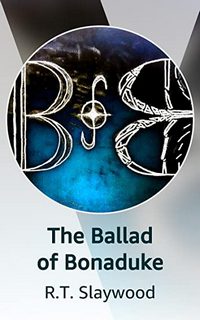
The Ballad of BonadukeThe Ballad of Bonaduke—
Episode 13: Realizations

by R.T. Slaywood

DETAILS:
Series: The Ballad of Bonaduke, #12
Format: Kindle Vella Story
Read Date: December 2, 2022

While previously, just seconds before, I had resented her for disappearing, I now resented the fact that I feared whatever she had become.

Just say vampire.

The Story So Far…

A drunken Michael Bonaduke decides to use a grift (with maybe some sort of magic/magic-like “help”) to win on a scratch-off lottery ticket so he has money to buy more to drink. He pulls off whatever he did, gets his money and some booze and stumbles off into the darkness to drink himself into oblivion so he can start again the next day. He’s hit by dark memories (probably what’s driving him to the drinking) of fire, pleading, and screaming. There’s going to be a price to pay for his grift, and he’s trying to be ready.

Before then, he gets himself drunk and we get some of his tragic backstory. As he ponders this, he decides to use some of his ill-gotten-gains to buy more booze and walks into a liquor store robbery. He foils it in some sort of magical fashion, gets some more to drink, and heads off to the park to drink until he’s arrested (probably for the failed robbery). At least that’s his plan, but it gets interrupted by being hit by a car. He wakes up on some sort of short, metal bed and is unsure what’s going on. It turns out that some group is subjecting him to a test—if he passes, everything will be explained to him (and hopefully the reader, too). He passes—and is brought somewhere for answers, or maybe training, or maybe another test. Time will tell (or things are going to get really annoying). Answers aren’t quick to come—but the mysteries and questions keep piling up.

What’s Realizations About?

Bonaduke rushes out, trying to catch up with his sister-in-law to get some more answers, but can’t find her. Then he realizes that he forgot to get dressed post-shower. When he gets back to the apartment, he’s alone. He gets dressed and decides to get out while he can—who needs answers when you can get away from the weirdness? He eventually finds himself back at the liquor store we started this story.

So, what did I think about Realizations ?

Eh…I’m of two minds. First—this makes total sense. You’ve got yourself a guy bent on self-destruction—and has been for years. Sure, there’s all this stuff going on around him that he’d like to understand. But more importantly, he’s got a chance to get away from it all and find a new bottle to disappear into. Obviously, what’s behind Door Number 2 sounds better.

On the other hand, in addition to fingers, you’ve got my perennial frustration at the lack of answers. At this point, it almost feels like Slaywood is just stringing us along. I’m pretty sure that if I read this as one story/novella/whatever rather than in installments, I wouldn’t feel this way and it’d all flow nicely. But as an episodic read, I’m unconvinced.

Still, I want answers, so I’ll be back.


3 Stars

REPOSTING JUST CUZ: The King of the Crows by Russell Day: Prescient. Gripping. Haunting. Unpredictable. What stories should be.

Things have gotten away from me today, so I don’t have anything new to share. But I’ve been thinking a lot about this book this week (I think about this book frequently, to be honest, but several times a day this week), so I figured I’d try to get others thinking about it, too. If you haven’t read this yet, you should strongly consider doing so, as I argue below. Incidentally, re-reading this now serves as a really good argument for me to adopt the current format of my posts using section headers and whatnot (I’d been rethinking them last week, but after this post? They’re sticking around)

King of the Crows

King of the Crows

by Russell Day

Kindle Edition, 456 pg.
Fahrenheit Press, 2020

Read: April 28-May 9, 2020

… for me at least, the first week of the Lockdown was the worst.

Knowing it had happened to me. I hadn’t escaped, I wasn’t one of the lucky ones. Lucky to be safe or lucky to be dead. Take your pick. I was neither.

That right there gives you a pretty good idea what kind of light and fluffy read this is going to be.

There are two timelines in this story—the primary focuses on a post-pandemic London, while the other shows what happened to a couple of the characters mid-pandemic (with plenty of material describing what the pandemic was like for others). In the primary timeline, Europe is a disaster—a “wasteland”—and eight years after the Outbreak, it’s beginning to put itself back together. But it’s going to take a long, long time to recover from this. Don’t let the fact that “eight years after” this fictional outbreak is 2028 bother you at all.*

* Good luck with that. I’ll get back to this in a bit.

I’m not going to try to list all the various ways that Day uses to tell this story: I’m certainly going to forget several. So here’s a partial list: here’s a third-person 2028 narrator describing a police investigation, a first-person perspective on the same investigation; a first-person account of that same detective’s life during the Outbreak; selections from a screenplay made about a group of Londoners during the Outbreak; selections from the Outbreak-memoir of one of those Londoners; and third-person narration of the same (N.B.: these three will vary in telling ways); redacted 2028 prison correspondence about the Outbreak; excerpts from scholarly works on aspects of the Outbreak (including a very illuminating work on the slang of the time); graffiti from 2021; internet message boards. Day weaves these together to tell his story, build the world, and help you to understand it. Frequently, I read something from the 2028 timeline, and understood it—only to find a new depth to it several pages later after getting another piece of the puzzle from 2020/2021. It’s hard to juggle that many narrative forms/voices/perspectives/calendars as a reader or a writer—Day pulled it off better than I did (any problems I had following things I attribute to myself, and it was pretty easy to clear out my misunderstanding with a minimum of backtracking*). It definitely helps paint the picture of the scope and variety of effects the sickness had on the world more efficiently than a consistent first- or third-person narrative would be able to.

* This would be easier in hardcopy than on an e-reader in my opinion. But that’s just a guess.

There are times (several of them) when I felt that the characters were getting lost amongst the plot and worldbuilding and sickness. But when I stopped and thought about it—and eventually got to the point where I didn’t have to—I realized I had a pretty solid idea about who these people were and was more invested in them than I expected. I thought there was so much going on that the people were getting hidden, but really, Day’s work was subtle—working in the characters into my subconscious like you give a dog its medicine. Normally, this isn’t something I require (or would like)—and it’s not Day’s usual M. O. (quite the opposite), but I think this approach really fit the novel and the story/world.

“They weren’t zombies,” he says, softly. “Don’t call them zombies.”

No one who was involved in the Outbreak for real uses the zee word.

So exactly what was the sickness?

I remember reading a couple of years ago about these ants that would succumb to a fungus which would short-circuit their brain and make them do certain things before killing them—or something like that, vague memories here. Then there were stories about parasites controlling the host’s actions—both of these stories had their 15 seconds of fame on social media around the same time (I may be messing the details up a little bit, but I’m not writing history here).

In Day’s world, one of these kinds of parasites will reside—asymptomatically, I should stress—in cats, who would pass it on to humans. Skipping the details, the humans would get very sick and then, survivors would maybe succumb to a psychosis that would make them violent. This sickness, HV-Tg (Human Variant-Toxo gondii), in a little more than a year would kill more than 20 million in Europe (at least 33% of France’s population) Et voilà!—an easy to believe pandemic that results in Zombie-like people wandering around.

Now, if one of those who’d “switched” and become violent infected you during an assault, well, you were likely to succumb. There were enough of these (“psychos” or “Gonzos”), and the sickness was so widespread, that the police and military couldn’t keep up, that civilians were forced to take action and defend themselves, their family and neighbors. People quickly forming into gang-like associations for mutual protection. It was a literal kill-or-be-infected (and likely killed) situation.

One such association became known as The Crows or The Kings of the Crows. They developed a legendary status mid-and post-Outbreak—and are the subjects of the memoir and film mentioned above. One of their number who happened to survive (and gain notoriety enough to get a publishing deal for a memoir) is the subject of the 2028 investigation. They survived the worst of the worst in one of the hardest-hit cities. They did so via means and methods that many (including their own) would find deplorable, but under circumstances that not only permitted, but required, those actions.

We also see what happens to an American in Paris for work when the Outbreak reaches the point that International travel is canceled (particularly to the U.S.). Her allies will never be considered the Kings of anything, and the contrast between how she survives to what the Crows do is pretty striking.

In 2028…eh…you know what? You should read that for yourself. I’m going to say something I’ll regret.

The biggest killer in those days wasn’t the disease or the psychos, it was stupidity.

However, it has been pointed out by many historians, logic was one of the first casualties of the Outbreak.

Some of the best moments of this book have nothing to do with advancing the plot, they’re little bits showing what the world of the Gondii-pandemic looks like. The man telling the story about taking his girlfriend to the ER because of a burn—how they were treated, and how she became infected. The soldiers coming back from a Middle East deployment being completely unprepared for what had happened to their home country. The mother and son who traveled with the Crows for awhile.

Ultimately, it’s not the story you think you’re getting…or is it? The marketing tag line is, “Ocean’s Eleven meets 28 Days Later.” It is, all things considered, a good, catchy line. I’m not sure it’s all that accurate a description of the novel (but it’s not inaccurate). What it is, really slides up on you—and when you see it it feels like it was obvious all along (even if you wouldn’t have said that 20 pages earlier). There’s a straightforward crime story at the heart of this novel—it’s just surrounded by so many layers, that you can miss it—there’s the sickness, there’s the horrible social and political context (both mid- and post-Outbreak), there’s what the characters are going through otherwise—and the whole thing is drenched in social commentary about 2020 society, e.g., sexism, economics, medical care.

And that’s not even touching the context we’re reading it in now. I truly wonder what I’d think of this book if I’d read it last Fall. I’d still like it, I’d still be impressed by it—but I don’t know if it would resonate with me the same way. There’s almost nothing about Gondii that’s comparable to COVID-19. But the way that people and governments respond—well, that’s pretty different, too. but if you can’t see what’s going on around us reflected in this novel? You’re not paying attention. That Day appears so prescient says something about his skill and observation (and a lot about Western culture, too).

I can see why people cling to the idea that the Gonzos were trying to tell us something. Something’s out there trying to get a message through: there’s a plan. Compared to the idea that it was all just chance, it’s a comfort of a type. Chance doesn’t care and can’t be appeased and can’t be reasoned with. Chance means it could all happen again.


5 Stars

PUB DAY REPOST: Killer Story by Matt Witten: A Desperate Reporter Works to Solve a Sensational Murder

Be sure to check out this Q&A with Matt Witten—it’s a great one!


Killer StoryKiller Story

by Matt Witten

DETAILS:
Publisher: Oceanview Publishing
Publication Date: January 17, 2023
Format: eARC
Length: 320 pg.
Read Date: December 26-27, 2022
Support Independent Bookstores - Visit IndieBound.org

What’s Killer Story About?

While studying journalism in school, Petra acted as a counselor for a high school journalism camp. In that role, she met and befriended a young girl named Livvy Anderson. Over the years since then, the two forged a strong friendship—almost like sisters. At some point though, the relationship faltered—in college, Livvy started posting videos online spouting (in Petra’s view) extreme right-wing politics, hateful speech, and the like. For example, she defended a star football player accused of raping a woman on campus by trashing her reputation and exposing personal details. Rather than pushing back or even arguing with her friend, Petra chilled communication, assuming it was a phase, and focused on her own work.

And it might have been a phase if Livvy hadn’t been killed. The murder was fairly sensational—it happened while Livvy was recording a video (but she paused the recording so no one saw it or the murderer). The accused killer was acquitted—and most of the country (including Petra) assumed it was a travesty of justice and that he got away with it. The Court of Public Opinion definitely found him guilty.

Years later, Petra has found herself (like most young print journalists) bouncing around from newspaper to newspaper, trying to stay employed. She’s now at a major Boston newspaper and thinks that life is stable—the subjects of her stories might not be that glamorous, but she’s working, and the big story is around the corner.

Until she’s laid off. She panics at this point—her boyfriend (who moved cross-country with her for this job, changing the course of his career) isn’t going to put up with the lack of stability much longer, and it’s going to only get harder getting a job at the rate she’s going. So she throws out a mad pitch to her editor—what if she could definitively prove who killed Olivia Anderson? She tells him this story isn’t just the kind of thing for the paper—it’d make a great podcast.

Visions of the kind of revenue that Serial and similar podcasts could bring to the paper, not to mention the publicity of this kind of story, he gives her two weeks to firm up the story, start producing the podcast, and they’ll see what happens.

Petra heads off to find the evidence she pretended to have during that meeting—and hopefully much more.

The Journalism of this Novel

I’ve talked before about how I’m a sucker for a novel about a driven journalist—typically a print journalist, too. I’m always ready, willing, and able to embrace and fall into the romance of the crusading reporter. Or just one who does the job well, without a crusade.

But those kinds of stories are getting harder to tell and to believe in our current media landscape. Not just because print journalism is dying (for worse or for worser). It’s definitely not the track that Witten takes here. Petra is desperate and acts desperately—she lies to her editor at every turn, overstating her case and the evidence she has at each step of the way. Almost every fictional reporter* cuts a corner here and there and bends a rule and the truth in pursuit of the story and/or the truth. Even thosPetra amputates corners and forces the truth about her actions into positions only the most experienced yogi can handle—at least when it comes to what she tells her editor, coworkers, the police, her boyfriend, and so on.

* Lawyers, please note that I’m not saying anything about the methods of actual reporters or the companies they work for. Please don’t sue me.

When it comes to her actual reporting, however—in print, podcast, and elsewhere—Petra is much more honest. Bowing to editorial pressure she may say something earlier than she should* and while she never lies, she sure edges close to it. Her scripts feature incredibly well-chosen words—true, but open to interpretation.

* There are a few hundred words I could write about other journalistic ethical moves here, but I’d be getting sidetracked.

The journalism—both in print and in the podcast—we see here is very likely what fills our screens and earbuds. It’s sensationalistic, click-driven, and not necessarily all that honest. It’s depressing to think about, and it’s not great to read about if you think about it in those terms—but it makes for a thrilling (and realistic) read. Still, I think I need to go watch Deadline – U.S.A. or something to restore my faith in humanity.

The Alt-Right Depiction

Thanks to Livvy’s online persona, even now, she has a good number of fans. Many of those fans are not happy about Petra’s podcast—and make that displeasure well known online. At least one goes further than that. Between them and Livvy’s videos (and other online activities), Witten has to walk a careful line—he needs to depict them in an honest and believable way without turning them into a convenient punching bag for a reader or character to spend a lot of time venting about their politics (perhaps even himself). Or, to go in the other direction, too.

I really appreciated the restraint he showed in this regard, it’d be easy to slip here, but on the whole, he simply reports on the views espoused—sure, it’s clear that Petra and her colleagues (and many of the witnesses that talk about it) disagree with Livvy and her fans/defenders, but with only one exception, we don’t get details their differences with the alt-right views.

That exception comes from Petra having to do a deep dive into their activities and to try to interact—so it comes about organically. Even then, Witten doesn’t let Petra go too far.

I mention this to say that readers shouldn’t let the politics involved in the book dissuade them—it’s there, but it’s just part of the atmosphere. And it’s fairly evenly handled, and I can’t imagine many readers having a problem with it.

So, what did I think about Killer Story?

Early on in the novel, I made assumptions (as you do) about the kind of story that Witten was telling and what kind of things the reader should expect from the plot and characters. I was wrong on just about every point. It was a very different kind of story, the characters ended up going in directions I wouldn’t have guessed (Petra’s editor, boyfriend, and best friend were probably the exceptions to this), and every theory I had about the killing was wrong.* And the result is a richer, deeper, and more satisfying novel than what I thought I was going to get (and I anticipated this being a good one!).

* Well, almost. I did have the motive and killer right for a chapter or two, but Witten and Petra got me off of that path.

Witten’s story in last year’s Jacked was one of the higher points in a collection full of high points, and this novel solidified my appreciation for his writing. Before I got to the point where I realized that the novel wasn’t telling the story that I thought it was and shifted my expectations, I spent a good deal of time not liking the book—but I couldn’t stop reading it or thinking and talking about it when I wasn’t reading it. It was just too well done. It got under my skin. Actually, it’s still there—I can’t stop thinking about Petra and her choices. I even emailed Witten to ask a couple of questions I had about some points—points that I think the reader could have divergent opinions on, but I wanted his authorial take on it. I’ve never done this before. But I had to know—and even having his take on them, I’m chewing on it.

I’m going to be haunted by Killer Story for a bit—in the best way. If you’re looking for a mystery you can sink your teeth into and chew on, look no further.


4 Stars

Disclaimer: I received a copy of the eARC of this novel from the author in exchange for this post and my honest opinion. This did not impact my view and the above is my honest opinion.

This post contains an affiliate link. If you purchase from it, I will get a small commission at no additional cost to you. As always, the opinions expressed are my own.

Blackwater Falls by Ausma Zehanat Khan: The Very Model of a Modern American Procedural

Blackwater FallsBlackwater Falls

by Ausma Zehanat Khan

DETAILS:
Series: Blackwater Falls, #1
Publisher: Minotaur Books
Publication Date: November 7, 2022
Format: Hardcover
Length: 371 pg.
Read Date: January 10-12, 2023
Support Independent Bookstores - Visit IndieBound.org

She’d thought to herself many times that the town was too shiny, too perfect, a vision of Americana, with fern-green pastures unfurling north of the reservoir, and pickup trucks and ranches that spoke of a vanished dream: the hardworking people of the heartland.

But there were hate crimes and harassment in this heartland, communities who lived at the mercy of their employers, and vigilantes and cops who were there to make them obey. In Chicago, the exercise of power was naked and direct; she knew that all too well. Blackwater’s old-fashioned gentility masked its insistence on the status quo, an insight that made her uneasy.

What’s Blackwater Falls About?

Well, I could put this in a very bare-bones way—a pair of detectives take over a murder investigation in a small town outside of Denver. There’ve been a number of complaints about the Sherriff, so Denver PD has sent them. One high school girl has been killed, and there are rumors of two others that are missing. The detectives deal with local roadblocks, an antagonistic Sherriff’s department, and some internal troubles as they search for answers.

This is not a new idea to Police Procedurals—at all. And for good reason—that’s the makings of a good story. But…let’s put some meat on those bones and see what Khan does that makes this novel stand out.

Detective Imaya Rahman has recently moved from Chicago to Denver, following some professional failure and personal trauma (it’s initially unclear what both were). She’s part of the Community Response Unit—which is assigned to any case calling for police accountability, particularly in cases involving overpoliced communities/areas. The unit was formed following the protests of 2020, and Rahman was involved in police oversight back in Chicago, it was a natural fit. The murder victim—a Syrian refugee—was a member of the same mosque that Rahman and her family attends (her father’s a criminal defense attorney, and her younger sisters attend a local college, I’m not sure what her mother does other than worry about getting her daughters married), and was discovered in that mosque. Her body was posed and displayed in a way that seemed to invoke both Christ’s crucifixion and the Virgin Mary. Between the victim, the building, and the imagery—this screams hate crime. And the tensions between the Sherriff’s Department and the (largely immigrant) Muslim community in the area are at a boiling point.

Enter CRU and Det. Rahaman, in particular. Her partner was a former trauma therapist who moved into criminal psychology, bringing valuable insights and profiling abilities. Before joining the CRU, Det. Catalina Hernandez had worked for years on the border helping immigrants with legal and medical aid. With her eye for detail, her ability to relate to the immigrant population of Blackwater Falls, and her people skills; and Rahman’s investigative instincts and shared background with the victim’s families—they’re the ideal team for this case.

There’s no dearth of suspects—there’s an evangelical megachurch in town where the preaching is as frequently anti-Muslim and anti-immigrant as it is pro-Christ. There’s the Disciples, a Christian motorcycle club—they appear to be the enforcers of the outlook of said megachurch (and make an aggressive appearance at the victim’s home the day of her body’s discovery). There’s the private (and very white) school the victim attended, where she’d been harassed and assaulted for her race, her apparel, and her success. Part of that success was getting a coveted internship at a local tech firm that she’d recently been fired from. Lastly, her father had been part of a movement to organize a union at the plant he worked at—and management’s response was both aggressive and seemingly targeted at the families of the organizers.

It seemed like a large suspect pool when I was reading it, but having typed it all out just now, it seems even more daunting.

As I said earlier, the Sherriff’s department is hostile—naturally because no one likes being pushed off a case, and possibly because there’s a good reason for them to be removed. At the same time, they seem awfully well-informed about what’s happening in the investigation (as do some of the potential suspects)—does the CRU have a leak?

The Subplots/Worldbuilding

Yeah, even with all of that going on, Khan is able to work in a handful of subplots—some of which serve the story, some establish the characters, and some help build the foundation of a series. It doesn’t feel over-stuffed and nothing is given short shrift. I’m not going to go into them all at this point because I don’t want this post to get too long, so I’ll be vague here.

This is a fantastic world here (well, okay, it’s a horrible world because it’s pretty realistic—but it’s a fantastic world for the purposes of an ongoing series. I’m pretty sure that the entities that proved to have nothing to do with the murder will be seen again in relation to a future crime.

The tensions and problems within the CRU will give all the characters opportunities for growth and development as that Unit becomes better (or devolves into uselessness).

Over the course of the case, Rahman and Hernandez form an alliance (and possible budding friendship) with a local attorney and minority rights activist—the potential for mutual aid and clashes within this group of women alone is enough to fuel readers’ imaginations for a few books.

Also, you have to account for Rahman’s backstory, family, and potential romantic entanglements that we’ve only scratched the surface of in this book, it’s going to take a few more to really explore all of this. And I’m sure the other members of the team could have similar arcs as well.

Culture Clashes

Blackwater Falls is a pretty diverse community at the present (but not historically)—you’ve got the families that have made this community over the generations—largely white, Protestant (of various types), and moderately-to-very affluent. There’s a new Muslim community appearing—Rahman’s family, Syrian refugees, and significant numbers of Somalis—largely brought into do blue-collar work. Denver’s CRU itself is pretty diverse.

The key to both success when it comes to this case and for the health of the community is understanding each other to some extent. Khan makes this point subtly throughout, but you can’t walk away from the book without it making an impression. The detectives struggle to overcome their lack of understanding of parts of the communities, cultures, and religions in the town, as do the citizens/residents, the suspects, and (I think I can say without spoiling anything) even the killer is tripped up by not really understanding things. The lack of mutual respect and awareness will destroy this unit and community until bridges are built—and used.

For the way she handles this theme alone, Khan deserves a kudos or two.

So, what did I think about Blackwater Falls?

I think I’ve tipped my hand already here. I was very impressed by this book—I’ve seen a lot of people talk about how a good police procedural can be written post-George Floyd. Here’s the answer. Khan tackles the struggles of a police department trying to do the job they’ve always done while making slow changes and resisting others—the CRU’s lieutenant (who I’ve ignored solely for reasons of space up until now) is the poster child for this. There are outside voices wanting these changes to happen more rapidly and others decrying the entire idea—and these detectives are stuck in the middle while trying to stop a murderer.

Is this a template for others? No. But it’s a shining example that the subgenre can survive and thrive. Possibly even drawing new readers in, too.

The character work—both major and minor—is fantastic, there’s not one of them that couldn’t walk off the page as a living, breathing person. The pacing is tight. The tension is organic and ratchets up throughout just the way it should. The mystery(ies) are well-plotted and executed. Khan left a giant red herring for readers to be distracted by, wondering why the detectives weren’t following one line of investigation—and my notes are full of my grumbling about it, smug in knowing that I’d figured out a significant part of the case (and maybe the killer’s identity) hundreds of pages ahead of them. And as I called it a red herring, I clearly couldn’t have been more wrong, but I didn’t give up on it until I had to.

Right now, I have this sense that there are a point or two that I intended to make that I’ve completely forgotten about—and I feel bad about that, because this is one of those books that you can really sink your teeth into. At the same time, I have a sense that I’m nearing the “said too-much” line, so I’ll leave this here and not try to think of those neglected points.

This is a great procedural in the way it embraces the defining traits and pushes them in new ways, it’s a great character study, a good commentary on several issues facing the country—and it’s a pretty solid mystery, too (can’t forget that). I’m more than eager to see where this series goes next. Get your hands on this one, friends.


4 1/2 Stars

This post contains an affiliate link. If you purchase from it, I will get a small commission at no additional cost to you. As always, the opinions expressed are my own.

The Ballad of Bonaduke—Episode 12: Whose There? by R. T. Slaywood: A Family Reunion

Had to take a couple of weeks off when things got busy on the homefront, but I’m back now (and apparently my 1-2 weeks became a month and change. That wasn’t my intention).

The Ballad of BonadukeThe Ballad of Bonaduke—
Episode 12: Whose There?

by R.T. Slaywood

DETAILS:
Series: The Ballad of Bonaduke, #12
Format: Kindle Vella Story
Read Date: December 2, 2022

“May I come in?” She asked from bluish lips that flashed a pair of pointed teetch as she spoke. I felt like a rabbit in the presence of a snake.

Or a fly to a spider

The Story So Far…

A drunken Michael Bonaduke decides to use a grift (with maybe some sort of magic/magic-like “help”) to win on a scratch-off lottery ticket so he has money to buy more to drink. He pulls off whatever he did, gets his money and some booze and stumbles off into the darkness to drink himself into oblivion so he can start again the next day. He’s hit by dark memories (probably what’s driving him to the drinking) of fire, pleading, and screaming. There’s going to be a price to pay for his grift, and he’s trying to be ready.

Before then, he gets himself drunk and we get some of his tragic backstory. As he ponders this, he decides to use some of his ill-gotten-gains to buy more booze and walks into a liquor store robbery. He foils it in some sort of magical fashion, gets some more to drink, and heads off to the park to drink until he’s arrested (probably for the failed robbery). At least that’s his plan, but it gets interrupted by being hit by a car. He wakes up on some sort of short, metal bed and is unsure what’s going on. It turns out that some group is subjecting him to a test—if he passes, everything will be explained to him (and hopefully the reader, too). He passes—and is brought somewhere for answers, or maybe training, or maybe another test. Time will tell (or things are going to get really annoying).

What’s Whose There About?

Before the conversation started in the last episode can bear any fruit, there’s a knock at the door. Before the door is opened, Bonaduke feels a chill—at first you think it’s the kind of chill someone gets when they’re nervous/worried—and he is both, but there’s more. It’s a physical chill that he’ll feel a lot of (and more intensely) as the episode goes on. It’s a relative he hasn’t seen in more than a decade—who apparently is one of the people who put him in this situation. Or maybe she’s just working with the people who abducted him—I’m not sure yet (although I lean toward the latter).

She delivers some bad news and some conditions to the others in the apartment, messes around with Bonaduke (she is not warm and fuzzy to her relative), and leaves. One of the men in the apartment leaves, and the other tells Bonaduke that it’s time to give him that explanation he has been waiting for (the reader, too).

Naturally, that’s when the episode ends.

So, what did I think about Whose There?

We start to get some answers here, and more are promised. Of course, we get new questions, too. Regardless, this is the best episode in quite a while. Things happen, a little more supernatural ability is thrown around, and it looks like the story is about to go somewhere.

Okay, the editing on this one was just bad. Distractingly and annoyingly bad. It happens (I know that better than anyone). But ick.

Regardless, I enjoyed this one, and am eager for the next.


3 Stars

The Friday 56 for 1/13/23: Lost in the Moment and Found by Seanan McGuire

The Friday 56This is a weekly bloghop hosted by Freda’s Voice.

RULES:
The Friday 56 Grab a book, any book.
The Friday 56 Turn to Page 56 or 56% on your ereader. If you have to improvise, that is okay.
The Friday 56 Find a snippet, short and sweet.
The Friday 56 Post it.

from Page 56 of:
Lost in the Moment and Found

Lost in the Moment and Found by Seanan McGuire

On the other side of the door, where the shop should have been, a jungle stretched all the way to the horizon, fat, round-trunked trees dripping with vines and flowers, their twisting branches reaching for the sky like the spread fingers of enormous hands. Something moved in the deep foliage, and brightly colored birds perched on the vines, clacking their beaks and calling to each other at the sight of her.

It wasn’t possible. It wasn’t logical. It wasn’t real. It couldn’t be real.

Antsy stepped through the door. Only one foot; she was at least clever enough to leave her other foot solidly on the wooden floor of the thrift store. One of the vast, bright-petaled flowers was close enough for her to lean over and pluck it before retreating back through the door and closing it behind her. The flower didn’t disintegrate when pulled into the thrift store. It remained in her hand, bright and blooming, petals almost the same color as a good, ripe watermelon.

She stared at it, trying to understand how this could be happening.

PUB DAY REPOST: Everything’s Changing by Chelsea Stickle: A Flash Fiction Collection You Don’t Want to Miss

Everything's ChangingEverything’s Changing

by Chelsea Stickle

DETAILS:
Publisher: Thirty West Publishing House
Publication Date: January 13, 2023
Format: PDF
Length: 37 pg.
Read Date: December 24, 2022

What’s Everything’s Changing About?

When I finished this, I sent a quick email to the publicist that started with, “How is anyone supposed to write something about Everything Changes??” There’s a decent chance that this post could end up as long as—if not longer—than several of the stories in the book. I’ll try to avoid it.

This chapbook contains 20 flash fiction pieces previously published in a variety of outlets about…well, I don’t even know how to summarize this (I already alluded to that, didn’t I?). Here’s what’s on the Publisher’s site:

Everything is changing in towns across the United States. What we think we know is wrong. Animals have gone wild. Myths and fairytales are upended. Women’s bodies are growing weapon appendages. Nothing is certain anymore. The stories we tell ourselves are shifting. EVERYTHING’S CHANGING is a chapbook full of everyday magic, transformations, chaos, and coming to terms with the world as it is and how we want it to be.

So, what did I think about Everything’s Changing?

The rest of that email I sent read, “So weird, so good, so beyond explanation…” And that’s going to be a theme for this post. My notes for the first story, “Worship What Keeps You Alive” ended with “So, this is going to be a weird book.” And I didn’t know how right I was.

Weird, but compelling. This collection includes what could be the best AITA ever (I’m so glad it’s fictional). “Modern Ghosts” is something I’m going to re-read. The story “Party Animals” just made me happy. There were a few that fell a little flat for me, and they’ll probably be your favorites.

The prose isn’t just concise, it’s crisp, with some stunning imagery. Stickle has a way with words that’s impressive—and not a little disturbing (I mean that as a compliment). I’m so glad that I read this—and will be getting her previous chapbook soon.

This is a fast, strange, and overall enjoyable read—pick it up!

Disclaimer: I received this eARC from the author and Lori Hettler of The Next Best Book Club in exchange for this post—thanks to both for this.


3.5 Stars

Catch-Up Quick Takes: A Few Audiobooks from December

I’m a little worried after all of last week’s Favorites lists, I’m having a hard time writing something that takes multiple paragraphs. Thankfully? I had another stack of books I don’t have that much to say, so…let’s do a few more quick takes.

As always, I want to note, the point of these quick takes posts is to catch up on my “To Write About” stack—emphasizing pithiness, not thoroughness.


Stone ColdStone Cold

by C. J. Box, David Chandler (Narrator)

DETAILS:
Series: Joe Pickett, #14
Publisher: Recorded Books
Publication Date: March 10, 2014
Format: Unabridged Audiobook
Length: 10 hrs., 49 min.
Read Date: December 2-5, 2022
Support Independent Bookstores - Visit IndieBound.org

(the official blurb)
This was a good way to bring Nate back into the series if nothing else. The story was okay, and seeing Joe balance out working for his new administrator and Gov. Rulon was fun. I was less-than-excited about Sheridan’s storyline, it was good to see her in action, and any way that Box can do that is okay with me—I just wanted more, I guess.

Bringing Missy in (and Box might as well have saved time with that reveal, anyone could’ve seen that coming 5 miles away) didn’t do much for me at all. The series really needs less of her, and I don’t get Box’s need to use her as much as he does.

A decent installment in this series—nothing special, but nothing bad, either.
3 Stars

The Twist of a KnifeThe Twist of a Knife

by Anthony Horowitz, Rory Kinnear (Narrator)

DETAILS:
Series: A Hawthorne and Horowitz Mystery, #4
Publisher: HarperAudio
Publication Date: November 14, 2022
Format: Unabridged Audiobook
Length: 8 hrs., 31 min.
Read Date: December 12-15, 2022
Support Independent Bookstores - Visit IndieBound.org

(the official blurb)
Until I heard Horowitz on a podcast talking about this book, I wasn’t sure if I was going to bother with the book—but he piqued my interest. I’m glad he did—he’s really good at keeping this series from falling into a formula, and bringing Hawthorne into this case to get Horowitz out of trouble was a nice twist (but something he can’t repeat).

I didn’t buy—at all—the way Horowitz didn’t involve his wife in his situation—or how she reacted. The way the other detectives focused on Horowitz and didn’t really listen to him seemed less-than-credible, too—but not as much.

Still, this was a fun listen—Kinnear’s a great narrator—and this mystery was clever. It was a good time—I know you’ll find more enthusiastic recommendations from several other people, and you should probably take their advice. The best I can do is that this book probably led me to get the next one .

3 Stars

Secrets Typed in BloodSecrets Typed in Blood

by Stephen Spotswood, Kirsten Potter

DETAILS:
Series: A Pentecost and Parker Mystery, #3
Publisher: Random House Audio
Publication Date: December 12, 2022
Format: Unabridged Audiobook
Length: 9 hrs., 40 min.
Read Date: December 15-19, 2022
Support Independent Bookstores - Visit IndieBound.org

(the official blurb)
This was a nice step up from the previous books. Spotswood is gaining in confidence and it’s showing. The main client this time out was the best yet and was so believable—the crime was an interesting twist on a familiar setup (see the Castle pilot, for example). The secondary case was pretty much just filler (so much so that Pentecost was willing to give it up), but it still gave some good moments and set up some other promising things. There’s a side trip into an ongoing crusade of Pentecost’s that was really well done—I’m really interested in seeing how this progresses in the future.

This is clearly a Nero Wolfe-inspired series, but it’s becoming less of one all the time—and that’s good. Even better because Spotswood’s Zeck is going to prove to be more formidable and subtle than Stout’s was. (although I wish he’d give Parker the same kind of privacy when it comes to her personal life as Stout gave Archie)

Overall, I liked this.
3.5 Stars

Your Perfect YearYour Perfect Year

by Charlotte Lucas, Alison Layland (Translator), Carly Robins, P. J. Ochlan (Narrator)

DETAILS:
Publisher: Brilliance Audio
Publication Date: October 31, 2019
Format: Unabridged Audiobook
Length: 13 hrs., 33 min.
Read Date: December 23-28, 2022
Support Independent Bookstores - Visit IndieBound.org

(the official blurb)
Ugh. A few years ago I was in the middle of a “I need to read more ‘General Fiction” kick and saw an advertisement (or something) for this—it wasn’t on a blog, I know that much. Something about the description appealed to me, and I got a good Whispersync deal, so the audio and ebook versions sat around since. I wanted to go through the ebook rather than the audio initially—but never seemed to find the time. But I finally broke down and just wanted to get it finished, it’s been calling to me for so long.

I should have held off a little (or a lot) longer. This book didn’t work for me in just about every imaginable way. Within a chapter or two you could see how the whole thing was going to go—including the “big surprise twist”. This is fine if the ride’s enjoyable. But it really wasn’t. The comedy wasn’t all that funny. The drama felt contrived (it’s fiction—all of it is contrived, I realize—but there’s “contrived” and there’s “feeling contrived”). The introspection and self-discovery really didn’t click for me, either.

The best thing I can say about it is that the arc of the publisher of only captial-L Literature and noteworthy Non-Fiction discovering the value and appeal of popular fiction was pleasant (and I just spoiled that…oops). A little self-serving for the writer of popular fiction, but I’m not going to criticize that.

Just pass on this one.
2 Stars

This post contains affiliate links. If you purchase from any of them, I will get a small commission at no additional cost to you. As always, my opinions are my own.

Bartleby and James: Edwardian Steampunk Chronicle by Michael Coorlim: Fun, Fast Steampunk Mysteries

Bartleby and James: Edwardian Steampunk ChronicleBartleby and James:
Edwardian Steampunk Chronicle

by Michael Coorlim

DETAILS:
Series: Galvanic Century, Book One
Publisher: Pomoconsumption Press
Publication Date: September 10, 2014
Format: Kindle Edition
Length: 123 pg.
Read Date: January 7, 2023
Support Independent Bookstores - Visit IndieBound.org

“Good news, James,” he said. “We are to be detectives.”

I looked up from my workstation, the jeweller’s loupe in my eye distorting his otherwise handsome face. “I’ve no desire to be a detective.”

“That’s unfortunate,” Bartleby said. “For it’s what we’re to be.”

What’s Bartleby and James: Edwardian Steampunk Chronicle About?

Alton Bartleby is something of an intellectual dilettante—he has some degree of brilliance and uses it to flit around from idea to idea, interest to interest, and so on. He gets very invested in some sort of project or occupation for a little while, and then plunges wholeheartedly into something else. Thankfully (for him) he has the wealth to indulge his flitting attention span.

James Wainwright is his friend—Wainwright’s a brilliant engineer, who is far more interested in whatever device he’s fiddling with than interacting with anyone. He seems to go along with Bartleby helping him out with whatever flight of fancy he’s on. But he’s not so sure about his latest idea—after meeting a certain retired Consulting Detective who now keeps bees, Bartleby wants to be a detective.

He sticks with it for longer than Wainwright or his fiancé expects—this book collects four short stories recounting some of their earliest cases. The Duo tangles with an automaton assassin, an out-of-control airship, a rogue spiritualist, and more.

The Tone

“I may be able calibrate my Forensic Viewers and attune them to his particular N- Ray signature.”

“I don’t know what that means.”

“My science goggles can track him.”

“Brilliant!”

These stories are told with a very light touch—they’re not comedic, but they have their moments, but they’re definitely not stories that take themselves too seriously.

That doesn’t stop them from brushing up against serious thoughts or emotions—and there is a little bit of character growth (and the “little bit” is solely a function of the brevity of the collection based on what I’ve read). Bartleby is largely the same man we meet in the beginning, except that he doesn’t seem to be tiring of being a detective. James, on the other hand, is definitely not someone he’d recognize from his pre-detective days.

So, what did I think about Bartleby and James: Edwardian Steampunk Chronicle?

Bartleby shook his head. “Look, can you invent… detective things?”

I raised an eyebrow. “Like what?”

“I don’t know. You’re the engineer.”

This was a fun, quick read—a nice little dose of Steampunk with a thin coating of Victorian P.I.

The stories were all a little too brief for me, I could barely get my teeth sunk into them—I’d prefer one story told over 120 pages rather than four.

But these were fun enough that I can see myself going on with the books. And think just about anyone would, too.


3 Stars
This post contains an affiliate link. If you purchase from it, I will get a small commission at no additional cost to you. As always, the opinions expressed are my own.

PUB DAY REPOST: Emily Wilde’s Encyclopaedia of Faeries by Heather Fawcett: Journaling Her Investigation into the Hidden Ones of the North

Emily Wilde's Encyclopaedia of FaeriesEmily Wilde’s Encyclopaedia of Faeries

by Heather Fawcett

DETAILS:
Series: The Emily Wilde Series, Book One
Publisher: Del Rey
Publication Date: January 10, 2023
Format: eARC
Length: 336 pg.
Read Date: December 19-21, 2022
Support Independent Bookstores - Visit IndieBound.org

What’s Emily Wilde’s Encyclopaedia of Faeries About?

Emily Wilde is a dryadologist. Imagine, if you will, what post-Darwin scientists and naturalists were doing for the study of plants and animals in the late nineteenth/early twentieth centuries; or what Carter and the rest were doing in Egypt; but dryadologists are studying fairies (oh, in this world, they are as real as the tomb of Tutankhamun—she’s not a literary theorist). Humans have been dealing with fairies for centuries, but what we know about them is really limited. Mostly left to legends, tales told around the fire or in an inn—where a third or fourth-hand account is rare and as close to an eyewitness as most people will ever get. Emily and her counterparts throughout the world are seeking to bring that to an end. She has a position at Cambridge but is hoping her current project is the kind of thing that will secure her tenure and allow her to further her research.

Her project is the first comprehensive Encyclopedia of Fairies (hence the title). She could publish what she has now and probably receive scholarly acclaim—and tenure. But she’s driven. She’s a completist. And, to be honest, she has a little bit of an ego and she wants more than probable acclaim. So she rents a small shack in a Norwegian village for a few months to try to find, interact with, and document the least-understood fairies in the world. The northern Hidden Ones (both the common and regal varieties) are powerful and secretive. They don’t interact much with humans—and when they do, it’s generally bad for the humans. If Emily can be the first to get any scholarly research done, it will definitely put her on the map.

Sadly, as good as she is at dealing with and understanding Fairy, Emily is bad with humans. She has no people skills, is aware of it, and doesn’t care. But in this inhospitable climate, she really needs help to survive—much less to learn a lot about the Hidden Ones.

Thankfully (?), soon after her arrival, a colleague/competitor—and her only friend—gatecrashes her trip and takes up residence in her shack with her. Wendell Bambleby is the very picture of a Victorian gentleman-scholar. He’s a charmer, and soon has the villagers eating out of his hand. He’s also pampered and demanding (would probably have been considered a bit of a dandy at the time)—and has a really hard time not wrapping his head around things like cooking for himself, working to keep the fire burning, etc. He’s decided that he’s going to collaborate with Emily (not really caring if she agrees) and that their work in Norway will be the thing to help him reclaim some academic respectability following a scandal.

He may be under a cloud, but Wendell has connections and can open doors for Emily to get her the audience she really needs. So she accepts his proposal to collaborate, assuming she’s going to do almost all of the work.

Things ensue. I really can’t say more than that.

Poe

The first fairy that Emily meets is a young brownie—she ends up referring to him as Poe. It’s great to see her in action with him. it shows that she does know what she’s doing—we don’t just have to take her word for it (not that we have any reason to think she’s lying, but it’s good to know).

Poe really ends up showing us so much about Emily—and other characters, too. He’s ultimately so integral and important to the novel—and in a very real sense, not important to the plot in any way. But through his interactions (both that the reader sees on the page and those that happen “off-screen”) with various characters, so much of the plot becomes possible and the reader gains a whole lot of insight. Really, he was well, and cleverly, used by Fawcett. I can’t say it better without spending a few hundred spoiler-filled words, but the more I think about him, the more impressed I am by Fawcett.

Knowing More than Emily

Around the time—probably a little before—I figured out that the story of the novel isn’t really what you think it is, I figured out a couple of things that Emily is utterly blind to for a very long time.

Knowing more than a protagonist can be frustrating—I spend a lot of time yelling at detectives in mystery novels in particular. But sometimes, it can be fun watching them catch up to the reader. Fawcett’s able to draw humor from us knowing things that Emily doesn’t. It also helps us empathize with both Emily and other characters as we see her work through various situations and conversations.

And then, when Emily catches up with the reader—and reality—it’s all the more satisfying. Most/all of what we know that she doesn’t really wouldn’t be that believable if we learned it when she does. We get to spend many pages urging, “Come on, come on, come on…open your eyes/pay attention/etc.” And then, finally, cheer when she does. It’s the closest many readers will get to the position of a sportsball fan yelling at their TV to communicate to someone in a stadium miles/states away.

Slamming on the Brakes

I did have one significant problem with this book. As part of her research—part of her life, really—Emily specializes in stories about faeries. She shares some of them as part of her journal. It makes sense, they serve both the character and the overall novel. They’re truly fitting.

However.

It was like slamming the brakes on. Everything that had been building, all the tension, the momentum, the development, and so on all came to a rapid stop. And then picked up again after the stories. It reminded me of a time in Kevin Hearne’s Hammered when everything stopped for some of the characters to tell stories. As fun as those stories were, it really made that novel hard to get through (that series went on for 6 more books, two spin-off series, and a number of novellas and short stories—so the jarring stop was obviously not too catastrophic).

If the transition to them had been smoother—or maybe they had been more spread out. Just something, I probably wouldn’t have mentioned them—or I’d have talked about what a great way it was for us to get an understanding of the Northern Fairies without an infodump. Instead, it came across as a stumble—one that the novel recovered from nicely. But in the moment, it really bugged me.

So, what did I think about Emily Wilde’s Encyclopaedia of Faeries?

Stick with me for a minute—I could tell from the opening pages that this was a well-composed and well-structured novel full of fantastic world-building. But it took longer for me to move beyond appreciation and admiration for what was being done to really care about it. I did, though, the book started out slowly and picked up momentum as it went—and as it did, I got more and more invested (and my appreciation and admiration increased, too). Somewhere around the mid-point, maybe a little later, I was as invested as is possible and only my notes tell me it took time for that.

I think I just used too many words to say—it’s a slow burn of a novel in almost every conceivable way. Not unlike Emily’s rented shack—it takes a while for a fire to really start heating the place, but once it has time, it’s nice and toasty warm.

There’s a lot I’d like to talk about, but I’m not sure how. I can see later installments being easier, but so much of the novel is about beginnings. To really talk about it would be to discuss the last 20% of the novel. And no one wants me to do that.

Just because of my own prejudices, I could spend a few paragraphs on her dog, Shadow, too. As much as he deserves them, I’m going to leave it with “he’s a very good boy.” I hope to see more of him in the books to come, too.

This book is rich in character, story, world-building (and world-revealing), magic, and subtlety. I’m not sure if you can be rich in subtlety, but Fawcett pulls that off. This is absolutely something I recommend and imagine the next few months are going to be filled with people gushing over this. Readers of this post might as well get in line now to be one of those gushing.

Disclaimer: I received this eARC from Random House Publishing Group – Ballantine, Del Rey via NetGalley in exchange for this post—thanks to both for this opportunity.


4 Stars

This post contains an affiliate link. If you purchase from it, I will get a small commission at no additional cost to you. As always, the opinions expressed are my own.

Page 76 of 342

Powered by WordPress & Theme by Anders Norén