Category: Non-Fiction Page 21 of 63

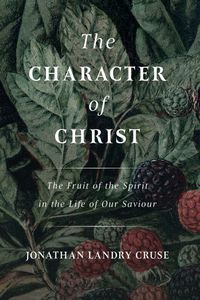
The Character of Christ by Jonathan Landry Cruse: The Fruit of the Spirit in Our Lord

The Character of ChristThe Character of Christ:
The Fruit of the Spirit in the Life of Our Saviour

by Jonathan Landry Cruse

DETAILS:
Publisher: Banner of Truth Trust
Publication Date: April 04, 2023
Format: Paperback
Length: 154 pg.
Read Date: August 6-13, 2023
Buy from Bookshop.org Support Indie Bookstores

The Goal/Design of the Book

The introduction is called “This Is Not A How-To Book.” This is vital, and this emphasis is likely why I bought this book* after hearing Cruse interviewed about it. Christian bookstores (wherever they may still exist) and websites are full of books on how to generate the Fruit of the Spirit in our lives, and are great ways to make yourself feel guilty when they don’t work.

Also, those books really miss the point anyway.

Cruse is clear about the need for believers to produce fruit—and he’s also clear about the way that happens. But that’s a secondary matter for this book—this book is about focusing on the Fruits of the Spirit and seeing how they were seen, manifested, and taught by our Lord.

This is a book about Christ, first and foremost. Following John Owen (and others) Cruse is convinced that as we see Him better, as we understand Him more, we will be transformed and those fruits will be seen.

* Given my appreciation for Cruse, that’s likely an overstatement–but I would’ve bought and read other books first.

What’s The Character of Christ About?

Okay, I just answered that—oops. After the Introduction, Cruse takes one chapter to look at each of the Fruits of the Spirit listed in Galatians 5: love, joy, peace, patience, kindness, goodness, faithfulness, gentleness, and self-control. The organization of each chapter varies—which is annoying for trying to sum it up briefly, but so nice when it comes to reading. It’d have been very easy for each of these chapters to have the same outline, just with different topics—and my eyes would’ve glazed over a lot.

Essentially, we get a good definition of each fruit along with examples of how we see that in the life of our Savior. Cruse will often show us what Christ Himself taught about the fruit, too. Each chapter ends with some sort of application—not in the “How To” sense. But here’s how you can display Christ, go to Jesus, and pray for this to be shown in your life as it applies to each fruit.

The book concludes with a reminder to look to Christ and how He has perfectly kept in step with the Spirit and borne the fruit. As we do so, as we are united to Him by the Spirit, we can be transformed as well.

So, what did I think about The Character of Christ?

This is too brief, not because Cruse was skimpy on details or needed to explain anything better. But each chapter could’ve been twice the length and not lost my interest, I could keep reading more and more about each of these ideas in this manner. Although I’m pretty sure if he did give us twice the length, I’d still be asking for more.

This was a great balance of doctrine and example/illustration. He’s careful not to let the reader focus too much on themselves as they ponder each idea but consistently points to the Author and Finisher of our Faith. It’s easy to read, wonderful to chew on, and truly helpful in the way that how-to books can’t be.

I strongly recommend this to your attention—not just for the content, but the manner in which Cruse presents it.


4 Stars
This post contains an affiliate link. If you purchase from it, I will get a small commission at no additional cost to you. As always, the opinions expressed are my own.

Irresponsible Reader Pilcrow Icon

These Dog Days Aren’t Over

(Updated and Revised 8/26/23)

It’s National Dog Day, the annual celebration of “all dogs, mixed breed and pure. Our mission is to help galvanize the public to recognize the number of dogs that need to be rescued each year and acknowledges family dogs and dogs that work selflessly each day to save lives, keep us safe and bring comfort.” So it seemed like a good day to post another version of this.

These Dog Days Aren't OverThis was a hard post to come up with a name for‡, essentially this post came from a comment not too long ago about being hesitant to read books about animals if the reader doesn’t know if they survive the book. I get that, I absolutely do. I still bear the scars of Where the Red Fern Grows and Marley and Me (sure, that wasn’t that long ago, but the wound still stings). So, for readers like my correspondent, here are some perfectly safe books prominently featuring dogs!

I plan on updating this regularly, so by all means, chime in with comments about Dogs I’ve forgotten about/haven’t encountered yet!

Non-Fiction

bullet The Particulars of Peter by Kelly Conaboy—this is a collection of humorous essays giving Conaboy the opportunity to rave about her dog, Peter. In her eyes, Peter is a perfect dog, and as you read this, you’ll be tempted to agree. (my post about it)
bullet Olive, Mabel & Me by Andrew Cotter—Cotter’s charming book describes his life with the two dogs that rocketed to international stardom (and brought him along). (my post about it)
bullet My Life as a Dog by L. A. Davenport—Davenport’s short little book about the relationship between the author and his dog, Kevin, a black and tan, pure-bred dachshund. It focuses on what the two of them did over two days and then a weekend selected from the years they spent together. (my post about it)
bullet Dogtology: Live. Bark. Believe. by Jeff Lazarus—Humans are so obsessed with their dogs, we’ve devoted so much time, energy, and work into them that it’s become a religion, with humans essentially worshipping their pets. This book is a look at that devotion and the rituals and beliefs that accompany it. It’s technically humor, but a lot of it seems pretty on-target. (my post about it)
bullet What the Dog Knows: The Science and Wonder of Working Dogs by Cat Warren—Warren basically covers three topics: there’s the science and history of using working dogs (of all sorts of breeds, not to mention pigs(!), birds, and even cats) to find cadavers, drugs, bombs, etc.; there’s the memoir of her involvement with cadaver dogs via her German Shepherd, Solo; and anecdotes of other cadaver dogs and trainers that she’s encountered/learned from/watched in action. (my post about it)
bullet What the Dog Knows Young Readers Edition by Cat Warren, Patricia J. Wynne—The above book adjusted for younger readers, with some great illustrations. It’s not dumbed-down, just adjusted. (my post about it)

Fiction

bullet Mace Reid K-9 Mystery series by Jeffrey B. Burton—A Dog Trainer/Cadaver Dog Handler and his dogs get involved in serial killer cases. Warning: Like many heroes in action novels, most of Mace’s dogs get beat up/injured. Some pretty badly. (my posts about them)
bullet Suspect by Robert Crais—One of my all-favorite books, a cop with PTSD gets assigned to the K-9 Unit and works with a dog fresh from Afghanistan combat. (my post about it) The pair also plays a major role in The Promise.
bullet Pug Actually by Matt Dunn—Doug, a loyal pug, plays cupid for his owner. This is a cute rom-com with a charming canine narrator. (my post about it)
bullet Stepdog by Nicole Galland—A love story where the major impediment to happily ever after is her dog (a gift from her ex). (my post about it)
bullet Noodle and the No Bones Day by Jonathan Graziano, Dan Tavis (Illustrator)—This picture book relates the origin of the Internet Craze and the wonderful, photogenic pug behind it. (my post about it)
bullet Oberon’s Meaty Mysteries by Kevin Hearne (Audiobooks narrated by Luke Daniels)—Oberon, the scene-stealing Irish Wolfhound from The Iron Druid Chronicles narrates this series of novellas (my posts about them).
bullet Neah Bay series by Owen Laukkanen—Lucy is a dog who is trained by prisoner Mason Burke, who has to track her down when he gets out. She’s a service dog for Marine Vet Jess Winslow. Lucy connects the two humans in her life and helps to keep them safe when a corrupt deputy comes after Jess. (my post about them)
bullet I Thought You Were Dead by Pete Nelson—I’m not sure how to sum this one up in a sentence. It’s a pretty typical novel about a troubled writer with a romantic life and family in shambles. But his dog is the thing that makes all the difference. (my post about it)
bullet Chet and Bernie books by Spencer Quinn—Bernie Little is a PI in Phoenix. Chet’s his four-legged partner and the series narrator. It’s too much fun to miss. (my posts about them)
bullet The Right Side by Spencer Quinn—”a deeply damaged female soldier home from the war in Afghanistan becomes obsessed with finding a missing girl, gains an unlikely ally in a stray dog, and encounters new perils beyond the combat zone.” (my post about it)
bullet Woof by Spencer Quinn—The beginning of an MG series about a with a penchant for trouble and her dog. (my post about it)
bullet Andy Carpenter books by David Rosenfelt—Andy Carpenter is New Jersey’s best defense lawyer and a devoted dog owner. He helps run a rescue shelter, too—and almost every client he takes as some sort of connection with a dog. These books aren’t dog-centric like the others on this list, but they’re dog-heavy. (my posts about them)
bullet The K-Team books by David Rosenfelt—a spin-off from the Andy Carpenter series. This features a PI team made up of Andy’s wife/investigator, Laurie; the near super-heroic Marcus; and Corey Douglas, a freshly-retired K-9 officer. His canine partner, Simon Garfunkel, comes along, too. Simon Garfunkel doesn’t play a giant role in the books, but he gets at least one good action scene per book. (my posts about them)
bullet Sharp Investigations by E.N. Crane—A series of comic investigations about an Ex-MP and her K-9 partner in Ohio. Both are pretty skilled and are walking disasters at the same time. (my posts about them)
bullet Voyage of the Dogs by Greg van Eekhout—SF for all ages about a team of dogs on a long-distance space flight. (my post about it)

Supportive Roles

These dogs aren’t as significant a presence in their books as the prior group, but they’re important enough to mention.
bullet Mouse from The Dresden Files by Jim Butcher. (my posts about them)
bullet The Midnight Plan of the Repo Man by W. Bruce Cameron and the sequel Repo Madness by W. Bruce Cameron— (my posts about them)
bullet Edgar from the Washington Poe books by M. W. Craven. (my posts about them)
bullet Rutherford from The TV Detective series by Simon Hall (my posts about them)
bullet Oberon from the Iron Druid Chronicles by Kevin Hearne. (my post about them)
bullet Ruffin from the I. Q. series by Joe Ide. (my posts about them)
bullet Dog from the Walt Longmire books by Craig Johnson (my posts about them)
bullet Purvis (and Beau) from The Good Kill by John McMahon (my post about it)
bullet Trogdor from The Golden Arrow Mysteries by Meghan Scott Molin (my post about them)
bullet Mingus from The Drifter by Nicholas Petrie (my post about it)
bullet Herbert and Daisy from Adult Assembly Required by Abbi Waxman (my post about it)

Books with paws on both sides of the line

Some books that belong on this list, but might be a bit too close to not fitting on it for some readers
bullet Lessons From Lucy by Dave Barry—there’s a strong “my beloved dog is old and will die soon-vibe throughout this (it’s the whole point), so some may want to avoid it. But the focus is on what Barry is learning from his aging but still full-of-life dog. (my post about it)
bullet Dead is … series by Jo Perry—the canine protagonist in these mystery novels is a ghost, so there’s a dog death involved. But we meet her as a ghost, so she won’t die (again) in the series. (my posts about them)
bullet Dogtripping: 25 Rescues, 11 Volunteers, and 3 RVs on Our Canine Cross-Country Adventure by David Rosenfelt—For various and sundry reasons, the Rosenfelts decide to move their home and dog shelter from California to Maine. As anyone who’s had to get a dog (or a toddler) into their vehicle for a drive across town can imagine—getting 25 dogs moved across the country is a logistical nightmare. In Rosenfelt’s capable hands, if “tragedy plus time equals comedy,” “nightmarish logistics plus time” does, too. The shelter specializes in senior dogs, so not every dog mentioned or featured lives, but that’s not the focus of the book. (my post about it)
bullet E. B. White on Dogs—if this isn’t every short piece or letter White wrote mentioning dogs, it’s so close as not to matter. Some are witty, some are touching, some are somewhere in between. There are even a few written from the point of view of his dog! Sadly, this does include a eulogy for one dog, a few other mentions of canine mortality, so it can’t make the main list. (my post about it)
bullet Lessons from Tara by David Rosenfelt—a sort-of-sequel to the above. Inspired by the death of their dog, Tara, the Rosenfelts now operate a no-kill shelter for senior dogs. This is the story about the origins and day-to-day of that life. There’s discussion of Tara’s death, and he has to cover the end of days for dogs, but it’s not the focus of the book. It’s one some will want to avoid, but you probably shouldn’t. (my post about it)
bullet Max Boucher Mysteries by Troy Lambert—Max used to be with the Seattle Police, but became a P.I. after the deaths of his wife and daughter. Because of the events of the first novel, Max gains a reputation as an animal detective. Particularly specializing in missing/kidnapped dogs. Most of the dogs in the series get out okay, but some are injured or worse. (my posts about them)
bullet Stray Ally by Troy Lambert—this is an action novel featuring heroics from several dogs working alongside a special ops soldier to try to stop a white supremacist group from launching a terrorist action. Some dogs are hurt, and a few die along the way. (my post about it)


‡ I brainstormed this a bit with my family, and wanted to share some of those titles that didn’t make the cut, just because I enjoyed their creativity:
bullet These Dogs Didn’t Go To Heaven/Not All Dogs Go to Heaven implies these dogs aren’t wonderful creatures, and that’s a solid loser
bullet No Kleenex Required too vague, and not necessarily true, they’re just not required because of a death
bullet The Best Bois
bullet Books Where the Author isn’t A Heartless Bastard (Looking at You, Marley and Me) too long, and boy howdy, does it seem my son has bigger issues with the book than I did
bullet Books that Even PETA Would Be Okay With
bullet Books for the Vegan in You suggests the dog books I don’t mention are in favor of eating them…
bullet Paw Patrol I’m almost confident my daughter’s boyfriend suggested as a joke, for his sake I’m assuming it was
bullet Pawfect Dog Stories I refuse to resort to that kind of joke

(Images by S K from Pixabay and josmo from Pixabay

REPOSTING JUST CUZ: The Christian’s True Identity by Jonathan Landry Cruse: An Introduction to the Glory that is Being “In Him”

Okay, I’m too tired to get something new ready. So instead of talking about Jonathan Landry Cruse’s newest book, let’s take a look at his previous one.


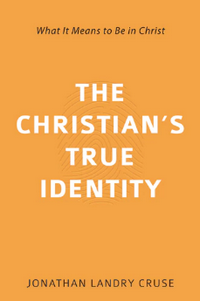
The Christian’s True Identity

The Christian’s True Identity:
What It Means to
Be in Christ

by Jonathan Landry Cruse

Kindle Edition, 144 pg.
Reformation Heritage, 2019

Read: March 21, 2021
Grab a copy from your local indie bookstore!

Many of us are raised believing that Jesus is simply the way to salvation. But no—He is salvation. He is the way, but He is also the life! He is both the giver and the gift. He is not a means to an end; He is the end. We are not to come to Christ looking for Him to give us something (like salvation, sanctification, a better life—or at least a better car), but instead we are to come to Christ looking for Him.

What’s The Christian’s True Identity About?

I’ve spent too much time trying to be clever or profound with this, it’s a short book, I can be brief here. The book’s point is pretty simple—despite all the noise and hubbub today about finding ourselves, choosing/shaping our identity. For the Christian, our identity comes from being rooted in Christ.

One of the—possibly the—greatest truths recovered by the Reformation was that union with Christ is at the core of all the blessings, all the amazing things that are true of the Christian, the Christian Life, and the Life of the World to Come. It’s all rooted and grounded in Him.

John calls it “abiding in” Christ. Paul repeatedly describes our blessings “in Him.” Cruse looks at ten passages from Paul’s epistles where he uses the phrase “in Him,” reviewing the passage, explaining how the passage reflects and teaches this truth about Christian identity, and applying it to the reader.

So, what did I think about The Christian’s True Identity?

Throughout this book we have considered how an identity in Christ far excels any identity the world might offer us. When we are in Christ we are chosen, forgiven, accepted as righteous, adopted into God’s family, placed in community, made new, and kept perfectly secure come what may. Our blessings in Jesus Christ are so expansive that it can truly be said that our union began in eternity with election and will forever continue in eternity with glorification.

That’s pretty much what’s covered in the book—done effectively, warmly, and clearly. Cruse has an easy-to-read, engaging style—he’ll draw you in and make you want to learn more. He skillfully uses writers from throughout Church History, contemporary scholarship, and current cultural examples to help bring these truths to life.

I think it could be deeper, I think it could be more detailed. But that’s not what the book aimed for—it’s an introduction or a refresher, that’s all. It’s supposed to drive the reader to further study, further reading. It accomplishes that goal while pointing to glorious, foundational truths. I commend it to you for that.


3.5 Stars

This post contains an affiliate link. If you purchase from it, I will get a small commission at no additional cost to you. As always, opinions are my own.

PUB DAY REPOST: Impossible Christianity by Kevin DeYoung: A Call for Assured Disciples

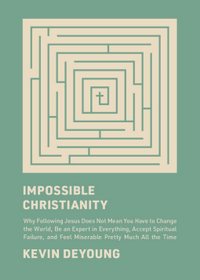
Impossible ChristianityImpossible Christianity:
Why Following Jesus Does Not Mean You Have to Change the World, Be an Expert in Everything, Accept Spiritual Failure, and Feel Miserable Pretty Much All the Time

by Kevin DeYoung

DETAILS:
Publisher: Crossway
Publication Date: August 15, 2023
Format: eARC
Length: 160  pg.
Read Date: July 23-30, 2023
Buy from Bookshop.org Support Indie Bookstores

What’s Impossible Christianity About?

On the one hand, the twenty-eight(!) words of the subtitle give a handy summary of what the book is about—but there’s still more to say. But it’s difficult to summarize outside of that without going on too long. Still, it’s worth a shot.

While exploring things like personal wealth, corporate guilt, and the call to individual holiness and sanctification, Kevin DeYoung reminds readers that our goal isn’t to change the world, it isn’t to achieve a perfection in behavior or ability, nor is it to wallow in our shortcomings and weaknesses. Rather, we are to press on when we stumble, ask God for forgiveness and help; keeping our eyes on our goal, see how far we’ve come; and rejoice in the work of grace in our lives—knowing that our Father is pleased with us.

There’s more to it than that (obviously, he spends eight chapters developing what I just used two sentences to convey). But that’s a decent thumbnail sketch.

The Highlights

In chapter 2, “Who Is It That Overcomes the World?,” we get an exploration of some of the more challenging material in 1 John. This treatment of 1 John and assurance is enough to justify picking the book up in the first place (for me, anyway. But I doubt I’ll be alone).

Where DeYoung will take these ideas from the epistle to encourage believers, to see signs of their faith and draw assurance from them, too many have taken the same words to use as tests of faith, to spur an attitude of “I must do more to earn God’s favor” or “I need to prove my devotion.”

While avoiding any kind of “cheap grace” (or whatever people call it today), DeYoung points to John’s heart in dealing with “little children” and encouraging their continuation in the faith.

He does something similar in Chapter 7 when reminding us of God’s Fatherhood and what the Scriptures tell us about Fatherhood. It’s an encouragement to fidelity and activity, not a whip to drive us to it. We’re called to virtues, not to-do lists—to reflect a character, not to change the world. The world (or at least things in our immediate vicinity) may be changed as a result, but that’s not our goal. Rather (as he argues in Chapter 8 ) is to live a quiet life of faithful discipleship.

I Could’ve Used a Bit More

DeYoung is known for frequently being on the pithy side with his books, and that’s certainly the case here. As it is characteristic of him, I don’t want to complain about that too much—I knew what I was getting into when I picked this book up.

Still, it felt a bit too brief. I wanted a little more from some of the chapters—a little more explanation, a little more depth, a little fuller idea of what he was trying to convey. It’s hard to explain while speaking broadly (and without citations because it’s an ARC), but I need 10-20% more of everything.

One thing, in particular, I wanted fleshed out was some criticisms he pointed at Christians who teach that we’re constant failures and should feel that weakness. I’d have appreciated less vagueness—direct citations, or at least references in a footnote would’ve been helpful so I could compare what he was arguing for to what he was arguing against.

So, what did I think about Impossible Christianity?

I think that’s my largest complaint—the book’s just a bit too brief. DeYoung was his typical engaging, clear (with the exception listed above), and helpful self in these pages. His illustrations and examples from his own life were amusing and helpful. If nothing else, I enjoyed reading the book.

On top of that criteria (in this type of book, it’s the least important), the book was helpful, encouraging, and gracious. Which is what it set out to be, so kudos for that. There was some material that was good to chew on, some healthy reminders of truths easy to forget or neglect, and a few moments to inspire a renewed activity.

Would I have appreciated more? Yes. Do I appreciate what DeYoung delivered? Also, yes. I’m afraid I come across as too critical, so let’s be clear—I wanted more of something helpful so it could’ve been more helpful.

From the smile-inducing opening illustration to the closing paragraphs of benediction (what a great addition to this book)—this was a pleasure to read. I do recommend this book and encourage others to pick it up.

Disclaimer: I received this eARC from Crossway via NetGalley in exchange for this post and my honest opinion—thanks to both for this.


4 Stars

This post contains an affiliate link. If you purchase from it, I will get a small commission at no additional cost to you. As always, the opinions expressed are my own.


Facing the Last Enemy by Guy Prentiss Waters: A Good Primer on Preparing for the The End

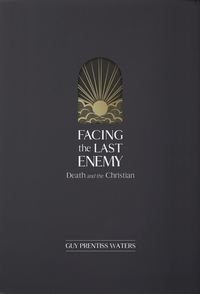
Facing the Last EnemyFacing the Last Enemy

by Guy Prentiss Waters

DETAILS:
Publisher: Ligonier Ministries
Publication Date: June 29, 2023
Format: Hardcover
Length: 132 pg.
Read Date: July 30 - August 6, 2023
Buy from Bookshop.org Support Indie Bookstores

What’s Facing the Last Enemy About?

Chapter 1 beings,

We all have questions about death. “What is death? Why do we die? Why do we all die? Why is death so scary? Why did Christ die? Why do Christians have to die? How can I face the death of someone I love? How can I prepare for death? How can I help others prepare for death? What happens after death?”

Essentially, the book is his attempt to answer those questions—largely along Scriptural and theological lines, but he also addresses some more practical aspects of preparing for death.

But before he answers those questions, Waters addresses some obstacles that 21st Century people face when thinking and talking about death seriously. We live in a culture of distraction, he says, which is nothing new but “we have taken distraction to new heights” between sports, movies, streaming services, the Internet, etc., etc. Secondly, we live in a “a culture of distancing and denial. We have all sorts of ways to try to keep death at arm’s length.” As a general rule, people go through the final stages of dying and death itself in an institution or facility of some sort—not home, surrounded by family and friends.

Those are the cultural obstacles, but there are some ecclesiastical obstacles as well. He points to the Evangelical embracing of consumerism—we treat people attending churches as customers, so we want to give them what they want to hear (things other than death) so they keep coming back. Secondly, there’s the embracing of an entertainment mentality. Death and dying are not entertaining at all—so we don’t discuss those things. Lastly, is the trend to divide congregations by age and stage of life, resulting in “a whole generation of Christians is deprived of witnessing the truth of Scripture exemplified and lived out in the lives of older Christians.”

Given these obstacles, it’s all the more important that people take steps to think about, study, and discuss things like death and the preparation for it.

The book is broken down into three parts. Part 1 “Defining Death” covers things such as the definition of death, why death is part of the world, why Christ died—why those who’ve trusted in Him continue to die, and so on. Part 2, “Encountering Death,” focuses on how we face the death of others—friends, acquaintances, family, and so on. How do we prepare ourselves to deal with (and grieve over) their deaths, how can we help them (both practically and spiritually) as they walk through the valley of the shadow of death? Then he spends two chapters on preparing for our own deaths—again, both spiritually and pragmatically (wills, living wills, burial choices, etc.) Then in Part 3, “Beyond Death,” Waters focuses on personal eschatology—the Resurrection, the Intermediate State, Final Judgement, and Heaven and Hell.

So, what did I think about Facing the Last Enemy?

The best thing that I can say about the book is that this is a good introductory—just look at the list of topics covered—in 132 pages you can’t say a lot about any of them. He does give some suggestions for further reading in the endnotes, which is good. But I wanted more. This feels like a well-developed outline than a book exploring the topics. It’s very likely the notes (or transcripts) of classes he taught for Ligonier that they put into book form—and those chapters would probably work for the time of Ligonier lessons. But if you’re going to take the time to turn those things into a book, you should as least expand on them a little bit.

Aside from that, there’s a lot to commend—on the purely theological issues, Waters is expectedly careful and thoughtful (or at least as thoughtful as he can). When it comes to definitions and explaining concepts he’s in line with the Westminster Standards—and the Christian thought throughout Church History. When it comes to contemporary concerns and the practical things that will vary from culture to culture—he’s careful to give advice and suggestions. When things are a matter of wisdom, prudence, or liberty, Waters says, “here’s some good ideas” or “think about this,” going out of his way not to label other options as sinful or his as “right.”

I think a conclusion wrapping things up, recapping some themes, and tieing into Chapter 1’s Introductory material would’ve been helpful. But that’s a matter of taste, I think. And the number of times I’ve said something like that over the last couple of years suggests that I really need to get over the idea of a concluding chapter.

Did I want more? Yes, particularly from someone of the caliber of Waters. Did I appreciate what we were given? Yes. It’s a great introductory volume and will undoubtedly be helpful for many.


3 Stars

This post contains an affiliate link. If you purchase from it, I will get a small commission at no additional cost to you. As always, the opinions expressed are my own.

Impossible Christianity by Kevin DeYoung: A Call for Assured Disciples

Impossible ChristianityImpossible Christianity:
Why Following Jesus Does Not Mean You Have to Change the World, Be an Expert in Everything, Accept Spiritual Failure, and Feel Miserable Pretty Much All the Time

by Kevin DeYoung

DETAILS:
Publisher: Crossway
Publication Date: August 15, 2023
Format: eARC
Length: 160  pg.
Read Date: July 23-30, 2023
Buy from Bookshop.org Support Indie Bookstores

What’s Impossible Christianity About?

On the one hand, the twenty-eight(!) words of the subtitle give a handy summary of what the book is about—but there’s still more to say. But it’s difficult to summarize outside of that without going on too long. Still, it’s worth a shot.

While exploring things like personal wealth, corporate guilt, and the call to individual holiness and sanctification, Kevin DeYoung reminds readers that our goal isn’t to change the world, it isn’t to achieve a perfection in behavior or ability, nor is it to wallow in our shortcomings and weaknesses. Rather, we are to press on when we stumble, ask God for forgiveness and help; keeping our eyes on our goal, see how far we’ve come; and rejoice in the work of grace in our lives—knowing that our Father is pleased with us.

There’s more to it than that (obviously, he spends eight chapters developing what I just used two sentences to convey). But that’s a decent thumbnail sketch.

The Highlights

In chapter 2, “Who Is It That Overcomes the World?,” we get an exploration of some of the more challenging material in 1 John. This treatment of 1 John and assurance is enough to justify picking the book up in the first place (for me, anyway. But I doubt I’ll be alone).

Where DeYoung will take these ideas from the epistle to encourage believers, to see signs of their faith and draw assurance from them, too many have taken the same words to use as tests of faith, to spur an attitude of “I must do more to earn God’s favor” or “I need to prove my devotion.”

While avoiding any kind of “cheap grace” (or whatever people call it today), DeYoung points to John’s heart in dealing with “little children” and encouraging their continuation in the faith.

He does something similar in Chapter 7 when reminding us of God’s Fatherhood and what the Scriptures tell us about Fatherhood. It’s an encouragement to fidelity and activity, not a whip to drive us to it. We’re called to virtues, not to-do lists—to reflect a character, not to change the world. The world (or at least things in our immediate vicinity) may be changed as a result, but that’s not our goal. Rather (as he argues in Chapter 8 ) is to live a quiet life of faithful discipleship.

I Could’ve Used a Bit More

DeYoung is known for frequently being on the pithy side with his books, and that’s certainly the case here. As it is characteristic of him, I don’t want to complain about that too much—I knew what I was getting into when I picked this book up.

Still, it felt a bit too brief. I wanted a little more from some of the chapters—a little more explanation, a little more depth, a little fuller idea of what he was trying to convey. It’s hard to explain while speaking broadly (and without citations because it’s an ARC), but I need 10-20% more of everything.

One thing, in particular, I wanted fleshed out was some criticisms he pointed at Christians who teach that we’re constant failures and should feel that weakness. I’d have appreciated less vagueness—direct citations, or at least references in a footnote would’ve been helpful so I could compare what he was arguing for to what he was arguing against.

So, what did I think about Impossible Christianity?

I think that’s my largest complaint—the book’s just a bit too brief. DeYoung was his typical engaging, clear (with the exception listed above), and helpful self in these pages. His illustrations and examples from his own life were amusing and helpful. If nothing else, I enjoyed reading the book.

On top of that criteria (in this type of book, it’s the least important), the book was helpful, encouraging, and gracious. Which is what it set out to be, so kudos for that. There was some material that was good to chew on, some healthy reminders of truths easy to forget or neglect, and a few moments to inspire a renewed activity.

Would I have appreciated more? Yes. Do I appreciate what DeYoung delivered? Also, yes. I’m afraid I come across as too critical, so let’s be clear—I wanted more of something helpful so it could’ve been more helpful.

From the smile-inducing opening illustration to the closing paragraphs of benediction (what a great addition to this book)—this was a pleasure to read. I do recommend this book and encourage others to pick it up.

Disclaimer: I received this eARC from Crossway via NetGalley in exchange for this post and my honest opinion—thanks to both for this.


4 Stars

This post contains an affiliate link. If you purchase from it, I will get a small commission at no additional cost to you. As always, the opinions expressed are my own.
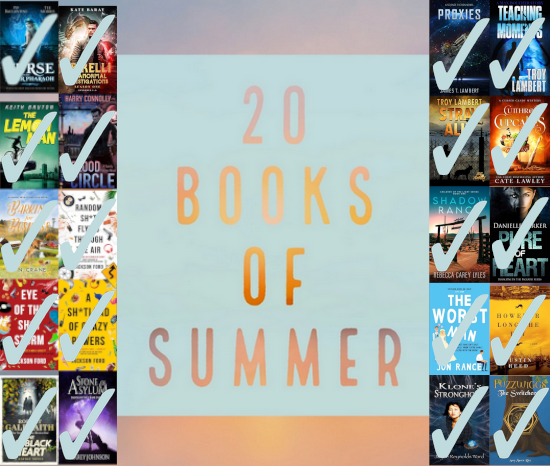
20 Books of Summer 2023: July Check-In

20 Books of Summer
Here’s a quick check-in for this challenge run by Cathy at 746 Books.

So far, I’ve read 11 of the 20—which puts me 2 behind last year (but 3 ahead of 2021, though). I should read at 2-3 over the rest of this week, so I’m feeling pretty good about where I am. I think I’ll have a week to spare.

Now I’ve only written about four of these books, so I’ve got my work cut out for me if I want to get caught up on these by the end of the Summer. It’s doable, but, I need to get to work on that.

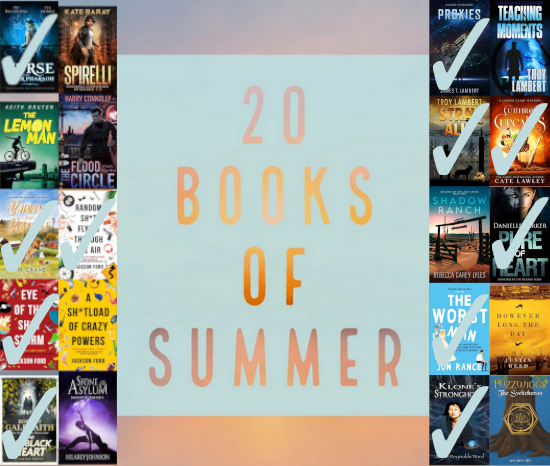
✔ 1. The Curse of the Silver Pharaoh by Pip Ballantine and Tee Morris
2. Spirelli Paranormal Investigations: Episodes 1-3 by Kate Baray
3. The Lemon Man by Ken Bruton
4. The Flood Circle by Harry Connolly
✔ 5. Barking for Business by E.N. Crane
✔ 6. Random Sh*t Flying Through the Air by Jackson Ford (my post about it)
✔ 7. Eye of the Sh*t Storm by Jackson Ford
8. A Sh*tload of Crazy Powers by Jackson Ford
✔ 9. The Ink Black Heart by Robert Galbraith
10. Stone of Asylum by Hilarey Johnson
✔ 11. Proxies by James T. Lambert
12. Teaching Moments by Troy Lambert
✔ 13. Stray Ally by Troy Lambert
✔ 14. Cutthroat Cupcakes by Cate Lawley (my post about it)
15. Shadow Ranch by Rebecca Carey Lyles
✔ 16. Pure of Heart by Danielle Parker (my post about it)
✔ 17. The Worst Man by Jon Rance (my post about it)
18. However Long the Day by Justin Reed
✔ 19. Klone’s Stronghold by Joyce Reynolds-Ward (my post about it)
20. Fuzzwiggs: The Switcheroo by Amy Maren Rice

(subject to change, as is allowed, but I’m going to resist the impulse to tweak as much as I can).

20 Books of Summer '23 July Check In Chart

Grandpappy’s Corner: The Biggest Story ABC by Kevin DeYoung, Don Clark (Illustrator): A Swing and a Miss

Grandpappy's Corner Logo The Biggest Story ABC

The Biggest Story ABC

by Kevin DeYoung, Don Clark (Illustrator)

DETAILS:
Publisher: Crossway
Publication Date: August 31, 2017
Format: Board Book
Length: 26 pg.
Read Date: July 16, 2023

What’s The Biggest Story ABC About?

This is an ABC book with a twist—DeYoung uses the alphabet to tell (in an age-appropriate way) to tell the story of Creation and Redemption from

In the beginning, God created Adam and Eve.

to

One Day we will live forever in Zion, the new world God is preparing for those who love him.

Let’s Talk about the Art for a Minute

On the whole, the art was stunning. It’s not at all the typical board book art. It’s not cute or bubbly. I think it’s pretty eye-catching, and striking. I’m not sure exactly how the Board Book-Set would appreciate it, but maybe just because it doesn’t look like every other book they get, they’ll be interested?

Or maybe it’ll be the colors that get them. I’m not sure.

Thankfully, there are examples on Crossway’s site so I don’t have to try to describe this. Here are the K and L pages so you can get an idea:
Biggest story K - L

How is it to Read Aloud?

It’s fine—there are no rhymes, there’s no consistent rhythm or pattern or anything like that. This book isn’t about that kind of thing—it’s simple and straightforward text. Easy to read and easy to understand.

I Have a Problem

The Reformed Confessions and Catechisms are pretty clear—no pictures of members of the Godhead. But, this book contains some images of Jesus. I realize that DeYoung argues against this interpretation in his book on the Heidelberg Catechism (a pretty good, but not great book), so at least he’s consistent.

Given that many of the readers (or at least buyers) of this book are going to be from the Reformed or Presbyterian traditions. Why risk offending them?

So, what did I think about The Biggest Story ABC?

The way DeYoung told the story of redemptive history was great. He had to get inventive (a less charitable take might say that he really stretched things, but he managed) with the way he used a couple of letters to stick with the storyline, but it was really a fantastic job.

The text is great, and I’d eagerly recommend the book based on it. But a board book/picture book for kids is never just about the text. It’s also about the pictures and the way the book looks. And because of the Second Commandment violations, I just can’t recommend it.

Grandpappy Icon

The Irresponsible Reader On…Self-Published Non-Fiction

(updated 7/26/23)
Self-Published Authors Appreciation Week

From the first moment that people did the strange thing of asking me to talk about their books on my blog, I’ve been impressed by the quality of a lot of what’s been published by authors going out on their own, taking all the risks, shouldering all the responsibility and doing all the work to get their words, their dreams, their blood, sweat, and tears. This should be celebrated—it’s definitely appreciated, as we’re trying to show this week.

In addition to the Q&As and Guest Posts I have this week, I’m also continuing my habit of highlighting the self-published works that I’ve blogged about over the last few years—just a sentence or two.  Hopefully, this’ll be enough to make you click on the link to the full post. Beyond that, it’d be great if I inspired you to add a few of these to your TBR. Also, be sure you check out the other posts over at the SPAAW Hub.

Today we’re going to be looking at Self-Published Non-Fiction—which are primarily memoirs at their core, it’s what the authors do with the memoirs that makes these really stand out. But there are a few other things, too.

bullet Life and Death Behind the Brick and Razor: Code Red Diamond by Isaac Alexis, MD—A prison doctor uses his experiences to give suggestions for a healthy/healthier life. (my post about it)
bullet How Not to Be an *SS: Essays on Becoming a Good & Safe Man by Andrew J. Bauman—Bauman calls men to an authentic, Biblical masculinity—one built on humility, kindness, and service. While offering concrete ways to set aside patterns of abuse and neglect. (my post about it)
bullet Kneading Journalism: Essays on baking bread and breaking down the news by Tony Ganzer—This is a collection of essays about the state of journalism, how people relate to and view the media we consume, and what the future may hold. Oh, and bread recipes, of course. It makes sense in context (and is a really great idea). (my post about it)
bullet No Problem, Mr. Walt: Building a Boat, Rebuilding a Life, & Discovering China by Walt Hackman—Hackman was one of the first self-published authors to reach out to me, and I’m so glad he did. A fascinating read about a man deciding to have an authentic Chinese junk built for him to use as a houseboat in California. (my post about it)
bullet Finding Hope in Hard Things: A Positive Take on Suffering by Pierce Taylor Hibbs—The central premise is that God uses the “hard things” in life to shape us into the people he wants us to be, and uses some of the hard things in his life as case studies to demonstrate how they were used so the reader is equipped to look at their own lives and see the purpose in their suffering. (my post about it)
bullet The Great Lie: What All of Hell Wants You to Keep Believing by Pierce Taylor Hibbs—Paired with Hibbs’ characteristic clear prose and gift with language and illustrations, Hibbs reminds the reader that God is always speaking to us, through both the Creation and His Word. (my post about it)
bullet In Divine Company by Pierce Taylor Hibbs—Pierce’s treatment of prayer focuses on the communicative nature of God and His image bearers and then nurturing that in our lives to improve our prayer. (my post about it)
bullet Struck Down but Not Destroyed: Living Faithfully with Anxiety by Pierce Taylor Hibbs—Drawing on what he’s learned from over 12 years of anxiety, Hibbs talks about learning to see what God’s purpose in the suffering is (anxiety disorders specifically, but easily transferable to other types), understanding that His hand is guiding all things—including our problems—so how do we in faith (without denying the suffering) rest in faith. (my post about it)
bullet And Drink I Did: One Man’s Story of Growing Through Recovery by Jay Keefe—It’s all there in the subtitle, Keefe tells about his OCD, his alcoholic days, his getting sober, and how he’s trying to help others since then. Powerful stuff. (my post about it)
bullet How to Take Over the World: Practical Schemes and Scientific Solutions for the Aspiring Supervillain by Ryan North—A tongue-in-cheek way to talk about some of the most advanced science around and how it can (and in some ways is) be used to destroy the world. (my post about it)
bullet The Genius’ Guide to Bad Writing by R.T. Slaywood, R.C. Martinez—A guide for the writer who is tired of success and wants to reclaim their lives from answering the siren call of fortune and fame that comes to every author. Slaywood and Martinez have a 10-Step program guaranteed to ruin a novel or two and stop a career dead in its spot. (my post about it)
bullet Uber Diva by Charles St. Anthony—a humorist writes a memoir of a Lyft/Uber driver mixed with a guide to starting/surviving/thriving as one in a tough market. St. Anthony also has a few other books out now that are probably worth a read. (my post about it)
bullet Flying Alone: A Memoir by Beth Ruggiero York—A female pilot’s memoir of her path from flight school to flying for TWA (now that I have a son learning to fly, some of her more harrowing experiences keep flashing through the back of my mind). (my post about it)


If you're a self-published author that I've featured on this blog and I didn't mention you in this post and should have. I'm sorry (unless you're this guy). Please drop me a line, and I'll fix this. I want to keep this regularly updated so I keep talking about Self-Published Authors.

Self-Published Authors Appreciation Week Footer

The 2023 Self-Published Authors Appreciation Week Logo was made by Witty and Sarcastic Book Club

I Will Build My Church: Selected Writings on Church Polity, Baptism, and the Sabbath by Thomas Witherow, Edited by Jonathan Gibson: Presbyterianism 101

I Will Build My ChurchI Will Build My Church:
Selected Writings on
Church Polity, Baptism, and
the Sabbath

by Thomas Witherow, Edited by Jonathan Gibson

DETAILS:
Publisher: Westminster Seminary Press
Publication Date: January 29, 2022
Format: Hardcover
Length: 251 pg.
Read Date: July 2-16, 2023

What’s I Will Build My Church About?

Thomas Witherow was an Irish Presbyterian pastor in the mid-Nineteenth Century, who later became a professor. Over the course of his ministry–in part thanks to the revivals of the time–he saw more competition in Ireland to the Presbyterian Church from a variety of Protestant groups. He also saw that too many Presbyterian members or ministers couldn’t define or defend the distinctives–many seeing them as a tradition more than a conviction.

One of Witherow’s driving missions was to help the Presbyterians he taught amongst to see that their distinctives were serious and defensible. He also wanted to explain them to the other Protestants and possibly convince them to at least consider them.

This is a collection of three of his works along those lines–about ecclesiology, sacraments, and the Sabbath–slightly edited for modern standards. Long sentences turned in to multiple, spelling updates, and so on–and the Bible citations modified to be the ESV. That sort of thing.

A Prince of Irish Presbyterianism

Before we get into the works, the editor, Jonathan Gibson, provides an almost 80-page biography of Witherow–sketching his education, family life, pastoral work, writing, and professorial work.

I just picked this up to read Witherow, and hadn’t counted on learning anything about him and it was a great bonus for me to get more context for his work both in terms of his own life and the Church situation he found himself in.

The Apostolic Church

Odds are, if you know anything that Witherow wrote, it’s this short book (in this edition, it’s about seventy pages long). The subtitle to this is “Which is it? – An Inquiry at the Oracles of God as to Whether Any Existing Form of Church Government is of Divine Right.” Which is a pretty good summary of the work.

Witherow’s convinced that too many people (no matter their preferred ecclesiology) see it as a matter of convenience, taste, and traition. He cannot abide by that kind of thinking–convinced that if the Church cannot find Scriptural endorsement of a way of doing something, it ought to be abandonded.

Witherow starts this work by listing and explaining six principles he sees in the Apostolic Church then he looks at the three forms of church government–prelacy (whether in Roman Catholic or Anglican form), congregational, and presbyterian–to see which, if any, does the best job of embodying those principles.

Scriptural Baptism

This is a slightly shorter book on the subject of Baptism–tackling (in turn) the mode of baptism and the subjects of it.

He deals with the question of mode pretty quickly–first by Scriptural evidence and then moving to practical considerations.

Then he moves on to the issue of the subjects of baptism–from the outset, he’s careful not to let prominent Irish Baptists set the terms of the debate, instead he reframes the typical way these conversations went in his circles. Rather than starting with the positions of the baptists and then responding to them, he sets out a few points he wants baptists to answer–and then shows how (from his vantage point, anyway) they cannot.

The Sabbath

The book on the Lord’s Day/Sabbath is more pointed than the others. Witherow takes a pretty traditional path–defining moral and ceremonial law at the outset. Then he addresses Christ’s attitude toward and teaching about the Sabbath before getting into the abrogation of the ceremonial law and the practice of the New Testament church.

Then Witherow addresses a move to adjust the equivalent of the Blue Laws there to make Sunday a day for amusement (I’m a little vague on the details and it’d take to long to explain my guesses). Basically, where you could go pay for theaters and shopping and the like. Witherow follows his explanation for the Christian observance of the Lord’s Day with a warning about what will happen if the laws are changed–how it will negatively impact workers, businesses, and the economy–in addition to the church.

Say what you will about Blue Laws (and I have plenty to say in other contexts), Witherow was spot-on with his predictions.

So, what did I think about I Will Build My Church?

I spent a lot of time with The Apostolic Church almost twenty years ago–I used it and a paper by him to compare with some contemporary American ecclesiologies. I haven’t read it since for a variety of reasons (mostly overkill), but man, it was fun to come back to it.

I appreciate the footnotes Gibson added, but I’m not so sure that we needed the ESV update. I don’t know what it gained, outside of maybe making it more accessible for contemporary readers. But those who are going to need an ESV rather than the AV for translation are really going to be put off by Witherow’s insistence to call the baptists Anabaptists throughout the second book. He’s definitely not a 21st century writer🙂

I enjoyed all these books–and Gibson’s biography was a great bonus. The photographs of Witherow and his family were unexpected, too.

Sharp, concise writing, with a little bit of punch (but not quarrelsome). This is a great introduction/tutorial on Presbyterian Church distinctives. Highly recommended.


5 Stars

Page 21 of 63

Powered by WordPress & Theme by Anders Norén