Category: Non-Fiction Page 28 of 63

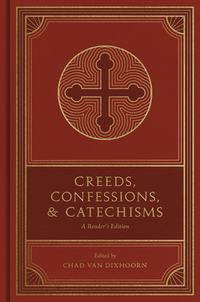
Creeds, Confessions, and Catechisms: A Reader’s Edition edited by Chad Van Dixhoorn

Creeds, Confessions, and CatechismsCreeds, Confessions, and Catechisms: A Reader’s Edition

edited by Chad Van Dixhoorn

DETAILS:
Publisher: Crossway
Publication Date: June 21, 2022
Format: Clothbound
Length: 434 pg.
Support Independent Bookstores - Visit IndieBound.org

What’s Creeds, Confessions, and Catechisms: A Reader’s Edition?

This is a collection of Ecumenical Creeds and some of the most-used Protestant Confessions and Catechisms. These are:
bullet The Apostles’ Creed
bullet The Nicene Creed
bullet The Athanasian Creed
bullet The Chalcedonian Definition
bullet The Augsburg Confession
bullet The Belgic Confession
bullet The Thirty-Nine Articles of Religion
bullet The Canons of Dort
bullet The Westminster Confession of Faith
bullet The London Baptist Confession
bullet The Heidelberg Catechism
bullet The Westminster Larger Catechism
bullet The Westminster Shorter Catechism

Each document is given a 1-2 page introduction by the editor describing “its origins and significance” to the church (as the Publisher puts it).

As I’m not foolhardy enough to give pluses and minuses (or whatever) when it comes to the matieral, so this isn’t going to be my typical kind of post.

Questions I Had

While reading through this collection, I had a few questions about why Van Dixhoorn selected certain Confessions (no offense, Lutherans and Baptists) or why he picked particular translations of some of them. And I’d intended to spend a little time discussing them and speculating about the answers. But then I read on Crossway’s site that this book was “Adapted from ESV BIble with Creeds and Confessions,” so I guess that edition of the ESV probably did the selecting in the first place and Van Dixhoorn stuck with that.

Why Should You Buy Creeds, Confessions, and Catechisms: A Reader’s Edition?

bullet It’s very attractive—the cover design is top-notch. The interior layout is pleasing to the eye and easy to read. The paper is nice and thick. It looks good on your shelf or in your hands. On the one hand, this is a minor point—but it’s a big selling point for a reference work.
bullet Along those lines, the binding and everything makes me think this is going to last a long time—and through repeated readings.
bullet The way it’s typeset and laid out would make it easier as a copy to read through some or all of the contents. I’ve got multiple copies of most of these documents, and a lot of them aren’t easy to read—they’re more things you consult briefly. This is one I could sit down with regularly and just read.
bullet That’s what it’s designed for—to read. It’s right there in the title. This isn’t an edition for people who are doing scholarship or research. You’ve got Schaff for that—or James Dennison’s set.
bullet Especially if you’re looking for an introduction to the Protestant standards, this is a handy edition and guide to the essentials.
bullet Van Dixhoorn’s introductions are user-friendly and helpful to orient the reader to the origin, concerns, and highlightings of each document.

This post contains an affiliate link. If you purchase from it, I will get a small commission at no additional cost to you. As always, the opinions expressed are my own.

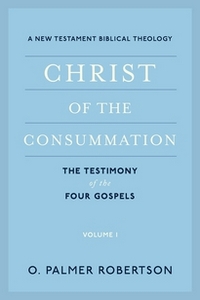
Christ of the Consummation, Vol. 1 by O. Palmer Robertson: The Beginning of A Wonderful Trilogy

Christ of the Consummation:Christ of the Consummation:
A New Testament Biblical Theology
Volume 1: The Testimony of
the Four Gospels

by O. Palmer Robertson

DETAILS:
Publisher: P & R Publishing
Publication Date: June 1, 2022
Format: Paperback
Length: 321 pg.
Read Date: August 7-28, 2022
Support Independent Bookstores - Visit IndieBound.org

In these new phases of redemptive history, the heart of the revelation does not change, but it broadens and deepens in the realities of the truth. Jesus Christ is the same, but his church, his precious bride, is being built by the addition of nations being born in a day as a consequence of Christ’s pouring out the gifts of his Spirit on all flesh. The kingdom of God has come and continues to come. The kingdom of God is yet to come. It will arrive in all its fullness on that day, the great judgment day, the day of resurrection and restoration of all things. To God be the glory for the things he has done, is doing, and yet will do.

What’s Christ of the Consummation, Volume 1 About?

At some point when reading Vos’ Biblical Theology most readers like me* start to wonder, “How is he doing to have time to cover the New Testament? While Vos doesn’t give his readers the same kind of insight into the history of revelation of the NT as he does the OT, he does set out some principles. Robert’s work is the first book-length attempt to apply Vos’ directions to apply his method to the NT (actually, the first of three book-length attempts).

That’d be people who didn’t know what was coming from pre-knowledge about the book or reading the Table of Contents.

He begins by stating the difference between the two works—there are centuries upon centuries of history of OT revelation, and a maximum of one from the announcement of Jesus’ birth to Mary to the end of John’s writing on Patmos. But that doesn’t mean that there’s no development, but how best to approach that? Robertson focuses on three distinctives in his approach:

  1. Retracing the Historical Progression across the Various Phases of New Covenant Revelation as the Organizing Principle
  2. The Foundational Role of the Old Covenant Scriptures
  3. Contemporary [to their writing] Application of New Testament Biblical Theology

With these distinctives in mind, Robertson looks at material concerning Jesus’ self-testimony; various phases of His life and work; the progressive revelation of the Kingdom during His life; His death, burial, resurrection, and ascension; and then he moves into closer looks at the various Gospels individually and corporately.

An Unexpected Bonus

A number of times throughout the text Robertson will hit pause on his exegetical work, the historical reflections, or the interpretative/theological conclusions from those, to offer application to the lives and hearts of the reader. Sometimes a broader or more general call and sometimes it’s a narrow focus. I really didn’t expect these at all, and I almost never saw them coming when he did pause for one. But I appreciated them all and found them to be a real enhancement to the work.

So, what did I think about Christ of the Consummation, Volume 1?

I’m clearly not qualified to evaluate Robertson’s application of Vos, but people like D.A. Carson and Richard Gaffin are, so I’ll take their word for it. Sure, they wrote the forward and a “further word” for this book, so it’s not like we’re talking about impartial evaluations.

Nor am I capable of—or willing to—give this a good and thorough review/evaluation. Although I do wish I could. So let me offer a few thoughts from my perspective as a lay reader. And I do think this is a book written with the layman in mind—it’s not a casual read by any means, but it is not a book solely for scholars.

I’m not sure I’ve read a Christian book this year that has made me think more, read slower/closer, and pushed my thinking more. It’s also been the most rewarding and I think it will prove the most fecund for my future reading, study, and devotion.

At the same time, the number of times that I read something I don’t think I’d ever been exposed to, or that was wholly novel to me is so small as to be negligible. This is not to say that it was all review or that he didn’t make me stop and think for a minute or ten to consider a point before moving on. But on the whole, it’s a reframing and refocusing of many things I’ve read in lay-friendly works or heard in sermons/lectures. It’s not “here’s a whole new way to read/think about the Gospels”—and Robertson would be the last to want something like that. Instead, this is a “here’s a way to profitably consider the way these things were revealed” and “here’s how the Gospels build upon one another and build up each other.”

I’m already trying to figure out when I can get in a re-read without ruining plans for next year—possibly in combination with a re-read of Vos’ Biblical Theology so I can more directly see for myself the connections between the two works and Vos’ influence.

This is the first in a trilogy—if the rest of the trilogy is as good as this one, the series will likely end up on shelves everywhere next to Vos. I know I’m already ready to dive into the next volume.


5 Stars

This post contains an affiliate link. If you purchase from it, I will get a small commission at no additional cost to you. As always, the opinions expressed are my own.

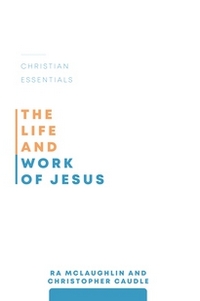
The Life and Work of Jesus by Ra McLaughlin and Christopher Caudle: A Broad and Capable Introduction to Christology

The Life and Work of JesusThe Life and Work of Jesus

by Ra McLaughlin and Christopher Caudle

DETAILS:
Series: Christian Essentials 
Publisher: P & R Publishing
Publication Date: April 26, 2022
Format: Paperback
Length: 286 pg.
Read Date: October 8-23, 2022
Support Independent Bookstores - Visit IndieBound.org

What’s The Life and Work of Jesus About?

One of the advantages of this series is that I can largely recycle what I said about the first volume (I tried to come up with something new, but it felt like I was wasting time reinventing it).

This is a basic and broad introduction to Christology—starting with the idea of a savior and dealing with the overall plan of salvation before moving into seeing the outworking of that idea in history through the Incarnation and Jesus’ life, death, and resurrection. Then it moves into a discussion of the offices Christ executes (prophet, priest, and king)–looking at them in the OT shadows, Christ’s fulfillment of them on Earth and now. It’s adapted from curriculum using language that’s easy to translate—particularly into languages that don’t have a well-developed theological vocabulary—so the English is kept basic, too. There’s almost no academic or technical theological language used, and those that are used are well-defined (including in a handy glossary).

The chapters are short (most around fifteen pages) and well-organized. Each contains a handful of side-bars consisting of a paragraph or two with the contents of interviews with pastors and theologians on the topic under discussion. These interviews were with people from a variety of theological perspectives helping broaden the text so that it’s not exclusively from a reformed perspective.

So, what did I think about The Life and Work of Jesus?

I wasn’t blown away by this, but I liked it. It was a good, basic but thorough introduction to both the life and work of Jesus. After the first book in the series, I thought I knew what to expect from this book–and got it, with a little bit more. I’d say these authors covered their topics a bit more thoroughly than the previous book did (but just a bit). I’m not as convinced that the sidebars were as helpful this time out, however, so maybe things evened out.

I didn’t stumble onto anything problematic in this work like I did in the previous one, which was very encouraging.

All in all, this is a solid work that would be great for a new believer or a young student looking to get a better grounding. It’s broad enough to appeal to any evangelical but solid enough to work for those who tend to prefer a bit more precision.


3 Stars

This post contains an affiliate link. If you purchase from it, I will get a small commission at no additional cost to you. As always, the opinions expressed are my own.
REPOSTING JUST CUZ: The Essential Trinity by Brandon D. Crowe and Carl R. Trueman, eds.

(the title’s not entirely true…there’s another re-run because I couldn’t stay awake Saturday to finish a new post. But there’s no event correlating with selecting this book. I’ve got three books to post about in the Sunday evening slot, hopefully you’ll see one of them here next week.)


The Essential Trinity The Essential Trinity: New Testament Foundations and Practical Relevance

by Brandon D. Crowe and Carl R. Trueman, eds.

Paperback, 273 pg.
Inter-Varsity Press, 2016

Read: July 31 – August 14, 2016

As far as consistency of quality amongst edited volumes goes, Crowe and Trueman have assembled one of the stronger line-ups I’ve read in a while — men from a spectrum of persuasions of Evangelical-ish thought have given the Church fourteen articles (approximately 20 pages each) to deepen our thinking about the Trinity. The aim was for a volume that “eschews overly technical discussion and focuses attention on the importance of the doctrine for every Christian.”

In Part 1, the articles look at the “trinitarian contours of every corpus of the New Testament, along with a chapter reflecting on the Old Testament roots of trinitarian doctrine.” If there are weak chapters in the volume, they’re in this part — but they aren’t that weak, either. Crowe’s chapter on Matthew is excellent, but the chapters on the Mark, Luke-Acts and John aren’t far off that Mark. Brian S. Rosner’s chapter on “Paul and the Trinity” is worth the price of the book. The chapters on the rest of the epistles are very helpful (particularity Hebrews). Mark S. Gignilliat’s article, “The Trinity and the Old Testament: real presence or imposition?” is very helpful and insightful — and as an added bonus, it’s the most stylistically entertaining and engaging piece in the book.

Benjamin Gladd’s chapter exploring Daniel’s influence on Revelation’s view of the Trinity is the biggest mental workout you’ll get in the book. I appreciated the material covered and the argument Gladd makes, but I’m going to have to read it a few more times before I think I have a good handle on it.

Part 2 addresses the importance of the Trinity for everyday living — many would say the doctrine is impractical and only belongs in Statements of Faith and academia. The authors here show the fallacy of that. It begins with a brief, but excellent, description of the doctrine by Scott R. Swain. Carl Trueman has the next chapter, “The Trinity and prayer,” which is probably as valuable as Rosner’s — it’s actually about more than prayer, but the material specifically on prayer is great — hugely indebted to John Owen (but not uncritically so). Robert Letham’s chapter on “The Trinity and worship” also draws deeply from Owen; if he doesn’t move you to worship as you understand the work of the Trinity in it, you aren’t paying attention (I probably have more problems with some of what he says than anything else in the book). Michael Reeves, typically, made me chuckle in his chapter on preaching — but he did more than that, too.

Timely, convicting, thoughtful and inspiring, this examination of the Trinity in Scripture and Life should be a great benefit to any believer ho reads it. It may not be the easiest thing read all year (but really, it’s not that difficult), but it’ll be one of the most rewarding.

—–

4 Stars

REPOSTING JUST CUZ: Heaven on Earth by Thomas Brooks

Heaven On EarthHeaven On Earth

by Thomas Brooks

ebook
originally published 1654
Read: May 11 – 25, 2014

I just might have myself a new favorite Puritan (I’m not the only one who has a list, right?). I’m kicking myself for not getting to Brooks earlier in life. What a wonderful book — I’m looking forward to getting to read more by him.

Aesthetically, this is fantastic. The language sings — the book begs to be read aloud (and I frequently did so, interrupting whatever anyone around me was doing). You can feel the passion, the fervor throughout. A few paragraphs from different chapters illustrate this:

Divine light reaches the heart as well as the head. The beams of divine light shining in upon the soul through the glorious face of Christ are very working; they warm the heart, they affect the heart, they new mold the heart. Divine knowledge masters the heart, it guides the heart, it governs the heart, it sustains the heart, it relieves the heart. Knowledge which swims in the head only, and sinks not down into the heart, does no more good than the unicorn’s horn in the unicorn’s head.

The only ground of God’s love is his grace. The ground of God’s love is only and wholly in himself. There is neither portion nor proportion in us to draw his love. There is no love nor loveliness in us that should cause a beam of his love to shine upon us. There is that enmity, that filthiness, that treacherousness, that unfaithfulness, to be found in every man’s bosom, which might justly put God upon glorifying himself in their eternal ruin, and to write their names in his black book in characters of blood and wrath. God will have all blessings and happiness to flow from free grace.

Faith is the first pin which moves the soul; it is the spring in the watch which sets all the golden wheels of love, joy, comfort, and peace a-going. Faith is a root-grace, from whence springs all the sweet flowers of joy and peace. Faith is like the bee, it will suck sweetness out of every flower; it will extract light out of darkness, comforts out of distresses, mercies out of miseries, wine out of water, honey out of the rock, and meat out of the eater, Judg 14:14.

But beyond that, the book is sound, it is orthodox, it is Biblical — throughout Brooks points the reader to The Book and The One Who inspired it. His aim is to show “that believers may in this life attain unto a well-grounded assurance of their everlasting happiness and blessedness.” He then goes on to examine the nature of that assurance, hindrances that keep believers from it, reasons to encourage believers to seek it, and how they can go about it, the difference between true and counterfeit assurance, as well as answering questions about assurance. Examining the doctrine from so many angles, you really feel (and probably do) that you come away from this book having an exhaustive look at the doctrine.

Chapter 6 — which takes more than its fair share of space, almost half of the book — is an extended detour from the point of the book, but it still serves to support the theme. He begins by saying, “In the previous chapter, you saw the seven choice things which accompany salvation. But for your further and fuller edification, satisfaction, confirmation, and consolation, it will be very necessary that I show you,” these seven choice things. Which are:

(1.) What knowledge that is, which accompanies salvation.
(2.) What faith that is, which accompanies salvation.
(3.) What repentance that is, which accompanies salvation.
(4.) What obedience that is, which accompanies salvation.
(5.) What love that is, which accompanies salvation.
(6.) What prayer that is, which accompanies salvation.
(7.) What perseverance that is, which accompanies salvation.

It is such a great chapter, and would make a remarkable little booklet unto itself that I really can’t complain too much that it’s such a departure from the rest of the book (though it did take me a little bit to get used to the notion).

Banner of Truth puts this out in paperback, monergism.com puts this out as a free e-book. Either way you go for it, this is a treasure I heartily suggest you grab.

—–

5 Stars

A Few Quick Questions with…Danielle Higley

Earlier today, I gave my take on Danielle Higley’s great book, The Stories Behind the Stories, and now I’m very excited and pleased to share this Q&A with her. I hope you enjoy


What was the genesis of this project? How did you select the authors to feature?
This book came about in a somewhat unconventional way. In my spare time, I proofread and copy-edit for publishers and independent writers. I was referred to Bushel & Peck via another publisher and began proofreading for them in late 2020. I guess they liked my work, because shortly thereafter, they came to me with an idea for a nonfiction children’s book: The Stories Behind the Stories.

They gave me free rein to come up with what titles would be included and how those stories would be told. We did go back and forth on a few of the chapters—Peter Pan or Peter and Wendy was particularly challenging to write—but they gave me a lot of creative freedom. I chose the stories inside, initially, based on the books I’d consider the most famous or influential children’s classics. I then filled out the list by looking at other lists. I did consider diversity in my selection process, but looking back, I wish I would have included more books by authors of color.

I compare my publishing journey to that of The Magic School Bus creators, where Craig Walker, an editor for Scholastic, recruited Joanna Cole and Bruce Degen for the project. Walker believed that if someone could find a way to combine curriculum science with fun fiction, kids would be more engaged with the subject matter. He was challenged to find an author who could do all the research and writing, and an illustrator who could meld creativity with scientific sketches, but of course we know that the end result was a huge success. As a Magic School Bus enthusiast, I’m secretly very pleased to be in the same camp as Joanna Cole and all the other writers out there who’ve been gifted with this sort of incredible publishing opportunity.

I loved the design of this book—both the cover and interior—did you have a hand in that? If so, what can you tell us about that process?
Thank you! I’ve received so many kind comments about the art in this book! Alas, I don’t have that sort of talent. The art in The Stories Behind the Stories was all created by David Miles. He and his wife are also the founders of Bushel & Peck—an incredibly talented and busy power couple. David used a collage of images in the public domain, I believe, to create the artwork for each story.

Undoubtedly, there were facts/stories that you couldn’t work in—any spring to mind? How about authors that you’d wanted to cover, but because of time/space you had to cut? Any chance of a volume 2 to get those?
Oh man, it’s absolutely impossible to tell someone’s whole story in such a brief number of words. And also, in many cases, the story behind a book. The challenge, for me, was trying to keep all the stories fun. I knew children would be reading them—not just their parents. And that meant I had to leave out the gruesome details of Peter Pan’s history, and the somewhat boring (but really fascinating to English majors like myself) connection between The Golden Compass and Paradise Lost.

I did write a piece for The Hunger Games, but the quotes I used from Suzanne Collins were a bit dark. She talked about seeing Iraq war updates on the nightly news, interspersed with reality TV shows, and how unsettling it was when those two things fused together as entertainment. I thought that was really interesting, as well as her perspectives on “just-war theory,” but I have to say that after doing in-person readings with small children and seeing my book in elementary school libraries, I’m glad that story didn’t make the final cut.

I don’t know if there will be a volume 2 in the future, but I hope so!

What was the biggest surprise about the writing itself? Either, “I believe X is so easy” or “If I had known Y was going to be so hard, I’d have skipped this and watched more TV.”
I think the biggest surprise, for me, was finding that I could do it—on multiple levels. From the beginning, I knew this was a topic I wanted to write about, but I was also nervous. My baby was weeks old when Bushel & Peck sent the proposal. I didn’t know how I was going to write a book and take care of a newborn. I felt very much like I only had half a [mom] brain, and I was getting like two hours of consecutive sleep a night. Not exactly ideal conditions for being smart and creative.

But I also knew that if I didn’t say yes, I might be missing out on the biggest opportunity of my life. Book deals don’t just drop into people’s laps—believe me, I’ve been rejected by editors and agents many times. I’m so glad I said yes, though. I learned that I can write a lot of words in just a few months (provided they’re split into bite-sized chunks). I also learned that I can write, even under the most challenging circumstances. I feel like I’m stronger for that experience.

Given your subject, I have to ask: What’re your personal Desert Island Top 5 Children’s Books?

  • The Watsons Go to Birmingham – 1963 for sure; that book makes me laugh and cry every time, and the characters would make great company on a desert island!
  • The Mysteries of Harris Burdick because each page is so intriguing; I could spend the rest of my life coming up with stories for every illustration.
  • Harry Potter and the Goblet of Fire because it’s Harry Potter and the Goblet of Fire.
  • The Adventures of Mrs. Pepperpot because it’s perfectly nostalgic for me.
  • Some kind of nonfiction survival book, because the thought of being on a desert island gives me anxiety haha!

What’s next for Danielle Higley, author?
I’ve recently been asked to be on the jury for the Lee Bennett Hopkins Poetry Award for Children. Because of that, I’ll be doing a ton of reading between now and the end of the year. Still, I’m hoping to write more when I can. I’m working on some children’s picture books right now, and also an adult novel that needs some serious love and attention.

Thanks for your time—and thanks for The Stories Behind the Stories!


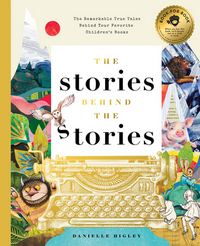
The Stories Behind the Stories by Danielle Higley, David Miles (Illustrator): Behind the Scenes of Some Childhood Favorites

I’ve got a Q&A with the author, Danielle Higley, coming up a little later this morning–be sure to come back for that!


The Stories Behind the StoriesThe Stories Behind the Stories:
The Remarkable True Tales
Behind Your Favorite Kid’s Books

by Danielle Higley, David Miles (Illustrator)

DETAILS:
Publisher: Bushel & Peck Books
Publication Date: November 2, 2021
Format: Hardcover
Length: 90 pgs.
Read Date: September 24, 2022
Support Independent Bookstores - Visit IndieBound.org

What’s The Stories Behind the Stories About?

It’s right there in the subtitle, isn’t it? “The Remarkable True Tales Behind Your Favorite Kid’s Books.” Higley takes 29 well-known and well-loved children’s classics—most from the Twentieth-Century, with a couple from before and a few after it.

We get roughly two pages on each book, with a full page of art to go along with them—although one of those pages will be heavily illustrated, too. The text will give a little biographical information about the author and then talk about the book itself—maybe how it was written, or received, or what inspired it. There’s also a sidebar with a little trivia about the book, too.

The books discussed range from Curious George to The Boxcar Children to Percy Jackson and the Lightning Thief, books written for children too young to read through books for Middle Grade readers.

The Design and Art

This is a wonderfully put-together book—let’s start with the cover design, a giant “Little Golden Book” look is an inspired choice for this. The collages used to illustrate the rest of the book are equally well done. They jump off the page and are well-paired with each book discussed.

Sure, the text of the book is my focus—and it should be here, too. But when it comes in a package this great to look at? That’s just a bonus.

So, what did I think about The Stories Behind the Stories?

I sat down to read about one or two of the books before starting something else one day, and read five before I realized it and had to force myself to stop. I ended up reading the rest of the book in one sitting. It’s the literary equivalent of Lay’s Potato Chips, “bet you can’t read just one.”

I’ve read 24 of the books talked about, and meant to read most of the others, so I was primed and ready for this—many readers in the target range (7-11 will be familiar with at least half, and this might inspire them to read more of them).

I think I learned a little about each of the books selected for this—except maybe Harry Potter and the Sorcerer’s Stone, because that’s been covered so well for so many years. Some of what I learned surprised me—The Boxcar Children was controversial? (okay, I probably should’ve guessed that one) Rawls almost didn’t get Where the Red Fern Grows published, and once it was, it took a lot of work to get it read—or put another way, I almost didn’t get my heart ripped out by it.

It’s engaging with a little dash of mild humor, nothing over-the-top—just enough to bring the occasional grin while not distracting from the point. It’s written in such a way that the target audience will have no problem reading it, and it’ll keep the attention of older readers, too—anyone who likes children’s books will find something to enjoy here. And you put that in an attractive package? It’s a win all the way around. I strongly recommend this book.


4 Stars

This post contains an affiliate link. If you purchase from it, I will get a small commission at no additional cost to you. As always, the opinions expressed are my own.
Athanasius of Alexandria: His Life and Impact by Peter Barnes: Tumultuous History and a Stalwart Bishop

Athanasius of AlexandriaAthanasius of Alexandria:
His Life & Impact

by Peter Barnes

DETAILS:
Series: The Early Church Fathers
Publisher: Christian Focus Publications
Publication Date: October 2, 2019
Format: eBook
Length: 176 pg.
Read Date: October 2-9, 2022
Support Independent Bookstores - Visit IndieBound.org

As he wrote to the bishops of Egypt in 356: ‘as therefore the struggle that is now set before us concerns all that we are, either to reject or to keep the faith, let us be zealous and resolve to guard what we have received, bearing in mind the confession that was written down at Nicaea’. And by God’s grace, his victory in that struggle has been of enormous blessing to the church ever since.

The Series

In case you hadn’t read what I thought of the other books I’ve read in this series, let me start with the thumbnail description of the series I came up with:

I literally stumbled on this series, The Early Church Fathers, a few weeks ago and thought it sounded like a great idea. It looked kind of like a mix of Crossway’s Theologians on the Christian Life and Oxford’s Very Short Introductions (incidentally, that’s what it ended up being).

What’s Athanasius of Alexandria About?

In the first chapter, Barnes sketches out what life is like for Christians in Alexandria in the years immediately before Constantine, through the Great Persecution, then he turns the focus on to Athanasius’ early years (and some of the competing theories as to what those were like).

He then spends four chapters reviewing the ecclesiastical movements surrounding the Arian conflict and related controversies. He discusses both the imperial moves, the various councils and reactions to them, and Athanasius’ various exiles and restorations.

After the overview of his life, Barnes discusses his theology and major works, On the Incarnation of the Word of God and Against the Gentiles, before moving into his views on the Bible, Asceticism, and Spirituality. Barnes talks about critiques and challenges as well as the lasting influence of the Bishop of Alexandria.

So, what did I think about Athanasius of Alexandria?

Athanasius considered himself inadequate as a theological writer, and unpracticed in speech. He never entered the fray as a detached academic philosopher. He was first and foremost a Christian, and his declared aim was that a right understanding of theology might strengthen faith in Christ, that ‘you may have ever greater and stronger piety towards him’.

I’m trying not to turn on this series, but they’re making it difficult for me (but I’ve read three of the five, so you know I’m going to finish them). It wasn’t bad, don’t get me wrong, but it didn’t give me enough of what I came looking for and too much of things I didn’t.

Let me try to explain.

Sixty-five percent of the book is the historical material—with an element of biographical material. So much of the history is dry and feels like he’s just rattling off names without really explaining why we should care about the names. This is supposed to be an introduction to Athanasius, not a crash course in Fourth Century History. Yes, most of those names—and the historians who have theories about them—are those a student of Church History should be familiar with. But in this context, it felt like meaningless trivia. It’s too much of this book—sure, it’s a complicated period of history so it takes a lot of work to cover it, but that shouldn’t be the emphasis of a book like this.

The last three chapters—about his works, his theology, his influence, and so on were great. If more of the book had been like that, I’d be singing a different tune. I did walk away feeling like I had a better understanding of Athanasius, but not as much of one as I’d hoped.

I think if my expectations were better, I’d have appreciated it more. Still, I did like it and did benefit from it, I expect others will, too.


3 Stars

This post contains an affiliate link. If you purchase from it, I will get a small commission at no additional cost to you. As always, the opinions expressed are my own.

The Great Lie by Pierce Taylor Hibbs: He Is Here, and He Is Not Silent

The Great LieThe Great Lie:
What All of Hell Wants
You to Keep Believing

by Pierce Taylor Hibbs

DETAILS:
Publisher: Truth Ablaze
Publication Date: September 12, 2022
Format: Paperback
Length: 190 pg.
Read Date: September 18-25, 2022
Support Independent Bookstores - Visit IndieBound.org

The great lie is that God is not everywhere and always present in his world.

What’s The Great Lie About?

Hibbs takes as his starting point that God is everywhere present in His world, and given his communicated nature—He is always speaking to us, through both the Creation and His Word. But since the temptation (and then fall) of Adam and Eve, the enemy wants us to think His presence is irrelevant (if He’s present). This is the Great Lie.

Hibbs spends five chapters establishing (or refreshing) the theological framework here—reminding us who God is and how He constantly is communicating to humanity, what the Great Lie is, and how we see it in Genesis 3 and worked out in the lives of some individuals as recorded in Scripture.

The second half of the book then looks at how that looks in our lives today—in the world around us, our words, our thoughts, and our actions. Then he looks at God’s response to this Great Lie.

So, what did I think about The Great Lie?

This pairs nicely with his In Divine Company, building on the idea of God’s communicative nature. This time, applying that in a different direction, but keeping the same central concern.

That alone made this book worth the read for me, I’d thought a little about how to apply thinking of God in those terms to other areas of life after reading the work on prayer, but hadn’t gotten as far as I should have. This book helps see the battle with sin through that lens—not in an exhaustive sense, but in a very real and helpful sense.

It’s incredibly practical and assuring while being grounded in thoughtful theology (as any Christian teaching should be as it aims for practically). This really doesn’t do anything new—Hibbs has no novel teaching. But he frames this in a way we’re not used to thinking about it—and that’s refreshing and challenging at the same time.

Paired with Hibbs’ characteristic clear prose and gift with language and illustrations, it’s a winner of a book. Check it out for sure.


3.5 Stars

This post contains an affiliate link. If you purchase from it, I will get a small commission at no additional cost to you. As always, the opinions expressed are my own.

Good Talk: A Memoir in Conversations by Mira Jacob: Explaining Race in the U.S. to a Child

Good TalkGood Talk:
A Memoir in Conversations

by Mira Jacob

DETAILS:
Publisher: One World
Publication Date: March 25, 2019
Format: Hardcover
Length: 349 pg.
Read Date: October 5-6, 2022
Support Independent Bookstores - Visit IndieBound.org

Sometimes, you don’t know how confused you are about something important until you try explaiing it to someone else.

What’s Good Talk About?

It’s 2014 when the book opens, Mira Jacob’s son Z is six and he’s asking Mom a lot of questions (because he’s six). They start off talking about Michael Jackson—Z is obsessed with him. Z eventually asks about Jackson’s skin color—Z is half-Jewish, half-Indian and has several questions about skin color that stem from this (and likely predate this, but what do I know) which leads to questions about race, race relations, and what he sees on the news. Jacob’s committed to being open and honest with Z, but struggles knowing how much she should say—and how optimistic she should be about the state of the US in terms of Ferguson, MO, and a lot of the rhetoric surrounding the 2016 elections.

The memoir comes in as Jacob recounts several scenes from her childhood/young adulthood that shaped her. Her parents immigrated from India in the 60s (a week before MLK was assassinated) and took up residence in Albuquerque. We get a few scenes from her childhood and teen years before moving to adulthood, dealing with misunderstandings, assumptions, and unintentional rudeness based on her background. Eventually, she finds herself in New York City trying to make it as a freelance writer and dating. This is all told with frankness and humor. The kind of humor that reminded me of Amber Ruffin/Lacey Lamar’s You’ll Never Believe What Happened to Lacey from last year—you laugh so you don’t have to cry.

The Art

I really don’t know how to describe the art here, but this is a graphic memoir, so it’s a major component of the book. So I’d better try.

I saw someone on Goodreads use the term “mixed media,” and without researching it, I think it’s close enough to use as a description (maybe not technically right?). Please note that this is me trying to describe it, not being dismissive as it may sound. It’s like Jacob drew nice, but not fantastic, paper dolls of each character (some at different ages, others static) and put them on top of photographs or drawings of various locations and added speech bubbles.

I just saw that she has an Instagram account that uses images from the book (in addition to the regular Instagram stuff), so I figure I can “quote” something to show what I’m talking about:

This is nowhere near the kind of art that appeals to me in graphic novels/memoirs etc. Give me something dynamic, something with some flair, something I can bask in. But…this really worked for me. It helped give this a “documentary” kind of feel (don’t ask me to explain this, but it struck me that way). This isn’t about the glitz or the pictures jumping off of the page, it’s about a woman having tricky conversations with her loved ones—and complete strangers, sometimes. The focus is on the words, but the images help carry you along.

So, what did I think about Good Talk?

Sometimes, you go along with it and pretend nothing happened. Sometimes, you hold your breath until the feeling of wanting to believed passes. Sometimes, you weigh explaining against staying quiet and know they’re both just different kinds of heavy. Sometimes, when it’s your mother-in-law—a woman you started calling Mom the day you got engaged because you admired the ferocity with which she loved her children, and maybe even wanted some of it for yourself—you look ahead and see all the years of birthdays and graduations and weddings that will be shadowed by things that she can’t imagine about your life. Sometimes, you can’t hold your breath long enough.

I typed “I really enjoyed this book”, but I’m not sure that’s the appropriate response. I don’t know that supposed to enjoy this—but her style and humor are really engaging and there’s enough hope in there that it feels natural to say. I feel okay saying that this is a good read—it’ll make you think, it might make you grin, and it’ll definitely make you wince.

Right away, when Jacob goes to visit families in India and they tell her that her skin tone (darker than her parents’ or her brother’s) marks her out as not as attractive or a good prospect for marriage, you can tell she will pull no punches. And you can understand why she wouldn’t want to. It’s one of the many, many things that guys like me on Scalzi’s Lowest Difficulty Setting don’t have to think of. There are many sections of the book that hit the same way—like the chapter where she talks about being mistaken for “the help” at a party her mother-in-law was hosting. The above quotation is part of that—she decides mid-way through the conversation that she’s not going to try to explain what happened, nor argue about it. Constantly having to explain your experiences—your life—to people who don’t get it has to be a kind of exhausting that I can’t imagine.

But there’s a lot of humor and hope here, too—not all of it at the expense of clueless white folk saying dumb things. There’s the chapter about getting her dad to use marijuana to help the pain of his cancer treatment, for example. It’s funny and heart-warming. Until he dies, of course, reminding you that this isn’t that the hope is tinged with reality.

I really recommend this book—it’s a deceptively easy read, and you shouldn’t let the style or format fool you into racing through it. There’s a lot to chew on, a lot to reflect on—and a perspective that should be listened to. Even if you can’t relate to her struggles, can’t agree with her politics, and find the whole discussion unsettling. Maybe especially then.


4 Stars

This post contains an affiliate link. If you purchase from it, I will get a small commission at no additional cost to you. As always, the opinions expressed are my own.

Page 28 of 63

Powered by WordPress & Theme by Anders Norén