Category: Non-Fiction Page 29 of 63

REPOSTING JUST CUZ: The Person of Jesus by J. Gresham Machen

The Person of JesusThe Person of Jesus: Radio Addresses on the Deity of the Savior

by J. Gresham Machen

Paperback, 101 pg.
Westminster Seminary Press, 2017

Read: March 19, 2017


If it’s J. Gresham Machen, it’s gotta be good! Yeah, that might be an oversimplification, but it’s true.

This book is made up of part of a series of radio addresses Machen gave in 1935 — this selection, obviously, focusing on the Person of Christ — his Deity (and what it actually means to describe him as such), what He says about Himself, and what He demonstrated about Himself. These are warm chapters that must’ve been easy to listen to (at one point Machen apologizes for technical language in a way that brought a smile to my face), but rich in teaching. I only wish we had the recordings. I don’t know how, but even with these addresses coming from eight decades ago, they feel like the could’ve been delivered last week.

My favorite chapter, probably, was on The Sermon on the Mount — it’s a long-standing favorite of liberal theologians, and other non-Christians as a way of talking about the “ethics of the New Testament” apart from anything supernatural, miraculous or theological. Machen directly takes on this idea and shows how it’s baseless and impossible to actually do.

These addresses were given towards the end of this life, after he’s gone through “The Presbyterian Conflict” and all the associated drama and trials. Through that experience, he’s a bit more direct. In Christianity & Liberalism Machen’s no less forthright, but he talks about Liberal Theologians, or “other teachers”, etc. Here, he doesn’t waste time — he just calls them “unbelievers.” It’s the same thing, as he demonstrated in his earlier work, but he doesn’t do that here.

This is how apologetics should look — easy to understand and follow, yet rich in doctrine and the Bible. Welcoming and winsome while not giving an inch to his opponents. As always, with Machen, this is how we should all be doing it.

—–

5 Stars

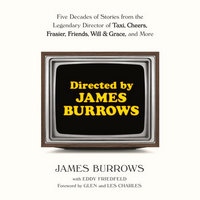
Directed by James Burrows (Audiobook) by James Burrows et al: Behind the Scenes of the Best Sit Coms

Directed by James BurrowsDirected by James Burrows
Five Decades of Stories
from the Legendary
Director of Taxi,
Cheers, Frasier, Friends,
Will & Grace, and More

by James Burrows, with Eddy Friedfeld; Narrated by James Burrows and Danny Campbell

DETAILS:
Publisher: Random House Audio
Publication Date: June 6, 2022
Format: Unabridged Audiobook
Length: 12 hrs., 18 min.
Read Date: September 23-26, 2022
Support Independent Bookstores - Visit IndieBound.org

What’s Directed by James Burrows About?

This is largely a professional memoir about the long and storied career of TV director/producer James Burrows.

The book starts with a chapter and a half (or so) describing his childhood, early family life, and so on—talking about his father’s Broadway writing and directing a bit and how that did/didn’t influence his career choices. Then we get about a half-chapter talking about his education/theater work. Which is all a lead-up to his TV career. We get a little more of his personal life sprinkled in throughout the following chapters, but not much—Burrows knows the interest in his own story is in the stories he told—and more importantly—helped others to tell. That’s where the focus of the book is—he’s giving the people what they want.

And it feels like a pretty a fairly exhaustive tale of the various shows he worked on and his involvement in them, with an occasional interlude to talk about something like screwball comedy and why one would use it, with some examples from his own career. There’s no way it can be exhaustive—and it sure isn’t detailed by any means*—he’s got too much under his belt, but he comes close.

* That’s a description, not a criticism. Burrows gives plenty of details, but not blow-by-blow kind of stuff too often.

He starts with a discussion of his time on The Mary Tyler Moore Show where he learned from some of the best around how to do what he does—and a lot about comedy. Then he moves on to where he becomes a driving influence on the show—and that’s the majority of the book. Which is what’s named in the subtitle: Taxi, Cheers, Frasier, Friends, Will & Grace. There’s plenty covered in the “and More” for sure—including many things I hadn’t realized he’d worked on (but make a lot of sense knowing that he did). The book does cover what he did in 2020 and 2021, so it’s about as up-to-date as you could want.

The stories of these shows include a lot of how they came about in terms of writers and networks and what kind of story they were going to tell before moving into casting, shooting the early episodes, audience reception, and success. The bulk of the material is behind-the-scenes, but there are a lot of descriptions of what ends up on-screen (including short-to-lengthy portions of the script), and how it landed. Most of his work is done with a live studio audience, so the immediate audience reception is almost more important than the TV audience’s.

There are stories of failure, things not working out quite right—and how he/the show recovered—either immediately or long-term. But almost all of the book is about the successes (why give more than a few sentences, for example, to a pilot episode that less than 100 people have seen/will see?)

The Narration

Burrows has some performing in his background, but not a lot. And that’s pretty evident in the narration here. He’s just not that good—there’s very little feeling in it—even when he’s telling a story he clearly (and correctly ) thinks is funny, you don’t hear it. When it’s an emotional moment for him, you don’t hear it. His affect is pretty much the same no matter what he’s talking about, and that really hurts the book.

Also, when he’s reading dialogue from a scene? You wonder how an actor will listen to him and come up with a good way to deliver a line. That feels harsh to say, but that’s the way it struck me. I think here it’s a deliberate choice—my gut tells me it’s a desire not to try to do an impression of an actor (especially one that would come across as unflattering) or he could be avoiding trying to give a different/competing take on the line. I don’t know—it comes across as flat, and these lines shouldn’t.*

* See We Had a Little Real Estate Problem for where a similar approach to narration worked better.

I know Burrows can tell a good story—I’ve heard and seen him interviewed. But here, he just comes across as wooden.

So, what did I think about Directed by James Burrows?

It’s clear to readers of this blog that I read a lot, but I could’ve easily done a TV-watching blog—and started one about the same time as this (but that’s another story). James Burrows is one of the first non-actors whose name I recognized as creating the TV I watched back in elementary school, and his involvement in a show will definitely get me to watch at least an episode or two if I’m at all interested in the premise. I’m the target audience for this book, no doubt.

The material overcame the narration—the first chapter and a half were really rough, I couldn’t connect with it at all, and was thinking about giving up. But once he moved into TV, I got over the fact that I didn’t care for the narration and had a blast with the book. The man has many insights, anecdotes, and memories that TV fans will eat up, and shares many of them.

Directed by James Burrows is full of trivia, insights, and just great stories. If not hampered by the narration, I’d be gushing about this. Instead, I’m just giving a hearty recommendation. TV junkies? You’re going to want to get your hands on this one.


3.5 Stars

This post contains an affiliate link. If you purchase from it, I will get a small commission at no additional cost to you. As always, the opinions expressed are my own.

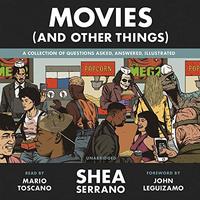
Movies (And Other Things) (Audiobook) by Shea Serrano, Mario Toscano: The Answers to Pressing Movie Questions

Movies (And Other Things)Movies (And Other Things)

by Shea Serrano, Mario Toscano (Narrator)

DETAILS:
Publisher: Twelve
Publication Date: October 7, 2019
Format: Unabridged Audiobook 
Length: 11 hrs., 7 min.
Read Date: September 21-23, 2022
Support Independent Bookstores - Visit IndieBound.org

What’s Movies (And Other Things) About?

Serrano discusses movies from the point of view of a massive fan—he knows what he’s talking about, he can discuss them objectively, critically, and as a fanboy—mostly a combination thereof. In this collection of essays, he approaches films of the mid-80s (largely) to today, answering burning questions such as:
bullet Who’s the better tough guy movie dog owner? (Will Smith in Legend, Tom Hardy in The Drop, or Keanu Reeves in John Wick?)
bullet Which Movie had the more intense opening, Face/Off or Finding Nemo?
bullet When did you know Booksmart was special?
bullet Who’s in the perfect heist movie crew
bullet Which race was white-saviored the best by Kevin Costner?
bullet When did Michael B. Jordan break your heart into the most pieces? (which was immediately followed by)
bullet When was Diane Keaton the most charming in Something’s Gotta Give?

The mental whiplash between those last two shows the range that Serrano is capable of. He also ranks the deaths/trauma in the Kill Bill movies, discusses adjusting recent Academy Award nominations/wins after making sure Romantic Comedies are given their credit due, what movie villains would be fun to hang out with, and how aN NBA post-game style press conference with Michael Myers would go.

There’s a great combination of movie knowledge/insight, social commentary, and humor mixed throughout each of these. Even when it came to movies I’ve never seen, have no interest in seeing, or saw ages ago and don’t remember well, Serrano kept me pretty engaged and entertained.*

* Except maybe with the Fast and the Furious discussion, I don’t know why…I just can’t care about this franchise.

A Word About the Narration

I’ve heard Serrano as a guest on podcasts, and would’ve assumed his natural ability, experience, and passion would’ve made him a natural to read his own audiobook. But for whatever reason, Mario Toscano got the nod instead.

And I can see why—I had no problem believing I was hearing Serrano himself read these (maybe if I’d pulled up a podcast to listen to first, that wouldn’t have been true)—which is important when I’m hearing something so personal or passionate as this often is (see Black Nerd Problems, for example). Toscano sounds like a knowledgeable film geek going off on various topics—I think he could’ve put a little more energy into some of the quotations, but I’m sure there are good reasons for not doing that.

Ohh, man…

While researching this post, I saw that the ebook has three additional exclusive chapters…I might have been able to resist, but one of the chapters is “When Was Hans Gruber’s Subtlety the Most Threatening?”

So, I’m going to have to buy a print copy of this, too. I have to read this take.

So, what did I think about Movies (And Other Things)?

I had a blast with this—it’s the equivalent of sitting around with a bunch of friends talking about movies for far too long, which is one of my favorite ways to spend a lot of time. Even when I think he was out to lunch or arbitrary in some of his choices, I could get behind them for the sake of argument or be entertained by them.

Man, I wish I knew where he came up with some of the topics. If I spent a year doing nothing more than coming up with the chapter titles (never mind the content), I couldn’t be half this creative.

I didn’t need anyone reminding me of Opie Winston’s death scene—ever. But especially not in a book about movies where I didn’t know to be emotionally prepared for such a thing. Serrano lost a star from me for that one.*

* Not really, but it was cathartic to say that.

That incredibly important quibble aside, if you’re a current/former/would-be movie geek, grab this, you’ll have a blast.


3.5 Stars

This post contains an affiliate link. If you purchase from it, I will get a small commission at no additional cost to you. As always, the opinions expressed are my own.

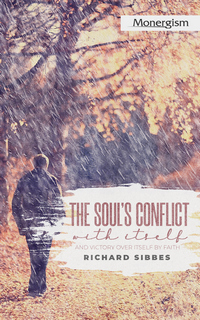
The Soul’s Conflict and Victory Over Itself by Faith by Richard Sibbes: Sibbes Gets a Lot out of Psalm 42:11

The Soul's Conflict and Victory Over Itself by FaithThe Soul’s Conflict and Victory Over Itself by Faith

Richard Sibbes

DETAILS:
Publisher: Monergism Books
Publication Date: July 1, 2022
Format: Paperback
Length: 230 pg.
Read Date: September 4-18, 2022

What’s The Soul’s Conflict… About?

This is a treatise on:

Why art thou cast down, O my soul? and why art thou disquieted
within me? hope thou in God; for I shall yet praise him, who is
the health of my countenance, and my God.—PSALM 42:11.

Sibbes has two types of believers in mind for this—those who are at peace with the world, who enjoy comfort, and those who are constantly troubled. He seeks to disquiet the former and help the latter to find peace.

He spends a chapter giving an overview of the psalm before diving into the discussion. Following it, the book is pretty cleanly divided into two parts—The Soul’s Conflict and The Soul’s Victory Over Itself. It was pretty easy, despite the lack of a Table of Contents saying “Part II,” to tell when Sibbes switched to the Victory side.

Both of these sections are typical of the Puritan era—squeezing every last drop of water out of the rock that was the topic. There is some exegesis, and a little interpretation of the passage, but it can feel like Sibbes was given an assignment for a listicle—here are 12 reasons your soul can be cast down.

So, what did I think about The Soul’s Conflict…?

Faith is an understanding grace; it knows whom it trusts, and for what, and upon what grounds it trusts. Reason of itself cannot find what we should believe, yet when God hath discovered the same, faith tells us there is great reason to believe it. Faith useth reason, though not as a ground, yet as a sanctified instrument to find out God’s grounds, that it may rely upon them. He believes best, that knows best why he should believe. Confidence, and love, and other affections of the soul, though they have no reason grafted in them, yet thus far they are reasonable, as that they are in a wise man raised up, guided, and laid down with reason; or else men were neither to be blamed nor praised for ordering their affections aright; whereas not only civil virtue, but grace itself is especially conversant in ruling the affections by sanctified reason.

I got to the point, I admit, that I had a hard time getting through the first part of the book, and wondered how long it was going to go on. I know that Sibbes actually could’ve—should’ve—gone on longer to be truly exhaustive about the ways we deceive ourselves, find ways to rebel, and so on. I acknowledge I might be one of the ones he targeted as “too comfortable,” who really needed to study and meditate on those parts before going on to the encouraging section.

Or maybe I’m a victim of 21st Century abbreviated attention-span. Or both. But it did go on so long that it felt like he was just stretching things to make word count (I know that’s not true—he didn’t have one). I had a similar reaction in the last couple of chapters of the Victory section, but it took a little longer for that to happen.

I know I’m coming across as negative here, I don’t mean to be. I liked this, just not as much as I expected to. I go into a Sibbes book expecting a 5 Star experience. If I don’t get it, I probably complain too much. Both sides were insightful and helpful—I think I profited more from the last section, a lot of it was great, and some of the better material I’ve read from Sibbes. I certainly think I’d have a different reaction at another time—and I am going to return to this in a couple of years. Both to understand it better and to see how I react.

In the meantime, for a great example of Puritan spirituality, of a spiritual doctor diagnosing and treating his patients (read: readers), you can’t do better than Sibbes (even if he gets tedious). It’s truly rewarding.


3.5 Stars

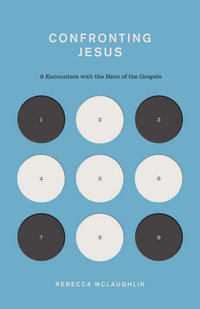
PUB DAY REPOST: Confronting Jesus by Rebecca McLaughlin: Introducing Jesus Without Any Baggage

Confronting JesusConfronting Jesus:
9 Encounters with
the Hero of the Gospels

by Rebecca McLaughlin

DETAILS:
Publisher: Crossway
Publication Date: September 20, 2022
Format: eARC
Length: 208 pg.
Read Date: August 21-28, 2022
Support Independent Bookstores - Visit IndieBound.org

What’s Confronting Jesus About?

Most people have a lot of preconceptions about Jesus, a lot of people have read and/or heard things about Him and the Scriptures that tell about him. But not as many have actually read those Scriptures, particularly the Gospels.

Rebecca McLaughlin tries to clear away some of the cultural debris that has piled up between non-Christians and the Gospels and the subject of the Gospels. For example, as she points out, given Christianity’s impact in shaping Western Civilization, it’s difficult to think of Jesus as non-Western.

The goal of the book is to help the reader (particularly those with little-to-know-exposure to Christianity) begin to see the Gospels for what they really are, not the readers’ preconceptions of them. And the Jesus revealed in the Gospels as the Gospels want to portray him, not what the reader may already think.

It’s a high and lofty goal—possibly too lofty for 200 pages. But this isn’t intended as a definitive work, more like an invitation for the reader to do their own work.

A Menagerie of References

A lot of writers (and preachers, truth be told) will introduce a subject or thought by grounding their introduction in some sort of shared knowledge. Sometimes it’ll be an experience (first day of school), a person everyone knows (George Washington), a current event, or some sort of cultural reference (literature, music, film/TV, etc.). McLaughlin almost always goes for the latter. And, for the overwhelming majority of the time, it’s a very contemporary reference.

She starts off by invoking the musical Hamilton, and does so in-depth—it wasn’t long at all before I made a note, “can we be done with Hamilton now?” The answer was no—she came back to Miranda’s hit time and time again. Thankfully my worries about this being a book about Jesus, the gospels, and a hip-hop musical about a Founding Father quickly evaporated and she moved on to other cultural touchpoints—Harry Potter, Doctor Who, The Princess Bride, Gladiator, The Picture of Dorian Gray, The Lord of the Rings, Jane Austen, A Tale of Two Cities, and more. It’s an interesting mix of pop-culture and more high-brow references.

I’m spending more time on this than I initially intended, but I kept bumping on this tendency of hers, and I ended up spending as much time thinking about it as I did her arguments. Now, I don’t think most readers will do that—but most readers aren’t considering the delivery of the content as they are the content. So I don’t think most readers will be distracted by this as I am.

Still, the volume of pop culture references strikes me as a dangerous strategy (as comfortable and relatable as it might be). It can trivialize the subject matter. It can possibly cause offense (how many people really want to relate to J.K. Rowling right now? A different crowd than those who didn’t want anything to do with her in the 90s, to be sure).

Lastly, it reduces the shelf-life of the book tremendously. Wilde, Dickens, and Austen are references that will stand (and have stood) the test of time—but will The Hunger Games and Ted Lasso? Maybe. But Maybe not. McLaughlin’s arguments and insights may be worth reading in ten years, but will the book as a whole? Or will what makes it most approachable today make it stale and off-putting within a presidential election cycle or two.

(that took a lot more time to express and explain my concerns than I thought it would—this is not a significant detriment to the effectiveness of the book, but it is one)

The Tone

McLaughlin has an approachable, almost breezy style. I started this book while taking a break from a more scholarly book, and the early chapters had some overlap with the other book I was reading. And I suffered a little mental whiplash. I got over it the more of the book that I read (especially as it diverted into different territory from the other), but it almost seemed too shallow. A lot of readers might think that, too. If you persevere, however you’ll see that’s not that case.

McLaughlin comes across as open, honest, and earnest—the kind of person you’d enjoy chatting with—and her grounding things in events with her life or a movie you’ve both seen (or that she’s told you enough about that you want to see it), makes the material something you connect with.

So, what did I think about Confronting Jesus?

I enjoyed the book. I was charmed by McLaughlin’s style and found her arguments compelling—not convincing. But, as I said, I’m not sure she was trying to convince her readers—I think she was set on moving them to do more research, more reading, and to deal with more convincing ideas and arguments. This was an introduction to Jesus, hopefully lowering perceived barriers to him—and a challenge to deal honestly with Him and His claims rather than preconceptions and reputations about Him (and His followers).

That said, I’m predisposed to agree with her. We’re on the same team, and don’t have the same barriers that the non-Christian will have. So I can’t ultimately say how well the book works. Do I think that several of my friends would benefit from it? Sure. But that’s just a guess/hope. The ultimate sign of the quality and effectiveness of this book is going to come from the non-Christian reader.

Also, this book does make me curious about McLaughlin’s other work—and I anticipate grabbing at least one of her earlier books soon.

Disclaimer: I received this eARC from Crossway via NetGalley in exchange for this post—thanks to both for this opportunity.


3 Stars

This post contains an affiliate link. If you purchase from it, I will get a small commission at no additional cost to you. As always, the opinions expressed are my own.
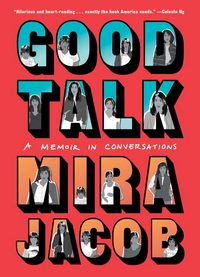
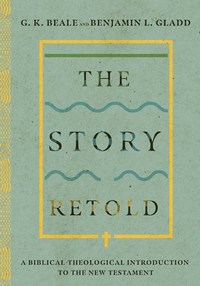
The Story Retold by G. K. Beale and Benjamin L. Gladd: Everything You Want in a NT Introduction and More

The Story RetoldThe Story Retold:
A Biblical-Theological Introduction
to the New Testament

by G. K. Beale, Benjamin L. Gladd

DETAILS:
Publisher: IVP Academic
Publication Date: February 24, 2020
Format: Hardcover
Length: 490 pg.
Read Date: January 2-August 14, 2022
Support Independent Bookstores - Visit IndieBound.org

What’s The Story Retold About?

From the Publisher’s Website:

New Testament introductions fall into two categories: those that emphasize the history behind the text through discussions of authorship, dating, and audience, and those that explore the content of the text itself. Few introductions weave the Old Testament into their discussions, and fewer still rely on the grand narrative of the Old Testament.

But the New Testament was not written within a vacuum. Rather, it stands in continuity with the Old Testament. Israel’s story is the church’s story.

In The Story Retold, G. K. Beale and Benjamin L. Gladd explore each New Testament book in light of the broad history of redemption, emphasizing the biblical-theological themes of each New Testament book. Their distinctive approach encourages readers to read the New Testament in light of the Old, not as a new story but as a story retold.

As an NT Introduction

After three chapters of introductory material: “The Story Line of the Bible,” “The Use of the Old Testament in the New,” and “Introduction to the Gospels” (all pretty self-explanatory), we get a chapter on each book of the New Testament (with some chapters combining multiple books—e.g., The Pastoral Epistles).

Like most NT Introductions (as the description above says), Beale and Gladd discuss authorship, dating, and so on, with a good outline and overview of the book. Some of the ways they phrase things, or organize the material are helpful and unique—but on the whole, they’re helpful and pretty much what you get in every NT Introduction out there.

This isn’t a good or a bad thing, it’s simply saying that on the basics this is a pretty good Introduction.

The Little Something Extra in Each Chapter

The thing that separates this from similar works is the way that the authors tie the particular Biblical book into the overall storyline of the Bible. By focusing on the Biblical Theological/Redemptive Historical themes of the books—specifically grounding them in one or more Old Testament books about the same themes, it helps the reader to deal with, wrestle with, and (frequently) review the use of the OT by the NT in order to further cement and to expand the reader’s understanding of how the Bible as a whole tells the same story about Jesus Christ and His people.

Some of these sections blew me away—all deepened my understanding of the various books. Not just the NT, but seeing how the OT is used by the apostles helps understand those books/passages.

Format

This was produced as a textbook and it’s nice to read one of these again—I haven’t since my undergrad days. It’s a heavy tome, with thick, glossy paper and a lot of pictures. Sure, it’s a bit difficult to curl up with to read—but you can’t help but feel that it’s going to last for years as you read it.

Also, it’s heavy enough to use as a self-defense device.

The format does make this a pretty spendy book (although cheaper than most textbooks I bought in my undergrad days). But it’s worth the purchase price (as I said, it feels like it’s going to last for years).

So, what did I think about The Story Retold?

This isn’t an overly technical read—I think it could be used by older high school students. But sure, it’s aimed at college/early grad-school students, so go to it with the right expectations.

I really don’t know what to say about it at this point—I spent months reading this thing, it feels as if I should have several more pages of things to say. Basically, if the description sounds good to you, it’s going to deliver exactly what it promised.

It’s not what most people think of as devotional material—but it worked for me as such. This is definitely one of the better and more useful books I read this year. It’s also going to serve well as a reference book. Whether you dip in and out or read cover-to-cover, The Story Retold is worth its weight.


5 Stars

This post contains an affiliate link. If you purchase from it, I will get a small commission at no additional cost to you. As always, the opinions expressed are my own.
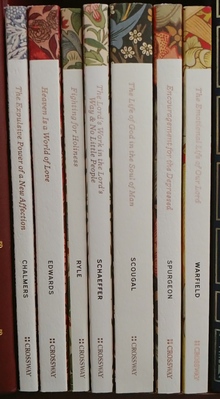
Crossway Short Classics: Scougal

Crossway Short Classics SeriesCrossway Short Classics Series

DETAILS:
Publisher: Crossway Books
Format: Paperback
Read Date: July 2022

Some Thoughts on the Series as a Whole

The point of this series is to take classic short works—sermons, tracts, articles—package them attractively, edit a bit (modernize language, eliminate footnotes, tweak grammar, etc.) and make them widely available. Each is given a short introduction to help the reader get the context and a bit of information about the author.

I think this is a great idea, and I don’t know how I didn’t hear about this until a few weeks ago. I do hope they put out new books in the series (at least one of the books on the original list isn’t out yet, but they did publish one not on that list, so maybe they exchanged the titles).

I wonder a bit about the cover design—I wonder if the floral theme is a bit off-putting (Evangelical publishers usually reserve that for books marketed for women, and I don’t get the impression that this series is designed for that).

I don’t want to try to cover the whole series in one post, so I’m going to do this in chunks. This is the third in the series of posts I’ll be doing (and the last until early next year, when other volumes are due).

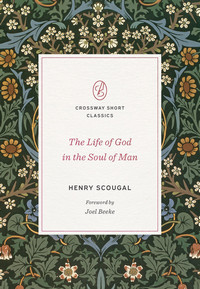
The Life of God in the Soul of ManThe Life of God in the Soul of Man

by Henry Scougal, Joel R. Beeke (Foreward), Robin Taylor (Abridgement)

DETAILS:
Publication Date: May 30, 2022
Length: 181 pg. 
Read Date: July 31, 2022
Support Independent Bookstores - Visit IndieBound.org

I’ve read this book a handful of times, and never walked away from it as impressed as I’ve heard I should be—but I keep trying. It was while reading the foreword by Beeke that I think I got an idea.

In reading Scougal’s work, one must remember that he assumes a doctrinal foundation that he does not explicitly lay out. All that Scougal writes about union with God presupposes the gospel that God the Father sent God the Son to become a man, die for our sins, rise from the dead, ascend into heaven, and reign as Lord, so that by faith in him God the Holy Spirit dwells within the heart. Scougal’s focus is quite narrow—namely, to assert that the Christian religion consists of more than just mental understanding and outward religious life by requiring an inward transformation that arises from spiritual union with Christ and communion with God.

This may say more about me than I intended, but I didn’t get that Scougal was presupposing anything, but always felt he was missing something. Working from that assumption, however, helped a lot during this read.

The last sentence in Beeke’s paragraph is a very effective summary of the book (the rest of the foreword is plenty helpful, too). Scougal focuses on the inward man, the change that has to take place—and the supernatural resources to make that change. His Christianity is an experiential, wholehearted, and supernatural one. It is near-impossible to read his work and not sense your need for deep spiritual renovation.

I don’t know the work well enough to really comment on the abridgment—but I had a couple of thoughts. The work is short enough that I wouldn’t have imagined it needed an abridgment to fit in this series. Despite having been abridged, it feels complete. So that’s got to be a good sign, right?

I’m still not convinced that I fully appreciate Scougal’s work—but I’m closer to it this time. There’s a lot to admire here, and it’s enough to make me want to keep reading until I get it.

3 Stars

This post contains affiliate links. If you purchase from them, I will get a small commission at no additional cost to you. As always, the opinions expressed are my own.

Confronting Jesus by Rebecca McLaughlin: Introducing Jesus Without Any Baggage

Confronting JesusConfronting Jesus:
9 Encounters with
the Hero of the Gospels

by Rebecca McLaughlin

DETAILS:
Publisher: Crossway
Publication Date: September 20, 2022
Format: eARC
Length: 208 pg.
Read Date: August 21-28, 2022
Support Independent Bookstores - Visit IndieBound.org

What’s Confronting Jesus About?

Most people have a lot of preconceptions about Jesus, a lot of people have read and/or heard things about Him and the Scriptures that tell about him. But not as many have actually read those Scriptures, particularly the Gospels.

Rebecca McLaughlin tries to clear away some of the cultural debris that has piled up between non-Christians and the Gospels and the subject of the Gospels. For example, as she points out, given Christianity’s impact in shaping Western Civilization, it’s difficult to think of Jesus as non-Western.

The goal of the book is to help the reader (particularly those with little-to-know-exposure to Christianity) begin to see the Gospels for what they really are, not the readers’ preconceptions of them. And the Jesus revealed in the Gospels as the Gospels want to portray him, not what the reader may already think.

It’s a high and lofty goal—possibly too lofty for 200 pages. But this isn’t intended as a definitive work, more like an invitation for the reader to do their own work.

A Menagerie of References

A lot of writers (and preachers, truth be told) will introduce a subject or thought by grounding their introduction in some sort of shared knowledge. Sometimes it’ll be an experience (first day of school), a person everyone knows (George Washington), a current event, or some sort of cultural reference (literature, music, film/TV, etc.). McLaughlin almost always goes for the latter. And, for the overwhelming majority of the time, it’s a very contemporary reference.

She starts off by invoking the musical Hamilton, and does so in-depth—it wasn’t long at all before I made a note, “can we be done with Hamilton now?” The answer was no—she came back to Miranda’s hit time and time again. Thankfully my worries about this being a book about Jesus, the gospels, and a hip-hop musical about a Founding Father quickly evaporated and she moved on to other cultural touchpoints—Harry Potter, Doctor Who, The Princess Bride, Gladiator, The Picture of Dorian Gray, The Lord of the Rings, Jane Austen, A Tale of Two Cities, and more. It’s an interesting mix of pop-culture and more high-brow references.

I’m spending more time on this than I initially intended, but I kept bumping on this tendency of hers, and I ended up spending as much time thinking about it as I did her arguments. Now, I don’t think most readers will do that—but most readers aren’t considering the delivery of the content as they are the content. So I don’t think most readers will be distracted by this as I am.

Still, the volume of pop culture references strikes me as a dangerous strategy (as comfortable and relatable as it might be). It can trivialize the subject matter. It can possibly cause offense (how many people really want to relate to J.K. Rowling right now? A different crowd than those who didn’t want anything to do with her in the 90s, to be sure).

Lastly, it reduces the shelf-life of the book tremendously. Wilde, Dickens, and Austen are references that will stand (and have stood) the test of time—but will The Hunger Games and Ted Lasso? Maybe. But Maybe not. McLaughlin’s arguments and insights may be worth reading in ten years, but will the book as a whole? Or will what makes it most approachable today make it stale and off-putting within a presidential election cycle or two.

(that took a lot more time to express and explain my concerns than I thought it would—this is not a significant detriment to the effectiveness of the book, but it is one)

The Tone

McLaughlin has an approachable, almost breezy style. I started this book while taking a break from a more scholarly book, and the early chapters had some overlap with the other book I was reading. And I suffered a little mental whiplash. I got over it the more of the book that I read (especially as it diverted into different territory from the other), but it almost seemed too shallow. A lot of readers might think that, too. If you persevere, however you’ll see that’s not that case.

McLaughlin comes across as open, honest, and earnest—the kind of person you’d enjoy chatting with—and her grounding things in events with her life or a movie you’ve both seen (or that she’s told you enough about that you want to see it), makes the material something you connect with.

So, what did I think about Confronting Jesus?

I enjoyed the book. I was charmed by McLaughlin’s style and found her arguments compelling—not convincing. But, as I said, I’m not sure she was trying to convince her readers—I think she was set on moving them to do more research, more reading, and to deal with more convincing ideas and arguments. This was an introduction to Jesus, hopefully lowering perceived barriers to him—and a challenge to deal honestly with Him and His claims rather than preconceptions and reputations about Him (and His followers).

That said, I’m predisposed to agree with her. We’re on the same team, and don’t have the same barriers that the non-Christian will have. So I can’t ultimately say how well the book works. Do I think that several of my friends would benefit from it? Sure. But that’s just a guess/hope. The ultimate sign of the quality and effectiveness of this book is going to come from the non-Christian reader.

Also, this book does make me curious about McLaughlin’s other work—and I anticipate grabbing at least one of her earlier books soon.

Disclaimer: I received this eARC from Crossway via NetGalley in exchange for this post—thanks to both for this opportunity.


3 Stars

This post contains an affiliate link. If you purchase from it, I will get a small commission at no additional cost to you. As always, the opinions expressed are my own.
20 Books of Summer 2022: Wrap-Up

20 Books of Summer
So today, I completed the 20 Books of Summer Challenge, as hosted by Cathy at 746 Books.

Or maybe it was Friday. If you count finishing the reading*, then it was Friday. Either way, I’m done.

And I typically do.

This is my third attempt at this challenge—one year, I finished only because I re-defined the deadline (in the U.S. we colloquially consider Labor Day as the end of Summer). Last year, I didn’t finish writing about the books until September (well, okay, I still haven’t written about one of them. Don’t ask me why, I can’t explain it). But this year—I put forth a list of 20 books, read that list, and posted about that list between June 1 and August 29.

I call that a win. Even better—I enjoyed all of them. Well, at least I appreciated the writing or storytelling of a few. I didn’t dislike any of them, anyway. Still, it’s a win.

Works for me.

✔ 1. The Deepest Grave by Harry Bingham (my post about it)
✔ 2. Condemned by R.C. Bridgstock (my post about it)
✔ 3. Payback by R.C. Bridgstock (my post about it)
✔ 4. Persecution by R.C. Bridgstock (my post about it)
✔ 5. AMORALMAN: A True Story and Other Lies by Derek DelGaudio (my post about it)
✔ 6. Against All Odds by Jeffery H. Haskell (my post about it)
✔ 7. One Decisive Victory by Jeffery H. Haskell (my post about it)
✔ 8. With Grimm Resolve by Jeffery H. Haskell (my post about it)
✔ 9. A World Without Whom: The Essential Guide to Language in the Buzzfeed Age by Emmy J. Favilla (my post about it)
✔ 10. Composite Creatures by Caroline Hardaker (my post about it)
11. Divine and Conquer by J.C. Jackson (my post about it)
✔ 12. Mortgaged Mortality by J.C. Jackson (my post about it)
✔ 13. The Ghost Machine by James Lovegrove (my post about it)
✔ 14. Roses for the Dead by Chris McDonald (my post about it)
✔ 15. A Wash of Black by Chris McDonald (my post about it)
✔ 16. Whispers in the Dark by Chris McDonald (my post about it)
✔ 17. Down the River unto the Sea by Walter Mosely (my post about it)
✔ 18. Crazy in Poughkeepsie by Daniel Pinkwater (my post about it)
✔ 19. Ghost of a Chance by Dan Willis (my post about it)
✔ 20. The Border by Don Winslow (my post about it)

(also, this is the first year that I didn’t end up making any substitutions along the way).
20 Books of Summer '22 Chart

Crossway Short Classics: Schaeffer, Spurgeon, Chalmers

Crossway Short Classics SeriesCrossway Short Classics Series

DETAILS:
Publisher: Crossway Books
Format: Paperback
Read Date: July 2022

Some Thoughts on the Series as a Whole

The point of this series is to take classic short works—sermons, tracts, articles—package them attractively, edit a bit (modernize language, eliminate footnotes, tweak grammar, etc.) and make them widely available. Each is given a short introduction to help the reader get the context and a bit of information about the author.

I think this is a great idea, and I don’t know how I didn’t hear about this until a few weeks ago. I do hope they put out new books in the series (at least one of the books on the original list isn’t out yet, but they did publish one not on that list, so maybe they exchanged the titles).

I wonder a bit about the cover design—I wonder if the floral theme is a bit off-putting (Evangelical publishers usually reserve that for books marketed for women, and I don’t get the impression that this series is designed for that).

I don’t want to try to cover the whole series in one post, so I’m going to do this in chunks. This is the second in the series of posts I’ll be doing.

The Lord's Work in the Lord's Way and No Little PeopleThe Lord’s Work in the Lord’s Way and No Little People

by Francis Schaeffer, Ray Ortlund (Foreward)

DETAILS:
Publication Date: May 30, 2022
Length: 90 pg.
Read Date: July 31, 2022
Support Independent Bookstores - Visit IndieBound.org

I’ve never read a sermon (in this case, two) by Schaeffer before, so I was pretty curious. I’ve read a couple of books by him, but there’s a big difference in genres.

I appreciated the content and found it helpful. But for a man who is capable of pretty profound thought, I thought these were a little shallow.

3 Stars

Encouragement for the DepressedEncouragement for the Depressed

by Charles H. Spurgeon, Randy Alcorn (Foreward)

DETAILS:
Publication Date: October 12, 2020
Length: 100 pg.
Read Date: July 31, 2022
Support Independent Bookstores - Visit IndieBound.org

It’s well documented that Spurgeon battled depression through much of his career, so if there’s someone who can speak to the topic with authority, it’s him. These two sermons are pretty helpful.

The first, which bears the name of this slim volume is far superior and is well-named. Not only is it encouraging for the depressed, but there’s plenty of encouragement for those with weak and struggling faith.

The second sermon, “The Minister’s Fainting Fits,” is directed primarily (obviously) toward ministers and preachers. It’s not bad, but it’s hard to relate to or find a lot that’s applicable to most readers of a series like this.

3.5 Stars

The Expulsive Power of a New AffectionThe Expulsive Power of a New Affection

by Thomas Chalmers, John Piper (Foreward)

DETAILS:
Publication Date: October 12, 2020
Length: 72 pg.
Read Date: July 31, 2022
Support Independent Bookstores - Visit IndieBound.org

I was a little disappointed by this one—Chalmers is regularly held up as a model of the best of Presbyterianism, and this sermon is regularly talked about as his best.

Now, I liked every bit of the sermon, I loved the argument and Chalmer’s perspective. I thought the language was a little stilted and the sermon left me a little cold. (those sentences seem contradictory when I read them, but they work in my mind). The central premise of this—that the love of God, in Christ, overpowers and pushes out the sinful inclinations and affections we’re born with. It’s an important emphasis, and one we would all do well to focus on.

This is one of those reads that in retrospect, I think I might not have been in the right headspace for—I’d also read a lot that day, and by the time I got to it, my mind might have been done. I expect when I revisit it, I’ll get more from it and think better of it.
3.5 Stars

This post contains affiliate links. If you purchase from them, I will get a small commission at no additional cost to you. As always, the opinions expressed are my own.

Page 29 of 63

Powered by WordPress & Theme by Anders Norén