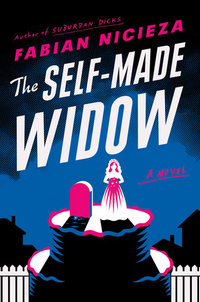
The Self-Made Widow by Fabian Nicieza: The Housewife Detective and the Disgraced Journalist Face Off with a Devious Mind

The Self-Made Widow The Self-Made Widow

by Fabian Nicieza

DETAILS:
Series: Suburban Dicks, #2
Publisher: G.P. Putnam's Sons
Publication Date: June 20, 2022
Format: Hardcover
Length:388 pg.
Read Date: July 7-11, 2022

Support Independent Bookstores - Visit IndieBound.org

[Det. Rossi] heard [Andi] sigh over the phone. He hated when she sighed. It was one of the few childish affectations she had, but he also knew that meant she was either frustrated, disappointed, or, worse, thinking something through.

Or even worse, he corrected himself, all three combined.

He suspected this was an “even worse” scenario.

What’s The Self-Made Widow About?

Andrea Stern’s social circle is shaken up when the husband of one of her friends dies suddenly. Many knew of his heart condition, so it wasn’t a total surprise, but it still wasn’t expected. Everyone rallies to support his wife and sons through this trying time.

During the funeral, however, Andi’s Spider-Sense starts tingling, and she starts to put some things that she’s noticed together—leading her to a daunting conclusion. Meanwhile, Kenny Lee, her collaborator in the exposure of the conspiracy and murder last year, gets an anonymous phone call saying that his death wasn’t due to natural causes, but that he was murdered by his wife.

Finding themselves interested in the same case again, they divvy up the avenues of investigating and get to work.

Kenny Lee

He was thirty years old and the only meaningful relationship he’d ever had in his life was with the fear of being in a meaningful relationship.

Kenny’s life since their last investigation has changed the most—he’s no longer a disreputable journalist, that case reestablished his reputation, got him some great publicity, and frequent TV exposure. He’s set to release his book about the murders/investigation in a few weeks and the Netflix documentary series will follow soon after that.

He is, for Kenny, back on top of the world—he’s bought a new car, is taking better care of himself, has a better attitude toward life, and maybe has a girlfriend. But it’s not enough—he’s restless, he realizes early in the novel that he needs to be chasing a story. Something makes him take another look at this death and he starts to ask questions.

He ends up using the team he has working with/for him on the documentary to help with the legwork, I really didn’t think that the novel’s cast needed to be bigger—but man, I had a lot of fun with this group. Most of them aren’t investigators, but (like with so many in this series) that’s part of their charm—and maybe the secret to their success.

I can’t help but wonder that the same impulses that led to his earlier professional downfall are being held back by his current wave of success. If that success slows or wanes, will that come back, leading him to a new round of scandal, possibly derailing Andie’s work? Or maybe making him a target for her?

Andrea Stern

Her insecurities kicked in. What was it about her that alienated people? She knew she was arrogant, sarcastic, and judgmental, but was that reason for people to be so wary around her?

Things haven’t been good for Andi and Jeff in the months since she uncovered the murder/had their fifth child. Long-simmering resentments and arguments have heated up. Andi hasn’t gone to work full-time or anything, but she has consulted with the police a little bit, and she’s clearly interested in doing more—if she can figure out how to do it. Jeff is not at all supportive of this, but Andi’s not deterred for a moment.

What does give her some pause is the effect that this particular investigation is having/going to have on her children and her friends. Yes, she’s (mostly) privately been judging the other moms, but they’re her social circle and have been for years. Can these relationships survive the secrets she will have to dig up and expose?

Thankfully, the friend she made last year, Sathwika* is encouraging, and supportive—and jumps into assisting Andi with both feet. Sathwika gets Andi more than anyone else seems to, and Andi may just have to rely on her alone after all this shakes out.

* This post is too long as is, so I won’t talk more about her now, but I need to spend a few paragraphs on Sathwika when I talk about the next novel.

That’s just what’s going on in the background—proving that Derek was killed is going to be hard enough. But then how is she going to prove her friend did it (assuming she is the one)? Is it all worth it? What will she gain and lose here?

Ruth Stern

…she also couldn’t accept someone getting away with murder.

Her first thought was: How does Mom do this?

But Ruth’s next thought, immediately coming after the first one, and bringing both excitement and trepidation in its wake, was: How do I do it better?

Like Anci in the Slim in Little Egypt books and Auri Vicram, one thing that almost always works for me is a daughter of a mystery protagonist taking it upon themselves to jump into mystery-solving (or being recruited to help). There’s a mixture of eagerness, naiveté, inventiveness, and immaturity that adds a freshness to a type of novel that can seem familiar before you even read it.

Ruth helped out her mom a little bit in the previous book, but she’s called upon to do more now. One of Molly’s sons is in her grade and they’re friendly with each other. Ruth uses this to get a better picture of life in the Goode household—both before and after Derek’s death.

It’s not the easiest thing for her to do—it feels like she’s betraying her friend. She knows the toll it takes on her mother’s relationships, and can understand that. But she continues to emulate her mother, driven by similar impulses. Ruth is one of the aspects of this series that works best, and I hope Nicieza continues to bring her in.

Molly Goode

Ohhh, Molly is possibly my favorite antagonist of the year. She’s the kind of woman that Bernadette Fox would feud with in the neighborhood or school. You can see her bullying mothers in a PTA meeting for not bringing the right kind of gluten and allergen-free goodies to a Bake Sale, or bringing the wrath of the HOA on someone who has let their grass get too long. She’s a meticulous planner, always gracious, with perfect children, and a (until he died) husband successful enough to enable her to live the kind of life she’s wanted.

In short, she’s the last person you’d suspect of a devious, premeditated murder. But then again…

What kind of person would you have to be to commit murder when one of the people closest to you solves murders as a hobby?

So, what did I think about The Self-Made Widow?

This was not a whodunit—both Kenny and Andi had a target in mind when they started looking into Derek’s death. It was a howdunit, a little bit of a whydunit—and, sure, a wasitdun? Then the biggest question—how could they prove any of it? I absolutely loved how they had to approach this one—I can’t think of a novel with an alibi like this one. This is a master class in how to put together a mystery novel for those readers who’ve read too many mystery novels.

My biggest (only?) complaint is that there’s a new Chief of Police in town, and we don’t spend nearly enough time with him—I hope that changes in the future, I liked him and think it’d be fun to see him lock horns with Andie more (and/or work alongside her).

For both Kenny and Andie, Suburban Dicks* was about them getting back to what they wanted/needed to be doing with their lives—Kenny needed to do some real reporting, and shake the scandal off; Andie needed to stop forcing herself into the mold of perfect suburban wife/mother, and do some profiling/investigating. This book focuses on some introspection for the two of them, what’s important to them? Are the choices they made last year—or this year—worth it to them? What made them this way? Between what we see about them in these books, we have a foundation for what’s to come (hopefully in many books).

* We get a nice dash of meta-humor about the title, incidentally.

It’d be easy to talk up the humor of the book—but it’s not a comedy. It’s comedically told—and there are some moments of slapstick—but at its heart, The Self-Made Widow is a murder mystery (with some other crimes thrown in for good measure). There’s a lot of darkness under the laughs, and readers should be prepared for that.

There’s a lot to chew on here when it comes to our protagonists as well as many of the supporting characters. Add in the murder and what they have to do to resolve things, and you’ve got yourself a great read. But you also get Nicieza’s laugh-out-loud humor, sharp observations, and strong narrative voice. If this novel had only one of these elements—character, plot, and writing—and it’d still be something I recommend. All three? Fuggedaboutit.


5 Stars

This post contains an affiliate link. If you purchase from it, I will get a small commission at no additional cost to you. As always, the opinions expressed are my own.


Book Blogger Hop: Do You Listen to Audiobooks?

Book Blogger Hop


This prompt was submitted by Elizabeth @ Silver’s Reviews:

Do you listen to audiobooks? If so, do you prefer listening instead of reading?

“Books on Tape” (what people of a certain age grew up knowing audiobooks as) weren’t really something I was much aware of growing up. In college my friends and I would hit up a truck stop on the drive home, you could rent one (like a Videotape/DVD) and return it to that truck stop/another one for a couple of bucks. Those made the drives a little more entertaining—assuming you and whoever you were riding with could agree on one. Most often, the length of the book determined if you’d rent it—why get a book you couldn’t listen to on the way home—or maybe over the round-trip, assuming you weren’t driving home for the summer. It was primarily a service for truck drivers, obviously, but hey, we’d take advantage of it, too. But beyond that? I didn’t listen to them.

But the first time I tried to listen to one outside of that was a disaster. I was working the graveyard shift and there wasn’t a whole lot for me to do—but I figured I could move around and do my paperwork and whatnot while listening. And that worked fine. But when I sat down for a minute between tasks (and there was a lot of that time), the audiobook was like listening to someone read me a bedtime story and I couldn’t stay awake. Which is pretty much the opposite of what I needed at 2 a.m. I really didn’t have time outside of that to listen to one—and I wasn’t taking road trips then, so I didn’t have time for one (and I think truck stops weren’t renting them anymore by that point).

Fast-forward a decade, and I’m working a day job (phew!!) that involved a lot of data entry that I didn’t need to think much about—and I could only listen to so many podcasts in a day before getting burned out. So I tried my library’s Overdrive services, and never looked back. I’m not in that job anymore, but I’ve found ways to keep listening while I work (although I do hit pause when I come to something that takes a little thought, I don’t want to miss anything) and will find time to listen every weekday. I have an audiobook in progress at all times nowadays and have a healthy library of my own titles.

I love audiobooks now and have a decent list of go-to narrators (and have even tried a couple of books I was on the fence about just because of them). I’m not sure that I could just sit and listen to an audiobook like I tried to do at work years ago—I think I’d still fall asleep. But while working, cleaning, cooking, driving? It’s a great way to keep moving on my TBR, try out a new series, or revisit a favorite. I also tend to do better with listening to Non-Fiction than I do reading them—I think I’m just more willing to devote the listening time than the reading time to it. I’m not sure I can explain that.

But on the whole, I prefer the experience of reading myself, not being read to—not just because I generally stay awake while doing that. It’s easier to stay in a passage and think about it—to flip back and double-check something, etc. Because I’m not multi-tasking I can get sucked in deeper (although some authors/narrators make it so that I’m close enough that I don’t care).

While I’m talking (far too much, I realize) about audiobooks, let me take a moment to say that Libro.fm is my preferred source of audiobooks, check them out!

Libro.fm support local, independent bookstores with their audiobook purchases

What about you—are you an audiofile?

Spelling the Month in Books: July

Spelling the Month in Books: July

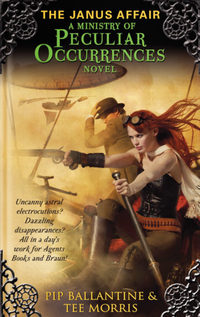
J The Janus Affair

The Janus Affair

This is the second in the Ministry of Peculiar Occurrances by Pip Ballantine and Tee Morris–a Steampunk adventure with elements of spies and SF, and a dash of romance. My Goodreads review from 2012 says, “This time out, our intrepid secret agents investigate the inexplicable disappearances of several leading British suffragists. Pasts come back to haunt, secrets are exposed, romances are kindled, clockwork doohickeys do all sorts of strange and wonderful things–all you can want.” Can’t think of a better way to put it.

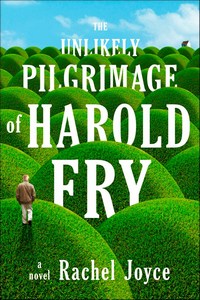
U The Unlikely Pilgrimage of Harold Fry

The Unlikely Pilgrimage of Harold Fry

The strongest memory I have of Rachel Joyce’s novel is how sweet it was–a retired gentleman hears that an old friend of his is in hospice on the other side of England. He writes a message to her and on his way to the mailbox, decides to hand-deliver it, so he sets out on a “stroll” from Kingsbridge to Berwick-upon-Tweed–it’d be hard to get two cities further apart in England (a quick search tells me it’s 7+ hours by train). Of course, he’s dressed to drop off a letter in the mailbox, not a cross-country hike. But he won’t let go of the idea. While walking, he deals with a lot of memories, rekindling feelings and ideas he’d long neglected; there’s a “Run, Forrest, Run” kind of public support that grows around him, and his wife has plenty of time to reflect on their marriage, too.

That’s the best you’re going to get from me about a book I haven’t read in a decade–but it’s not a great summary. It’s a feel-good kind of book, and as I recall, is pretty effective.

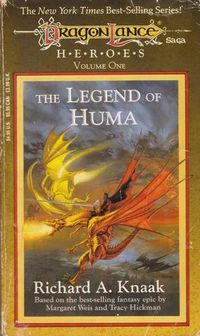
L The Legend of Huma

The Legend of Huma

Richard A. Knaak’s tale of the Knight who discovered the Dragonlancewas the first entry in the Dragonlance Heroes, and I think was the first in the world not to be written by Weis and Hickman. I haven’t read it (or any Dragonlance novel) in decades, but it was possibly my favorite. I know I read it more than any of the Chronicles or Legends (the benefit of being a standalone, rather than part of a trilogy). Huma is the kind of knight you reflexively think of: moral, brave, determined, and pretty good with his weapons. I have nothing but good memories of this.

(which is probably why I’ll never revisit it again–I don’t want to risk being disappointed)

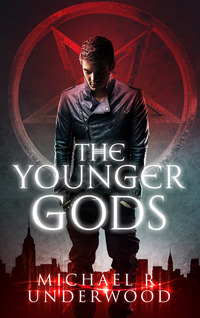
y The Younger Gods

The Younger Gods

Michael R. Underwood’s first non-Ree Reyes book was a good departure in style and subject, making a statement that he’s not a one-trick pony. This time out, his protagonist escapes from the Doomsday Cult he was raised in and goes to NYC to start fresh. Which is not easy, but he’s trying to learn how to live outside of that very insular world he grew up in. Here’s the thing–this cult isn’t like your typical cult, they are actually on to something–they have the magical abilities and know-how to bring about The End of the World. Then his sister shows up in NYC to actually initiate the apocalypse–and Jacob has to find a way to stop her.

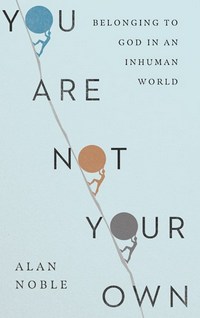
You Are Not Your Own: Belonging to God in an Inhuman World by Alan Noble: Correcting Our Understanding of Humanity

You Are Not Your OwnYou Are Not Your Own:
Belonging to God in an Inhuman World

by Alan Noble

DETAILS:
Publisher: IVP
Publication Date: October 11, 2021
Format: Kindle Edition
Length: 232 pg.
Read Date:  May 29-June 12, 2022
Support Independent Bookstores - Visit IndieBound.org


I’ve tried to write this post 4 times since I finished it—and I’ve struck out each time, because I keep trying to interact with and reflect on Noble’s arguments—because there’s a lot to chew on, a lot to commend, and a great deal to unpack. But that’s not what I’m supposed to be doing here—I’m supposed to talk about the book, talk about how Noble wrote it, and what I thought about it—sure that involves some reflection on the content, but it’s not supposed to be my focus (as much as I might like it to be). So, I’m going to take a more surface-level approach, just so I can get something out.

(I said something similar with Winslow’s The Border recently—you’re probably not going to find a lot of people discussing these two books in similar fashions anywhere else)

The Back of the Book Description

(from ivpress.com)

“You are your own, and you belong to yourself.”

This is the fundamental assumption of modern life. And if we are our own, then it’s up to us to forge our own identities and to make our lives significant. But while that may sound empowering, it turns out to be a crushing responsibility—one that never actually delivers on its promise of a free and fulfilled life, but instead leaves us burned out, depressed, anxious, and alone. This phenomenon is mapped out onto the very structures of our society, and helps explain our society’s underlying disorder.

But the Christian gospel offers a strikingly different vision. As the Heidelberg Catechism puts it, “I am not my own, but belong with body and soul, both in life and in death, to my faithful Savior Jesus Christ.” In You Are Not Your Own, Alan Noble explores how this simple truth reframes the way we understand ourselves, our families, our society, and God. Contrasting these two visions of life, he invites us past the sickness of contemporary life into a better understanding of who we are and to whom we belong.

Acting as If We Are Our Own

The part of the argument from the first paragraph takes the first four chapters and the majority of the book. I guess you could consider this the “Here’s What’s Wrong and Why” part—if we are our own (as we’re told) several problems ensue—personally, culturally, and ecclesially. We (and Noble includes most of the American Church here) have a faulty anthropology, and that results in many problems.

Noble explains where he sees the faulty anthropology leading with compassion and sensitivity, while not pulling any of his punches.

Understanding We Belong to Christ

But for the Christian, our faith begins with the realization that we are not our own (as explained in the words of Heidelberg Catechism Q&A 1). Noble points the believer to recalibrate their understanding of human nature—particularly redeemed human nature—to begin to understand what being the possession of Christ means to our life, our future, our identity.

The strength of this section comes from Noble’s honesty:

At this point you might expect me to introduce my “Five Steps for Changing Your Life by Accepting That You Are Not Your Own.” But as this is a work of nonfiction, I won’t be doing that.

Instead, he gives some advice, based on his own experiences and observations—but he offers no guarantees. I found his honesty refreshing and thought there was a lot of wisdom to his advice, but I was mostly impressed by the humble nature of the approach—advice, not a program or techniques.

So, what did I think about You Are Not Your Own?

I really liked this—I thought it was insightful and helpful. Noble’s diagnosis and advice were sound—they seemed to match up with the world around us and the problems we see. More importantly, he points to the One whose grace, mercy, and care offer any true hope and help in this broken and dying world.

Noble’s writing flows—he’s engaging, compassionate, and relatable. It’s easy to understand even the more complex points he’s making, and his illustrations give the reader plenty to hang on to.

I think Noble’s book would serve as a great companion piece to Kapic’s You’re Only Human: How Your Limits Reflect God’s Design and Why That’s Good News*. Both of these authors remind the reader of our place in the world, and why we’re there—so we can respond in dependence and trust accordingly.

* Meador’s What Are Christians For?: Life Together at the End of the World, and even the better parts of Thompson’s Growing Downward fit here, too, I think—just not as neatly.

I’ve already re-read parts of this book, and find myself chewing on it repeatedly—especially as I compare it to Kapic’s. I heartily recommend and encourage you to pick it up.


4 1/2 Stars

This post contains an affiliate link. If you purchase from it, I will get a small commission at no additional cost to you. As always, opinions are my own.

Saturday Miscellany—7/16/22

Odds ‘n ends about books and reading that caught my eye this week. You’ve probably seen some/most/all of them, but just in case:
bullet Ever used real bacon as a bookmark? Library workers share their more unusual finds in returned or donated books.
bullet TV: America’s Next Great Author—Nothing says “gripping reality TV” like a bunch of writers. I’d be snarkier, but I think Nick Kolakowski said it better than I could.
bullet Libby is stuck between libraries and publishers in the e-book war
bullet Comic-book sales had their best year ever in 2021 — and this year is on pace to be even better. Here’s what’s behind the surge, from manga to ‘Dog Man.’
bullet Nadine Matheson: In the Mind of a Killer: The author considers whether her work as a criminal defense lawyer allows her to more easily move into the minds of killers.
bullet 100 Years of Popular Books on Goodreads—They went year by year, “picking the most popular books published over the past 100 years, as determined by Goodreads members’ digital shelves.”
bullet Tips for Battling Reader’s Guilt—It’s a little NetGalley-centric (which makes sense given the source), but there’s some applicability beyond that site, too
bullet Find Your One “Must Read” Book of Summer 2022!
bullet Some Thoughts on Multiple PoVs and Plot Strands—Peat’s on to something here
bullet A Day in the Life of a Rural Public Librarian
bullet 10 (Not So) Easy Steps to Cure A Book Hangover
bullet Let’s Talk About: Self-Published Authors Appreciation Week—There’s just one week until SPAAW 2022 kicks off, are you in?

A Book-ish Related Podcast episode (or two) you might want to give a listen to:
bullet The Dresden Files Podcast Episode 161: Jim Butcher and James Marsters for The LAW!—Recorded on Publication Day for The Law, but I just listened to it this week. They cover the novella a bit, but spend most of the time talking about recording audio books, a glimpse into Butcher’s next projects, and a little mutual admiration.

This Week’s New Releases that I’m Excited About and/or You’ll Probably See Here Soon:
bullet The Binding Room by Nadine Matheson—Matheson’s The Jigsaw Man was one of my favorite debuts last year, I can’t wait to see what trouble she’s put Anjelica Henley into this time.

Lastly, I’d like to say hi and extend a warm welcome to Celeste | A Literary Escape and Robert Jones who followed the blog this week. Don’t be a stranger, and use that comment box, would you?

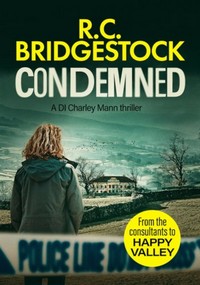
Condemned by RC Bridgestock: This DI has Two Cases that Couldn’t Be More Different

CondemnedCondemned

by RC Bridgestock

DETAILS:
Series: DI Charley Mann Crime Thrillers, #2
Publisher: Canelo
Publication Date: Canelo
Format: April 8, 2021
Length: 266 pg.
Read Date: July 13-14, 2022

What’s Condemned About?

DI Charley Mann is called out to look at a probable arson at a house that’s set for demolition. It takes no time to determine that, yeah, it was arson—but since the house was abandoned and set to be torn down, no one cares to invest the resources to investigate further—what’s the point?

Charley was curious about the house—since before she grew up in the area, there were stories about the manor house. Many (especially area children) call it haunted. Who wouldn’t be curious?

Then the demolition company finds two bodies at different locations in what little of the building still standing just before they finish their job. And now it’s time for Charley and her detectives to get to work. One body was tucked into a hidden compartment behind a fireplace, it’d been behind there for weeks—maybe a few months—and was the victim of a gunshot. The other body was hidden in the basement and seems to have been interred in the manner of a pagan ritual—possibly killed that way, too. That body has been in the basement for several decades, maybe a century.

Two homicides in one house. Two cases that couldn’t be more different. This is going to take a lot of work, and a decent amount of luck for Charley and her team.

Grinding Slowly

In Police Procedural novel after Police Procedural novel, inevitably one character will say something to another about how forensics don’t get results as quickly as they do on TV. We all know this, anticipate this, and are ready for it. But, boy howdy, do things move slowly in West Yorkshire—they’re probably more realistic than many of the other procedurals that make the same disclaimers.

The same things go for interagency communications—when Mann gets a call from some other law enforcement agency for information, etc. it’s frequently long enough ago that I’d wondered if Bridgestock had just left that hanging, or decided to not pursue that line for whatever reason.

I absolutely believe that Bridgestock is more realistic in this than the majority of their contemporaries. How does anything get done? Sun Tzu had no idea about the pace of 21st Century bureaucracy when he wrote, “Wheels of justice gind slow but grind fine,” but the man was prophetic. I just hope he’s as accurate about that fine grinding…

Trusting the Reader

While I have been enjoying this series—there’s been something nagging me about the writing (well, a few things, but let’s just focus on one). RC Bridgestock doesn’t trust their readers. After illustrating (or sometimes before) what a character is thinking or feeling, they state it. They explain a joke—or a pretty clear statement.

One example:

‘He comes across as dodgier than a care salesman,’ Annie said, ‘and car salesmen are well dodgy!’

‘Not all of them, Annie,’ Charley chuckled.

What reader isn’t aware of the general view of car salesman as being unreliable, honesty-impaired, shifty—in short, dodgy? Who (in the conversation or reading it) needs Annie to elucidate that? Then to add Charly’s disclaimer and chuckle? It’s like the old 70s/80s shows that end with a punch line and then a freeze frame showing the entire cast laughing. Cut that section at “Annie said.” Then you move on to the next scene—it’s punchier, it displays the necessary information about the suspect and the requisite jaded cop humor (it’s good to see Annie getting experienced enough to show that, by the way), and trusts the reader to know how people are going to react. It also cuts a little of Charley’s sanctimoniousness, no one needs her to defend car salesman in that conversation.

Bridgestock does this kind of thing all over the place. It’s not needed, it’s off-putting, and it slows everything down. Especially with all the—very necessary—exposition in this book, the last thing you need is to let things drag.

So, what did I think about Condemned?

I’ve had a good time with the first two books in this series—I think I enjoyed this one a bit more than the predecessor. Charley’s a good protagonist—dogged, determined, and flawed. Just what you need. A good leader, but not a perfect one. The rest of the cast of characters are just as promising, they’re the kind you want to watch grow and develop and be fleshed out.

In this book, Bridgestock has given two of the detectives on Charley’s team interesting backstories—and added to the backstory of one other. I don’t know that they’ve done enough with them to justify the time spent—but there’s promise for the future. I hope they deliver on that promise.

The mechanics of the writing still bother me—there’s one chronological flub that I keep tripping on—but I find the cases, the storytelling, and the characters engaging and compelling enough to keep me going and I can gloss over 99% of the problems. The procedural aspects seem as sound as they can be. Two murders at the same location that are clearly unrelated? That’s a great hook, and once you dive in you have to know how they’re resolved.

I do recommend this—with a couple of qualifications—you’re going to have a good time with it, and probably (like me) be ready to come back for more.


3 Stars

The Friday 56 for 7/15/22: AMORALMAN by Derek DelGaudio

The Friday 56This is a weekly bloghop hosted by Freda’s Voice.

RULES:
The Friday 56 Grab a book, any book.
The Friday 56 Turn to Page 56 or 56% on your ereader. If you have to improvise, that is okay.
The Friday 56 Find a snippet, short and sweet.
The Friday 56 Post it.

from Page 56 of:
AMORALMAN

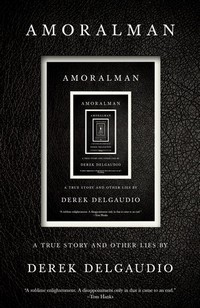
AMORALMAN: A True Story and Other Lies by Derek DelGaudio

“Why do you think the puppeteer was there?”

“How should I know?”

I told her I wasn’t a philosopher and then accused Plato of being a lazy writer. She tried to move on and discuss other elements of the story—the shadows, the prisoners, and the inexplicable escape. But I couldn’t. For me, the story was centered around a deliberate act of deception. To gloss over that deception, and ignore the motives of the deceiver, was incomprehensible to me. The Universe wasn’t trying to deceive us when we believed the Earth was at its center. And the Earth wasn’t trying to pull the wool over our eyes when we believed it was flat. But the puppeteer in the cave was trying to deceive those prisoners. And I wanted to know why.

AMORALMAN by Derek DelGaudio: Engaging and Compelling, but Maybe Left Me with Too Many Questions

AMORALMANAMORALMAN:
A True Story and Other Lies

by Derek DelGaudio

DETAILS:
Publisher: Knopf
Publication Date: March 1, 2021
Format: Hardcover
Length: 235 pgs.
Read Date: July 11-12, 2022
Support Independent Bookstores - Visit IndieBound.org

What’s AMORALMAN About?

Derek DelGaudio is a performer. writer, and illusionist. This book claims (and that subtitle should make you suspect everything) to be an account of DelGaudio’s childhood, his early interest in magic tricks and illusions—and then how he was introduced to card sharps, eventually becoming friends with some and learning how to use the card tricks he’d practiced for so long to become a cheat at cards.

At some point, he takes this theoretical knowledge into the practical—to help a good friend, despite that friend’s former insistence that DelGaudio not follow him into that life. After some time exposed to this lifestyle, he has to make a choice? What kind of man is he? What place does morality hold?

It’s tied throughout to Plato’s Allegory of the Cave, the role of the perceptions, reality, and the participants.

The Title

Obviously, DelGaudio is playing with things in the title. Is this book about a moral man? an amoral man? Is it a story without a moral?

How much of this is the true story and how much is a lie? It could be seen as a collection of stories—so is only one true, or is the overall narrative true, with a scattering of lies?

I’m mildly amused by that, but I really don’t think I care.

So, what did I think about AMORALMAN?

Ehhhhh. I wanted more. And not in a “this was so good, I’ve got to have more” kind of way, but in a “this was okay, but…is this all there was?” way. Ultimately, what we’re dealing with is a memoir that tells you upfront (and repeats it) that at least some of what you’re told is a lie—and probably not just from those people who are liars by vocation.

I thought the premise promised more. I expected to get something with a bit more meat on it. A bit more to chew on.

Still, DelGaudio can tell a story. You get engaged right away and you’re eager to see how this detached, disinterested, and largely aimless kid becomes the guy who stars in In & Of Itself*. We don’t get that answer, but it’s not hard to see the foundation being laid.

* And, yeah, I bought this book without knowing anything about it because of the film version.

I do think I’d read another book by DelGaudio—I’m curious about what else he has to offer. And I do think that people interested in his other work would find something compelling here. But that’s about as much as I can say—you won’t be wasting your time.


3 Stars

20 Books of Summer

This post contains an affiliate link. If you purchase from it, I will get a small commission at no additional cost to you. As always, opinions are my own.

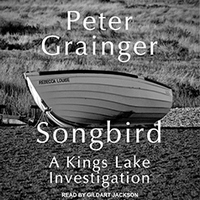
Songbird (Audiobook) by Peter Grainger, Gildart Jackson: Passing the Baton

SongbirdSongbird

by Peter Grainger, Gildart Jackson (Narrator)

DETAILS:
Series: A Kings Lake Investigation, #1
Publisher: Tantor Audio
Publication Date: September 18, 2019
Format: Unabridged Audiobook
Length: 15 hrs., 6 min.
Read Date: June 27-July 1, 2022
Support Independent Bookstores - Visit IndieBound.org

DCI Reeve was in the room now, accompanied inevitably by Detective Chief Superintended Allen. Another promotion, how was that possible—what did he actually do all day but get in the way of more junior officers trying to solve crimes and bring about convictions. Waters stopped that train of thought. Over time, we all become our fathers and mothers, that’s a sort of natural process. But surely we don’t all become our first Detective Sergeant as well.

What’s Songbird About?

It’s the first murder that’s fallen under the jurisdiction of King’s Lake since Chris Waters was promoted to Detective Sergeant, and it’s time for him to step up.

There’s been a killing at a caravan site that’s well-known to Waters, and he knows the manager. This will both work for and against him, but early on it gives him some confidence—he knows this area and doesn’t have to learn anything about his surroundings. He needs all the confidence he can get.

DI Terek and DCI Reeve take the lead on this investigation (Reeve’s much more hands-on than her predecessor, and things are better for it). Some very convincing evidence leads them to focus on a suspect early, and they go about building their case.

For reasons he can explain, and some that remain ineffable, Chris Waters doesn’t believe in their suspect’s guilt and Waters follows his mentor’s example and sniffs around a little himself. He doesn’t have the relationship with his superiors that DC Smith did, though, so he has to be careful about it. Thankfully, Serena Butler (when she’s not giving him grief over his promotion), agrees with him and the two are able to come up with some compelling reasons to look elsewhere for the guilty man.

Passing the Baton

It’s a tricky thing that Grainger tries here—the series protagonist is gone, and yet it continues. It reminded me of when Kyra Sedgwick’s Deputy Chief Brenda Leigh Johnson left The Closer and the show became Major Crimes, and the team was then led by Mary McDonnell’s Capt. Sharon Raydor. The tone shifted, the characters got to grow and develop in different ways, the team functioned differently, and the approach they took to closing cases changed, too. But the show still worked.

Grainger’s always kept a broad view of the characters while focusing on DC Smith in the past—now we spend a little more time with everyone, but the focus is on Chris. That alone will change how things go—Chris has less experience to draw upon, he’s not quite as jaded (but he’s getting there), and generally sees things differently. The introduction of Cara Freeman and her methods to the mix also changes things (sure, she’s been around for a while, but we really see her at work here).

So the series continues, it just looks and feels a little different. But the core of the storytelling seems like it’s going to persevere.

Gildart Jackson’s Narration

It’s a subtle thing, but I thought I picked up a little change in the narration—it’s got less of “DC’s voice” but it’s still distinct from other books that Jackson’s narrated. Maybe it’s all in my head, but I think I can tell the difference in his approach to the books. It doesn’t matter, Jackson’s voice and characterizations bring me to King’s Lake Central they bring the world to life. Another great job by Jackson.

So, what did I think about Songbird?

Okay, the initial suspect was clearly innocent—and it took far, far too long for someone to figure out where the evidence that implicated him came from—it was maddening yelling at my phone, waiting for them to get there. But it was satisfying very satisfying when they finally put two and two together.

And for readers of procedurals, the guilty party was pretty clear all along—but getting to the motive and then working the case so that they had evidence to arrest, that was great. Watching Waters and the rest carry on Smith’s mission was exactly what a fan wants—and the new DCI in charge of the Murder Squad, Cara Freeman has her own style and pace that makes for a pleasant new dynamic.

The plot part of this novel wasn’t Grainger at his best, but it was close enough (so close). But the heart of this book was on the transitions—the team moving on from DC, the further establishment of the Murder Squad, Waters transitioning to DS (and people getting used to that), DC transitioning to his new life—plus some personal stuff that I don’t want to spoil. And Grainger absolutely nailed it.

As this is a transition point—it’s a great time to jump in. Yeah, there’s a lot of backstory, but none of it is necessary to get 98% of this book.

This had to be a tricky needle to thread for the series (singular or plural, take your pick), and Songbird pulled it off. I’m not at all surprised to see it, but I’m very pleased.


4 Stars

This post contains an affiliate link. If you purchase from it, I will get a small commission at no additional cost to you. As always, the opinions expressed are my own.

Would You Rather: Extreme Book-Lovers Edition Book Tag

Would You Rather Book Tag
I saw this over at chasing destino, and decided to give it a try–I had a lot of fun with this one, hopefully, you have fun reading this.

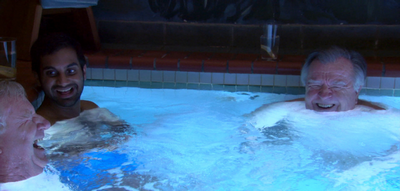
Mid-way through putting this together, I had a vision of Tom Haverford and his pals in the Hot Tub playing this game (Parks and Recreation, Season 3, Episode 2: “Flu Season”), and I can’t get it out of my head. Thankfully, these questions are easier (and more tasteful) than anything Tom came up with.

Tom Haverford in Spa

1. Would you rather have a friend who loses your books, or one who dog-ears them?

I’d rather have one less friend.

I don’t know…On the whole, dog-eared pages don’t bother me too much (not that I’ve done that in decades myself)–but I do have some older books that would look nicer if that had never happened to them. But a lost book can simply be replaced–which (barring the book being out of print, the new one having an ugly cover, or some other calamity befalling it) is almost easier to deal with than manhandled pages (especially if said friend secured their spot in my friendship roster by paying for the replacement unprompted). I guess, ideally, I’d take a lost book over a dog-eared one, but a friend is worth more than either.


2. Would you rather secretly love a book everyone else hates, or secretly hate a book everyone else loves?

I have to keep my love or hate secret? That might be a deal-breaker, for me–I just don’t know if I could get by without writing about my love/hate.

There’s a decent number of books I’ve enjoyed that few have read and, and I’m okay with not being part of the crowd when it comes to super-popular books–especially if I can understand why people think it’s great while I happen to disagree with them. If it’s one of those times where I don’t understand what everyone loves about a book, that bugs me.

I think I’d rather hate a book the rest of the world loves. If I’m a fan of a book, I’m going to want to spread the word and try to find like-minded readers. I want that possibility–exposing friends, family, blog readers, etc. to good books makes me happy. Grousing about a book isn’t particularly a thing I enjoy.


3. Would you rather be stuck on a very long plane or train ride without a book?

I’ve never traveled on a train that wasn’t an attraction on an amusement park, so I’m not honestly sure. But I do know that I’ve never been on a plane without at least one book (and usually a backup). Once we get in the air, I don’t think I’d mind flying all that much–but I don’t want to take the chance, I prefer being locked away in another world when we’re at crusing altitude. So let’s try to get me stuck on a very long train ride and see what happens.


4. Would you rather have dinner with your favorite author or your favorite character?

This is a tough one…I assume whatever fantasy-world that could give me this option could also give me the ability to shrug off my anxiety in order to converse with either the author or character? I could have a lot of fun over a steak sandwich or a Whopper with Harry Dresden (for example), but if I broke bread with Jim Butcher, he could tell me a lot about Harry–and Mouse, Toot-toot, Molly, and everyone. Harry couldn’t tell me anything about Butcher. The same would apply to other favorite characters and favorite authors. So, I’m going to have to go with the author.

Although, there’s a better than even chance that Tilly Bradshaw could tell me things about M.W. Craven that he doesn’t know himself.


5. Would you rather date a character you have a crush on or your crush from real life?

I’m pretty sure my wife would object to me dating anyone. I typically turn questions/prompts about book crushes into questions about fictional dogs, so let’s do that here.

Yeah, I’d love to spend some time with Dresden’s Mouse, Andy Carpenter’s Tara, Atticus’ Oberon (especially if I could hear him tell a story), or Washington Poe’s Edgar (and so on). So, put me down for a play date with a fictional dog. Nothing too major–they’ve got a human to hang out with, and I’ve got a couple of pooches that need attention.


6. Would you rather have your favorite book turned into a movie, or your favorite movie turned into a book?

I’ve read some really solid novelizations of movies (and several ‘meh’ novelizations, too). And like everyone who’s reading this post, I’ve both enjoyed and been disappointed/angered by bad adaptations of novels. Even the most barely adequate novelization is better than a bad adaptation. I don’t want to risk it with my favorite book.

Also, it’s easier for me to forget a disappointing movie than it is a disappointing book.


7. Would you rather read a book with an annoying cliffhanger, or one where your favorite character is killed off?

The phrasing here gets me–is the author of the tag suggesting that there are non-annoying cliffhangers and their target is the annoying kind? Or do cliffhangers get this descriptor automatically?

I’ve survived Dragons of Winter Night, Harry Potter and the Deathly Hallows, Where the Red Fern Grows, Battle Ground, and Marley & Me–along with several others that I won’t name so I can leave the liquor cabinet untouched today. I can handle deaths of favorite characters. Usually, after a period, understand and defend the author’s choice (fat chance of that happening with Battle Ground)–but that doesn’t mean I’d rather read something like that.

No, give me a cliffhanger–annoying by definition, annoying in practice, or any other kind.


8. Would you rather lose the ability to read any new books, or the ability to reread books you’ve already read?

Oh, wow…this is tough. This ranks right up there with that poor guy from The Twilight Zone who breaks his glasses before getting to spend the rest of his (probably short) life reading.

I’m super curious about new books–I imagine I always will be. Not being able to read a new book again is a dire fate indeed.

Never returning to Wolfe’s brownstone? Not seeing Spenser at his best? Never fighting back a tear when Harry Dresden uses the knife to win a war? Not getting to see Mercy Thompson torment the Alpha next door with her rusted out VW? Never seeing Kinsey Milhone at work again? Reading about Rov and the guys at Championship Vinyl and their Top 5 Lists? Not going through the Wardrobe again? Saying goodbye to Boo Radley? … Nope. Just can’t do that. I’d lose too many old friends and characters who might as well be family.

I guess I’d opt for losing the ability to read new books.


9. Would you rather live in a library or a bookstore?

I think a library would have to be my answer here. I learned a thing or two from Claudia and Jamie Kincaid that I could apply to a library, for one (and, in a library, I’d have an easy time finding a copy to brush up on, too).

Librarians are more likely to have a microwave and decent coffeepot–not to mention decent restroom facilities–than bookstore employees are (except for those bookstores with a coffee bar). Also, in a bookstore, you’d have the pressure of keeping the books pristine and ready to sell. Library books are supposed to be well-read/thumbed-through, so I wouldn’t have to worry about that. Lastly, I think it’d be far easier to hide out in a library than in a bookstore.


10. Would you rather lose your place or get a paper cut every time you read a book?

With losing your place there’s the danger that you’ll get something ruined if you check a page ahead of where you left off–or that you’ll miss something important. Both have happened to me more than I care to think. But I spent one summer in college working in binderies and print-shops and paper-cuts were a near-daily thing–drawing blood at least fortnightly. And…no. Just no. You’d think you’d get used to it, but I never did. I did get a lot better at paper-handling and by late July the cuts were decreasing in frequency, but I never got used the cuts. I’ll take losing my place regularly.

Come to think of it, if anyone is around when I’m reading now (including one of the dogs), I’m bound to get distracted and lose my place anyway.


11. Would you rather have to always read in the dark, or always read books with tiny text?

Well, I get some kind of light, right? I’m not the Newton that wrote Opticks, but I’m pretty sure you have to have some light to see print. So I’m going to intrepret this question as “Would you rather have to always read with very little light, or always read books with tiny text?” Either is not going to do favors for my not-yet-fifty-year-old (but getting close) eyes, but I’m going to go with in the dark/very little light.

Going back to the days when I had a small selection of flashlights next to my bed to use after my folks said “lights out,” I’ve done okay with limited light, frequently without noticing it until my wife turns a lamp on. I still do okay with that–but I think my days are numbered there. Small print is getting harder and harder for me, even with my new bifocals, and I just don’t enjoy it. Large Print editions still give me a headache, so my eyes aren’t too bad, yet.

Of course, if we’re talking about an e-reader, it can be as dark as you want in the room…


12. Would you rather read by a fireplace, or on the beach?

I’ve done both of these repeatedly, so this is easy-peasy. Fireplace.

Fireplaces are indoors, which is almost always a plus in my book. They can be just sitting there inert, or making the vicinity warm and toasty. Either way, it’s an improvement over the absence of a ceiling and the yellow ball of fire overhead. Beaches frequently involve people yelling in the distance, strangers walking by and distracting you, a well-intentioned family member shouting at you to look at something–or telling you that you should put your book down and enjoy things.

Also, fireplaces almost never get sand everywhere on your person, making it too uncomfortable to read. Whereas that’s an ever-present danger on a beach.


As usual, I’m not tagging anyone in this—but I’d like to see what you all have to come up with.

Page 239 of 630

Powered by WordPress & Theme by Anders Norén