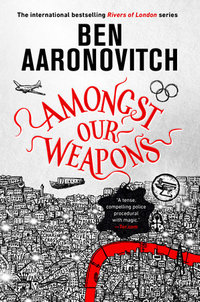
Amongst Our Weapons by Ben Aaronovitch: Fear, and Surprise, and Ruthless Efficiency, and two Births.

Amongst Our WeaponsAmongst Our Weapons

by Ben Aaronovitch

DETAILS:
Series: Rivers of London, #9
Publisher: DAW
Publication Date: April 11, 2022
Format: Hardcover
Length: 294 pg.
Read Date: April 12-15

Support Independent Bookstores - Visit IndieBound.org

What’s Amongst Our Weapons About?

Peter’s called in for an initial assessment on an odd murder scene, just to make sure that there’s nothing magical about it. He brings along the newest trainee to the Folly’s Course in magical policing, just to familiarize police throughout the country with their methods. On an initial glance, it looks like it’s something that would belong to the Folly, but there’s an odd lack of vestigium—almost a suspicious lack. The method of murder—and the damage to the more technical devices in the area make it clear that this is a magical murder.

So, Peter and his trainee, join Guleed and Stephanopoulos in their investigation. They soon discover that this murder is actually the second in a string—there’s little to tie the two victims together at first glance, except a similar taste in platinum rings. “Taste” is a poor word there, it’s more of an obsessive need to have their ring that invites Gollum comparisons (however they might be discouraged).

This case is likely the most International that the novels have recorded (although no one leaves the country—as helpful as that might have been) and involves history and magical disciplines that Nightingale and Postmartin can only speculate about. In other words—everyone’s in for a pretty steep learning curve before this is all done.

I feel like I’ve spent a lot of words there to say very little, but it’s one of those setups, I’m not sure what else to do.

Everyone Expects…

With a title like that, if the words “Spanish Inquisition,” aren’t on the tip of your tongue, something’s wrong with you. So, you can’t help but look for the Inquisition to show up in the novel—it’s the how it shows up that’s clever and wholly within what you expect for the series.

Aaronovitch doesn’t work Monty Python into this novel quite as thoroughly as he did with the Hitchhiker’s Guide references in False Value—but it’s there. Which is a fun little garnish.

Building Worlds and Bridges

If everything else in this novel was a “bleh” (and it wasn’t), I’d consider this one a win only for the things I’m talking about in this section.

The Rivers of London series has a pretty well-developed world, and there’s a lot of room to play already. But Aaronovitch keeps building it out—and we get a good deal of it here. There’s a whole other side to the world of practitioners in England pre-WWII that we didn’t know about and that Nightingale hasn’t seen a reason to share with Peter before. I loved this new discipline, how it was introduced, and how it ties in with other non-Society of the Wise British practitioners.

It’s very clear that whatever the Magical community looked like pre-WWII, the War devasted it—alliances are shattered, secrecy and nationalism became the order of the day—with a healthy dose of suspicion. Slowly some of the barriers are coming down and Peter has a lot to do with that—his activity alone has helped practitioners in other nations (see: Germany) become aware of the Folly’s current status. Also, Peter’s relationship with Beverly and her family is strengthening and altering the relationship between the Folly, the Demi-monde in general, and The Rivers in particular. We see a big jump on the domestic front with the other discipline and some other things in these pages—but also, there’s a real sign that Peter’s trying to forge a stronger connection between the magical communities of the U.K. and the U.S. I can only hope that this will soon result in Tobias Winter and Peter meeting up.

Also, there’s something that was briefly mentioned in False Value that’s returned to here, but isn’t given all that much attention. I think, ultimately, this is going to be the post-Faceless Man Big Bad, and this slow build-up to it in a series of 2+ is great. I’m including this with the Worldbuilding because it’s pretty clear that whatever this ends up being, Peter (and I bet Nightingale, too) are going to have to reconsider what they know about the world.

Awwwww…

When the book opens, Beverly is close to delivering the twins. In practically every conversation that Peter gets into, someone is asking him about the upcoming birth, the christening (or whatever they end up doing), etc. Seemingly every minor character from the series so far is talking about it.

There are all sorts of goings-on at Beverly’s home to prepare for the birth—and those who aren’t asking Peter questions are chipping in to get things ready.

All hands are on deck—several in unexpected ways—on this front, and for long-time fans, this whole story through the novel is going to be a real pleasure—it’s the emotional heart of the novel and it pays off well. This storyline—especially the last ten pages of the book—is almost enough to tip me from the 4 Stars I was going to give the novel to a 5.

So, what did I think about Amongst Our Weapons?

I’ve tipped my hand already, I realize, but I liked this novel—a lot. This is fairly predictable—it’s the ninth novel in a series that I’m a completist in. I’ve read and listened to the previous eight novels, short stories, and novellas at least once—and have read all the comics one or two times, too. So, it’d take a massive drop in quality for me to be negative about this. It’s not my favorite in the series—but it’s on the upper end of the spectrum.

I do wonder if the main story could’ve been focused on a bit more in the midst of the personal story and all the expansion of the world that’s going on, it sometimes seemed to take a backseat to other things. I think we got a simpler story so that Aaronovitch could do all the extra things without overcrowding the novel. Also, I can’t think of a thing he should’ve cut. If anything, I think it could’ve been improved with another 100-150 pages of material. For example, we’d have been better served to have our favorite FBI Agent, Kim Reynolds, get 2-4 scenes showing some work in the States related to the crimes.

There are some great character moments—including from some unexpected corners. For example, we get some background on one character that I’d simply assumed we’d never learn more about (I think Peter was with me on this point). Like so many things in this novel, that’s a real treat for the fans.

It’s hard to say without knowing where things are going, but it feels to me like the first arc wrapped up in Lies Sleeping and False Value served as a chance for the characters and readers to catch their breath after it, and Amongst our Weapons is setting things up for the next arc. Given all the things that are set up? It’s going to make taking down the Faceless Man seem easy. I can’t wait.

Obviously, I recommend this to those who’ve read this series—although I probably don’t need to. If you’ve read this far and haven’t read the series—I encourage you to do so. I don’t know that this is where I’d jump on—it’s not a bad place, per se, but it’s not the best. Maybe try False Value first—however, going back to the beginning would be best.


4 1/2 Stars

This post contains an affiliate link. If you purchase from it, I will get a small commission at no additional cost to you. As always, opinions are my own.

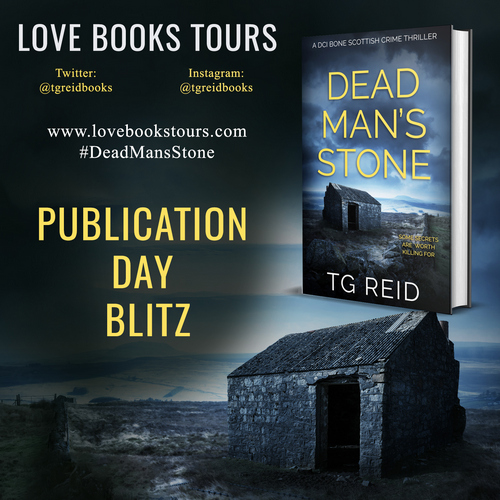
BOOK BLITZ: Dead Man’s Stone by TG Reid

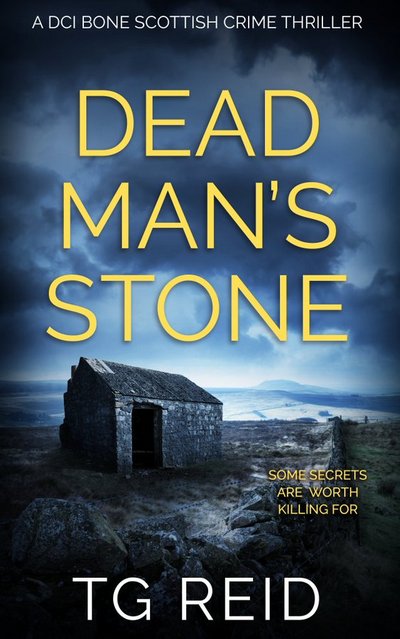
This morning I’m pleased to host a Book Blitz for TG Reid’s Dead Man’s Stone—the third DCI Bone Scottish Crime Thriller—to celebrate its publication today. It looks like a heckuva ride.

Dead Man's Stone Blitz Banner

Book Details:

Book Title: Dead Man’s Stone by TG Reid
Series: DCI Bone Scottish Crime Thriller
Publisher: Glass Work Pres
Release date: April 20, 2022
Format: Ebook/Paperback
Length: 342 pages

Dead Man's Grave Cover

About the Book:

Some secrets are worth killing for.

When DCI Duncan Bone is contacted by a terminally-ill psychiatric patient and given clues linking a forty-year-old unsolved murder to high-profile public figures, he finds himself locked into a conspiracy at the very heart of the Scottish criminal and political establishment.

With his bosses stonewalling the investigation, lives under threat, and his career on the line, Bone faces a race against time to hunt down a group of men who will stop at nothing to cover their murderous crime.

Can DCI Bone catch the killer before the killing starts again?

Set among the dramatic hills and glens of Scotland’s Campsie Fells, Dead Man’s Stone is the third in a series of edge-of-your-seat crime thrillers that will keep you guessing right up to the nail-biting, heart-stopping climax.

Perfect for fans of Ian Rankin, J.D. Kirk, Val McDermid and Stuart MacBride.


Purchase Link:

Amazon UK ~ Amazon US

My thanks to Love Books Group for the invitation to participate in this Blitz.

Love Books Group

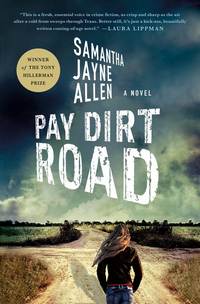
PUB DAY REPOST: Pay Dirt Road by Samantha Jayne Allen: A Tale of Oil, Murder, and Land

Pay Dirt RoadPay Dirt Road

by Samantha Jayne Allen

DETAILS:
Series: Annie McIntyre Mysteries, Volume 1
Publisher: Minotaur Books
Publication Date: April 19, 2022
Format: eARC
Length: 304 pg.
Read Date: March 21, 2022
Support Independent Bookstores - Visit IndieBound.org

What’s Pay Dirt Road About?

Annie just graduated from college and moves back to her hometown to decide her next move. That’s the generous way to look at it, anyway, we’ll get back to that in a bit. She’s waiting tables at a local diner—well, the local diner in Garnett, TX. It’s hard to say exactly how large Garnett is, but it’s not big. But given the nearby oil fields, there’s a lot of money as well as a lot of poverty in this smaller town.

Annie and her roommate/cousin spend a lot of their evenings drinking, frequently with others they graduated from high school with. One night they go to a bonfire at the home of one of Annie’s former classmates and unexpectedly run into a co-worker, Victoria. Victoria has overserved herself at this point and doesn’t show signs of slowing down. When Annie decides to leave, she tries to find Victoria but is told that she’s gone off with someone.

That’s the last anyone sees Victoria—the last anyone will admit to, anyway. Her body is found a few days later. Driven by guilt for abandoning her, Annie takes advantage of an offer from her grandfather—former sheriff, now a PI—to work for him and look into the case.

Annie

Annie is what many would call a deeply flawed character, but others would just say human. She’s trapped by her own insecurities as well as ego. She knows she could likely do well in law school—but it would be hard and risky. She could probably talk herself into the challenge, but failing means losing hope she could get away from Garnett, and I don’t think she’s willing to do that.

Like so many people in similar circumstances, not knowing what to do, she drinks, so she doesn’t have to think about it for a while. And drinks a lot. This wouldn’t be a big deal for me as a reader, but Annie spends a lot of time judging her grandfather for his drinking—especially when they’re supposed to be working. She doesn’t say anything to him, she just keeps it inside and lets herself indulge. It’s things like this that make her a wonderful, complex character.

The Sense of Place

I’m vague on a lot about the town of Garnett (size, demographics, etc.), but I also have some concrete visions of certain parts of it. It reminds me a lot of the TV version of Dillon, Texas—which seemed to change size, economic status, and makeup from week to week, depending on what the story called for.

As I type that, I realize that my ideas about Garnett are basically half-Samantha Jayne Allen/half-Friday Night Lights. Annie would basically fit in with the Tyra Colletes and Tim Riggins of the world, not the Jason Streets and Lyla Garritys (although we get glimpses of that part of Garnett, too). I just thought of three paragraphs I could do paralleling the worlds of these two fictional towns, so I’d better move on before this becomes a very different kind of post.

What I kept getting was a feel for the town more than anything—it’s the kind of place where the best and brightest leave after high school, and the big question is: will they come back? You get the impression that if they do, it’s not because they chose to—they either have no choice, or it’s just as a way station–like Annie intends. Some of those in the latter category end up sticking around, usually not by choice. This bleakness covers the whole of the novel—in the successes as well as the failures (and the in-between moments).

At the same time, it seems that few of these people are there by choice. It is their home. Up until two weeks before her death, Victoria had been tied to Garnett, but she had plans. Annie intends on leaving. But when it comes to the land of Garnett? Their families’ acres? There’s a reflexive, instinctive, and deep sense of possession and binding. Everyone knows that Annie’s going to leave town at some point—but when there’s a suggestion that someone is going to buy the land she’s set to eventually inherit? That sets an emotional fire in her that I think surprised even her. You see something similar with Victoria, too. People like them may not like Garnett, may not want to live there but it’s home. It’s their home, and will be.

So, what did I think about Pay Dirt Road?

I don’t know that I can say that I particularly enjoyed this book—by design, it’s not a good time. But it’s a great experience. Allen’s sense of character and sense of place ensures that the reader feels what’s going on. Particularly, but not limited to, Annie’s experiences.

Like with any good mystery—and look at character—Pay Dirt Road is as much about the investigation as it is the history of the characters—for Annie, this goes back to High School, for her family, the history we see goes back far before that. The past illumines the present, and helps the reader—and eventually, Annie and others—to see what’s going on in the present.

Last year, I finally got around to reading The Far Empty by J. Todd Scott. Garnett doesn’t have the same kind of corruption (at least that we see) going on, but it has the sense of setting, of bleakness, and dedication to place/city/home. Between these two books—not to mention Locke’s Bluebird, Bluebird and Kent’s The Dime—I’m starting to think I should focus more of my Crime reading on the Lone Star State.

This could be the beginning of a series—and if it is, I’ll be at the front of the line for the sequel. This could be a stand-alone, and if so, it leaves the characters in a good place—both in terms of closure and promise for the future. Either way, this is a book that’s going to linger in the back of my mind for a while, and I think that’ll be true for others.

Disclaimer: I received this eARC from St. Martin’s Press via NetGalley in exchange for this post—thanks to both for this.


4 Stars

This post contains an affiliate link. If you purchase from it, I will get a small commission at no additional cost to you. As always, opinions are my own.
Book Blogger Hop: Book Jackets On or Off?

This prompt was submitted by Billy @ Coffee Addicted Writer:

Do you prefer to leave book jackets on or off while reading?

Obviously, we’re talking books that I own or borrow from a friend, right? Because I absolutely leave the dust jackets in that film (plastic? polyester? mylar? whatever) wrap the library uses on all the time. I’m no vandal.

But if we’re talking about my own books, those jackets are off when I read (or, before I loan it out). And I treat a borrowed book the same. I’m the biblio-equivalent of the person that makes you take off your shoes before you enter their house. I try, for reasons I don’t care to examine, to keep those as pristine as possible–if I’m manhandling them the whole time I’m reading, they’re going to get torn, creased, frayed, etc.–and that would drive me batty.

Now, I used to know a guy who hated dust jackets. The first thing he did when he bought a book was to throw it away. His shelves were full of hardcovers, too. I never understood that. The cover design is all in the dust jacket (well, almost all of it).

What about you?

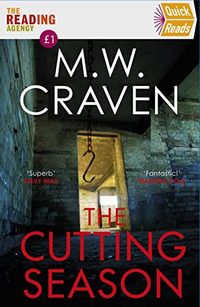
The Cutting Season by M. W. Craven: A Fast, Satisfying Read in this Dynamite Series

The Cutting SeasonThe Cutting Season

by M.W. Craven

DETAILS:
Series: Washington Poe, #3.5
Publisher: Constable
Publication Date: April 14, 2022
Format: Kindle Edition
Length: 105 pages
Read Date: April 15-16, 2022

What’s The Cutting Season About?

In lieu of writing a synopsis, how about the first four paragraphs?

It started with an old lady.

An old lady who had stepped in front of a train.

There were gangsters and bent cops and a contract killer called the Pale Man, but they were not as important as the old lady. And neither was the dead good man who turned out to be a dead bad man.

In the years that followed, some people would forget about the old lady. They would forget that, if it was not for her, none of this would have happened. Nobody would have been murdered. Nobody would have dangled from a meat hook in a cold warehouse. Nobody would have called in the Pale Man.

There you go—there’s murder, there’s drama in a warehouse, there’s a man known by a title, and a dead woman. There’s your hook. Add in a detective from the National Crime agency—Washington Poe, who’s called in to help with the murder investigation (although he usually investigates serial killers)—and his friend/colleague who is a wizard with tech—Tilly Bradshaw—and you’ve got yourself the makings of a great thriller.

Quick Reads

The Cutting Season was one of eight novellas published this year as part of The Reading Agency’s Quick Reads program.

Quick Reads provide a route into reading that prioritises great story telling and adult-focused content while ensuring the books are written in an accessible and easy to read style. The books are written by some of the most popular authors in the UK – including Andy McNab, Jojo Moyes, Anne Cleeves, Ian Rankin and Benjamin Zephaniah – so they can be a brilliant entry point to new genres, authors as well as the spark to reignite or build up the joy of reading.

The Quick Reads programme has collaborated with over 30 publishers to produce a total of 135 titles since 2006 (many still available to borrow from your public library or buy from The Reading Agency’s bookshop) with over 5 million copies distributed and over 6 million library loans.

That just sounds fantastic, doesn’t it?

So, what did I think about The Cutting Season?

This is a novella—short, sweet, to the point. Well, not that sweet—there’s a lot of dead people and threats to health and well-being. So it’s short and to the point. Think of it as a Washington Poe/Tilly Bradshaw novel in espresso form.

It’s got everything you want—a disturbing killing, Poe’s antics, Tilly saving the day—and as a nice bonus, there’s a chapter at the beginning where Poe is enjoying himself at the office with co-workers, so we get to see there’s more to him than just the single-visioned man we see when he’s on the case (a great way to introduce Poe and Tilly to new readers).

Given the streamlined way this story had to be told to fit, there weren’t any twists or nuance—for a 105-page novella, I’m fine with that. I think this’d work well to introduce Poe and Tilly to a reader who hasn’t done much in the genre before—and I could definitely see this convincing someone who really doesn’t read novels to give one in the series a shot.

As is to be expected from a M.W. Craven work, I strongly recommend this. I had a blast reading it, you will, too.


4 Stars

Nero Wolfe on Taxes

I can’t tell you when this became a (largely) annual thing for me to post, but it was on a blog that pre-existed this one. As always, seems like a good day to post it.

Nero Wolfe Back CoversA man condemning the income tax because of the annoyance it gives him or the expense it puts him to is merely a dog baring its teeth, and he forfeits the privileges of civilized discourse. But it is permissible to criticize it on other and impersonal grounds. A government, like an individual, spends money for any or all of three reasons: because it needs to, because it wants to, or simply because it has it to spend. The last is much the shabbiest. It is arguable, if not manifest, that a substantial proportion of this great spring flood of billions pouring into the Treasury will in effect get spent for that last shabby reason.

–Nero Wolfe
from And Be a Villain

Instruction in Christian Love by Martin Bucer, Paul Traugott Fuhrmann (Translator): A 16th Century Classic We Need Today

Instruction in Christian Love [1523]Instruction in Christian Love [1523]

by Martin Bucer, Paul Traugott Fuhrmann (Translator)

DETAILS:
Publisher: Wipf & Stock Publishers
Publication Date: August 4, 2008
Format: Paperback
Length: 52 pg.
Read Date: April 10, 2022
Support Independent Bookstores - Visit IndieBound.org

What’s Instruction in Christian Love About?

This was written in response to some requests to expand on Bucer’s “sketchy lectures,” on the topic. In this brief book, he considers two ideas:

…according to the Scripture I exhort every one of you not to live for himself, but for his neighbor. I shall later show how to attain this ideal, for it can be realized in this world and life…

There are two chapters in the work, the exhortation, and application.

The Exhortation to not live for yourself, but for your neighbor takes the bulk of the work. Bucer begins by showing this obligation comes from the way humans were created and that the obligation continues—particularly for the believer. He then goes on to decry men seeking their own advantage, how that fuels injustice, wrapping up by saying the Christian not only shouldn’t seek their own advantage but should give up what is rightly due to them in order to promote the well-being of others.

The second chapter focuses on how the believer can carry out their duties—it was helpful and convincing. Almost everything he says here isn’t exclusive to this call to self-abnegation, but can be applied to most/all Christian duties. Which makes it more valuable, really.

So, what did I think about Instruction in Christian Love?

It’s a short work, so there’s not much to say. The second chapter is useful and can even be easily applied to the modern reader (sometimes 16th Century works are harder to relate to in their application).

But the treasure of this book is in the convicting and inspiring first chapter. I really had to be impressed with some of Bucer’s arguments and interpretation.

I came across a mention/description of this book in Meador’s What Are Christians For?, and I probably should’ve waited longer between the two—I couldn’t appreciate this work for Bucer’s genius as Meador’s words were still echoing in my ears. If I came to it fresher, I think I’d be more impressed.

But oh, well, it’s still a good work—and an easy read (outside of the conviction) that was well worth the time, and in years to come will be a very profitable re-read for me.

This post contains an affiliate link. If you purchase from it, I will get a small commission at no additional cost to you. As always, opinions are my own.

Saturday Miscellany—4/16/22

Odds ‘n ends about books and reading that caught my eye this week. You’ve probably seen some/most/all of them, but just in case:
bullet How to make reading a regular habit—I’d say this is a shorter version of the usual thing written on this topic, but it is from Reader’s Digest, so I guess it’s about standard. Also, Reader’s Digest is still a thing?
bullet The Summer of Ree!—Michael R. Underwood is re-releasing the series that started it all for him this summer—including in paperback this time! A great time to pick up this fun UF series.
bullet The Art of the Book Recommendation
bullet 8 Types of Audiobook Listeners—I’m the last 3–okay, I’ve become too lazy to be all 3, I’m the last 2 types. But I should be the last 3.
bullet Starting a Home Lending Library Has Made Me a Better Friend
bullet Interview with Literature & Lofi and Announcement—Self-Published Authors Appreciation Week will be back this year, read here to see what Literature and LoFi and Witty and Sarcastic Bookclub have to say about it.
bullet Against Sub-Genres—this comes so close to what I’ve been thinking lately, it’s kind of creepy.

This Week’s New Releases that I’m Excited About and/or You’ll Probably See Here Soon:
bullet Amongst Our Weapons by Ben Aaronovitch—I finished this new Rivers of London book yesterday, and it’s so good!
bullet The Cutting Season by M.W. Craven—This quick Poe & Tilly novella pulls no punches.
bullet Still Just a Geek: An Annotated Memoir by Wil Wheaton—Wheaton’s put out a new edition of his memoir, with added material–including annotations on his original material, casting whole new lights on it. Sounds like a great idea.

Lastly, I’d like to say hi and extend a warm welcome to Brothers Campfire , who followed the blog this week. Check out their blog, folks.

The Friday 56 for 4/15/22: The Cutting Season by M.W. Craven

The Friday 56This is a weekly bloghop hosted by Freda’s Voice.

RULES:
The Friday 56 Grab a book, any book.
The Friday 56 Turn to Page 56 or 56% on your ereader. If you have to improvise, that is okay.
The Friday 56 Find a snippet, short and sweet.
The Friday 56 Post it.

from Page 56 of:
The Cutting Season

The Cutting Season by M.W. Craven

Poe was dragged feet first out of the van. His skull cracked against the wet concrete. He ran his tongue across his teeth. One of his fillings had come loose.

Great, he thought.

He was pulled to his feet and pushed into a building. It immediately got colder. He was still wearing a hood and his nose felt like it was full of broken glass, but Poe knew where he was. The smell of raw meat and the sudden drop in temperature meant he was in the meat warehouse the Hole in the Wall Gang had bought twenty years earlier. It was where they cured and air-dried the pork and beef and game meats they served in Battista’s Bar and Grill and the other restaurants they owned. It was where the sausages were made.

Poe knew it was also where the gang disposed of anyone who bothered them. The turf wars of the eighties were long over, but all gangs squabbled from time to time. A building whose only purpose was the processing of meat was also perfect for making humans disappear without a trace.

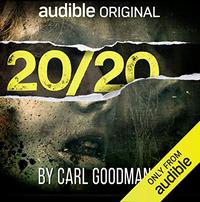
20/20 (Audiobook) by Carl Goodman, Louise Brealy: A New DI Finds Herself in a Disturbing Investigation

20/2020/20

by Carl Goodman, Louise Brealey (Narrator)

DETAILS:
Series: DI Eva Harris, #1
Publisher: Audible Originals
Publication Date: June 4, 2020
Format: Unabridged Audiobook
Length: 13 hrs., 4 min.
Read Date: March 30-31, 2022

What’s 20/20 About?

So you know how in most police procedurals, the protagonist detective(s) is helped out by a super-geek (usually, but not always, a female) who befuddles the Luddites/barely-computer literate detectives with what they can do? Well, Carl Goodman’s DI Eva Harris is the super-geek who is also the protagonist detective in the best kind of a 2-for-1 deal.

Harris is driven, she knows she’s good with computers—a real rival (if not a flat-out superior) to all kinds of cyber-criminals. But the only way for her to advance in the police services is to spend time being a non-cyber officer, out on the streets, working with other detectives for two years. Which is both hard to believe, and completely believable (if anyone knows how legitimate that is, please let me know).

On her first day as a DI in the Surrey Police, she’s summoned to a crime scene before she can even introduce herself to anyone. A woman has been murdered—meticulously exsanguinated, with her eyes meticulously removed. I stress the meticulousness there because this is a very clean crime scene that is going to be forensically unhelpful (if not worse).

And then more bodies show up. There’s a similarity here to a serial killer’s M.O., but that killer wasn’t careful about the crime scenes. Is this the same killer, who has taken the time and effort to refine his method? A copycat? Someone who just seems similar to the serial killer? That’s for DI Harris and her new team to ascertain.

If that’s not enough, part of the reason Harris has been assigned to this command is that she’s being forced by the Intelligence Services to look into corruption at her new HQ. And some skeletons from her past are coming back to haunt her.

How’s the Narration?

Brealey nailed this—she captures Harris’ analytical approach, the distance she’s keeping from her team and the assignment—and then how that distance crumbles—and general unease with some aspects of the assignment. She also does a great job portraying the rest of the cast, and the unexpected attitudes from some of the suspects.

I’m seeing a lot of negative reviews of her work on Audible and Goodreads. I don’t get it—I can see where she might be everyone’s cup of tea (who is?), but I don’t get the negativity. I thought she did exactly what this book needed.

So, what did I think about 20/20?

This was an intense, multi-layered, unnerving, and tough-to-predict police procedural with a little something extra going on. Maybe too much—just maybe.

I think I could’ve lived without the whole Harris investigates her own team aspect of the novel (although, that would have cost the novel some great scenes). The novel might have been a little stronger had it stayed focused on the killings with Harris’ past as the only subplot. It’s hard to judge things like that, so I could be completely wrong.

I cannot stress enough that some of these murders are pretty disturbing and that there is no way I ever want Carl Goodman mad at me. The way he describes murder scenes and artwork, in particular, is really impressive—there’s a lot of narrative and description that’s really impressive, but those really jumped out at me. I could “see” those very clearly.

I sussed out the 2 of the 3 main mysteries early on—that’s fine, it’s not a whodunit kind of read, it’s about Harris getting the answers and what she has to go through for that. As such, it’s a winner—she’s a fish out of water in several ways (geographic, social, vocational, for starters) and that’s the focus of the book. Still doesn’t make it less satisfying when I found out I was right. Also, I really don’t want to live in a world where the motives for the killings are plausible. Sadly, I absolutely believe them.

It’s a gripping listen, and I think you’ll be glad you gave it a shot. There’s a sequel, too—I don’t think it’ll be long before I dive into that.


3.5 Stars

Page 254 of 630

Powered by WordPress & Theme by Anders Norén