Happy Jack and the Scary-Ass Book of Doom (Audiobook) by Rich Partain, read by JP Adams: DNF’d Without Prejudice (or any interest)

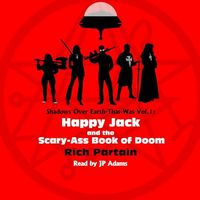
Cover of Happy Jack and the Scary-Ass Book of Doom by Rich PartainHappy Jack and the Scary-Ass Book of Doom

by Rich Partain, JP Adams (Narrator)

DETAILS:
Series: Shadows Over Earth-That-Was, Book 1
Publication Date: December 17, 2024
Format: Unabridged Audiobook
Length: 12 hrs., 50 min. (I made it 3.5 hours )
Read Date: April 16-17, 2025

What’s Happy Jack and the Scary-Ass Book of Doom About?

From Audible:

What happens when the geeks inherit the Earth? For starters, things get a little weird.

In the year 2475, the remnants of humanity have taken to the skies, inhabiting massive domed cities that hover five miles over the ruined ecological disaster of old Earth. The Powers That Be, in their infinite wisdom, decided that the few million people left deserved to live their best lives, so they gave each sub-orbital platform its own theme and legally enforced tech level. Named for afterlives and sacred places from all of the world’s great cultures, Elysia, A’Aru, Valhalla, Tian and the other orbitals range from cyberpunk metropolises to Tolkienesque medieval fantasy lands; from Victorian steampunk cities of glass and copper to snowbound Viking kingdoms.

Not content with merely cosplaying their days away, a significant portion of the population have become transhuman “cybernaturals,” electing to transform into creatures from myth through cybernetic enhancements and advanced genetic therapies; orcs, dwarves, elves, vampires and werewolves now exist through super-scientific means, not supernatural ones.

In the middle of this madness, Daniel Davidson, a pop culture archaeologist and mercenary of dubious repute and his band of foul-mouthed friends are charged with tracking down an ancient book that could, in the wrong hands, erase all of reality. It could be a huge payday and might even involve saving the known universe as a tidy bonus. That is, if they manage to NOT die at the hands of cannibal sex cultists, swashbuckling rogue vampires, prankster demigods, Templar knights, horrifying biblical angels, the angry star-spawn of elder things, and Satan himself. And possibly food and/or alcohol poisoning. Or suffocation in a sex dungeon.

It’s a filthy, hilarious, epic journey through an off-kilter future filled with bullets, blades, beasts, and boat drinks. If you like your profane sci-fi action comedies with a side order of urban and traditional fantasy, look no further.

I Do Have One Issue

Daniel Davidson makes too many late 20th/early 21st Century references. He uses the slang of these eras, talks about music, books, TV, movies, video games of this era. Yes, he explaines it. But I can’t buy that this kind of a geek–no matter his specialty–doesn’t make references to things outside of this time. Something from the intervening 300+ years would’ve snuck in.

His complaints about Evangelical Christians are also very 2020+–there’s no way that they wouldn’t have moved on to other ways to provoke the culture around them.

Listen, it makes sense for the Bobiverse’s clones to be stuck in contemporary references. That absolutely works. This just doesn’t. John Crichton might be full of references to Earth, but he also picks up the lingo and culture of those he interacts with once he joins Moya’s crew (see also Buck Rogers).

So, why didn’t I finish Happy Jack and the Scary-Ass Book of Doom?

It just never grabbed me. It was occasionally amusing. I thought the blue language was overdone, but it wasn’t as offensive as the Author’s Note at the beginning made it sound like it’d be. If you’re going to overuse some or all of The Nine Nasty Words be interesting with it, otherwise it just fades into the background like a dialogue tag.

I’m leaving the door open to returning to this–it didn’t anger me, offend me, or bore me. Like I said, I found bits of it amusing–even entertaining. But it just left me apathetic. I’d rather be annoyed by a book than totally uninterested. I’ll stick with a book to see if the author can make something good/decent out of something bad. But I can’t stick with something to see if I ever have a reaction.

I have no opinion on JP Adams, either. I don’t think James Marsters, Lorelei King, or Ray Porter could’ve done more with the material. So, I’m absolutely open to something else by him, too.

So, I’ll check out of this for now, and maybe return to in later.

Irresponsible Reader Pilcrow Icon

Grandpappy’s Corner: Life Lessons by Titan as told to Melaney Taylor Auxier: Wise Words from a Noble Dog

Grandpappy's Corner Logo with the Cover of Life Lessons by Titan by Melaney Taylor Auxier

Life Lessons by Titan

as told to Melaney Taylor Auxier

DETAILS:
Publication Date: June 28, 2024
Format: Paperback
Length: 39 pgs.
Read Date: April 9, 2025

What’s Life Lessons by Titan About?

We meet this very good-looking dog, Titan, at the shelter when he meets his human, she “fell in love instantly because I’m so loveable.” Titan decides to keep her.

We get a couple of pages showing Titan adjusting to his new home and friends, making some mistakes and then Titan teaches some life lessons. He teaches about friends, making mistakes, eating well, being grateful, that sort of thing.

Let’s Talk about the Art for a Minute

The art consists totally of home photographs of Titan—and occasionally some other good-looking dogs—and a couple of human feet.

On the one hand, these are not studio-quality pictures. They’re just candids of Auxier’s dog, likely her phone is loaded with them (like any person who has pets and a phone). She took the best—sometimes goofiest—of these to illustrate Titan’s lessons.

Are they the best dog photos you’ll see? No. But they’re taken and shared with love for the subject—and that’s more than enough to justify looking at them. Also, little kids are not known for being discerning when it comes to pictures of handsome doggies.

So, what did I think about Life Lessons by Titan?

This is a great tribute to a great dog.

My grandson isn’t ready for Lessons From Lucy by Dave Barry, Lessons from Tara by David Rosenfelt, or even The Teachings of Shirelle by Douglas Green. But he is ready for this one (pretty much). Many of the lessons/perspectives/thoughts in this book match those books for older readers, so even if he has a decade or so before I can introduce him to Lucy, Tara, or Shirelle, I can introduce him to Titan and his wisdom.

Also, this one has far more pictures. And who doesn’t want that?

It’s short, sweet, and to the point. It’ll win over young dog lovers, and even bring a smile to us older ones when we need a quick fill of puppy love.

Grandpappy Icon

WWW Wednesday—April 16, 2025

For a few years, April 15 was the apex of my professional life–months of effort led up to it, weeks of effort spent dealing with it, and then we had a couple of months of reprieve before starting the cycle again. I left that employer almost 4 years ago, but it’s still in the back of my mind to be stressed right now. It’s always such a relief when I realize I don’t have a reason to be, even if my subconscious is convinced I should be. I do feel bad for former coworkers who are still there, and the long hours they “get” to work.

I can’t remember where I was going with that, but I can’t think of another introduction for this. So pretend I had a punchline, and let’s get on with today’s WWW.

WWW Wednesdays Logo

This meme was formerly hosted by MizB at A Daily Rhythm and revived on Taking on a World of Words—and shown to me by Aurore-Anne-Chehoke at Diary-of-a-black-city-girl.

The Three Ws are:
What are you currently reading?
What did you recently finish reading?
What do you think you’ll read next?

Seems easy enough, right? Let’s take a peek at this week’s answers:

What are you currently reading?

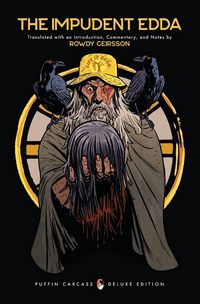
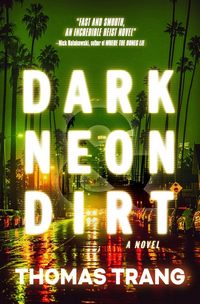
Cover of The Impudent Edda by Rowdy Geirsson Cover of Dark Neon & Dirt by Thomas Trang Cover of Happy Jack and the Scary-Ass Book of Doom by Rich Partain
The Impudent Edda
by Rowdy Geirsson
Dark Neon & Dirt
by Thomas Trang
Happy Jack and the Scary-Ass Book of Doom
by Rich Partain, read by JP Adams

The Impudent Edda bills itself as a translation of the last Edda, this time made by a Bostonian. It is ridiculously fun. It’s also hard to take in large chunks, so I also started Trang’s debut, which is almost the complete opposite–it’s fun, but only because it’s gritty LA noir done right. Assuming I survive the mental whiplash between these two, the next couple of days are going to be great.

Yeah, it’s a couple of weeks after I said I was going to listen to the Rich Partain book but Library holds came a calling.

What did you recently finish reading?

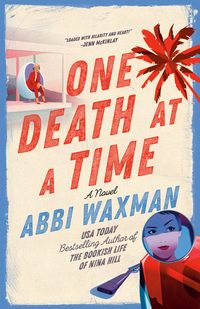
Cover of One Death at a Time by Abbi Waxman Cover of Everything Is Tuberculosis by John Green
One Death at a Time
by Abbi Waxman
Everything Is Tuberculosis: The History and Persistence of Our Deadliest Infection
by John Green

It felt like Waxman turned her comedy up a few notches with this one–while delivering a strong mystery novel filled (as you expect from Waxman) with fantastic characters.

I learned far, far more about Tuberculosis than I ever expected to (including how much I have yet to learn–and it’ll likely stay that way). In the midst of this history/social commentary is the (true) story of a very sick teenager. It’ll surprise no one to learn that Green is very good at talking about sick teenagers.

What do you think you’ll read next?

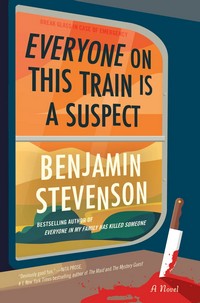
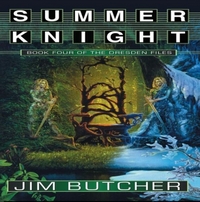
Cover of Everyone on This Train Is a Suspect by Benjamin Stevenson Cover of Summer Knight by Jim Butcher
Everyone on This Train Is a Suspect
by Benjamin Stevenson
Summer Knight
by Jim Butcher, read by James Marsters

Why did it take me so long to get to Stevenson’s sequel? No one will ever know. But I’m hoping to take care of it by the end of this week.

My Dresden Files re-listen got derailed last year, so I might as well get back on track, right?

How are you faring in the post-Tax Day world?

REPOSTING JUST CUZ: Death and Taxes by Mark David Zaslove: The most rootin’ tootin’ shoot ’em up about accountants you’ve ever seen

This seems like a good day to revisit this (sort of a shame there were no sequels)


Death and TaxesDeath and Taxes

by Mark David Zaslove
Series: Tales of a Badass IRS Agent, #1

ARC, 219 pg.
Aperient Press, 2018

Read: August 13 – 14, 2018
I’m not sure I can go this book justice with a hand-crafted synopsis, I’ll just copy and paste from Zaslove’s site:

           Death and Taxes follows Mark Douglas, an ex-Marine turned IRS agent, who, along with auditing the weird and the profane, also spearheads weekend raids with his locked-and-loaded gang of government-sanctioned revenuers, merrily gathering back taxes in the form of cash, money order, or more often than not, the debtor’s most prized possessions.

Things turn ugly when Mark’s much-loved boss and dear friend Lila is tortured and killed over what she finds in a routine set of 1040 forms. Mark follows a trail dotted with plutonium-enriched cows, a Saudi sheik with jewel-encrusted body parts, a doddering, drug sniffing, gun-swallowing dog named The Cabbage, a self-righteous magician with a flair for safecracking, a billionaire Texan with a fetish for spicy barbecue sauce and even spicier women, and an FBI field agent whose nickname is “Tightass.” All of which lead to more and bloodier murders – and more danger for Mark.

Enlisting his IRS pals – Harry Salt, a 30-year vet with a quantum physical ability to drink more than humanly possible; Wooly Bob, who’s egg-bald on top with shaved eyebrows to match; Miguel, an inexperienced newbie with a company-issued bullhorn and a penchant for getting kicked in the jumblies – Mark hunts down the eunuch hit man Juju Klondike and the deadly Mongolian mob that hired him as only an angry IRS agent can. There will be no refunds for any of them when April 15th comes around. There will only be Death and Taxes.

This is hyper-violent (not that filled with blood and guts, really — there is some), a lot of guns, bombs, more guns. Sometimes played for comedic effect, sometimes it’s the good guys vs. the bad guys. Sometimes, it’s a little of both. It never got to the overkill point for me, probably because this felt more like a cartoon than a “realistic” thriller.* What was overkill for me was the hypersexualization of every woman under the age of sixty. I didn’t need to hear that much about every woman’s physical appearance — there are more gorgeous women with perfect (sometimes surgically enhanced) bodies in this guy’s life than an episode of Miami Vice.

But man, is this funny. There are sections — sometimes a sentence or two, sometimes several paragraphs long — that are the literary equivalent of a shot of espresso, they are so taught with action, cultural references, and humor that you just revel in them. This reminds me a lot of the John Lago Thrillers by Shane Kuhn — I think Kuhn shows more discipline in his plots and characters, but on the whole, these two are cut from the same cloth. The same energy, a similar style, similar sense of humor — and frankly, that stuff is catnip to me. I think the plot got a little convoluted, a little confusing — but it was worth working through.

Am I planning on reading Tales of a Badass IRS Agent, #2? Yeah, I will be keeping an eye out for it. This is a heckuva romp, and will entertain anyone who gives it a shot.

* Really, what thriller is realistic?

Disclaimer: I was provided with a copy of this novel in exchange for my honest opinion, which you see above.

—–

3 Stars

2025 Plans and Challenges: First Quarter Check-In

This year is speeding by, the way they do more and more…let’s take a quick look at the challenges and goals I set for the year
2025 Plans and Challenges
I’d hoped to keep charging ahead with Grandpappy’s Corner and Literary Locals, and while those haven’t completely died off, I haven’t done that much with them. I think the next couple of months should bear fruit along those lines, though. We’ll see. HC Chats are plugging around.

How’s the perennial, “Cut down on my Goodreads Want-to-Read list and the unread books that I own” goal going? Well, I bought very few books in February, so that helped, but overall…?

Audio E-book Physical Goodreads
Want-to-Read
NetGalley
Shelf/ARCs/Review Copies
End of 2024 3 68 78 167 10
End of 1st Quarter 5 72 77 172 11
End of 2nd Quarter
End of 3rd Quarter

John Cleese saying 'Not Good Enough'

2025 Book Challenges


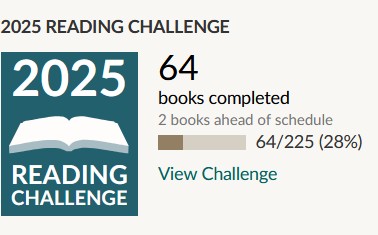
Goodreads Challenge
Goodreads Challenge 1st Quarter

This actually looked better at the first of the month, but I forgot to get the image. Still, I’m on track.


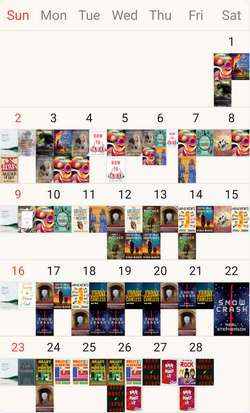
Read Every Day in February for the American Cancer Society
Nailed it. Even better, raised a couple hundred dollars.
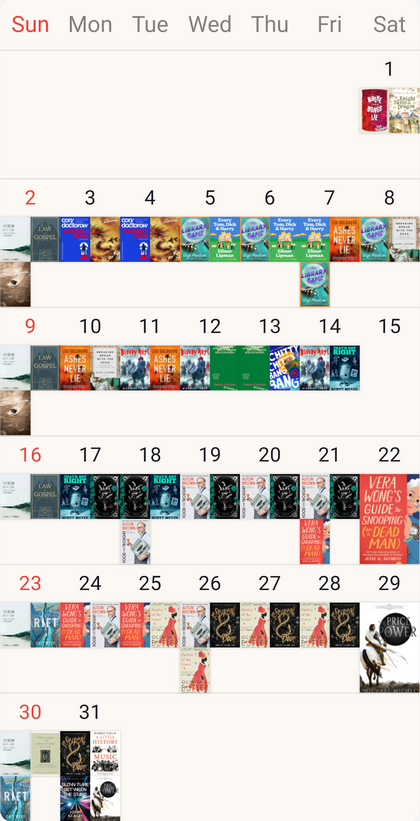
February Reading Calendar


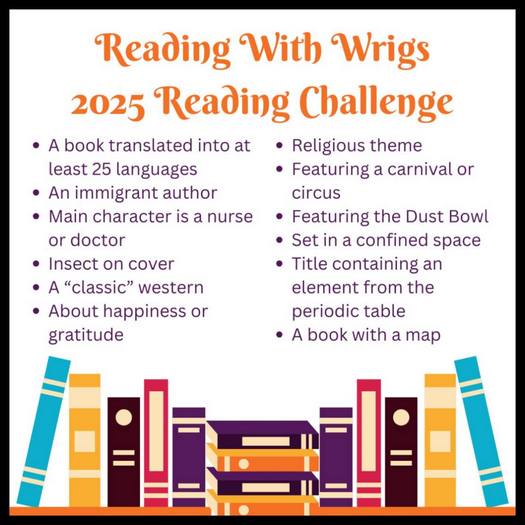
Reading with Wrigs
Reading with WrigsI missed completing this one last year, but have done some pre-planning on it and am about on schedule.

    • Religious theme: The Pilgrim’s Regress by C.S. Lewis
    • Set in a confined space: Anxious People by Fredrik Backman
    • A book with a map: The Price of Power by Michael Michel (technically not completed during the first quarter, but…)

The 2025 Booktempter’s TBR Challenge

The 2025 Booktempter's TBR Challenge
January–First steps: You have my permission to read the last book you added to the TBR pile: Sword & Thistle by S.L. Rowland
February: Short and Sweet: Read 28 short stories – they can be in magazine, anthology or collection form. You don’t even have to finish the books! Just 28 tales to read: Promise by Christi Nogle and Passageways edited by Rebecca Carey Lyles
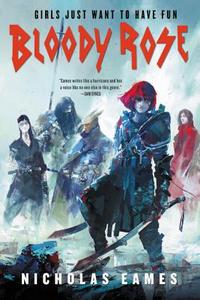
March – Ready Steady Go!: Start a series, or the next book in a series that has been lingering on those shelves: Bloody Rose by Nicholas Eames


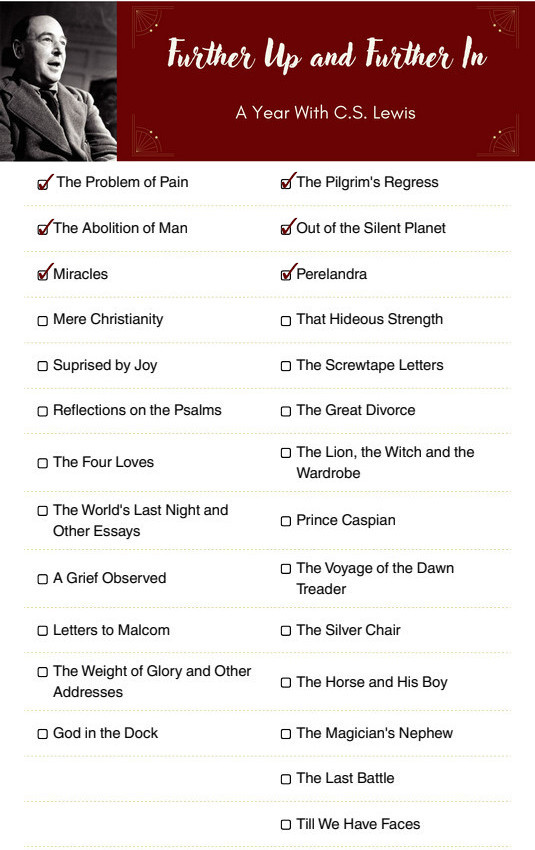
Further Up and Further In
Further Up and Further in A Year with CS Lewis
I’m on track here


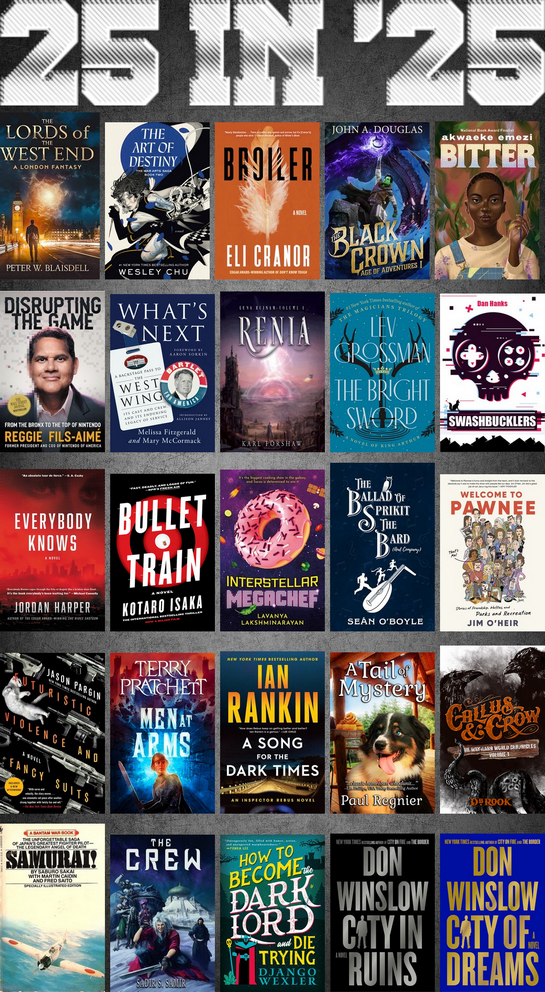
25 in ’25
25 in 25 grid

Ouch. Drawing a blank here.


Auditing Challenges
I’m not sure that I want to commit to these, but I saw them on Bookforager’s page, and wanted to give them a shot–they look fun. So I’m going to track them, and if I happen to do well with them, great. If not…oh, well.

(yeah, that’s true with all of these, but I’m sort of calling my shot with the above)
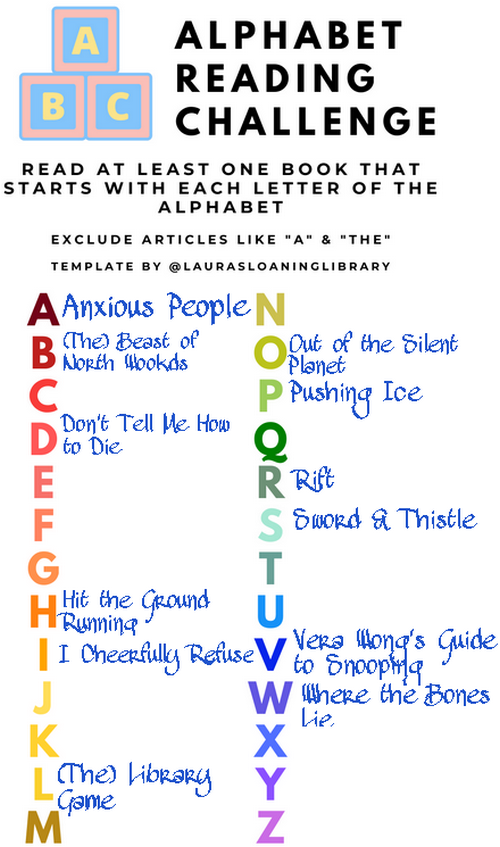
Alphabet Reading Challenge

Alphabet Reading Challenge 1st Quarter
Not bad…


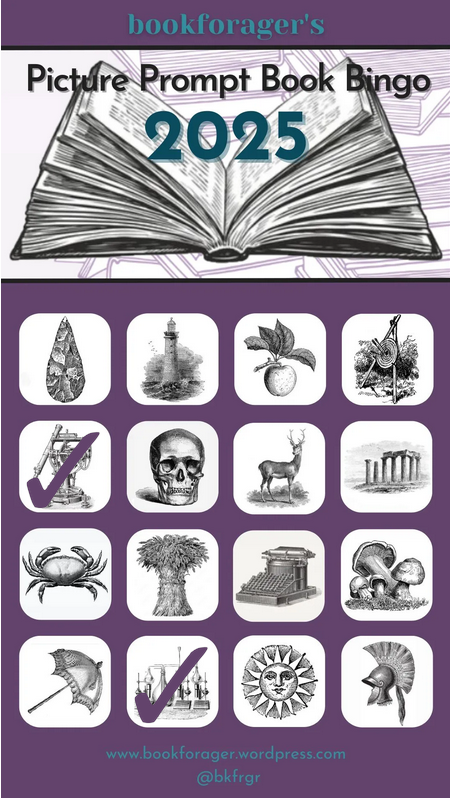
Picture Prompt Book Bingo Challenge for 2025

Picture Prompt Book Bingo Challenge for 2025

1. A prehistoric flint knapped stone knife 2. A lighthouse 3. An apple on a leafy branch 4. An archery target with three arrows in it
5. A very large mechanical telescope
Pushing Ice
6. A human skull 7. A stag 8. The ruins of a temple-like structure
9. A crab 10. A sheaf of wheat 11. An old mechanical typewriter 12. A cluster of four mushrooms
13. A fringed umbrella / parasol 14. A chemistry set-up of bottles and tubes
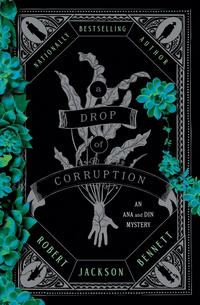
A Drop of Corruption
15. A stylized sun with a human face 16. A Roman helmet

Not bad…have one more finished already, maybe two.


I’m in decent shape, overall…

Nero Wolfe on Taxes

I can’t tell you when this became a (largely) annual thing for me to post, but it was on a blog that pre-existed this one. As always, it seems like a good day to post it.

Nero Wolfe Back CoversA man condemning the income tax because of the annoyance it gives him or the expense it puts him to is merely a dog baring its teeth, and he forfeits the privileges of civilized discourse. But it is permissible to criticize it on other and impersonal grounds. A government, like an individual, spends money for any or all of three reasons: because it needs to, because it wants to, or simply because it has it to spend. The last is much the shabbiest. It is arguable, if not manifest, that a substantial proportion of this great spring flood of billions pouring into the Treasury will in effect get spent for that last shabby reason.

–Nero Wolfe
from And Be a Villain

MUSIC MONDAY: “You Love to Sing” by Copeland

The Irresponsible Reader's Music Monday logo

Music Monday's originated at The Tattooed Book Geek's fantastic blog and has shown up hither, thither, and yon since then.

I don’t know that I’ve ever really paid much attention to Copeland over the years, but they opened at a concert I attended a couple of weeks ago, where I heard this song for (almost certainly) the first time. The chorus has been stuck in my head ever since:

Sing with your head up
With your eyes closed
Not because you love the song
Because you love to sing

This is billed as the “Slow Version.”

This would be the non-“Slow Version.”

Irresponsible Reader Pilcrow Icon

March 2025 in Retrospect: What I Read/Listened to/Wrote About

I finished 21 titles (4 down from last month, 2 down from last March), with an equivalent of 5,675 pages or the equivalent (749 down from last month), and gave them an average of 3.67 stars (.27 up from last month).

I knew I’d been busy, sick, and tired lately–but it wasn’t until I looked at the part of this wrapup where I list what I posted, that I realized just how little I’ve done here lately. Thanks for sticking with me–I’m not saying it’s over (if you could hear me cough yesterday, you’d know that was the case), but I’m working on it.

So, here’s what happened here in March.
Books/Novels/Novellas Read/Listened to

Still Reading

Cover of Wisdom for Life by Michael P. V. Barrett Cover of The Price of Power by Michael Michel Cover of The Core of the Christian Faith by Michael Goheen
Cover of A Little History of Music by Robert Philip

Ratings

5 Stars 1 2 1/2 Stars 1
4 1/2 Stars 4 2 Stars 0
4 Stars 5 1 1/2 Stars 0
3.5 Stars 3 1 Star 0
3 Stars 7
Average = 3.667

TBR Stacks/Piles/Heaps

Audio E-book Physical Goodreads
Want-to-Read
NetGalley
Shelf/ARCs/Review Copies
End of
2024
3 68 78 167 10
1st of the
Month
3 69 78 171 9
Added 7 4 2 2 6
Read/
Listened
5 1 3 1 4
Current Total 5 72 77 172 11

Breakdowns:
“Traditionally” Published: 22
Self-/Independent Published: 1

Genre This Month Year to Date
Children’s 0 (0%) 4 (6%)
Fantasy 4 (19%) 8 (12%)
General Fiction/ Literature 3 (14%) 7 (11%)
Mystery/ Suspense/ Thriller 5 (24%) 14 (22%)
Non-Fiction 4 (19%) 1 (17%)
Science Fiction 3 (14%) 8 (12%)
Theology/ Christian Living 2 (10%) 8 (12%)
Urban Fantasy 0 (0%) 5 (8%)
“Other” (Horror/ Humor/ Steampunk/ Western) 0 (0%) 0 (0%)

Review-ish Things Posted

Other Things I Wrote
Other than the Saturday Miscellanies (1st, 8tha>, 15th, 22nd, and 29th), I also wrote or posted:

Enough about me—how Was Your Month?


March Bookmory

The Price of Power by Michael Michel: An Addictive and Powerful Multi-Threaded Fantasy Novel

I talked about this book before I finished reading it a week or so ago, but I wanted to make some corrections to bad guesses/assumptions and then just talk about things in general now that I’m finished. But yes, a lot of this material is reused.


Cover of The Price of Power by Michael MichelThe Price of Power

by Michael Michel

DETAILS:
Series: Dreams of Dust and Steel, #1
Publisher: Chainbreaker Books
Publication Date: April 2, 2025
Format: eARC
Length: 498 pg.
Read Date: March 29-April 4, 2025

Buy from Bookshop.org Support Indie Bookstores

What’s The Price of Power About?

This is not the easiest question to answer, I’ll tell you right now. The title really sums it up well, this is a story about what power costs—political, familial, monetary, military, personal, magical.

But that’s not much of a plot, that’s more of a description. There are four plotlines—that somewhat overlap, but most of that overlap is promised for Book Two and beyond. But the further you read, the more you see how they are intertwined even if most of the characters don’t see/understand that yet.

So I’m going to steal a little from the blurb that Michel sent me (and that I posted recently) to give some quick thoughts about each plotline.

“A mad prophet determined to control reality”

This is the hardest one to talk about, primarily because this storyline is full of symbolism, visions, dreams, and magic. The point of view character and most of the people him aren’t sure what is going on—what’s real, what’s a dream, and what’s their imagination. Those who do know what’s going on are either lying, deluded, or a supernatural entity who is trying to trick the humans.

I was engrossed, though. I may not have understood it all, but I was hooked by what I did figure out. By the last chapter of this storyline? I was gobsmacked. While I felt like I should’ve understood what Michel was going for early on, there was no reason for me to have. It was one of those situations where an author did something fairly unexpected, but did it so well that you couldn’t imagine any other way it could’ve gone.

“A dead prince who isn’t dead”

This, on the other hand, is a straightforward story about a prince whose thirst for vengeance—driven by rage and grief—led to a type of destruction that might make Tywin Lannister take a step back.

Now he’s just trying to avoid contact with everyone, denying who he is, dwelling on what he did, and what it cost him (the price he paid, to make it less than subtle). You almost feel sorry for him and wish he’d snap out of his self-pity and self-destruction when he needs to (which is right about the time we meet him). But also…if anyone should hate themselves, it’s hard to argue against him.

The action in these chapters is just great—the prince and his allies face off against some very vile criminals. The fight scenes will get your blood pumping—and maybe a fist or two (but not every time). There are horrors—and the closest you’ll get to grins in this book.

Barodane is set up for a redemption story. But I’m not convinced that’s what Michel has in mind. Of all these four plots, this is the one I’m most invested in because of some of the surrounding characters.

“An orphan with hero’s blood”

This, too, feels like a familiar fantasy story. A princess raised to take the place of her dead parents leading the nation through a tumultuous time, with everyone wondering if she is capable of doing the job. You just can’t help but feel bad for this girl. She’s got the weight of the world on her shoulders (or at least the weight of a nation), and pressures and expectations on her are as high as can be.

On the one hand, what she’s called upon to do (so far) is easier than the rest—but her age and visibility even out the scales a bit. I like her, I like her teachers and her animal companion. But honestly, everyone else in her immediate circle could be wiped out and the only reason I’d care is because of the impact it’d have on those four.

I’m pretty sure that I’ve spent a decent amount of time leaning forward during her chapters like you do during a tense part of a film (am I the only one who does that while reading?). A lot of the turns her story took were expected—but not all of them were. And a couple left me reeling.

“And a powerful seer “

This is a hard storyline to work through. This grandmother/Obi-Wan figure is a tough old lady, having to act tougher than she really is to do what she has to. Her ability to see time and reality have shown her what needs to happen, and the price she and her grandson will have to pay.

Michel keeps the details vague at this point—but you get to see enough to keep you invested and eager to learn alongside her grandson. If, as I/the title/and I think the author say, this book is about the price you pay for power—this seer has paid a hefty price already and is preparing to pay a bigger price. She’s also caused (and plans on causing) others to pay—it’s a little unclear who benefited from them paying great prices, but the seer would claim it’s for the greater good (and probably believes that).

There’s a very cool magic battle in this story—at least one, anyway—and just knowing that this kind of thing is possible around this woman will keep you invested, even if you weren’t inclined to be anyway.

This seer is very much in the Elizabeth Best (from The Thursday Murder Club)/Taishi (from The Art of Prophecy)/Akina Azure (from Partial Function) mold of scarily competent elderly characters. Barodane might be a frighteningly violent warrior, but honestly, this woman would worry me more if I lived in this world. The way she’s tied to every other storyline just makes me want to understand her more than her own did.

Dramatis personae

There’s a lengthy (or maybe my e-reader font is just set large enough that it seems that way) dramatis personae at the beginning of the novel—if you’re like me, keep it open on your phone while you use an e-reader for easy reference. If you got your hands on a paper copy, keep a bookmark there—you’re going to want to check it often for the first third or so (results may vary on your attention span or memory).

Even if you don’t rely on it, it’s a good way to think about the book—4 rosters of characters to get to know now.

I expect that those who survive will get tossed together like a salad in the ensuing novels.

How the Novel Works

This isn’t a “Book One: Barodane”, “Book Two: Princess” kind of thing where each book tells the complete story of each character. Each character/storyline gets a chapter and then it moves on to the next, and keeps rotating that way. There are some variations from the pattern, but it holds more often than not—and any of the variations only serve to push the story forward.

There are two schools of thought when it comes to chapters—a lot of authors will close an idea, or a time period at the end of a chapter. This makes it easy to put your bookmark/quitter strip in the book and set it down to sleep, eat, converse with people, or whatever. Other writers will end a chapter in a way that propels you to move on to the next (Jim Butcher, for example, talks a lot about this practice). This keeps you engaged, moves you to keep reading—and is an excellent way to annoy a reader who really has other things they should be doing.

Michel falls into the latter category. Of course, the trick with this book is that as a Bardodane chapter leaves you hungry for the next thing in his story—but you have to go through three other plotlines before you get back to it (and each one of those will leave you hungry to press on with that storyline). I love this—I also hate it. Some people will choose to skip chapters to stick with one story through the end. This is a mistake—and will inevitably involve you getting something spoiled (I can think of at least once where that spoiler is major. There may be more to come).

So gird up, and prepare for Michel to play with you like a fisherman trying to tire out his catch before reeling it all the way in.

The Secondary Characters

To keep this to a length people would want to read, I’ve limited what I’ve said about secondary characters. This is a problem—some of them just as interesting and compelling as the point-of-view characters (possibly more so). That long dramatis personae is filled with people you will want to spend time with, or at least understand better. And sure, some of them are despicable and you will root for their defeat (but you’ll still want to understand them and maybe spend time with them on the page, just not at a pub).

There are a few secondary character deaths in this book—and you know there are more to come. One of them provoked me to send a message to Michel (the number of times I do that mid-read is incredibly small), threatening him if he did something similar to another character before the fifth book (at which point, I assume almost everyone will die or be defeated). I suspect I will not be alone in feeling that way about some of these characters, even if you pick ones that aren’t as cool as the ones I pick.

Michel is not playing around when it comes to character design or messing with his reader’s emotions.

So, what did I think about The Price of Power?

I don’t know what else to say here—I think I slipped out of my typical post outline above. In case you haven’t picked up on it—this book is one of my favorite Fantasy novels in recent memory.

This is about as far from cozy fantasy as you can get, obviously. But it doesn’t quite reach what I’d define as grimdark—I’m no expert in those definitions, but that’s what my gut says. Michel prefers the term gritty—and that makes sense to me. It’s very noir, a Fantasy version of hard-boiled. I’m not going to say that it’s what Nathanael West would’ve written if he wrote a Fantasy novel—but if that idea intrigues you, this just might, too.

The prologue wowed me. The first chapter raised the stakes—and as every point-of-view character was introduced the intrigue grew. I was already impatient for the next book to be published before I finished with this one.

Go grab this one as soon as you can. Books 2 and 3 are scheduled for release this year—Book 2 should be out in June—and you’re going to want to be ready for them.

Disclaimer: I received this eARC from the author in exchange for this post which contains my honest opinion—but also, I bought the earlier edition of the novel and just hadn’t gotten around to it yet, so I’m not sure how necessary this disclaimer is.


4 1/2 Stars

This post contains an affiliate link. If you purchase from it, I will get a small commission at no additional cost to you. As always, the opinions expressed are my own.

Irresponsible Reader Pilcrow Icon

Miracles by C.S. Lewis: A Pleasant, If Not Particularly Helpful, Read

Further Up and Further In A Year with C.S.Lewis


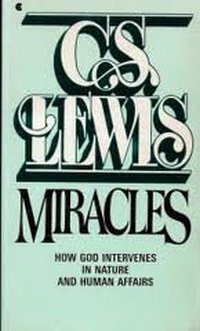
Cover of Miracles by C.S. LewisMiracles: A Preliminary Study

by C. S. Lewis

DETAILS:
Publisher: Collier Books
Publication Date: 1960
Format: Mass Market Paperback
Length: 168 pg.
Read Date: March 2-9, 2025
Buy from Bookshop.org Support Indie Bookstores

…the shock comes at the precise moment when the thrill of life is communicated to us along the clue we have been following. It is always shocking to meet life where we thought we were alone. “Look out!” we cry, “it’s alive.” And therefore this is the very point at which s many draw back—I would have done so myself if I could—and proceed no further with Christianity. An “impersonal God”—well and good. A subjective God of beauty, truth and goodness, inside our own heads—better still. A formless life-force surging through us, a vast power which we can tap—best of all. But God Himself, alive, pulling at the other end of the cord, perhaps approaching at an infinite speed, the hunter, king, husband—that is quite another matter. There comes a moment when the children who have been playing at burglars hush suddenly: was that a real footstep in the hall? There comes a moment when people who have been dabbling in religion (“Man’s search for God”!) suddenly draw back. Supposing we really found Him? We never meant it to come to that! Worse still, supposing He had found us?

So it is a sort of Rubicon. One goes across; or not. But if one does, there is no manner of security against miracles. One may be in for anything.

What’s Miracles About?

In this book, Lewis sets out to defend the idea of miracles. The possibility of them. He flat out says he won’t defend the historicity of Christian miracles—that’s not his field (of course, neither is theology, but that doesn’t stop him). He wants to lay the groundwork. If he can convince the reader that miracles are possible—even better they expect them and appreciate the relationship between them and Christianity—well then, he hopes the reader will—like Lewis himself did—examine the claims of Christianity on a more reasonable and ready basis.

The Direction of the Argument

First, Lewis starts with Supernaturalism vs. Naturalism (and it’s here that he might be at his best for the book)

Belief in miracles, far from depending on an ignorance of the laws of nature, is only possible in so far as those laws are known. We have already seen that if you begin by ruling out the supernatural you will perceive no miracles, We must now add that you will equally perceive no miracles until you believe that nature works according to regular laws. If you have not yet noticed that the sun always rises in the East you will see nothing miraculous about his rising one morning in the West.

His point is essentially that his readers will fall into two camps: those who will refuse to accept a miracle because they can’t happen or those who are willing to accept there are—or at least might be—supernatural possibilities in the world. If you are a committed reader in the former camp, there’s nothing that Lewis can do or say to make you change your mind. He will, at least, help you to see that—and lay out the possibilities of a supernatural explanation.

If you’re open to a supernatural explanation for things—like a miracle. Then Lewis has some things he’d like to talk to you about.

…it is mere confusion of thought to suppose that advancing science has made it harder for us to accept miracles, We always knew they were contrary to the natural course of events; we know still that if there is something beyond Nature, they are possible. Those are the bare bones of the question; time and progress and science and civilisation have not altered them in the least.

Then he moves into Christian miracles—or at least the miracles that Christians claim as part of their story—their Scriptures, their religion.

…you cannot [remove miracles] with Christianity. It is precisely the story of a great Miracle. A naturalistic Christianity leaves out all that is specifically Christian.

This is, he suggests, part of the path that he took to get to where he is.

If at any point along the line of argument, Lewis loses you, he will not ask you to accept his conclusion—or at least he has no basis to do so. Otherwise…

So, what did I think about Miracles?

You are probably quite right in thinking that you will never see a miracle done: you are probably equally right in thinking that there was a natural explanation of anything in your past life which seemed, at the first glance, to be “rum” or “odd.” God does not shake miracles into Nature at random as if from a pepper-caster. They come on great occasions: they are found at the great ganglions of history—not of political or social history, but of that spiritual history which cannot be fully known by men. If your own life does not happen to be near one of those great ganglions, how should you expect to see one? If we were heroic missionaries, apostles, or martyrs, it would be a different matter. But why you or I? Unless you live near a railway, you will not see trains go past your windows. How likely is it that you or I will be present when a peace-treaty is signed, when a great scientific discovery is made, when a dictator commits suicide? That we should see a miracle is even less likely. Nor, if we understand, shall we be anxious to do so. “Nothing almost sees miracles but misery.” Miracles and martyrdoms tend to bunch about the same areas of history—areas we have naturally no wish to frequent. Do not, I earnestly advise you, demand an ocular proof unless you are already perfectly certain that it is not forthcoming,

I enjoyed it—this was the second or third post-Narnia book I read by Lewis, and it’s one of them I’ve returned to the most. It’s also less and less effective to me the more times I read it. I just don’t like his line of argument. Nor do I appreciate some of what he says about the Scriptures. But, I do enjoy reading this.

There are two major aims for an apologetic work, as I’ve heard from a few apologetic professors/writers. The first is to present a defense for the faith to unbelievers—to convince them, to provide evidence for the faith to them, or at least to show that Christianity has a rational basis (things along those lines). The second aim is to buttress the confidence of the believer that they haven’t taken a blind leap of faith, that their convictions can stand against a hostile culture—or a disinterested one. I don’t see this working to well with the unbeliever (outside of maybe stressing that they’re committed to not accepting the possibility of miracles), rather the strength of his book falls into the latter category.

I appreciate what Lewis attempted to do here. I enjoy seeing him think through these things, and generally have a good time with his language. But it’s not the best thing he penned, and I’m not sure it’s all that useful.

Still, I like it. And anyone who’s going to name a chapter what he called Chapter 9? I want to spend a little time with.


3.5 Stars

This post contains an affiliate link. If you purchase from it, I will get a small commission at no additional cost to you. As always, the opinions expressed are my own.

Irresponsible Reader Pilcrow Icon

Page 52 of 606

Powered by WordPress & Theme by Anders Norén