Tag: 3 Stars Page 17 of 55

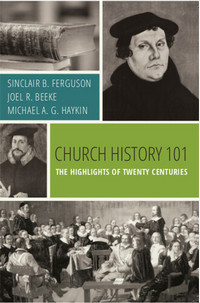
Church History 101: The Highlights of Twenty Centuries by Sinclair B. Ferguson, Joel R. Beeke, Michael A.G. Haykin: A Quick Look at 20 Centuries

Church History 101

Church History 101:
The Highlights of
Twenty Centuries

by Sinclair B. Ferguson, Joel R. Beeke, Michael A.G. Haykin

Kindle Edition, 99 pg.
Reformation Heritage Books, 2016

Read: July 25, 2021
Grab a copy from your local indie bookstore!

… the record of church history teaches us to hold fast to Christ, assured that He is with us always, even to the end of the world. He will build up His church and kingdom to all generations.

What’s Church History 101 About?

That’s the controlling idea behind this book—it’s a survey of Church History—which is the story of Christ building his church. There will be highlights and lowpoints. This, and more, is sketched out in the preface—as well as a description of the book that follows.

The chapters came from Ferguson’s time in the pulpit. Then Beeke, Haykin and their assistants revised them for use in The Reformation Heritage KJV Study Bible, and then there were published as this book.

Application

Each chapter sums up a century of Church History, talking about major movements controversies and figures incredibly briefly. It’s a ninety-nine page book, covering 20 Centuries—so to say the chapters are brief is an understatement. Most chapters include (not always as the concluding point) a “lesson” for application. Like:

Gregory’s vision produced a kind of nominal Christianity with which the church continues to struggle to this day.

The church should honor Gottschalk’s memory despite his human frailties. We should also continue to educate ourselves about missionaries such as Cyril and Methodius, and remember that the quest for power and recognition, demonstrated by Pope Nicholas, ultimately detracts from the mission and witness of the church.

Today we must see that the church exists to bring light to the world, and we must be willing to separate earthly power and gain from the mission of the church. The church accomplishes her mission by the power of the Holy Spirit, not by the might of kings or political leaders.

I get these came from a Study Bible, and those tend to be very object lesson-oriented, but I’m not sure it’s all that helpful (or necessary) in this context.

So, what did I think about Church History 101?

I think I read something wrong about the length—I knew it was a brief survey, but I didn’t expect it to be so brief that I finished it in under 90 minutes.

But, for a quick, very surface-level look at 2,000 years of History? This is good—it focuses on the essentials, it helps orients the reader to what matters—and hopefully ignites someone’s interest in diving deeper into a person, period, or movement mentioned in these pages.

I enjoyed it, I appreciate what it tried to do, I wish it had done more, but that would’ve defeated the purpose, I guess.

I do recommend this for anyone Junior High and up for a solid overview, a refresher, or a nice way to spend an hour or so. It won’t change your life, but for those who don’t need the introduction, it will serve as a reminder that Christ is building His Church and what that looks like.


3 Stars

This post contains an affiliate link. If you purchase from it, I will get a small commission at no additional cost to you. As always, opinions are my own.

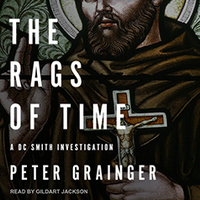
The Rags of Time (Audiobook) by Peter Grainger, Gildart Jackson (Narrator): DC Smith is a Fly in a Colleague’s Ointment

The Rags of Time

The Rags of Time

by Peter Grainger, Gildart Jackson (Narrator)
Series: A DC Smith Investigation, #6

Unabridged Audiobook, 9 hr., 29 min.
Tantor Media, 2017

Read: March 9-11, 2021
Grab a copy from your local indie bookstore!

What’s Rags of Time About?

While DC was recuperating from knee surgery and dealing with his past in Northern Ireland—basically, while In This Bright Future was going on—DC’s rival, DS Wilson led both teams in a murder investigation. By the time DC returned, it was almost completed, he was assigned to do some clean-up on the details. Take care of a couple of witness statements, address some of the paperwork, and whatnot—busy work, really, so he stays out of Wilson’s way and keeps occupied.

But as one expects when DC gets involved, things don’t go that easily. In the first book, for example, he is supposed to sign off on an accidental death investigation and within days there’s an arrest, evidence of war crimes, and Secret Services personnel in Kings Lake.

This time? DC asks a few questions, gets curious, asks some more, and then turns up some evidence that really doesn’t fit the narrative being constructed. Before you know it, there are some big problems with Wilson’s case, and the DS isn’t taking it too well.

So, what did I think about Rags of Time?

I enjoy anytime I get to spend with DC, Chris Waters, DC Murray, and the rest. I love hearing DC’s little jokes (mostly for his own amusement) and his musings about life and the rest. Every one of these books is comfort food for me. Gildart Jackson’s narration just makes them more enjoyable, and this one was no exception.

But…I don’t know, there was something missing with this one. Something felt flat. Maybe it seemed like DC went around in circles for a little too long before stumbling on to the fact that I’d guessed at long before (although, I have the advantage of knowing it’s a novel and I can go for who’d make the most dramatic impact rather than finding evidence).

I liked it, I’m glad I listened to it, and was eager to move on to the next one—so eager that I broke my own rule and listened to it before I had a chance to write about this one. But…it’s the weakest of the series thus far. It’s good, just not as good as the rest. DC will be back up to snuff soon.


3 Stars

2021 Audiobook Challenge

In Plain Sight by Dan Willis: A P.I. with a Magical Edge Races the Clock in this UF Series Start

In Plain Sight

In Plain Sight

by Dan Willis
Series: Arcane Casebook, #1

Kindle Edition, 311 pg.
2018

Read: July 1-5, 2021

What’s In Plain Sight About?

Alex Lockerby is a P.I. in the late 1930’s New York. He occasionally consults with the police, but most of them don’t respect him. Generally, he’s taking small-time jobs (lost pets, etc.) to make ends meet—and it’s largely because his gorgeous secretary finds those jobs for him.

Oh, Alex is a Runewright—by drawing elaborate designs in a (generally) special ink and then setting the drawing on fire he activates various things—finding charms, disguises, a way to look at the past of a room/item, healing, etc.

His ability doesn’t necessarily mean riches aplenty or fame—it means that he has an edge in certain circumstances, but that’s it.

In this novel, Alex is dealing with three cases—a distraught young woman hires him to look for a missing brother. A case he consulted on for the police didn’t go the way he said it would, and he has only three days to fix the problem or he’ll be charged with something and his friend on the force will be unemployed. And, a local church’s soup kitchen—volunteers, priests, nuns, and those being fed–are killed by an impossibly fast-moving disease, and Alex (with the guidance of his medical doctor mentor) needs to track down the source of the disease.

The clock is ticking to deal with all three of these—also in the mix are the NYPD, the FBI, a powerful sorcerer, and an ages-old secret that threatens to destabilize the magic world.

Magic System

There are, we’re told, three types of magic users in this world: Alchemists, Sorcerers, and Runewrights. We don’t get to see a lot of Alchemy (but we hear a little about it). We see enough of Sorcery to get a pretty good idea what it’s like. But the star of the show is the use of and making of Runes.

Willis’s version of Runes are similar to Hearne’s Sigils, but it’s only similar (various wizards, witches, and other magic users from various UF series are more similar than these, though).

I liked the way that all three versions of magic are used, and interweave with each other. Also, while various magic users aren’t necessarily esteemed (Alex is dismissively called “scribbler”, for example), they’re all out in the open, selling their services, both on small scales and large scales.

We need more UF where the magic is out in the open—all the various series with a dozen different ways that the magic (and so on) is hidden from the general populace is getting tired. Magic being an everyday thing, something commercial…I like seeing that.

1930’s P.I.

We’re supposed to get a hard-boiled P.I.-feel from Alex here. Philip Marlowe with magic, kind of a thing. It’s close, but it feels sanitized. Safe. Really, Alex Lockerby is more Dixon Hill than Marlowe or Sam Spade.

I’m not saying I didn’t like the idea or the execution—I enjoyed it. It just felt tame.

So, what did I think about In Plain Sight?

This was fun—inventive, cleverly told, and a premise/magic system that is a breath of fresh air.

I appreciated Willis’ voice and style—I do wish he’d made things a bit more nuanced, a bit harder to figure out (although there is a reveal late in the book that took me by surprise), but it’s the first book—a setup for the series as a whole, and that’s not easy to do.

There’s a lot of charm to the writing and the characters, I can easily see this series becoming a favorite, until then, this was a fun way to spend a couple of hours, and the rest of the series looks to be the same. I’m looking forward to diving into the rest, and suspect you would be as entertained as I was.


3 Stars

20 Books of Summer '21

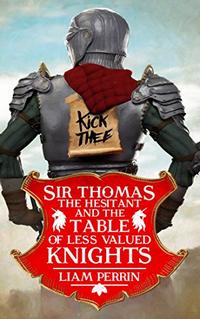
Sir Thomas the Hesitant and the Table of Less Valued Knights by Liam Perrin: Heroism Comes from the Unlikeliest Places

Sir Thomas the Hesitant and the Table of Less Valued Knights

Sir Thomas the Hesitant
and the Table of
Less Valued Knights

by Liam Perrin
Series: Less Valued Knights, #1

Kindle Edition, 272 pg.
2018

Read: July 6, 2021

…there were other tables, some almost as lofty, some not so much. Among those in the not-so-lofty category, the Table of Less Valued Knights was far and away the unloftiest. The Knights of Less Valued Table were the workhorses of the court, performing the inglorious duties that are nevertheless essential to a realm’s operation and taking care of any requests that the other orders found… uninteresting.

What’s Sir Thomas the Hesitant and the Table of Less Valued Knights About?

Thomas is the second son of a soldier turned farmer, his older brother—the favored and talented son—has recently been imprisoned for daring to ask the local Baron for aid for the struggling local populace, suffering under famine.

Thomas goes to Camelot to become a Knight—with the goal of using this position to help the people of his valley and hopefully get enough glory to impress his parents.

He is made a knight (to his surprise) and is assigned to the Table of the Less Valued Knights—those knights who keep the nation running by performing the needed, but unglamorous tasks, freeing up others to tackle the bigger, flashier tasks. It’s a noble calling, a better life than Thomas had before—now the question is, can he still use this role to help his family and their neighbors?

It’s the Characters and Relationships

The story is simple and straightforward, and charming enough. But what elevates this novel are the characters around Thomas and his relationships with them.

He meets and befriends an evil wizard who is working to put that life behind and simply be a healer. There’s a giantess with esteem issues, which lead to her changing size. Thomas’s little sister will steal your heart. And when it comes to best friends/sidekick characters, you won’t find many as fun as his fellow Less Valued Knight, Philip the Exceptionally Unlucky.

There’s a cute romance between Sir Thomas and one of Guinivere’s Ladies-in-Waiting, Marie. Marie’s an intelligent woman who’s constantly prodding Thomas to understand what’s going on around him and how he ought to respond. It’s not that Thomas isn’t that intelligent, he’s just naive and needs someone with a bit more experience to point things out and remind Thomas what he cares about.

And Thomas’ magic sword? You have to see it in action to believe it.

As far as the standard Camelot characters go, this Arthur is heroic and wise (an increasingly uncommon take on the King), Gawain might not be as heroic as you’d want, but he’s a lot of fun. Kay and Bedivere make up for Gawain on the heroism front.

So, what did I think about Sir Thomas the Hesitant and the Table of Less Valued Knights?

You want a hard slog like that to end with the bad guy losing. Through some last minute opportunity, or some deep fault of the villain, or even just sheer stubborn grit on the part of the hero, you want the good guy to stand alone in the end, battered but victorious.

[This fight] didn’t end like that.

It’s not every day I get to use words like “wholesome” around here, but it fits. Why does that strike me as a bad thing? It shouldn’t be, it just conjures up images of someone trying to be squeaky-clean enough for 1980’s Saturday Morning TV, and while this book would be, it doesn’t feel like Perrin forced anything into that mold. It just is that way. Nor does it feel like he’s constrained by this kind of writing, it just feels appropriate to the type of story he told.

The subtitle to Perrin’s website is “Agreeable Stories for Kind-Hearted People Who Take an Interest in Words.” This is a pretty good description of the book. Agreeable—full of kind-hearted people (and some who aren’t so kind-hearted, but they get theirs).

This isn’t written for an MG crowd, but it’s an increasingly rare “adult” novel that I wouldn’t blink at letting a middle-grader read. It’s the anti-grimdark.

What this is is a lighthearted, optimistic tale told with a wink and a smile. There’s peril, there’s bravery of the uncommon and very real sort, there’s hope, there’s struggle, and there are clear lines between good and evil. It’s also pretty entertaining, too. Perrin has a crisp and appealing style that ensures the reading experience will be pleasant.

I liked this, I wish I could read more things like this (aside from the sequel, which I’ll be getting soon). It’s a thoroughly pleasant way to spend a few hours. You should give it a chance.


3 Stars

20 Books of Summer '21

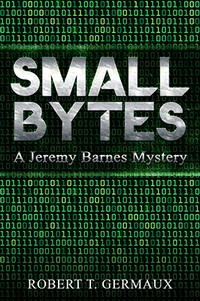
Small Bytes by Robert Germaux: Back to the Beginning of JB Barnes

Small Bytes

Small Bytes

by Robert Germaux
Series: Jeremy Barnes, #3 (Chronologically #1)

Kindle Edition, 286 pg.
2019

Read: July 5, 2021

Tony’s Bar and Grill was your typical local hangout. Located in a working-class neighborhood where everyone knew everyone else and their business, it had gone through several changes of ownership over the years, but the one constant had always been that strangers weren’t particularly welcome, and anyone who lived more than ten blocks away was a stranger.

I lived on the other side of town.

When I walked into Tony’s on a warm spring night, the place didn’t suddenly become silent, the way things happen in the movies, but there was a noticeable drop in the level of conversation.

What’s Small Bytes About?

JB’s oldest friend asks him to give one of her friends a call—her husband had recently been murdered, and she’s dissatisfied with what the police are telling her. Could JB look into things for her?

Terry Pendleton is shot outside his home on his way to work. The police (primarily a lazy and racist lead detective) have determined that it was a mugging gone wrong—despite no evidence of theft, or anything else, really. The widow and many of his colleagues deem that out of character—if a mugger had approached Pendleton demanding money, he’d have been given it all without a struggle.

Barnes isn’t convinced by Rachel Pendelton or the others at the firm, but he thinks there might be something to it. Once he meets the lead detective, JB wants to prove him wrong just out of distaste for the man. But before he really gets anywhere at all in the investigation, a man with ties to organized crime warns JB from continuing to look into things.

JB has no idea what he might be getting into, but at this point, he sure knows it’s something…

Not Technically a Prequel

In the Author’s Note before Chapter 1, Germaux says this was the first he wrote in the series, but he published books #4 and #5 in the series first. So this serves as a prequel, if you go in publication order—not something I’m used to seeing in a P.I. series, but it works.

I think I would have guessed that this was the first JB Barnes that he wrote even if he hadn’t said it. There’s something—maybe just confidence, maybe just the experience of having written other complete novels, probably something else—that’s missing from this that was present in Hard Court or In the Eye.

I’m Not Sure About that Title

There are only so many things that “Bytes” can apply to. As this is a Detective Novel, you know some sort of cybercrime is involved—at the very least some sort of electronic data is going to be very important to the P.I. wrapping things up.

When there is zero discussion of anything along those lines (at least in reference to JB’s case), it’s hard to believe that he’s uncovering anything that matters up until a related concept shows up.

Thankfully, the book was interesting, the characters were engaging and the subplots were compelling, and JB’s narrative voice keeps you turning pages. So even while wondering when we were going to get anything computer-related, I was enjoying things. Still, that title doesn’t do the text any favors.

So, what did I think about Small Bytes?

Along the way, I dropped the envelope in a mailbox and thought about what Uncle Leo had told me the day I’d first expressed an interest in joining him in the business. The most important thing, he’d said, was learning to balance the highs and the lows, “‘cause you’re gonna have both, the good and the bad. Ya gotta learn to balance them, son, or the demons’ll be dancin’ in your head way too many nights.”

I’m still learning.

With both of Germaux’s series—the Jeremy Barnes and Daniel Hays books—I’ve said that each book feels like you’re returning to a well-established series that you’ve been reading for a while. And, given the order he wrote these books in, that makes sense. But even Small Bytes feels like it’s not the beginning, but something mid-series. Sure, this is a turning point in the series, but there’s no sense of Germaux introducing people and relationships, just picking up where he left off. I really appreciate that.

Small Bytes is a fun read, and I’m glad I read it, but I’m glad it’s not the first book I read by Germaux or about JB. But even here at the beginning, I want to stress, there are a few passages that just sing. Germaux has the knack for spinning a solid PI tale and captures the feel, voice, and style of the best of the genre.

Which is why I’ll be back for the others in the series soon—and why I’ll jump on anything else Germaux has in store for JB, and why I’ll suggest you give him a try, too.

20 Books of Summer '21

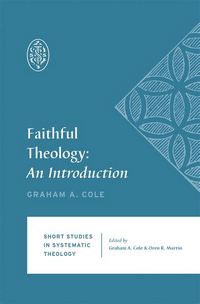
Faithful Theology: An Introduction by Graham A. Cole: Basics for Building a Theological Method

Faithful Theology: An Introduction

Faithful Theology: An Introduction

by Graham A. Cole
Series: Short Studies in Systematic Theology

Paperback, 106 pg.
Crossway, 2020

Read: June 27, 2021
Grab a copy from your local indie bookstore!

…faithful theology is a human project that arises from wise reflection on the self-revelation of God. Because it is our reflection on God’s revelation, it is always to be reformed and corrected by that revelation…it is one thing to have an evangelical’s high view of Scripture. It is quite another to know how to derive teaching (doctrine or theology) from Scripture.

Cole’s purpose in this is to give his readers a method to use in “doing faithful theology.” Moving from Scripture to doctrine. Trying to balance orthodoxy, orthokardia, and orthopraxy (right opinion, right-heartedness, right practice of life), Cole organizes his approach through five elements, exploring each in a chapter. The first element is the foundation on which the others are built—God’s self-revelation in Scripture. The second is reflecting on the witness of the theology and practice of the Church through history—not on an equal footing with Scripture, but it should inform how we approach doctrine. The third element is realizing our context as we do theology—we’re in a fallen world, yet we are redeemed and are awaiting the return of Christ. Our thinking, our theologizing needs to be done fully aware of what that means. The fourth is centered on wisdom. We need to be wise in our application of the previous. The last element puts all of the above together and focuses it in a doxological direction—our theology should be a service to God.

Throughout, Cole uses examples of these principles applying to Christological and Trinitarian thought. There are some other examples, too, Which is a tremendous help—if for no other reason than they’re bedrock doctrines on which there should be no disagreement. He brings up baptismal practices at one point as an example of something where there’s an opportunity for a divergence of opinion, standing in contrast to Trinitarian dogma.

So, what did I think about Faithful Theology: An Introduction?

This is an easy read, full of solid, useful advice. I found it a little wanting, a little…uninspired? A little basic? I’m not sure precisely what word I want but it’s somewhere in that vicinity. But it’s supposed to be basic—it’s an introduction. It’s a tool to be used as someone begins working on their theology. So, what do I know?

The for Further Reading and books/articles suggested in the footnotes are helpful, but I didn’t feel inspired to track any of them down right away, but they seemed like solid and useful recommendations.

The last chapter, where he brought all the ideas together and gives a great example of how to use his elements in shaping our Trinitarian dogma is great. It makes all the rest of the book worth it.

It’s good stuff, I think it’ll be helpful to a lot of readers. I just wanted a bit more. I think Swain’s book on the Trinity left me with higher expectations. I’m looking forward to the next book I get in this series to see which of these first two are more representative of the series as a whole.


3 Stars

This post contains an affiliate link. If you purchase from it, I will get a small commission at no additional cost to you. As always, opinions are my own.

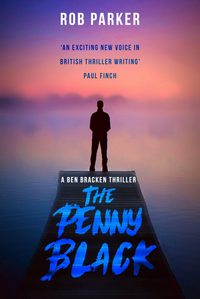
The Penny Black by Rob Parker: Ben Bracken Takes a Breather (for a bit)

The Penny Black

The Penny Black

by Rob Parker
Series: Ben Braken, #3

Kindle Edition, 218 pg.
Lume Books, 2020

Read: June 8-9, 2021
Grab a copy from your local indie bookstore!

What’s The Penny Black About?

After the…shall we say, extreme conclusion of Morte Point, Ben Bracken has to disappear. Not like he disappeared after he escaped from prison either—this is a whole new level. Not only does he have to hope that the several governments and criminal organizations never learn what he did, but he also has to hope that the 3 other people who know what he did don’t come looking for him.

So he assumes a name and lives in a tiny town called Horning. He gets a job that pays him just enough, he boards with an older couple (some of the nicer people you’ll ever meet). Ben takes the time to recuperate, to soak in the atmosphere, to remember what it is about people—British people, in particular—that made him love his country so much that he is what he is.

As he starts to prepare to leave this town and move on, he stumbles on to a criminal conspiracy in this quiet community. Because that’s what Ben Bracken does. Bears bear. Bees be. Ben finds conspiracies.

Ben feels like he owes people of Horning a debt because of the solace they’ve given him. So he decides to clean up town on his way out.

Things go from quiet and bad to loud and worse before long—and then it gets deafening and horrific.

So, what did I think about The Penny Black?

It wasn’t bad. It wasn’t my favorite, but there were some really good moments. The fight scenes were well done, as I’ve come to expect, and I really liked the self-reflection Ben undertakes and the steps he takes to move on with his life.

I honestly don’t have a lot to say—and I feel bad about that. It was alright. I think it’ll end up being a pivotal moment in the series, and I’m eager to see where things go from here, but I just can’t get that excited about this one.


3 Stars

This post contains an affiliate link. If you purchase from it, I will get a small commission at no additional cost to you. As always, opinions are my own.

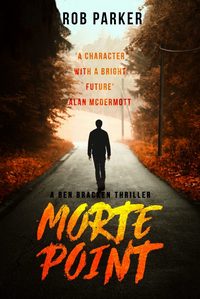
Morte Point by Rob Parker: Things Go From Worse to Worse to Much Worse for Bracken

Morte Point

Morte Point

by Rob Parker
Series: Ben Braken, #2

Kindle Edition, 218 pg.
Lume Books, 2020

Read: May 21-25, 2021
Grab a copy from your local indie bookstore!

I’m…enjoying myself.

Some people like collecting beer mats. Some like keeping tabs on birds, bugs, animals… whatever. Some like walking, running, going to the gym. We all get our kicks from somewhere. I’m open enough to enjoy all the above. But I’m never happier, nor more focused, than when I am getting shit done while the chips are down. Now, floating between the shallow rocks off the Atlantic, using my wits, guts and training to elude a mysterious force, I am in my element; my absolute, unrelenting element.

What’s Morte Point About?

Something is about to happen at Morte Point, he can’t get into details with Ben, but his police contact and his entire agency have been waved off from it by a higher power. Which just means it’s time for something unofficial to happen—enter Ben Bracken, the former soldier, escaped convict, and patriot on his one-man crusade to take on the criminals that England’s justice system can’t handle.

With only a couple of details given to him, Bracken finds his way to the North Devon coast just in time, retrieves the item he was sent for—and then has to spend the next few days eluding armed men of various skill levels, government officials with differing priorities and ethics, and nature red in tooth and claw—and a few other hazards.

Can he survive long enough to do the right thing with what he retrieved? Is there a right thing to do with it? Is Ben on his own enough, or will he have to find allies to get the job done?

Does Parker Have Something Against Ben?

The number of things that go wrong for Ben in the first 40% of this novel is pretty astounding. And by “go wrong,” I generally mean “inflict some sort of injury” to him. He’s being hunted by a group with numbers, resources, and determination; he cannot make contact with anyone he can trust; and he’s injured repeatedly (to varying degrees of seriousness). It’s bad enough that if you didn’t know there were two more books published (with one imminent), you’d start to wonder if the last half of the book was going to get a different narrator. It’s like Parker was angry about something and took it out on Ben.

Things to lighten up for him—which isn’t to say that the rest of the book is easy, the problems continue, just less frequently (but they’re of a higher degree of seriousness).

A Step too Far?

I sleep the sleep of a man who knows he has done wrong. I sleep a sleep that is deep, yet forced, unbroken yet tormented, as my subconscious pretends that what I did hasn’t happened at all. And if it did somehow happen, surely it is not time yet to wake and face it.

Not long after the physical hazards lighten up, the moral and psychological ones become more pronounced. Ben has certain ideas about what kind of person he is—so does the audience at this point. Ben takes a couple of actions that are truly disturbing, and may (should) haunt him. It certainly looks as if they will.

A lot of this kind of “wandering one-man army” type characters don’t seem to think much about their acts of violence for very long, and it seems like Ben might be an exception to the rule—and I think we need more like him. One of these morally questionable acts is fairly justifiable for a fictional action hero, but the other (the one prior to this tormented sleep)…I don’t know He has a hard time letting himself off the hook for it, and I’m pretty much with him on that one. I’m curious to see if later books see him shying away from that kind of thing.

So, what did I think about Morte Point?

Parker’s writing is crisper; while outlandish, the plot seems more grounded; on the whole, the action scenes are more convincing and exciting (although the destruction of the floating nightclub in A Wanted Man tops anything here); the characters are better fleshed out—and, when applicable, more chilling. Generally speaking, Parker took what he did in the previous novel and improved it—exactly as one would hope to see. Parker barely establishes a status quo before he proves that he’s willing to blow it all up—a gutsy move this early in a series.

However…

I can’t quite put my finger on it but something about this didn’t work as well as A Wanted Man. I think objectively, it’s probably a better novel, but subjectively, I’m not as enthused about it. I’m still diving into the next one in a day or two—I want more Ben Braken, I just also want a bit more out of the books. Nevertheless, if you’re looking for a thrill ride full of action, adrenaline, and morally complicated choices? Morte Point will deliver.


3 Stars

This post contains an affiliate link. If you purchase from it, I will get a small commission at no additional cost to you. As always, opinions are my own.

Reposting Just Cuz: Death and Taxes by Mark David Zaslove: The most rootin’ tootin’ shoot ’em up about accountants you’ve ever seen

Like the Wolfe quotation from earlier today, it felt like this was a good day to re-run this:

Death and TaxesDeath and Taxes

by Mark David Zaslove
Series: Tales of a Badass IRS Agent, #1


ARC, 219 pg.
Aperient Press, 2018

Read: August 13 – 14, 2018
I’m not sure I can do this book justice with a hand-crafted synopsis, I’ll just copy and paste from Zaslove’s site:

Death and Taxes follows Mark Douglas, an ex-Marine turned IRS agent, who, along with auditing the weird and the profane, also spearheads weekend raids with his locked-and-loaded gang of government-sanctioned revenuers, merrily gathering back taxes in the form of cash, money order, or more often than not, the debtor’s most prized possessions.

Things turn ugly when Mark’s much-loved boss and dear friend Lila is tortured and killed over what she finds in a routine set of 1040 forms. Mark follows a trail dotted with plutonium-enriched cows, a Saudi sheik with jewel-encrusted body parts, a doddering, drug sniffing, gun-swallowing dog named The Cabbage, a self-righteous magician with a flair for safecracking, a billionaire Texan with a fetish for spicy barbecue sauce and even spicier women, and an FBI field agent whose nickname is “Tightass.” All of which lead to more and bloodier murders – and more danger for Mark.

Enlisting his IRS pals – Harry Salt, a 30-year vet with a quantum physical ability to drink more than humanly possible; Wooly Bob, who’s egg-bald on top with shaved eyebrows to match; Miguel, an inexperienced newbie with a company-issued bullhorn and a penchant for getting kicked in the jumblies – Mark hunts down the eunuch hit man Juju Klondike and the deadly Mongolian mob that hired him as only an angry IRS agent can. There will be no refunds for any of them when April 15th comes around. There will only be Death and Taxes.

This is hyper-violent (not that filled with blood and guts, really — there is some), a lot of guns, bombs, more guns. Sometimes played for comedic effect, sometimes it’s the good guys vs. the bad guys. Sometimes, it’s a little of both. It never got to the overkill point for me, probably because this felt more like a cartoon than a “realistic” thriller.* What was overkill for me was the hypersexualization of every woman under the age of sixty. I didn’t need to hear that much about every woman’s physical appearance — there are more gorgeous women with perfect (sometimes surgically enhanced) bodies in this guy’s life than an episode of Miami Vice.

* Really, what thriller is realistic?

But man, is this funny. There are sections — sometimes a sentence or two, sometimes several paragraphs long — that are the literary equivalent of a shot of espresso, they are so taught with action, cultural references, and humor that you just revel in them. This reminds me a lot of the John Lago Thrillers by Shane Kuhn — I think Kuhn shows more discipline in his plots and characters, but on the whole, these two are cut from the same cloth. The same energy, a similar style, a similar sense of humor — and frankly, that stuff is catnip to me. I think the plot got a little convoluted, a little confusing — but it was worth working through.

Am I planning on reading Tales of a Badass IRS Agent, #2? Yeah, I will be keeping an eye out for it. This is a heckuva romp and will entertain anyone who gives it a shot.

Disclaimer: I was provided with a copy of this novel in exchange for my honest opinion, which you see above.

—–

3 Stars

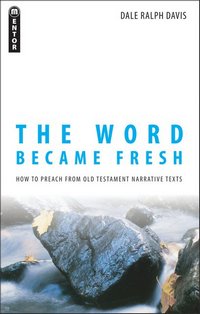
The Word Became Fresh by Dale Ralph Davis: Principles for Old Testament Reading “For Fun and Profit”

The Word Became Fresh

The Word Became Fresh:
How to Preach from Old
Testament Narrative Texts

by Dale Ralph Davis

Kindle Edition, 154 pg.
Mentor, 2012

Read: April 11-18, 2021
Grab a copy from your local indie bookstore!


Dale Ralph Davis is one of those authors I’ve meant to read for ages now, I’ve seen him quoted and referred to for as long as I can remember and I just hadn’t gotten around to reading any of his work. This book seemed like a decent place to start.

What’s The Word Became Fresh About?

In the preface, Davis sets out the impetus for the book—too many Christians see the Old Testament as unimportant, or too complicated to understand—it’s good for a couple of morality lessons or the occasional Psalm, but that’s about it.

I still believe that traditional Old Testament criticism has had the effect of killing the Old Testament for the church. This little tome can hardly reverse that, but it is meant as an exercise in reading the Old Testament for fun and profit. As my mother- in- law used to say, ‘It’s different anyway.’ And maybe it will help.

While yes, the book is intended as a help for preachers*, these tools can and should be used by the laity in their personal reading.

* Maybe I’m just a snob, but if preachers don’t have the tools to handle the Old Testament passages at this level already, perhaps they skimped on their training.

Davis describes and then illustrates several principles to be used when approaching (primarily narrative) Old Testament texts to help the reader focus on the main ideas and themes of the passages without getting bogged down in the minutiae. The illustrations are plentiful and insightful—and are probably the best part of the book—taken from all over the Old Testament to help illustrate how useful they are for a variety of texts.

So, what did I think about The Word Became Fresh?

The writing is warm, approachable, and engaging—I can see why so many people have quoted Davis in the various things I’ve read—and I can see myself quoting him in the future (and reading more of him to get those quotations).

While I found the principles and tools he lays out to be helpful, I’m not sure I needed any of them. I’ve been exposed to—and using—most of them (generally without knowing I was using a hermeneutical tool, which should’ve been obvious to me).

What I found most helpful is his illustrations, seeing this stuff at work—and the conclusions (both exhortations and assurances) that he draws from his examples. These turn each chapter into a collection of sermonettes for handy use.

I’m not sure I learned a lot from this book, but I really appreciated the time I spent in the book and the gems I was able to collect from Davis. This won’t be my last book by him.


3 Stars

This post contains an affiliate link. If you purchase from it, I will get a small commission at no additional cost to you. As always, opinions are my own.
Page 17 of 55

Powered by WordPress & Theme by Anders Norén