Tag: 4 Stars Page 41 of 88

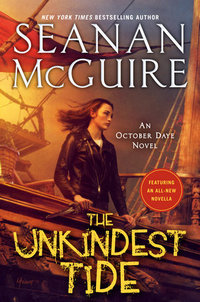
The Unkindest Tide by Seanan McGuire: The Luidaeg takes Center Stage in this Water-filled Adventure

The Unkindest Tide

The Unkindest Tide

by Seanan McGuire

Series: Toby Daye, #13

Hardcover, 301 pg.
DAW Books, 2019

Read: September 10-11, 2019

I finally took my eyes off the water, peering at her through the disheveled curtain of my hair. “Are you just babbling at me until I start feeling better?”

“Yup!” Marcia beamed. “Is it working?”

My stomach was no longer roiling. I didn’t trust myself to stand up on my own, but I also didn’t feel like I was about to introduce the barnacles to my breakfast. Again. I blinked. “Actually, yes.”

“Sometimes you need to take peoples’ minds off their problems if you want those problems to resolve themselves,” said Marcia. “Focusing on things can make them worse.”

“Not all problems go away if you ignore them. Most don’t.”

“No, but not all problems can be fixed. Sometimes you have to wait until the situation changes.” She smiled sympathetically. “Like if you’re on a boat and you get seasick.”

Yup. Toby’s on a boat—a sailing ship, to be precise—just the place for someone who hates water. Why is she there? Well, that has something to do with the debt she owes the Luidaeg. The Luidaeg has decided that time is up and it’s now time to pay that mysterious bill she told the Selkies was coming due. And Toby has to come along to help her collect. A couple of months ago, when I listened to the audiobook of One Salt Sea, I wondered what happened to that ominous future event, so that was nice to see. On the other hand, we’re told that this was nearly three years ago, which means it takes only three-ish years for books 6-12 to occur? That’s an eventful life right there.

Because they’re apt to be useful, and because Toby isn’t likely to come nicely without them, the Luidaeg also brings Tybalt and Quentin along on their trip to the Duchy of Ships, where a convocation of Selkies will be held to pay this bill. Due to the significance of this happening, a few other dignitaries come, too—delegations from the Kingdom of the Mists, the Duchy of Saltmist, and Goldengreen—oh, and Gillian (which makes sense for people who’ve read the previous book, Night and Silence).

So we’ve got a group of Toby’s friends, a new Duchy for most of them to visit, a bunch of debts the Luidaeg is collecting, and the fate of an entire race in the balance. What could go wrong?

Naturally, that’s the wrong question. SOmething better to ask is: how many pints of blood will Toby lose while trying to fix what goes wrong and how many others will die? Obviously, I’m not going to answer those, but we need to get our thinking straight.

Something I want to mention before I forget: Before the Sea Witch shows up at her door, Toby’s narration gives a very thorough and succinct recap of the entire series (one of the best of those I’ve read lately, it’s a tricky thing to accomplish) before noting

…there’s a lot of history around here, and sometimes it doesn’t summarize very well.

It’s a small thing, but it made me smile—McGuire excels at those.

The Luidaeg has got to be just about the most popular character in this series, and we really get to know her so much better here than we have before—and it made me so happy to see this. I’d gladly take another Luidaeg-centric book or three any day of the week. Seeing her at this turning point in all her power and all her grief is just stunning. I don’t think I’d ever felt bad for her (at least not for long), but watching her being resolute in carrying out the duty she was bound to here—while clearly not wanting to go through with it—was moving. Early in the book, there’s a scene between her and a little girl that just about broke my heart. At the same time, she has plenty of great lines and made me chuckle a lot, too. Her interactions with Quentin (and vice versa) might be my favorite parts of the book.

The Luidaeg/Selkie story was strong enough that I don’t care so much about the rest of the book, which is good, because I think it’s one of her weakest. There’s an adventure in Saltmist that seemed pretty perfunctory and while the ending is very clever—and gives Toby a chance to embrace the technicalities of Faerie in a way she usually doesn’t (that is, keeping the letter of the law, but doing a tap dance all around the intent)— it seemed anti-climatic. We have a great build-up and then an almost let-down of a conclusion.

A few quick bullet points that I don’t have the time to expand on (nor do I think I could do them justice without talking too much about them):

  • No one expected, I trust, that things between Toby and Gillian would get better after Night and Silence, but it was tough (yet understandable and believable) to read Gillian’s reactions to Toby here.
  • There are repeated references to the weakness/susceptibility to harm of one member of Toby’s group—McGuire hit that note so often that I really feared for that character. One that I didn’t realize I liked as much as I did when I feared for their safety and longevity.
  • We get to meet another Firstborn! She’s just fantastic and I hope we get to see more of her. Also, the reactions of various members of her descendant races to meeting her in the flesh were priceless.
  • Someone’s blind fosterage is getting harder to maintain. That could prove interesting (and in the Toby-verse, interesting usually is defined as calamitous)
  • Clearly, Toby’s reputation as someone who topples monarchies has spread far and wide. This isn’t good for her, but will be good for us readers.
  • Marcia continues to show more depth and ability than I gave her credit for when we met (which surprises me almost every time we see it)
  • What we’re told about future books here (in terms of Toby’s future obligations) is enough to get long-term readers excited (not that we needed the encouragement, really, but it’s nice to know)

This isn’t one of the best in the series—but it features some of the best moments, scenes, events. It’s not a trade-off I’m entirely pleased with, but I can live with it (and thankfully the good far outweighed the less-good). It’s safe to say that a lot won’t be the same again in this world or for many of these characters. Any time I spend with Toby, Tybalt, Quentin, the Luidaeg, etc. is a good time, and I thoroughly enjoyed the read, I just wanted a bit more from an author who usually brings more than you could realistically ask for.


4 Stars

Reposting Just Cuz: Communication Failure by Joe Zieja

Communication FailureCommunication Failure

by Joe Zieja
Series: Epic Failure, #2

ARC, 325 pg.
Saga Press, 2017

Read: October 31 – November 2, 2017


So, Captain Rogers has escaped with his life after saving the 331st Meridian Fleet from a takeover from almost all the droids on board, now he’s been made acting admiral and is faced with a potentially bigger threat: the Thelicosan fleet — the very fleet that Rogers’ ships are to keep on their side of the border — has informed him that they are about to invade. Given the size of the fleets facing off, this is an invasion that will not go well for the 331st.

So how is this would-be con-man, former engineer, and current CO going to survive this? He hasn’t the foggiest idea.

Clearly, for those who read Mechanical Failure (and those who haven’t have made a mistake that they need to rectify soon), whatever solution he comes up with is going to rely heavily on Deet and the Space Marines (the Viking/Captain Alsinbury and Sergeant Malin in particular) will be heavily involved. Malin has taken it upon herself to help Rogers learn some self-defense (even if that’s primarily various ways to duck), the Viking is questioning every decision her new CO is making, and Deet is continuing his exploration into human behavior/consciousness (he’s exploring philosophy and spirituality at the moment — which is pretty distracting). Basically, if Rogers is looking for a lot of support from them, he’s going to be disappointed.

It turns out that the Thelicosans didn’t intend to send that message at all, what they were supposed to communicate was very different, actually. But before Rogers and his counterpart can find a way to de-escalate the situation, shots are fired, milk is spilled, and events start to spiral out of control. Which isn’t to say that everyone is doomed and that war is inevitable, it’s just going to take some work to keep it from happening. There are forces, groups, entities — whatever you want to call them — hawkish individuals who are working behind the scenes to keep these cultures at odds with each other, hopefully spilling over into something catastrophic. Which is something too many of us are familiar with, I fear — and something that someone with Zieja’s military background is likely more familiar with. The Thelicosans and Meridians discover who these people are — and how they are attempting to manipulate the fleets — and the big question is how successful they’ll be.

We focus on three Thelicosans, but spend almost as much time on their flagship (The Limiter) as we do the Meridian flagship (Flagship). Grand Marshall Alandra Keffoule is the commander of the border fleet — at one time, she was a star in the special forces, and now she’s been assigned to the border fleet as a last chance. She fully intends on taking full advantage of this opportunity to make history and restore herself to her position of prominence in the military. Her deputy, Commodore Zergan, has fought alongside her since the special forces days and is now trying to help her rebuild her reputation. Secretary Vilia Quinn is the liaison between the Thelicosan government and the fleet. Quinn’s development through the book is a lot of fun to watch — and is probably a bigger surprise to her than it is to the reader, which just makes it better. Thelicosan culture is saturated in science and math, and is full of rituals that are incredibly binding and incredibly difficult for outsiders to understand. In many ways, the culture is hard to swallow — how a society develops along those lines seems impossible. But if you just accept that this is the way their society functions, it ends up working and stays consistent (and entertaining).

Lieutenant Lieutenant Nolan “Flash” “Chillster” “Snake” “Blade” Fisk, the best pilot the 331st has is a great addition to the cast — yeah, he’s probably the most cartoonish, least grounded, character in Rogers’ fleet — but man, he’s a lot of fun (and I think it’s pretty clear that Zieja enjoys writing him). think Ace Rimmer (what a guy!), but dumber. Mechanical Failure‘s most cartoonish character, Tunger, is back — the would-be spy/should-be zookeeper finds himself in the thick of things and is well-used (as a character) and is well-suited to his activities. Basically, I put up with him in the last book, and enjoyed him here. I’d like to talk more about Deet and the other characters here — I’ve barely said anything about Rogers (he develops in some ways no one would’ve expected) — but I can’t without ruining anything, so let’s just say that everyone you enjoyed in the previous installment you’ll continue to enjoy for the same reasons.

Mechanical Failure didn’t feature a lot of world-building outside life on the ship. Zieja takes care of that this time — we get a look at the political situation between the various governments, and the history behind the four powers. Which isn’t to say that we’re drowning in details like George R. R. Martin would give us, it’s still breezy and fast-paced. Still, there’s a handle you can grab on to, some context for the kind of madness that Rogers finds himself in the middle of.

One of my personal criteria for judging books that are heavy on the humor in the midst of the SF or mystery or fantasy story is judging what the book would be like without the jokes. The Hitchhiker’s Trilogy, for example, would fall apart in seconds (and few rival me for their devotion to that series). Magic 2.0 would hold up pretty well, on the other hand. The Epic Failure series would be another one that would hold up without the jokes. I’m not saying it’d be a masterpiece of SF, but the story would flow, there’d be enough intrigue and action to keep readers turning pages. However, you leave the humor, the jokes and the general whackiness in the books and they’re elevated to must-reads.

There are too many puns (technically, more than 1 qualifies for that), there’s a series of jokes about the space version of The Art of War that you’d think would get old very quickly, but doesn’t — at all; and Rogers has a couple of bridge officers that make the pilot Flash seem subtle. Somehow, Zieja makes all this excess work — I thought the humor worked wonderfully here, and I think it’ll hold up under repeated readings.

I thoroughly enjoyed this book and can’t wait to see where Zieja takes us next.

Disclaimer: I received this book ARC from the author, and I can’t thank him enough for it, but my opinion is my own and wasn’t really influenced by that act (other than giving me something to have an opinion about).

—–

4 Stars

Reposting Just Cuz: Mechanical Failure by Joe Zieja

Oddly tired today, so I can’t get my post for 9/17 finished. So, I’ll dig up a couple of blasts from the past in honor of volume 3 of the Epic Failure trilogy’s release today. There are a few sentences here that I wish I could rewrite, but oh, well…This is one of the funniest books I’ve read in years, and I can’t wait to dive into System Failure.

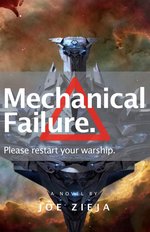
Mechanical FailureMechanical Failure

by Joe Zieja
Series: Epic Failure, #1

Hardcover, 343 pg.
Saga Press, 2016

Read: August 17 – 18, 2016

No duty was too great that R. Wilson Rogers couldn’t find a way to shirk it.

This is the essence of R. Wilson Rogers (don’t ask what the R. stands for) compressed into one sentence — an engineer for the Galactic Navy during the longest peacetime in Galactic Memory. As a result of all the peace, there’s not a whole lot for a Naval ship to do — nor for the men assigned to it. So, Rogers and his fellow crew members got up to a lot of nonsense — drinking, gambling and worse. Eventually, Rogers finds himself leaving under less than auspicious circumstances. Not long after that, under even less auspicious circumstances (which I’ll leave for you to read about and chuckle over) he finds himself back on the appropriately named Flagship which has transformed in his brief absence in to a serious-minded place, full of random inspections, wartime preparations (despite centuries of peace), and odd assignments.

Before long, Rogers finds himself getting promotions, leading a group of battle droids, and seriously considering suicide and desertion (favoring the the latter, I assure you) — and that’s when things really start to get interesting.

This is pretty decent Military SF with a twist of humor, a dollop of irony, a pinch of satire, and so on — I don’t want to compare it to Adams. But I’ll compare it to a mix of Scalzi, Harry Harrison, Jack Campbell, Grant Naylor and Peter David. There’s a sense of play, even when he’s not going for the comedy, which makes the whole thing fun to read.

Best ‘droid since Marvin, best malfunctioning human personality software since Marvin (or Lore — but not as creepy or murderous), funniest ‘droids since Kryten. I could keep those comparisons going — essentially, I really liked all of the Droids on Flagship (especially Deet). The CO that reminded me of some sort of hybrid between the pointy-haired boss and Douglas Reynholm is great comic relief, but there’s more to him than that.

Honestly, I could go on and on, Zieja assembled a great cast of characters — real enough that you can like them, outlandish enough that you don’t take them terribly seriously. Not just the obviously comedic characters either, there are a few “straight (wo)men” characters scattered throughout, keeping the rest grounded. Rogers is the best of the bunch — there’s a little personal growth to him (no one’s more surprised and dismayed by that than him), I enjoyed seeing that come out. I liked how despite himself he learns to set aside prejudices, take things seriously, and even act a little heroically. I as amused by (and occasionally disturbed by) his attraction to/fascination with the Amazonian Marine Captain. Rogers’ way of looking at the world is pretty relatable (I’m not saying that he’s the kind of guy you spend time with, he’s the guy you want to spend time with), and he’ll win you to his side pretty quickly.

One thing that I really appreciated was the respect that Zieja showed to the military personnel throughout this — too often everyone (with a maximum of a couple of exceptions) in a book like this is depicted as a moron — think of Richard Hooker’s classic for a moment. It’s just one example, but it’s a good one. You’ve got Jones, the Painless Pole, Hawkeye, Trapper, Duke, and a couple of nurses here and there who are competent, if not great, doctors. Who else? Everyone else is a “regular Army” schmuck ho shouldn’t be allowed in an operating theater or near anything where life and death decisions come into play.

Zieja doesn’t play it this way — these Navy and Marine men and women (with one or two exceptions, because there are always exceptions) are treated as competent, equipped and dedicated people whose greatest problem is that they have nothing to do, so things get a little loopy from time to time. But you give then an enemy, you give them a goal, you give them some way to target their talents and energy — good things happen. Even the really incompetent turn out to be quite competent when put in the right spot, doing what they’re good at (even if that’s not what they want to be good at). Problems are solved, crises averted, and enemies thwarted. That’s just not seen often enough, and I appreciate Zieja doing that.

That doesn’t mean he can’t find ways to make fun of the dedicated, the competent, and equipped — but he doesn’t make them into buffoons to do so (mostly).

I knew that I was going to like this book by page 3, I was audibly chuckling by page 4. The rest was just gravy. I laughed, chortled, and grinned my way through this — practically from beginning to end. The story as pretty good, the story plus the comedy made this gold. If I could think of stronger words to use to endorse this, I’d probably slap them here. But I can’t — just get your hands on this one. Meanwhile, I’m already looking forward to the sequel.

Disclaimer: I received a copy of this from the Publisher in exchange for my honest comments on it — sorry for the delay, I greatly appreciate the book.

—–

4 Stars

Pub Day Repost: The Bitterest Pill by Reed Farrel Coleman: Paradise, MA comes face to face with the Opioid Epidemic

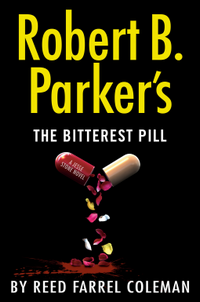
The Bitterest Pill

Robert B. Parker’s The Bitterest Pill

by Reed Farrel Coleman
Series: Jesse Stone, #18

eARC, 368 pg.
G.P. Putnam’s Sons, 2019

Read: July 31 – August 3, 2019

Well, it’s pretty clear that Don Winslow has left his mark on Reed Farrel Coleman—there’s a quotation from Winslow on the so-called War on Drugs as the epigraph to this novel. Jesse cites it and alludes to it later in the novel. It’s a good line—catchy and insightful (and, not that it matters, I agree 100% with it)—don’t misunderstand me, but I’m used to Robert B. Parker characters citing Shakespeare, (Edmund) Spenser, Shelley, and songs from the late 60s/70s. I don’t think I’ve ever seen one quote someone contemporary. The latest focus of most of our country in that War is the Opioid Crisis, in The Bitterest Pill, that epidemic shows up in Paradise, Massachusettes—partially fulfilling Vinnie Morris’ prediction to Jesse that Boston crime was on its way to Paradise.

A student at Paradise High—the daughter of a city councilman—dies of an overdose and the city is rocked. It can’t be the first drug-related death in its history, but this was a different kind of thing. She’s not an obvious user, cheerleader, from a well-to-do family, and so on. Not the kind of person that Paradise is ready to believe would be an addict or that would die of an O.D.

What’s obvious to Jesse and his team is that if they don’t shut down the supply chain that fed this girl her drugs, she won’t be the only death, she’ll just be the first. This sets Jesse on a Hunt through Paradise High School and Boston’s underbelly. There’s a moment that made me think of Connelly’s Two Kinds of Truth (which just means that Connelly and Coleman have both done their research into the ways prescription drug rings work, not that Coleman’s copying anything)—but there’s a difference. Bosch is trying to deal with a situation, he’s involved in busting a ring as a means to an end. Jesse? He’s trying to protect his town it’s personal—and the ways that this particular ring is trying to invade Paradise are more diverse than what Bosch dealt with.

Skip this next paragraph if you’re worried about Colorblind spoilers.
I avoided talking about the new character Cole last time out, because, how could I? I’m on the fence with him, honestly. I don’t see where he was necessary—Jesse has Suit to father (although, at this stage, Luther doesn’t need much), he’s got the weight of the city on his shoulders, what’s added to the character by this relation? On the other hand, scenes with him are done so well, and Jesse’s different with him. I really enjoy him—he’s not the Paradise equivalent of Paul Giacomin, thankfully (nothing against Paul, we just don’t need another one), he’s a different kind of character (as Jesse was compared to Spenser and Sunny).

Speaking of Suitcase, I think I’ve loved everything Coleman’s done with him (every major thing, anyway, there might have been a scene or two that I forgot about), other than not using him as often as he could. But there’s a scene with Suit and Cole in this book that is so well done that it’s one of those passages I could read from time to time just to smile at. He’s come a long way. Molly seemed a little under-used, but she was good whenever she showed up and did get to shine a bit. I think Coleman overplayed the difficulty of Molly doing her job because of the way this case impacted Paradise’s children a bit (really not much), and, as always, he’s too dependent on bringing up the incident with Crow in relation to Molly. But on the whole, Suit, Molly and the rest of Paradise PD came off pretty well.

For awhile under Coleman and Ace Atkins, Vinnie Morris seemed more dangerous, more of a wild card—less “tamed.” But both the way that Atkins has used him the last time or two and here he seems to be tacking back to a friendly criminal who’s too willing to help out the non-criminal element. Frankly, I prefer the less-tame version, but as someone who’s enjoyed Vinnie since he worked for Joe Broz ages ago, I don’t care, I just like seeing him on the page.

After the very effective use of the mayor recently, I was surprised at her absence in this novel—not that there was room for anything like that.

There’s really one more supporting character that we should talk about—Alcohol. Jesse’s greatest foe (although, you could argue he’s the enemy and alcohol is the tool he uses to attack himself, but…eh, let’s make this easy and say alcohol). He may be clean and sober, but he’s still an addict, and his drug of choice is still a near-constant presence in his life. I love, respect and admire the way that Jesse (and Coleman) have dealt with this subject, particularly since Jesse stopped drinking. It’s so much more believable (and healthy) than Jesse’s attempts to manage his drinking before. I liked the approach in Colorblind, and continuing it in The Bitterest Pill made it stronger.

So, we’ve got Jesse battling personal demons (but with a clearer head), adjusting to a new personal reality, and dealing with a potentially crushing crime wave that’s leaving a trail of destruction through the youth of Paradise. Throw in the instability of a new romantic relationship? Jesse’s in a pretty healthy place, but given the pressures (and a couple I didn’t list)—it’s gotta be weighing on him, and Coleman does a pretty good job of balancing the health and precarious nature of Jesse’s state of mind.

As Coleman’s writing, it seemed frequently that he was trying too hard to make this something the level of Colorblind or Debt to Pay, and didn’t quite make it. Maybe because he was trying so hard? The topic he’s dealing with is important, so it’s understandable he’s taking big swings to hit this out of the park. But there are a few sentences that no one but Reed Farrel Coleman could have written. They were gorgeous and practically sang. I don’t want to sound like one of those anti-genre literary snobs, but Coleman comes close to transcending the genre and its easy to see the impact his poetry frequently has on his prose.

At the same time, he’s an effective mystery writer—there are red herrings all over the place for readers to get distracted with. As far as the main conduit for drugs into the school goes, I had a candidate I was sure of and a back-up, and another one, too. I couldn’t have been more wrong and had dismissed the actual perpetrator without much thought at all. While ratcheting up the tension, keeping me locked into the story, he pulls the wool over my eyes and manages a few lines that are practically lyrical. There are few in the genre who can match that.

The ending of this novel came as a little bit of a gut punch. Granted, there was a sense in which the last couple of pages couldn’t have gone any other way—I’ll leave the specifics out of it, but the last few paragraphs were hard to read. But they were so, so good. They might be the most effective few paragraphs in the book. I don’t think it’s much of a spoiler to say that just when you think the story’s done, it’s not.

Rumor has it that this is Coleman’s last Jesse Stone book—I hope it’s not true, but it’d make sense as he’s switching publishers. As I said when his first entry in this series came out, his was the best Jesse Stone since Parker’s early days with the series. Yes, he didn’t do things the way Parker would have (especially later), but what he did was honest and genuine to the spirit of the characters and series that Parker left. Stone has a complexity that Spenser lost in the mid-80s, and Coleman recaptured that. The Bitterest Pill might not have been Coleman’s Stone at his best, but I think that’s largely because he was trying too hard to say something about the societal impact of the drugs (whereas in Colorblind it seemed effortless). And, while it wasn’t as good as it wanted to be, it was very, very good, and will go down as one of the higher points of the series.

The Bitterest Pill would be a good place to meet Jesse Stone and the rest of the Paradise Police Department, and it’s a great way for long-time fans/readers to touch base with them. I strongly recommend this.

Disclaimer: I received this eARC from Putnam Books via NetGalley in exchange for this post—I thank both groups for this.


4 Stars

2019 Cloak & Dagger Challenge

Heaven on Earth by Thomas Brooks: A Classic Examination of and Exhortation to Assurance of Faith

Heaven on Earth

Heaven on Earth: A Treatise on Christian Assurance

by Thomas Brooks

eBook, 325 pg.
originally published 1654

Read: July 14 – August 11, 2019

Assurance is not of the essence of a Christian. It is required to the well-being, to the comfortable and joyful being of a Christian; but it is not required to the being of a Christian. A man may be a true believer, and yet would give all the world, were it in his power, to know that he is a believer. To have grace, and to be sure that we have grace, is glory upon the throne, it is heaven on this side heaven.

I am his. I am as sure that I am his, as I am sure that I live. I am his by purchase, and I am his by conquest; I am his by donation, and I am his by election; I am his by covenant, and I am his by marriage. I am wholly his; I am peculiarly his; I am universally his; I am eternally his. This I well know, and the knowledge thereof is my joy in life, and my strength and crown in death.

Here we have a description of assurance, and then an expression of the assured heart. Brooks’ Heaven on Earth is both an explanation of the doctrine and an exhortation to pursue it. Quotations like this are just a hint of that. Brooks is one of the best Puritans on this topic—and everything the Puritans wrote about the doctrine is head an shoulders above their Continental brethren. This is pure gospel gold.

I liked my post about it last time more than anything I’d say this time, so let me just use it (the final paragraph is new):
I just might have myself a new favorite Puritan (I’m not the only one who has a list, right?). I’m kicking myself for not getting to Brooks earlier in life. What a wonderful book—I’m looking forward to getting to read more by him.

Aesthetically, this is fantastic. The language sings—the book begs to be read aloud (and I frequently did so, interrupting whatever anyone around me was doing). You can feel the passion, the fervor throughout. A few paragraphs from different chapters illustrate this:

Divine light reaches the heart as well as the head. The beams of divine light shining in upon the soul through the glorious face of Christ are very working; they warm the heart, they affect the heart, they new mold the heart. Divine knowledge masters the heart, it guides the heart, it governs the heart, it sustains the heart, it relieves the heart. Knowledge which swims in the head only, and sinks not down into the heart, does no more good than the unicorn’s horn in the unicorn’s head.

The only ground of God’s love is his grace. The ground of God’s love is only and wholly in himself. There is neither portion nor proportion in us to draw his love. There is no love nor loveliness in us that should cause a beam of his love to shine upon us. There is that enmity, that filthiness, that treacherousness, that unfaithfulness, to be found in every man’s bosom, which might justly put God upon glorifying himself in their eternal ruin, and to write their names in his black book in characters of blood and wrath. God will have all blessings and happiness to flow from free grace.

Faith is the first pin which moves the soul; it is the spring in the watch which sets all the golden wheels of love, joy, comfort, and peace a-going. Faith is a root-grace, from whence springs all the sweet flowers of joy and peace. Faith is like the bee, it will suck sweetness out of every flower; it will extract light out of darkness, comforts out of distresses, mercies out of miseries, wine out of water, honey out of the rock, and meat out of the eater, Judg 14:14.

But beyond that, the book is sound, it is orthodox, it is Biblical—throughout Brooks points the reader to The Book and The One Who inspired it. His aim is to show “that believers may in this life attain unto a well-grounded assurance of their everlasting happiness and blessedness.” He then goes on to examine the nature of that assurance, hindrances that keep believers from it, reasons to encourage believers to seek it, and how they can go about it, the difference between true and counterfeit assurance, as well as answering questions about assurance. Examining the doctrine from so many angles, you really feel (and probably do) that you come away from this book having an exhaustive look at the doctrine.

Chapter 6—which takes more than its fair share of space, almost half of the book—is an extended detour from the point of the book, but it still serves to support the theme. He begins by saying, “In the previous chapter, you saw the seven choice things which accompany salvation. But for your further and fuller edification, satisfaction, confirmation, and consolation, it will be very necessary that I show you,” these seven choice things. Which are:

(1.) What knowledge that is, which accompanies salvation.

(2.) What faith that is, which accompanies salvation.

(3.) What repentance that is, which accompanies salvation.

(4.) What obedience that is, which accompanies salvation.

(5.) What love that is, which accompanies salvation.

(6.) What prayer that is, which accompanies salvation.

(7.) What perseverance that is, which accompanies salvation.

It is such a great chapter, and would make a remarkable little booklet unto itself that I really can’t complain too much that it’s such a departure from the rest of the book (though it did take me a little bit to get used to the notion).

Banner of Truth puts this out in paperback, monergism.com puts this out as a free e-book. Either way you go for it, this is a treasure I heartily suggest you grab.

When I read this five years ago, it struck me like a breath of fresh air, it was precisely what I needed at the time. I read it again last month, looking for the same thing. I didn’t find it—don’t misunderstand, it was very helpful, inspiring, and insightful. I was reminded and grew in my understanding of assurance. And, I collected a handful of great quotations from Brooks. But…the book as a whole didn’t sing for me. The first time, I didn’t know what to expect. This time, I probably came in with expectations that were too high. Last time I read it, I gave it 5 Stars. This time, I logged it as 3 Stars. So…let’s call it 4, shall we?


4 Stars

2019 Cloud of Witnesses Reading Challenge

The Editor by Simon Hall: Even after the best of intentions lead to disastrous consequences, there’s hope.

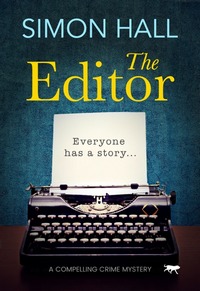
The Editor

The Editor

by Simon Hall

eARC, 352 pg.
Bloodhound Books, 2019

Read: August 30 – September 2, 2019

Hope is the true immortal in life. It never leaves us and it never dies. Sometimes, hope’s gentle voice might be drowned out by all the noise in our lives. But find a hidden corner, listen hard, and you will always hear the quiet song of hope.

A man known only as Ed gathers a large number of people with only a small newspaper advertisement about hope. From that meeting, four strangers embark on a campaign to restore hope to others and themselves via an unusual startup enterprise. Then what starts off as a search for a compelling human interest story, becomes a heartfelt search for a neighborhood’s missing pets, and then turns into something with life and death consequences for a handful of people and something that stirs a nation.

I don’t want to say more about the plot than that brief paragraph—the details of Hall’s story need to unfold slowly for you as you read the book. I spent a lot of time wondering how this qualified as Crime Fiction at all. I didn’t really care about the answer, because I got sucked into the narrative right away and was thoroughly enjoying the book, no matter what genre it ended up being. It does end up as a very compelling Crime Novel, but it takes its time getting to that point. The Editor is a book better experienced and read than explained, so I’m going to be a lot briefer than normal.

Hall’s typically an engaging author, with characters that you like despite not liking the way they always act, and can really tell a story. But in The Editor he pulls out all the stops and adds some extra “writerly flair” to the text. Lines like:

That small hiccup overcome, however, the story not only settled in their laps but purred happily in the process.

And Florence, despite her sad experience of how life could always find a way to confound her, smiled. Optimism was always one of the toughest drugs to quit.

add that je ne sais quoi that elevate this novel.

And then he’ll make you smile with things like this reaction from an elderly woman:

‘What do you think should happen to whoever might have taken George, and the other cats?’

‘Death!’ Elizabeth declared, with all the certainty of her soul. ‘I never understood why we abolished the death penalty in the first place. Here now, if ever there was one, is surely a case for bringing it back.’

There’s a very real sense in which you won’t (and cannot) figure out what’s really going on in The Editor until the end when Hall tells you. It’s frequently an annoying trait/trick when it’s pulled. But if it’s done correctly, it can be very satisfying—and Hall does it perfectly. But I’ve gotta say, even when the curtain is drawn back and the metaphoric Wizard is exposed, I was far more interested in the stuff that didn’t have to be revealed—the story itself, prima facie, is what matters most. It’s what’s going to leave a lasting impression on the reader. The other stuff is interesting and (again) well-executed, but it’s not as important as the rest.

And really, when is the central theme of this book not something that you can use?

“There’s still hope. Of course there’s still hope. There’s always hope. Feel it. Live it, breathe it…”

I think Hall’s TV Detective series is a lot of fun, and one of the things that’s bugged me most about 2019’s reading is that I haven’t made more of an effort to catch up on that series. But this? This is a special kind of book that bears almost no resemblance at all to the other Hall works I’ve read—it’s effective and affecting, inspirational and singular, wholly unexpected. You’ve gotta grab this one.


4 Stars


My thanks to Bloodhound Books for the invitation to participate in this tour and the materials (including the novel) they provided.


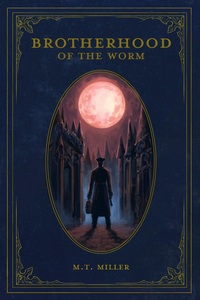
Brotherhood of the Worm by M. T. Miller: A little Sam & Dean, a little more Van Helsing, a lot of Monster Killing

Brotherhood of the Worm

Brotherhood of the Worm

by M. T. Miller
Series: The Culling, Book 1

Kindle Edition, 332 pg.
2019

Read: August 28-29, 2019

The door leading to the hallway and the rooms upstairs slammed open without warning, and in came the missing patron. He was tall, thin, and wide in the shoulders. He had been lodging upstairs for the last three days, and always wore the same grey coat and cocked hat. In his gloved left hand was a heavy-looking leather bag that he never let anyone else touch. Apparently, he even took it to the outhouse.

“Listen to me!” he bellowed after letting the bag down and shutting the door. “And listen well. Until the sun rises, no one may leave this inn!”

Having just emptied a goblet down his throat, Moritz gave the man a look of dull surprise. “What is this? A robbery?”

“I’m afraid not,” the strange patron said. “If it were, we’d all have a better chance of getting through it alive.”

The inn is in an 18th-Century(ish) Germany(ish) country. The strange patron is Conrad Shast, the last member of a noble household turned monster hunter. That’s about as friendly as he gets. He goes from town to town, wherever he’s called to go to eliminate any one of a multitude of monsters on behalf of a shadowy organization that, well, let me let Shast tell it:

“Few refer to it by name, but it is called the Culling, and it’s been protecting the world from monsters and witches for as long as history remembers. From time to time, others have tried their hands at monster hunting, but it never lasted. In the long run, only the Culling has survived the test of time.

“Officially, no noble is under obligation to aid a hunter. But the consequences of rejecting a plea for help far outweigh their potential cost.”

The Culling is a busy group, it seems, there are monsters everywhere in this world (even overrunning some continents), and, as the man said, they’re the only game in town. Generally, they send one or two people to any particular place, but if there’s a big enough problem, they will send out reinforcements. During the course of this novel, Shast ends up working with two other hunters. It’s clear that no two hunters are alike—there’s a variety of approaches, specialties, backgrounds, and personalities (I was a little afraid it’d be armies of Shasts, Miller might have been able to pull it off, but I like this approach better).

Shast is a classic loner, a wandering knight à la Jack Reacher or TV’s David Banner (but with less of a sense of humor). He comes to down, gets his prey and the money he (and The Culling) is owed for that service and moves on. No friends, no family, no entanglements. The particular hunt he’s on when he takes over the inn is a little trickier than most (and will end up being a lot trickier in the end)—he eliminates the monster, but not the source of the infestation. The source has moved on and has likely infested at least one more city by this point. So he has to hit the road to track down the source.

One woman in the inn was so changed by her exposure to the monster that she can detect the hidden creature (not that she wants to), so Shast brings her with him to expedite the hunt. The city guard also dispatches a knight old enough to be her father to act as chaperone and guard. Eventually, they cross paths with another hunter after the same target. She’s into poisons, explosions (Shast prefers a good knife) and making sure her enemies suffer. She joins this grim band as they continue to track down the source, eventually reaching the capital city and discovering things are worse than they thought.

It’s not a smooth journey, and there are distractions and obstacles (both monstrous and human) along the way. The group is not united in any way, and most aren’t that willing to be participating, but there’s not a lot of choice offered any of them. Putting this in an 18th-Century(ish) setting is a great idea—you get a little bit of technology (guns, primarily), but not enough that swords, horses, traveling on foot and slow modes of communication aren’t the flavor of the day. You get a shifting prominence of nobility, a rising middle class, and a church struggling to survive in a hostile world, also. It’s a tumultuous time, not helped at all by the creatures plaguing the citizenry. It’s also a great change from the post-apocalyptic wasteland of Miller’s previous series.

And I wish I had time to give good descriptions of these monsters—and you’d be better to read them for yourselves anyway. The first one we see is simply disgusting and disturbing (and, boy howdy, am I glad we don’t get a bunch of them). Some aren’t that bad (relatively speaking, anyway), but a lot of them could be nightmare fodder is Miller used them a little differently. None of them are easy targets for the Hunters, but it’s only in large numbers that they’re a giant threat. We don’t seem to get anything that you’ve seen before (at least nothing I’ve seen before), which is great. Nothing against trolls, orcs, vampires, wights, etc.—but I appreciate seeing something new.

A common thread, it hit me this weekend, to all the books I read—Crime Fiction, SF, Fantasy, Urban Fantasy, even General Fiction, Non-Fiction or Theology—is that the worst enemies, the greatest predators, the most dangerous threats to humans aren’t aliens, monsters, demons, or whatever external threat you can think of. It’s humanity, our neighbors, our leaders, those like us. And as horrible as the creatures that The Culling targets may be, there’s something hundreds of times worse. Miller using that reality, reflecting that in his fantasy, is my favorite part of this novel (the competition for that was stiff), it’d have been easy and understandable to make a parasite that can control its host—or some other creature—to be the ultimate evil that Shast and the rest contend with. But Miller took the better—and harder—road. Which speaks good things for this new series (and bodes ill for how things are going to go in future installments).

Speaking of future installments, I know he’s already getting things ready to release the sequel in a few months. I can see a lot of options for what that sequel will hold—Character A’s next hunt, or Character B’s hunt/attempt at redemption, Character C & D going forward (together or separately), or a completely new batch of characters in the same world. All of which are pretty appetizing—I’d prefer A or C and/or D to another group or B—but I can see any of those working. Miller’s earned my trust at this point, and I’ll take whatever eagerly.

This is the sixth work I’ve read from Miller (you can read about the four novels and one novella of The Nameless Chronicle here), and I love watching him grow and develop—he’s learned a lot from that last series, and is applying those lessons well. This is more assured and better executed than those—and I had few complaints about them! Jump on to this one at the beginning of what promises to be a great ride.

Disclaimer: I was given a copy of this novel by the author in exchange for my unbiased opinion.


4 Stars
LetsReadIndie Reading Challenge

Reposting Just ‘Cuz: What the Dog Knows: The Science and Wonder of Working Dogs by Cat Warren

Real Life™ interfered today (a good thing, but time consuming), and I wasn’t able to finish a post, so in honor of yesterday’s (8/26) National Dog Day, here’s my look at Cat Warren’s wonderful book. By the way, a Children’s version is coming out in October, looking forward to that!

What the Dog KnowsWhat the Dog Knows: The Science and Wonder of Working Dogs

by Cat Warren

Hardcover, 280 pg.
Touchstone, 2013
Read: May 7 – 15, 2015

People are smart, just like dogs.

Seriously, how do you not like a book that contains that line?

Honestly, the only reason I gave this book a second glance — okay, a first glance — is that Robert Crais blurbed the paperback edition and it showed up on his Facebook page. It seemed kind of interesting, but I wasn’t sure — then I noticed that Spencer Quinn also wrote a blurb. And if two of my favorite mystery novelists (who have a thing for dogs) tell me the book is good, it must be.*

They were right — Warren was a journalist, is now a professor, and knows her way around a sentence. She clearly cares about the subject and has invested a lot of time and effort into getting to know it, her style is engaging and charming (I was chuckling within a couple of pages), and she doesn’t mind showing her own failings and weaknesses.

Warren basically covers three topics: there’s the science and history of using working dogs (of all sorts of breeds, not to mention pigs(!), birds, and even cats) to find cadavers, drugs, bombs, etc.; there’s the memoir of her involvement with cadaver dogs via her German Shepherd, Solo; and anecdotes of other cadaver dogs and trainers that she’s encountered/learned from/watched in action.

The history and science of dogs/other animals being used for their sense of smell, is probably the most fascinating part of this book, but it’d be really easy for the material to be too dry to bother with — Warren’s voice keeps that from happening. I think it’s terrific that at the end of the day, no one knows what it is about the smell of the human body that dogs sense — she’ll explain it better than me, but that’s the kernel the story. I just really enjoy it when the best and the brightest have to shrug and say, “I don’t know.” The chapter she spends on the future of dogs and/or digital replacements is good for similar reasons. Actually, I could just keep listing little facts/factoids/ideas here, but I don’t want to steal Warren’s thunder.

The best part of the book — the part that I found most interesting, and most frustratingly small — is the Warren’s story about getting Solo, discovering he had just too much energy and personality, and needing to find an outlet for it all. Which is followed by the trials and tribulations of a newbie cadaver dog handler and her pup-in-training, growing into a capable working dog. Anyone who has a dog lover as a Facebook friend knows just how easy it is for someone’s stories about their dog to get to the point where you can’t stand to hear another**. Somehow, Warren avoids this totally — not an easy feat. It probably helps that dog does far more fascinating things than just hiking through the woods or chasing a ball.

The stories about the others — her friends, colleagues, teachers, etc. — round out the book. It’s not just about Warren and Solo, it’s not just about the military/police efforts with training animals — it’s about dedicated volunteers, K-9 officers and dogs all over the country (and the world) making a difference. In places and ways you wouldn’t expect. Really? Sending in one guy and his dogs into Vietnam decades later to search for POW/MIA? Also, seeing how different dogs act differently, yet get the same job done was mind-boggling. Especially for dogs trained together/by the same person, you’d think they’d act similarly.

I imagine it’s to spotlight the work of others, to not brag about Solo too much, to talk about things that she and her dog haven’t done/seen/smelled — or whatever reason there is, I wanted more Solo. A lot more. I have no problem with the rest of the book, it’s just that there’s not enough Solo (or Coda).

Fascinating, entertaining, and educational — can’t ask for much more than that.

—–

* Yes, I’m aware there are flaws in the thinking there.
** Of course, your friends don’t have dogs as cool as mine. Let me tell you a little bit about her . . .

—–

4 Stars

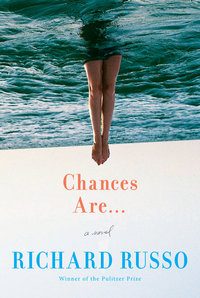
Chances Are . . . by Richard Russo: Russo almost writes a Crime Novel, but manages to avoid it.

Chances Are . . .Chances Are . . .

by Richard Russo

Hardcover, 302pg.
Knopf Publishing Group, 2019
Read: August 5 – 6, 2019

What were the odds these three would end up assigned to the same freshman-dorm suite at Minerva College on the Connecticut coast? Because yank out one thread from the fabric of human destiny, and everything unravels. Though it could also be said that things have a tendency to unravel regardless.

Whatever the odds were, three very different freshman from very different backgrounds did end up assigned to the same dorm suite and ended up working in the kitchen together. It’s the kind of friendship created by shared living space, shared experience and intense emotions (college in general, and the Vietnam Draft they watched on TV together). They became the Three Musketeers—in spirit and in name to those who knew them—and then they left Minerva College and started their lives. Then, yes, things unraveled.

It’s now forty-four years later and they reunite at Lincoln’s Martha’s Vineyard home for one last hurrah before Lincoln sells the family home. The three of them spent plenty of time there in college, and what better way to prepare to sell? But there’s a shadow over their reunion (and not just the fact that they’re all showing their age in different ways).

As with Dumas’ trio, there was a fourth—like them, yet not. Her name was Jacy. All three men were in love with her, but in a true one for all fashion, they didn’t try to see if there was any chance for a relationship with any of them. On the last weekend they spent in this house, a few weeks after graduation, Jacy left early one morning and was never seen again. All three—Lincoln, Teddy, and Mickey—are haunted by memories of that weekend as they assemble.

Each man responds to these memories differently, Teddy indulges in self-introspection, Mickey drinks a lot and spends a good deal of time planning for the trio to catch some live music. Lincoln starts looking for an explanation—and ends up talking to a retired police officer who remembered the case, tries to build a case against a neighbor, and generally stirs up trouble asking questions.

This sounds like the setup of a Crime Novel, doesn’t it? I’ve read so many book blurbs that this sounds like that I started expecting this to be Russo’s take on Crime Fiction. While we do learn what happened to Jacy and why; the book is about so much more. It’s about friendship, fleeting youth, the expectations of others, aging, and love—probably a few other things, too.

“How about a cup of coffee?”

“I had one on the ferry. ”

“Doesn’t mean you can’t have another.”

“With me it does, actually.” In fact, it was distinctly possible the near-constant state of gastric distress Lincoln suffered these days was a symptom of an as-yet-undetected ulcer traceable to the 2008 financial meltdown. On the other hand, it might be nothing more than acid reflux, which came with the territory of getting old. His wife, being a woman, wanted clarity on this issue, whereas Lincoln himself, not being one, was content to dwell in uncertainty a while longer.

I don’t think I even really looked at the blurb for this, I just knew it was a new Richard Russo novel that didn’t feature Sully. That was enough for me to put it on reserve at the library weeks ago, so I could be one of the (possibly the) first to get my hands on it. As no two of his books are really the same kind of thing, it made for a pleasant surprise that way.

I don’t know that I was captivated from the get-go, but these three (and poor Jacy) grew on me, each had a story that was familiar, yet felt fresh. These were complicated me with complicated feelings—well, you’re never sure about Mickey, he seems pretty straightforward. We spend most of the novel seeing things (past and present) from Lincoln and Teddy’s perspectives—which helps us see everything going on with them, and primes us to pay close attention when it shifts for Mickey’s perspective.

I’m ignoring most of my notes now because I think I’ve really said everything I needed to say. Russo’s about as close as you can get to a sure thing in writing today and he brings that skill to these pages and these characters. Chances Are . . . is not something I’ll look forward to rereading like Straight Man, or as powerful as Empire Falls or as moving as Bridge of Sighs, but more interesting—and with more staying power—than That Old Cape Magic or anything published before Straight Man (not that any of those were bad, they just don’t appeal to me the way his latter works do). Still, there’s an ineffable quality to this work that will make me keep thinking about it—the power of friendship, lost love, how our youth controls our futures, and what really anchors us to this world.

I liked the story, I liked the characters, Russo can’t write a bad anything—there’s a lot to commend this book, and little to discourage a potential reader. Russo’s one of the best America has to offer right now, and this is further evidence of that.

—–

4 Stars
2019 Library Love Challenge

The Bitterest Pill by Reed Farrel Coleman: Paradise, MA comes face to face with the Opioid Epidemic

The Bitterest PillRobert B. Parker’s The Bitterest Pill

by Reed Farrel Coleman
Series: Jesse Stone, #18
eARC, 368 pg.
G.P. Putnam’s Sons, 2019

Read: July 31 – August 3, 2019

Well, it’s pretty clear that Don Winslow has left his mark on Reed Farrel Coleman—there’s a quotation from Winslow on the so-called War on Drugs as the epigraph to this novel. Jesse cites it and alludes to it later in the novel. It’s a good line—catchy and insightful (and, not that it matters, I agree 100% with it)—don’t misunderstand me, but I’m used to Robert B. Parker characters citing Shakespeare, (Edmund) Spenser, Shelley, and songs from the late 60s/70s. I don’t think I’ve ever seen one quote someone contemporary. The latest focus of most of our country in that War is the Opioid Crisis, in The Bitterest Pill, that epidemic shows up in Paradise, Massachusettes—partially fulfilling Vinnie Morris’ prediction to Jesse that Boston crime was on its way to Paradise.

A student at Paradise High—the daughter of a city councilman—dies of an overdose and the city is rocked. It can’t be the first drug-related death in its history, but this was a different kind of thing. She’s not an obvious user, cheerleader, from a well-to-do family, and so on. Not the kind of person that Paradise is ready to believe would be an addict or that would die of an O.D.

What’s obvious to Jesse and his team is that if they don’t shut down the supply chain that fed this girl her drugs, she won’t be the only death, she’ll just be the first. This sets Jesse on a Hunt through Paradise High School and Boston’s underbelly. There’s a moment that made me think of Connelly’s Two Kinds of Truth (which just means that Connelly and Coleman have both done their research into the ways prescription drug rings work, not that Coleman’s copying anything)—but there’s a difference. Bosch is trying to deal with a situation, he’s involved in busting a ring as a means to an end. Jesse? He’s trying to protect his town it’s personal—and the ways that this particular ring is trying to invade Paradise are more diverse than what Bosch dealt with.

Skip this next paragraph if you’re worried about Colorblind spoilers.
I avoided talking about the new character Cole last time out, because, how could I? I’m on the fence with him, honestly. I don’t see where he was necessary—Jesse has Suit to father (although, at this stage, Luther doesn’t need much), he’s got the weight of the city on his shoulders, what’s added to the character by this relation? On the other hand, scenes with him are done so well, and Jesse’s different with him. I really enjoy him—he’s not the Paradise equivalent of Paul Giacomin, thankfully (nothing against Paul, we just don’t need another one), he’s a different kind of character (as Jesse was compared to Spenser and Sunny).

Speaking of Suitcase, I think I’ve loved everything Coleman’s done with him (every major thing, anyway, there might have been a scene or two that I forgot about), other than not using him as often as he could. But there’s a scene with Suit and Cole in this book that is so well done that it’s one of those passages I could read from time to time just to smile at. He’s come a long way. Molly seemed a little under-used, but she was good whenever she showed up and did get to shine a bit. I think Coleman overplayed the difficulty of Molly doing her job because of the way this case impacted Paradise’s children a bit (really not much), and, as always, he’s too dependent on bringing up the incident with Crow in relation to Molly. But on the whole, Suit, Molly and the rest of Paradise PD came off pretty well.

For awhile under Coleman and Ace Atkins, Vinnie Morris seemed more dangerous, more of a wild card—less “tamed.” But both the way that Atkins has used him the last time or two and here he seems to be tacking back to a friendly criminal who’s too willing to help out the non-criminal element. Frankly, I prefer the less-tame version, but as someone who’s enjoyed Vinnie since he worked for Joe Broz ages ago, I don’t care, I just like seeing him on the page.

After the very effective use of the mayor recently, I was surprised at her absence in this novel—not that there was room for anything like that.

There’s really one more supporting character that we should talk about—Alcohol. Jesse’s greatest foe (although, you could argue he’s the enemy and alcohol is the tool he uses to attack himself, but…eh, let’s make this easy and say alcohol). He may be clean and sober, but he’s still an addict, and his drug of choice is still a near-constant presence in his life. I love, respect and admire the way that Jesse (and Coleman) have dealt with this subject, particularly since Jesse stopped drinking. It’s so much more believable (and healthy) than Jesse’s attempts to manage his drinking before. I liked the approach in Colorblind, and continuing it in The Bitterest Pill made it stronger.

So, we’ve got Jesse battling personal demons (but with a clearer head), adjusting to a new personal reality, and dealing with a potentially crushing crime wave that’s leaving a trail of destruction through the youth of Paradise. Throw in the instability of a new romantic relationship? Jesse’s in a pretty healthy place, but given the pressures (and a couple I didn’t list)—it’s gotta be weighing on him, and Coleman does a pretty good job of balancing the health and precarious nature of Jesse’s state of mind.

As Coleman’s writing, it seemed frequently that he was trying too hard to make this something the level of Colorblind or Debt to Pay, and didn’t quite make it. Maybe because he was trying so hard? The topic he’s dealing with is important, so it’s understandable he’s taking big swings to hit this out of the park. But there are a few sentences that no one but Reed Farrel Coleman could have written. They were gorgeous and practically sang. I don’t want to sound like one of those anti-genre literary snobs, but Coleman comes close to transcending the genre and its easy to see the impact his poetry frequently has on his prose.

At the same time, he’s an effective mystery writer—there are red herrings all over the place for readers to get distracted with. As far as the main conduit for drugs into the school goes, I had a candidate I was sure of and a back-up, and another one, too. I couldn’t have been more wrong and had dismissed the actual perpetrator without much thought at all. While ratcheting up the tension, keeping me locked into the story, he pulls the wool over my eyes and manages a few lines that are practically lyrical. There are few in the genre who can match that.

The ending of this novel came as a little bit of a gut punch. Granted, there was a sense in which the last couple of pages couldn’t have gone any other way—I’ll leave the specifics out of it, but the last few paragraphs were hard to read. But they were so, so good. They might be the most effective few paragraphs in the book. I don’t think it’s much of a spoiler to say that just when you think the story’s done, it’s not.

Rumor has it that this is Coleman’s last Jesse Stone book—I hope it’s not true, but it’d make sense as he’s switching publishers. As I said when his first entry in this series came out, his was the best Jesse Stone since Parker’s early days with the series. Yes, he didn’t do things the way Parker would have (especially later), but what he did was honest and genuine to the spirit of the characters and series that Parker left. Stone has a complexity that Spenser lost in the mid-80s, and Coleman recaptured that. The Bitterest Pill might not have been Coleman’s Stone at his best, but I think that’s largely because he was trying too hard to say something about the societal impact of the drugs (whereas in Colorblind it seemed effortless). And, while it wasn’t as good as it wanted to be, it was very, very good, and will go down as one of the higher points of the series.

The Bitterest Pill would be a good place to meet Jesse Stone and the rest of the Paradise Police Department, and it’s a great way for long-time fans/readers to touch base with them. I strongly recommend this.

Disclaimer: I received this eARC from Putnam Books via NetGalley in exchange for this post—I thank both groups for this.

—–

4 Stars

2019 Cloak & Dagger Challenge

Page 41 of 88

Powered by WordPress & Theme by Anders Norén