Tag: 4 Stars Page 40 of 88

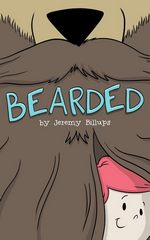
Bearded Too by Jeremy Billups: The Bearded Bear is Back on the Road

Bearded Too

Bearded Too

by Jeremy Billups
Series: Bearded, #2

Kindle Edition, 18 pg.
Billups Creative, LLC, 2019

Read: October 29, 2019


Jeremy Billups has just given us a sequel to 2015’s Bearded—the story of a red-haired girl and her bearded bear traveling and having adventures.

I want to start off talking about the art—I know, I know, I’m usually a word guy—but these are “Picture Books,” right? There’s just something about the way that Billups draws these books that really works for me. Unlike, say, the art in Sea This and Sea That, with all the detailed backgrounds, there’s a lot of whitespace around these drawings, which makes them jump out at you (which is the point of the white space, I know—I’m not good at talking about this stuff). I will admit I’ve flipped through the book a couple of times without glancing at the words (something I assume the target audience will do more often than me).

But that’s not a reflection on the cute rhyming tour of the world seeing bearded animals (a guitar playing orangutan, cab driving markhor, and so on). There’s a dash of education in there, because some of these animals aren’t your typical Picture Book fare, too.

And, hey, a celebration of beards! I’m always down with that.

Not much to say about this, really. It’s a fun follow-up to Bearded that should please the ears and eyes of the picture book readers in your home.


4 Stars

LetsReadIndie Reading Challenge

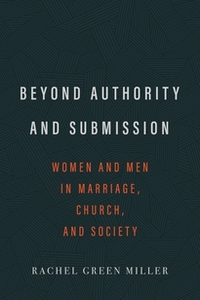
Beyond Authority and Submission by Rachel Green Miller: Starting-Point for a Discussion the Conservative Church Should’ve Already Had

I feel compelled to repeat the disclaimer I threw on a book last week—and I should probably throw this on a lot of theologically-oriented works. This is another one of those works that I feel really unqualified to discuss. So, know that this is from the perspective of an opinionated and semi-(formally)educated reader and occasional armchair theologian. Not the reflections of an ordained minister or professional theologian.

Beyond Authority and Submission

Beyond Authority and Submission: Women and Men in Marriage, Church, and Society

by Rachel Green Miller

Paperback, 259 pg.
P&R Publishing, 2019

Read: September 22-29, 2019

Contrary to what popular culture states, women and men are not from different planets. We’re complementarymore alike than different. Without denying the differences, we need to stop defining women as the polar opposite of men and vice versa. Such divisive definitions create and encourage unnecessary conflict and set up unrealistic and unbiblical expectations for how women and men should behave.

Paul frequently refers to fellow believersboth men and womenas co-laborers. The word he uses, sunergos, means “a companion in work.” As we will see in the next sections, co-laborer captures the sense of what we were created to be and what we are called to be in Christ.

I can’t get where this is controversialI’m definitely not the kind of guy to say “in this day and age” when it comes to this kind of thing, so please don’t hear me saying that. In any day and age where someone’s thinking is shaped more by the Bible than it is by the surrounding culture (either of the moment or by some version of a historical point of view). I don’t get where this is controversial. Sadly, it is. But as long as that’s Rachel Green Miller’s controlling thought (and I firmly believe it is), I’m on board with this book.

So I should say at the outset, I’ve appreciated Miller’s writing for years now and am very sympathetic to Miller’s general perspective on the issues she tackles in the book. I came into it expecting a useful and beneficial book for those wading through issues relating to the relation of the sexes to each other from a Christian worldviewand I got it. I didn’t expect a book to settle arguments, or a panacea to problems churches/ministries/individuals are having on this frontwhich is good, because she doesn’t try.

After setting the stage for what she wants to discuss in the book, Miller goes on a brief historical survey of views of men and women in the Greco-Roman World and Victorian Era (which she posits have more of an influence on conservative Christianity than we realize), and then she looks at First, Second and Third-Wave Feminism and how the Church has reacted to each. I think her book would be better served if this section were expanded and depended less on secondary sourcesbut given space limitations, I can live with it. From there she explores Biblical teaching on the Nature of Men and Women, how the two should relate in marriage, the Church, and society. In these chapters, she tries to show how current understandings are (too) frequently largely molded by a reaction to a political movement or values imported from a historical context (that needed Biblical reform). Each section here could be a book unto itselfand maybe should bebut Miller’s treatment is a good starting point for discussion.

If you see the book as thata starting point for conversation, with a lot of very helpful things to bear in mind, this is a very commendable and worthwhile read. If you’re thinking of it as definitive in any sense of the word (and I think Miller would warn against that herself), the book will not come close to living up to expectations.

Miller critiques both the foundation of the worldviews she disagrees withancient pagan cultures or recent/contemporary naturalistic views. Latter feminism, as well as godless patriarchal views, are her targetsas are the ways those presuppositions or their expressions are imported into the Church.

Where I think this book stumbles is in the positive case for what she believes. Miller is very clear on what she’s not trying to say (though many aren’t paying attention to this), she’s also clear on what she disagrees with (no one would deny this)but she’s too unclear about what she’d like people to think. I think I just did the same thing hereso I’m going to resort to metaphor. Most of what I talk about here is fiction, so I’m going to employ that for a minute. If Andy Carpenter, Eddie Flynn and Mickey Haller (various fictional defense attorneys) have taught me anything, it’s that while it’s all well and good for a defense attorney to poke holes in a prosecution’s case, what will really turn a jury around is a good alternative suspect, someone to blame, to hold accountable for whatever crime is in question. Miller’s done a great job in showing problems with the prosecution’s case, and we know she doesn’t want us to find her client guiltybut I don’t have anyone else to hold accountable/punish for the crime.

Now, the problems with that metaphor are plain enough, but I think my point is clear (clearer than I could’ve made it earlier). For what it’s worth, I think she’s dead to rights on what she’s not wanting to say, and by and large, she’s right on what she’s critiquing. I just wish I had a clearer notion of what she wants readers to think in a positive sense. Also, while I agree that we need to do more than talk about the relationship between the sexes in terms other than “authority” and “submission” we still need to have clear ideas about how those roles should function (if we’re going to understand the Bible), and Miller should have addressed that.

This book has, regrettablyyet not at all unsurprisinglykicked up a hornet’s nest of controversy. Sadly, it seems that most of the reviewers have dug into two hard-and-fast camps: the “this is a load of drivel that Miller and P&R should be ashamed about” camp on the one hand, and the “this is the greatest thing since the Institutes” camp on the other. Neither is even close to right. This is a good book (with clear flaws) and deserves to have its good points, flaws, and pushes to conversation discussed without vitriol. Sadly, I can’t see that happening, which is probably why books like this are needed.

Honestly, if we can’t deal charitably with each other on this kind of thing, how can we expect a lost and dying world to listen to us at all?

I know that more than a few reviewers have taken issue with the way that Miller treats some of the sources she’s citing and critiquingand there were a couple of times I wondered if she and I had read the same article/chapter/book, because I didn’t come away from it with the same ideas she did. At timesand more often than should be acceptableshe comes across as saying that “Writer X is problematic on these issues and therefore everything they’ve ever said about them is wrong.” I don’t think that’s her intention, but I do think that she gives that impression. But on the whole, I think there’s a lot of straining at gnats by her critics when it comes to her treatment of sources.

I think I’ve lost the thread a bit here. Such is the nature of the tempest in the conservative Christian teapot, that I can’t really think about the content of the book without thinking about the reaction to it. I wish I’d found/made the time to write about this book before I read about it. That’s on me.

Let me try to get back on track. I liked this book. It made me re-examine a lotand will probably continue to do so as I mull on what she has to say (and I’ll probably find a lot to disagree with ultimately, and a lot to agree withas it ought to be). How much of what I think about how women and men should interact with each other (in the home, Church and society) comes from Scripture and how much from the culture? How much of what I think it means to be a man or what it means to be a woman has more to do with Ancient Greek culture or the Victorians? (more than it should). The core of the message should be heard and weighed, and hopefully, after the hubbub has died down a bit, we can start to deal with it.

The Bible testifies to our unity. We don’t have one Bible for men and a different one for women. The armor of God isn’t just for men, and the fruit of the spirit doesn’t apply only to women. No, we have one Bible for us all, and most of the Bible’s commands apply to all of usmale or female, old or young, rich or poor, servant or master.

It’s important to emphasize that when God made humanity in His image, He did so by making a man and a woman. Women are as much made in the image of God as men are. Men don’t have more of God’s image because of their masculinity. We are equal in worth, but we’re not the same. We are different, but we are also interdependent. We were created to complement each other, and we need each other.

Tolle Lege.


4 Stars

Reposting: Bearded by Jeremy Billups: A Charming Picture Book about a Bearded Bear

Local Artist, Picture Book Writer and All-Around Good Guy, Jeremy Billups’ third book is scheduled to release today. It’s called Bearded Too, the sequel to this here book. I’ll post about Too soon, but in the meantime, here’s a look back at Bearded.

Bearded

by Jeremy Billups
Hardcover, 34 pg.
Billups Creative, LLC, 2015
Read: September 5, 2018
Picture books about bears are everywhere—I have a hard time believing many kids get out of the picture book stage without exposure to at least 4 of them (and that’s before they’re at the Pooh or Paddington stage). But how many of those bears have been bearded?


Enter Jeremy Billups and his little book.

This is the story of a little red-haired girl (no, not that one) traveling the world with her bearded bear, having all sorts of adventures and meeting a bunch of different animals. There really isn’t a lesson, moral or much of a plot—just a bunch of quick looks at the pair. A few quick lines and a picture on each pair of pages.

The art is simple and arresting. They just pop off the page—this is one of those times I wish I had the necessary vocabulary to describe why I like the drawings, but I don’t. I bought a print of what turns out to be page 16 before I even picked up the book to flip through. I’ve bought a handful of prints this year, and it’s my absolute favorite—I like it even more now that I’ve read the book. Also, If you ever see a better picture of someone making buffalo wings, I’ll eat my hat.

Oh, and the endorsements on the back cover are a lot of fun. If that doesn’t convince you to try it out, I can’t imagine what will.

Great art, cute story, fun rhymes—everything you want in a picture book. Even better—animals with beards are the best animals that aren’t dogs. This is a charming little book that’s sure to please.

—–

4 Stars

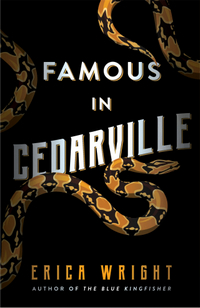
Pub Day Post: Famous in Cedarville by Erica Wright: Small Town Life and Hollywood Glamour Collide in this Mystery

Famous in Cedarville

Famous in Cedarville

by Erica Wright

eARC, 320 pg.
Polis Books, 2019

Read: October 16, 2019


Reading this book made me think of that overused 90’s-era sitcom line: Who are you, and what have you done with Erica Wright? Famous in Cedarville and its protagonist, Samson Delaware are so far removed from Kat Stone and her world, it’s hard to believe they come from the same mind. That said, as much as I want to see more of Kat Stone, if Wright’s going to give us more like this? I won’t complain too loudly.

I’m getting ahead of myself, we should start with the beginning when Samson Delaware joins some fellow citizens of Cedarville, TN to carry the body of Barbara Lace from her home. Lace left her small town home at a young age to pursue fame and fortune in Hollywood. She found it, too—she wasn’t a superstar, she didn’t reach the heights of fame or craft; but she was someone that people all over the country knew. And the only person from Cedarville that anyone not from the area knew was alive. After decades in California, she retired from film and television and basically became a recluse.

Delaware is a carpenter and probably the area’s antiques expert. He appraises pieces, advises buyers, in addition to buying and restoring pieces to sell. While in Lace’s home, he can’t help himself from looking around more than he ought. While it’s nowhere near his expertise, something doesn’t seem right about the scene to him, and he starts to think that Lace didn’t die peacefully in her sleep.

A few days later, Lace’s personal assistant is murdered (no ambiguity about that one), leading Delaware to step up his unofficial investigation—which soon becomes official, as the local authority (note the singular, Cedarville is just that small) and State investigators are both stymied. The sheriff is desperate enough to grant official status to anyone who can help.

Looking into Lace’s murder takes Delaware on a journey through time and space—the key to it has to be in Lace’s past (she saw so few people recently, it has to be in the past). And Lace’s past is in Los Angeles, so Delaware heads out to L.A. to do some footwork and talk to those who knew the actress during her heyday (and after it, too).

Delaware’s own investigation pulls double duty—not only will it hopefully bring the community some answers about their favorite daughter, but it also distracts him from the all-consuming grief following his wife’s death. More than once, he has to wrestle with the question of whether he’s pursuing justice for justice’s sake or if it’s because it helps him not deal with his wife’s death.

As its protagonist looks into a by-gone era of film, the novel takes on the feel and atmosphere of that era while retaining a feeling of fresh and contemporary. Don’t ask me how Wright does that, but it’s great to see it done. Beyond that, there’s a depth to the emotion and characters that you don’t see every day. It’d be easy to argue that Delaware coming to grips (in whatever way he does) to his current state, how he got there and where he’s going is more important to the novel than showing what happened to Lace and her assistant (it’d be easy to argue against it, too, but that’s my point).

I’m not doing a good job describing how different this book comes across—not just from Wright’s previous work, but from most of what’s out there in the genre at the moment. Hopefully, others can articulate it—I’m confident any reader will feel what I’m getting at.

There were two distinct “What the —!?!” moments (there are a few more surprises, but two that you won’t forget soon). One of which, technically, is the result of Wright cheating. But it’s such a cool development and Wright reveals it so deftly that I couldn’t complain. The other one was completely honest and caught me completely flat-footed. Far from clearing everything up, both of these added layers and complexity to this already intricate plot.

A complex mystery, rich characters (I don’t have time to talk about Lace’s long-time agent or the people of Cedarville), a nostalgic yet timely feeling novel that looks to Hollywood’s glamorous past and the very human, very real present. Wright knocks this one out of the park and will earn herself some new fans with this one.

Disclaimer: I received this eARC from Polis Books via NetGalley in exchange for this post—thanks to both for this.


4 Stars

Theological Retrieval for Evangelicals by Gavin Ortlund: An Accessible Call for 21st Century Christians to Learn from the Past

I ended up having more time in the day to write this post than I normally do, and as a result ended up a bit more rambling and less-focused than intended. Hopefully it’s worth the read, despite my laxness.

Theological Retrieval for Evangelicals

Theological Retrieval for Evangelicals: Why We Need Our Past to Have a Future

by Gavin Ortlund

eARC, 224 pg.
Crossway, 2019

Read: October 5-12, 2019


This is another one of those theological works that I feel really unqualified to discuss. There’s part of me that thinks I should stop requesting them from NetGalley, or buying them and deciding that I want to post about them, but I probably won’t. So, know that this is from the perspective of an opinionated and semi-(formally)educated reader and occasional armchair theologian. Not the reflections of an ordained minister or professional theologian.

I’m glad Ortlund talks about this right out of the gate—but the case he lays out for Theological Retrieval here, strikes me as very similar to Michael Allen and Scott R. Swain’s Reformed Catholicity: The Promise of Retrieval for Theology and Biblical Interpretation and Kevin J. Vanhoozer’s Biblical Authority after Babel: Retrieving the Solas in the Spirit of Mere Protestant Christianity. Ortlund says they’re aiming for the same target, but those works are more oriented toward the Reformed, where he’s focused on Evangelicalism. I’d say that they’re all wanting the same thing, but his work is more accessible (by design) and less-inclined to advertise his scholarly awareness (particularly with the former).

One problem that you encounter right away is a nebulousness about the term “Evangelical.” If Ortlund defined his usage, I missed it. He seems to use it to apply to Bible-believing Protestants who aren’t Reformed or Lutheran. Which is fair enough, I guess, it’s just not an easily defined term anymore. Frankly, I’m with Carl Trueman and others, and consider the label “evangelicalism” meaningless as it can be applied to “everyone from Joel Osteen to Brian McLaren to John MacArthur.”

Ortlund doesn’t give a strict definition of Theological Retrieval—in fact, he avoids it, preferring to see it as a mindset or attitude toward the pre-Reformation Church and Theology, drawing from its strengths, seeing its weaknesses in our own, and putting the contemporary (and Reformation) Church in context of a developing understanding from the end of Acts to Second Coming. Given that, we should be more aware of, and interact more with, the Patristic and Medieval Church. He uses Turretin, in particular, to great benefit in showing that this was the mindset of the Protestant Reformation, and calls us back to it. Along the way, he uses Warfield (and the rest of Old Princeton) as emblematic of Evangelicalism’s departure from this thinking. I’m not sure that’s the best reading of Warfield, but it’s not worth arguing, because his overall point is so right.

The first Part of the book—roughly 60 pages in three chapters—sets the agenda, it’s “A Manifesto for Theological Retrieval.” He begins by asking if Evangelicals can Retrieve Patristic and Medieval Theology, before moving to asking why they need it, and then sketching out both the benefits and perils of it. All of which is profitable and well-worth reading.

But what makes this book different than so many, is that Ortlund doesn’t focus on the project, the theory behind it, or the method. He gives the rest of the book—120 pages or so—to examples of what he’s calling for people to do. Case-studies in theological retrieval—which is some of the best theological reading I’ve done this year, maybe the last couple of years.

The first is a chapter called “Explorations in a Theological Metaphor: Boethius, Calvin, and Torrance on the Creator/ Creation Distinction.” A nice mouthful, to be sure. To illustrate the Creator/Creature Distinction, he compares Tolkein’s relationship to The Lord of the Rings to God’s relationship to his creation, in terms of Boethius’ understanding, and how Calvin’s view would differ, before wrapping up with Torrance. Now, I have little use for what he tries to do with Tolkein—I think this sort of thing is almost as bad as trying to teach the Trinity by analogy (which always quickly lands the teacher in heresy). I know enough people do this sort of thing in teaching and writing, and I should try to pay more attention, but my eyes just glazed over. Most readers will get more out of this than I did. I did appreciate what he said about Boethius and Torrance in distinction from Calvin and feel like I understand the three a little better (not that I’m all that familiar with Boethius and Torrance), and think I got something from the chapter overall, but I know my own prejudices kept me from a full appreciation.

Things improve with “God Is Not a Thing: Divine Simplicity in Patristic and Medieval Perspective.” Rather than going head-on for contemporary critics of the doctrine, he takes a look at historic formulations (not limited to Aquinas’) of the doctrine and seeing how that should actually deepen Evangelical’s commitment to Simplicity as well as broaden our understanding of it. He interacts a good deal with James Dolezal’s wonderful All That Is in God and God without Parts here and reminds me that I need to re-read the former and read the latter. A better blogger (one also focused on theology, not the book) would camp out here for a few paragraphs, but I won’t. It’s just a great chapter and the kind of thing we need to see more of.

My favorite case study is the third, “Substitution as Both Satisfaction and Recapitulation: Atonement Themes in Convergence in Irenaeus, Anselm, and Athanasius.” I would read a book-length version of this tomorrow. Well, not tomorrow. I would start a book-length version of this tomorrow, and have a lot of fun over the following days. Ortlund shows the overlapping concerns of Irenaeus and Anselm (who are so often pitted against each other), how the Christus Victor and Substitutionary Atonement models are interdependent, not rivals (while not giving an inch to contemporary critics of Substitutionary Atonement, it should be pointed out). From there, he moves onto some of Athanasius’ work on the Incarnation, demonstrating that these works have a good deal to say about the Atonement, as well. If I got nothing else out of this book, I’d consider the time I spent reading it well-spent just for this chapter. I could’ve lived without the use of Aslan and the Stone Table portion of the study, but (contra the Tolkein), it proved to be a useful illustration.

“Cultivating Skill in the “Art of Arts”: Pastoral Balance in Gregory the Great’s The Book of Pastoral Rule” is the last case study. I remember reading healthy portions of this work by Gregory in a Church History class for much the same reason that Ortlund uses it. There’s a lot of wisdom for pastors of every age in this very old work—he also shows how manuals like Baxter’s or Spurgeon’s will say similar things. Timeless truths and advice put in ways that others wouldn’t. I really don’t have much to say about this, but it’s almost as good as the previous two.

This is one of the most-easily outlined books I’ve read this year (possibly the most), that’s a fantastic aid for referring back to it in the future or for going back and taking thorough notes. I’d go crazy if I read too many books like this, I prefer the more organic feeling approach. But when this is done right, it’s a handy bonus. Beyond that, as I said before, it’s very accessible. Sure, there are parts that are demanding, but nothing’s out of reach for the committed and attentive reader—and most of the time you don’t have to be that committed.

Like their counterparts from the previous century, Twenty-First Century Christians don’t know enough historical doctrine, and certainly don’t know how to treat what little they do know. Too often, Protestants will cede everything prior to 1517 to Rome (maybe Rome and the East), focusing only on the last 500 years—if they’ll even pay attention to anything prior to Fanny J. Crosby. Ortlund’s work is a great call for the everyday Christian to familiarize themselves with the past and learn from them as we ought the rest of the Church Militant. I strongly recommend this.

Disclaimer: I received this eARC from Crossway via NetGalley in exchange for this post—thanks to both for this stimulating read.


4 Stars

Pub Day Repost: Ghosts of You by Cathy Ulrich: The thing about murder victims is . . .

Ghosts of You

Ghosts of You

by Cathy Ulrich

eARC, 150 pg.
Okay Donkey Press, 2019

Read: September 23-30, 2019


This collection of 31 pieces of flash fiction shouldn’t work. This is probably not the sentence that the author and her publicist want me to start with, but hear me out. It shouldn’t, but it does.

Why shouldn’t it work? For starters, each story has essentially the same title. “Being the Murdered _____.” Earle Stanley Gardner got away with it, as did Lilian Jackson Braun—but I can’t see how anyone else does. Add Ulrich to the list.

Secondly, each story starts with the same sentence:

The thing about being the murdered [word/phrase from title] is you set the plot in motion.

Outside of “Once Upon a Time,” that should not be done (it’s arguable that it shouldn’t be done there, either). But it does work.

From these nearly identical launching pads, Ulrich spins 31 incredibly distinctive tales about what happens after various women are murdered. I should probably clarify a bit, about what I mean about the various women (and the blanks above). These stories focus on people like the murdered Girl, Wife, Lover, Homecoming Queen, Babysitter, Mother, Extra, Jogger—mostly the kinds of women you read about/see in the beginning of a murder mystery. Ulrich also goes for some unexpected types, e.g.: Politician, Mermaid, Muse, Chanteuse (she probably deserves extra points for using that word in the Twenty-First Century), and Taxidermist.

Their murders change the lives of those around them, those who knew them, knew of them, investigated their deaths both immediately and for years to come.

Now, as the word “plot” in the topic sentences indicates, these are primarily reactions to/depictions of/commentaries on the way that the homicides of fictional women are portrayed in Crime Fiction (or even “Literary” Fiction), TV, Movies, etc. I think it has a lot to say about those depictions, but I think there are a lot of weaknesses to Ulrich’s approach, too. Too often, her critiques are overgeneralized, inflammatory and outdated—while retaining a kernel worth chewing on.

Thankfully, the book is about more than that (or I’m not sure I’d have bothered to finish it). I frequently felt like my reaction to the stories was not what it was intended to be. When she’s telling a story (as abbreviated as they are), describing human reactions to situations that “tragic” doesn’t quite begin to apply to—these pieces shine. For someone who shuns self-help books, I’ve read a lot about grief in the last couple of years—these stories contain some of the best portrayals of it in all its varied expressions—that I can remember. If your heart doesn’t break a little at least twice while going through this collection, you need to go listen to some community singing in Whoville, so they can help yours grow.

Beyond that, there’s the obvious strength of the economy of words here—these stories are lean, without a wasted word, and are pound-for-pound some of the most effective stories I’ve read this year.

As with any collection, there are stronger pieces and weaker pieces—some that will satisfy some and other readers will be stupefied by or indifferent to the same ones. I do think there’s a better hit to miss ratio in this collection than I’m used to. For what it’s worth, “Being the Murdered Bride”, “Being the Murdered Student” and “Being the Murdered Mama” were the high-points for me.

While these are all very different (Ulrich almost never plays the same note twice), I don’t recommend reading too many in one sitting (I limited myself to three at a time, for example)—beyond that, you risk robbing them of their impact.

I heartily recommend this collection that works far better than it should. It’ll cause you to stop and think, stop and feel, and hopefully change your perspective on a few things.

Disclaimer: I received this eARC from the author via Lori @ TNBBC Publicity in exchange for this post—thanks to both for this.


4 Stars
LetsReadIndie Reading Challenge

System Failure by Joe Zieja: The Epic Failure Trilogy Concludes with a Big Success

System Failure

System Failure

by Joe Zieja
Series: Epic Failure, #3

Paperback, 417 pg.
Saga Press, 2019

Read: October 1-2, 2019

“You are literally placing the fate of the galaxy in my hands.” [Rogers] thought for a moment. “Again. You need to stop doing this.”

Every author closing out a series—a trilogy or something longer running—has a daunting task (not that stand-alones or duology’s aren’t daunting themselves, but it seems easier to me). They have to tell a self-contained story; weaving in the character and story arcs that have been percolating since the first book; resolve the new and old arcs; leave the characters in a place that readers will find satisfying; and provide some sort of ending to all of that to leave everyone in a place where you can move onto the next thing. For writers like Joe Zieja there’s an additional challenge—you have to make the whole thing funny.

Thankfully, Zieja does all of that very, very well.

Rogers’ fleet (including the Thelicosans) arrive at the home base for the Free Systems to meet with their High Command. Fully aware that the only military commander that’s had any kind of success with this new enemy is Captain Rogers, he’s named the head of the Joint Force tasked with preventing Snaggardirs from destroying the galaxy.

They also realize that the only way Rogers has had any kind of success is by throwing out all the rule books—including The Art of War II: Now In Space by Sun Tzu Jr. So they tell him to do just that. They don’t care how ridiculous or uneducated his plans are, as long as they get the job done. Snaggardirs has given the Free Systems a very limited time to acquiesce or face the destruction of the galaxy. And they seem to be able to pull that off.

So with help from a very unexpected source, Rogers reaches out to the same space pirates we haven’t seen since the disastrous opening to Mechanical Failure and also is forced to accept help from a Thelicosan practitioner of something that’s a combination of horoscopes and astrophysics (you’ll have to read the book to understand it). These, um, unconventional tools are added to the rag-tag bunch that has come to help Rogers in a last-ditch effort to save reality as we know it.

As usual, Rogers is the focus. He’s been on a journey of personal growth since we first met him—despite his best intentions, it should be stressed. He really comes a long way just in these pages and it’s pretty cool to see.

Of course, I can’t go without talking about Deet—the droid that Rogers assembled from junk. He’s also on a journey of personal growth—just a different kind. In addition to trying to understand how to justify and explain his existence, he’s trying to learn to empathize, as well as lie convincingly (or at all), and he continues to improve his [EXPLETIVE] swearing. He does get better at it and made me laugh out loud several times (both in his successes and failures). There was one misstep that he made, and I re-read that sentence a few times to figure out what he may be trying to say. Naturally, after I gave up and moved on, I learned that no one understood what he was going for.

I should add a little something about Tunger. I found him amusing in Mechanical Failure, but I thought he was overused (and became a little annoying). In Communication Failure, I stopped finding him all that entertaining, mostly trying. Which is how he started in System Failure. But he soon became a very cool character and one of the real strengths of the book. He really might be the best thing that Zieja did throughout the series.

It seems like a bonus to me—not at all the kind of thing one expects from a book like this—we’re given an antagonist that the reader can almost sympathize with. Yes, their methods and strategies are wrong and harmful to innocents. But you can’t help but understand why a people would set off in this direction. I can’t imagine anyone reading about their plight will start hoping for a failure for Rogers and the rest, don’t get me wrong. But you just might see where the Jupiterians are coming from.

There’s a key acronym in the book that a. is fitting, b. is funny, c. took me far too long to get. Once I stopped feeling stupid, I realized it was a great example of this being one of those books where even if you don’t get the jokes, the book holds up as a story well enough that you won’t even notice there are jokes you don’t get until later.

There’s one figure with access to the top of Snaggardirs who isn’t on board with their destroying the galaxy plan. So they set out to sabotage it by helping Rogers. Their scheme was pretty clever, but with one giant flaw. Which made their sacrifice sad—and their attempts at success very funny. It’s a good mix for the reader (a pathetic one for the character).

I’m not sure it’s entirely fair (and I don’t mean to disparage any of the books I’m about to mention in any way), but while reading this, I couldn’t help but compare this to two other humorous series and their conclusions. I hate to compare any comedic SF to The Hitchhiker’s Trilogy, but how do you not? This series never got as funny as the best of Hitchhiker’s (maybe a couple of times it got pretty close, though), but it was a cohesive and believable story, populated with better characters and a solid ending — unlike Adams repeated attempts at a conclusion that never really felt satisfying. Similarly, Epic Failure trilogy went out strong, with its strongest material still working, unlike The Tales of Pell which went a little off-course in the final volume and didn’t stick the landing the way that System Failure managed to do.

Zieja successfully called back to elements of the first book (some I’d forgotten about, some I thought had fully served their purpose) and built on the developments of the second to give this volume a bit more heft and greater stakes. Then he added a great story new to this novel and wrapped up everything in a satisfying and definitive way. All while making me chortle, chuckle, grin and occasionally laugh. Who can ask for [EXPLETIVE] more? I don’t know what Zieja has planned next, but sign me up for whatever it is.


4 Stars
Humor Reading Challenge 2019

Ghosts of You by Cathy Ulrich: The thing about murder victims is . . .

Ghosts of You

Ghosts of You

by Cathy Ulrich

eARC, 150 pg.
Okay Donkey Press, 2019

Read: September 23-30, 2019


This collection of 31 pieces of flash fiction shouldn’t work. This is probably not the sentence that the author and her publicist want me to start with, but hear me out. It shouldn’t, but it does.

Why shouldn’t it work? For starters, each story has essentially the same title. “Being the Murdered _____.” Earle Stanley Gardner got away with it, as did Lilian Jackson Braun—but I can’t see how anyone else does. Add Ulrich to the list.

Secondly, each story starts with the same sentence:

The thing about being the murdered [word/phrase from title] is you set the plot in motion.

Outside of “Once Upon a Time,” that should not be done (it’s arguable that it shouldn’t be done there, either). But it does work.

From these nearly identical launching pads, Ulrich spins 31 incredibly distinctive tales about what happens after various women are murdered. I should probably clarify a bit, about what I mean about the various women (and the blanks above). These stories focus on people like the murdered Girl, Wife, Lover, Homecoming Queen, Babysitter, Mother, Extra, Jogger—mostly the kinds of women you read about/see in the beginning of a murder mystery. Ulrich also goes for some unexpected types, e.g.: Politician, Mermaid, Muse, Chanteuse (she probably deserves extra points for using that word in the Twenty-First Century), and Taxidermist.

Their murders change the lives of those around them, those who knew them, knew of them, investigated their deaths both immediately and for years to come.

Now, as the word “plot” in the topic sentences indicates, these are primarily reactions to/depictions of/commentaries on the way that the homicides of fictional women are portrayed in Crime Fiction (or even “Literary” Fiction), TV, Movies, etc. I think it has a lot to say about those depictions, but I think there are a lot of weaknesses to Ulrich’s approach, too. Too often, her critiques are overgeneralized, inflammatory and outdated—while retaining a kernel worth chewing on.

Thankfully, the book is about more than that (or I’m not sure I’d have bothered to finish it). I frequently felt like my reaction to the stories was not what it was intended to be. When she’s telling a story (as abbreviated as they are), describing human reactions to situations that “tragic” doesn’t quite begin to apply to—these pieces shine. For someone who shuns self-help books, I’ve read a lot about grief in the last couple of years—these stories contain some of the best portrayals of it in all its varied expressions—that I can remember. If your heart doesn’t break a little at least twice while going through this collection, you need to go listen to some community singing in Whoville, so they can help yours grow.

Beyond that, there’s the obvious strength of the economy of words here—these stories are lean, without a wasted word, and are pound-for-pound some of the most effective stories I’ve read this year.

As with any collection, there are stronger pieces and weaker pieces—some that will satisfy some and other readers will be stupefied by or indifferent to the same ones. I do think there’s a better hit to miss ratio in this collection than I’m used to. For what it’s worth, “Being the Murdered Bride”, “Being the Murdered Student” and “Being the Murdered Mama” were the high-points for me.

While these are all very different (Ulrich almost never plays the same note twice), I don’t recommend reading too many in one sitting (I limited myself to three at a time, for example)—beyond that, you risk robbing them of their impact.

I heartily recommend this collection that works far better than it should. It’ll cause you to stop and think, stop and feel, and hopefully change your perspective on a few things.

Disclaimer: I received this eARC from the author via Lori @ TNBBC Publicity in exchange for this post—thanks to both for this.


4 Stars
LetsReadIndie Reading Challenge

The Unkindest Tide by Seanan McGuire: The Luidaeg takes Center Stage in this Water-filled Adventure

The Unkindest Tide

The Unkindest Tide

by Seanan McGuire

Series: Toby Daye, #13

Hardcover, 301 pg.
DAW Books, 2019

Read: September 10-11, 2019

I finally took my eyes off the water, peering at her through the disheveled curtain of my hair. “Are you just babbling at me until I start feeling better?”

“Yup!” Marcia beamed. “Is it working?”

My stomach was no longer roiling. I didn’t trust myself to stand up on my own, but I also didn’t feel like I was about to introduce the barnacles to my breakfast. Again. I blinked. “Actually, yes.”

“Sometimes you need to take peoples’ minds off their problems if you want those problems to resolve themselves,” said Marcia. “Focusing on things can make them worse.”

“Not all problems go away if you ignore them. Most don’t.”

“No, but not all problems can be fixed. Sometimes you have to wait until the situation changes.” She smiled sympathetically. “Like if you’re on a boat and you get seasick.”

Yup. Toby’s on a boat—a sailing ship, to be precise—just the place for someone who hates water. Why is she there? Well, that has something to do with the debt she owes the Luidaeg. The Luidaeg has decided that time is up and it’s now time to pay that mysterious bill she told the Selkies was coming due. And Toby has to come along to help her collect. A couple of months ago, when I listened to the audiobook of One Salt Sea, I wondered what happened to that ominous future event, so that was nice to see. On the other hand, we’re told that this was nearly three years ago, which means it takes only three-ish years for books 6-12 to occur? That’s an eventful life right there.

Because they’re apt to be useful, and because Toby isn’t likely to come nicely without them, the Luidaeg also brings Tybalt and Quentin along on their trip to the Duchy of Ships, where a convocation of Selkies will be held to pay this bill. Due to the significance of this happening, a few other dignitaries come, too—delegations from the Kingdom of the Mists, the Duchy of Saltmist, and Goldengreen—oh, and Gillian (which makes sense for people who’ve read the previous book, Night and Silence).

So we’ve got a group of Toby’s friends, a new Duchy for most of them to visit, a bunch of debts the Luidaeg is collecting, and the fate of an entire race in the balance. What could go wrong?

Naturally, that’s the wrong question. SOmething better to ask is: how many pints of blood will Toby lose while trying to fix what goes wrong and how many others will die? Obviously, I’m not going to answer those, but we need to get our thinking straight.

Something I want to mention before I forget: Before the Sea Witch shows up at her door, Toby’s narration gives a very thorough and succinct recap of the entire series (one of the best of those I’ve read lately, it’s a tricky thing to accomplish) before noting

…there’s a lot of history around here, and sometimes it doesn’t summarize very well.

It’s a small thing, but it made me smile—McGuire excels at those.

The Luidaeg has got to be just about the most popular character in this series, and we really get to know her so much better here than we have before—and it made me so happy to see this. I’d gladly take another Luidaeg-centric book or three any day of the week. Seeing her at this turning point in all her power and all her grief is just stunning. I don’t think I’d ever felt bad for her (at least not for long), but watching her being resolute in carrying out the duty she was bound to here—while clearly not wanting to go through with it—was moving. Early in the book, there’s a scene between her and a little girl that just about broke my heart. At the same time, she has plenty of great lines and made me chuckle a lot, too. Her interactions with Quentin (and vice versa) might be my favorite parts of the book.

The Luidaeg/Selkie story was strong enough that I don’t care so much about the rest of the book, which is good, because I think it’s one of her weakest. There’s an adventure in Saltmist that seemed pretty perfunctory and while the ending is very clever—and gives Toby a chance to embrace the technicalities of Faerie in a way she usually doesn’t (that is, keeping the letter of the law, but doing a tap dance all around the intent)— it seemed anti-climatic. We have a great build-up and then an almost let-down of a conclusion.

A few quick bullet points that I don’t have the time to expand on (nor do I think I could do them justice without talking too much about them):

  • No one expected, I trust, that things between Toby and Gillian would get better after Night and Silence, but it was tough (yet understandable and believable) to read Gillian’s reactions to Toby here.
  • There are repeated references to the weakness/susceptibility to harm of one member of Toby’s group—McGuire hit that note so often that I really feared for that character. One that I didn’t realize I liked as much as I did when I feared for their safety and longevity.
  • We get to meet another Firstborn! She’s just fantastic and I hope we get to see more of her. Also, the reactions of various members of her descendant races to meeting her in the flesh were priceless.
  • Someone’s blind fosterage is getting harder to maintain. That could prove interesting (and in the Toby-verse, interesting usually is defined as calamitous)
  • Clearly, Toby’s reputation as someone who topples monarchies has spread far and wide. This isn’t good for her, but will be good for us readers.
  • Marcia continues to show more depth and ability than I gave her credit for when we met (which surprises me almost every time we see it)
  • What we’re told about future books here (in terms of Toby’s future obligations) is enough to get long-term readers excited (not that we needed the encouragement, really, but it’s nice to know)

This isn’t one of the best in the series—but it features some of the best moments, scenes, events. It’s not a trade-off I’m entirely pleased with, but I can live with it (and thankfully the good far outweighed the less-good). It’s safe to say that a lot won’t be the same again in this world or for many of these characters. Any time I spend with Toby, Tybalt, Quentin, the Luidaeg, etc. is a good time, and I thoroughly enjoyed the read, I just wanted a bit more from an author who usually brings more than you could realistically ask for.


4 Stars

Reposting Just Cuz: Communication Failure by Joe Zieja

Communication FailureCommunication Failure

by Joe Zieja
Series: Epic Failure, #2

ARC, 325 pg.
Saga Press, 2017

Read: October 31 – November 2, 2017


So, Captain Rogers has escaped with his life after saving the 331st Meridian Fleet from a takeover from almost all the droids on board, now he’s been made acting admiral and is faced with a potentially bigger threat: the Thelicosan fleet — the very fleet that Rogers’ ships are to keep on their side of the border — has informed him that they are about to invade. Given the size of the fleets facing off, this is an invasion that will not go well for the 331st.

So how is this would-be con-man, former engineer, and current CO going to survive this? He hasn’t the foggiest idea.

Clearly, for those who read Mechanical Failure (and those who haven’t have made a mistake that they need to rectify soon), whatever solution he comes up with is going to rely heavily on Deet and the Space Marines (the Viking/Captain Alsinbury and Sergeant Malin in particular) will be heavily involved. Malin has taken it upon herself to help Rogers learn some self-defense (even if that’s primarily various ways to duck), the Viking is questioning every decision her new CO is making, and Deet is continuing his exploration into human behavior/consciousness (he’s exploring philosophy and spirituality at the moment — which is pretty distracting). Basically, if Rogers is looking for a lot of support from them, he’s going to be disappointed.

It turns out that the Thelicosans didn’t intend to send that message at all, what they were supposed to communicate was very different, actually. But before Rogers and his counterpart can find a way to de-escalate the situation, shots are fired, milk is spilled, and events start to spiral out of control. Which isn’t to say that everyone is doomed and that war is inevitable, it’s just going to take some work to keep it from happening. There are forces, groups, entities — whatever you want to call them — hawkish individuals who are working behind the scenes to keep these cultures at odds with each other, hopefully spilling over into something catastrophic. Which is something too many of us are familiar with, I fear — and something that someone with Zieja’s military background is likely more familiar with. The Thelicosans and Meridians discover who these people are — and how they are attempting to manipulate the fleets — and the big question is how successful they’ll be.

We focus on three Thelicosans, but spend almost as much time on their flagship (The Limiter) as we do the Meridian flagship (Flagship). Grand Marshall Alandra Keffoule is the commander of the border fleet — at one time, she was a star in the special forces, and now she’s been assigned to the border fleet as a last chance. She fully intends on taking full advantage of this opportunity to make history and restore herself to her position of prominence in the military. Her deputy, Commodore Zergan, has fought alongside her since the special forces days and is now trying to help her rebuild her reputation. Secretary Vilia Quinn is the liaison between the Thelicosan government and the fleet. Quinn’s development through the book is a lot of fun to watch — and is probably a bigger surprise to her than it is to the reader, which just makes it better. Thelicosan culture is saturated in science and math, and is full of rituals that are incredibly binding and incredibly difficult for outsiders to understand. In many ways, the culture is hard to swallow — how a society develops along those lines seems impossible. But if you just accept that this is the way their society functions, it ends up working and stays consistent (and entertaining).

Lieutenant Lieutenant Nolan “Flash” “Chillster” “Snake” “Blade” Fisk, the best pilot the 331st has is a great addition to the cast — yeah, he’s probably the most cartoonish, least grounded, character in Rogers’ fleet — but man, he’s a lot of fun (and I think it’s pretty clear that Zieja enjoys writing him). think Ace Rimmer (what a guy!), but dumber. Mechanical Failure‘s most cartoonish character, Tunger, is back — the would-be spy/should-be zookeeper finds himself in the thick of things and is well-used (as a character) and is well-suited to his activities. Basically, I put up with him in the last book, and enjoyed him here. I’d like to talk more about Deet and the other characters here — I’ve barely said anything about Rogers (he develops in some ways no one would’ve expected) — but I can’t without ruining anything, so let’s just say that everyone you enjoyed in the previous installment you’ll continue to enjoy for the same reasons.

Mechanical Failure didn’t feature a lot of world-building outside life on the ship. Zieja takes care of that this time — we get a look at the political situation between the various governments, and the history behind the four powers. Which isn’t to say that we’re drowning in details like George R. R. Martin would give us, it’s still breezy and fast-paced. Still, there’s a handle you can grab on to, some context for the kind of madness that Rogers finds himself in the middle of.

One of my personal criteria for judging books that are heavy on the humor in the midst of the SF or mystery or fantasy story is judging what the book would be like without the jokes. The Hitchhiker’s Trilogy, for example, would fall apart in seconds (and few rival me for their devotion to that series). Magic 2.0 would hold up pretty well, on the other hand. The Epic Failure series would be another one that would hold up without the jokes. I’m not saying it’d be a masterpiece of SF, but the story would flow, there’d be enough intrigue and action to keep readers turning pages. However, you leave the humor, the jokes and the general whackiness in the books and they’re elevated to must-reads.

There are too many puns (technically, more than 1 qualifies for that), there’s a series of jokes about the space version of The Art of War that you’d think would get old very quickly, but doesn’t — at all; and Rogers has a couple of bridge officers that make the pilot Flash seem subtle. Somehow, Zieja makes all this excess work — I thought the humor worked wonderfully here, and I think it’ll hold up under repeated readings.

I thoroughly enjoyed this book and can’t wait to see where Zieja takes us next.

Disclaimer: I received this book ARC from the author, and I can’t thank him enough for it, but my opinion is my own and wasn’t really influenced by that act (other than giving me something to have an opinion about).

—–

4 Stars

Page 40 of 88

Powered by WordPress & Theme by Anders Norén