Tag: 4 Stars Page 47 of 88

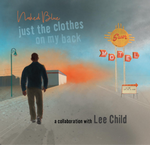
Just the Clothes on My Back – a collaboration with Lee Child by Naked Blue: Jack Reacher Rocks

Jut the Clothes on My BackJust the Clothes on My Back – a collaboration with Lee Child

by Naked Blue
Series: Jack Reacher


CD, 10 tracks
Bluetick Records, 2018

Mutual fans/friends Naked Blue and Lee Child collaborated on this album — 10 songs from Jack Reacher’s point of view. Well, 9 from his POV and 1 (“Reacher Said Nothing”) that could be the soundtrack for about 90% of the books.

I’ve listened to this album a lot since it came out and I’ thoroughly enjoy it. I think it does a great job capturing the “inner essence” of Reacher (a concept he’d probably boggle at) and delivering it with some great bluesy-rock/Americana tunes. Even if you’re not Reacher-obsessed, or you don’t think about the character the songs hold up just fine — you don’t even have to know anything about the album to appreciate it. But if you are a Reacher fan, you’ll enjoy it a lot more.

“Just the Clothes on My Back” and “Big Man” do great jobs of encapsulating Reacher’s approach to life. “Killing Floor” and “Blessed or Cursed,” are almost as good. All of them have great tunes that get into your head and threaten to take up earworm-like residence.

It’s not all about the action-hero side of Reacher. “The Midnight Line” does a great job of capturing a chapter (or part of one) with the allusions and euphemisms for sex and “Sanctuary,” also does a fine job of recreating the kind of scene in a Reacher book that I skim. This doesn’t mean they’re bad songs, in fact, they’ll be selling points for many. They just don’t work for me.

As for “Reacher Said Nothing”? An almost entirely instrumental piece (with some vocals by Lee Child himself) — how that hasn’t become my ringtone is beyond me. Just love that song.

Now, Jennifer Ferguson Smith might not seem the ideal person to give musical voice to the 6’5″, 210–250 lbs., ex-MP with a 50″ chest, but she somehow pulls it off. The vocals are great — I don’t really know how to describe someone’s singing voice, so I’m not going to try. They match the rootsy-bluesy-rock well. I don’t know if it’s helpful to anyone, but she reminds me of Amy Rigby.

A great album for fans of Reacher. An album that should earn Naked Blue some new fans/listeners. A good album just in and of itself. Give it a whirl.I’m going to give it 4 stars, but based on the way that music like this tends to grow on me, if you ask me in 6-9 months, I’ll probably rate it higher.

—–

4 Stars

Blackwater by GJ Moffat: A Brutal and Gripping American Crime Story

BlackwaterBlackwater

by GJ Moffat

Kindle Edition, 292 pg.
Fahrenheit Press, 2017

Read: December 14 – 15, 2018

           Early went to [redacted]’s body and hunkered down in front of [redacted]. His skin was flaccid and his jaw and face swollen and misshapen from the effects of his injuries. His shirt was entirely soaked in blood.

Early shook his head, thinking: this is what men do.

Take Walt Longmire (Deputy Longmire, before Lucian Connally’s retirement) throw him into Jesse Stone’s Paradise, and then tell a story imbued with the spirit of Fargo (movie or show), your results will be pretty close to GJ Moffat’s stunning Blackwater.

It’s a tale of violence, bloodshed, power, inevitability and death — what men do.

Deputy Sheriff Early Simms of Blackwater County is the son of the previous sheriff and probably the only member of the Department really fit for the job. A tragic accident in High School changed the direction of his life, and as a result he’s in the same dying New England area he grew up in. He’s made peace with this, and even seems to be happy — he’d be happier if his boss (and colleagues) cared a bit more about the job and his father wasn’t battling Alzheimer’s, sure. But this is his life.

And then everything changes in a couple of days — his old high school flame (and love of his life) returns to town, there’s an investigation into a corrupt public official, an investigation into an assault/attempted murder at a nearby jail, and a couple of brothers on a killing spree have come to the region. There’s also some drug running, spousal abuse, a pretty nasty bar fight. I don’t want to say that Early Simms is the only one investigating the crimes, in trying to preserve the peace — there are three (that we know of) other members of the Sheriff’s Department, some other local law enforcement officers and some FBI agents running around. But Early’s the only individual who’s in each of the stories — he’s the region of intersection in the Venn diagram of Blackwater (and frequently the most capable person around).

One of the criminals we meet in these pages (not saying which one) is clearly not an evil man. There’s some sort of undiagnosed (by the author or by any professional this criminal has ever encountered) mental health issue affecting him. Which does not lessen the evil he does and the trauma he inflicts on others. Part of me wants to know more about the whys, hows, wherefores, and whatnot about this disorder and is a little frustrated that Moffat doesn’t give us any of it. The other part of me is so glad that he didn’t succumb to temptation to get into tall that, instead merely showing his readers what was going on with this man, leaving it to us to do the work. There’s someone else who probably has some sort of Traumatic brain injury symptoms — not quite the same, but some of the same results.

We also see crime perpetrated by someone motivated by power, money and meanness. Also, there are some criminals who just don’t seem to have options, means or inclination to do anything but break the law. It’s up to Early to face down these people, no matter where on the spectrum they seem to be found, to prevent them from inflicting too much harm on the community.

How successful he is at that, well . . .

Moffat can write. That’s all there is to it. It took almost no time at all to recognize that. You get a strong sense of every character in just a few lines and his world is as fully realized as you could hope for. He presents the evil Early sees and fights against in this book fairly realistically, in a way that is as capricious and destructive as anything you see on the news.

So many times — almost every chance he gets — Moffat will do precisely what you don’t expect. What people just don’t do in this kind of book. He’ll put the characters in a situation you’ve seen dozens of times before, and just when you think “X will happen right after I turn the page,” B happens before you can turn the page. I realize there’s a danger in saying that — you’ll be looking for that kind of thing. But I expect that the same thing’ll happen to you as it did to me every time he pulled the rug out from under me — you’ll get sucked in by his writing and the characters (and possibly still be reeling from the last shock) and you won’t even think to expect that he’ll do it again.

I finished the book I was reading before this earlier than I expected to, and didn’t have the next on my list with me, so I took the opportunity to pay a visit to what I call my Kindle’s “Fahrenheit Ward” — where I stick all the Fahrenheit Press books that I buy without time to read — and I grabbed this. I’m so glad my timing worked out that way — this is exactly what I needed. I got sucked in by this immediately, and it was practically impossible to put down. Before I got to the novel’s final confrontation(s), I jotted in my notes, “Man, I hope this isn’t the first of a series — I don’t know if the community can survive another book.”

But if Fahrenheit published a sequel today? I’d shell out cash before the end day. I strongly expect you’ll feel the same way once you recover from Blackwater.

—–

4 Stars

The Complaints by Ian Rankin: Introducing the anti-Rebus, Malcolm Fox

The ComplaintsThe Complaints

by Ian Rankin

Series: Malcolm Fox, #1

Hardcover, 438 pg.
Little, Brown and Co., 2011

Read: November 20 – 22, 2018

I left the last Rankin book thinking, “If I didn’t know that there were more Rebus books coming, I’d be really depressed.” There are advantages to being this far behind a series. Thanks to a podcast interview I heard with Rankin around the time I started to plan my Rebus reading (I think it was this A Stab in the Dark episode), I knew that at some point, he pushed “Pause” on Rebus to introduce a new character — initially, I think, to replace Rebus. But it didn’t work out that way. Still, I wanted to read them in chronological order, so I could appreciate it when the new guy was merged into the Rebus books.

And that’s where we are now, with the introduction of The New Guy: Malcolm Fox, of the Complaints and Conduct division (aka “The Complaints”) — essentially, Internal Affairs (aka “The Rat Squad”). It’s almost like Rankin came up with a list of Rebus’ characteristics and put a “not-” in front of every one of them to create him. He doesn’t drink (because he’ll end up like Rebus does, or worse), he follows the rules (generally speaking), he gets along with and respects/trusts his superiors, he’s close with his family . . . et cetera, et cetera, et cetera. He’s a lot more likeable than Rebus, too — as a person and as a fictional character. He’s not as well-developed — this is his first book and Rebus had 17 at that point, so that makes sense. Although, typically, IAB/Complaints type characters are usually dramatic obstacles to the series protagonists and are therefore little-liked, so that was strange.

The novel starts with Fox riding high — he’s just closed a major investigation, and is doing clean up on that when he’s given a new assignment. He’ll be helping out another division — I suddenly forgot their name, but essentially, they’re the equivalent of the Special Victims Unit. So right away you know this is not going to be a fun book — a detective who polices the police investigating sex crimes. There’s just no way to paint a “fun-loving romp” face on that premise.

But before we can get too far down that road, a pretty big complication arises. (Minor Spoiler warning) The abusive boyfriend of Fox’s sister is found murdered. And guess who is the first suspect? That’s right. Better yet: guess who is one of the investigating officers? If you guessed the target of Fox’s new investigation, give yourself a pat on the back.

So Fox has to investigate a detective without him knowing about it, while being investigated by that same detective — and to keep it from looking like payback. Which is a pretty cool setup for a novel, you’ve got to admit. Better yet, it’s Rankin behind the wheel, so you know he can (and does) deliver on the setup.

The bulk of the novel is about Fox doing his best to find the killer — for his sister’s sake (primarily) — and keep himself out of the cross-hairs of the investigators. This will lead him to some very not-regulation investigative techniques, some of which might remind people of the Rankin creation that Fox isn’t. The mystery itself and the way it’s told is classic-Rankin. Lots of twists, a couple of good turns, very satisfying throughout.

Meanwhile, we get a pretty good character study/introduction to this new character through this — and through a friendship he develops with another detective during this. I really enjoyed the novel, and Rankin gave his new character a serious challenge to start with, a very cleverly constructed mystery to untangle. Fox is a worthy entry into the world of Rebus and Rankin.

I’ll leave with this — if after 2007’s Exit Music I’d have been nervous about what was to come next, I’d have been relieved after 2009’s The Complaints. Now, I’m just eager to see the two detectives on the same page.

—–

4 Stars
2018 Library Love Challenge

The Frame-Up by Meghan Scott Molin: Likeable Characters, Strong Mystery, & Geeky Fun Combine for a Winning Debut

The Frame-UpThe Frame-Up

by Meghan Scott Molin
Series: The Golden Arrow Mysteries, #1

eARC, 304 pg.
47North, 2018
Read: November 28 – 29, 2018

There are some posts I’m not sure how to start. Introductions are probably the hardest part for me (I say this today, tomorrow I’ll be struggling with a conclusion). I thought about starting this post this way:

    If you liked . . .

  • the Dahlia Moss books, but want something less sit-com and more dramedy
  • the Kirby Baxter books, but wish that Molly was the star?
  • Seanan McGuire’s Antimony Price, but wish you didn’t have to put up with the cryptozoology?
    and/or
  • the Castle pilot episode
  • …then this is the book for you!

But that just seemed frivolous. So I abandoned it.

A chance encounter in a slow-moving coffee shop line and an overheard offhand remark leads to LAPD Narcotics Detective Matteo Kildaire consulting comic book writer Michael-Grace (call her “MG”) Martin about an unusual crime. A couple of drug dealers had been tied together and left for the police, a photo printed in the newspaper (or at least an online version of it) reminded MG of one of her favorite comic book panels when she saw it — a panel from a comic in the Eighties. It turns out that there are additional reasons to tie the crime scene to that particular comic, and the detective could use some help. He’s clueless about this kind of thing and is desperate to get any kind of line on the vigilante responsible.

Matteo is concerned for various and sundry reasons that MG and her coworkers at Genius Comics might be a target for trouble (and/or responsible for it). MG is intrigued by the entire thing (and the fact that an incredibly hunky detective is talking to her about it doesn’t hurt, even if he is the Muggle-ist Muggle around) — actual crimes being committed around town by someone very inspired by the comics that shaped her early geekness?

Now, Matteo doesn’t want word to get out about a. MG consulting for him; b. the close eye Genius Comics employees are being watched with; c. really anything about the vigilante. So he poses as someone MG’s dating, without really consulting her on it. Spending time with her in social settings allows him to investigate her coworkers and friends — although he really seems interested in getting to know her better.

MG’s dealing with several things in her own life — she’s up for a big promotion at work; her side project of designing costumes (for cosplay, and her friend Lawrence’s drag queen act) is dangerously close to turning into something more than a hobby; and somehow she has to work in a fake relationship (without tipping off the true nature of things to her roommate or Lawrence).

The chemistry between the two main characters is fantastic — Matteo comes across as a very nice guy, the kind of person you’d like to think every detective is — driven, honest, kind. MG’s the kind of person I’d like to hang out with — creative, funny, geeky (although her LOTR views means we won’t be best friends). When you put the two of them together they work really well — on a detective/consultant basis, or as a couple. It’s obvious from at least Chapter 2 that the sparks are there, so I don’t feel too bad talking about this — but they do keep it pretty professional. Mostly. Whether they’re being professional, or they’re in one of their more personal moments, these two are a great pair.

Now while the pair are getting to know each other, the crimes associated with the comics continue to pile up, get more serious and start to involve significant damage and danger to human life. Other than Matteo, the police and the FBI aren’t that convinced that MG can really help them. And at least one of her friends becomes a person of interest in the investigation. These two things spur MG to do some independent investigating in addition to her consulting. Which goes about as well as you might think for a comic book writer/would-be fashion designer starring in a comedic novel.

And it is funny. MG is a great narrator — honest about herself and her foibles; snarky about the foibles (and strengths) of those around her; clever, witty and her narration is chock-full of geek-culture references. Molin tends to over-explain some of MG’s references. You don’t need to tell me that “Winter is coming,” is a Jon Snow line. You can just say it and everyone will know you’re talking about Game of Thrones (or Death and Boobies, as MG prefers). I don’t remember noticing that later on, I either got used to it or Molin course-corrected. Either way, it’s not a major problem.

The story is strong, the culture around Genius Comics is interesting (and rings true), the secondary and tertiary characters are fun — it’s a very satisfying debut novel. I do think that MG’s roommate and coworkers could’ve been developed a bit more. At least we could’ve spent more time with them, not much, just a little (except the roommate, we could’ve had more time with him — but that seemed intentional). But that’s about my strongest criticism, come to think of it. There are some scenes that are just fantastic — Matteo watching the original Star Wars trilogy with MG and her coworkers for the first time is magic. There’s a moment in the last chapter that’s a little better, too (but I won’t spoil anything). Molin can tell a good story and capture small elements well.

I started this by joking around about the kind of people that’ll like this book — but seriously, there’s something about this that’ll appeal to most. Just thinking of friends/family/workplace proximity associates who read novels — I can’t think of one who wouldn’t find something in this to enjoy. My mother would like the interplay between the characters (particularly between MG and Lawrence) and the story, even if she didn’t get most of the fandom references; my buddy Paul would like MG’s spirit, the mystery, and Matteo; Nicole would dig the mystery, MG, and the fandoms (even if she doesn’t share them, she’ll get it), MG’s design work, too; I’ve got another friend who’d like the mystery but would roll his eyes at some of the relationship stuff; Rosie would get a kick out of it all, especially MG’s voice — and so on. Okay, to be honest, I can think of one reader I know who wouldn’t like it — between the subject matter, the voice, the crime story — it’d be beneath her (unless Molin gets interviewed by NPR, then she’d be a big fan). My point is — there’s at least a little something here for everyone to get into, if you don’t let any of the particulars of the setting or character get in the way.

Sure, I liked Dahlia Moss/Kirby Baxter/Antimony Price/Castle without any of the conditions that I started things off with — so this was definitely in my wheelhouse. But more importantly, it was a fun story well told, with charming characters that you want to spend time with. If I’m reading Molin’s tweets correctly, we’re looking at at least a trilogy with these people — I’m all in for that, I’m very interested to see where she takes the story and the characters. I fully expect that I’m not going to be alone in my appreciation for The Frame Up.

Disclaimer: I received this eARC from 47North via Little Bird Publicity and NetGalley in exchange for this post — thanks to all for this great read.

—–

4 Stars

They Promised Me the Gun Wasn’t Loaded by James Alan Gardner: The Newest Canadian Super-Heroes are Back in Action

 They Promised Me the Gun Wasn't Loaded They Promised Me the Gun Wasn’t Loaded

by James Alan Gardner
Series: The Dark vs. Spark, #2

Paperback, 350 pg.
Tor Books, 2018

Read: November 26 – 27, 2018

When I read the first book in the series, All Those Explosions Were Someone Else’s Fault, back in January, I said “the sequel can’t get here fast enough.” I didn’t quite expect to be reading it 11 months later, but I’m okay with that.

It’s just a couple of weeks after the events of the previous book, and the newly formed team of superheroes has gone home for Christmas break. Now with just a few days before classes start up again, the team is coming back. In the last book we focused on Kim/Zircon, this time our protagonist is her roommate/teammate Jools/Ninety Nine.

Jools doesn’t even make it out of the airport before she’s dealing with the police and a powerful Darkling — and maybe a powerful Spark artifact.

(Quick reminder: In this world there are two super-powered groups: the Darks/Darklings and the Sparks. The Darks are all the supernatural-types you can think of (and some you can’t): vampires, weres, etc. The Sparks are Super-Heroes and the like (although some have gone astray))

Jools, with a little help from her friends, gets out of that mess — only to find herself signed up for more.

Soon, in an effort to keep this artifact from falling into the wrong hands — Jools finds herself cut off from her friends and in the secret-hideout with a very maverick group of Sparks — a modern-day Robin Hood and his Merry Men. This gives her an opportunity to watch other Sparks in action, to see how they live and think — and come up with some ways to evaluate her new lifestyle. Also, there’s a lot of fighting and nifty tech to read about.

I wasn’t crazy about how little time we got with the rest of the team because of this, but I think in the long run, it’ll work for the strength of the series. And when we get the team together again, it’s even better to see than it was before.

Again, I had a blast with this book. Gardner’s world is ripe with story-telling possibilities and I’m enjoying watching him develop these characters and this world. Jools is a great character — a solid combination of vulnerable and snarky, unwise and ridiculously intelligent — you’ll probably end up with her as your favorite character in the series (at least until book 3). Go grab this (and the other one, too) now.

—–

4 Stars
2018 Library Love Challenge

My Sister, the Serial Killer by Oyinkan Braithwaite: A Charming, Dark, and (somehow) Fun Serial Killer Tale

My Sister, the Serial KillerMy Sister, the Serial Killer

by Oyinkan Braithwaite

Hardcover, 223 pg.
Doubleday Books, 2018

Read: November 23, 2018

Ayoola summons me with these words — Korede, I killed him.

I had hoped I would never hear those words again.

That’s one of the best pair of opening sentences I can recall. How do you not get hooked right there? You get so much in those two sentences, you know that Ayoola has killed multiple times, at least three (otherwise, Korede would’ve said something like “What, again?”); the fact that she says “him,” instead of “someone” or a name suggests that Korede will know who she’s talking about without explanation; and you hear a put upon sibling fed up with their sister’s antics.

And yeah, that’s the book in essence — Ayoola has killed her third boyfriend (in self-defense, she swears . . . again), and calls on her big sister to come help clean up. Korede’s a clean freak — she’s not quite OCD, but close. When life gets stressful, she cleans, and with her little sister, she’s got plenty of stress in her life.

Korede is beginning to think that Ayoola might not just be the innocent girl who has been able narrowly escape assault. Three kills, she’s read online, qualifies you to be a serial killer. And what’s worse — the doctor that Korede has unrequited feelings for has caught her sister’s eye, too (and vice versa) — and that can’t be good for him. I had about a dozen ideas how this was going to end — and I was wrong on every point. Which is good, because Braithwaite’s ideas were far better than mine would’ve been. She zagged when most would’ve zigged and nailed the resolution to this book.

This is enough to make an entertaining and suspense filled book. But then you throw in the characters that Braithwaite has created and things take on a different twist.

Korede’s a nurse — a demanding, dedicated, compassionate one. Ayoola is a vapid knockout who knows that it doesn’t matter what she knows, does, or thinks — she’s convinced that all she has to do is continue to look good and make men feel good about themselves and she’s set. This seems shallow, but neither Ayoola or Korede can prove that she’s wrong.

The dynamic of the long-suffering, responsible, plain(er) sibling doing the right thing and looking out for the spontaneous, outgoing, super attractive one isn’t new. Adding a mother who takes the responsible one for granted and dotes on the other, doesn’t change things, either. But somehow, Braithwaite is able to depict these three in a way that seems wholly familiar (so you can make assumptions about a lot of the relationship) and yet it feels so fresh she might have invented the archetypes.

If Jennifer Weiner lived in and wrote about Lagos, Nigeria and included murders in a tale of sibling rivalry and learning to accept yourself — you’d get something a lot like this book. There’s an intangible, ineffable quality to Braithwaite’s writing that I cannot capture better than that — but it’s better than my illustration sounds. The story goes to some really dark places, and there’s really no reason to find the characters or story so charming — but that’s all down to Braithwaite’s fantastic authorial voice. Yes, it’s about murder, the importance of family, self-sacrifice and what’s more important in this life — skill, intelligence and dedication, or beauty and sex appeal; but you might as well be reading about Bridget Jones counting cigarettes and worrying about Daniel Cleaver and Mark Darcy.

One other thing — this is just a wonderfully designed book. The size — smaller than your typical hardcover — is distinctive, the typeface used in chapter headings and page numbers are peculiar enough to stand out. The whole thing just feels like a different kind of book. Does this make an impact on your enjoyment of the novel? Probably not, but I appreciated the experience and look.

I can’t think of enough ways to praise Braithwaite — there’s an intangible quality to this book that just won me over pretty much on page one. You will not believe that this is her first novel — and you will hope it’s not her last. The sibling rivalry story was well-told and engaging, the hospital stories were enough to be the core of a very different novel by themselves, the serial killer story was unpredictable. The characters are the kind that you’ll remember for a long time. Stop reading me and go find a copy of this book.

—–

4 Stars

2018 Library Love Challenge

The Lord’s Supper as the Sign and Meal of the New Covenant by Guy Prentiss Waters: A Thoughtful & Encouraging Look at the Supper in its Redemptive-Historical Context

The Lord's Supper as the Sign and Meal of the New CovenantThe Lord’s Supper as the Sign and Meal of the New Covenant

by Guy Prentiss Waters
Series: Short Studies in Biblical Theology

eARC, 128 pg.
Crossway, 2019
Read: November 18, 2018

“All the salvation and redemption brought about by Christ for his disciples is founded in the body and blood he gives them to eat and drink at the Eucharist”
                                                                           — Herman Ridderbos

Waters uses that insight from Ridderbos to help explain the significance of the Lord’s Supper in the Christian religion, and thinking along these lines undergirds this entire book — not just that the Supper is something we ought to do, but something it’s vital to participate in — for our own spiritual health.

Waters begins by reviewing the basics of covenant theology — defining covenant and looking at the major covenants and how they point to Christ. Then Waters shifts to looking at the signs and seals of the various covenants — with a focus on the purpose of visible, tangible signs. The third chapter narrows that focus to covenant meals throughout redemptive history. Once the context has been firmly established, Waters introduces the Lord’s Supper with a survey of applicable biblical texts. Finally, Waters considers some practical and contemporary questions and applications. I’m not going to get into any specifics beyond this because what I want to focus on takes a lot of foundation work, and this would stop being about the book and would become a recap of the whole thing.

In a book this short (by design), I’m not sure Waters did his readers any favors by being as thorough in the first two chapters — it will be review material for many readers, and those who aren’t that grounded in covenant thinking are going to need more explanation of the ideas. Still, I appreciated what he wrote. The other three chapters were just great — I could’ve used more of all of them, but that’s not the point of the books in this series. The careful consideration of the Supper in its redemptive-historical context is so important and putting these ideas in a size and format that aren’t intimidating is going to be valuable.

I wish I had this book twenty years ago when I started studying the Lord’s Supper, it would’ve been very helpful and would’ve saved me a lot of time. I took a lot of notes while reading this and am going to spend a lot of time following up on them — and rereading this a couple of times. It’s the kind of book you want to hand out to your friends so you can talk about it with them. The last chapter was particularly helpful and encouraging. This would be a great companion read to Letham, Mathison, and Wallace (to be read after Letham, but before Mathison, probably).

Waters is one of the better academic writers the Reformed world has — thankfully, he’s also capable of producing concise and clear works for laity. This short volume demonstrates that well. It’s helpful, encouraging and I have no doubt will strengthen some believers’ in their use of the Supper as it shows others how important it is.

I’d been previously unaware of the series Short Studies in Biblical Theology, I’m pretty sure I’m going to be getting my hands on some of the other volumes. I love the idea behind the series and if they’re all this helpful, it’ll be worth it.

Disclaimer: I received this eARC from Crossway via NetGalley in exchange for this post — thanks to both for this.

—–

4 Stars

Know Me from Smoke by Matt Phillips: A heart-wrenching noir love story.

Know Me from SmokeKnow Me from Smoke

by Matt Phillips

Kindle Edition, 193 pg.
Fahrenheit 13, 2018
Read: November 15 – 16, 2018

If you’re looking for an example of noir — in the classic sense — look no farther than Matt Phillips’ Know Me from Smoke. You can tell that’s going to be the case from the opening paragraphs. The first chapter builds on those first three or four paragraphs and sets the atmosphere, the mood, the tone for the rest of the book — and pretty much casts a spell on the reader, too. The second chapter — where we meet our second protagonist firms that up, and from there Phillips builds on this foundation to deliver a book that will stay with you long after you’re done with it.

But let’s step back from that for a minute — we begin by meeting Stella Radney. She’s in her mid-40’s, a lounge singer, and a widow still grieving her murdered husband twenty years after his death. During the robbery that left Virgil dead, Stella was shot as well and the bullet’s still in her hip — a constant reminder that her loss and pain are physical as well as emotional. Both pains seem a bit fresher in the beginning of the book because Stella’s been informed that new DNA technology (unavailable 20 years ago), has led the DA’s office to reopen the case and they hope to have an arrest soon. Stella’s feeling a little raw, hanging on only by more alcohol than is probably good for her and losing her self regularly in the music she performs.

Royal Atkins is a free man, a man with a second chance — a convicted killer released on a technicality and determined to make the best of his second chance. Sadly, a couple of men at his halfway house decide that the best thing for Royal would be to join them and pull a few stickups — and a few other forms of robbery as well. Royal resists — but it’s as clear to him as it is to the reader that this won’t last.

Stella and Royal meet and the chemistry is instantaneous. The chapter where they meet for the first time is possibly the best chapter I’ve read this year — just magic. For obvious reasons, Royal edits the personal history he tells Stella, and his associates from the halfway house use this to blackmail him into going along with them. He’s trying to build a new life, she’s trying to rebuild her life, and neither of them want to be alone in the process.

So we get to watch the growing love story of Stella and Royal, Royal’s history being used against him, the crime spree, and the certainty that this is going to all going to come to a messy end. A little before the halfway point, I put in my notes, “if I stop, some broken people get to live a decent life. If I read another chapter or two, everything will fall apart and lives will be ruined. So tempted to walk away from it.” I really was — I liked these two so much, I wanted to let them have this chance.

But there was no way I was going to stop, Phillips’ prose was too good to abandoned, and I had to see what actually happened to these characters (no matter how inevitable the end seemed). Seriously, I’d have kept reading just so Stella could think about her relationship to music and songs some more — those sections of the book are practically poetry.

There’s conversation between a couple of characters about Pulp Fiction — and Tarantino’s work feels appropriate to this book. But not that movie. Jackie Brown is the movie that this feels like. Maybe the novel, too, but I haven’t read Rum Punch. They’re both from the same species of sweet, second-chance at love story in the middle of a story of crime, criminals and ex-cons.

This is going to go for my entry for “Read a book you chose based on the cover” in the While You Were Reading challenge — it’s not entirely true, but the cover is fantastic and got me to read the blurb a few times, so it’s close enough.

I love that title, too.

There’s just so many things that are right about this book, and so little that’s wrong. This is a winner — it’ll grab you by the heartstrings, will pull you along through the highs and lows of this story, and only let you go some time after you finish (I’m not sure how long that effect will last, but it’s been almost a week and it really hasn’t let go yet).

—–

4 Stars

✔ Read a book you chose based on the cover.

The Vinyl Detective: Written in Dead Wax by Andrew Carmel: A great intro to one of the most unlikely thriller heroes around

The Vinyl Detective: Written in Dead WaxThe Vinyl Detective: Written in Dead Wax

by Andrew Cartmel
Series: The Vinyl Detective, #1

Paperback, 476 pg.
Titan Books, 2016
Read: August 6, 2018

How did it take this long for me to realize that the protagonist had no name? I just noticed that now, three months after reading the book, as I was flipping through the book to refresh my memory — and then giving up and using the Internet to cheat. Other than the lack of name — he’s a very thoroughly drawn character, so much so that you don’t notice little things like no one calling him by name.

I’d initially thought of the book as Rob Fleming (from High Fidelity), P.I. But that’s not right — our protagonist isn’t Rob, he’s Championship Vinyl’s best customer. Someone who can talk to Rob about minutiae of music, who can go toe-to-toe with Dick and Barry in music trivia, who will be there any time they have new vintage records, etc. He’s an expert in jazz — and might as well be an expert in just about everything else. He lives alone, makes enough to get by (but wouldn’t mind making more, if he could do it on his terms) and loves his pet cats.

One day, a beautiful woman approaches him with an offer he can’t (and doesn’t want to) refuse — on her employer’s behalf, she wants to hire him to track down an incredibly rare — impossibly rare, some would say — jazz record. It’s rare enough that even the reissues are nigh-impossible to track down.

They’ve not been looking for long, until it’s clear that there are a couple of other people who are actively looking for the record (in addition to a handful of people who always have an eye out for it). Then a fellow jazz aficionado is attacked — and money and violence start surfacing around the vintage vinyl circuit in London. Because that’s a thing that happens.

At some point, our protagonist starts to realize there are reasons beyond wanting a complete jazz collection to have the originals, and in conjunction with someone with family ties to the records, he plunges further into the hunt for the record and to uncover whatever dark and violent secrets that are being kept by the record.

This is not a story that should work. But it does — it absolutely does. It sort of makes sense that this quest starts to involve violence, lethal violence — and that both sides are prepared for it. The protagonist’s reaction to it all is what sells it. This is a guy who just wants to spend time with his cats, track down and listen to good music, and maybe enjoy some female company. He doesn’t expect to get plunged into some strange international quest, he doesn’t expect to fear for his life, or to have to outsmart people who are prepared to do him harm. It’s this nameless guy, the Vinyl Detective, who makes it all work.

In addition to the contemporary hunt for the record (which turns into a hunt for records), there’s the story behind the making of the records, the people involved, the reason that people are willing to spend a lot of money to recover the records (in addition to everything else they’re willing to do). It’s fascinating, believable stuff — especially the backstory to the recordings. I’d 100% believe that all the backstory actually happened that way, and that Cartmel used that true story as something to frame his novel around.

I don’t know how to adequately capture this book (note how long it’s taken me to post anything), it’s a very clever story, very well told. It’s exciting, it’s funny (at times), it’s heartfelt, it’s everything you want in a thriller within a world you don’t really think that much about. Not only does this strange premise hold-up well, it’s apparently good enough to spawn at least three sequels (two published, one on the way). Don’t ask me how it works — well, it has a lot to do with Cartmel’s skill and charm.

Give this guy a shot — you’ll be glad you did (and you’ll wish you could listen to his record collection).

—–

4 Stars

The Twisted Web by Rebecca Bradley: A Great Hook and Subtle Storytelling Make for a Compelling Read

The Twisted WebThe Twisted Web

by Rebecca Bradley
Series: DI Hannah Robbins, #4

Kindle Edition, 277 pg.
2018
Read: November 9 – 10, 2018

‘So, he talks about crime online and is murdered and left to be found in what is made to look like a crime scene?’ Ross asked, clarifying the situation in his own mind. A situation we all needed to get our heads around.

‘That appears to be the gist of it, Ross…’

I can’t come up with a plot summary as succinct as that, no matter how hard I try. As far as hooks go, they don’t come much better than that. This is my second Rebecca Bradley novel, and it’s the second one with a killer hook. In many ways, a killer hook — like knowing — is half the battle.

It’s up to DI Hannah Robbins and her team to find this murderer, and from the get-go, the cards are stacked against them. To begin with, social media was aware of the body before the police were (despite the number of CCTV cameras in the area the body was dumped), and Twitter was demanding action. Which means — like in so many aspects of society today — the pressure on those seeking to do the work in a professional, careful manner works against them. The online mob (and the politicians that fear getting on their wrong side) demand instant action, instant results and instant justice. Good police work rarely gives you instant anything.

Robbins’ team is in a little bit of flux at the moment — they have a relatively new DCI, who isn’t thrilled with the makeup of the team and doesn’t trust Robbins’ leadership (possibly not her ability at all — I’m not sure) as well as a newish DC who has started to prove herself (but is still trying to); they’re short a vital member due to a recent heart-attack; and Robbins herself is recovering from an injury and isn’t quite herself while being distracted by some family drama. But like any good team of professionals, they band together, adapt and get to work. I can easily see versions of this book where the internal problems distract the team from the investigation enough that the killer strikes again (which doesn’t mean that the killer doesn’t strike again here, but it’s not for this reason).

Robbins seems to do a pretty solid job running things, using her personnel and herself efficiently and wisely — from this particular armchair, the procedural part of this novel is the way things are supposed to go. No maverick detective bucking the system, going their own way, or bending any rules of evidence. How many “police procedurals” can claim that? Through that careful, ticking every box kind of approach — the stuff that Rebus can’t be bothered with, Bosch only gives lip service to, and Peter Grant submits to (grumbling the entire way) — Robbins team gets the job done. Not that serendipity doesn’t play a role, but that happens.

While delivering on that front, Bradley gives us a lot of really good character moments and subtle emotional beats. The observations about witnesses trying to insert themselves into things, the effect that a crime can have on the family of a victim, what goes on in a postmortem, and so on — elevated this from merely a solid procedural. (not that there’s anything wrong with a solid procedural)

One death permanently changed the life of many people.

Those affected by a murder often felt as though their life had also been taken once a loved one had been snatched so ruthlessly. But a court, should a murder ever go to trial, only ever counted one life. The media only counted and reported on the one life. Investigating the murder, you soon came to realise it was a hell of a lot more than one life. You don’t live in a vacuum. You are more than yourself in the world.

There were a couple of times, however, that she ruined the moment (well, diminished it greatly) by following a nice bit of description and showing us what was going on by following it up with an unessential and clunky sentence telling us what she’d just shown. Displaying a little more trust in her readers would help things. But overall, I was really impressed with the way she described the thinking and emotions behind the actions of her characters — even the tertiary ones.

Her characters are fully-developed and well-rounded. Even many of those we meet for only a few paragraphs. I’m a newbie to this series, but by the end, I thought I had a pretty good handle on almost everyone in Robbins’ world, as well as the killer and their family. That’s not easy to accomplish in a book like this that really had a lot more going on than just the murder inquiry. I really want to find out how things progress with a few of these people, and would jump on book five in this series tomorrow if it were available for that reason alone (well, okay, December — but only because I’ve got the rest of this month tightly scheduled).

I spent most of the novel annoyed by how much time we were spending with the killer — typically, novelists don’t pull this part off well, or at least with enough value added to make it worth my while (and several novelists and novels that are my favorites have this problem). Getting his perspective on the reaction to his crimes and on the official investigation didn’t seem to add much to the book, and took time away from the more interesting characters and actions. Because, really, almost all of his reactions were what the reader would’ve guessed if Bradley hadn’t given us this. But, I have to admit by the end, Bradley made almost all of it worthwhile — it was some pretty clever plotting on her part and a subtle bit of character work — and turned what was a weak point (for me, not for others) into a strength.

I was impressed with Dead Blind when I read it a few months back — but this The Twisted Web is so much better. Maybe because she’s had more time to create this world and knows her characters better, maybe it’s just the world she’s created. Either way, this book has insured that I’m going to be on the lookout for whatever she’s doing next (and, time permitting, I’ll grab the first three in this series). The Twisted Web delivers it all — some reflection on the driving forces behind our contemporary culture (and a well-deserved critique!), a solid police procedural, a villain with a credible motivation, a crime spree one can actually imagine happening, a couple of legitimate surprises, and human characters (as opposed to cardboard cutouts or stereotypes) driving it all.

—–

4 Stars

My thanks to damppebbles blog tours for the invitation to participate in this tour and the materials they provided.

Page 47 of 88

Powered by WordPress & Theme by Anders Norén