Tag: Audiobooks Page 1 of 24

What Can I Possibly Say about Dungeon Crawler Carl That You Haven’t Read Dozens of Times?

Okay, after putting it off for months, I finally got around to reading the paperback I bought last year. Then a friend got me the audiobook—and I had to see if Hays was as great as everyone said. So I did both versions in a month. Which isn’t how I usually do things, but sometimes…


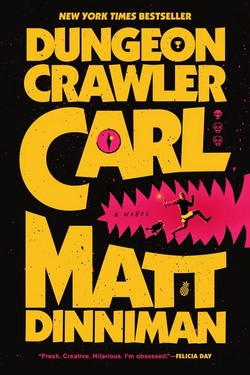
Cover of Dungeon Crawler Carl by Matt DinnimanDungeon Crawler Carl

by Matt Dinniman, read by Jeff Hays

DETAILS:
Series: Dungeon Crawler Carl, #1
Publisher: Ace; Audible Studios
Publication Date: December 30, 2025; January 28, 2021 
Format: Paperback, Audiobook
Length: 427 pg.; 13 hrs., 31 min.
Read Date: June 9-11, 2026; June 26-30, 2026
Buy from Bookshop.org Support Indie Bookstores

“Not everything will be social commentary.”

“It’s usually just stupid,” I muttered.

“It’s entertainment,” Mordecai said.

What’s Dungeon Crawler Carl About?

For the maybe 5 of you who haven’t learned this (inadvertently or purposefully), after living amongst us for decades, an alien race nearly wipes out the human race in an instant. Every human being—or physical object, plant, or animal—that was in an enclosed space was crushed when those buildings flattened. Those who survived were given the opportunity to enter a Dungeon to compete in a Hunger Games sort of reality show for several alien races to watch.

Sadly, for Carl, he only survived this because he was outside to catch his ex-girlfriend’s cat in the middle of the night. As he thought this would be a quick dash outside, he was wearing a jacket, t-shirt, boxers, and his girlfriend’s Crocs. Somehow, he didn’t realize he’d be in these clothes—and only these clothes—for (possibly) the rest of his life.

On the other hand, Carl is a veteran of the Coast Guard with plenty of experience in explosives, who worked as a marine technician in Seattle before the Dungeon.

The series is about he and that cat doing everything they can to survive the Dungeon.

Grand Champion, Breed Winner Regional, National Winner Princess Donut the Queen Anne Chonk

Cats are assholes. I get it. But do you know why people like cats, despite their asshole-ness? It’s because they don’t fucking talk. If they did, and they were all like you, they’d all be extinct because we’d have killed you all by now.

Ignoring my mild allergy, I’m not anti-cat. I’m just ambivalent about them. It generally comes across as a vague dislike (especially if I’m not ignoring my mild allergy). And when it comes to fictional Felis catus representation, I’m ambivalent at best.

So imagine my surprise when I’m about halfway through this book when I have to confess to my cat-loving daughter that there’s a good chance that my favorite new character of the year is a particular tortoiseshell Persian cat—”one of those fluffy, flat-faced cats that look like they need to be sitting on the lap of a Bond villain.” Okay, her surprise was bigger than mine.

Princess Donut is just so much fun—well, at least once she eats the Enhanced Pet Biscuit which turns her into a talking, sentient cat with plenty of memories of her life before the Dungeon (mostly to Carl’s consternation). She soon picks up the ability to hurl magic missiles from her eyes.

She is vain, she is mildly manipulative when it comes to Carl, her charisma score enables her to charm just about every NPC they encounter (and she does okay with the rest, too). Thanks to her history of competing in cat shows, she’s a natural when it comes to dealing with the media.

And…I don’t know…she’s got buckets of je ne sais quoi and I can’t get enough of her. I’m not sure I trust her choice in pets (she adopts a baby velicraptor-like creature toward the end of the book), but I can’t see how that won’t prove to be hilarious down the road (just seeing some fan art online assures me of that).

One Monster Description That Tells You a Lot About the Book

Part of a collective mind intent upon destroying any semblance of scientific progress in the universe, the Krakaren is the only communal brain entity in the galaxy who actually gets stupider as time moves on. Consisting of multiple, shrieking tentacles, members of the Krakaren cooperative spend their days birthing their disease-laden minions, creating and selling harmful products, attempting to debate scientific experts, and proselytizing to the weak-minded, all in an attempt to… Well, nobody knows what the hell their end goal is. Even Eris, Goddess of Chaos, doesn’t want anything to do with these crazy assholes.

(was this essentially me reaching to find an excuse to post that quotation? Yes. But also…it really does give you the flavor of the prose, humor, and strangeness of the monsters)

A Quick Word about the Narration

Jeff Hays is on his way to being my favorite audiobook narrator. He’s got stiff competition, but after two books, he’s got a shot at knocking people like Lorelei King, Gildart Jackson, Luke Daniels, and Ray Porter off the podium.

His choice to base Carl’s voice off of Patrick Warburton (and his performance of it) was inspired. His portrayal of Princess Donut is dynamite. And the way he does every other character is great.

If this is how polished he is with the first book—I can only imagine he’ll be fantastic once he gets some experience with Dinniman’s characters and style.

So, what did I think about Dungeon Crawler Carl?

If we get to the point where we don’t help each other anymore, that’s when we stop being human.

I really do think that it’s possible to dig deep with a lot of this book, to sink your teeth into it and see that Dinniman is accomplishing a lot and has a lot to say.

It’s also entirely possible to shutdown all your critical faculties and just have a blast with this book.

Both are totally appropriate ways to enjoy this (well, that’s true of just about every book—but it feels truer here).

I’m going to try to dig deeper when I get to future installments. But for now, I’ll just note that this is more than just jokes and killing things and leave it at that.

Dinniman draws on a bunch of video games, Douglas Adams, The Hunger Games, The Running Man, Ready Player One to create this world—and that would be enough, but when you add in his particular brand of humor and heart…I tell you what, that’s just great stuff.

If you, like me, have held off from this for whatever reason you have. Reconsider it. This is one of the most entertaining books I’ve read in ages, and I’m counting down the days until they finally release book two in paperback (and/or I decide to pay for the hardcovers).

This post contains an affiliate link. If you purchase from it, I will get a small commission at no additional cost to you. As always, the opinions expressed are my own.

Irresponsible Reader Pilcrow Icon

Quick-Take Catchups: The Leftovers from April

Once again, I’m a few weeks behind on this, but that “To Write About” stack is still calling. Time for me to do a few more of these—emphasizing pithiness, not thoroughness.


Cover of Violet Thistlewaite Is Not a Villain Anymore by Emily KrempholtzViolet Thistlewaite Is Not a Villain Anymore

by Emily Krempholtz, Emma Ladji (Narrator)

DETAILS:
Publisher: Penguin Random House Audio Publishing Group
Publication Date: November 18, 2025
Format: Unabridged Audiobook
Length: 11 hrs.
Read Date: March 31-April 2, 2026

A nice little story about a supervillain (however coerced into it she might have been) trying to go straight and live a quiet life. Naturally, it doesn’t go that well, people learn who she is/was and…things get dicey. It’s a very cozy little story with just a hint of danger. This is primarily a Romance with a streak of Fantasy. Not totally my cup of tea, but a very pleasant book.

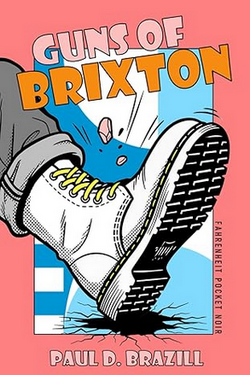
Cover of Guns of Brixton by Paul D. BrazillGuns of Brixton

by Paul D. Brazill

DETAILS:
Publisher: Fahrenheit Press
Publication Date: November 15, 2025
Format: Paperback
Length: 181 pg.
Read Date: April 15, 2026

This is a dark noir full of insane comedy and violence. Peopled by characters you love reading about and never want to meet the likes of in real life. The various plotlines and character arcs overlap and weave together in a way that is really impressive–and is very typical for this kind of read. Just kick back and enjoy it.

It’s fast and furious read that will make you want more from Brazill. I have to leave it for a catch-up post like this, where I’m forced to be vague, I’d end up telling you too much about it in a full-length post.

My only complaint is that as an American with little (read: no) understanding of FIFA history, I had to hit up a friendly-neighborhood search engine to understand the ending. I’d be clearer there, but I don’t want to ruin anything. It’s worth getting to that point and then learning what it meant–the delayed gratification is still gratifying.

Cover of Replaceable You by Mary RoachReplaceable You: Adventures in Human Anatomy

by Mary Roach

DETAILS:
Publisher: Penguin Random House Audio Publishing Group
Publication Date: September 16, 2025
Format: Unabridged Audiobooks
Length: 8 hrs., 37 min.
Read Date: April 13-16, 2026

Overall, a really good look at the frontiers of human transplant technology—and other ways to replace broken/sick/malfunctioning human parts. Oh, and hair. There was a lot about hair replacement and the various technologies there.

As is typical for a book by Roach, there’s a lot of good information here. A couple of chapters that don’t seem worth it. Some jokes were winners. Some jokes didn’t seem worth the effort.

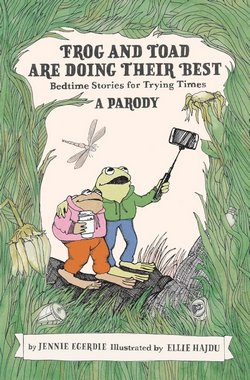
Frog and Toad Are Doing Their Best by Jennie EgerdieFrog and Toad Are Doing Their Best [A Parody]

by Jennie Egerdie, Ellie Hajdu (Illustrator)

DETAILS:
Publisher: Running Press Adult
Publication Date: October 5, 2021
Format: Hardcover
Length: 96 pg.
Read Date: April 17, 2026
Buy from Bookshop.org Support Indie Bookstores

As I recall, I always thought that the Frog and Toad were pleasant enough, but needed something more to be something I’d read when there wasn’t anything else handy. Things were similar with my kids and the books. This is a little better—only because it’s updated and vaguely amusing to see the pair in 2020s mode.

The art is as perfect as it could be, like it was by the original artists.

It’s not a must-read, but it’s a quick shot of pleasure.

Cover of Worse than a Lie by Ben CrumpWorse than a Lie

by Ben Crump

DETAILS:
Publisher: Bantam
Publication Date: February 17, 2026
Format: Hardcover
Length: 368 pgs.
Read Date: April 16-17, 2026
Buy from Bookshop.org Support Indie Bookstores

I had huge hopes for this one, expecting that I’d read the series to follow. That is not going to happen. The dialogue is atrocious. The plot was…fine, but executed messily, yet predictably. The bad guys are as evil as evil can be—no subtlety to it at all. Actually, that was one of my notes about the book as a whole—there’s nothing subtle about it. The solution and the aftermath were practically a fairy tale. I really can’t think of anything positive to say. The promising premise deserved a whole lot better.

Cover of This Book Made Me Think of You by Libby PageThis Book Made Me Think of You

by Libby Page, Zadeiah Campbell-Davies (Narrator)

DETAILS:
Publisher: Penguin Random House Audio Publishing Group
Publication Date: February 3, 2026
Format: Unabridged Audiobook
Length: 10 hrs., 26 min.
Read Date: April 16-20, 2026

Oh, golly, this book was so heartwarming and sweet. It’s also a great look at grief and the way it lingers in the lives of those affected by death. Primarily it’s a sweet book about a (dead) husband’s love expressed through his wife’s passion for reading. Each month, a book is waiting for her at a local bookstore.

Oh, yeah—this is also a tribute to local bookstores and what they can mean for a community.

Grief, books, love, and bookstores. What more could you want?

Cover of A Memory Called Empire by Arkady MartineA Memory Called Empire

by Arkady Martine

DETAILS:
Series: Teixcalaan, #1
Publisher: Tor Books
Publication Date: February 25, 2020
Format: Paperback
Length: 480 pg.
Read Date: April 20-24, 2026
Buy from Bookshop.org Support Indie Bookstores

Oh, there were just so many great ideas packed into this volume. Several layers of political machinations—with two cultures that are new to the reader. A mind-blowing technology that raises all sorts of questions about identity, memory, and life. A character death that makes me mad months later. And a looming threat that’s so far in the background that few characters realize it’s a thing.

I did enjoy it, I’m just not sure how much —but I’m so glad that I read it. I need to find time for book two.

This post contains affiliate links. If you purchase from any of them, I will get a small commission at no additional cost to you. As always, opinions are my own.

Quick-Take Catchups: The Leftovers from March

I’m a few weeks behind on this, but that “To Write About” stack is still calling. Time for me to do a few more of these—emphasizing pithiness, not thoroughness.


Cover of Rabbit Cake by Annie HartnettRabbit Cake

by Annie Hartnett, read by Katie Schorr

DETAILS:
Publisher: Blackstone Publishing
Publication Date: March 7, 2017
Format: Unabridged Audiobook
Length: 7 hrs., 7 min. 
Read Date: March 9-13, 2026

This is told from the point-of-view of a very bright 10-12 year-old girl (named Elvis) grieving the recent death of her mother. She has an older sister who is having some pretty severe mental health challenges (likely inherited from the mother)—and it’s unclear about Elvis’s mental health, too.

This covers roughly a year in the life of the family—dad and the two daughters trying to deal with it (our protagonist has an internal calendar in her head for when she’ll be done grieving). There’s some mild comedy, some strong emotional moments–all learned.

I think I came into it expecting something different than what it was. I thought it was…fine? A little better than fine—I enjoyed it, and assume many people will click with it better than me.

Cover of The Cyclist by Tim SullivanThe Cyclist

by Tim Sullivan, read by John Heffernan

DETAILS:
Series: The DS Cross Mysteries, #2
Publisher: W. F. Howes Ltd
Publication Date: November 4, 2021
Format: Unabridged Audiobook
Length: 7 hrs., 26 min.
Read Date: March 13-16, 2026

I think I read this too close to the previous one—it seemed to hit a lot of the same notes for the same reason. I get that we’re not going to see a lot of growth in DS Cross. That’s just not him. But it feels like the characters around him should be learning from their time with him—and how does his father not know how to introduce changes to him at this point in life?

The mystery felt a little more convoluted than complex—but the solution was pretty satisfying (although I was faster by a few chapters than our DS), as was the reveal.

Wholly satisfying and entertaining—just not quite what I was expecting. I’m hoping with a little more distance that the third mystery won’t be overshadowed by The Dentist the way this was.

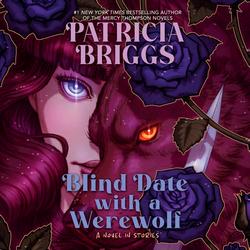
Cover of Blind Date with a Werewolf by Patricia BriggsBlind Date with a Werewolf

by Patricia Briggs, read by Holter Graham

DETAILS:
Series: Alpha and Omega
Publisher: Penguin Random House Audio Publishing Group
Publication Date: October 21, 2025
Format: Unabridged Audiobook
Length: 8 hrs., 5 min. 
Read Date: March 17-18, 2026

I’ve read one (maybe two) of these stories in various anthologies before—they’re all fine. Asil is a fun character to read, but I don’t know that he’s enough to sustain my attention for that long. Well, maybe if there was a novel-length plot—but this series of stories gets pretty redundant quickly. I think the gimmick turned me off a bit, too.

The characters that Asil interacts with are amusing enough, I suppose. Asil seems better as a supporting/secondary character. There’s some nice character growth for him, and I’m curious to see what that looks like in Briggs’ future works.

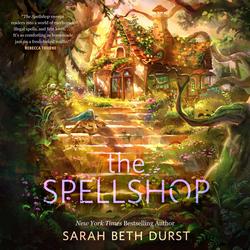
Cover of The Spellshop by Sarah Beth DurstThe Spellshop

by Sarah Beth Durst, read by Caitlin Davies

DETAILS:
Publisher: Macmillan Audio
Publication Date: July 9, 2024
Format: Unabridged Audiobook
Length: 12 hrs., 29 min. 
Read Date: March 18, 2026

You’ve got a librarian—with a sentient talking fern—who is chased from the Capitol city during a coup. She returns to the home her parents abandoned when she was a child and sets up a jam shop/black market potions shop. Adventure and found-family ensue.

Okay, this is technically (according to some, anyway) a romance. And I know some of my readers will be scared away by this. It’s pretty tame on that front—and I just don’t mean it’s PG. I mean, the love story is pretty tame and mixes in pretty well with everything else that one could be forgiven for not thinking of it as a Romance. Like I do.

I had a blast with it, and am looking forward to getting my paws on Durst’s follow-up.

Cover of Nav'Aria: The Marked Heir by K.J. BackerNav’Aria: The Marked Heir

by K.J. Backer

DETAILS:
Series: Nav'Aria, #1
Publication Date: January 18, 2019
Format: Paperback
Length: 390 pg.
Read Date: March 26-31, 2026
Buy from Bookshop.org Support Indie Bookstores

This is a fun, sort of porthole fantasy—Darion has been sent by his parents to Earth with some caretakers. He doesn’t know he’s from this different world—he just thought his parents had weird hobbies for him—martial arts, a lot of time in the forest, hunting, and so on.

There’s very little new or unexpected to this story—it doesn’t matter, it’s done well and is entertaining. It’s a very comfortable read in that sense. You’ve got a noble king and queen, a jealous upstart relative, loyal countrymen, oppressed citizenry…yada yada. We’ve all read it, we all like it (otherwise we’d find another genre). It’s in the telling, and some of the small touches. Backer shines there.

For example: The relation between dragons and unicorns—which we’re going to explore more in volume two—is pretty interesting. And unicorns at the top of the power structure? That’s cool.

And we’re not talking plush unicorns with rainbows and flowers. We’re talking big, strong animals who know that pointy thing can be used for. They have other cool magic abilities, too. Really, the unicorns alone are worth reading this.

My concern is that Darion seems to be shedding his Earth-ness for Nav’Arian as fast as Peter Pevensie did when he went back to Narnia in Prince Caspian, I’d like to see that hanging on a little longer. Otherwise, instead of Earth, he might as well have been sent to live in a hovel in a small town to hide. I’m back for more soon.

This post contains affiliate links. If you purchase from any of them, I will get a small commission at no additional cost to you. As always, opinions are my own.

Enemy of My Enemy (Audiobook) by Alex Segura, read by Michael David Axtell: A Lot of Devils in Hell’s Kitchen

Cover of Enemy of My Enemy by Alex SeguraEnemy of My Enemy

by Alex Segura, read by Michael David Axtell

DETAILS:
Series: Marvel Crime, #2
Publisher: Audible Studios
Publication Date: March 24, 2026
Format: Unabridged Audiobook
Length: 8 hrs., 28 min.
Read Date: April 8-13, 2026
Buy from Bookshop.org Support Indie Bookstores

What’s Enemy of My Enemy About?

I don’t need a lot of words to describe this—Wilson Fisk, the Kingpin of Crime, is dead. Shot in his own home, and all the evidence points to Frank Castle as the shooter. Well, most of the evidence, anyway. Castle even lets himself be arrested without incident and seems ready to take the fall. Matt Murdock knows the facts don’t match up (for one, a police officer was also killed in Fisk’s office and Matt knows the Punisher wouldn’t do that), and can’t let him get railroaded. So he basically forces Castle to accept his representation.

It’s up to Matt Murdock and Daredevil to make sure Castle goes free and that the right killer is identified.

This was cleverly released shortly after the launch of Daredevil: Born Again season 2, but it’s not that much of a tie-in to the television series. This is the comic book version of Daredevil and the rest. It’s a minor point, but it does explain things like why we get someone so cartoonish* as Hammerhead and why certain characters are dead/alive.

* This is not a criticism, but a description. I enjoy the character.

Why did I pick this up? Why did I keep reading?

I picked this up because I like the idea of this Marvel Crime series, the strength of the Jessica Jones novel, and Segura’s reputation.

I kept at it because this is a smart mystery/legal thriller with some great comic book action. There are plenty of twists, some good curve-balls, and more uses of the word “internecine” than I typically see in a book.

How was the Narration?

There’s only one other voice I’d like to hear as Matt Murdock/Daredevil than Michael David Axtell, but I think it was good for them not to cast Charlie Cox. This was just great—he handled every character in a way that fit perfectly. I was as entertained by his performance as I was the by text.

Really well done.

So, what did I think about Enemy of My Enemy?

I had a lot of fun with this one—for everything I just said in that last paragraph.

Segura nailed every character—well, I’m not sure about [surprise name withheld] because I haven’t read much about them, but given the way he dealt with everyone else, I figure he did right by them. And the cast of characters is large. Segura dove deeply into Marvel’s Hell’s Kitchen here.

Also, he wasn’t shy about killing off characters. It’s clearly outside the Marvel canon.

There’s not much else to say—it’s a solid thriller, a captivating superhero story, and you won’t see what’s coming. Enemy of My Enemy is a heckuva ride that I easily recommend to fans of any of the characters I mentioned.

This post contains an affiliate link. If you purchase from it, I will get a small commission at no additional cost to you. As always, the opinions expressed are my own.
Irresponsible Reader Pilcrow Icon

Head Fake (Audiobook) by Scott Gordon, read by Nick Mondelli: Hoop Dreams and Sometimes Crushing Reality

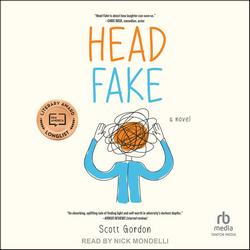
Cover of Head Fake by Scott GordonHead Fake

by Scott Gordon, read by Nick Mondelli

DETAILS:
Publisher: Tantor Media, Inc.
Publication Date: April 29, 2025
Format: Unabridged Audiobook
Length: 9 hrs., 43 min.
Read Date: February 27-March 2, 2026
Buy from Bookshop.org Support Indie Bookstores

What’s Head Fake About?

Mikey has been unhoused a lot recently, but is currently staying with his father to recover from a sickness. If he can keep a job for a while, he can stay with him. His dad has a connection that can get Mikey a job at a school for high-risk offenders with mental illnesses as a bus driver.

It’s not much, but it’s something.

Then, due to a fun set of circumstances, he’s put in the job of coaching the team’s small basketball team.

Oh, I should probably mention that Mikey’s dad is a couple of months away from becoming the winningest High School basketball coach in the U.S., and despite the tortured relationship between the two, Mikey learned a lot from him.

Mikey needs to get the trust of his team (and the school’s administration), fight through his own mental illness struggles, and keep his father from tossing him out. That should be no problem at all, right?

What did I think about the Narration?

I have no notes. Mondelli got everything from Mikey’s attitude, the students, his father, and everyone else just right.

Why did I pick this up? Why did I keep reading?

I honestly don’t remember how I came across this book. But I put it on a list at some point, and eventually got around to picking it up.

I stuck with it because I liked Mikey—his voice and him as a person. He got his hooks in me right away and wouldn’t let go. I really just had to find out what happened to him—the more I got to know the students, the more I got invested. (just the way a reader is supposed to)

What does this book tell us about humanity?

This is a book about broken people helping other broken people (and, in some cases, hurting broken people). While there are some similarities in the problems each character has faced and is facing, it’s not the commonalities that connect them—it’s that they’ve faced a problem and are still trying, however weakly.

Also, a love for basketball.

So, what did I think about Head Fake?

While set in a high school, this is not a YA book. But it is YA-friendly.

This book is really a mash-up of two sure-fire feel-good stories. First, you’ve got an underdog sports team battling just to be taken seriously—and it ends up winning a lot. Gordon nails this part. Granted, it’s hard to mess that kind of story up—but there’s something so satisfying when it’s done right.

The other part of the mash-up is the outsider connecting with students in an inspirational way. Think Lean on Me or Sister Act 2 (more of the latter than the former). Granted, a bus driver isn’t much of an authority figure—but that’s where the coach part comes in.

You combine the two with some strong character growth from one of the underest underdog characters I can think of, some dumb humor, and a metric ton of earnest goodwill, and you’ve got yourself a wholly pleasant book that I can’t imagine a reader/listener wouldn’t be charmed by.

This post contains an affiliate link. If you purchase from it, I will get a small commission at no additional cost to you. As always, the opinions expressed are my own.

Irresponsible Reader Pilcrow Icon

The Greatest Sentence Ever Written (Audiobook) by Walter Isaacson: Looking at Things Self-Evident

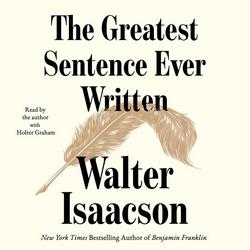
Cover of The Greatest Sentence Ever Writtenhe Greatest Sentence Ever Written

by Walter Isaacson, appendices read by Holter Graham

DETAILS:
Publisher: Simon & Schuster Audio
Publication Date: November 18, 2025
Format: Unabridged Audiobook
Length: 1 hr., 28 min.
Read Date: February 18, 2026
Buy from Bookshop.org Support Indie Bookstores

What’s the Description of The Greatest Sentence Ever Written?

To celebrate America’s 250th anniversary, Walter Isaacson takes readers on a fascinating deep dive into the creation of one of history’s most powerful sentences: “We hold these truths to be self-evident, that all men are created equal, that they are endowed by their Creator with certain unalienable Rights, that among these are Life, Liberty, and the pursuit of Happiness.”

Drafted by Thomas Jefferson and edited by Benjamin Franklin and John Adams, this line lays the foundation for the American Dream and defines the common ground we share as a nation.

Isaacson unpacks its genius, word by word, illuminating the then-radical concepts behind it. Readers will gain a fresh appreciation for how it was drafted to inspire unity, equality, and the enduring promise of America. With clarity and insight, he reveals not just the power of these words but describes how, in these polarized times, we can use them to restore an appreciation for our common values.

How Was the Narration?

If this is how his lectures go? Sign me up for a class. Isaacson comes across as a knowledgeable person just talking to you about something he cares deeply about–not as someone reading text (even text he wrote). There’s just enough personality to it to keep you listening, but not so much that it overshadows the material.

It’s just what this book needs.

So, what did I think about The Greatest Sentence Ever Written?

It feels strange to talk about a book that clocks in at 80 pages or 88 minutes in audiobook format (and that counts the appendices). But that’s how it’s being sold, so that’s how I’m going to talk about it. And really, he’d have had to tackle at least one more sentence

Do I wish he’d spent a little more time on a phrase or two? Did I really need as much detail has he gave on one thing or another? Yes to both. But I can’t remember what those things were now. And if I listened to/read it again today, I’d probably have other things I’d like to hear more/less about.

At the end of the day, this is a very nice meditation on that vital sentence, and a reminder that it’s still something important, something to rally around.

For the 250th anniversary of the Declaration, this is something important to think about. On the 249th or 252nd, it would be to. It’s sort of an evergreen idea. Probably an evergreen book, too.

This post contains an affiliate link. If you purchase from it, I will get a small commission at no additional cost to you. As always, the opinions expressed are my own.

Irresponsible Reader Pilcrow Icon

The Dentist (Audiobook) by Tim Sullivan, read by John Heffernan: A Promising Series Start for a Distinctive Detective

Cover of The Dentist by Tim SullivanThe Dentist

by Tim Sullivan, read by John Heffernan

DETAILS:
Series: The DS Cross Mysteries, #1
Publisher: W. F. Howes Ltd
Publication Date: September 2, 2021
Format: Unabridged Audiobook 
Length: 10 hrs,. 12 min.
Read Date: February 10-12, 2026
Buy from Bookshop.org Support Indie Bookstores

What’s The Dentist About?

DS George Cross is called to a murder scene for what the uniformed officers are assuming is going to be a simple, probably unsolvable, murder of a homeless man at the hands of another homeless person. Cross almost instantly sees some things that tell him that’s not the case at all, and saddles up for a complicated case.

It is a complicated one, too (obviously, you don’t want your novel’s protagonist to be wrong at the first thing he concludes in the book). Cross and his not-very-willing partner, DS Josie Ottey, start learning a good deal about this homeless man—who not that long ago was a prominent dentist in the area. Cross becomes convinced that this murder is tied to an unsolved case from over a decade ago and sets himself to solving both crimes.

This sets him at odds with former police detectives who investigated the earlier case, the higher ups in the Service who are looking for a quick conclusion, and parts of the dentist’s own family. Ottley supports him in this, but gets the other side, too—and will try to guide him to the “safer” conclusion (while hoping his obstinacy will show that he’s not the person she should be partnered with for the next case).

I Have to Talk About Cross and the Spectrum

We meet George Cross having a very awkward introduction to a new coworker—it doesn’t go well for either of them (and only one of them understands why). And then he finds calm in leaving that conversation to focus on the murder victim in front of him. A crime to investigate, clues to notice, a puzzle to solve—that’s what Cross needs. Not a friendly (and we’ll learn, clever) new coworker.

In many ways, Asperger’s Syndrome* is what distinguishes Cross from his peers (on the force and in Police Procedural fiction). But Sullivan never makes this out to be a super-power (as so many tend to do), or a disability for him to overcome in some inspirational manner (phew). Nor—and this is the big one—is it played for comedy (think Adrian Monk’s OCD which is portrayed comedically, tragically, and with sensitivity—often in the same scene.)

It’s just who Cross is. He is off-putting, he is borderline rude, he only realizes how to better handle a conversation at work or in private after the fact (and almost never goes back to redress things). He is hyper-focused at times, to the point of obsession. He is very self-aware of his challenges and has done many things to ease his way through them (one would argue, not enough). His co-workers and superiors are also very aware of his challenges and have done things to ease his way through them (one would more easily argue, not enough).

He’s on the spectrum, just the way that Ottley is a black single mom. The way that his father is a hoarder. The way that their civilian aid is anxious to prove herself. The way their DCI is a better politician than a detective (but one who can see when he needs to get out of the way and let detectives detect). It’s just part of him.

That’s the way this should be handled.

* I realize that “Asperger’s Syndrome” is considered an outdated term, but it’s what the novel uses, so I’m using it, too.

How was the Narration?

Well, first I had to cope with Heffernan’s pronunciation of “Asperger’s” (well, the British pronunciation, its not just his). It doesn’t really matter to me, but it, more than anything, reminded me where this book takes place (I really didn’t register the accent otherwise).

Other than that—I really appreciated and enjoyed Heffernan’s work here. He got the tension just right (when appropriate) and captured the humanity of all the characters and Cross’ investigation. He conveyed the rigor of Cross’ style and thought process as well.

I don’t know if I can separate the Heffernan’s reading of the book from my appreciation of it—it’s likely a series that I’ll have to continue on audio, because the two are joined so solidly in my mind. (and, boy, do I hope Heffernan’s got a long-term contract).

Why did I pick this up? Why did I keep reading?

I picked this read “Mind and Matters of Crime: Meike Alana Lokos at the DS George Cross Mysteries” over at The Hard Word and the series seemed like something I should give a shot.

I kept going because I was right—this is totally my thing. Some great characters, a unique way to approach a criminal investigation, and a pretty twisty mystery.

What does this book tell us about humanity?

It feels like the obvious thing here is to talk about Cross being on the spectrum, and the way that others respond to him, avoid him, get frustrated with him, and yet respect his work. Or the way that has learned to make his way in the world. This is valid and important.

It also feels too easy—and like something I could copy and paste for the next however many books there are. More than that, it wasn’t the thing that jumped out at me the most.

What really rises to the top when I think about this book are the connections between the people—what forges them, what strengths (or weakens them), and how that plays out over the course of their lives. Cross and his father have a very solid relationship—it’s predictable, it’s reliable. Cross and Ottley have a…strained and awkward relationship—but one that Cross somewhat depends on, one that Ottley frequently resents (I think she softens a bit). The relationship between Cross and his superiors isn’t what you get from other procedurals—even with “the brass” isn’t wild about a particular detective who does things their own way.

And as for the relationships between the victims, suspects, and others that Cross encounters in this case—those are firmly in spoiler territory, but watching the web be revealed—and add layers as the book goes on was really intriguing. The book really is about human relationships and much of their diversity more than just about anything else—including the murders. (although, well, they’re rooted in them, too.)

So, what did I think about The Dentist?

I was charmed instantly, by the end of Chapter One—I was sold. My appreciation and enjoyment grew from there, and I wasn’t halfway through before I knew I was at least getting the sequel to this soon. And anticipated catching up on the series by the end of 2026.

This satisfied me on every front—mystery, character, storytelling, writing, and promise for things to come. I felt like I understood Cross and Ottley, and wanted to see them ply their craft with another case or twelve.

Lastly, while DS Cross isn’t DC Smith, and no one would confuse the Bristol police with King’s Lake Central—there’s something about this book (and Heffernan’s narration) that scratched a Peter Grainger-itch in my psyche. This is good, because now that I’ve caught up with Grainger’s series, he can’t produce things quickly enough to satisfy me. Also, it’s pretty high praise in my book for Sullivan.

For readers who are into British Procedurals, atypical Detectives, and/or quality fiction. I strongly encourage you to pick this up.

This post contains an affiliate link. If you purchase from it, I will get a small commission at no additional cost to you. As always, the opinions expressed are my own.
Irresponsible Reader Pilcrow Icon

My Favorite Non-Fiction Books of 2025

Covers of Algospeak, Class Clown, Food for Thought, Enshittification, Everything Is Tuberculosis, Killer Conversations with Rex Stout and John McAleer, Pronoun Trouble, How to Stand Up to a Dictator, and Robert E. Lee and Me, next to an image of an anthropomorphized Pilcrow and the words 'My Favorites of 2025 Non-Fiction'
My 2025 Wrap-up continues and now we’re on to the Non-Fiction list. While I liked a number of works that didn’t make this list, I felt strange calling them a “favorite.” These are the ones that stuck with me through the year; the ones I cited in conversation; that I thought about when reading something else or watching something on TV. Yeah, there’s some overlap between this list and the audiobook list from yesterday—lately, most Non-Fiction books I work through are in audiobook format. So it makes sense, even if it makes this post seem like an echo.

As always, I only put books that I’ve read for the first time on this list. I don’t typically return to NF books (outside of looking up things for one or three points), but occasionally I do—for example, The Pleasures of Reading in an Age of Distraction by Alan Jacobs would get a permanent spot on this list, were it not for this rule.

(in alphabetical order by author)

Cover of Algospeak by Adam AleksicAlgospeak:
How Social Media Is Transforming the Future of Language

by Adam Aleksic

My original post
Language in general—but English particularly—is a constantly-changing thing, and these changes are happening faster and faster all the time. Algospeak is a great look at the hows and whys of a lot of the current evolutionary processes. It is about more than language—it’s also about how the Internet changes the way we think and express ourselves in general. And therefore, how society changes (which leads to Internet changes, and other circle-of-life things).

Aleksic has obvious expertise and passion for the subject (look at just one of his videos). He’s also active in these areas. It’s a great read, informative and entertaining. Hard to ask for more.


Cover of Class Clown by Dave BarryClass Clown: The Memoirs of a Professional Wiseass—How I Went 77 Years Without Growing Up

by Dave Barry

My original post
It comes as no surprise to any that I loved a Dave Barry book. It takes something pretty lackluster by him to get that reaction (and he doesn’t do that often–but I can prove it if you want). But this is something else–it’s insightful, it’s touching, it’s (seemingly) honest, and human. It’s a look at his childhood, his professional humorist origin story, and then scattered accounts of some of the very strange things that his profession has let him do.

I don’t say this about many authors–but I really don’t know that I’ve wondered anything about Barry’s personal life. But now that I know? I am more than happy to get some understanding about it. Does it necessarily help me understand his work better? No (but we’ll see the next time I take up his work, I guess). But it makes me like Barry the person a bit more.


Cover of Food for Thought by Alton BrownFood for Thought: Essays and Ruminations

by Alton Brown

Like any good fan of a TV show/personality, I like to know how they got started, how the show was developed, etc. Brown talks about how he got into food education media–and it’s not really how you’d expect. How he moved on from Good Eats to other things. There’s some great stuff about his education. But perhaps the most rewarding portion of the book is his musing and observations on the place of food/eating to human society (writ large or on an individual level).

Really, there’s so little to not appreciate from this book. Alton Brown has spent decades thinking and writing about food. This is the result of all that.


Cover of Enshittification by Cory DoctorowEnshittification: Why Everything Suddenly Got Worse and What to Do About It

by Cory Doctorow

I don’t know how to talk about Doctorow’s screed against Big Tech, the policies that led to these platforms that have taken over the internet and made it less-good than it used to be. Even that sentence is not a great way to talk about the book. The book wowed me. I wouldn’t say it radicalized me on some of this, but I sort of wish it did. The Ressa book below really struck me as a giant proof for Doctorow’s case (good idea to read the two of them around the same time). It’s a great–and terrifying–read.


Cover of Everything Is Tuberculosis by John GreenEverything Is Tuberculosis: The History and Persistence of Our Deadliest Infection

by John Green

I never imagined I would appreciate a book about an infectious disease. And despite all the good things I heard about this book, I didn’t rush to pick it up. But I’m so glad I did.

First of all, you could probably pick any number of things to use in place of Tuberculosis to trace human history, seemingly at major turning points and shaping societal developments. Say…bread, or writing, or…I dunno this is a sentence I regret starting. But from a certain point of view–you can buy the theory posited at the beginning of this book, that Tuberculosis shaped human history.

Green talks about the treatments that have been tried (and failed), the way it impacted population sizes, the devastation it’s left in it’s wake, and how things are going in the battle against the disease now. Interwoven with these is the story of one particular patient in Sierra Leone that Green met years ago. We follow his personal struggle–ups, downs, way downs, and more.

Green can relate these facts–even the bleak ones–in an engaging way that will stick with the reader. But then he drives it home and makes it gets you emotionally involved through the patient’s story.

You just can’t help but being taken in by the book and it’ll leave a lasting impression.


Cover of Killer Conversations with Rex Stout and John McAleerKiller Conversations with Rex Stout and John McAleer

My original post
Granted, there is a very limited audience for this kind of thing. But for that audience (and I’m part of it), this is catnip.

These snippets of conversations between Rex Stout and his biographer and friend are just wonderful. Quick back and forths on any number of topics–life, death, love, reputation, writing, Stout’s characters, his career, and more–it’s fun to read. It’s fun to think about. You’ll wish you were half as clever as Stout.


Cover of Pronoun Trouble by John McWhorterPronoun Trouble: The Story of Us in Seven Little Words

by John McWhorter

So, sure–this looks like it’s nothing but a screed on one side or the other about the problem we’re having with third-person pronouns the a socio-political front in English. And, yes, it is about that, (but only from a linguistic point of view), but there’s more to it. There’s also that pesky second-person plural.

Like in his book, Nine Nasty Words, McWhorter gives a quick look at the history of English pronouns one at a time–looking at various forms, usages, spellings, and assorted trivia. When appropriate, the then talks about some of the contemporary challenges and controversies with them.

Completely entertaining–McWhorter’s a great narrator–and very educating. I heartily commend this to you (no matter what you think of using “they” for the third-person singular).


Cover of How to Stand Up to a Dictator by Maria RessaHow to Stand Up to a Dictator: The Fight for Our Future

by Maria Ressa, read by Maria Ressa & Rebecca Mozo

Maria Ressa’s story is fascinating. It’s just that simple. I mean, you rarely find a Nobel Peace Prize recipient without an interesting backstory of some sort.

Like I said above, when you add this to Doctorow’s book and you see how everything he said is entirely possible and how it can work against someone.

There’s, of course, more than just Ressa’s story and struggles reflected here. There’s a call to action, a call to do the necessary work, and a call to hope, when it comes to oppressive governments or platforms.


Cover of Are Women Human by Dorothy L. SayersAre Women Human?

by Dorothy L. Sayers

These are two essays by Sayers on the subject of women in society–with a particular look at academia. They are pointed, clear, and witty.

I’m not sure what else to say, really.


Cover of Robert E. Lee and Me by Ty SeiduleRobert E. Lee and Me:
A Southerner’s Reckoning with the Myth of the Lost Cause

by Ty Seidule

My original post

This is a powerful read. This very-Southern, Lost Cause adherent, West Point history professor starts looking at what he’d been raised believing, and the systemic racism of the culture he’d been raised in. The book then recounts example after example after example of the racism everywhere and the excuses made for covering up the treason of the Confederacy everywhere, including the U.S. Army–the army he left and fought against.

I thought Seifert made a compelling case in an engaging read that will stick with you for a long time.


My Favorite Audiobooks of 2025

My Favorite Audiobooks of 2025

It’s time to talk about my favorite Audiobooks. How do I keep this from being just a rehash of my other year-end lists? By focusing on the audiobook experience over the content. What was it like to listen to it? How engaging was it, how did the narrator do? Was it a good match in terms of tone, content, and performance? All of these books are/were good—but the audiobooks are a bit better because of the narrator and the rest of the people involved in the production.

As always, re-reads don’t count for these lists.

(in alphabetical order by author)

Cover of Food for Thought by Alton BrownFood for Thought: Essays and Ruminations

by Alton Brown

If you’re a fan of Brown, this is essential. It’s part memoir; it’s part behind the scenes of Good Eats, Iron Chef America, and more; it’s part musings on the state of cooking, food television, eating, etc.; and there’s even some cooking tips. I wouldn’t be surprised to learn a little more than that is covered.

The audiobook brings his signature style, snark, and passion to the material–which really doesn’t need anything to raise the level–but it doesn’t hurt. I had a blast reading it–I don’t know how many people I’ve pushed it on, either.


Cover of Sunrise on the Reaping by Suzanne CollinsSunrise on the Reaping

by Suzanne Collins, read by Jefferson White

I thought I was over the whole Panem/Hunger Games thing. I loved the original trilogy, but just couldn’t bring myself to read the prequels. A review or two and a co-worker convinced me to try this one.

As messed up as you may think that Haymitch was when we first met him…he deserved to be. He earned that–and more. Collins made that clear in the book, but Jefferson White brought that to life–with all the heartbreak, anger, and grief.

It was the audiobook that kept this from being something I checked off to satisfy an itch (and that itch would’ve been greatly satisfied, don’t get me wrong), and turned it into an experience that unsettled me in all the right ways.


Cover of Chitty Chitty Bang Bang by Ian FlemingChitty Chitty Bang Bang

by Ian Fleming, read by David Tennant

I remember precious little about the movie version of Chitty Chitty Bang Bang, and most of that is just the car. But some fellow-blogger mentioned Tennant doing this audiobook (and I’ve lost track of who that was, I feel lousy for it). Curious, I gave it a shot.

I came away with this with two firm impressions: when Fleming let his hair down, he could spin a fun tale. Not one that necessarily makes a lot of sense–but it’s fun. Second–David Tennant was as fantastic at this as I imagined.

I don’t know what else to say–I’m sure I’d have been entertained by just about anyone reading this book. But very few (if any) could’ve made me relish the experience the way I did.


Cover of Future Boy by Michael J. Fox and Nelle FortenberryFuture Boy:
Back to the Future and My Journey Through the Space-Time Continuum

by Michael J. Fox and Nelle Fortenberry

My original post

I was a huge Michael J. Fox fan at the time this book is set (okay, I’ve pretty much been a huge Michael J. Fox fan since then, too),  I was definitely part of the target audience for this. Throw in Fox as narrator, and you know I’m in.

As far as the narration goes, age and disease have impacted his voice—but it’s still Fox, and he delivers it well. The quick audio clips from others involved in the productions Back to the Future and Family Ties are fun bonuses.

This is a fun—and fast—look at a madcap time in Fox’s life with enough of the behind-the-scenes stuff. Fox’s trademark self-deprecation is on display as well.

The only problem with this book is its brevity. Beyond that, I have no complaints—fans of the actor or the film should enjoy this book. I sure did.


Cover of I See You've Called in Dead by John KenneyI See You’ve Called in Dead

by John Kenney, read by Sean Patrick Hopkins

My original post

Hopkins did a great job of bringing this very strange book to life and convinced me that an outrageous character like Bud Stanley could not only exist, but be someone I wanted to spend several hours with. Not just Bud Stanely, either–there’s a pretty diverse and wide cast of supporting characters that Hopkins did an equally convincing job with (the little neighbor boy was one of his best).

It’s not just the performance, obviously, I really got into this funny and heartfelt novel about friendship, mortality, and thinking about mortality. But it’s what pops to mind as I’m talking about audiobooks.

This was the whole package.


Cover of Songs for Other People's Weddings by David LevithanSongs for Other People’s Weddings

by David Levithan with songs by Jens Lekman, read by Jefferson Mays

I found the resolution of this novel disappointing, but I enjoyed a lot of the journey worth the time. This is a novel about a pop musician of some (small) renown who is much sought after as a Wedding Musician–it’s more than I can get into here, but alone is a charming story.

A bonus to this book is that Jens Lekman wrote and performs songs to go with the weddings. I don’t know what this looks like in the text version of the book–maybe just the lyrics, which is nice enough. But a novel about a singer that contains actual songs (purportedly by this singer) is a great bonus and adds something to the book.

Sure, I’m not crazy about most of the songs–just not my vibe. But that they’re there is really nice.


Cover of The Millicent Quibb School of Etiquette for Young Ladies of Mad Science by Kate McKinnonThe Millicent Quibb School of Etiquette for Young Ladies of Mad Science

by Kate McKinnon, read by Kate McKinnon & Emily Lynne (Narrator)

My original post
(Edging out the sequel, Secrets of the Purple Pearl, by a hair–I did go back and forth on it a bit)

Would I enjoy this in print? Yeah—especially the illustrations. But the performance by McKinnon & Lynne makes these things you have to listen to. And likely re-listen to.

These are silly, silly, silly adventure novels about three sisters who wind up at The Millicent Quibb School of Etiquette because they can’t manage to stay in other schools without being disruptive by being themselves. Quibb introduces them to a world of pizza, self-expression, curiosity, mystery, danger—and the chance to save the world from mad scientists.

I cannot say enough good things about this book. The plot is insane, the text are ridiculous, and the jokes are a great balance of silly enough for children but clever enough for adults. They’re perfect for young or young-at-heart readers. McKinnon and Lynne make a good book a great audio experience.


Cover of How to Stand Up to a Dictator by Maria RessaHow to Stand Up to a Dictator: The Fight for Our Future

by Maria Ressa, read by Maria Ressa & Rebecca Mozo

Ressa’s story–from childhood up through the present–is mind-blowing, and the kind of thing one might be skeptical about in a novel. And I’m not going to say more about it now.

But it’s her delivering this material–the raw emotion, the pride, the anger, the conviction–that makes this audiobook. It’s a great story, it’s a powerful call to action–and a strong dose of hope for the future.


Cover of The Accidental Joe by Tom StrawThe Accidental Joe

by Tom Straw

It is difficult to explain just how entertaining this is–and I’m not sure if the narration or the text gets the majority of the credit. Tom Straw did both, so he gets all the credit.

This is the story of a celebrity chef with a travel show who is recruited by the government to use his show as a way to conduct espionage. Which totally makes sense, right? Well…with an iron-clad plan like that, things get out of control.

The book is a hoot. The jinks are hi. And Straw’s narration is perfectly suited to the material.


Cover of The Bang-Bang Sisters by Rio YouersThe Bang-Bang Sisters

by Rio Youers, Kristen Sieh (Narrator)

My original post
So, this is a story about a touring rock band–and after their shows at various bars around the country, they occasionally slip away to kill some criminals that the judicial system can’t put away. Totally normal, stuff right.

Youers fills it with humor, heart, and so, so much violence. It’s fast, it’s furious, it’s bloody, it’s raw emotion, it’s dangerous. It is so much fun. It is Rock and Roll.

And Kristen Sieh? She’s just the lead vocalist that this album needed. I believed the music, I believed the vigilantism, I believed the sisterly-tie between the bandmates/friends/allies; I believed every second of the trap they were caught in and the way they got out of it.

It’s the kind of audiobook that leads me to overhyping.


The Faithful Executioner (Audiobook) by Joel F. Harrington, read by James Gillies: The Plight of a 16th Century Executioner

Cover of The Faithful Executioner by Joel F. HarringtonThe Faithful Executioner:
Life and Death, Honor and Shame in the Turbulent Sixteenth Century

by Joel F. Harrington, read by James Gillies

DETAILS:
Publisher: Novel Audio
Publication Date: October 24, 2017
Format: Unabridged Audiobook
Length: 9 hrs., 39 min.
Read Date: December 4-8, 2025
Buy from Bookshop.org Support Indie Bookstores

What Does the Publisher Say About The Faithful Executioner?

Based on the rare and until now overlooked journal of a Renaissance-era executioner, the noted historian Joel F. Harrington’s The Faithful Executioner takes us deep inside the alien world and thinking of Meister Frantz Schmidt of Nuremberg, who, during forty-five years as a professional executioner, personally put to death 394 individuals and tortured, flogged, or disfigured many hundreds more. But the picture that emerges of Schmidt from his personal papers is not that of a monster. Could a man who routinely practiced such cruelty also be insightful, compassionate—even progressive?

In The Faithful Executioner, Harrington vividly re-creates a life filled with stark contrasts, from the young apprentice’s rigorous training under his executioner father to the adult Meister Frantz’s juggling of familial duties with his work in the torture chamber and at the scaffold. With him we encounter brutal highwaymen, charming swindlers, and tragic unwed mothers accused of infanticide, as well as patrician senators, godly chaplains, and corrupt prison guards. Harrington teases out the hidden meanings and drama of Schmidt’s journal, uncovering a touching tale of inherited shame and attempted redemption for the social pariah and his children.

The Faithful Executioner offers not just the compelling firsthand perspective of a professional torturer and killer, but testimony of one man’s lifelong struggle to reconcile his bloody craft with his deep religious faith. The biography of an ordinary man struggling for his soul, this groundbreaking book also offers an unparalleled panoramic view of Europe on the cusp of modernity, a society riven by violent conflict at all levels and encumbered by paranoia, superstition, and abuses of power. Thanks to an extraordinary historical source and its gifted interpreter, we recognize far more of ourselves than we might have expected in this intimate portrait of a professional killer from a faraway world.

How’s the Narration?

Gillies was fine. I did wonder a bit about why a British narrator was used, especially when Harrington brings up his own U.S. citizenship at least once. It’s not a big deal.

He also didn’t pronounce the Lutheran theologian Philip Melanchthon’s name in a way I’ve never heard before—and that threw me out of things for a moment.

Other than that, I had no substantive complaints. I don’t know that he wowed me, but he didn’t detract from the material.

So, what did I think about The Faithful Executioner?

One thing that should be remembered that the description doesn’t mention is that Executioners in that day were also healers—as a result of their training and experience in their primary profession, they understood human anatomy to a degree that most people didn’t, so they augmented their income by helping heal others.

It’s interesting little tid-bits like that that’ll keep you reading. But not for trivia, for the history.

Okay, this didn’t resonate with me the way it did with my friends who read this. I didn’t get as invested in Frantz’s story as Lawrence did.

That said, I was fascinated by this. The history of the era. The cultural/political shifts going on—and how that impacted his life/profession were my focus. I could’ve read a lot more about the “criminal justice system” (as much as there was one) described. Well, I like to think I could’ve—but I really needed it tied to Frantz’s story for me to actually stick with it.

And honestly, that’s basically it—I was only mildly interested in Frantz. It was the changing context around him that got me. I do find that strange—I really would’ve thought I cared about the guy and his poor family (don’t get me wrong, it’s not like I didn’t care—but not much—also, I found what the author said about the life of two of his children at the end strangely heartening). But the history—culture, penology, politics, health care, criminology? That material was just great.

The story of one man is gripping (and really, the stuff of novels), as is the look at humans at the time—if you’re looking for either (possibly both), you’re going to relish this book and are going to be so glad that Harrington stumbled onto these journals to bring them to us.

This post contains an affiliate link. If you purchase from it, I will get a small commission at no additional cost to you. As always, the opinions expressed are my own.
Irresponsible Reader Pilcrow Icon

Page 1 of 24

Powered by WordPress & Theme by Anders Norén